HMS Furnace- First Bomb to Blaze a Trail North

On that fateful day of May 19th, 1845, when the crews of Sir John Franklin’s last expedition in search of the Northwest Passage departed Greenhithe, England – never to return – they did so onboard two absolutely incredible vessels. Her Majesty’s Ships Erebus and Terror hadn’t originally been designed for polar exploration. Rather, these were both examples of a highly specialized type of warship called a “bomb vessel.” Why send a warship that was meant to bombard enemy positions on a polar exploration mission? This post briefly explores the history and design of the first bomb vessel that was sent north, HMS Furnace, which left England in 1741 on an earlier effort to locate that same illusive passage to the Pacific Ocean.1 Did Furnace blaze a trail across the frozen northern latitudes? Not exactly, but her modifications for exploration set an important precedent for a lineage of tough little ships which would be used on Arctic and Antarctic exploration missions.2
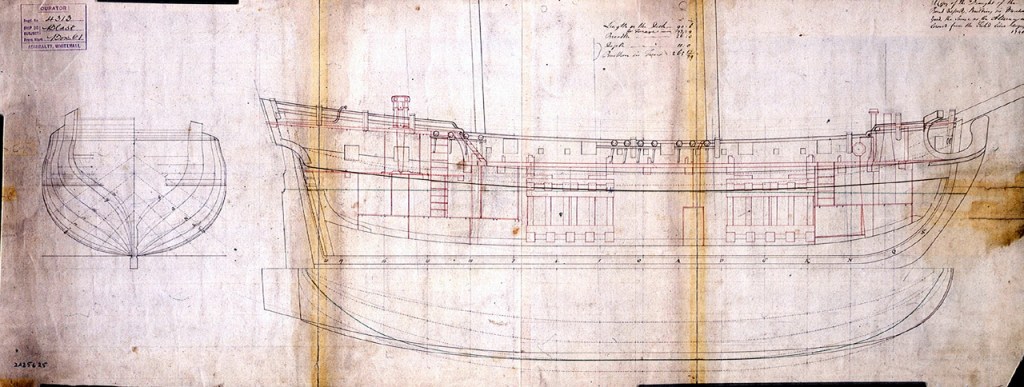
The Blast class, the original as-built configuration of Furnace from 1740, showing the two heavy mortar beds (cribbing) in the waist, the ketch rig (mainsail and a mizzen aft) a simple capstan perched high above the aft deck, and a windlass in the bow. Credit: © Crown copyright. National Maritime Museum, Greenwich, London ZAZ5625.

Maritime historian and former National Maritime Museum curator Chris Ware’s work on the history of bombs, The Bomb Vessel: Shore Bombardment Ships in the Age of Sail, provides the development history of the Royal Navy’s bomb vessels, and highlights the careers of selected ships.3 The type had been created late in the 17th century to carry one or two heavy mortars amidships. Like many other great British naval developments, the idea had come from France, whose navy had built the first bomb vessels, galiotes à bombes, starting in 1681.4 The mortars (which had been developed originally for land warfare) fired a type of fused shell called bombs (explosive) or carcasses (incendiary) on a high trajectory over the bulwarks. They were used against fortifications or cities and towns. The bombs would plunge downwards to explode against or over targets. These were terrifying weapons, with destruction and fire plummeting down from the skies.
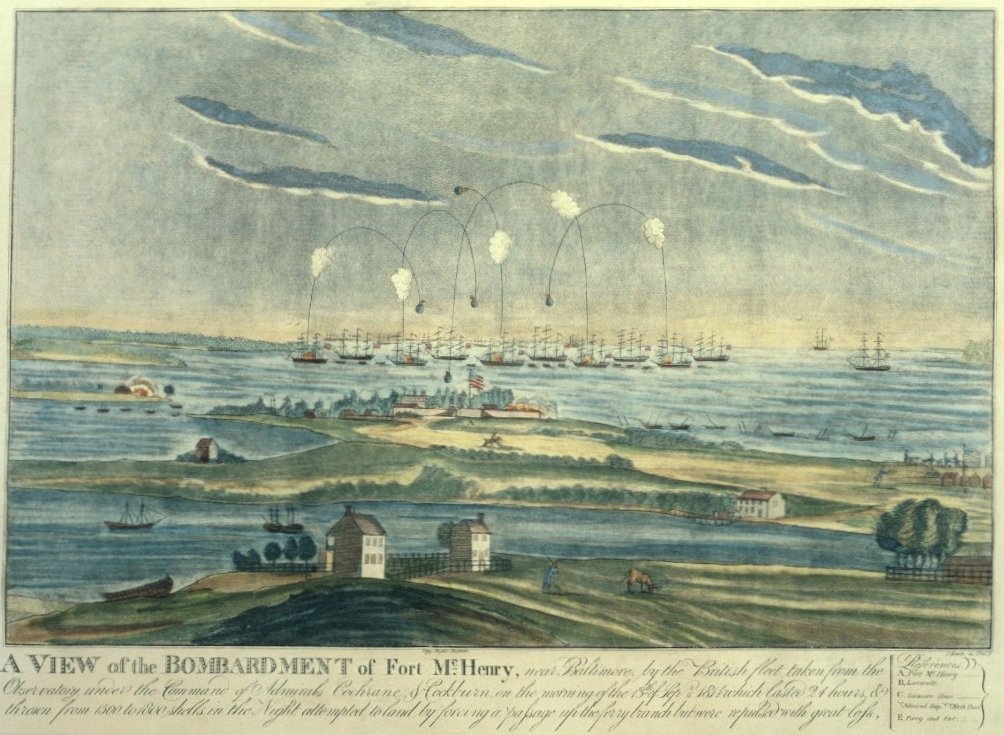
John Bower’s engraving of the Bombardment of Fort McHenry, near Baltimore, in September 1814 by the British fleet, including HMS Terror and an earlier generation of HMS Erebus, and several other bombs. Credit: Dr.frog at en.wikipedia, Public domain, via Wikimedia Commons

To carry the massive mortars and handle their powerful recoil, which was transmitted down from their carriage directly into the wooden timbers of the vessel, bombs had to be very strongly built: They were framed, decked, and reinforced much more stoutly than other ships of their relatively small size. While the first English bombs resembled small coastal craft, by the 1730s new designs appeared that were closer to naval sloops.5 There were usually only a handful of bombs active at any given time. Most spent the vast majority of their careers out of commission or converted to other roles. The Board of Ordnance, which had responsibility for both the guns and the specialist personnel to work them, would unship and land the mortars to help preserve these valuable weapons. When being used as patrol vessels, a stronger battery of cannon was installed along the gundeck.
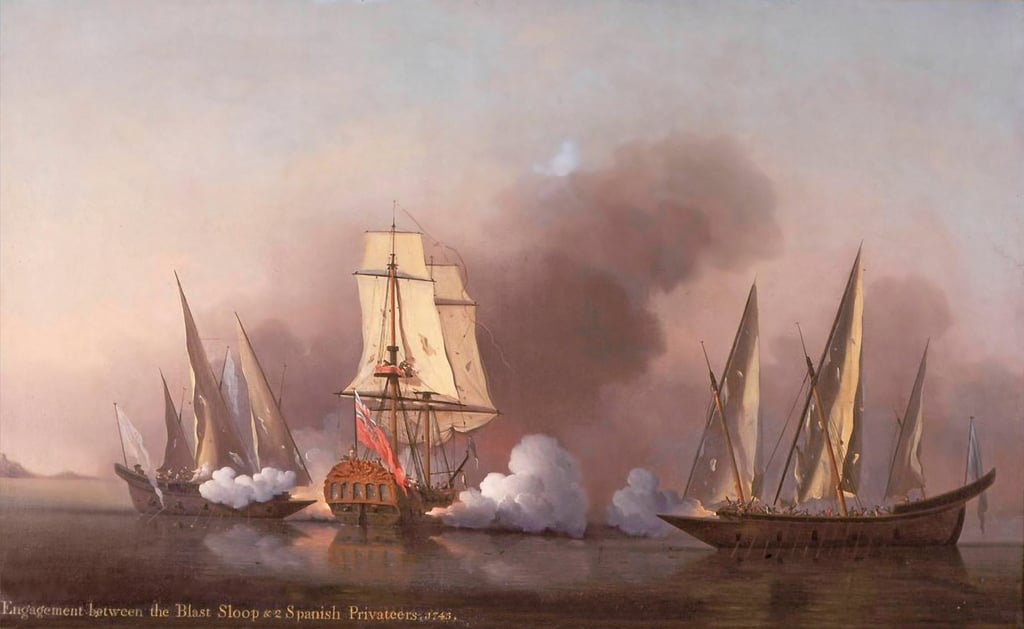
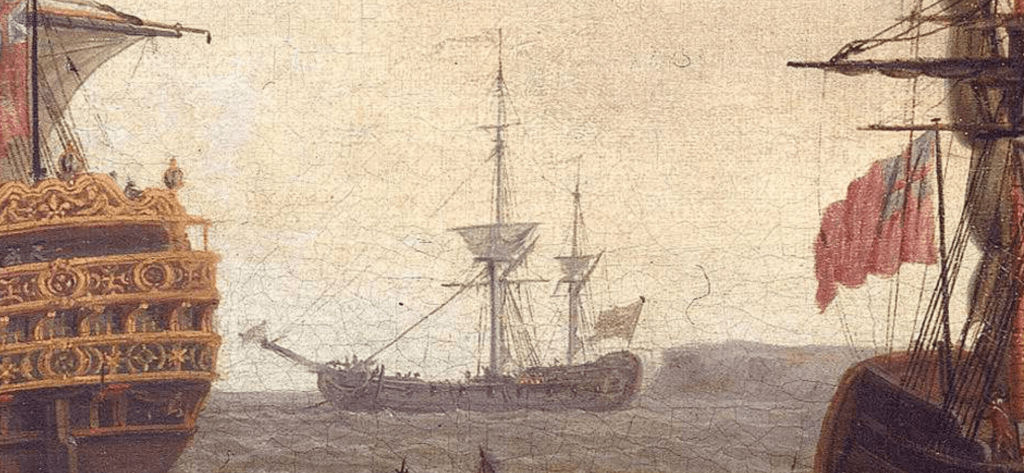
This painting by Samuel Scott is a rare representation of a mid-18th Century bomb vessel. It depicts the capture of HMS Blast, lead ship of Furnace’s class, in 1745. Blast was captured while serving as a sloop, and would have been armed without the mortars but with ten 4-pounder cannon when captured by two Spanish privateers. Blast appears to have a full 5-light (windowed) stern, and the additional armament has been added to the stern cabin (seen in the lower siting of the gunports aft). Oddly, the ship is now depicted rigged in the reverse of a ketch, as a brig or a snow. Credit: Samuel Scott, (Earl of Pembroke. Paul Mellon Centre for Studies in British Art) Public domain, via Wikimedia Commons

In contrast to the great and tragic expeditions that came both before and after, Christopher Middleton’s Northwest Passage Expedition of 1741 is rarely mentioned, even in polar exploration literature. Middleton was an experienced ship’s captain and a skilled navigator who had conducted a variety of scientific observations (including magnetic studies) while sailing to and from Hudson’s Bay, on annual supply missions for the Hudson’s Bay Company. He had an early enthusiasm for exploration, the search for the Northwest Passage, and also an interest in establishing the fate of the vanished James Knight expedition of 1719.6 Middleton had been nearby at Prince of Wales Fort (present-day Churchill, Manitoba) when, unbeknownst to anyone, the crews of Knight’s two small ships were marooned on Marble Island in 1721-22.7 In recognition of his scientific publications, Middleton was elected a Fellow of the Royal Society in 1727. In 1741, having left the employ of the HBC, the Royal Navy appointed him to command HMS Furnace. His orders were to seek a Northwest Passage somewhere along the Western coasts of the Bay. In reviewing the available units of the fleet, the new and rugged generation of bombs must have seemed ideal candidates for an exploration mission, where ships were in danger of colliding with icebergs, grounding, or being forced ashore out in Baffin Bay or the Hudson Strait, or being damaged or crushed by pack or land ice. Furnace would be accompanied by a hired collier, HMS Discovery, which was commanded by Middleton’s cousin, Lt. William Moor. The Admiralty optimistically believed that, a Passage having been located and exploited, the ships might link up with Commodore George Anson’s 1740-44 circumnavigation of the World, somewhere in the Pacific.

After crossing the Atlantic, the crews spent a terrible winter at Prince of Wales Fort to get an early start to the season. Expedition members stayed ashore in a disused wooden fort.8 They would have first prepared the ships for being iced into the harbour – with Furnace becoming the first bomb to overwinter. Once the exploration work commenced in July 1742 they quickly discovered that a promising inlet did not in actuality offer any corridor to the west (Middleton thought this a river and named it “Wager” after Sir Charles Wager, First Lord of the Admiralty, but it was later determined to be a bay). Other useful exploration work included the discovery of Repulse Bay (now known as Naujaat) and the assessment that the Frozen Straits offered no likely passage to the west. With the crew weakening from scurvy, and the major exploration work having led to dead-ends, Middleton hastened back to England.9

Middleton’s surveying work was attacked after his return, with Arthur Dobbs (a wealthy and influential Irish landowner who has supported Middleton’s original appointment) and Moor both coming around to the view that not enough had been done to rule Hudson’s Bay out as the beginning of a passage towards the Pacific.10 Moor departed on another expedition which explored more of the same coasts of the Bay. This privately-funded expedition served to underline that there was no reason to keep exploring the shores of Hudson’s Bay for a Northwest Passage. Future expeditions would take other reinforced bomb vessels further north to continue the search for a navigable passage amongst the Arctic islands. As William Barr has pointed out, the criticisms Middleton was subjected to were baseless, and the accuracy of his surveying was eventually confirmed.11

HMS Furnace was a Blast class bomb vessel, completed in October 1740 by Quallett (presumably the commercial yard of John Quallett of Rotherhithe in South London, which built other Royal warships such as HMS Chesterfield and several sloops). She was 91.5 feet long on the gundeck and 26’4” broad, with an 11-foot draft. All told she was almost 273 tons burthen.12 This new class of six bomb vessels were rushed into service as war broke out again against Spain in late 1739. As the War of the Austrian Succession (1740-1748) spread across Europe, a second group of five almost identical sisterships were constructed the next year. Among them was the second bomb vessel to be named HMS Terror.13

Like most early bomb vessels, Furnace was rigged as a ketch, with a tall mainmast and a shorter mizzen aft. This rig proved to be problematic for the complicated laying, or aiming of the mortars, as it left only a small arc of fire unimpeded by the masts, yards, rigging and shrouds. When it came to the deck machinery, earlier bombs had been fitted with windlasses (horizontal drums) to assist in heavy tasks such as lifting the anchor cables, or the complex effort of warping the ship around on the anchor cables to precisely aim the mortars. The Blast ships, by contrast, were fitted with a windlass and the more powerful capstan (vertical drum) on the quarterdeck.14

HMS Grenado, a near-contemporary of Furnace, is depicted in a superb sectional model at the National Maritime Museum, Greenwich, which helps us explore the peculiarities of the design:
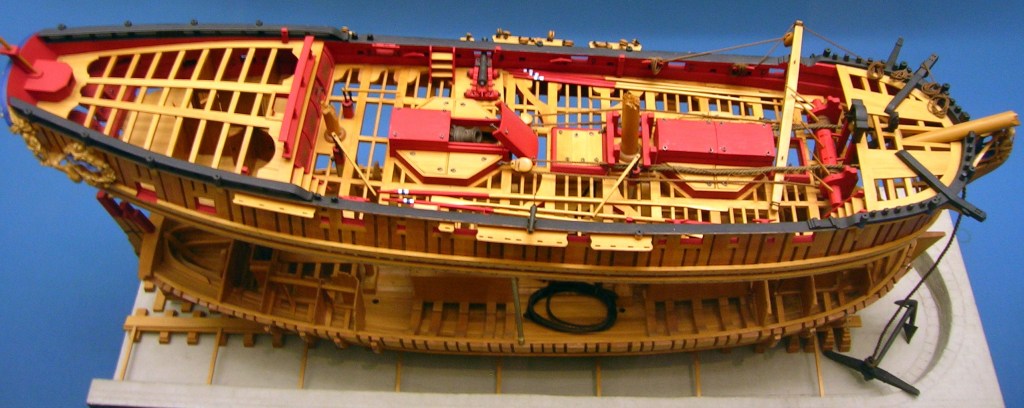
HMS Grenado model showing both octagonal mortar pits, the new trunnioned mortars, and the exposed deck beams and hull framing. Credit: Rémi Kaupp, CC BY-SA 3.0, via Wikimedia Commons the original model was built by Robert A. Lightley and is catalogued at National Maritime Museum as SLR0331.

We can observe a robust, wide hull, with closely spaced frames. The solid construction continued into heavy knees supporting the deck beams. In Grenado and Furnace, the mortars were originally sited forward and aft of the mainmast, while the mizzen mast rises above the deck just forward of the break on the quarterdeck. A new type of mortar had been developed, which could elevate and depress on trunnions, and rotate in its octagonal pit. The mortars could be lowered and covered over with sliding hatches, and protected from the elements. The long run of the open waist amidships was necessary to provide the room needed to work the mortars. These ships, like the later Franklin vessels, were originally armed with a 13″ and a 10″ mortar. The secondary weapons, a battery of six light 4-pounder cannon, created a modest broadside for defensive purposes. Additional empty gunports, evenly spaced along the gundeck, allowed for the augmentation of these cannons when the mortars were unshipped. The officers’ cabins were tucked aft under a small quarterdeck, on a deck stepped slightly lower than the main run of the gundeck. There was a very small covered foc’sl forward of the large windlass, and between those was the usual belfry with ship’s bell.
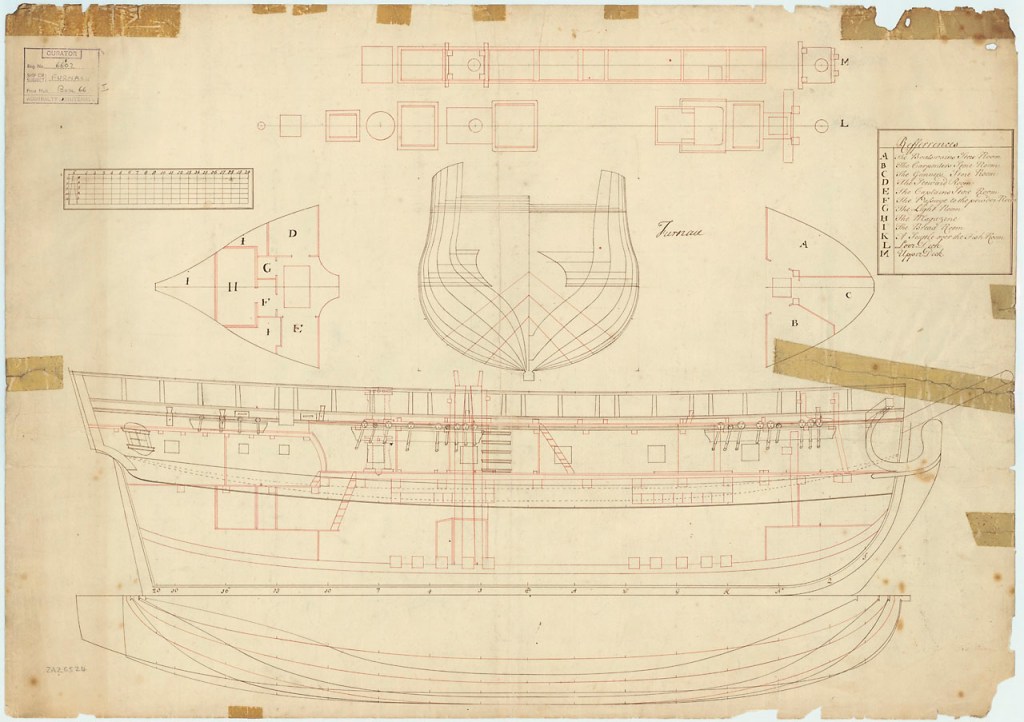
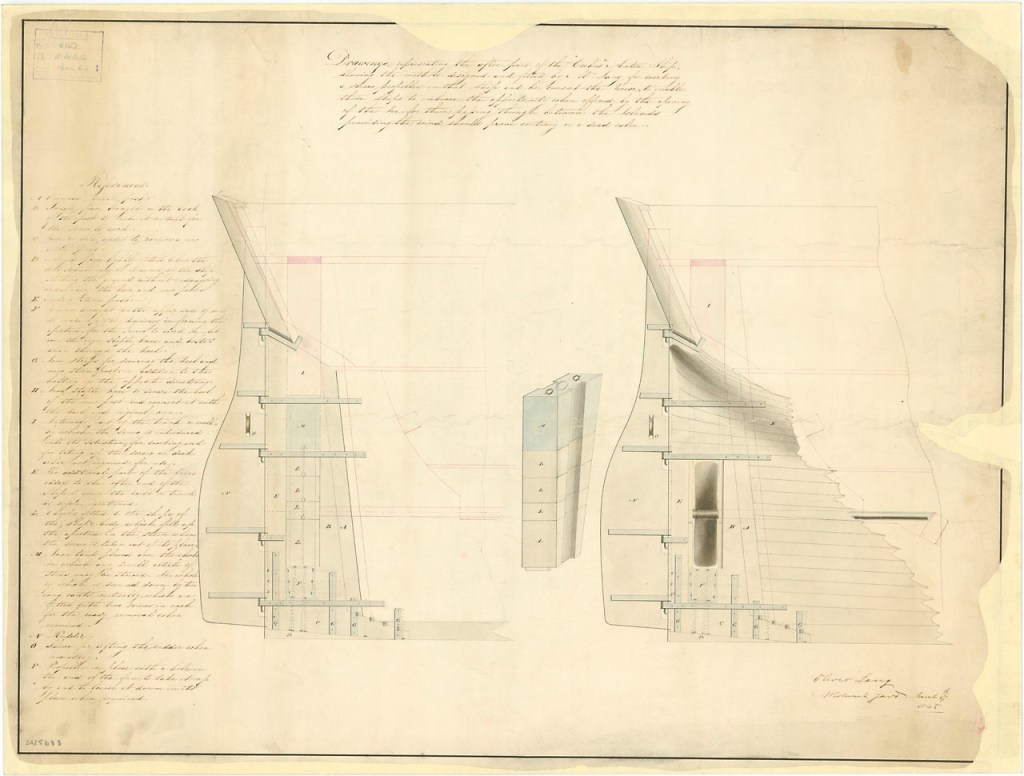
HMS Furnace as converted for the Middleton Expedition in 1741. Credit: © Crown copyright. National Maritime Museum, Greenwich, London ZAZ6524.

As can be seen by comparing the above Admiralty plans, preserved at the National Maritime Museum in Greenwich, with the Grenado model or the plans at the beginning of this post, Furnace was extensively modified for exploration. The masts were relocated, with a third mast making the vessel a sloop.15 There are many elements of the design that set the pattern for the Admiralty modifying ships for polar exploration, right down to those final modifications to Franklin’s two ships. Compared to the unmodified bomb vessels, this ship now has a shorter, less vulnerable stem, and higher sides. The open waist where the two mortars were once sited was fully decked-over by a continuous weather deck. The mortars, beds, and cribbing have been removed down to the keel. Furnace even has channels that have been reinforced with ice chocks to make them less vulnerable.16 The ship now has a larger double capstan, installed further forwards between the mizzen and mainmast, which could be worked by crew on both weather and lower decks. The windlass near the bows has apparently been removed. Furnace appears to be the only bomb to have gone north steering a course with the old-fashioned tiller bar controlling the rudder. All subsequent bomb-derived exploration vessels would have ship’s wheels aft.

Upon Middleton’s return, Furnace was modified back to her original design. Although we could expect that the overwintering in the Bay and the exploration work could have shortened her career, in actuality, she served longer than all the other 1740-constructed bombs. She was eventually decommissioned in 1763. HMS Furnace’s 1741 refit set the pattern for the modification of six other bomb vessels to be sent on future Arctic and Antarctic missions.17 This era ended more than a century later when the last two serviceable bombs disappeared into the Canadian Arctic.
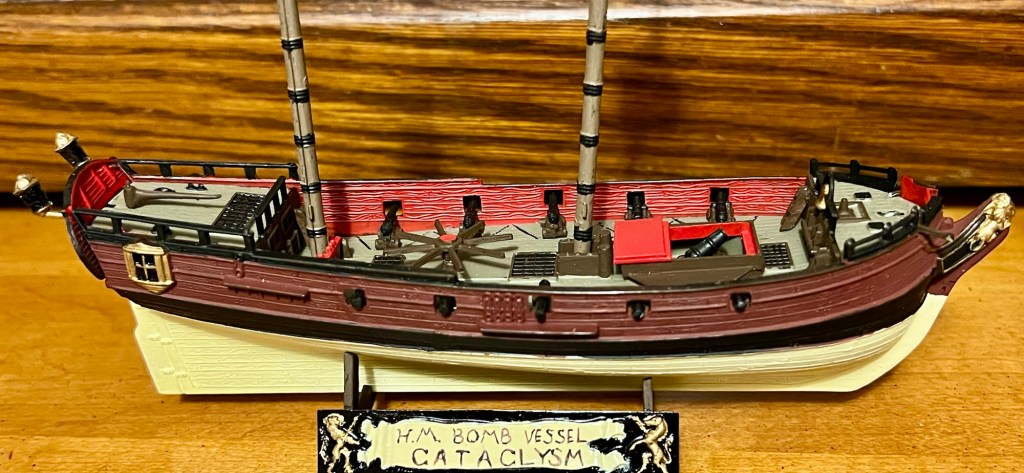
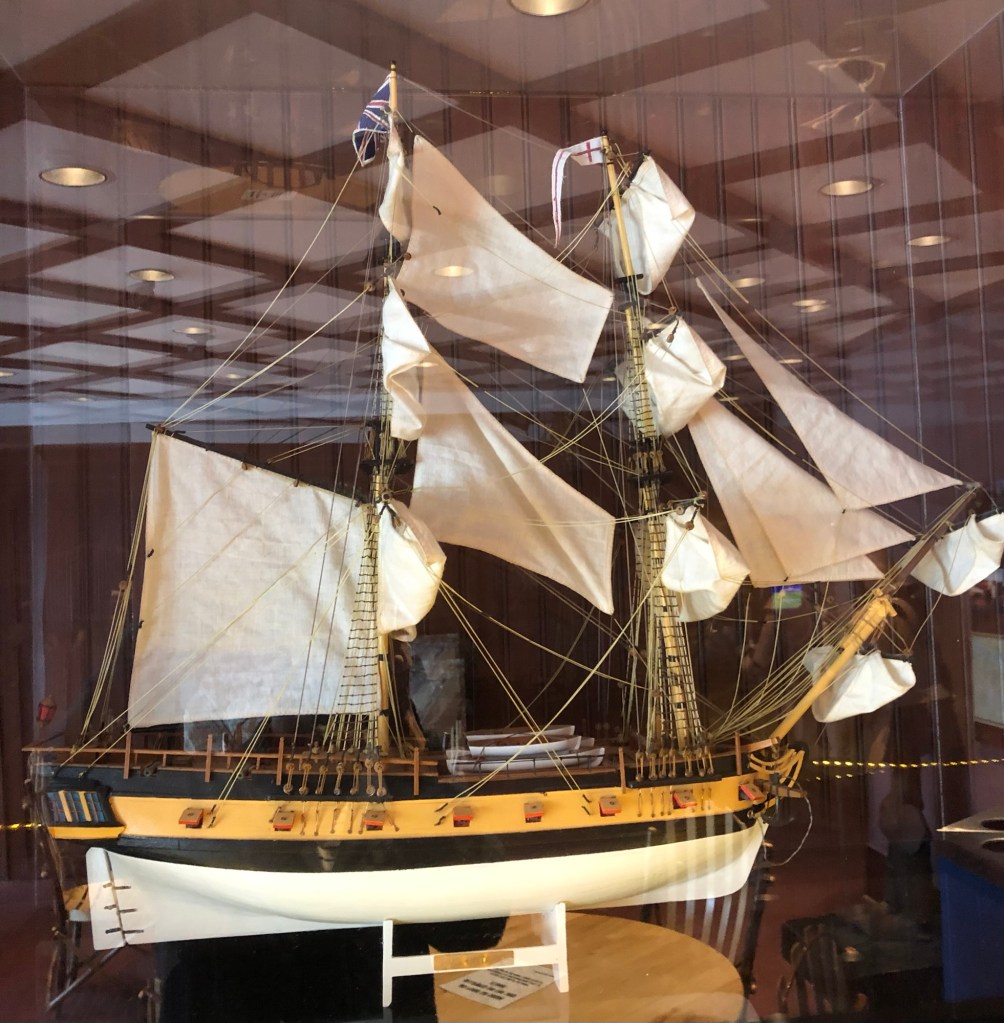
A model I worked on years ago, a modified Pyro British Bomb Vessel in (tiny) 1/150 scale. The design seems to be a simplification of a mid-eighteenth century bomb, which I modified as a fictional HM Bomb Vessel Cataclysm.
ENDNOTES:

A Voyage through History aboard HMS Calypso

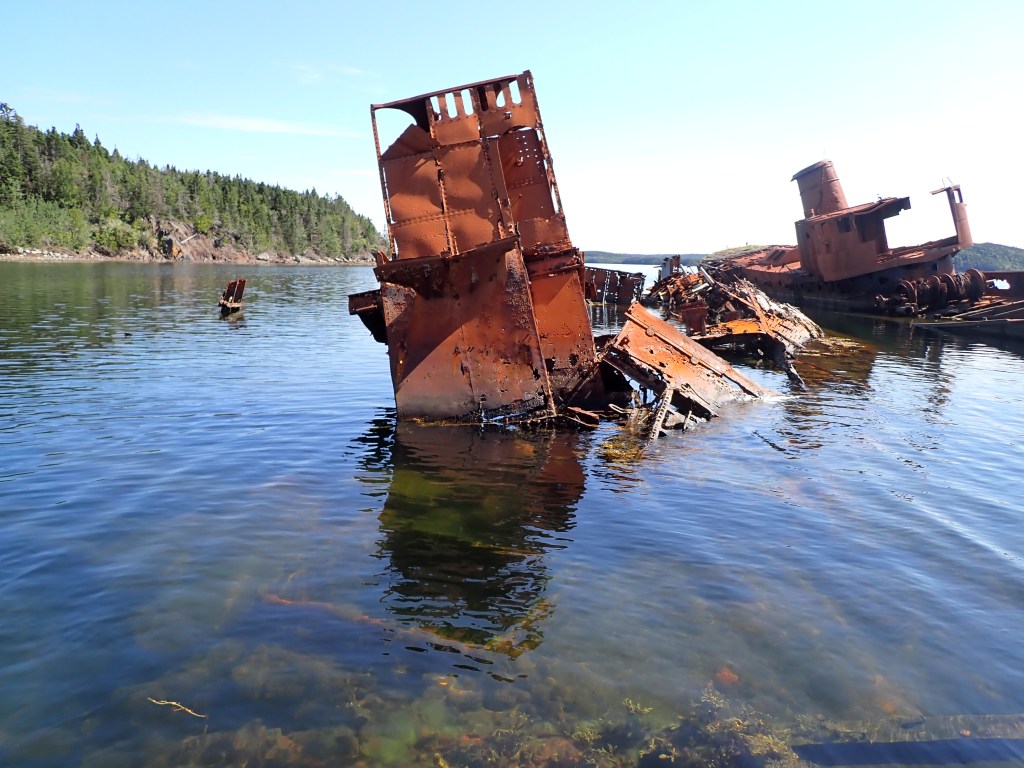
HMS Calypso was completed as a a steam-powered corvette – a uniquely Victorian mix of old and new technologies- in 1883. After a career of transformations, her hulk rests, all these years later, in a quiet cove in Newfoundland. She remains a historic artifact of Newfoundland’s important naval traditions. Years after adding a Google Earth view to my shipsearcher database, I recently got a chance to visit the site. Join me as I explore Calypso’s interesting past and current state!

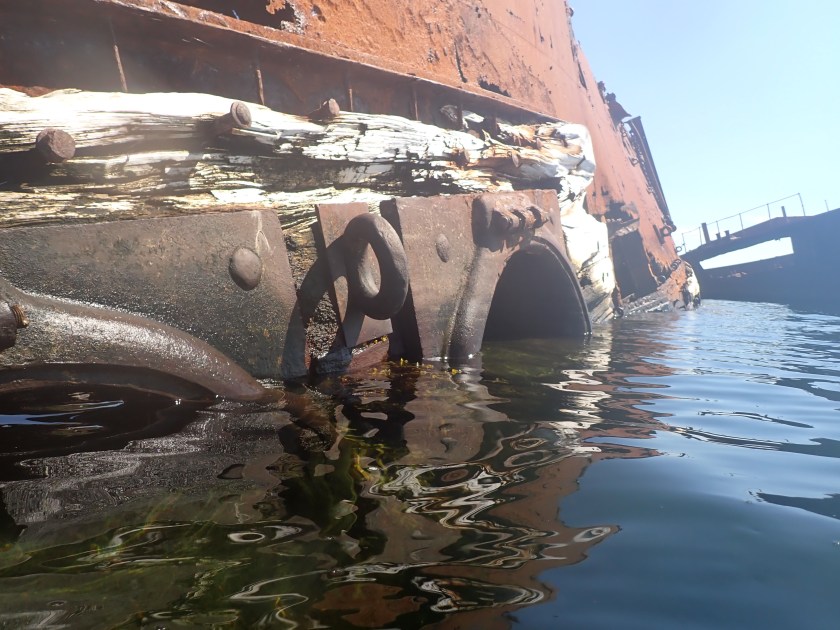
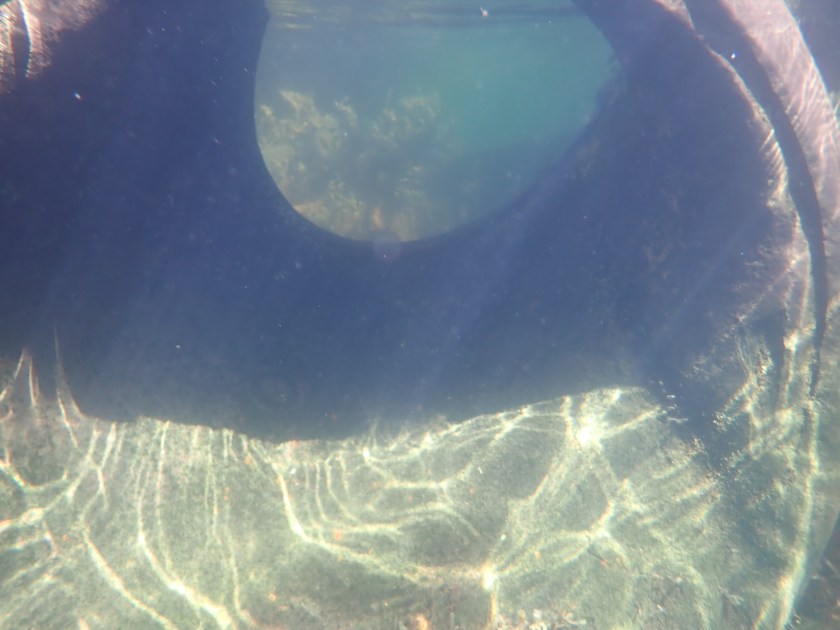
Calypso’s port bows, including two large hawse pipes. This is one of the most recognizable sections of the derelict hull (Credit: http://www.warsearcher.com). Inset image shows Calypso under sail, driving before the wind, ca. 1898. Credit: Imperial War Museum, Symonds & Co. collection (Q 21057).

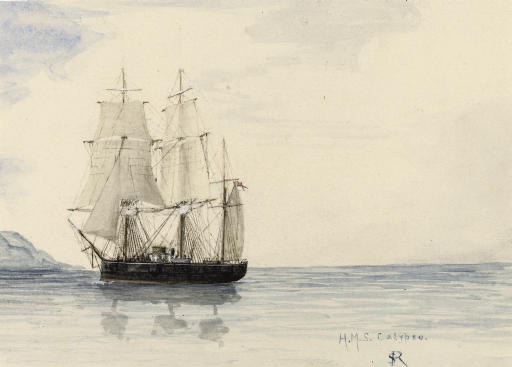
In 1883, Robert Falcon Scott, a young midshipman serving in HMS Boadicea, sat down to sketch a picturesque seascape and a lovely ship: The newly-commissioned HMS Calypso. Boadicea, an older corvette, was sold to the scrappers at the turn of the 20th Century. Scott went on to legendary fame as a polar explorer, before perishing in Antarctica after attaining the South Pole in 1912. All these decades later, Calypso remains.

Robert Falcon Scott sketch of Calypso, ca. 1883, sold at a 2007 Christie’s auction. Via wikimedia commons

Sir Nathaniel Barnaby, Director of Naval Construction, had designed this and several predecessor classes of corvettes, and sisterships Calypso and Calliope were both built at Chatham Royal Dockyards. Where earlier corvettes were built of a mix of iron frames and wood planking, the Calypso class had a steel hull, with wooden sheathing, and a copper-clad underbody. The modern steel hull was structural and complete, but the wood (mahogany planking above water) aesthetically linked the ships to the rest of the sail-and-steam navy. More wood below the waterline created a barrier between the steel and the same sheets of copper alloy that the Royal Navy had used to protect its ships from wood-boring marine life and biofouling since the mid-eighteenth Century.1

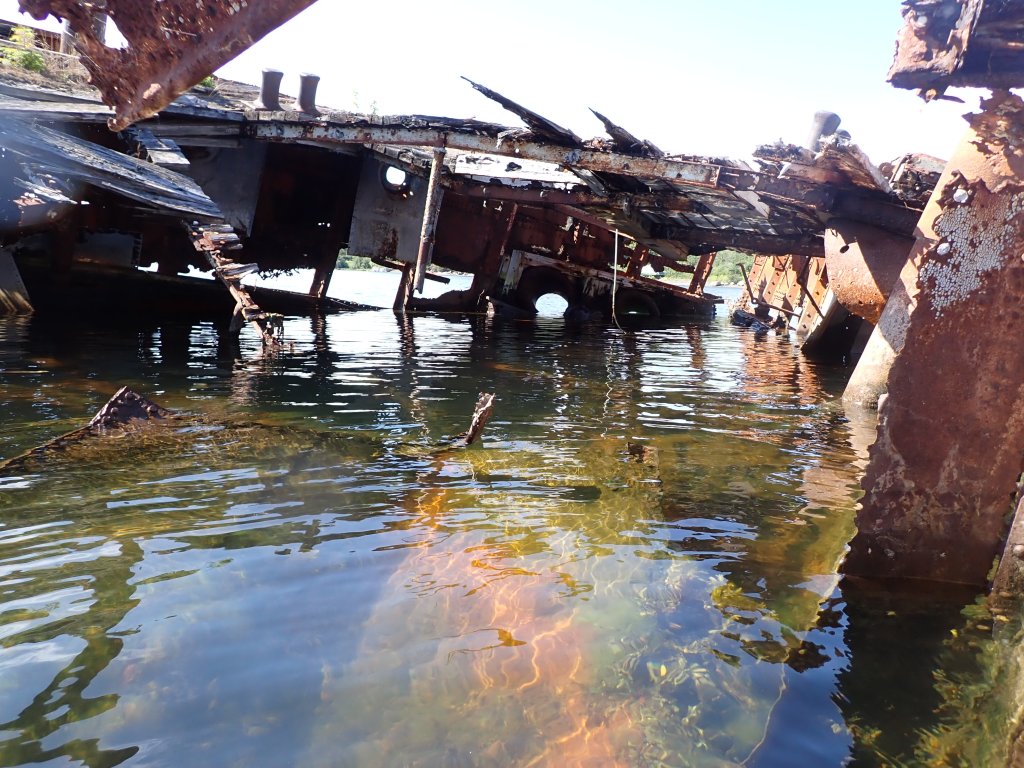
The view looking forwards towards the bows of the ship, with the inside of the distinctive hawseholes and some of the forecastle deck remaining above, including the cutout for the forward skylight, portholes, and a pair of heavy bollards. The steel hull is the reason that any of the structure of Calypso survives today, after deterioration and fire damage. Credit: http://www.warsearcher.com

The ship had vestigial features from the Victorian sailing navy: A towering three-masted sailing rig, a broadside layout of cannon, and elaborate stern galleries (which were merely decorative cladding).2 Contemporary photographs show that the Calypso had a spectacular appearance with all sails set, and, when running before the wind, studdingsails could extend the canvas outwards like wings. Improving on the Barnaby’s earlier Comus class, they were slightly longer, at 235’/71.6 m between perpendiculars, and heavier, at 2,700 tons. They were substantially more powerful, with larger engines that could propel the single screw with over 4,000 units of installed horsepower.3

HMS Calypso‘s original appearance, with a stately rig and aesthetic elements derived from the wooden-hulled sailing frigates. Allan C. Green original glass negative in State Library of Victoria, Australia, Public domain, via Wikimedia Commons

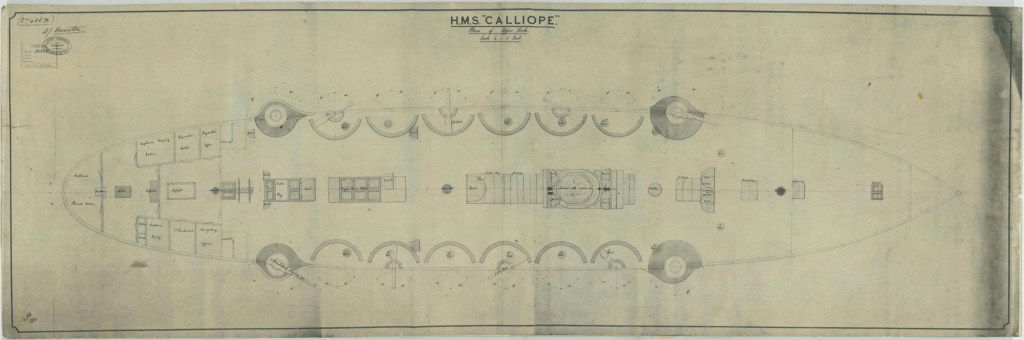
The class was armed with modern 6” breech-loading rifled guns.4 These were mounted in four sponsons (structures that mount armament which project out from the hull), with a wide field of fire. Five gunports were sited along the upper deck between the sponsons. A 5″ gun was mounted behind each port. Quicker firing light guns, Nordenfelts, were mounted high on the bulwarks, and were intended to protect from smaller, faster craft, such as torpedo boats. The two ships had a pair of 14″ diameter “carriage torpedoes.” These used compressed air to launch themselves out of cradles to start their run. Like the Comus class, the Calypsos had a partially-armoured deck of steel that protected some of the vital machinery – engines and boilers – low down in the hull just under the waterline.

Plan of Upper Deck of HMS Calliope (1884) National Archives and Records Administration 78116457
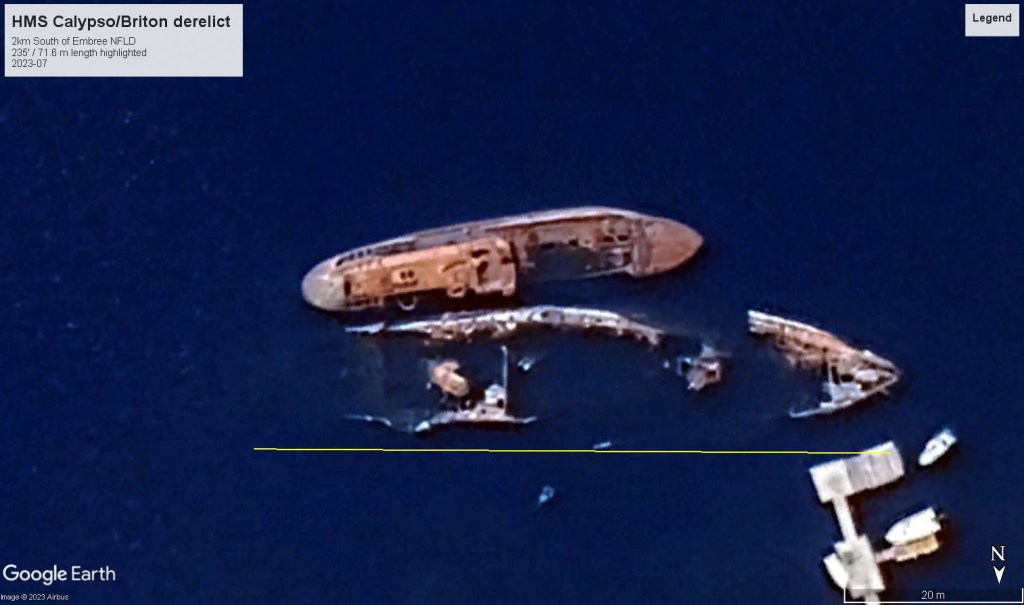
A recent Google Earth capture from July 2023 of the remains of Calypso, with a smaller trawler outboard. The google earth historical imagery shows marked deterioration since the first image, from 2006.

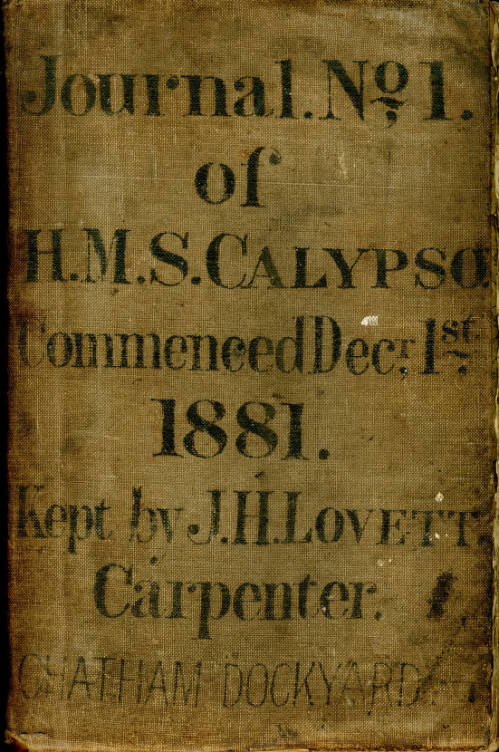
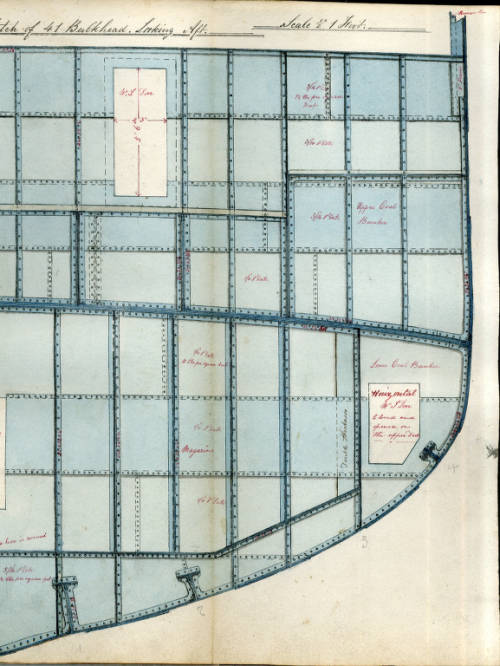
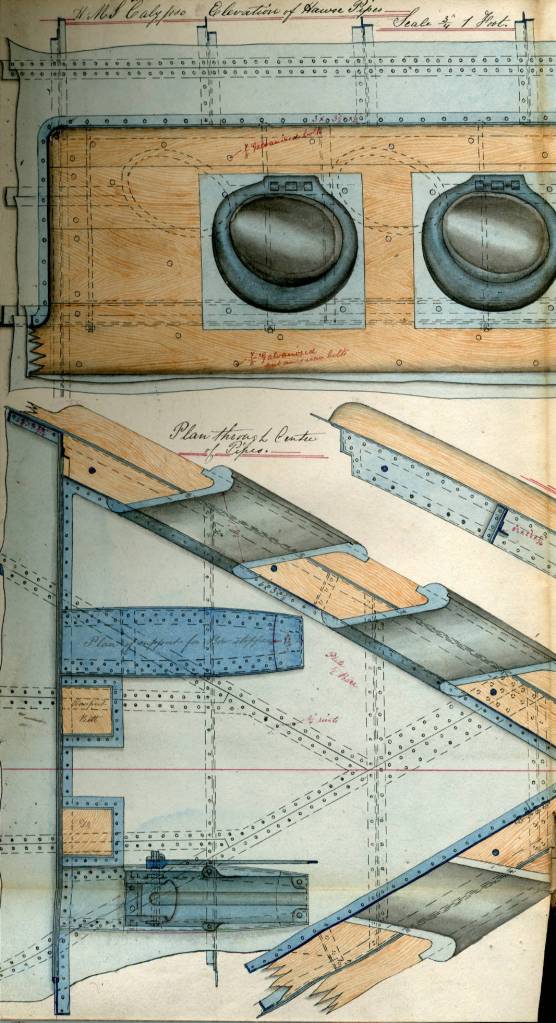
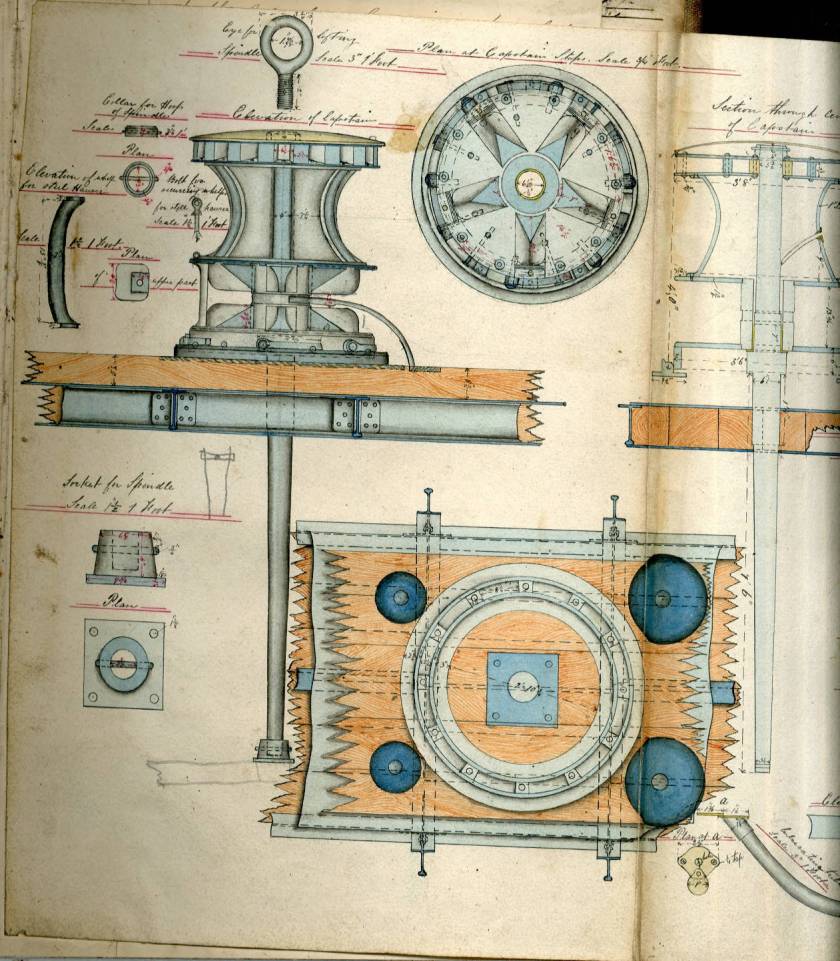
Predecessor Royal Naval classes had abandoned the graceful clipper stem for an upright bow with a massive bronze ram installed underwater. These were the last Royal Navy corvettes with a full sailing rig. Gaping deck ventilators and a wide buff-coloured funnel broke up the run of the upper deck. The ships were designed to be economical for long-distance cruising about the far-flung British Empire, and could sail and steam between widely-dispersed coaling stations. A contemporary folio of design blueprints, today in the archival collection of the Maritime History Archive, Memorial University, Newfoundland and Labrador, helps us reconstruct some of these technical design features (look out for these structures in our photos of what remains of Calypso elsewhere in this post)5:

Unfortunately, from the day they were designed, the idea of a sailing-steaming corvette cruising the world’s oceans was on borrowed time: A new generation of cruisers, the Leander class were being designed, and the Admiralty quickly halted plans to build more corvettes.6 The Leanders were larger, heavier, more powerful, and had more armour and more bunker capacity to steam to distant ports, or police merchant sea lanes. They improved upon the Iris class despatch vessels, and had a similarly cut-down barquentine rig.

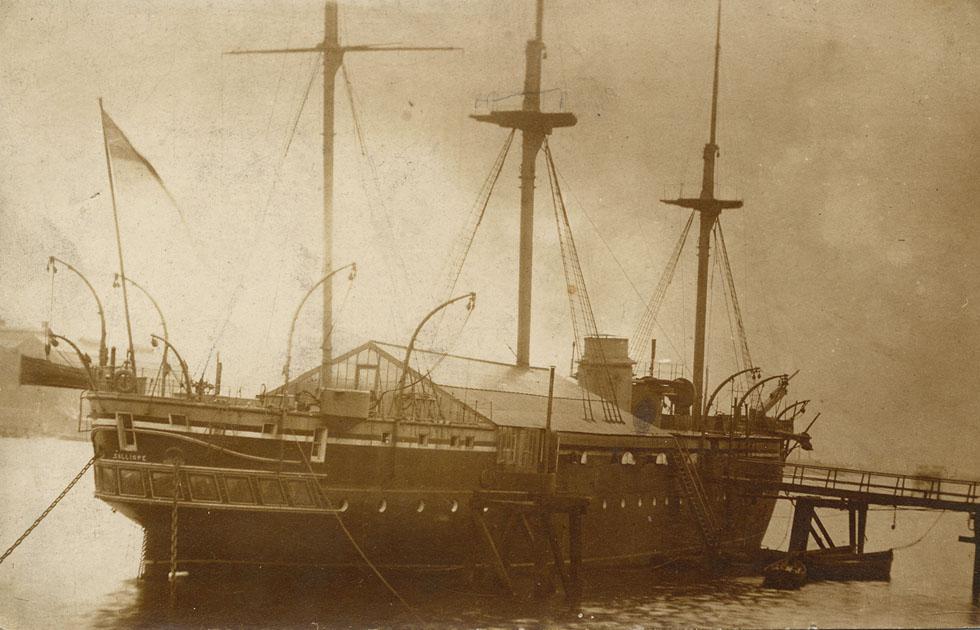
Calypso’s Sistership HMS Calliope -completed in 1884- had an eventful career in the Far East, gaining fame for being the sole surviving warship from a terrible cyclone off Samoa in 1889. Calliope became a drill ship on the Tyne in 1907, and survived until dismantlement in 1951. Her name is perpetuated by the current shore establishment at Gateshead.

HMS Calliope at Blyth, ca. 1920 . This shows the trim appearance of the class, which is hulked with a built-up quarterdeck housing and rigging mostly unshipped, but still has the sponsons and funnel fitted. Credit: From an uncredited postcard collection, Public domain, via Wikimedia Commons

Calypso had a brief period of active service, cruising to distant ports as a member of the Sail Training Squadron. In 1895, Walter Hose, who would go on to serve as Director of the (Canadian) Naval Service during the Interwar era, was posted to Calypso. She was laid up at the end of the Nineteenth Century. In 1902, she was taken out of reserve and sent to Newfoundland to help train naval reservists in St. John’s for the newly-created Newfoundland Royal Naval Reserve. Newfoundland was the first colony where a naval reserve was formally established, and the Dominion was seen as a potential goldmine of seafaring experience, with many residents connected into seafaring traditions in the ports and outports of “the Rock.”7 Calyspo’s sailing and steaming days were over; the vessel was quickly converted to a depot ship, with deck houses built over the weather deck, funnels and machinery taken ashore, and most of the masts taken down.

Across the North Atlantic from Calliope, at St. John’s, Newfoundland, here is a similar view of Calypso around 1915. The false gallery windows have been emphasized in white, which also are cut-through with two heavy stern hawse pipes. The standing lower mizzen mast, the only vestige of the original rig, would remain a feature of the ship until at least 1960. Credit: Maritime History Archive, Malcolm Griffin Sealing Album collection PF-345.004

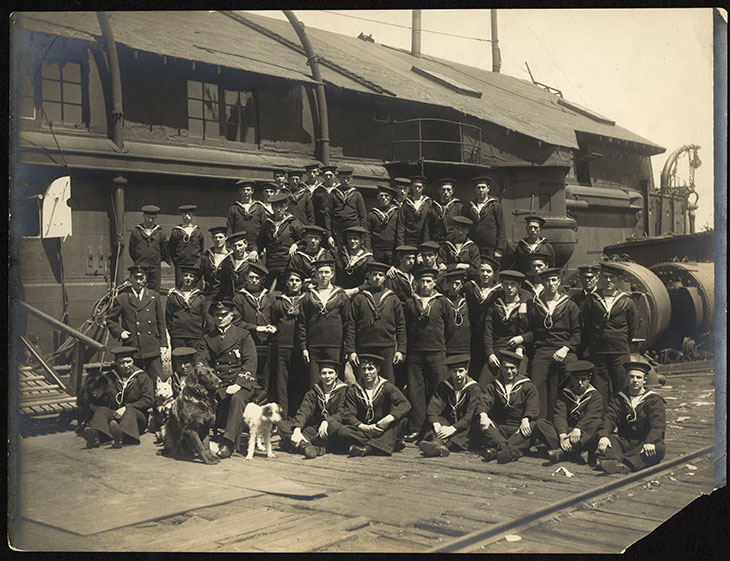
During the First World War, the Calypso establishment trained many young Newfoundlanders for service with the Royal Navy. Almost 2,000 members served in everything from the massive battlewagons of the Grand Fleet, to armed trawlers, and 192 died.8 Alongside the Royal Newfoundland Regiment, the Forestry Corps, and merchant mariners, they represented the Dominion’s outsized-contribution to the Allied cause.

Reservists alongside the forward starboard side of Calypso, St. John’s, ca. 1916-1922. The ship still has armament in the sponsons, a Hotchkiss gun mounted near the gangway, and a heavy anchor suspended from the forward davit. Credit: The Rooms, Collection MG 110, Item A 142-30; B 3-29; NA 1529
The starboard bows, showing the remains of forecastle decking, skylights, paired bollards and a heavy fish davit for the anchors. Credit: http://www.warsearcher.com

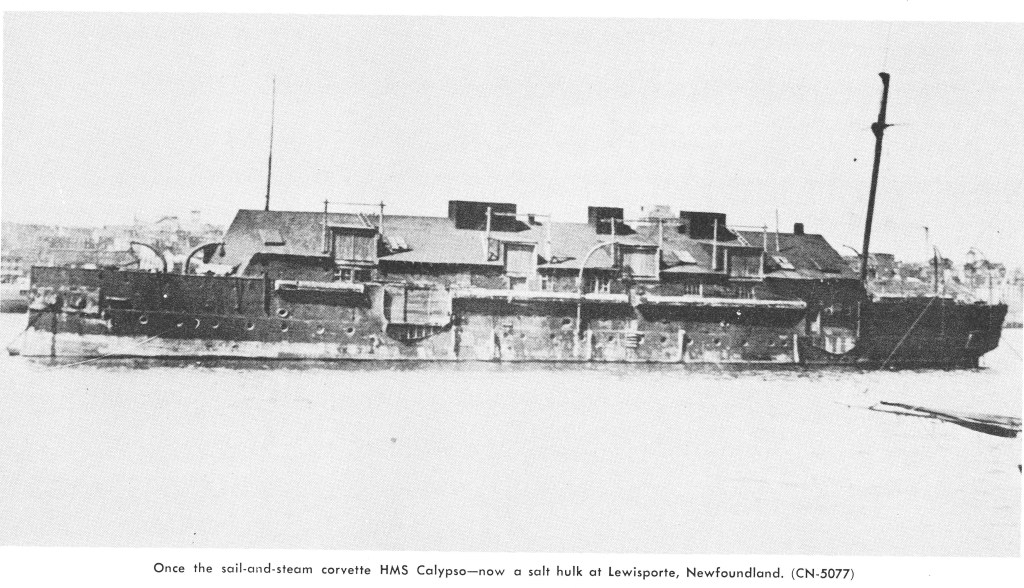
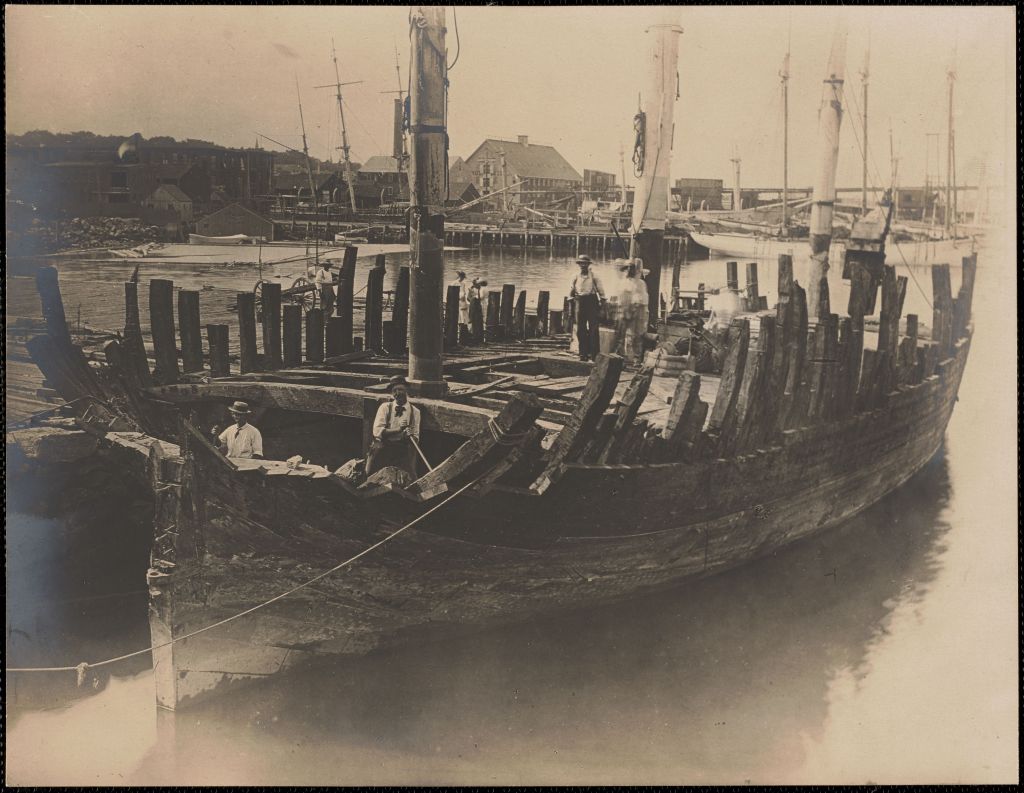
Calypso was renamed HMS Briton in 1916, to leave the name available for the new “C” Class cruiser. Eventually, Briton was sold off in 1922 to become a salt hulk in St. John’s. Moved to Lewisporte in 1952, most of the interior was stripped of valuable items. Some local residents hoped to save the moldering vessel for preservation. Instead, during 1968 the hulk was towed slightly north to near Embree, and set on fire.9

Calypso/Briton hulk with both port sponsons removed, decks built-over, and the lower mizzenmast still stepped. The photo was taken at St. John’s before the tow to Lewisporte. The Crowsnest Vol.12 No.4 Feb. 1960 P.15, Department of National Defence CN-3077.

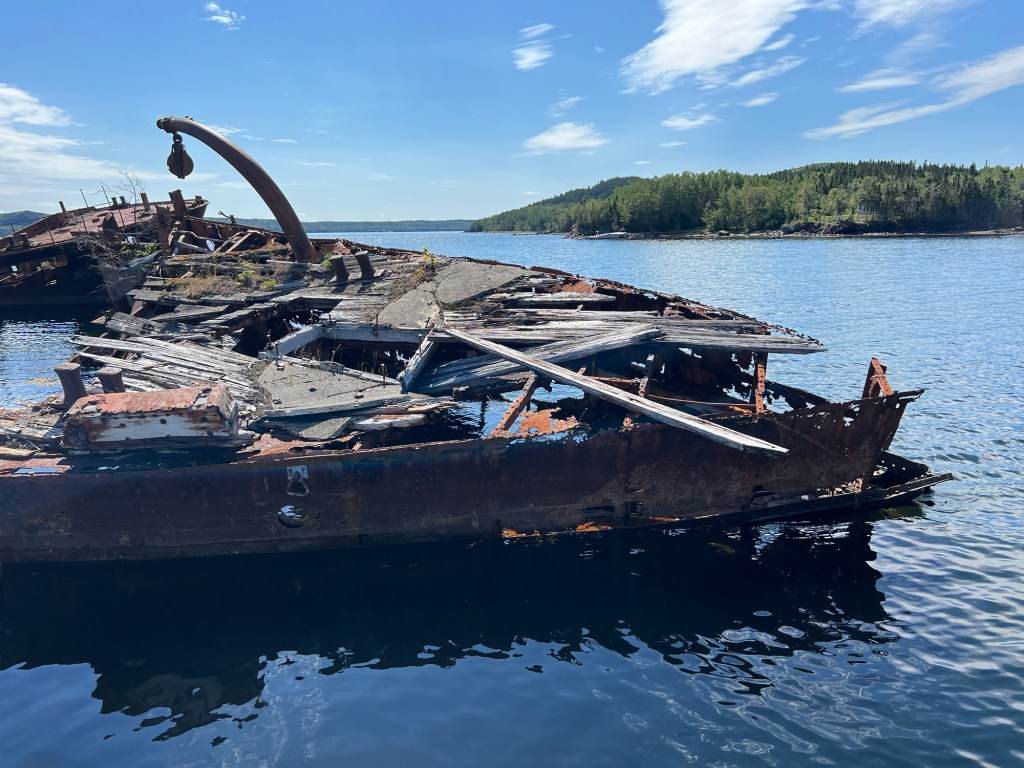
The derelict has slowly deteriorated there ever since.10 Today, she functions as a sort of jetty or breakwater, alongside an old fishing trawler. There is remarkable drone and video footage of the site from 2022 at “Discovering Newfoundland.”11 Take a look at the footage below to see the submerged portions:

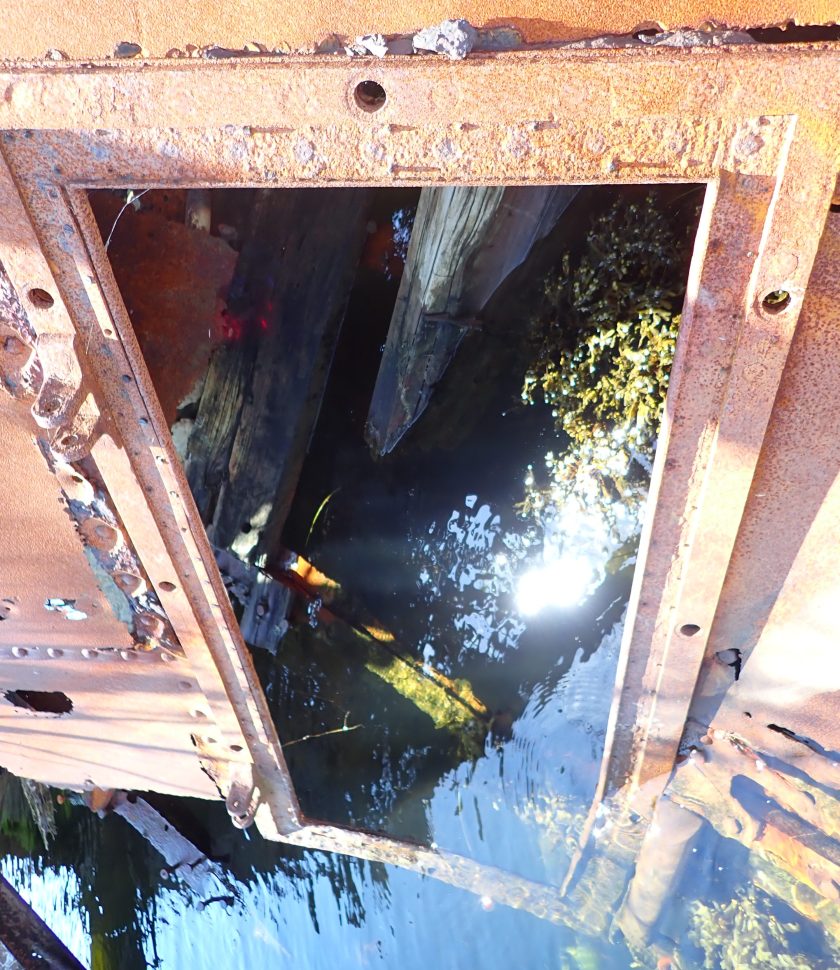
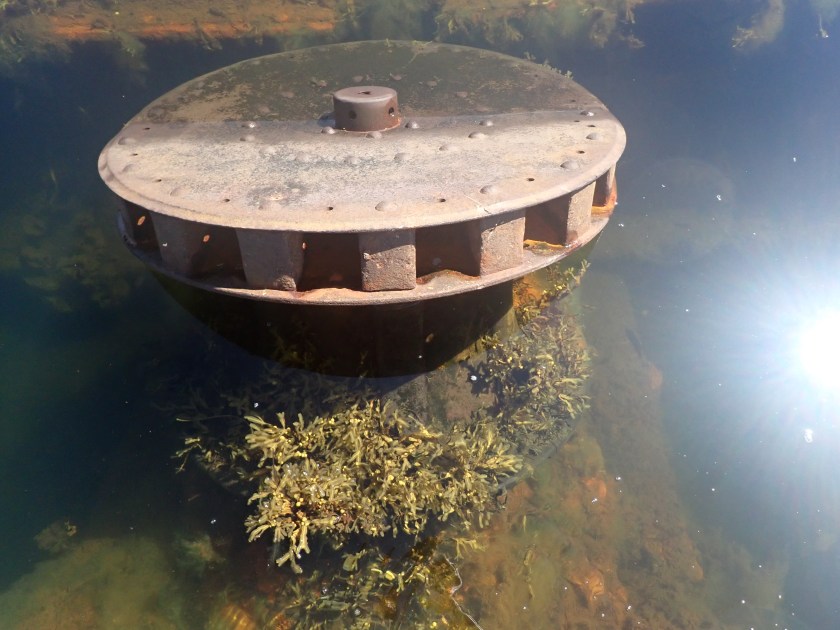
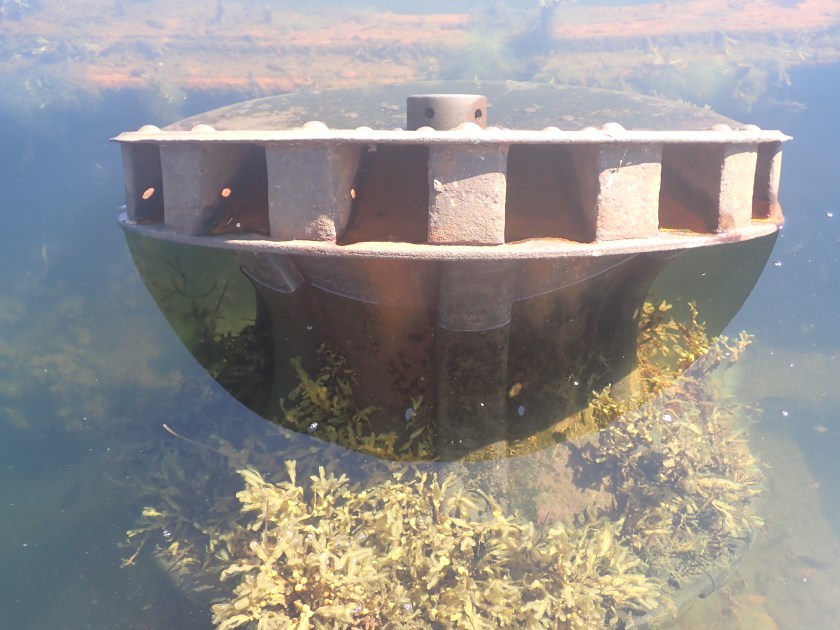
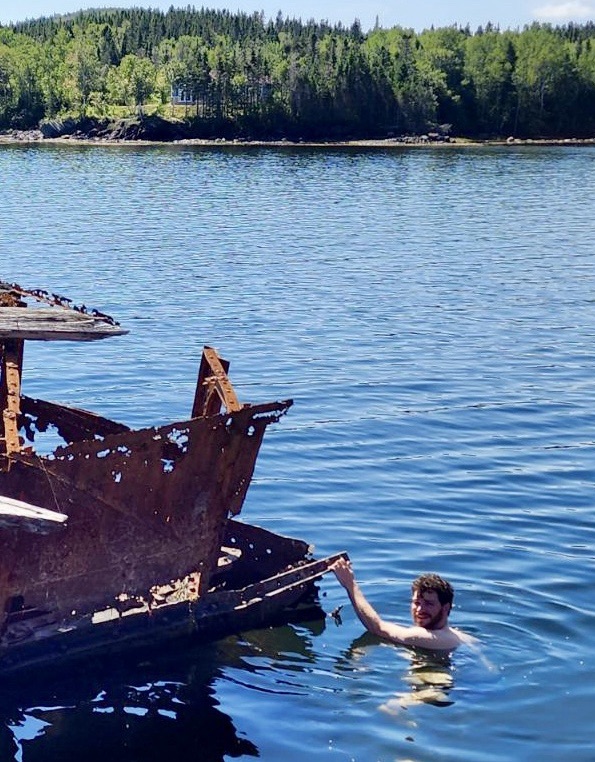
On a recent trip to Newfoundland, I had a chance to visit Embree and swim around the remains. The hull has settled at a slight list to starboard. The bows are most recognizable, along with the some of the ship’s deck structures, which rise out of the muck. These tall boxy features originally housed a set of ventilators, connected by a louvered structure. As the above drone footage shows, the submerged stern section is recognizable, and, incredibly, Calypso still had the remains of the lower mizzen mast jutting upwards above the site in 2022!12 The capstan, about a third of the way aft from the bows, is one of the remaining distinctive naval artifacts.

Much of the starboard side, adjacent to a small pier, is collapsed and displaced outwards onto the bottom. A small portion rises where the wheel would have been, where a bulkhead still shows a doorway.

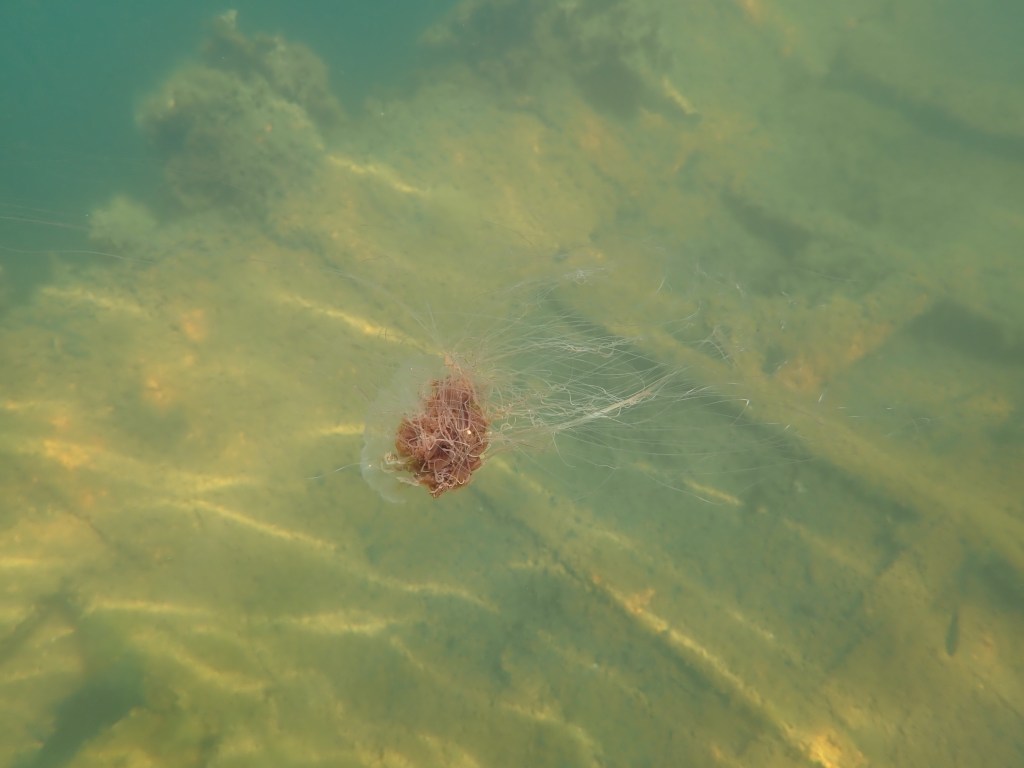
The now submerged starboard side, with a visiting jelly fish. Much of that side appears to have collapsed outwards onto the cove seabed. Credit: http://www.warsearcher.com

Immediately forwards of that is the housing for a large central ventilator with another distinctive louvered top. The port side elevation is more intact. In addition to this massive semi-submerged hulk, there are many artifacts which are preserved from Calypso.

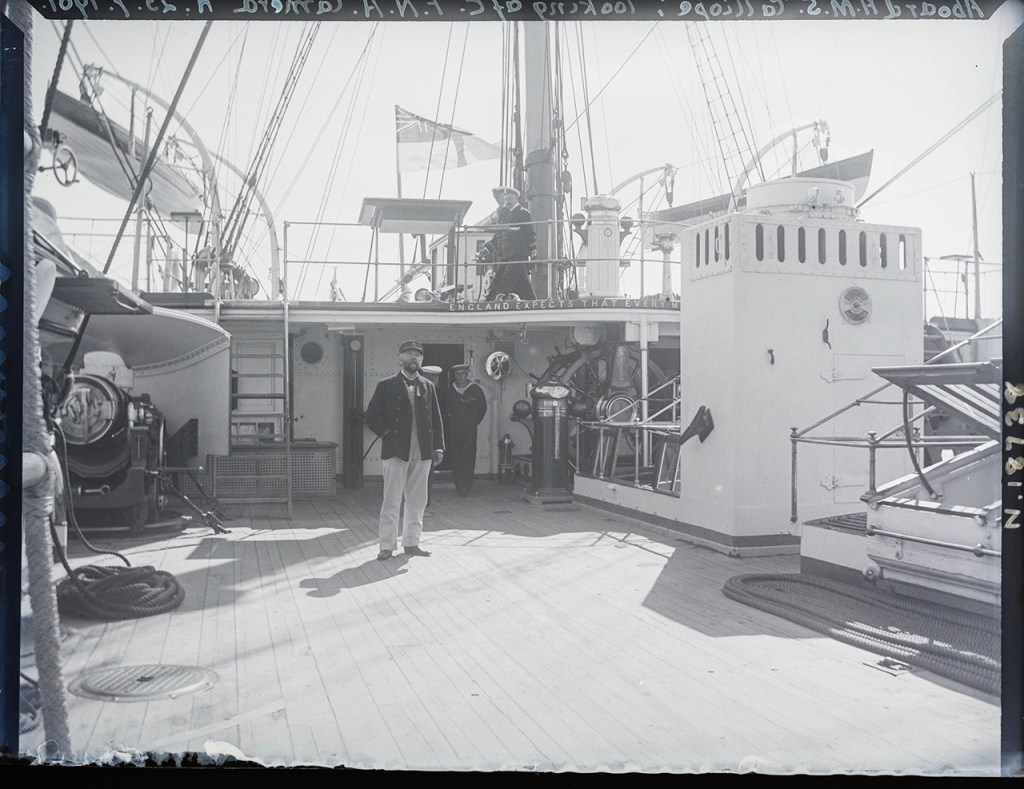
On deck of HMS Calliope in July, 1901, at anchor in the Downs, looking after towards the poop with the ships double wheel. A 6” gun is at left, while at right there is a distinctive deck structure, near the ladders to the lower deck, that trunked up a single large ventilator. N18738 Credit: National Maritime Museum, Greenwich, London, Adams Collection
We are roughly at the level of the upper deck, looking aft from the original break of the forecastle deck. A similar structure near the forward ladderway is one of the remaining highpoints of Calypso. It originally brought a matched set of ventilators above deck level (note two circular cutouts in the original roof). Credit: http://www.warsearcher.com

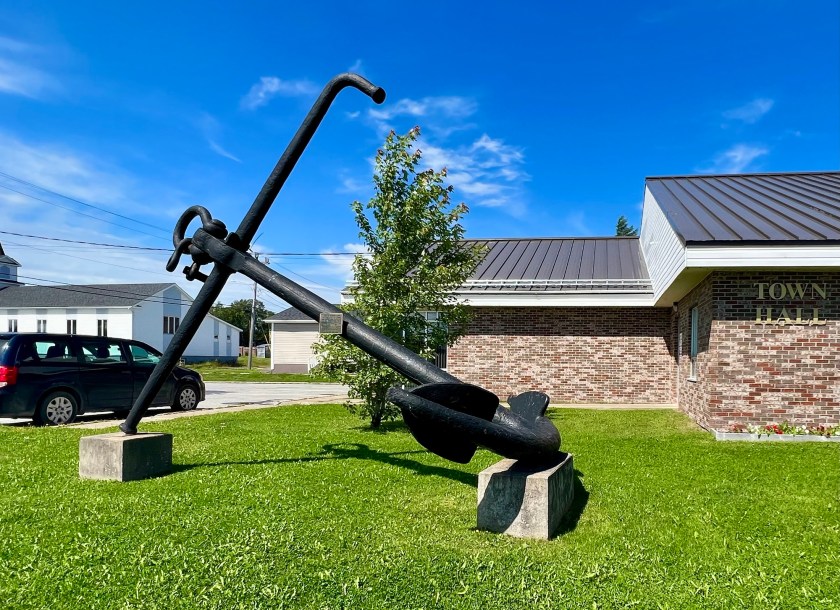
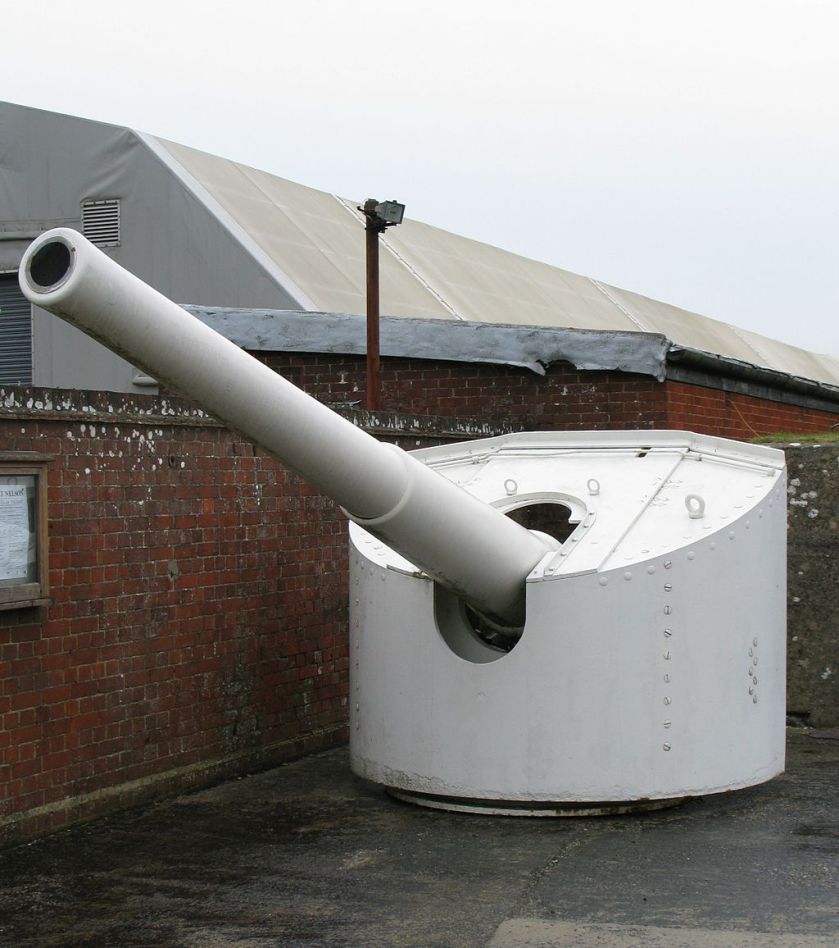
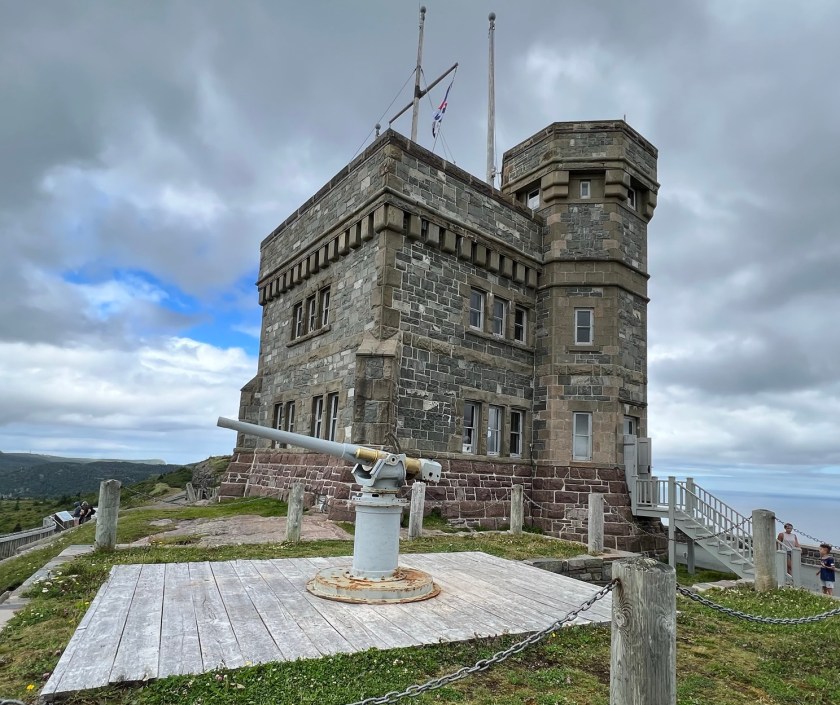
One of the ship’s large stockless anchors is now on display at Embree, while one of the 6” guns that originally was housed in one of the four sponsons is on display back in Portsmouth, UK. Two 3 pdr. Hotchkiss guns said to be from Calypso are also found at the shore establishment in St. John’s, HMCS Cabot, and near Cabot Tower at Signal Hill.13 This last still serves as a Noon Day Gun during the Summer!

Back where it all began, at Chatham dockyards, we are fortunate to have a preserved example of a smaller Barnaby design: A Doterel class sloop. HMS Gannet was about half the size of Calypso, and commissioned five years earlier. Like Scott’s old ship Boadicea, Her hull is composite – wood with iron frames – and she has a more traditional clipper bows.14 However, many of the interior spaces share much in common with Calypso, and this preserved museum ship has a sponson aft and quick-firing Nordenfelts installed!

HMS Gannet at Chatham, ca. Credit: Nilfanion, CC BY-SA 4.0 , via Wikimedia Commons

Do you have old photos of HMS Calypso / HMS Briton that could complement the above post? Please comment!

The author, looking for and not finding any remains of the bronze stem.
References (CLICK)

Interpreting that “Melancholy Relic” – the Erebus Bay Boatwreck

In this post I will describe the “boat place” boat at Erebus Bay that searchers looking for the lost Sir John Franklin 1845 Expedition came across in 1859. A later post will show my effort to construct a small model of this unique and sadly-fated boat, and propose some likely dimensions of the full complement of Franklin boats.

William Thomas Smith’s powerful 1895 work “They forged the last link with their lives: HMS Erebus and Terror, 1849-50.” The boat has several well-researched components, such as the washcloth around the gunwale and the ice grapnel. It also appears rigged for sailing with full masts stepped. (CC-BY-NC-ND) copyright: National Maritime Museum, Greenwich London

On May 23rd, 1859, at a wide bay on the frozen western shores of King William Island, a group looking for the lost Franklin Expedition found something incredible: A large boat on a sledge. Fourteen years after Franklin’s two ships had left Greenhithe, England, searchers had finally arrived at “ground zero” of the Franklin Expedition escape saga. They were a decade too late. Quartermaster Henry Toms and Carpenter’s Mate George Edwards – both members of Lt. William Hobson’s detached sledge party searching the coast as part of Francis Leopold McClintock’s Franklin search expedition – first spotted something odd projecting out of the snow as they scouted ahead of their mates.1 Closer examination revealed it to be a wooden stanchion, hanging like a beacon over the curved outlines of a gunwale in the high drifts of snow – beneath their feet was the ghostly outline of a large boat.

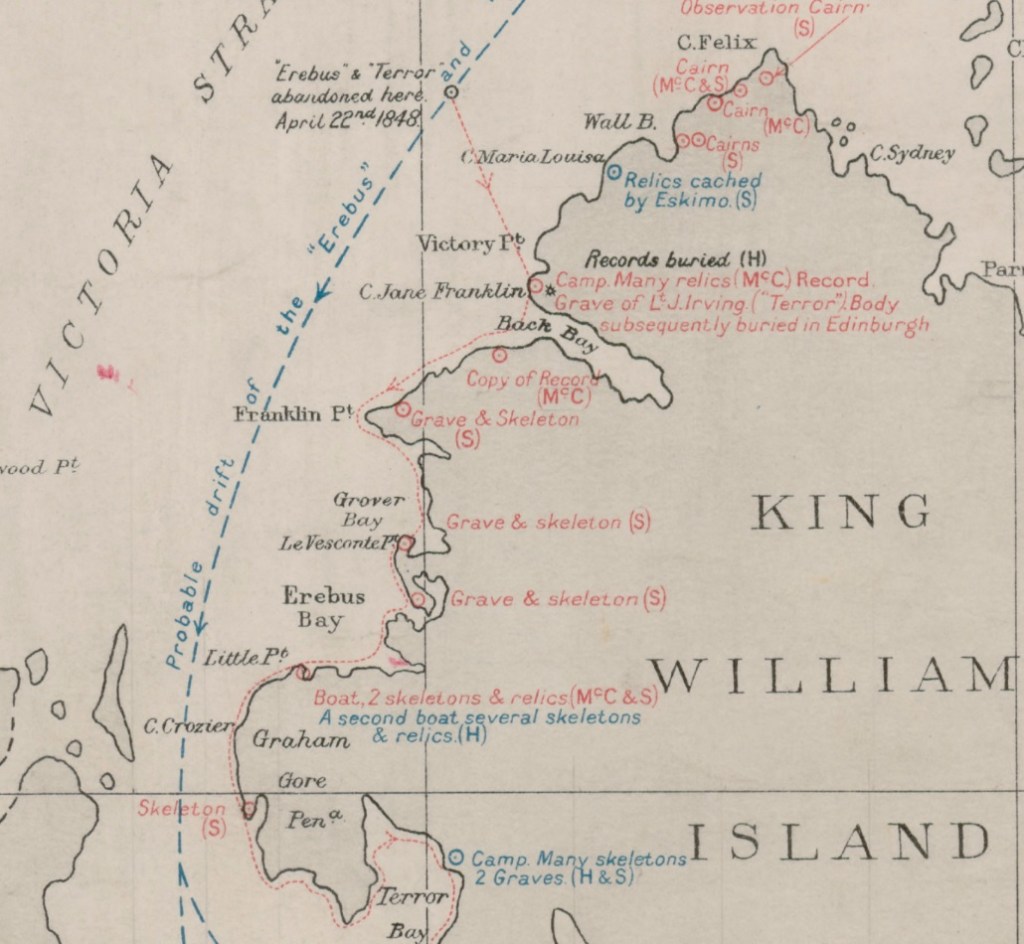
Chart showing the vicinity of King William Island with the various positions in which relics of the Arctic expedition under Sir John Franklin have been found / compiled by Lieut.-Cmdr. R.T. Gould, R.N [detail of]. “Boat Place” is indicated in red text at the base of Erebus Bay. Credit: Library and Archives Canada 3674742

The next morning Hobson’s group began in earnest a two-day process of clearing out the site and inventorying an unusual assortment of artifacts. That stanchion also marked a gravesite – the resting place of at least two unidentified Royal Navy crewmembers who were entombed within the hull. McClintock’s sledge team arrived a few days after Hobson had departed. His published description of what he called this “melancholy relic” is the standard account of the site.2 But Hobson had also drafted a report on his sledge team’s discoveries, which included a detailed description of the boat. We are indebted to archaeologist Dr. Douglas Stenton’s work resuscitating Hobson’s report about his journey from obscurity. Stenton’s publication of the report provides important additional details to help explore the boat place.3 Since Hobson’s team had excavated the snow from the boat and examined the objects found therein, the site had already been altered before McClintock’s party reached it. For a detailed list of the interesting and unusual contents of the boat, please see Russell Potter’s Visions of the North blog “The Boat” on the topic. My interest here remains focused on the boat itself.

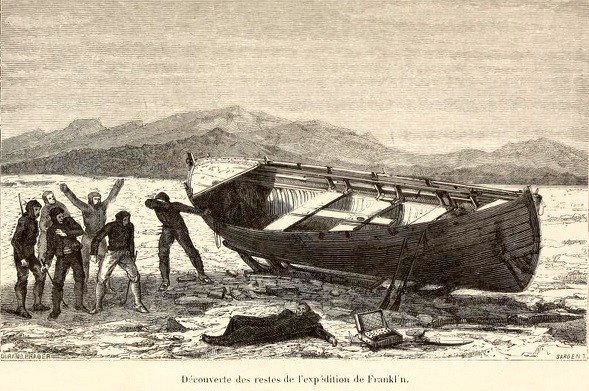
This early 1860s illustration represents some of the major relics accurately, and shows the double-ended appearance and large proportions of the vessel. Credit: Durand-Brager, from Arthur Mangin, Voyages et Découvertes outre-mer au XIXe siècle, illustrations par Durand-Brager, 1863 ː Découverte des restes de l’expédition Franklin. Public domain, via Wikimedia Commons

The Erebus Bay find remains the only Franklin Expedition boat and sledge, originally encountered reasonably intact, whose appearance and contents were described in detail. Its importance is tied to the slightly earlier discovery by Hobson’s party of the Victory Point record, in a sealed cylinder in a cairn about 60 km northeast. An update to a routine Admiralty form mentioned the abandonment of the long-beset ships, and recorded captains Crozier and Fitzjames’s intention to mount a desperate trek with their ailing crews towards Back’s Great Fish River. The note had no specific information about how they planned to cross the vast distances involved. The Boat Place discovery seemed to illustrate the mechanism of the evacuation plan: Crew members would use drag ropes to man-haul boat/sledge combinations down and around the coastline of King William Island. They would then unship the sledges and navigate the boats to the mainland and down a treacherous river towards a still-distant fur trading post. We don’t know how this plan changed as they struggled along, losing more men, and abandoning more boats. Some of the last of a group of weary men laid down to die, under another boat, on the mainland at Starvation Cove.

Back at Erebus Bay, the 28’/8.5 m boat was found just above the frozen shoreline. It listed dramatically down to starboard. A hole may have allowed wildlife – bears or scavenging foxes – access on the low side. Both boat and heavy sledge were oriented back towards the northeast, though if that was by intent (to return towards the ships), or by happenstance, no one can say. McClintock commented on both the boat’s lightness, and the sledge’s weight. He estimated the weight of the boat to be about 700-800 lbs while the sledge could have been as much as 650 lbs (the average weight of a 28-foot whaling boat, by contrast, was about 1,000 lbs).4 His observations were informed by his great expertise in sledging, acquired during his participation on this and earlier expeditions.

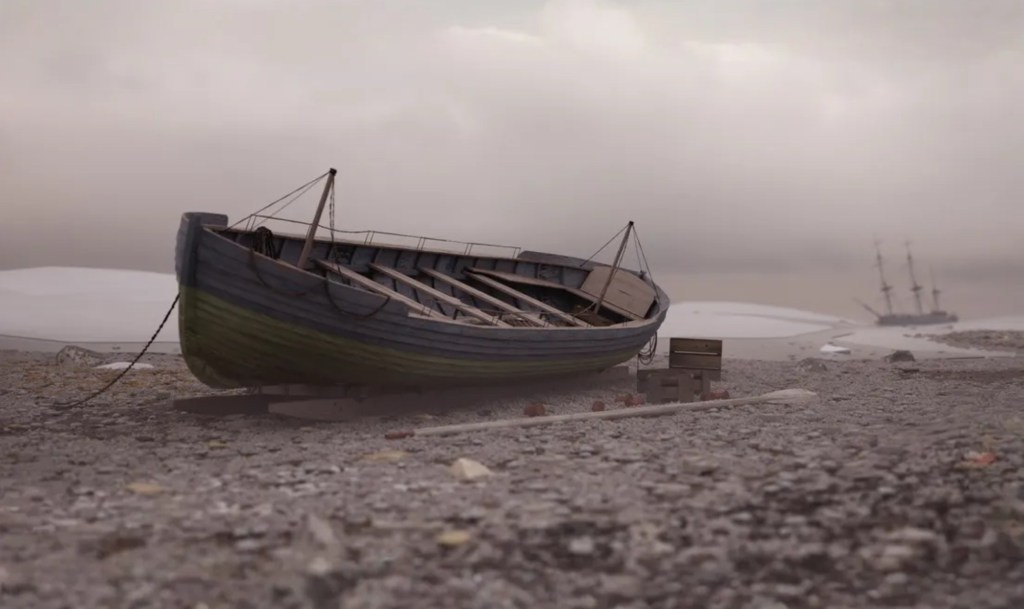
A remarkable 3D interpretation of “Boat Place.” This well-researched depiction of the boat and sledge is a recent and valuable addition to the artistic reconstructions of Erebus Bay. It was inspired by Matthew Betts’ reconstruction (see notes). The outlines of one of the ships in the distance heightens the pathos of this bleak scene. Certainly, the ships did transit by the Bay at some point after April 1848. Used with written permission of Case Western, who maintains a site with 3D printing models.

The boat had been modified by the ships’ carpenters – the square transom at the stern had been removed and the boat was now pointed or “sharp” at both ends, with a curving stem and sternpost, like a broader, deeper version of the two ships’ whale boats. The “carvel” planking (flush-edge-to-edge) of the top strakes of the hull had been replaced and lighter fir “clinker” planks (overlapping) re-laid in their place. An ingenious washcloth design of canvas was fitted in the place of the heavier washstrake boards. The set of six paddles – cut-down oars converted with larger “add-on” blades – indicate that the boat had been converted for inland/river navigation.

The stem, as drawn by McClintock in his 1859 edition of The voyage of the ‘Fox’ in the Arctic seas: A narrative of the discovery of the fate of Sir John Franklin and his companions (P 292) see notes section for link.

The distinctive stem of the boat was sketched by McClintock. This was recovered two decades later by American Franklin searcher Frederick Schwatka, who, while looking for records, was leading the first expedition on King William Island that encountered the sites in the summer, not under cover of snow and ice.

According to Inuit oral testimony, there was at least one other abandoned boat with many more skeletal remains that was located nearby.5 Both boats were dismantled in the early 1860s for their useful materials and fittings. Following the initial recovery of some artifacts, the dismantling, and Schwatka’s later removals, only archaeological traces and a memorial with bone fragments remain at the site – the last vestiges of a melancholy relic.

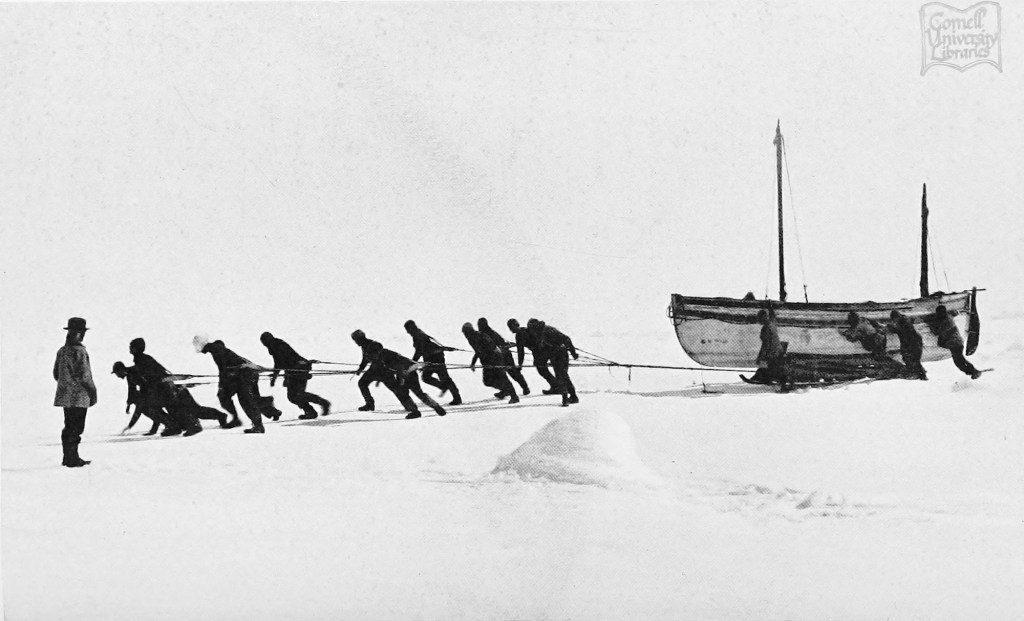
Another famous boat/sledge with a less tragic outcome, the James Caird, originally one of Sir Ernest Shackleton’s 22.5’/6.9m boats from his exploration ship Endurance, being dragged across the sea ice in Antarctica, Dec. 1915. Credit: Frank Hurley : via wikimedia commons.
The Design Dossier and References (click here):

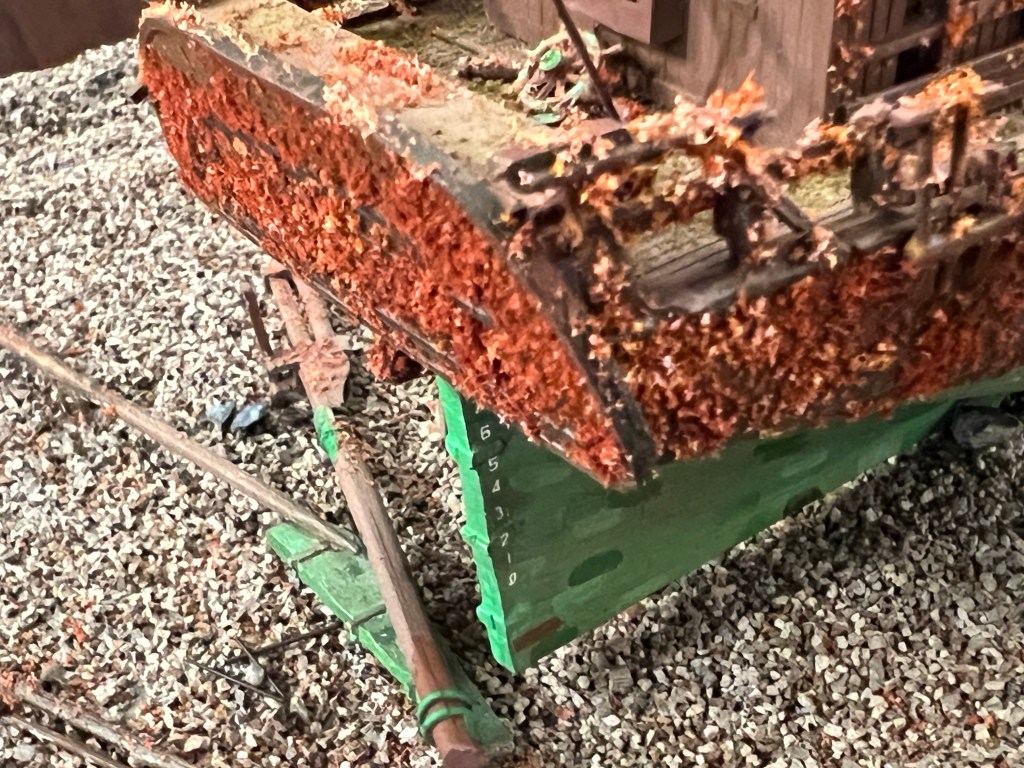
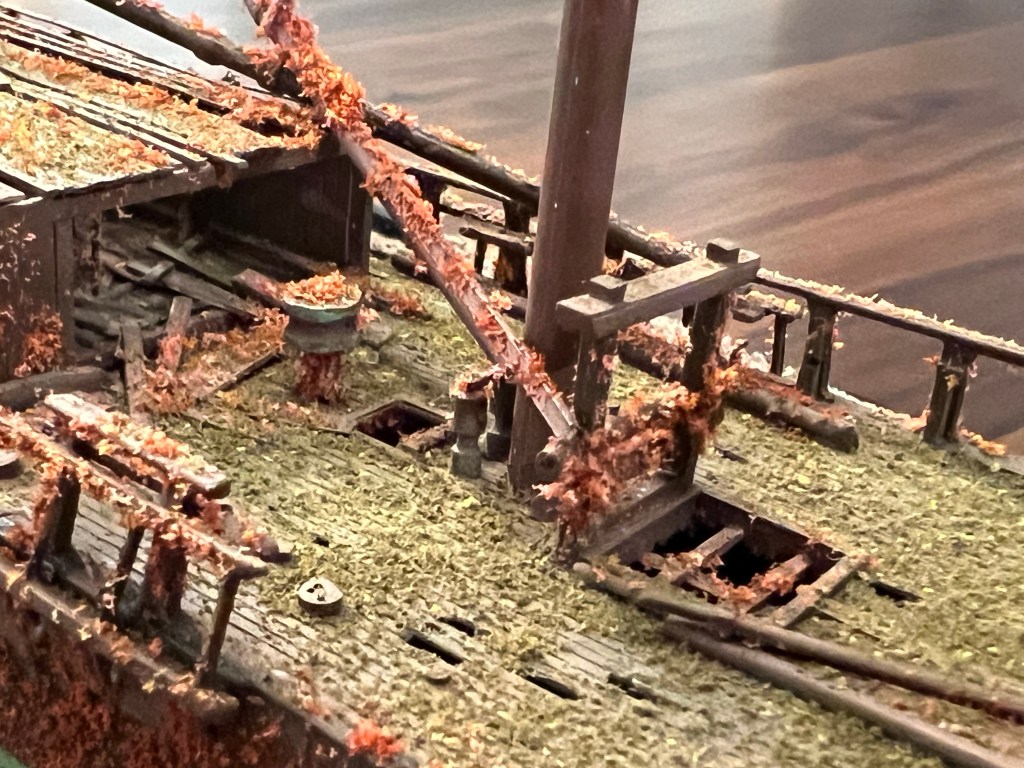
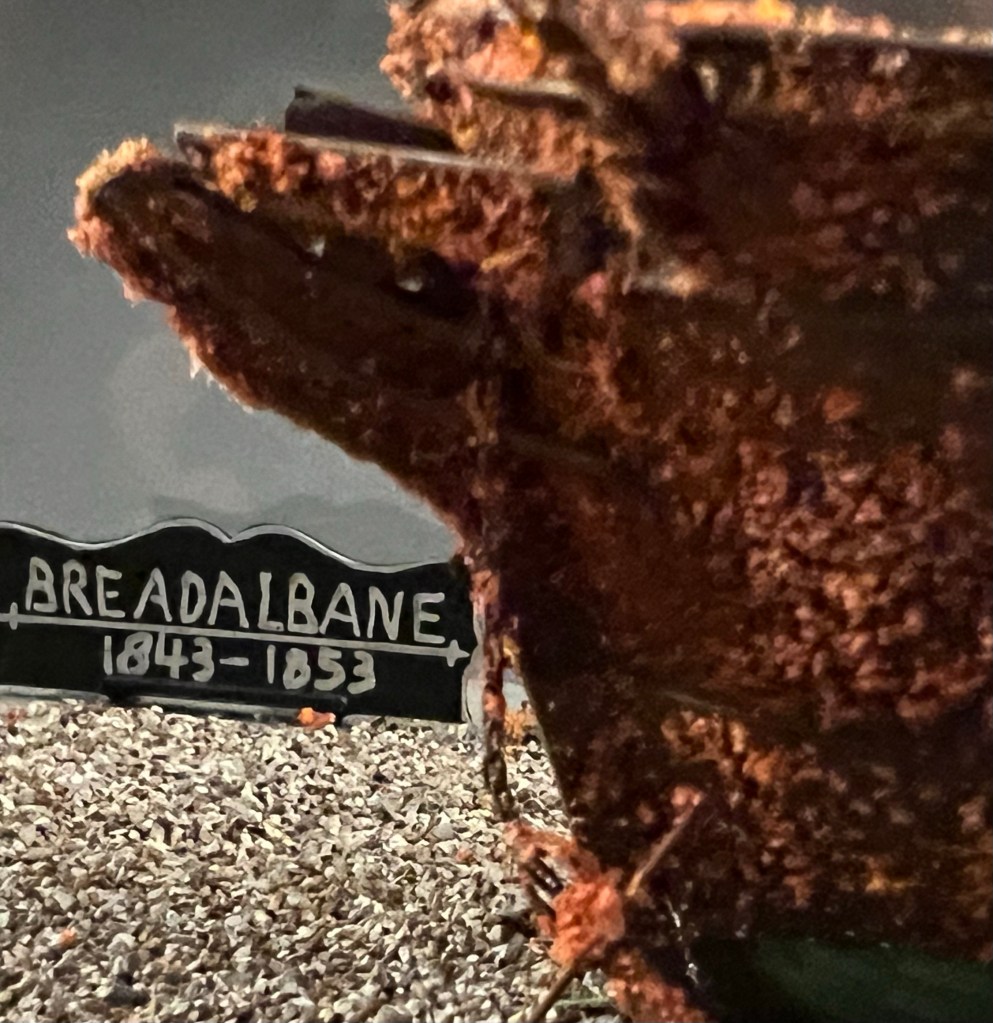
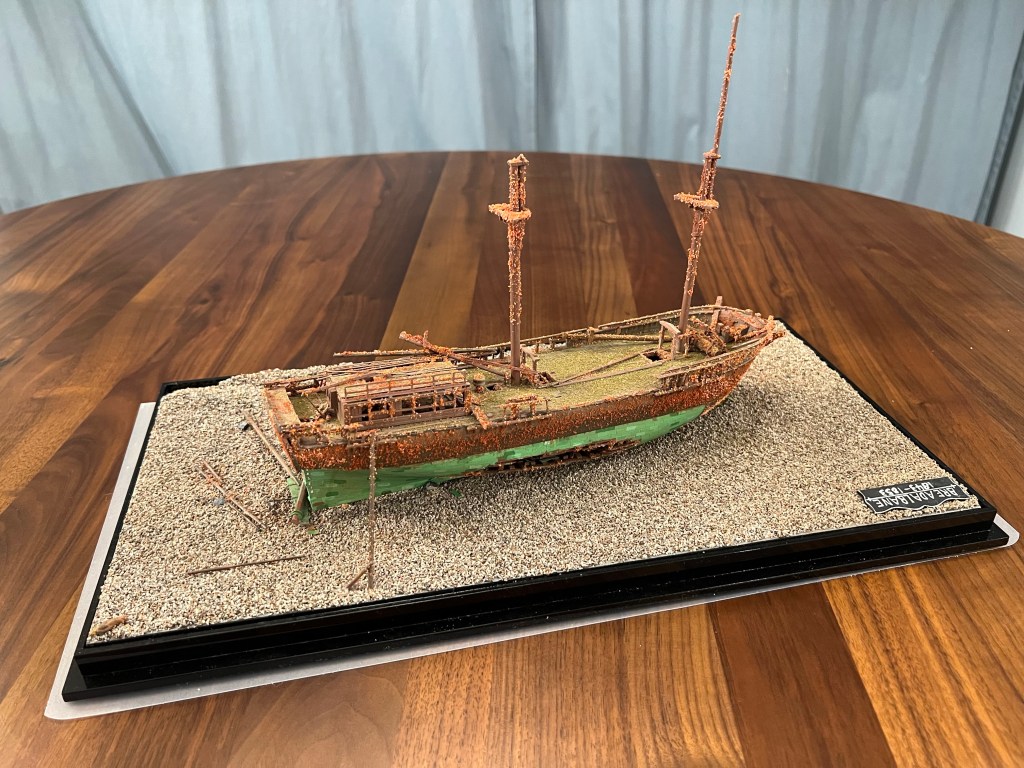
Breadalbane Part 4: 171 years on – Still the Beautiful Wreck!

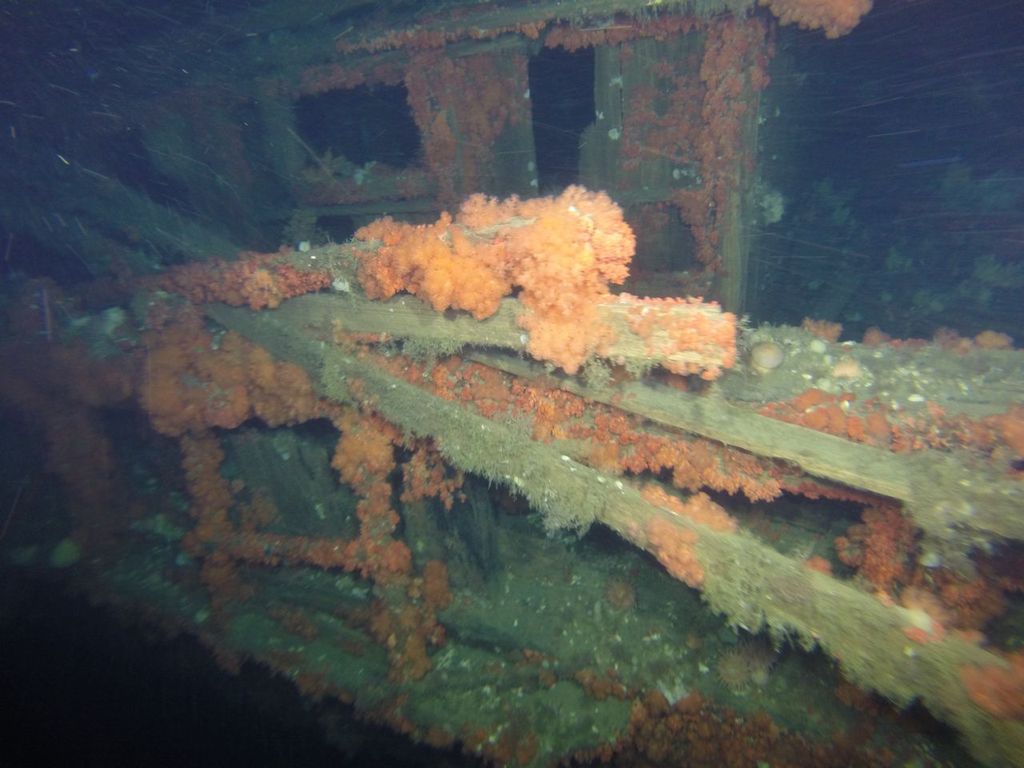
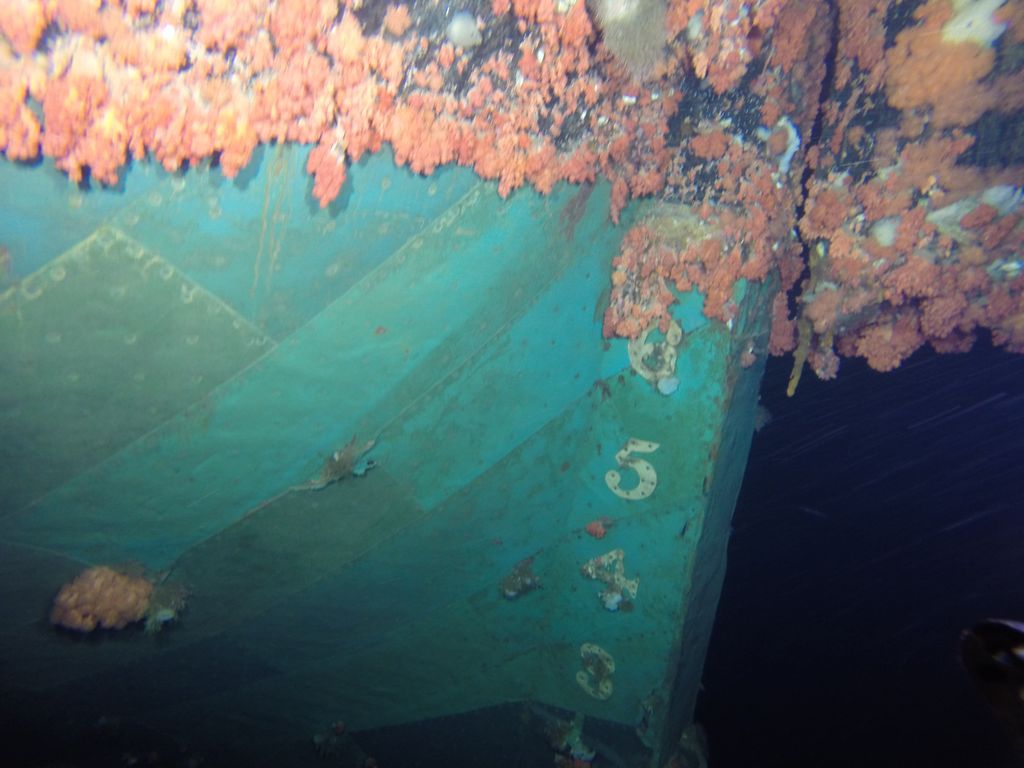
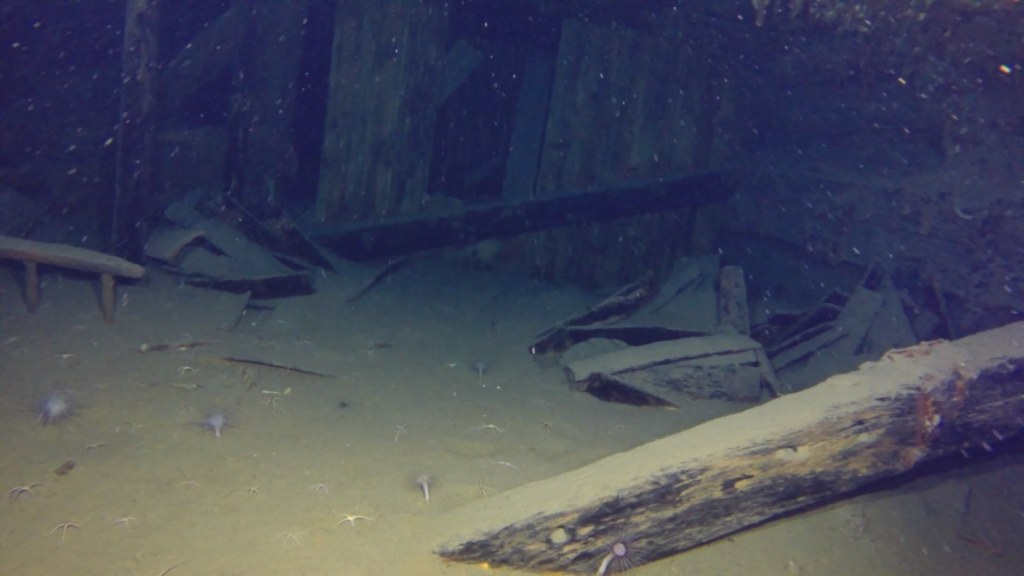
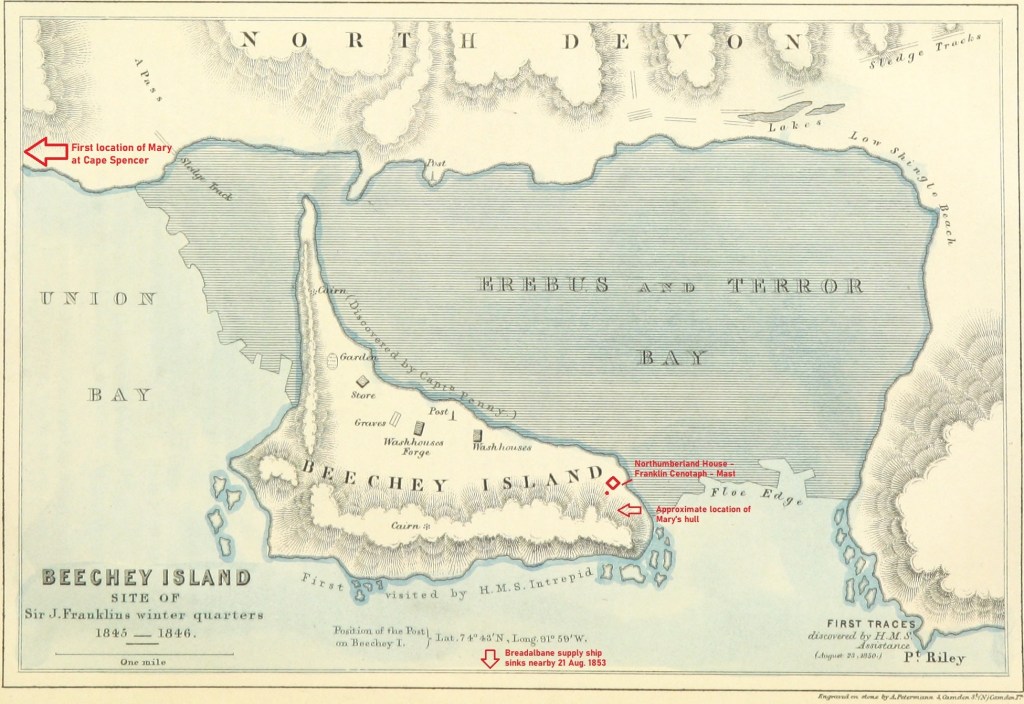
A hundred-and-seventy-one-years ago, crew members of the supply ship Breadalbane gazed forwards from the bow rails, looking towards the forbidding cliffs and unknown shores of Beechey Island, in the High Arctic. Today, the spot where they once stood is preserved 310 feet/ 95m underwater, near those same cliffs. Breadalbane’s shipwreck endures as a magnificent time capsule of a remarkable era of Arctic exploration.

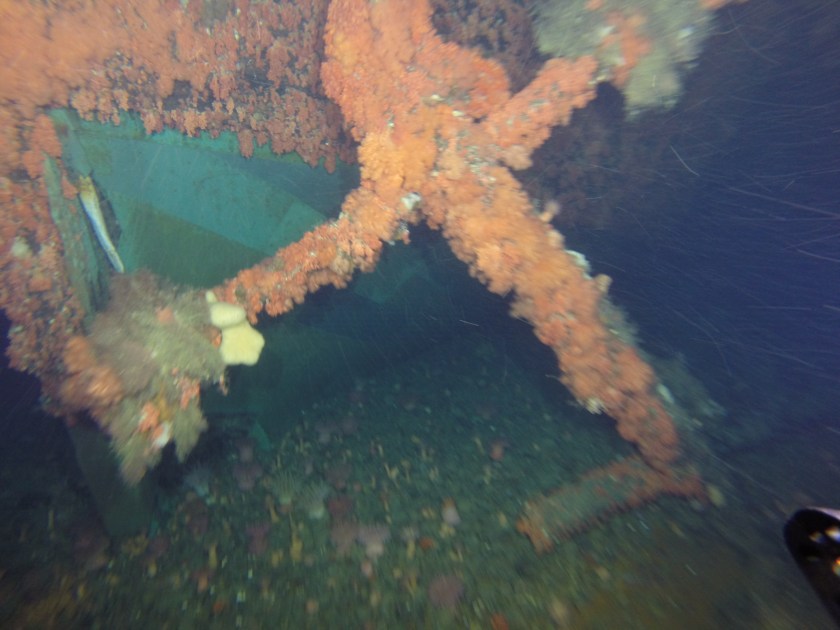
Breadalbane’s broken bowsprit and head rails. The bowsprit was most likely sheared off as the ship plunged through the ice. Credit: used with written permission of Parks Canada, who retain copyright

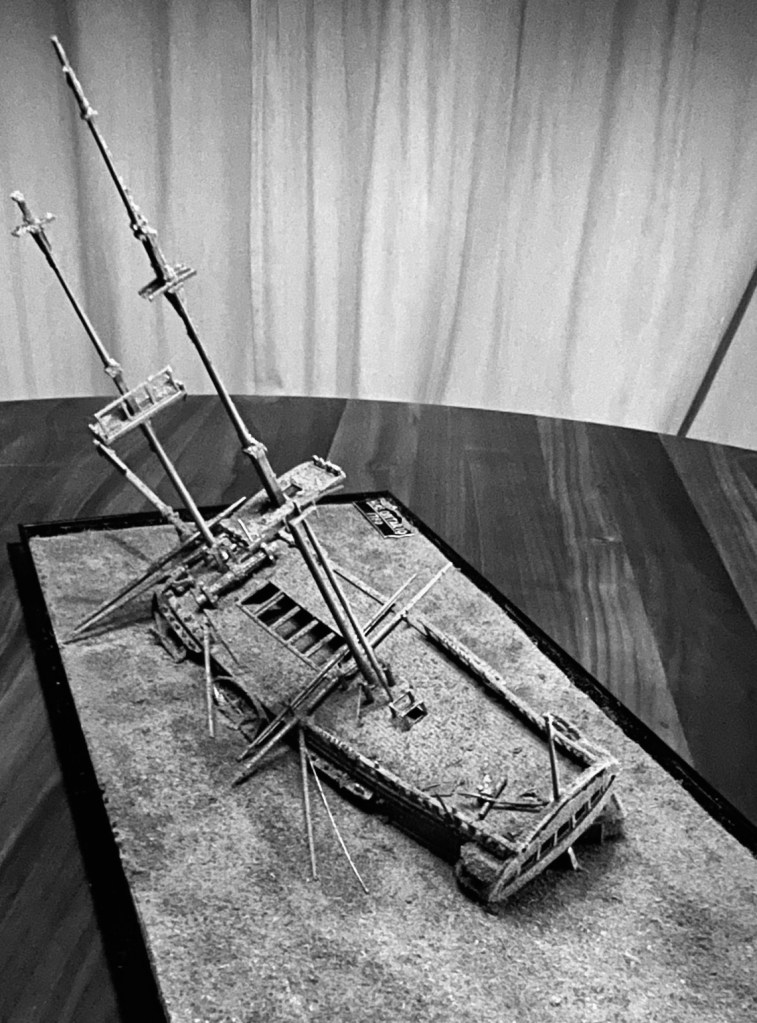
This fourth post will focus on the program of archaeological research conducted ten years ago by Parks Canada and the Canadian Armed Forces at Beechey Island, Nunavut. We will also provide a brief description of the wreck, accompanied with remarkable images. The first post summarized the loss of this supply ship in the High Arctic in August 1853, while provisioning search expeditions looking for the Franklin Expedition. The second post described the original 1980s discovery and exploration of the wreck. The third post showcased the construction of an archaeologically-based scale diorama of this National Historic Site of Canada.

Two decades after the last visits to Breadalbane, there was a revived interest in exploring the wreck. The 2012 Canadian Armed Forces (CAF) work involved a preparatory survey by a naval dive team using a remotely operated vehicle (ROV). Parks Canada archaeological participation would correspond with the 2014 iteration of Operation NUNALIVUT, a CAF exercise in the Arctic.

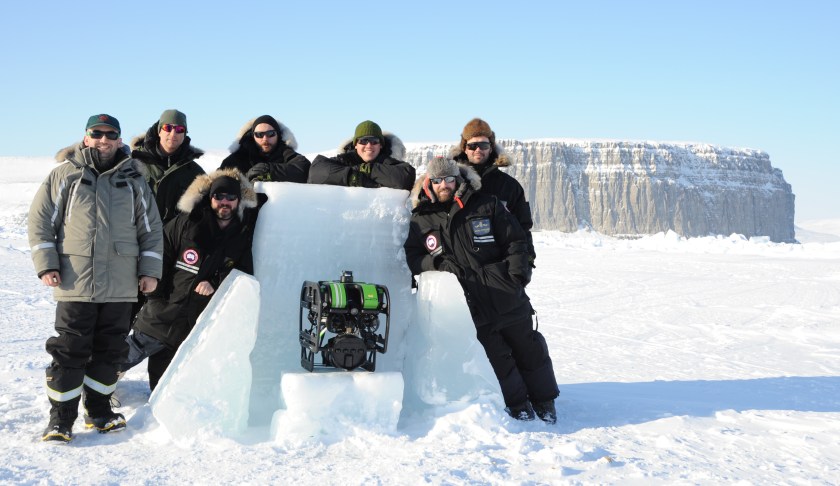
Combined dive team photo Operation NUNALIVUT 2014 with Beechey Island’s cliffs in the background (left to right): Jonathan Moore (Parks Canada Underwater Archaeology Team), Jesse Rodocker (SeaBotix Inc.), Petty Officer Second Class Geoff White, Petty Officer First Class Yves Bernard, Leading Seaman Luke Therrien, Lieutenant Greg Oickle and Leading Seaman Quinn Audette from Fleet Diving Unit (Atlantic). Credit: Crown Copyright Department of National Defence/Canadian Armed Forces RE2014-0013-140 (cropped)

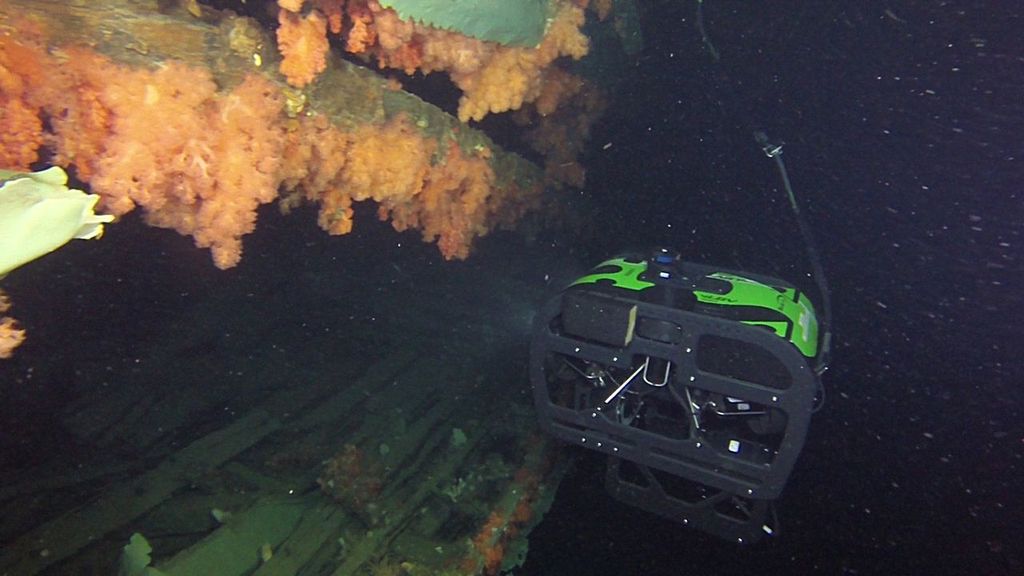
This visit involved surveying and filming efforts employing SeaBotix ROVs, one of which used multibeam sonar to guide the exploration to sites of interest, and to construct a detailed visual survey of the site. Parks Canada Underwater Archaeologist Jonathan Moore was the permit holder for the archaeological program, working from an ice camp 330’/100m above the seafloor.

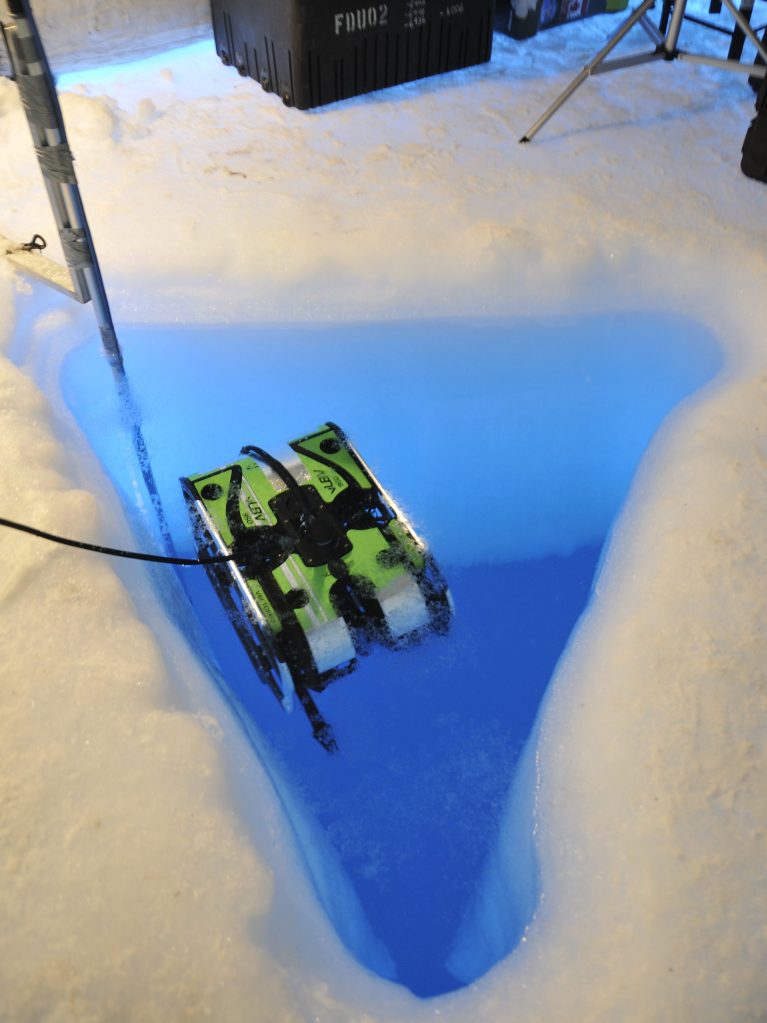
One of the Seabotix ROVs in the ice hole above Breadalbane Credit: Crown Copyright Department of National Defence/Canadian Armed Forces RE2014-0013-139 [cropped]

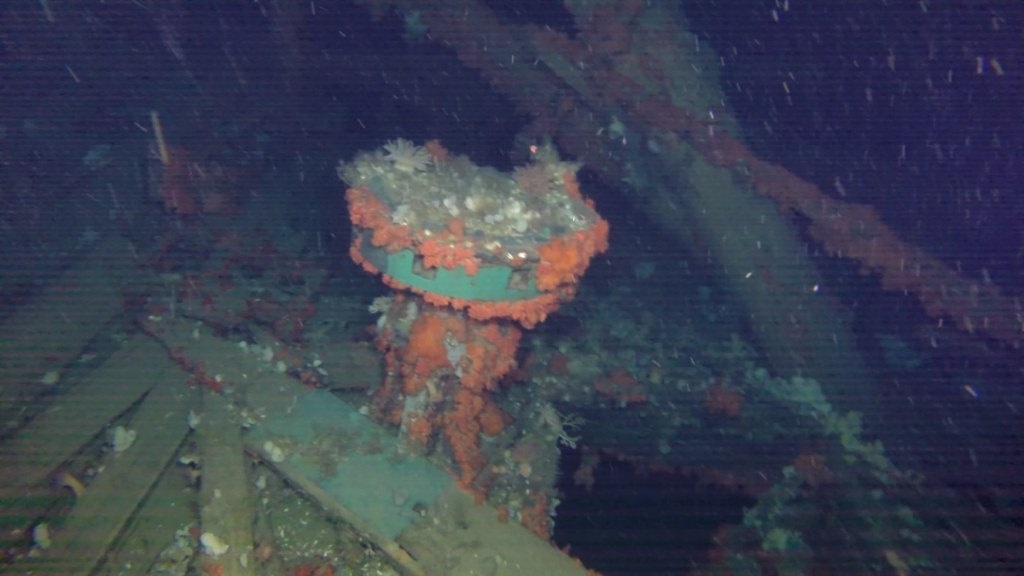
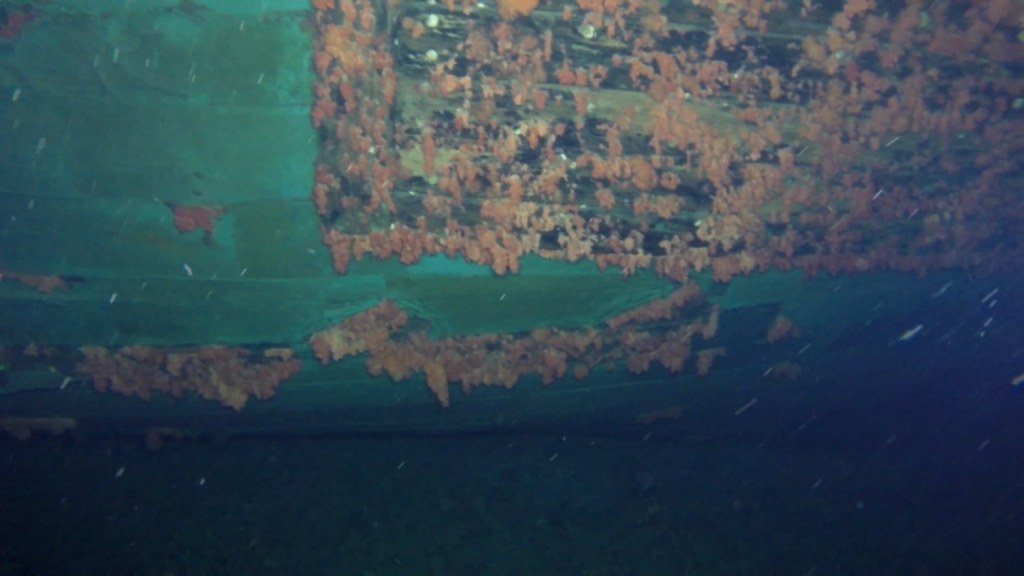
We are very excited to share stunning ROV images from this visit. Some photos were generously provided to us by Parks Canada, and others are from the Department of National Defence. These allow us to navigate around and inside this wrecked supply barque to note some of her outstanding features.*

The ship’s port bower anchor, resting on the seabed near the copper-clad stem. Credit: used with written permission of Parks Canada, who retain copyright

The return to Breadalbane was an exciting phase in the archaeological survey of Franklin Expedition-related sites, continuing on from the 2010-2011 Parks Canada-led location and dives on HMS Investigator at Mercy Bay, Northwest Territories, and coming a short time before the discovery of Sir John Franklin’s lost flagship, HMS Erebus, in September 2014. One objective of the underwater survey was to assess changes to the Breadalbane since the 1980s.

The broken port quarter rail and rear of the unusually large deckhouse, showing fallen roof planking, the tight fit with the ship’s side rails, and the small aft deck. This area is little changed in 30 years. Credit: Crown Copyright Department of National Defence/Canadian Armed Forces RE2014-0013-133

Though Breadalbane is often treated as a footnote in the saga of Arctic exploration, and as “also wrecked” in the high-drama surrounding the lost Franklin Expedition, it is an incredible site – many areas have not witnessed significant deterioration.

Breadalbane’s well-preserved lower hull, clad in copper sheathing, and stern post (the rudder lies under the wreck on the seabed). This shows the draft marks that climb up the post. Credit: Crown Copyright Department of National Defence/Canadian Armed Forces RE2014-0013-131

The marine life growing at the wreck site is as stunning as what Dr. Joe MacInnis and his teammates encountered in the early 1980s.

Breadalbane’s capstan between the forward wall of the deckhouse and a companionway. Credit: used with written permission of Parks Canada, who retain copyright

Breadalbane helps us understand the range of options available to the British Admiralty for reinforcing mid-19th Century vessels intended for polar service. This supply vessel was not a “paper ship”, totally unprepared for the rigors of Arctic service, but rather received hybrid modifications which were suitable to her intended role: “Continuation service” outbound for the Lancaster Sound.1

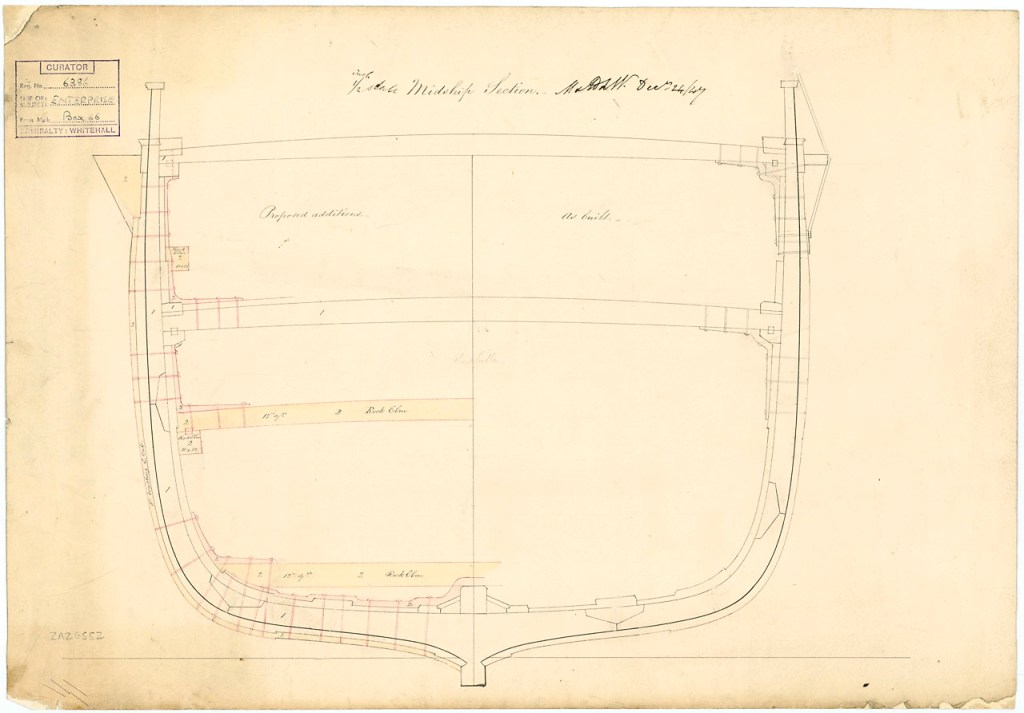
This shows a sectional plan of HMS Enterprise, a barque similar to Breadalbane, which was given the full reinforcement for polar service on the Franklin searches in 1848. This plan contrasted her internal arrangements and hull prior to modification (right) with the polar modifications (left). Breadalbane did not receive most of these upgrades. The most obvious external difference is there was no heavy ice chock or channel which girdled the hull. Credit: © Crown copyright. National Maritime Museum, Greenwich, London J7311

Breadalbane was going north in the high summer. The ship was not intended to be beset by ice – frozen-in over the long, dark months. The commanding officer of HMS Phoenix, Captain Edward Augustus Inglefield, was under specific instructions to unload Breadalbane’s vital cargo at Beechey, and then get her turned around and on her way back south before the season changed and all the navigable waters froze.

Breadalbane’s interior spaces. The Lower deck looking aft from near the companionway, towards closed cabins near the stern. Note the heavy timbers to reinforce the hull. Credit: used with written permission of Parks Canada, who retain copyright

An 1853 Lloyd’s special survey report notes that the outside of the bows was shielded by 4″ thick Canadian elm planks, which extended 7′ / 2.1m below the water, from the stem back to a point even with the foremast. This was a lighter-duty version of the combined sheathing and iron-plates installed at the bows of the Franklin search ships.

Lower area of the starboard bow. This view shows the coppering of the lower hull and the beginning of the elm sheathing that extended 7′ down from the waterline and forwards to the stem. Credit: used with written permission of Parks Canada, who retain copyright

Ultimately, these reinforcements did not save the ship from being crushed. The unexpected movement of the ice south of Beechey Island on 21 August, 1853 was instantly fatal to the fabric of the lower hull. The ice created a large rent that stretches for 70’/ 21m along the starboard side, revealing the ship’s mostly empty cargo hold.

The ROV explores the massive hole in the starboard side, running along the bilge. The ice punched through the copper sheathing, ship’s side, and interior framing, before continuing on to damage supporting knees, bulwarks, and decks. Credit: Crown Copyright Department of National Defence/Canadian Armed Forces RE2014-0013-130

I would like to acknowledge the significant assistance of Parks Canada’s Underwater Archaeology Team, and especially Jonathan Moore, who generously shared Parks’ substantial research and the above images.

  1. This is how the Captain of HMS North Star, William J.S. Pullen, described Breadalbane in a letter to John Barrow, written at Beechey Island soon after the sinking. At this time North Star was frozen-in on the inland side of Beechey. As noted in the first blog, the Lloyd’s survey report of early 1853 is an important source for interpreting the modifications Breadalbane received for her “Continuation Service” (a termed used in their survey) in early 1853. ↩︎

The Ontario Wreck Diorama – Yours to Discover!

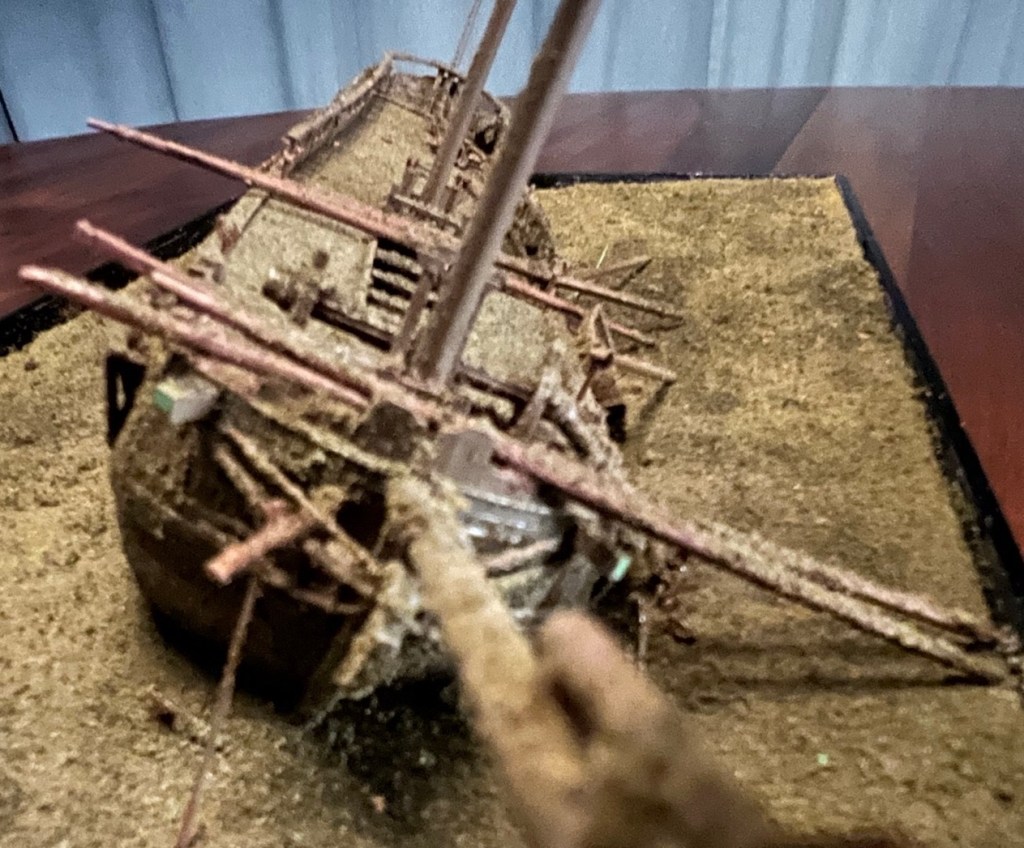
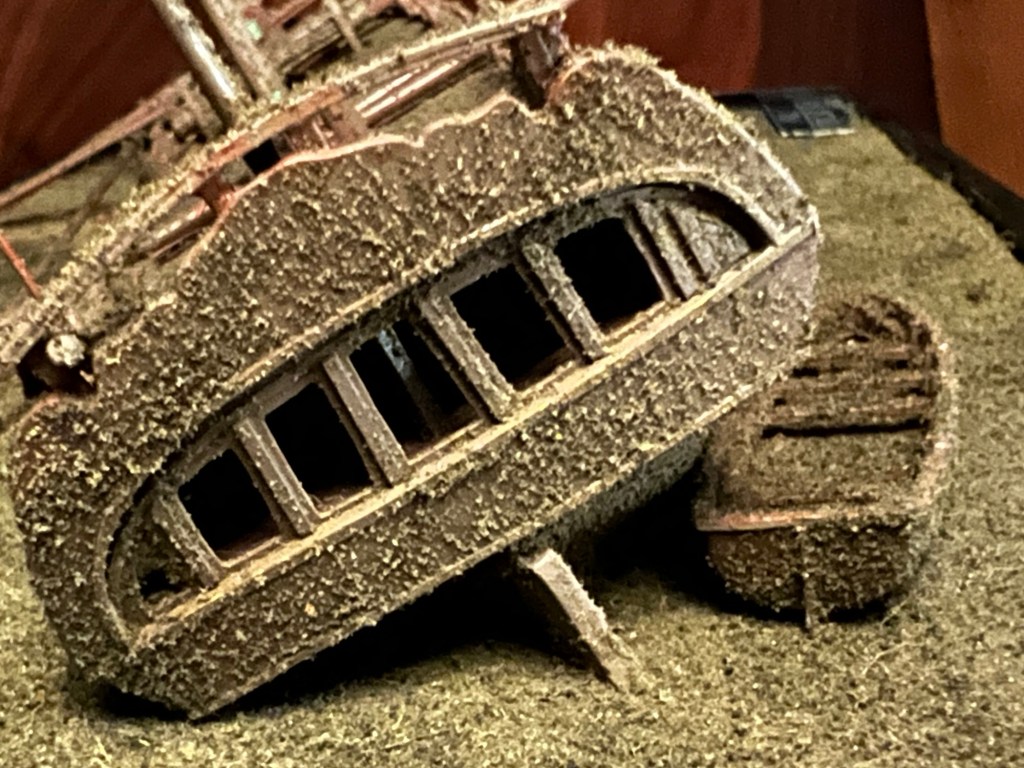
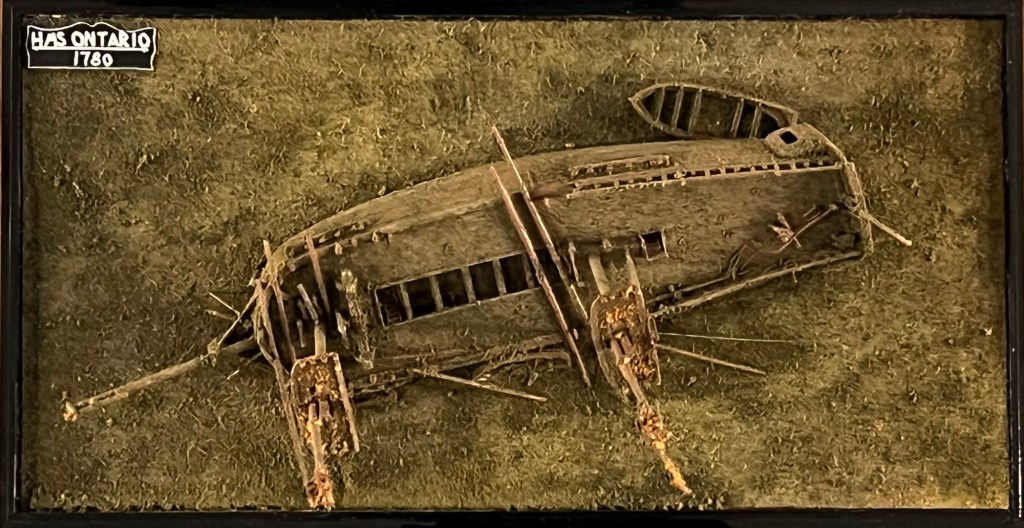
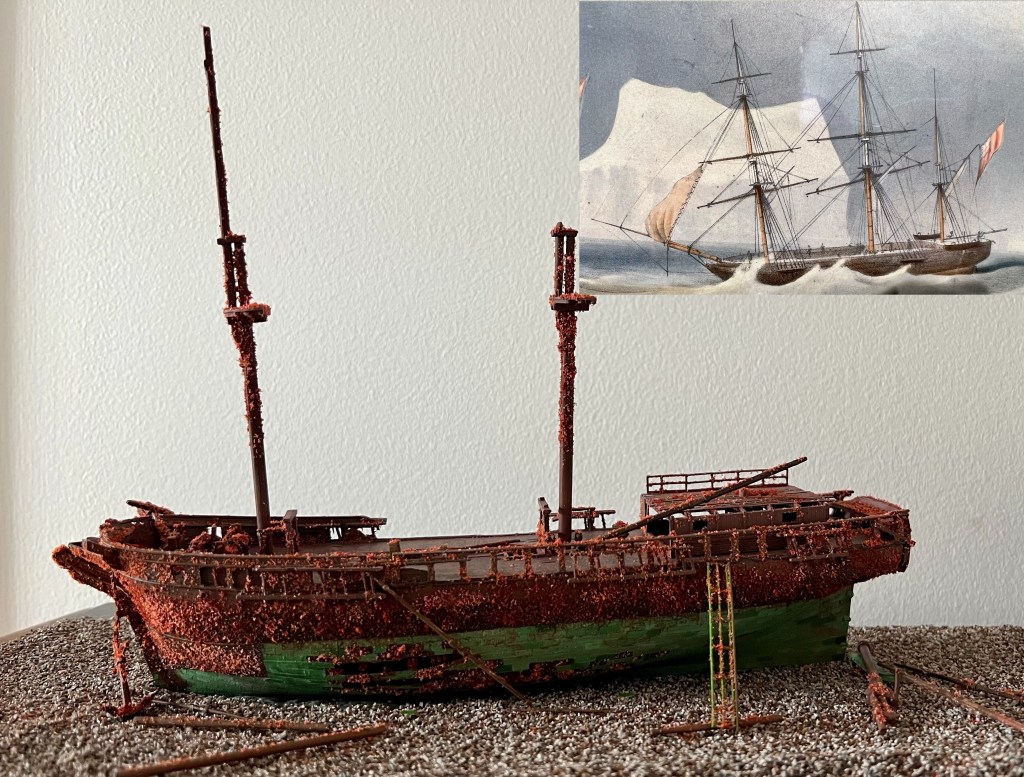
There is an incredible ship, frozen in time down in the depths of Lake Ontario. HMS Ontario was a wooden warship that sank in a storm October 31st, 1780. This tragedy claimed the lives of as many as 129 sailors, soldiers, Indigenous warriors, American prisoners, women and children. All these decades later she is still down there, astonishingly intact. This ghostly Revolutionary War relic appears almost as if she is sailing west across the lakebed. After months of work, we have completed a model diorama to help interpret the history of this archaeological marvel.1

The wreck diorama Credit: http://www.warshearcher.com

Early in 1779, with the American Revolutionary War raging along the Lower Great Lakes watershed, Master Shipwright Jonathan Coleman designed a British warship for service on Lake Ontario. He drafted out a scaled-down version of his Royal George, already active on Lake Champlain.

British vessels active on nearby Lake Champlain early in the Revolutionary War. These types are similar to those on Lake Ontario. The ship-rigged Inflexible (near left) was a similar size to Ontario, but had been taken apart at Quebec City and rebuilt. Lake Champlain was a more contested body of water, and many of these ships would fight an American flotilla at the Battle of Valcour Island, in 1776. Charles Randle Credit: Library and Archives Canada, Acc. No. 1996-82-1

This new vessel, to be named Ontario, had a pleasing sheer, a full underbody, and elegant decoration at the stern.2 The bows were adorned with a simple scroll. This impressive inland warship was built at Carleton Island (the dockyard facilities of the British on Lake Ontario near present-day Kingston). She was launched 10 May 1780, and when completed that summer, her twenty-two cannon made her the most powerful warship operating on the Lake.

The original plans for Ontario, ca. 1780,signed by Jonathan Coleman ZAZ4725 Credit:
© Crown copyright. National Maritime Museum, Greenwich, London

The gundeck was 80’/24.4m long, the ship displaced about 220 tons and the two masts were set up as a snow (similar to a brig-rig but with a small pole mast running from deck up to the level of the maintop, which normally carried a loose-footed gaff sail). She was a beamy 25’/7.6m wide, and had a capacious hold, appropriate to her main role of military transport. Her armament consisted of sixteen six-pounder cannon, mostly disposed on the gundeck, and lighter pieces on the quarterdeck and focs’l. Her hull was somewhat shallower than an ocean-going vessel of this length.

A model of Ontario on display at the Aquatarium, Brockville ON (modeller unknown). From details, the model appears to have been completed before the discovery. The bowsprit has been forced up in the case. Credit:www.warsearcher.com

The careers of warships on the Great Lakes during the 18th and early 19th centuries were generally brief, as hulls were often hastily-constructed of green wood and wore-out quickly over the harsh winters. Even so, Ontario had a woefully short existence: a few months of ferrying troops and supplies. Under the command of Captain James Andrews, she supported the continuing “Burning of the Valleys” campaigns, helping to supply John Butler and Mohawk leader Thayendanegea (Joseph Brant)’s forces and other Indigenous allies fighting as part of the Haudenosaunee / Iroquois confederacy. On 26 October 1780, she departed Niagara bound for either Oswego or Carleton Island. Lt. Colonel Mason Bolton, Commanding Officer of the 8th King’s Regiment at Fort Niagara, was taking passage to England to convalesce. The crowded ship was sailing along the southern shore of the Lake.

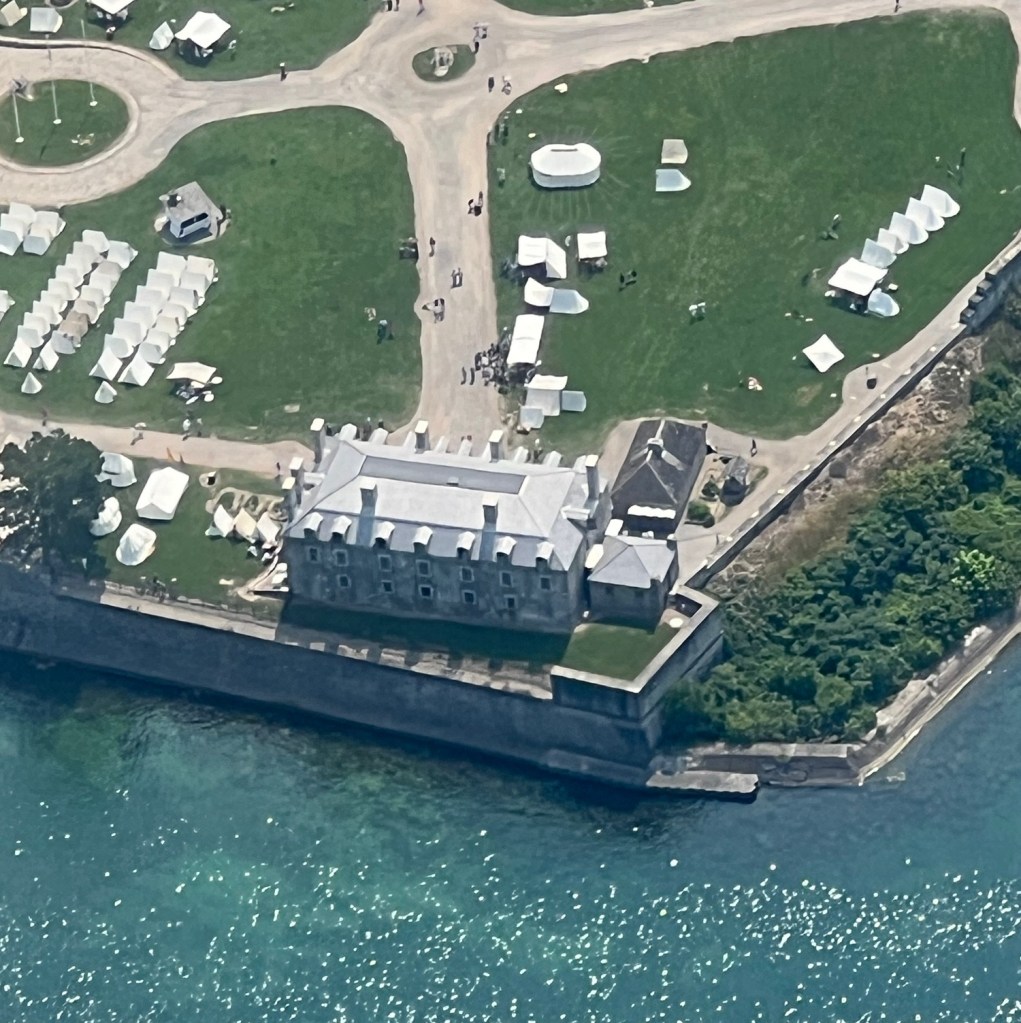
Fort Niagara, now located in New York. This is the original French fort HMS Ontario departed from. Taken from a PBY Canso aircraft belonging to the Canadian Warplane Heritage Museum 2024/07/27. Credit: http://www.warsearcher.com

A violent storm swept from northeast to southwest across the Lake on 31 October. The crew were likely caught by surprise late at night, as a sudden squall overcame the ship in the darkness and laid her over on to her beam ends. Andrews, Bolton, and more than a hundred other unfortunates disappeared into the Lake.3 The next day, debris was found near Golden Hill by a party of Butler’s Rangers and others who were returning to Niagara from Oswego. Boats, hatch coamings, sails, hats (including Andrews’ own tricorn), the binnacle cabinet, and some sections of quarter lights (windows) had washed up. Much later, in July 1781, a macabre reminder of the loss surfaced–six bodies floated ashore. These victims had been trapped at some intermediate depth until the lake waters released them. No other discoveries would provide context to the loss. The War and life in the (warring) colonies moved on. Ontario’s place in the squadron was taken by a new sistership, Limnade, and the story faded from memory.

The bows of the wreck, showing fallen spars. Credit: http://www.warsearcher.com

Historians of the frontier campaigns of 1780, maritime scholars, and history buffs did not forget about Ontario. Of the many ships that have come to grief in the Lake, her story remained unique. When new technologies were developed that allowed amateur shipwreck hunters to search in deeper areas (which had been the preserve of well-funded professional expeditions employing incredibly expensive specialist equipment), enthusiastic searchers set out on the Lake to find the resting place. There were several claims over the years announcing that Ontario had been located, and many other lost ships were discovered.

Jim Kennard, of Fairport, NY, had an interest in Ontario that stretched back to the 1970s. After retirement, he returned to searching and built his own sonar outfit. He partnered up with Dan Scoville, a recreational diver from Rochester who had experience building ROVs (Remote Operated Vehicles). On 24 May 2008 – after three years of dedicated searching – a promising target appeared on side-scan sonar images onboard their search boat. In common with almost every discovery story we have ever heard, they were packing up and turning for home when the target appeared! The find was confirmed two weeks later by footage from Dan’s ROV. The rich documentary record revealed a shocking sight 500’/152m down: During the twenty-two decades the ship had awaited discovery, she had barely decayed!4

Ontario’s decorative stern gallery, with the large ship’s launch sitting on the lake tucked against the starboard quarter. The rudder post is visible in the central stern light, climbing to the hard-over tiller on deck. There is a single stern-chaser cannon still poking through the carvings over the damaged port quarter-gallery.

The ship is deeply embedded in lake sediment, with a pronounced list to port. The two masts still tower over the site. The mainmast is fully intact to its topgallant mast cap. It is unusual for a wooden wreck to be leaning so steeply to one side, and may speak to a fatal shifting of ballast or guns under the onslaught of the storm. The bowsprit and decorative scroll points west, back towards Fort Niagara.

The foremast top rises above the bows, and bowsprit. Credit: http://www.warsearcher.com

A large ship’s boat rests just off the starboard quarter above the sediment. The loss of lights from quarter and stern galleries opens up tantalizing views of the interior of the great cabin. On deck the tiller bar leans over hard, continuing the angle of the rudder tucked under the counter. It is as if the ship went down while the crew tried desperately to steer the vessel to starboard. Two cannon carriages appear to be wedged underneath it. There is very little visible damage, and few missing elements. On the whole, it is difficult to credit that an 18th Century ship could have survived into the 21st Century in this condition. The Ontario site endures as a lovely wreck of a beautiful ship. We hope the diorama helps interpret this site, and that the Ontario resting place is protected from harm.

Site overview of the diorama. Credit: http://www.warsearcher.com

For more information about the model and the sources consulted, read more in the Dossier! (next page)

Continue reading “The Ontario Wreck Diorama – Yours to Discover!”

Frigates for Finding Franklin!

“Franklin Search Frigates!” What?! The three ships we are profiling today were involved in an important but unglamorous role: sustaining the search efforts for the missing sailors of the 1845 Sir John Franklin Expedition ships HMS Erebus and Terror. They helped support the search missions by caching supplies along the Alaska coast to provision the crews that were exploring the Canadian Arctic. This was important work, but is rarely mentioned in the literature about the lost Expedition or the many searches.

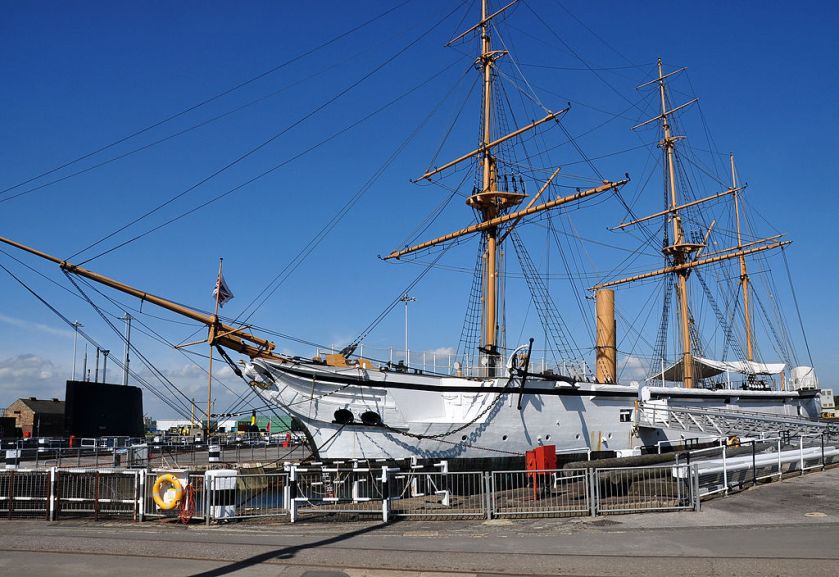
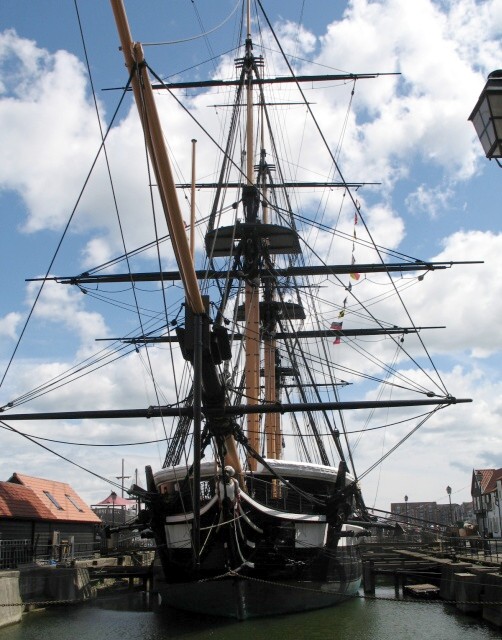
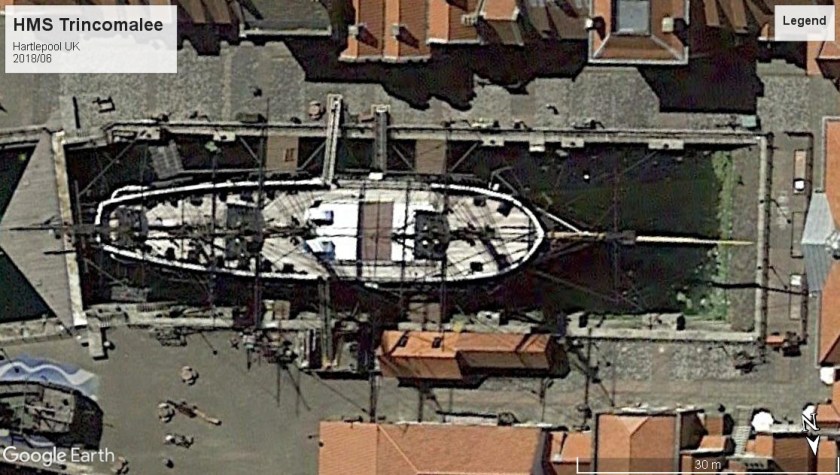
The last of the Franklin adjacent ships! HMS Trincomalee at Hartlepool Maritime Experience, 2009. Credit: Ian Petticrew, CC BY-SA 2.0 https://creativecommons.org/licenses/by-sa/2.0, via Wikimedia Commons

The Leda class frigates HMS Daedalus, Amphitrite, and Trincomalee were the largest ships that we are aware of that were involved in supporting the Franklin search efforts.1 The service of these three powerful vessels, from 1851 to 1854, involved supply missions to sustain the western Arctic searches (and especially the ongoing searches of HMS Plover under captains T. E. L. Moore and then Maguire). These efforts complement the Atholl class corvettes’ similar work, which we explored in more detail in a recent post.

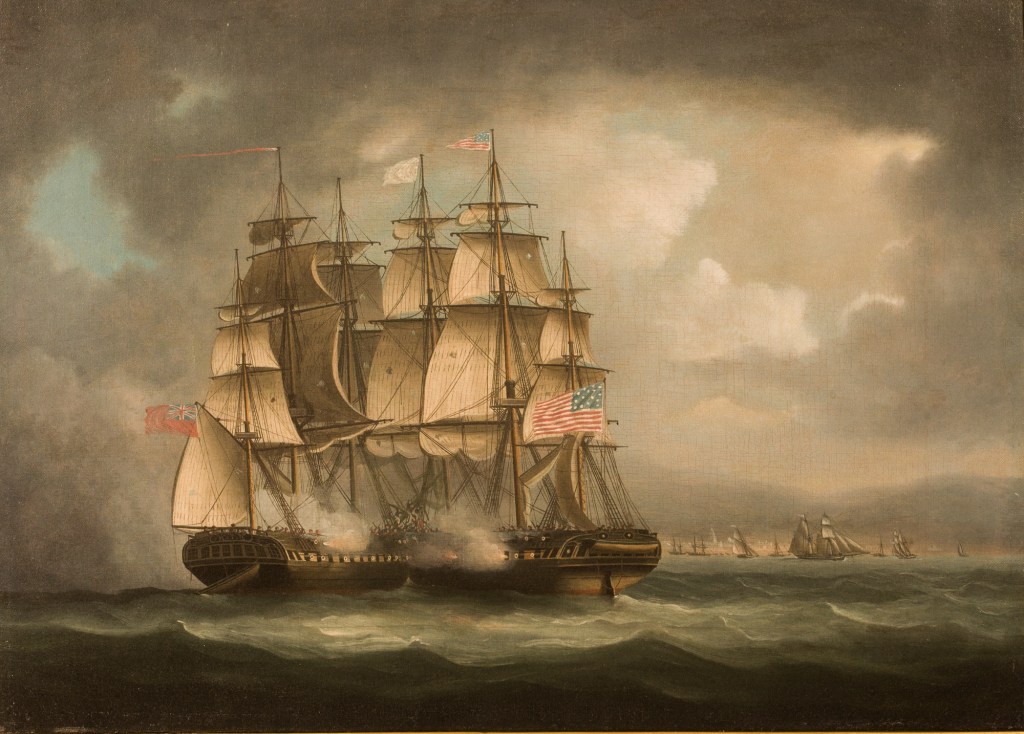
The Ledas were a highly successful group of forty-seven frigates based originally on the lines of a French Hébé, which had been captured back in 1782. Copying French ships was a fine tradition in the Royal Navy.2 The design was adapted to Royal Naval requirements. These were large frigates, that displaced more than a thousand tons – twice the size of the Atholl class supply ships also assisting in the searches and three times the size of Franklin’s two missing exploration vessels. They were originally armed with thirty-eight or more heavy cannon – the main armament on the expansive 150’ gundeck consisted of twenty-eight 18-pounders. During the War of 1812, a member of the class, HMS Shannon, had captured USS Chesapeake in an incredible duel off Boston.

HMS Shannon boards USS Chesapeake on the afternoon of 1 June 1813 off Boston, by Thomas Buttersworth via wikimedia commons. Shannon (left) displays the original fine lines and traditional galleries of the first Leda frigates.

Since units were under construction for almost thirty years, the design was modified many times. “Improved” members of the class eventually boasted updated diagonal framing and circular sterns. The early Victorian sailing navy was serving through an innovative period of technical experimentation, and Ledas underwent some quite radical transformations in their long careers. Today, astonishingly, two members of the class, HMS Trincomalee and Unicorn, are preserved and show different eras of the design.

A 1968 view of HMS Unicorn showing small masts stepped, and the innovative “round stern” design that allowed more cannon to be trained aft, to defend the vulnerable stern. Unicorn and Daedalus were nearly identical. Courtesy of National History Ships UK http://www.nationalhistoricships.org

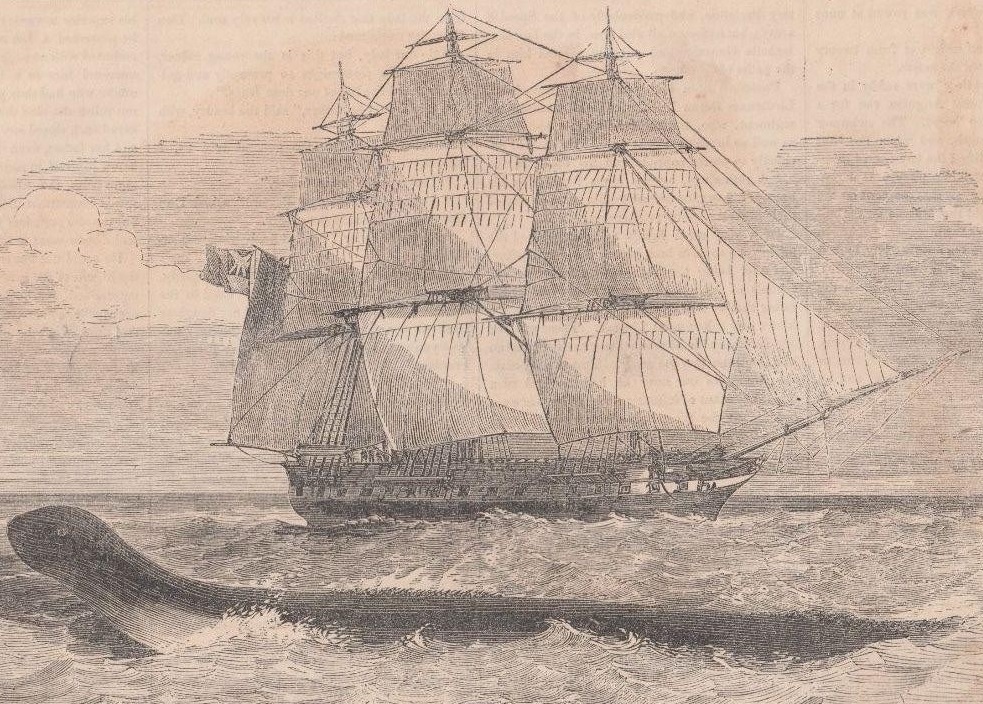
Daedalus was launched in 1824 just prior to the similar Unicorn, which survives today as a museum ship. Both ships featured the then-revolutionary “circular stern” design. Like Unicorn, she was left in reserve status for decades. The design was cut-down or razéed and converted to a steam-powered screw-propelled 19-gun corvette in 1844, with the stern galleries omitted. Given the odd numbering of cannon, she likely had a single rotating gun over the stern. She famously “tangled” with an enormous sea serpent near the Cape of Good Hope in 1848. Under the command of Captain George Wellesley, Daedalus was sent in 1851 to support the searches of HMS Plover. Daedalus survived as a naval reserve drill ship until 1911 when she was dismantled at Bristol.

“Sea Serpent Sighted by HBMS Daedalus,” from Gleason’s Pictorial 3 July 1852. [Detail of]. This is a nice depiction of Daedalus refitted to a corvette, though we can’t speak to the accuracy of the sea serpent. Uploader Andrewelston inston, CC BY-SA 4.0 https://creativecommons.org/licenses/by-sa/4.0, via Wikimedia Commons

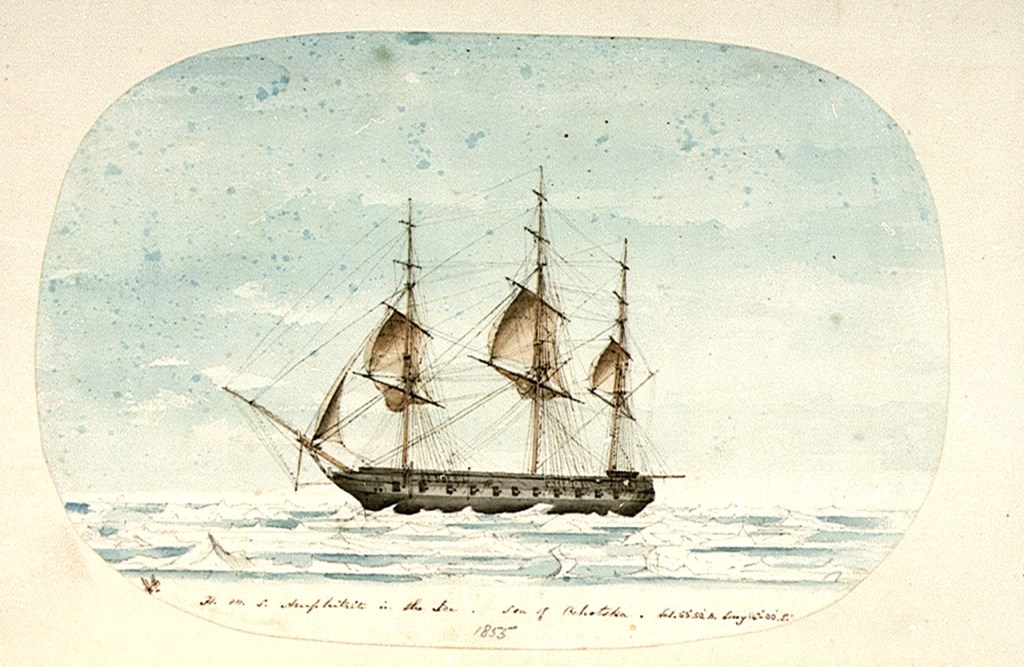
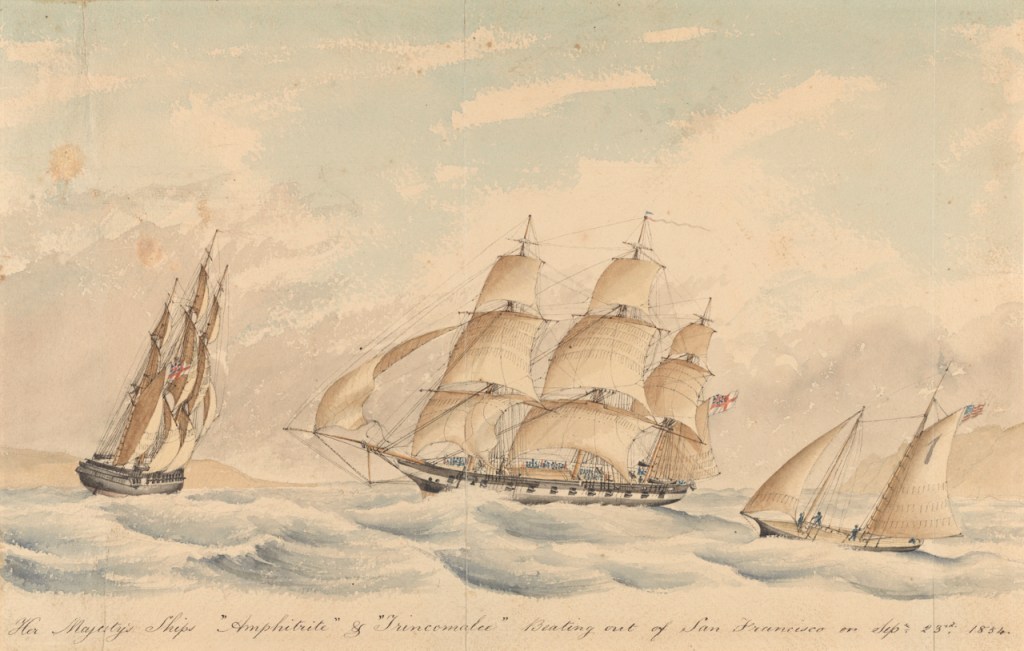
Amphitrite was built in Mumbai of teak, a durable hardwood that proved as resilient as the traditional English oak. She was launched in 1816. While serving as a unit of the Pacific Squadron, under the command of Captain Charles Frederick, she was used on supply missions in 1852 and again in 1853. From the illustrations used in this post, she appears to be the only ship of the three that had not been substantially rebuilt to the lighter specifications of a corvette by the 1850s. Amphitrite was eventually broken up in 1875.

“HMS Amphitrite in the Ice, Sea of Ochotska. Lat. 53o 50′.n. Lony.142o OO’.E” Watercolour by Henry Hand. Credit: National Maritime Museum, Greenwich, London.
Her Majesty’s Ships Amphitrite & Trincomalee leaving San Francisco, 1854. Amphitrite (left) displays the elements of the Leda class design, whereas Trincomalee (centre) had been refitted as a corvette. Watercolour by Henry Hand, PAH0799 Credit: National Maritime Museum, Greenwich, London.

Trincomalee was also a teak-built frigate built in Mumbai. She was launched in 1817 and had to transit to England for completion. Soon after arrival, she was placed in reserve status and remained that way until 1845. The ship was under refit at the same time as Franklin’s ships, Erebus and Terror, and was modified with a new elliptical stern and down-rated as a corvette. Interestingly, this stern is actually a later style than the circular sterns of Daedalus and Unicorn, but fits aesthetically more with the traditional lineage of elaborate Georgian-era galleries. Trincomalee, a unit of the Pacific Squadron, was sent up to Alaska in 1854, under the command of Captain Wallace Houston, and met HMS Rattlesnake. Serving for more than a century as a tender, and a training ship, TS Foudroyant – the companion of the venerable Trafalgar prize Implacable – she was preserved as a museum ship during the 1990s.

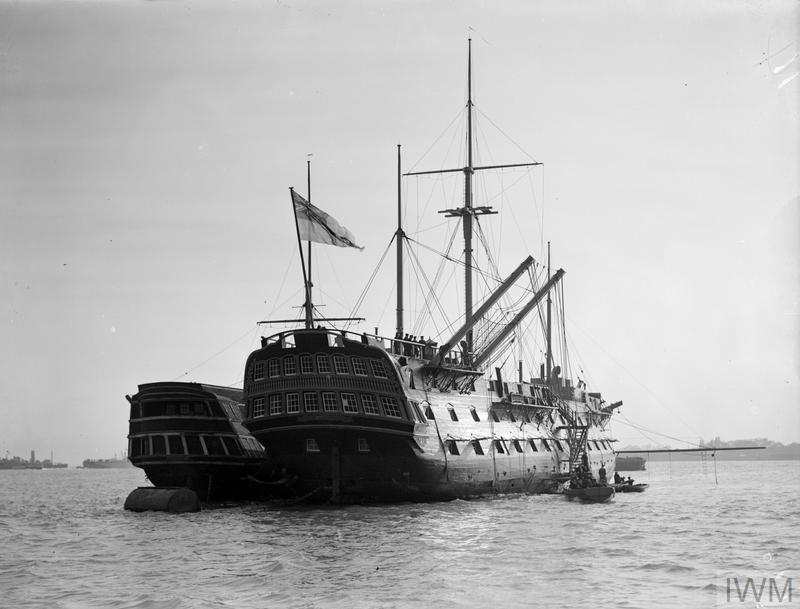
Training Ships Foudroyant (left) and Implacable. Foudroyant was and would be renamed Trincomalee, while Implacable, scuttled in 1949, was originally the French prize Duguay-Trouin, captured at the Battle of Trafalgar, 1805. © IWM (A 25960)

Today this lovely frigate, restored to her 19th Century appearance, exists as the last non-wrecked vessel that participated in any way in the Franklin searches.

  1. The author is again basing this off the list of participating ships found in W. Gillies Ross’s “The Type and Number of Expeditions in the Franklin Search 1847–1859,” ARCTIC Vol. 55, No. 1 (MARCH 2002) 57–69 https://pubs.aina.ucalgary.ca/arctic/Arctic55-1-57.pdf ↩︎
  2. The origins of the whole frigate category were from French vessels captured during the War of the Austrian Succession (1740-48). The same is arguably true of the move from inferior third rate line-of-battle ships to proper 74-gunners in the mid-18th Century. ↩︎

What Sir John Franklin’s High Arctic Cenotaph is Made of – A Whaler of a Tale!

A cenotaph to lost Royal Navy personnel – a National Historic Site of Canada – and archival records that show that it is made from an American shipwreck! Readers may recall the very origins of this website were to help explore and add provenance to relics and artifacts connected to Canadian military cenotaphs. So in a sense, after interpreting the history and shipwrecks connected to the lost 1845 Sir John Franklin Expedition in search of a Northwest Passage, we’ve come home!

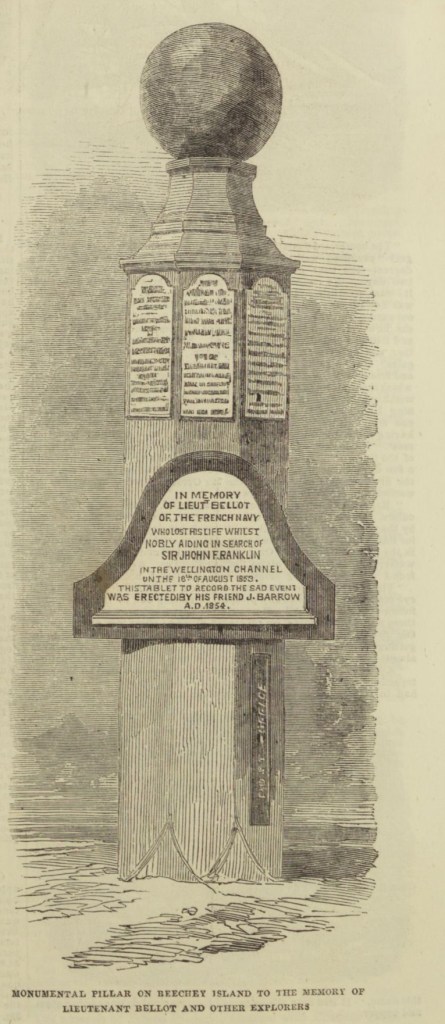
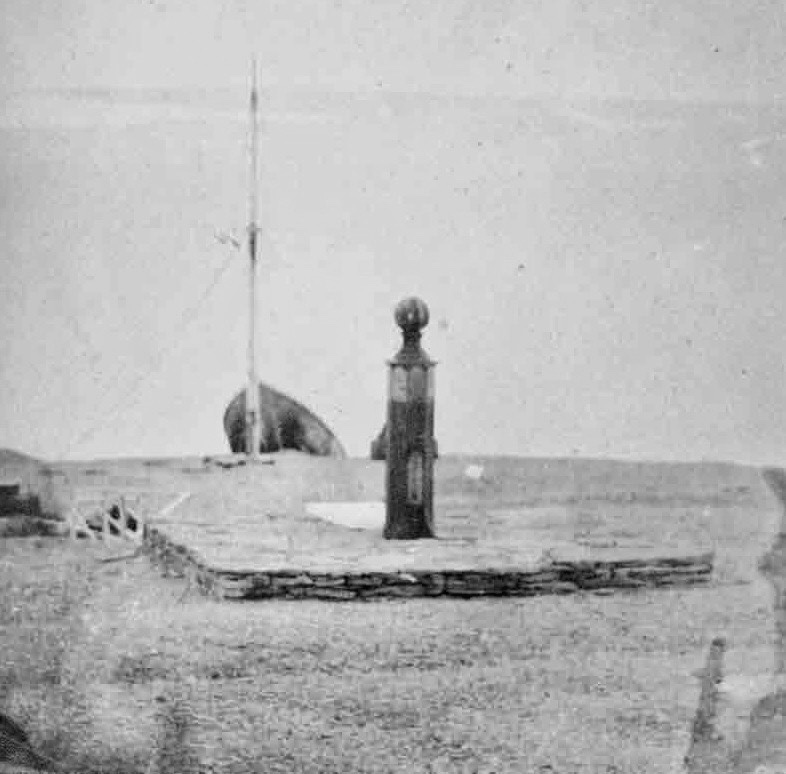
We recently posted about the history of the “Franklin Cenotaph” at Beechey Island, Nunavut. This isolated monument is an incredibly rare memorial to the crews of the lost 1845 Sir John Franklin Expedition and the searchers who died looking for them. It is identified by Parks Canada as a “character-defining element” of the Beechey Island Sites National Historic Site of Canada. It is important to understand what the cenotaph is and what components combine to create it.

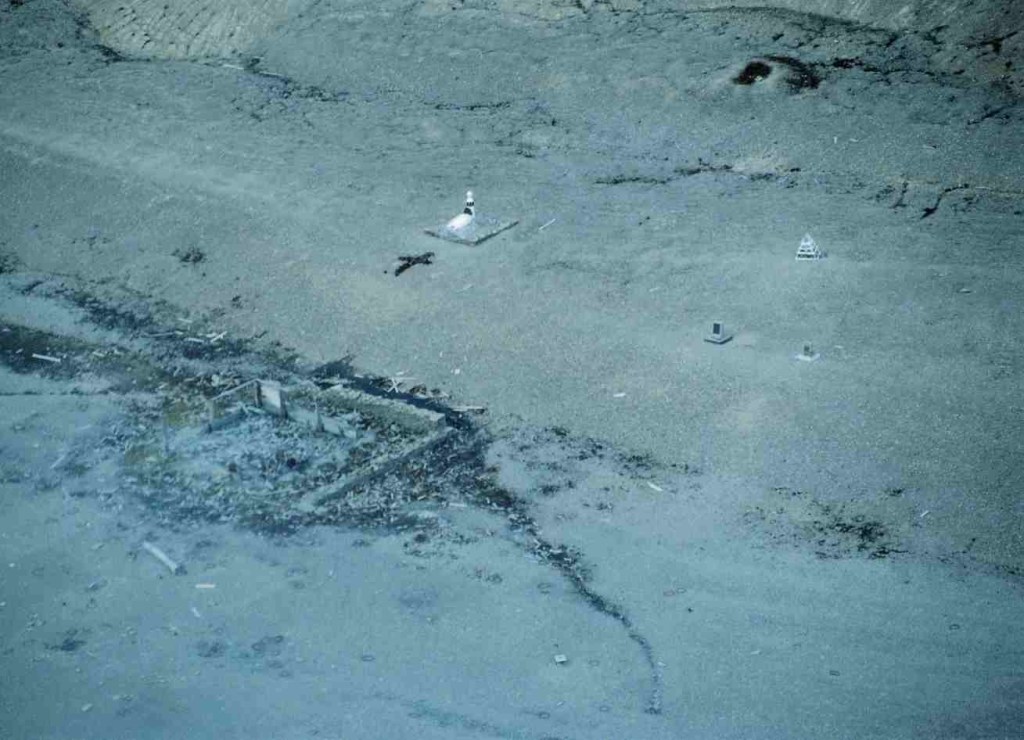
Beechey Island sites, photographed from the air in 1997. This shows the Franklin Cenotaph at the top center above the crucifix made out of empty tins. The ruins of Northumberland House (the supply depot) are down towards the beach, while other memorials are located at right. Credit: Ansgar Walk, CC BY-SA 3.0 http://creativecommons.org/licenses/by-sa/3.0/, via Wikimedia Commons

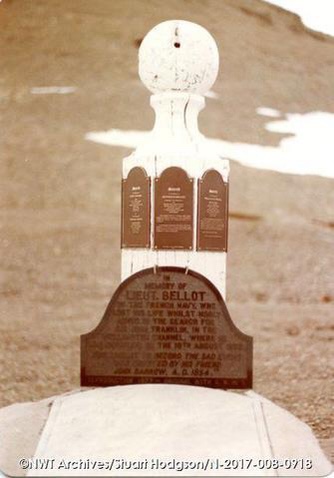
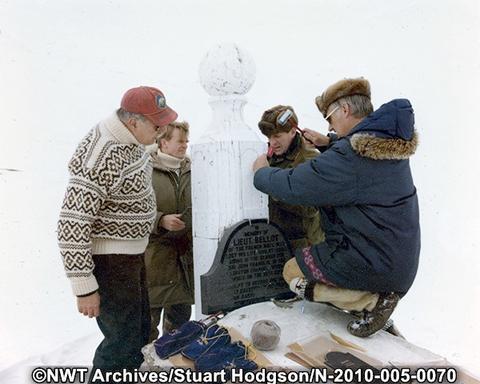
The column itself, built in the arctic summer of 1854, under the direction of Captain W.J.S. Pullen, HMS North Star, is thought to be made out of the machinery of a lost American whaling ship, the McLellan. This little-known detail further solidifies the Anglo-American character of the commemorative program of the monument.1 We ended our earlier post with a series of questions we hoped could be answered about the column’s origins. We also wondered if it really could have been made out of the capstan of the McLellan, as has been reported.2 A capstan, as defined by wikipedia is “a vertical-axled rotating machine developed for use on sailing ships to multiply the pulling force of seamen when hauling ropes, cables, and hawsers.”

An image of the “Franklin Cenotaph” and surroundings (left) compared to a capstan located at Whitby, England. One origin story of the Franklin monument is that the central “Belcher Column” is made from the capstan of the American whaling ship McLellan. The model of capstan at right exposes the octagonal spindle, which more often formed the core, surrounded by a substantial drum. Credit: (left) NWT Archives/Stuart M. Hodgson fonds/N-2017-008: 0918 / (right) Neil Reed / Capstan, Whitby East Pier, 2009 via wikimedia commons.

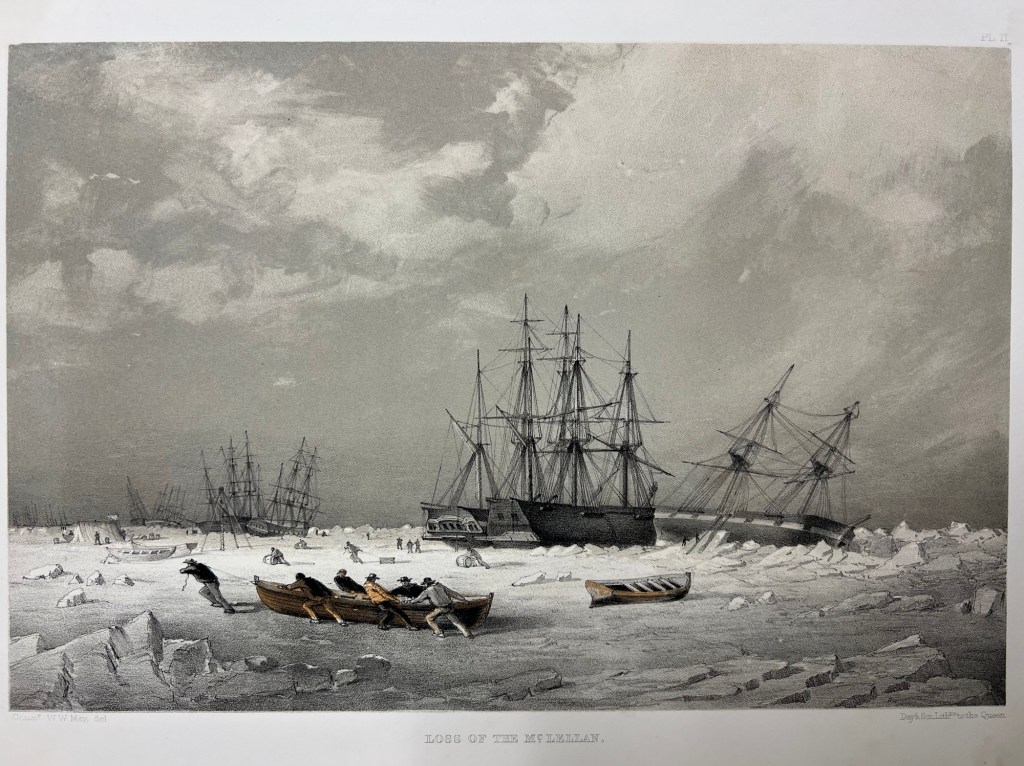
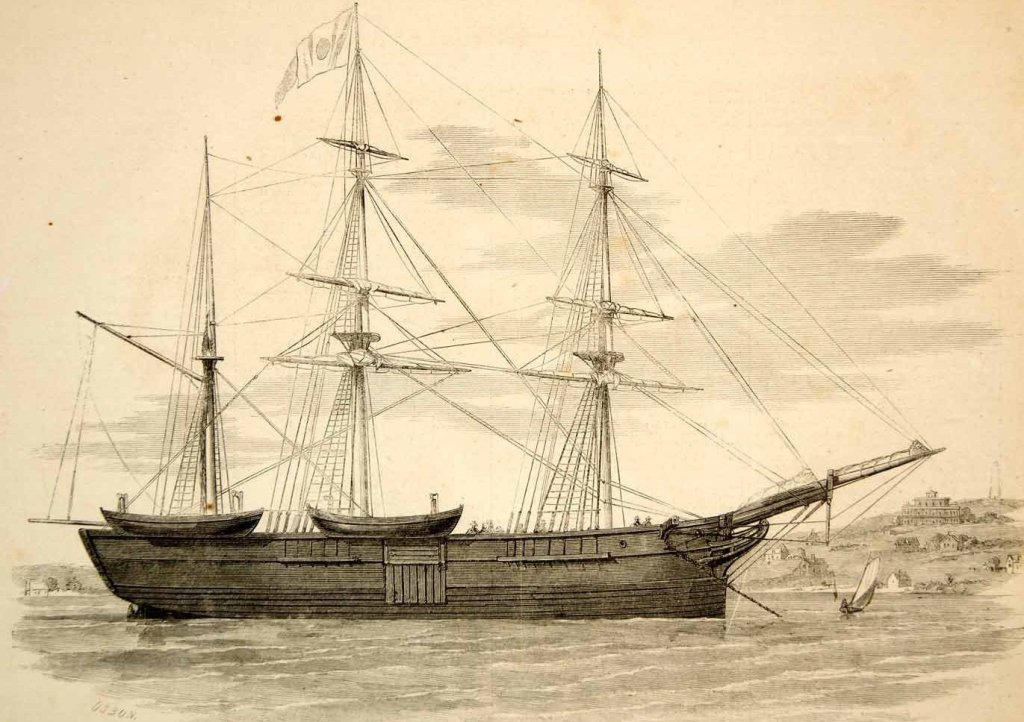
McLellan was a 366-ton barque-rigged wooden ship which had served as a general merchant in the 1830s, but had been purchased by the firm Perkins & Smith for the bowhead whaling industry in 1846. It was homeported out of New London, Connecticut, under the command of Captain William Quayle.3 We recently had an opportunity to closely examine a work at Library and Archives Canada which depicts the July 1852 loss of this ship:

Cmdr. Walter W. May (1855) “Loss of the McLellan” (Engr. J. Needham) Credit: Library and Archives Canada, Acc. No. R9266-2137 Peter Winkworth Collection of Canadiana.

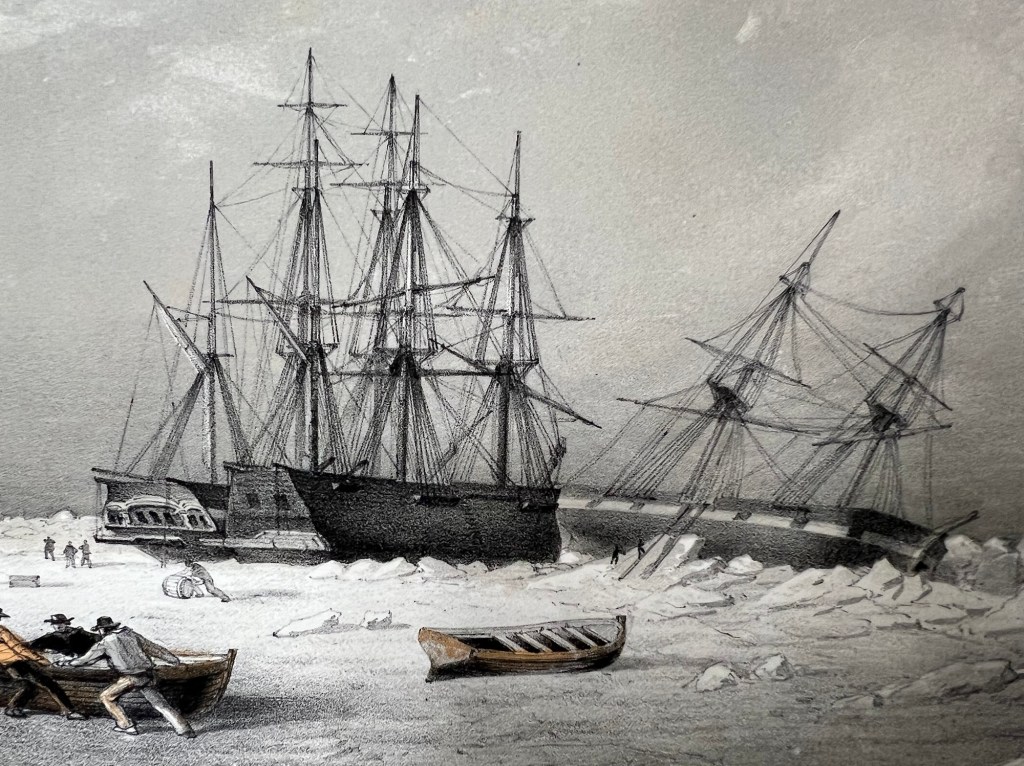
The engraving, made from a sketch by Cmdr. Walter W. May – who witnessed the events –includes many interesting details of whaling ships beset in ice near each other, and Royal Navy vessels. It also shows crew members salvaging items from a visibly-damaged ship.

Walter W. May was a gifted artist and an officer serving on HMS Assistance. This most likely depicts HMS North Star, which was nipped, but repaired, Alexander, a whaling ship, and McLellan at the far right being salvaged. [detail of op. cit.]

During the 1851 season, McLellan had been involved in a milestone in the development of the American whaling industry. Quayle had landed a shore party, led by mate Sydney O. Budington, at Nimegen Island, Cumberland Sound. This small group built a stout structure there and hunkered down to overwinter. With the assistance of local Inuit families, crew were able to live in relative comfort into 1852, trading for items and swapping their clothes for warmer furs.4

The plan was for the group to begin whaling far earlier than any ship-based crew could gain access to the area. It was a bold plan and it worked – they were able to land a huge catch of seventeen bowheads. They also became the first commercial interest to overwinter in the Canadian Arctic since the 16th Century voyages of Martin Frobisher. This shore party stayed on until September of 1852, and would eventually have to be taken off by another whaling ship.

The George Henry (1841) whaling ship. This ship was similar to McLellan, and was later commanded by both Sydney O. Budington and his uncle James Buddington. James would stumble across the abandoned Franklin search ship HMS Resolute in 1855. The prominent boarded-up port amidships is for the “cutting stage,” a relatively recent development to flense whales. Credit: Sherard Osborn, Public domain, via Wikimedia Commons

At the beginning of the 1852 season, McLellan, on the return voyage to the whaling grounds and to pick up Budington’s party, was one of a group of whaling ships that were beset in ice in the Davis Strait near Melville Bay. The ships were in a perilous position, between the land ice and the shifting sea floes.  Sir Edward Belcher’s Arctic Squadron, comprising HM Ships North Star, Assistance, Resolute, Pioneer, and Intrepid, were on their way up to Lancaster Sound to launch a sustained effort to locate Sir John Franklin and the crews of HMS Erebus and Terror (by this time missing for seven years). On June 20th, just as the naval squadron was coming up with the group of whalers, the veteran Kirkaldy whaling ship Regalia was crushed by ice. What followed seems unusual nowadays, but was apparently the accepted practice: The ship was quickly stripped of valuables, crew set out to find another whaler to serve in, something of a party broke out on the ice, and the hulk was burned to ensure it would not menace other ships.

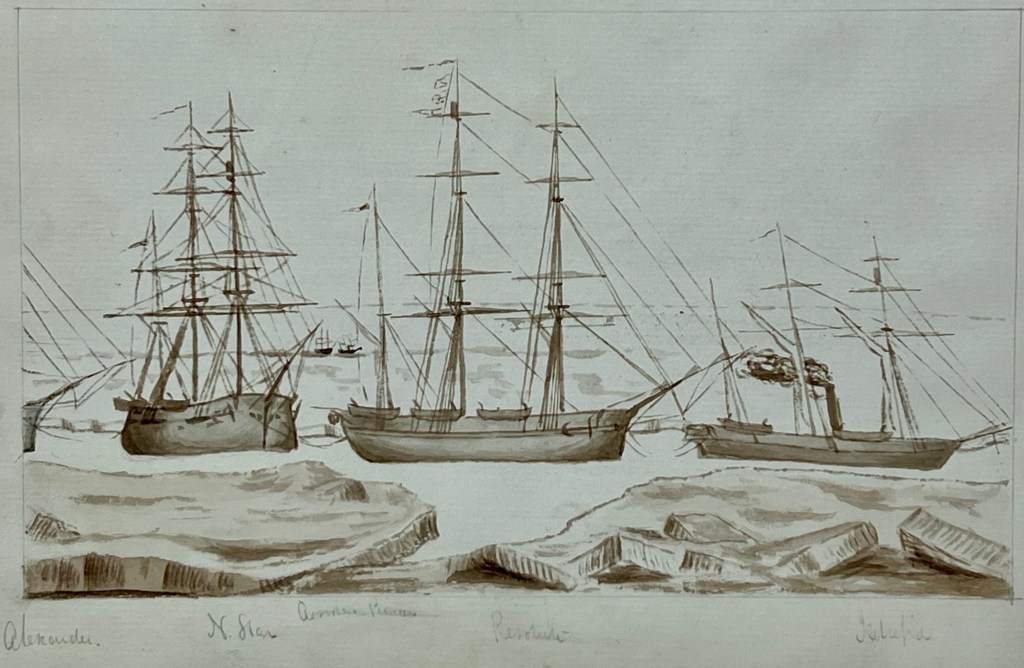
In early July, McLellan ran afoul of North Star, the depot ship of the Expedition, and the Alexander, a Dundee whaler. It damaged the cathead of the North Star, and the bowprit of the Alexander. The mizzen mast of McLellan had to be cut away to avoid further damage. The American whaler was severely nipped by the encroaching ice. The crew were preparing to abandon ship and the whalers in the area looked forward to commencing the usual “sacking and burning.” Instead, Belcher purchased the damaged vessel from Captain Quayle. The Royal Navy crews set about repairing the whaler. The repairs held until the ship was nipped more forcibly on 8 July. McLellan was gradually crushed over the next week. Naval crews salvaged spars, stout timbers, fittings, machinery, and cargo from their newly-purchased hulk. Valuable items were shifted over to North Star and the search ships.

Crew members salvage boats, casks, and other items as McLellan is destroyed. [detail of op. cit.]

Two years later, these parts were a ready source of materials for the program of construction and “beautification” that Belcher and W.J.S. Pullen organized at Beechey Island, the site of the Expedition’s depot. We originally believed that the (interior) spindle of McLellan’s capstan had been transformed into the central element to the Franklin Cenotaph. At the time of our earlier post, we were concerned about one issue: not all whaling ships had capstans. For example, the most similar ship to McLellan remaining in existence, the Charles W. Morgan, isn’t fitted out with this prominent piece of machinery. To effectively operate a capstan, a ship required a large crew. Many merchant ships favoured the use of their windlasses, which could be operated with their smaller crews. A windlass, normally situated near the bows, forward or immediately aft of the foremast, is “ A mechanism operating on the same principle as the capstan, but on a horizontal axis, used on board merchant ships, and some smaller vessels of the royal Navy, for weighing the anchor, hoisting and hauling.”5

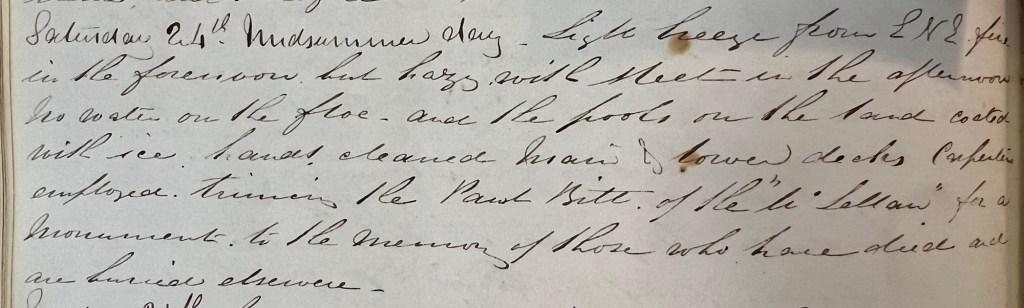
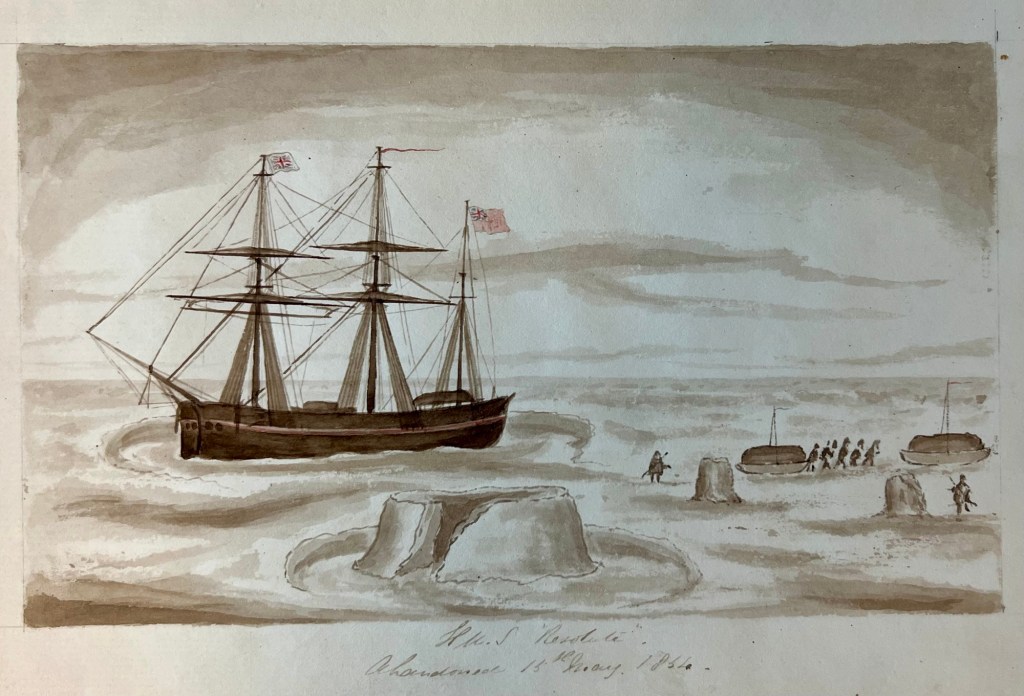
Resolute’s apprentice carpenter, William T. Mumford, the subject of our recent post, was an active participant both in the July 1852 salvage of McLellan, and in building the cenotaph during June 1854. He had just arrived back to Beechey after the mid-May abandonment of Resolute off Dealey Island. Mumford’s information, from his records at Library and Archives Canada, has helped us update the provenance of this important memorial. He wrote in his diary on Saturday, June 24th, 1854: “Midsummer Day, Light breeze from the E-N-E full in the forenoon but hazy with sleet in the afternoon. No water on the floe, and the pools on the land coated with ice. Hands cleaned main & lower decks carpenters employed trimming the Pawl Bitt of the McLellan for a monument to the memory of those who died and are buried elsewhere.

“The Pawl Bitt of the ‘McLellan'” – WT Mumford Diary entry 24 June 1854 (not paginated). Credit: Library and Archives Canada W.T. Mumford Fonds, 1986-018 PIC.

More than almost any other member of the Belcher expedition, Mumford’s occupation and prior experiences make him the expert on the origins of the central monument at Beechey. The “Pawl Bitt” was a strong timber, normally square, that was an important part of a ship’s windlass in the era of wooden sailing ships. It supported the “pawl”, a strong ratchet that ensured that leverage gained by the rotation of the windlass barrel was not lost. The pawl bitt was a substantial structural timber that usually connected straight down to the lower deck. It also usually supported the ornamental bracket the ship’s bell was hung off. This made it an important ceremonial and commemorative site. In this case, the Belcher Expedition carpenters’ efforts at “trimming” seems to have involved carefully working the square timber into an octagonal column, creating a finial ball to surmount the column, carving out or adapting some cavity to house the idiosyncratic “postal office” plaque now located at the rear of the column, and installing the original eight dedicatory plaques to memorialize lost crew members (which are individually identified in a note in our earlier post).

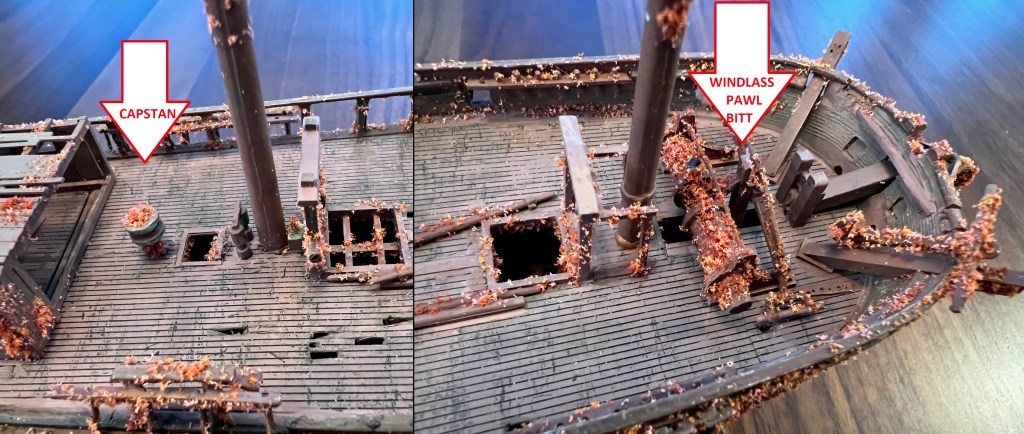
As it happens, there are contemporary examples of both a capstan and a windlass less than three kilometers away from the Cenotaph, on the seafloor of the Barrow Strait! Breadalbane, whose well preserved-wreck is also part of the National Historic Site at Beechey Island, was equipped with both a capstan and a windlass, including a pawl bitt. The pawl bitt is the stout post just forward of the horizontal windlass drum, with the ratchet-like pawl angling down. There was usually a brass ship’s bell sited atop this bitt. This is our scale model interpretation of the wreck. Credit: http://www.warsearcher.com

As we hope we have shown with both posts about the “Franklin Cenotaph,” this memorial is a powerful site of memory of a great era of polar exploration history. As a very early example of a military cenotaph, it has much in common with First World War battlefield memorials. It was constructed from relics and materials on hand, by comrades who knew the lost and the missing. Ship’s Carpenter William Mumford’s diary has helped enrich the provenance of this important monument by linking it to an identified feature of the wrecked American whaling ship McLellan. We hope that visitors to Beechey Island, Nunavut, who stand in contemplation before the cenotaph can better appreciate this remarkable artifact. To paraphrase a oft-repeated inscription from other memorials: HERE SEARCHED BRAVE SAILORS – YOU WHO TREAD THEIR FOOTSTEPS REMEMBER THEIR GLORY.

  1. An inscription added later recognizes Anglo-American cooperation in the search efforts over the High Arctic. The United States participated in search efforts such as the two Grinnell expeditions, and Elisha Kent Kane’s later searches. The 1858 addition to the monument of Lady Franklin’s marble (eventually brought up by Captain Leopold McClintock) expresses the shared Anglo-American concern for establishing the fate of the Franklin crews. ↩︎
  2. The link between the Belcher column and McLellan is noted in Barr and Stein’s January 2017 article “Frederick J. Krabbé, last man to see HMS Investigator afloat, May 1854” Journal of the Hakluyt Society. (P27) The authors appear to have consulted Mumford’s diary, but mention the source of the column is McLellan’s capstan drum. ↩︎
  3. This description of McLellan’s wrecking draws extensively from information in Philip Goldring’s Jan-Feb. 1986 Beaver Magazine article “The Last Voyage of the McLellan” PP39-44. The issue is currently accessible at the Canada’s History Magazine archive: https://www.canadashistoryarchive.ca/canadas-history/canadas-history-feb-mar-2019/flipbook/1/ Captain (later Colonel) William Quayle had a remarkable life, before and after his four years with McLellan, with many notable events outlined in a 20 June 1901 Moberly Weekly Monitor profile of him: https://www.newspapers.com/article/moberly-weekly-monitor-william-quayle/66609/ that article also gives Quayle’s description of McLellan as having been a barque of 110 feet overall length, 27 feet 7 inches wide, 14 feet nine inches deep, of about 326 tons. ↩︎
  4. McLellan and the other American whalers had more diverse crews than mid-Victorian Royal Navy ships. It would be interesting to know if Budington’s shore party had brought Black whalers directly into contact with Inuit families. ↩︎
  5. “Windlass” A Sea of Words ; A Lexicon and companion for Patrick O’Brian’s Seafaring Tales (New York: Owl Books 1997) P.458. ↩︎

“Dreadful and Perilous Positions” – More Mumford Art!

Ships in desolation, in dire straits, in peril, beset, with icebergs the size of fortresses barreling down upon them. William Mumford painted what he saw, and what he saw was a lot of natural forces conspiring to destroy his ship, HMS Resolute. He was the ship’s carpenter, an important position, onboard a wooden ship surrounded by frigid water, ice, and barren rock.1

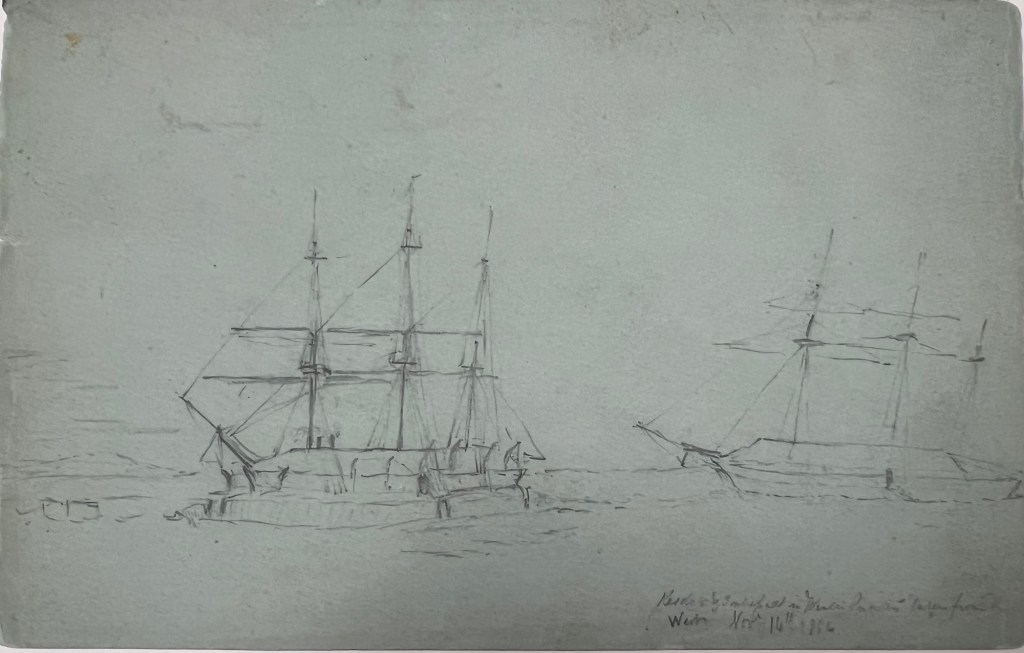
Here is more of the remarkable William T. Mumford collection of watercolours now in the custody of Library and Archives Canada.2 Please visit our recent post “A Resolute Perspective – What Mumford the Carpenter saw while searching for Franklin” for context, and the first group of artwork. Today, his little-known watercolours are a fine visual record of his 1852-1854 experiences on board Resolute, a member of the Sir Edward Belcher Expedition looking for the lost crews of Sir John Franklin. This instalment documents the transit up to Greenland and the early period of the searches. Mumford’s keen eye for detail will feature in several upcoming posts! Additional information has been supplied, mainly from passages in Mumford’s shipmate, George F. McDougall’s published journal The eventful voyage of H.M. discovery ship “Resolute” to the Arctic regions: in search of Sir John Franklin and the missing crews of H.M. discovery ships “Erebus” and “Terror.”3

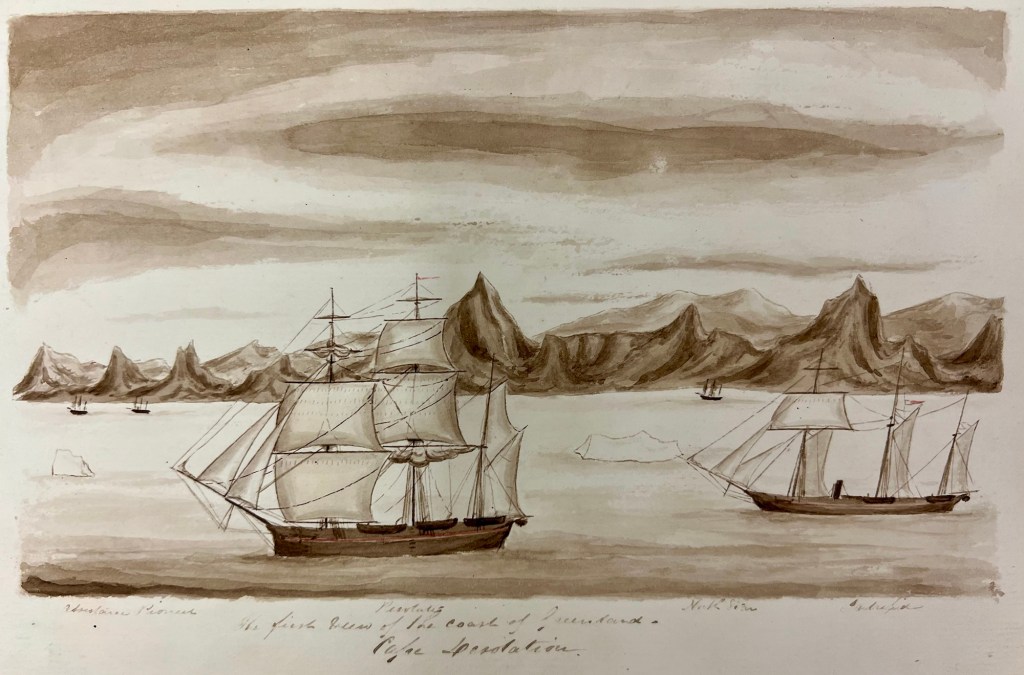
“The first view of Greenland, Cape Desolation 21 May 1852” the squadron is all depicted, with Resolute and Intrepid in the foreground, passing some bergy bits. Credit: LAC 86-18-3
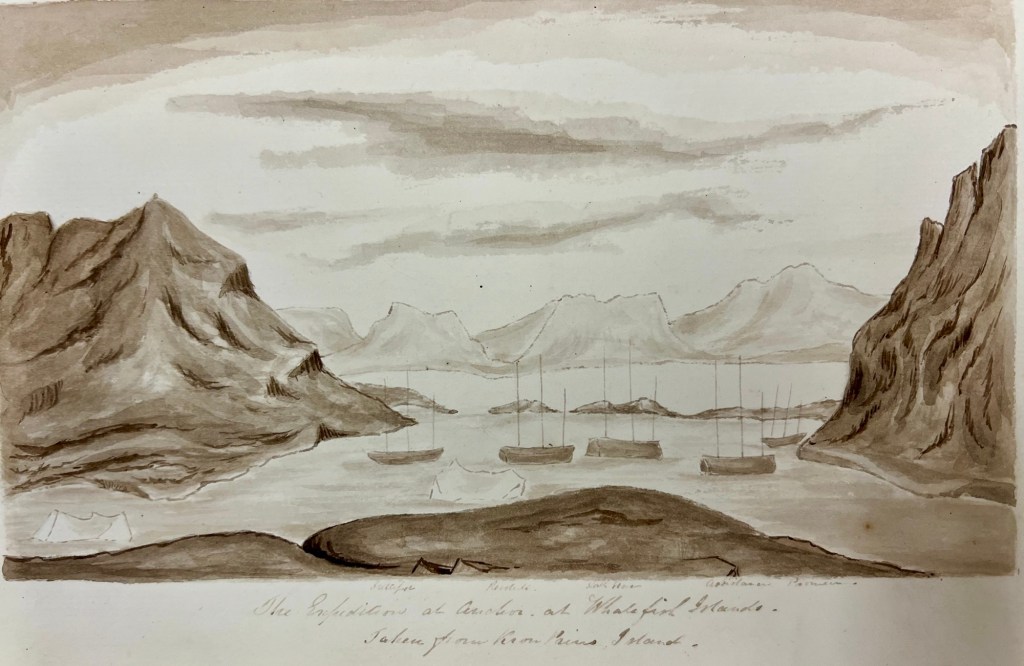
“The expedition at Anchor, Whalefish Islands. Taken from Kron Prins Island, Greenland May 1852.” The ships are identified (from left to right) HMS Intrepid, Resolute, North Star, Assistance, Pioneer. This view appears very similar to a calotype that Dr. William Domville, Resolute’s surgeon, captured somewhere on the Expedition. (Today in the custody of Royal Museums Greenwich P36CAL) Credit: LAC 86-18-4
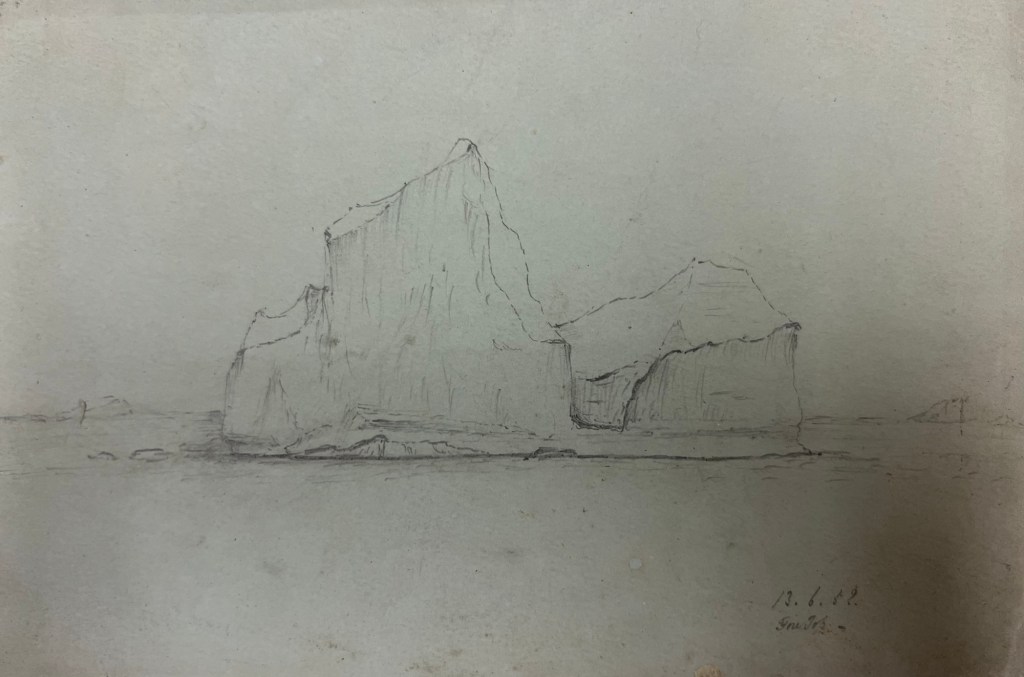
“Four Top Iceberg, Wargal Straits, Greenland June 13th 1852.” These impressive bergs were encountered in Waygat or Waygate Channel. Credit: LAC 86-18-5
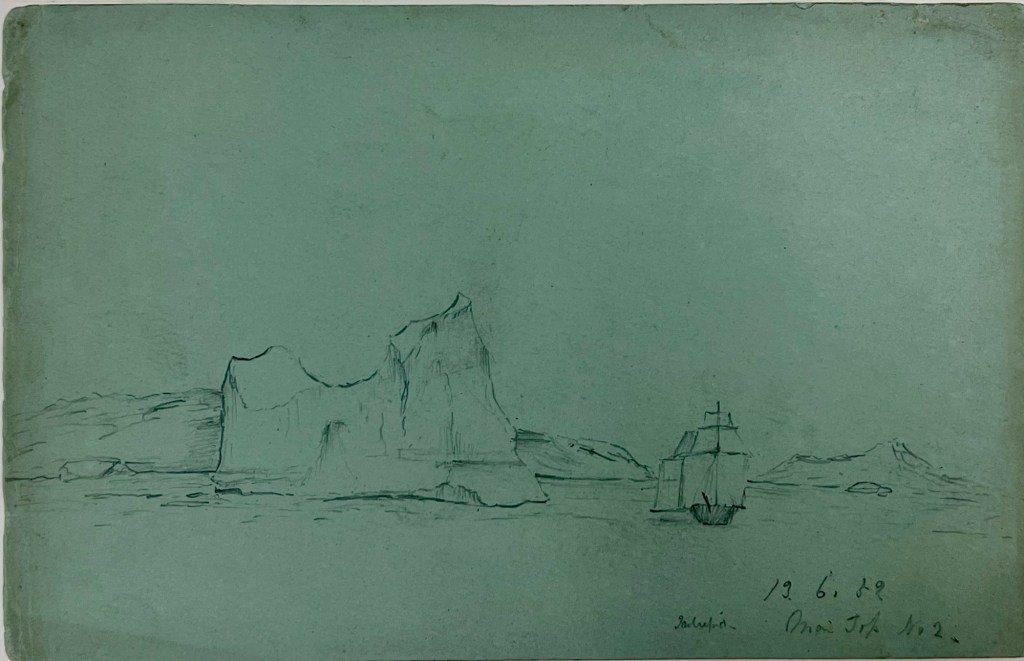
“Main Top Iceberg, Wargal Straits, Greenland June 13th 1852.”Credit: LAC 86-18-6
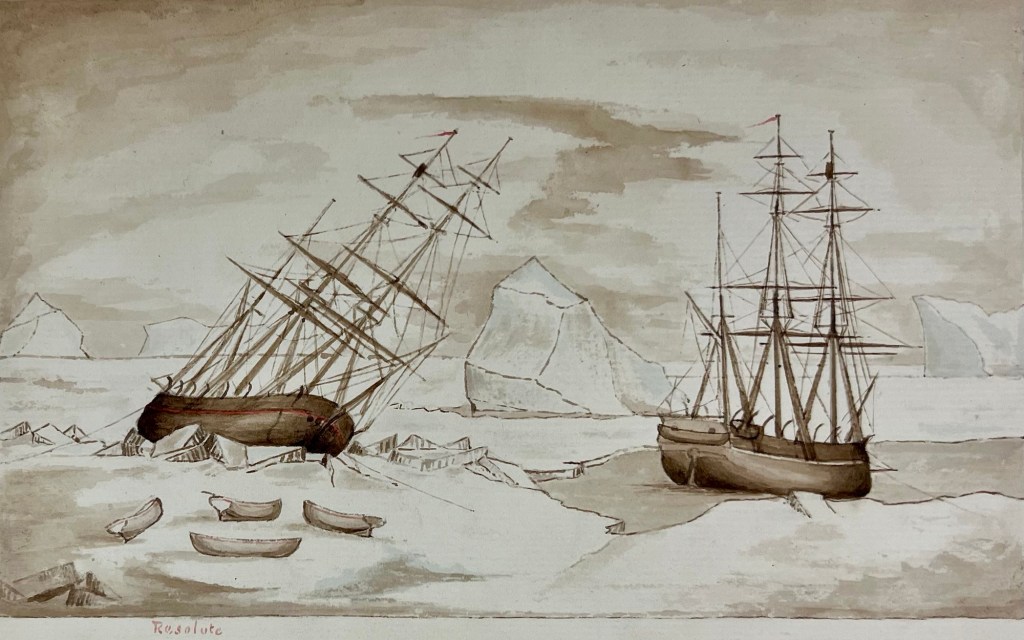
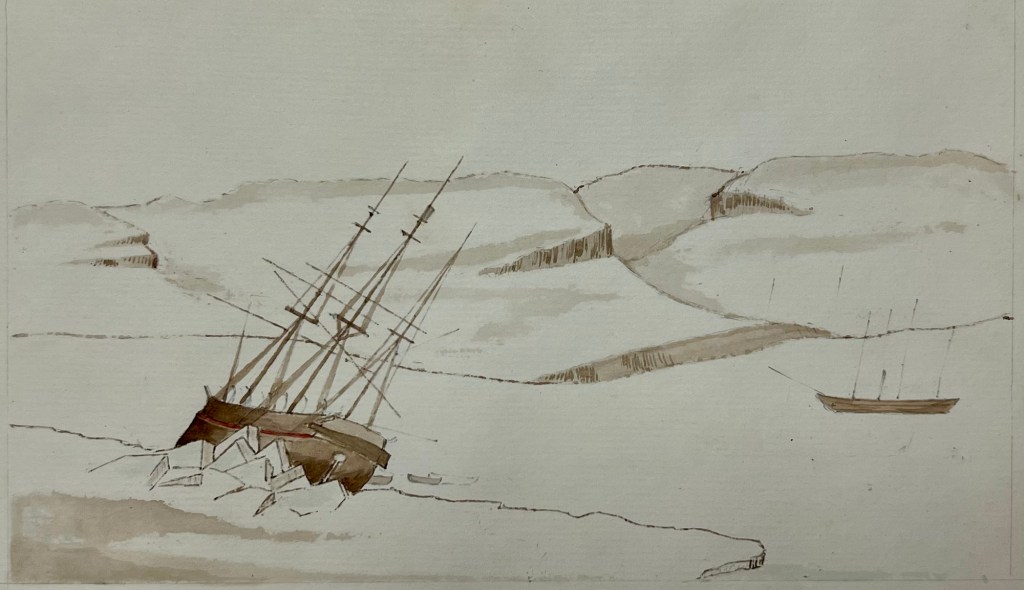
“The Resolute [left] and another ship in Perilous Position in the Ice, Melville Bay, Greenland” ca. 26 June 1852. Mumford has added some colour by showing Resolute with her distictive red band around the ice channels. George F. M’Dougall relates in his published journal that on the 26th Resolute was badly nipped between a moving flow and land ice. The ship’s bell rung on its own, the boats were dragged out to the ice, and the rudder was destroyed. The vessel at right should be Assistance, which had a single white band, was nearby, and was cutting in to an ice dock. Mumford would have been heavily involved in setting up the spare rudder. Credit: LAC 86-18-7
“The Alexander, North Star, Assistance[distant], Intrepid[distant], Resolute, Pioneer off Melville Bay, Greenland July 1852.” Given the complete absence of McLellan, a whaling ship which damaged Alexander and North Star, and the freeing of the ships, we can speculate that this is later in July. Alexander (a whaler from Dundee) accompanied the naval ships longest of the whalers. Credit: LAC 86-18-8
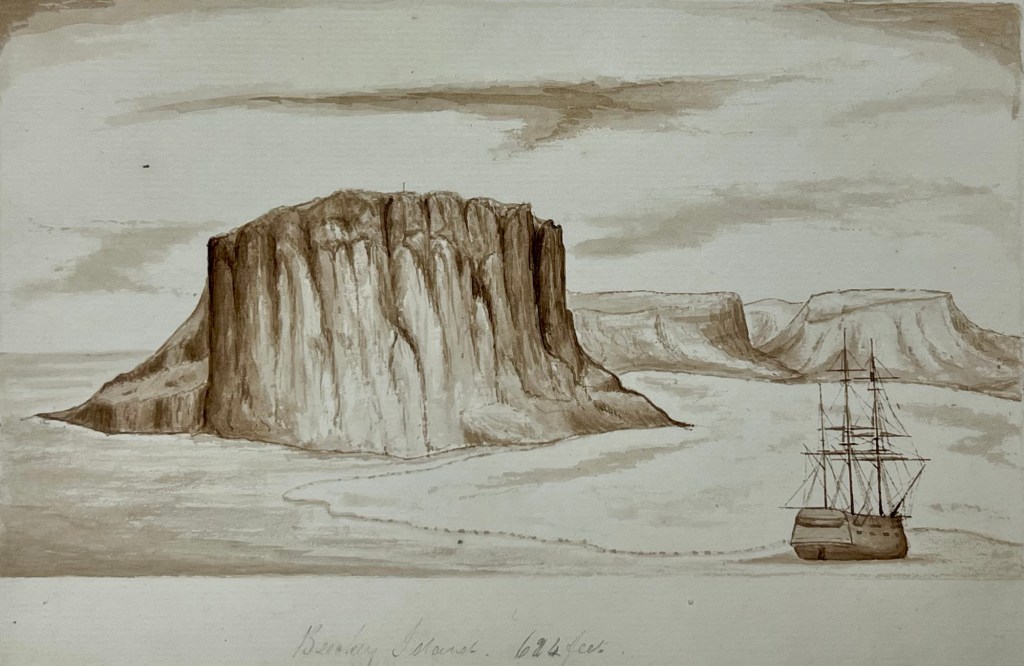
“Beechey Island, 629 feet” [ca. 10 Aug. 1852] Our ID of this vessel would be HMS North Star. With Erebus and Terror Bay not yet clear of ice, she is waiting on the 10th or 11th to take up her inshore position off Beechey as the expedition’s longtime depot ship. Credit: LAC 86-18-10
“The Resolute (?) in a Dreadful Position in the ice off Beechey Island (?) 16 August 1852” From M’Dougall’s diary we know that, while near Assistance Harbour on an errand to drop a whaler off at Cape Hotham, Resolute was again in peril of receiving a nip, with Intrepid nearby. Resolute (red band) and her crew has sensibly unshipped her rudder and hung it over the stern. Credit: LAC 86-18-12
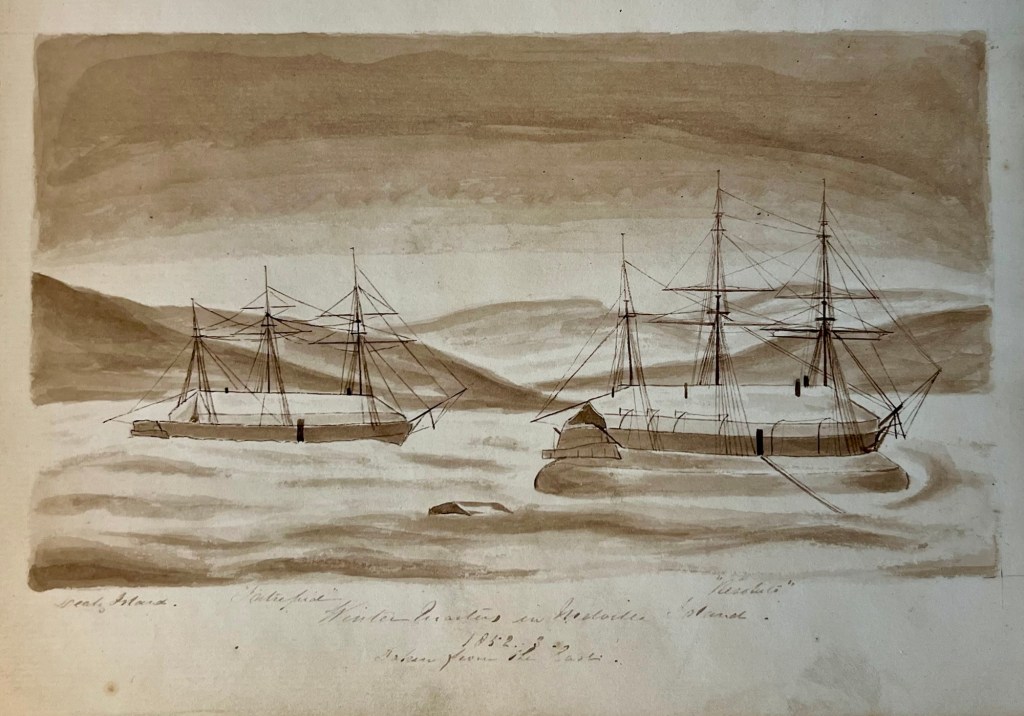
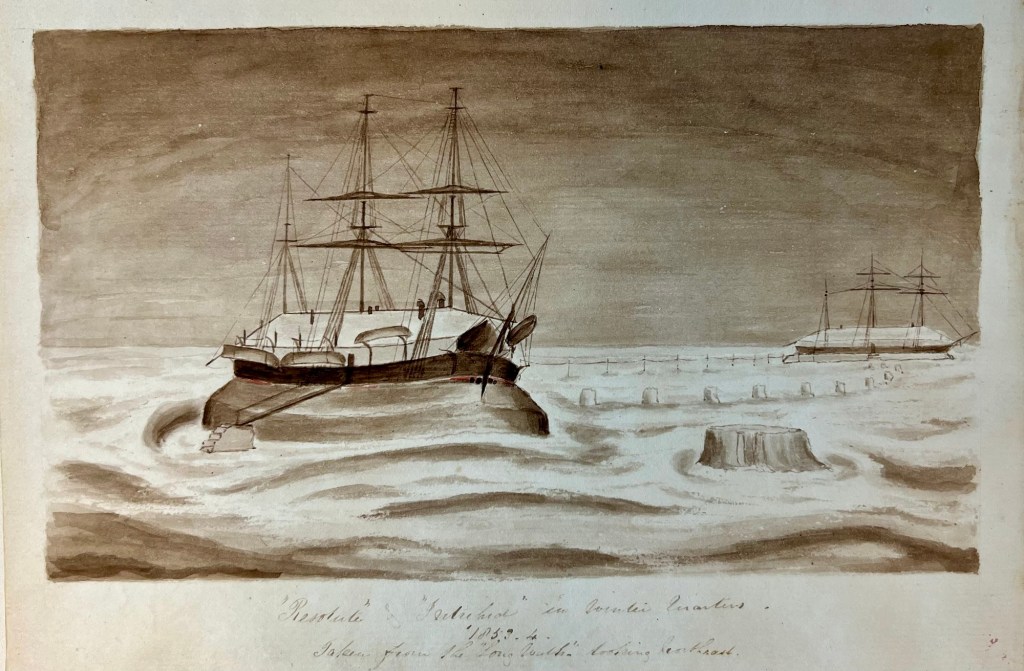
Resolute and Intrepid in Winter Quarters, Melville Island November 16th 1852” Resolute’s first overwintering location. Credit: LAC 86-18-13

  1. HMS Assistance (flagship), Intrepid, Pioneer were crushed in ice or otherwise foundered. As related in the previous Mumford post, Resolute, incredibly, drifted to discovery by whaling ships 1,900 km East. North Star survived her Beechey Island ordeals to help evacuate the other crews. Considering the marine casualties, and compared to Franklin’s two-ship Expedition, very few crew members died. ↩︎
  2. Source: Library and Archives Canada, Acc. No. 1986-18. Consulted MFL reel H-1662 and separate artwork. ↩︎
  3. George F. McDougall, Resolute’s sailing master, published his journal (1857 publication), which is available online: https://babel.hathitrust.org/cgi/pt?id=aeu.ark:/13960/t6737jj60&seq=12 ↩︎

HMS Terror (1916-1941)-Queen of Bombardments

24 February 1941 – HMS Terror, a veteran warrior, slipped beneath the waves of the Mediterranean Sea, off the Libyan coast.

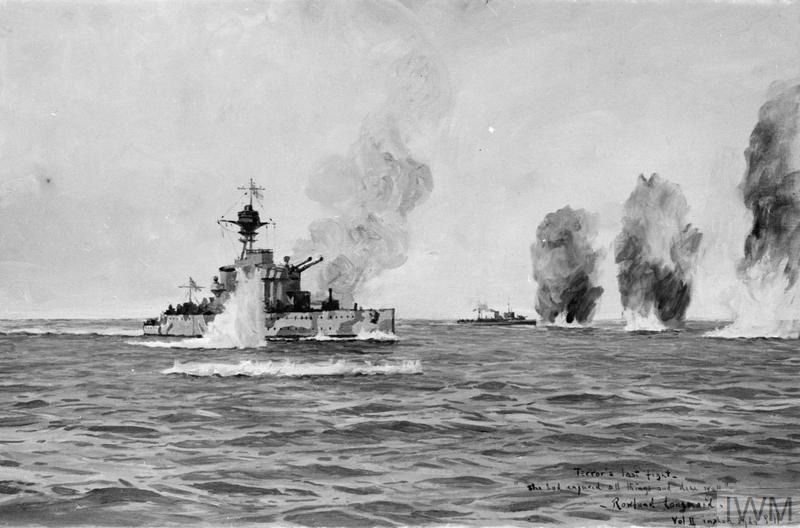
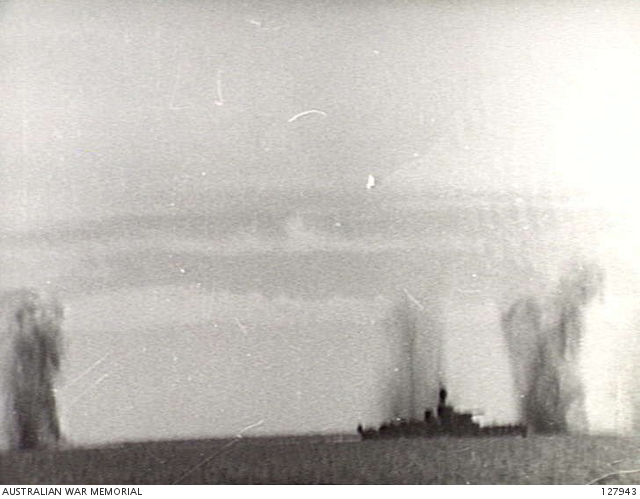
Terror’s Last Fight. Photograph by Lt. E.E. Allen of a painting by Lt. Cmdr. Rowland Langmaid, Official Fleet Artist depicting the 23 February 1941 air attacks by German JU-88 bombers that contributed to Terror’s abandonment the next day. © IWM A 13648

This site has posted on topics related to the wreck of HMS Terror (1813-1849ish), Sir John Franklin’s second ship on the doomed 1845 Expedition to chart a Northwest Passage at the top of North America. That long-lost wreck, which began life more than three decades earlier as a bomb-vessel, was discovered September 2016 in a bay at King William Island, Nunavut. There have been several other commissioned Royal Navy ships named Terror, and at least one of these is also wrecked on the seabed today. This later British warship has not been explored, or even located, in the very different waters of the Mediterranean Sea north of the Libyan coast.1 This namesake should not be forgotten: She upheld the reputation of her famous predecessor as an incredibly tough warship. A fierce combatant in two global conflicts, she was scuttled eighty-three years ago today.

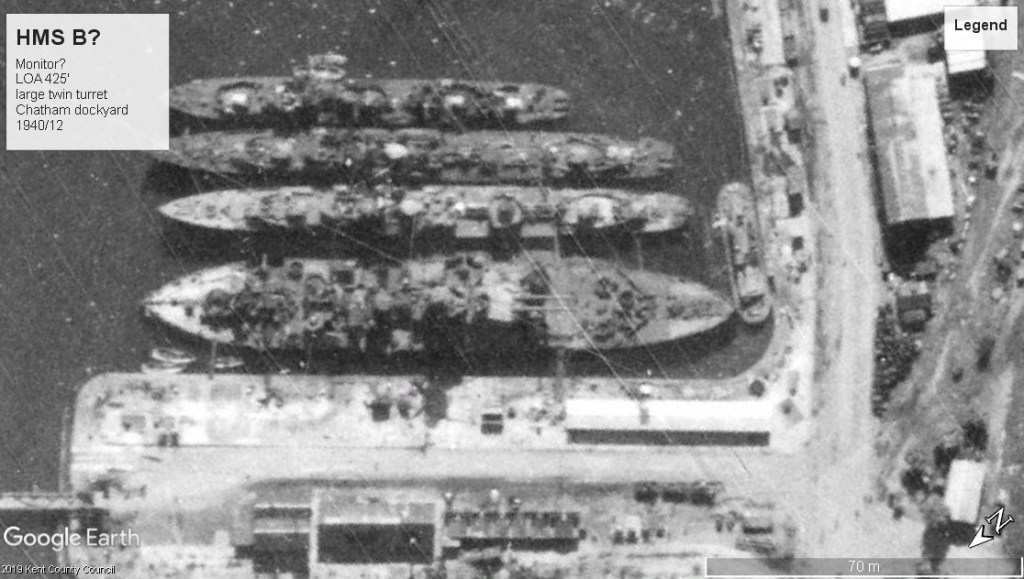
Terror, an Erebus class monitor, was built by the firm Harland & Wolff (known as the builders of several White Star liners, including RMS Titanic), at Belfast and completed in mid-1916. A monitor performed the traditional function a bomb vessel did during the age of sail –shore bombardment–albeit with a level of destructiveness that would have been barely imaginable when the 1813 Terror first tasted water. Of all twentieth-century monitors, the Erebus sisters were the only ones to continue the historic lineage of bomb vessel names. They also paid tribute to the memory of the specific Franklin ships. The lead ship, HMS Erebus, remained in commission until 1946.

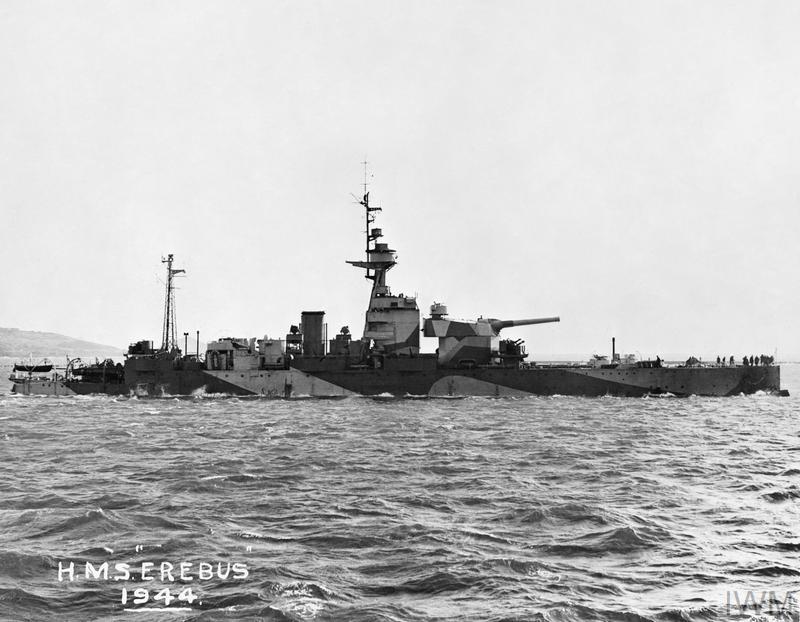
HMS Erebus (FL 693) At a buoy in Plymouth Sound, 1944, around the time of her participation in bombarding targets during the D-day landings. Copyright: © IWM. Original Source: http://www.iwm.org.uk/collections/item/object/205120082

A brief comparison of the 1813 and 1916-built Terrors: where the 1813 wooden sailing vessel was armed with two heavy mortars—a 13” and a 10” variety – and some light cannon, the 1916 armoured monitor was fitted with two 15” rifled battleship guns that fired a variety of explosive and armour-piercing ammunition. Secondary armament included anti-aircraft guns. Length: 1813- 100’ on deck, 1916-405’. Breadth: 1813-30’; 1916- 88’. Displacement 1813-330 tons; 1916-8,450 tons, (larger by the Second World War). 1813-wood, later reinforced for Arctic service with a heavy wood ice chock encircling the hull. 1916-High tensile steel armour up to 13” thick on the turret, with a large anti-torpedo bulge encircling the hull. Lastly, the installed power: HMS Terror (1813) was fitted with a single steam locomotive boiler in 1845, generating 25 horsepower for one retractable two-bladed screw – 4 knots maximum speed while under steam. 1916-four large oil-fired boilers generating 6,000 horsepower for the twin screws – 12 knots maximum speed.

The monitors were a novel way of fitting the 15″ guns of a more conventional design of British battleships, such as the Queen Elizabeth (1912) class – with four turrets and eight 15″ guns – to a smaller, lighter, shallower hull. Brassey’s Naval Annual, 1923 edition, artist not identified, Public domain, via Wikimedia Commons

Early in the First World War, a new design evolved for monitors. With Belgium in enemy hands, there was a role for heavy coastal bombardment of land targets. Battleships, with their deep draughts, could not work close enough inshore to strike deep into occupied territory with their 12′ or larger guns. A boxy, very wide, shallow hull was required to accommodate a rotating turret with what – to most observers – would look like absurdly oversized guns.

HMS General Wolfe, an earlier Lord Clive class monitor. In addition to the regular forward turret armed with twin 12″ guns, she was one of only two monitors to receive a single 18″ gun, the largest fitted to a warship until the Second World War Japanese Yamato battleships. This massive gun was fitted aft, in a fixed structure pointing off to starboard. Wolfe achieved the longest accurate bombardment in Royal Navy history: A target at Snaeskerke, Belgium, 32.2 km distant. Credit: William Lionel Wyllie, Royal Museums Greenwich PAE2675

As monitors went, the Erebus class pair of ships were enormous. They were a significant improvement on the preceding Marshal Ney class, and the design remedied shortcoming of all previous British monitors with heavy guns.2 Their length of 405′ was similar to the battleships of the 1890s that were still serving in the fleet. Their breadth (width) was proportionally even greater – on par with newest dreadnought battleships. This ensured the ships were stable firing platforms for their formidable armament: a rotating turret armed with twin 15” BL MkI guns with 42 caliber barrel lengths. These were the premier Royal Navy capital ship armament, and equipped generations of the Grand Fleet’s battlewagons, from 1915 to 1959. Where the 1813 Terror could lob a 13”, 200-pound explosive or incendiary shell about 3.8 kilometers, the 15” gun could fire a 1,940 pound shell out to about 24 km.

Animation of loading process of a 15” BL MK1 gun. This model of gun delivered one of the longest hits in battleship history when HMS Warspite struck the Italian battleship Guilio Cesare 23.8 km away in July 1940. Via wikimedia commons CC-BY SA

During their First World War service, the Erebus sisters bombarded targets in German-occupied Belgium, as units of the Dover Patrol, and assisted the Allied land armies in bombardments during the Fifth Battle of Ypres (28 Sep-2 Oct. 1918). On October 19, 1917, while operating off Dunkirk, against several German torpedo boats, Terror was torpedoed three times, and was severely damaged, with much of the bows blown off. After an agonizingly-slow tow from Dover to Portsmouth – with some of it backwards to try and keep the forward bulkheads from giving way – the ship was rebuilt. Back to the Dover Patrol to participate in famous April 1918 Raid on Zeebrugge, the Erebus sisters and Marshal Soult – another monitor – bombarded targets. Following the November 1918 Armistice, many of the monitors were decommissioned, laid up in reserve, converted to other purposes, or scrapped. Terror continued in commission on various peacetime assignments, and was assigned to HMS Excellent, the gunnery school at Whale Island near Portsmouth. She was used as a testbed for different artillery, firing on targets which included worn-out battleships.

With the outbreak of the Second World War, the sisters were again required for the bombardment of enemy fortifications and positions. Terror was under long refit in Singapore. Her anti-aircraft defences were upgraded-they would become vitally important to Terror’s survival. Returning to Europe in 1940 by way of the Mediterranean, the monitor became implicated in defending Malta, under siege from Italian air and naval forces. She endured aerial attacks, helping to defend the beleaguered garrison from Italian bombing. Her massive guns bulked up the Island’s coastal batteries. After a stint in Greece, her next assignment was to proceed to the North African coast in early 1941 to assist in the opening of the Libyan campaign against occupied North Africa.

HMS Terror under aerial attack 2 January 1941 off Bardia, Libya, in the lead up to the Australian assault on Italian fortifications: Operation Compass. Terror’s accurate bombardment caused the partial collapse of a cliff, which took Italian short fortifications and artillery positions with it. Credit: Damien Peter Parer, Australian War Memorial 127943

During mid-February the vessel was at Benghazi. On the 22nd, while leaving the port, Terror was damaged by two nearby mine explosions. The damage was not significant enough to delay the departure. The next day, off the African coast, a lone Hurricane fighter covering the embattled monitor had to turn back to refuel. Terror was soon under air attack from three German Junkers JU-88 bombers. Though there had been no single decisive hit, flooding from the accumulated damage was becoming uncontrollable. Though destroyers were coming to Terror’s aid, the help did not come soon enough to save the vessel. Lt- Cmdr John Kellar made the difficult decision to scuttle the ship.3 The entire crew of 300 were evacuated to nearby escorts and Terror sank at position 32.04N 24.05E. A careful perusal of the Commonwealth War Graves Commission’s site reveals that this Terror remained a lucky vessel: in both World Wars, despite torpedoing, air attacks, and mine damage, almost no one died while serving in Terror.4

We have not heard of any effort to locate and survey this wreck. Nor, happily, is there evidence it has been quietly found and salvaged for the significant metal content. The amount of information about the search for and exploration of HMS Terror (1813) effectively hampers research into this topic! The Terror (1916) wreck would be an outstanding example of an unusual type of warship. She had an important record of service with substantive contributions to First and Second World War campaigns. As we eagerly follow the archaeological study of the earlier ship, it is worth sparing a thought for this other Terror shipwreck.

A monitor at Chatham dockyard during the Second World War that we titled “target B”. The elevated large turret can be seen just to the right of midships, while the circular features show the powerful secondary and AA armament. This is one of the oldest captures in Google Earth catalogue. From identifying features, this is Erebus.

  1. We have been unable to locate any sources suggesting the wreck location has been surveyed, or the wreck has been visited. Please let us know if it has! ↩︎
  2. Though the primary role of a monitor at this time was to fit large guns for shore bombardment, there were several more balanced designs that were armed with 9.2″ or 6″ guns. One monitor of this type, HMS M-33 is preserved at Portsmouth. ↩︎
  3. Naval History.net entry with additional information about scuttling: https://www.naval-history.net/xGM-Chrono-03Mon-HMS_Terror.htm ↩︎
  4. This Commonwealth War Graves Commission website search show the incredibly low fatal casualties of Terror’s crew while serving in two World Wars. ↩︎

A Resolute Perspective – what Mumford the Carpenter saw while searching for Franklin

William T. Mumford (1830 – 1908) was a young apprentice carpenter when he volunteered for service with HMS Resolute–captained by Henry Kellett–to scour the Arctic for Sir John Franklin and the missing crews of HMS Erebus and Terror (last seen by Europeans in 1845). Resolute was one of five vessels in a squadron commanded by Sir Edward Belcher. As Ship’s Carpenter, Mumford was rated a warrant officer. He kept a diary and other records of this 1852-1854 expedition. He also created a detailed visual record. He documented the Belcher ships, mostly during their long imprisonment in ice, their Beechey Island staging base, and important or perilous moments. Once Resolute was abandoned, he kept up with his diary and continued to illustrate his difficult journey back. Today, these interesting records are in the collection of Library and Archives Canada.

Mumford was an active participant to the important events of this phase of Arctic exploration. The two main search parties, Belcher in Assistance, Kellett in Resolute, respectively accompanied by their steam tenders, Pioneer and Intrepid, left their depot ship, North Star, at Beechey Island, to push further north and west. Once the ships were beset in ice, crews conducted further searches using sledges. Though they found virtually no new information out about the fate of the Franklin crews, they surveyed large swaths of the Arctic archipelago. A happy discovery was the location of the long-beset HMS Investigator at Mercy Bay. Kellett ordered Robert McClure, Investigator’s captain, to abandon his command and bring in his ailing crew. During June 1853 McClure sledged to Resolute. The next Spring, with his ships still firmly seized in ice, Belcher made the difficult decision to abandon all primary expedition vessels (still tightly frozen in), and retreat to Beechey to seek passage home. Kellett’s whole party, including the Investigators, were doing quite well after all this time, but Belcher ordered them to go.

HMS Resolute beset, with ship’s boats on the ice and her rudder swung out over the stern. The joys of consulting microfilm from a vintage reader! Credit: Library and Archives Canada, Acc. No. 1986-18

The Mumford collection was acquired by the National Archives of Canada in 1984 with the assistance of a grant from the Government of Canada under the Cultural Property Export and Import Act.1 In contrast to many of the official works and the officers’ records documenting the search efforts, Mumford’s archival fonds provides a different perspective: what a warrant officer with a keen eye for details witnessed of this great era in Arctic exploration. Mumford went on to have an important career with Lloyd’s of London, as a surveyor of ships from 1857-1889.2 He knew his ships, and so his depictions can be considered an accurate visual record. The diary was microfilmed soon after acquisition, and copies passed to Cambridge University and the National Maritime Museum. Interleaved with the text of some 150 pages were watercolours and drawings of ships and topographical scenes, maps, printed poster playbills for onboard theatrical entertainments, and some later correspondence (mostly a curated collection of press clippings that show Mumford to have kept up on developments in Canada’s distant North). After filming, the watercolours were removed and housed separately for long-term conservation. Of Mumford’s diary, we viewed the microfilm copy at LAC last October, and we failed spectacularly to decipher most entries! We hope the fine visual record, presented in chronological order with additional context, are of interest:

“Winter quarters at Melville Island, taken from the East” Feb. 1853. Even fitted for overwintering and bulwarked with snow, the contrast between the doughty search vessel Resolute, (right) and the rakish, fine lines of Intrepid, is notable. Credit: LAC 86-18-18
“HMS North Star forced on shore by the ice at Beechey, near Cape Spencer”, This dramatic June 1853 view shows HMS North Star, the Belcher Expedition’s depot ship, located at Beechey Island, the site of the Franklin Expedition’s first wintering. Credit: LAC 1986-18-20
“The Last Move” September 1853. HMS Intrepid, the steam tender, is leading Resolute with sail and steam up. Credit: LAC 1986-18-22
“The Resolute and Intrepid in winter quarters, 1853-1854, taken from the ‘Long Walk’ looking East” Ca. Dec. 1853. This shows the two ships now wintering at their second encampment, located (in the moving pack) off Dealy Island. LAC 86-18-25
“HMS Resolute abandoned May 15, 1854.” A depiction of the beginnings of the sledging trip of the combined crew of the Resolute and Investigator (Robert McClure’s ship, abandoned earlier at Mercy Bay) making a start towards Beechey Island, with Resolute and Intrepid still beset. Resolute was abandoned in good order with flags nailed to the mast trucks.3 Credit: LAC 1986-18-26
HMS North Star, still at Beechey. Dated May 1854, this remarkable view shows Beechey’s imposing and bleak cliffs. Ashore, Northumberland House, the storehouse the Belcher crews built, and a large boat which is likely Sir John Ross’s rescue yacht Mary, are visible. [Detail of] LAC 1986-18-27
“HMS Diving Bell, Phoenix” This dramatic watercolour appears to show Edward A. Inglefield’s command, HMS Phoenix, in a perilous situation. September 1854. At this time Inglefield was engaged in returning Robert McClure and the crew of Investigator to England. The distant vessel could be the accompanying HMS Talbot or North Star. Credit: LAC 1986-18-29

  1. Source: Library and Archives Canada, Acc. No. 1986-18. Consulted MFL reel H-1662 and separate artwork. ↩︎
  2. Charlie Kelly “The remarkable ship Resolute,” https://hec.lrfoundation.org.uk/whats-on/blogs/the-remarkable-ship-resolute ↩︎
  3. Mumford’s ship would eventually free itself from the ice, to drift on an incredible journey. Salvaged by American whalers in 1855, Resolute would be presented back to Great Britain in 1856. For a detailed summary see the online HMS Resolute project: https://www.hms-resolute.co.uk/the-nutshell/ ↩︎

The Terror we Wish we Knew

HMS Terror, Sir John Franklin’s second exploration vessel, was discovered in Sept. 2016. Captain Francis Crozier’s sturdy little ship had vanished seventeen decades earlier. HMS Erebus, the flagship of the lost 1845 expedition, was located in 2014, about 70km south. Franklin’s mission was to have taken them into uncharted waters, to finish surveying a Northwest Passage across the top of North America. Where they went, none could follow.

So many questions about Terror and her lost crew remain unanswered. Archaeology on the incredibly well-preserved wreck is still in the early stages. The yearly dive season is all too short – late August to mid-September on a good year. Underwater Archaeologists are up there right now (2023/09).1 See our earlier post for possible Terror-related archaeological priorities. Here are some questions we have about this fascinating shipwreck:

A. When, why, and how did Terror actually sink? How did Terror get from the point of original Apr. 1848 abandonment by Crozier and the crew, Northwest of King William Island, to a resting spot under the waters of Terror Bay?

B. What documents or artifacts are in the great cabin desk? What other objects are along the shelves there? What is in Capt. Crozier’s bedchambers (behind the only blocked door on the lower deck)?

C. Is Terror’s screw propeller deployed in its trunk, or raised up? Since we know the massive rudder is unfitted and mounted on the ship’s port side channels, this info could help understand Terror’s last movements near Terror Bay, King William Island.

March 1845-dated plan of the modifications to the stern of both HMS Erebus and Terror, showing the massive rudder and stout construction. At left the screw propeller is raised and the full chock in place. © Crown copyright. National Maritime Museum, Greenwich, London ZAZ5683, CC BY-NC-ND

D. What did the stern gallery (windows at stern of ship) really look like and was there any transom decoration?

E. What else is on the seabed, besides the 23-foot ship’s cutter (boat) off the port quarter. The original Arctic Research Foundation 2016 wreck discovery film showed a variety of weird and interesting objects on the seabed.

F. How high do the remains of the masts project above the weather deck? We know the foremast is entirely missing (most likely on the seabed under the bowsprit – see link to last post’s multibeam sonar video clip)

G. Since the wreck and debris are highly localized, are there any significant timbers or structures missing, that suggest damage or removal by the crew?

H. What condition are the lowest decks in? How much provisions and fuel remain aboard?

I. Are there any human remains on the ship? (either the wreck is a tomb to members of its crew, or it is a powerful site of remembrance of those departed explorers)

It’s seventeen long decades since these ships of fame
Brought my Lord Franklin across the main,
To Baffin Bay where the whale fish blow
The fate of Franklin no man may know.
(Adapted Lady Franklin’s lament trad.)

  1. Early indications suggest the balance of September 2023 archaeology has again prioritized Erebus. ↩︎

An Excellent State of Terror Now Exists

“Who knows what lies behind that closed door!” (R. Harris, Parks Canada, 5 Sept. 2019) As this year’s underwater archaeological season commences on the Sir John Franklin 1845 Expedition shipwrecks, HMS Erebus and Terror, we highlight what we believe to be an important description of the incredible condition of the shipwreck of Terror, discovered September, 2016.

Model diorama we constructed during 2022 which was inspired by the sources of information discussed below.

The most detailed public statement regarding the condition and archaeological plan for HMS Terror that we are aware of remains Ryan Harris’s 5 September 2019 comments to visitors onboard Parks Canada’s Research Vessel, David Thompson.1 It is an authoritative and concise description of Terror, from an experienced underwater archaeologist who has significant dive time on both Franklin wrecks. (There is more context about the vessels mentioned in this post from our 2022 update)

Ryan Harris (left), Parks Canada project lead, alongside Prime Minister Stephen Harper (center) and Minister of the Environment Leona Aglukkaq, announcing the discovery of HMS Erebus 9 Sep. 2014 [cropped]. Credit: Jason Ransom Library and Archives Canada R16093-50252-9-E.

Harris was recorded by Adventure Canada crew members or passengers during the first (and thus far only) visit of members of the general public to the Wrecks of HMS Erebus and HMS Terror National Historic Site. This was included in a remarkable video with other clips featuring Marc-André Bernier, veteran underwater archaeologist, and other Underwater Archaeology Team (UAT) members. Site sketches and multi-beam sonar of both wreck sites made jaw-dropping cameo appearances.

A sonar image of the HMS Terror wreck, ca. 2017, which was similar to one of the images in the film. credit: Parks Canada, Crown Copyright source.

The film was uploaded to the company’s YouTube account and was also featured in Bunny Laden’s blog post “A Visit to the Wrecks of the HMS Erebus and HMS Terror National Historic Site of Canada” released on Adventure Canada’s site eleven months later. The lucky participants from the Northwest Passage cruise onboard MS Ocean Endeavour had been able to board the dive support barge, Qiniqtiryuaq, which was anchored near the wreck of Erebus. They also explored David Thompson. Harris spoke candidly about Terror, and also the plans for the 2020 archaeology season. After the heady days of 2019, events (The Covid-19 Pandemic and an increasing concern about Erebus’s fragility) caused the postponement of these best-laid plans. Rumours have circulated that this year’s archaeological season, which appears to have started, may involve a significant return of the archaeologists to Terror.

1927 Gould Admiralty Map, which listed Franklin-related discoveries and conjecture about the ships up to that time [modified with several updated locations, including the approximate wreck locations and geographic features]. Credit: Library and Archives Canada May Fluhmann fonds MG31-C3 vol.1

Harris’s statement is important, so we transcribed it to the best of our ability, and encourage readers to visit the hyperlinks to see what he was referencing:

This is another multibeam image that we collected just a few days ago in Terror Bay. This is the other ship, HMS Terror, and you can probably readily see that this is in really really good condition, even better than the Erebus. It’s essentially completely intact. So it has all kinds of structures sticking up, including davits, these suspended the various boats, and raised and lowered them over the side. We still see masts standing to a certain height, sheared off about 10 feet in the case of the mainmast, above the deck. And along the centerline are various openings in the upper deck, including the forward companionway down to the focs’l. (BREAK)

And those openings, even though they are sometimes skylights with all the panes of glass still intact, we’re able to insert that Remotely Operated Vehicle you may have seen on the dining room table here, into, on several different occasions, and we’ve explored 90% of the lower deck just a few days ago. If you have seen the Youtube video [link], a lot of that footage – some of the good stuff!

The only cabin or compartment we couldn’t access was Captain Crozier’s bedchamber. So tantalizing – behind the only closed door on the ship that we haven’t seen – so who knows what lies behind that closed door! But you peer down the corridor with the ROV and you can see the list of the ship, because the ROV rights itself naturally…and through the darkness you see the lights penetrating, and then a succession of cabin doors, all sliding doors all open, and we went in one after the other…probably twenty different times -every single cabin except for that one – open. And you could see an incredible array of artifacts all in situ, chamber pots below the beds, washbasins on the shelves, muskets attached to the wall ready for action, ceramics, the plates for the different mess groups, showing different ceramic patterns mess group by mess group…little cradles that are in the sick bay, which are the sick beds…just a wondrous array of artifacts that are going to be documented in the years to come.

So the plan for next year is to basically take that barge, anchor it over the Terror, and do the same thing but with the surface-supply diving equipment, the hats and umbilicals and we’ll go inside and we’ll go cabin by cabin and learn what we can.

Ryan Harris, Parks Canada, Adventure Canada 5 Sep. 2019 interview (loaded on Youtube).
A 2017 plan of HMS Terror wreck site released by Parks Canada and uploaded to their site in late 2021. Credit: Parks Canada, Crown Copyright source.

We hope that that plan comes to fruition in the next few weeks and that this is a productive season for exploring the always astonishing, barely-wrecked ship of wonder, HMS Terror!

  1. Another essential description of the wreck is the epilogue “The Discovery Vessel Herself Discovered” that concludes Matthew Betts’ recent book, HMS Terror; the Design Fitting and Voyages of a Polar Discovery Ship (Pen & Sword 2022). The authors of the foreword, Ryan Harris and Jonathan Moore, UAT Manager, note that Betts provides a summary of Parks Canada’s findings up to publication. ↩︎

A Lonely Cenotaph to Lost Searchers

One of the remarkable monuments at Beechey Island, connected with the searches for the Sir John Franklin 1845 expedition, is the “Franklin Cenotaph.” It may be the oldest cenotaph – an incredibly early example of a memorial that commemorates sailors individually by name – in Canada. This distinctive monument is located inland of the ruins of Northumberland House and the fallen mast of Sir John Ross’s yacht Mary. Beechey Island is an isolated, barren place, just off the southwest coast of Devon Island, in the High Arctic, in present-day Nunavut. It had been the site of the Franklin Expedition’s first winter encampment, when HM ships Erebus and Terror had sought shelter here in 1845 and been frozen-in. In 1846, before the ice released the ships, three members of the Expedition were buried just up the beach. The area later became prominent as a staging base/supply depot in the expeditions sent to try and ascertain the fate of Franklin and his crews. Today, this incredibly remote 170-year old cenotaph serves as a lasting memorial to the human cost of these efforts.

The monument, ca. 1978. Credit: NWT Archives/Stuart M. Hodgson fonds/N-2017-008: 0918

A brief description of the monument could be: A column now white but sometimes black, in the form of an octagonal piece of ships’ machinery, affixed with plaques, with a larger one predominating, surmounted by a large finial (ball), the column approached by a marble slab on a concrete base, with the whole raised on a small platform of cemented limestone. The Belcher column and Bellot’s monument AND Lady Franklin’s memorial plaque have a unique history, like many other relics, ruins, graves, and wrecks at Beechey. This composite monument, often simplified to “the Franklin Cenotaph,” was begun in June 1854 by the crew of HMS North Star, under the command of W.J.S. Pullen. Its original intent was to honour sailors who had perished in the great efforts to locate the crews of Franklin’s vanished ships. North Star was serving as a depot and stores vessel for the larger Royal Navy search effort, Sir Edward Belcher, commanding.

Map of the 1845-46 Franklin Expedition sites, and a record of their discovery[annotated with approximate locations of some sites mentioned in this post, including the cenotaph, located just behind the square Northumberland House] The British Library, “Papers and Despatches relating to the Arctic Searching Expeditions of 1850-51. Together with a few remarks as to the probable course pursued by Sir John Franklin, etc. [Compiled by James Mangles. With maps.(London: 1851)] No restrictions, via Wikimedia Commons

This new “Belcher column” adhered to the classical definition of a cenotaph: It memorialized the dead without being a burial site. By commemorating enlisted personnel – sailors and marines – it was also incredibly rare for its time.1 Small plaques on each face of the column identify 13 deceased members of HM ships Investigator, Resolute, Assistance, Intrepid, whose remains were buried elsewhere.2 These men are not all commemorated in the same manner; some entries are descriptive, some employ religious passages, some are brief.

The column was reportedly made out of the interior section (the spindle) of the capstan of the American whaling ship McLellan. McLellan had been lost two years previously, on 8 July 1852 on the way to Arctic whaling grounds, in Melville Sound, when it and a fleet of British whaling ships had been frozen in pack ice, alongside Belcher’s small Royal Navy squadron, then journeying up to begin the search. McLellan had run afoul of North Star. It was then crushed by fast moving ice. The vessel must have remained on the surface or pinned to the ice for some time, as much seems to have been salvaged. McLellan’s spars would also be a source of timbers used to construct Northumberland House, the large storehouse constructed soon after the ships got to Beechey.3

Dismantling the very old whaling ship Rousseau at New Bedford MA, ca. 1893. This shows many of the spars, masts, timbers, and other materials that would have been sourced from the similar ship McLellan, that were used in Beechey Island construction projects. note the crews are down to the level of the lower deck, and the vessel is still afloat with intact coppering! Credit: Joseph G. Tirrell 2012.008.0055, Digital Commonwealth (CC BY-NC-ND)

The second major component of the monument was added later that summer to memorialize Lt. Joseph-René Bellot. Bellot, an officer of the French Navy, had accompanied Captain Edward Augustus Inglefield, commanding HMS Phoenix, on the same 1853 journey to resupply Belcher’s ships that resulted in the loss of the Breadalbane supply ship nearby.

Portrait gravé sur acier de l’explorateur français Joseph-René Bellot (1826-1853), en tête de son ouvrage Journal d’un voyage aux mers polaires à la recherche de Sir John Franklin, introduction de Paul Boiteau, Paris, Perrotin, 1866.Credit: Wikinade, CC0, via Wikimedia Commons

Bellot was a seasoned Arctic explorer who had already been out as second in command on the 1851 William Kennedy expedition. He was respected and admired by his comrades. As Phoenix and Breadalbane were driven away from Beechey, in a gale, he had volunteered to brave the ice and elements to carry despatches north to Wellington Channel, to deliver them to Belcher. Bellot disappeared 18 August, when the ice suddenly opened around him. This loss was felt deeply by the searchers in the Arctic.
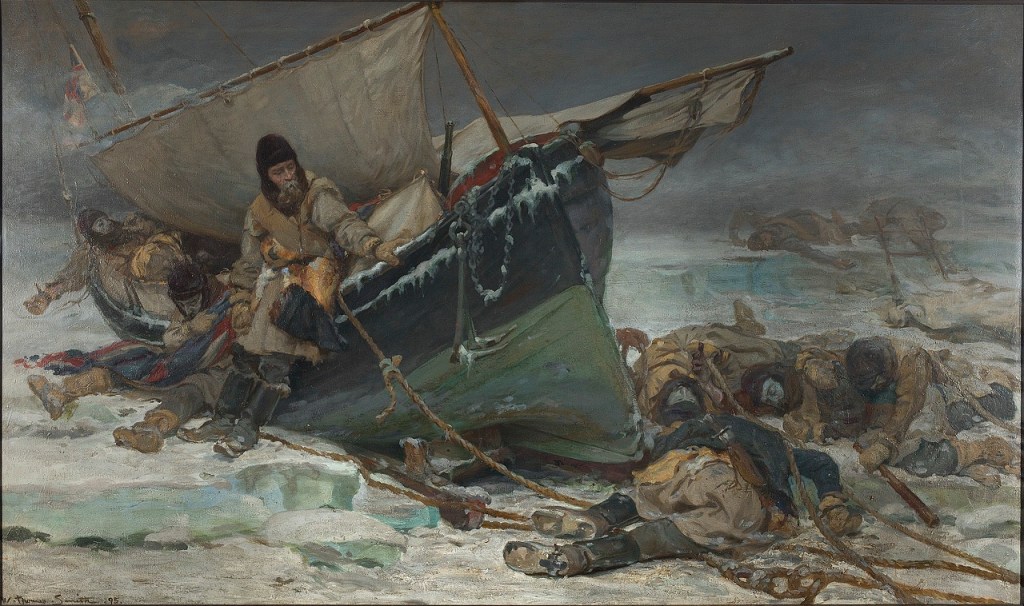
HMS Phoenix, with Breadalbane supply ship behind on 18 Aug. 1853, in the same perilous conditions that Bellot, transporting despatches, was lost in. Credit: Admiral Sir Edward Augustus Inglefield, Public domain, via Wikimedia Commons

In August 1854, when Inglefield returned to the Arctic on the next resupply effort, he brought up a plaque dedicated to the memory of Bellot to be added to the Belcher column. The plaque had been commissioned by an important friend, Sir John Barrow, (Second Secretary at the Admiralty and the second Barrow heavily involved in polar exploration) and was cast in a headstone-like shape.

The monument as it appeared soon after construction, with the Bellot plaque, whose text is legible here, mounted low on the front face. The Illustrated London News, 28 October 1854[detail of] Unidentified engraver, Public domain, via Wikimedia Commons

Francis Leopold McClintock’s search expedition of 1858 brought up the last major addition to the monument: A large marble slab commissioned by Lady Jane Franklin, Sir John Franklin’s widow. The marble was inscribed with text dedicating it “To the Memory of Franklin, Crozier, Fitzjames, and all their gallant brother officers and faithful companions…” This, aptly, concluded the memorialization program on the monument by incorporating the lost explorers into the monument to the lost searchers of those explorers. The marble was to have been brought north in 1855 by an American expedition looking for Dr. Kane, commanded by Lt. Henry J. Hartstene. That expedition turned back when they located Kane, so the plaque waited at Disko, Greenland, for three years. McClintock’s expedition routed it on up (with an additional small plaque added to reference this) and deposited the marble flat on the ground in front of the column.

One of the original oddities of the monument is the metal “Post Office” letterbox panel affixed to a rear surface. Despite the prevalence of seances in Victorian England, this was not intended as a correspondence box to the lost, to communicate with the spirit world. According to an October 1854 London Illustrated News article, which featured a sketch of the monument, this letterbox was actually functional, intended for future visitors to leave letters as a receipt of having visited the Island.

Lt. Allen Young’s 1876 photograph of the monument, looking towards the beach at Beechey, with Lady Franklin’s marble on the ground and the post office plaque on the lower rear face. Credit: Allen Young “Cruise of the Pandora” (London, 1876) Page 43. Public domain via Library and Archives Canada 1984-109 NPC

In 1876, Allen Young, in HMS Pandora, revisited Beechey’s lonely shores. He had last been there while serving as Navigator on Fox, McClintock’s ship. He took a valuable photographic record of the site that was incorporated into his published journal.4 At this time the monument was painted black. Young described opening the letterbox on the monument to retrieve a single document. Pen pals were in short supply at Beechey, and the only contents were a memo left by Belcher more than two decades before.

The cenotaph, like so many other relics, wrecks, and remains at Beechey, seems to have mostly escaped the ravages of time. A half-century after its installation, in August 1904, the Canadian ship DGS Neptune visited Beechey, as part of the Dominion Government Expedition, A.P. Low commanding. This visit saw expedition members raise the marble plaque for a photograph and then reorient it to face upwards (Low’s interesting description of Beechey and the cenotaph is in this 1906 report). At this time a flagpole may have been installed at the rear or very near the monument.

The Dominion Government expedition’s visit to the memorial, 15 August 1904. A.P. Low describes how they found a note from the previous year in a sealed case attached to the rear of the cenotaph, left by Roald Amundsen, whose ship Gjoa was unlocated at this time. The note was forwarded to the Norwegian government. Credit: Albert Peter Low / Library and Archives Canada / PA-053580

During the 1922-23 visit to the monument, on one of Captain J.E. Bernier’s yearly voyages/sovereignty patrols north in CGS Arctic, the marble appears to have been set into a more secure and aesthetically pleasing angled concrete base. The head of the marble now rested just under the Bellot plaque. Other than the removal of the flagpole, and the application of white paint, the memorial has remained substantially unaltered since then. It continues to stand tall in a lonely vigil at Beechey, down through the decades. Today, the Franklin Cenotaph is a powerful site of memory connected with the search for the Northwest Passage, and an important tribute to the men who died far from home looking for lost comrades.

Capt. Bernier, CGS Arctic, with other crew at the Franklin Cenotaph, 1923. Credit: Library and Archives Canada R216, Vol. 14946, p54.

Please see our 2024/03 update to this story, where we used an archival source, William Mumford’s diary, to determine more accurate provenance of the column to a different part id the McLellan whaling ship. We still have many questions about the monument, including what dates sections of the monument were altered or rebuilt, why the small plaques were sometimes missing from archival photos, and the subsequent history of archaeology at the monument. There are many discrepancies in the sources, and we know there are folks out there who know more than us, so we are happy to stand corrected! We also hope this post spurs greater study of this important memorial. If you’ve visited Beechey Island, we’d love to see your photos!

Northwest Territories Commissioner Stuart Hodgson (at left – the creator of the Franklin Probe, a maritime historian and a Canadian naval veteran) and others help replace the Cenotaph plaques with replicas during a July 1978 visit.

  1. This cenotaph may even be unique on Canada. We have never heard of one that commemorates not just senior officers but the regular sailors and marines of military ships, erected before the 20th century. A hundred years earlier, the terrible loss of more than a thousand officers and enlisted men, when HMS Victory (1737-1744) sank in the English Channel, had resulted in the kind of traditional commemoration to the leader, Admiral Sir John Balchen, at Westminster Abbey. The oldest naval monument now located in Canada is Montreal’s Lord Horatio Nelson column (constructed 1809). ↩︎
  2. Thomas Morgan of HMS Investigator, who died 1854-05-22 onboard North Star, is buried nearby with the three original Franklin crewmembers. Aside from Morgan and Bellot (who is commemorated twice on this monument), the other members of search crews memorialized on the column (with their ships and dates of death) are: William Cutbush HMS Assistance 1853-02-27; Isaac Barnett HMS Assistance 1854-01-28; George Harris HMS Assistance 1854-01-09, John Ames, HMS Investigator 1853-04-11; John Boyle HMS Investigator 1853-04-05; H.H. Sainsbury HMS Investigator 1853-11-14; Thomas Mobley HMS Resolute 1852-10-19; George Drover HMS Intrepid 1852-12-12; John Coombs HMS Intrepid 1853-05-12; Thomas Hood HMS Intrepid 1854-01-02; John Kerr HMS Investigator 1853-04-13; James Wilkie HMS Intrepid 1854-02-2. These names can be verified at Maritime Memorials at RMG. ↩︎
  3. Brian D. Powell Polar Record 42 Issue 4 provides a detailed summary of the construction of this and other monuments at Beechey, and there is still more work to do on the commemorative intent of the various monuments. Other evidence for the source of the Belcher column, the whaling ship McLellan, is found in Barr and Stein’s January 2017 article “Frederick J. Krabbé, last man to see HMS Investigator afloat, May 1854” Journal of the Hakluyt Society. We have usually encountered spindles with ten or more sides as part of naval capstans. ↩︎
  4. Young had been sent in HMS Pandora to aid the 1875-76 British Arctic Expedition, which encountered many difficulties. Young’s ship, a reinforced gunboat, would be acquired as USS Jeanette for the Grealy expedition, which ended in more shipwreck and tragedy. His account The Two Voyages of the Pandora ; 1875-76 has a chapter (pp. 43-46) about Beechey with a brief description of the letter box, Northumberland House, the Mary yacht left by Sir John Ross, and other boats on the site: https://archive.org/embed/cu31924091208565 ↩︎

Breadalbane Part 3: Building a Beautiful Wreck in Miniature

One-hundred-and-seventy years ago today, a ship was dying, incredibly far North. Early on 21 August, 1853, ice suddenly penetrated the Breadalbane’s cargo holds, where vital supplies had been stored a few days previously. The crew scrambled away to safety. The ship sank like a stone in 330’ of water. All these years later, what remains of this relic of the great searches to find the lost Sir John Franklin Expedition? What if today we had the technology to “Drain the Barrow Strait” (to borrow a National Geographic-inspired dramatic device) and check up on Breadalbane? Well, on this important day, we are doing just that – in reduced scale!

“A ship above and a ship below”–The wreck diorama accompanied by a contemporary view. E.A. Inglefield’s illustration of HMS Phoenix towing the ship, Credit Library and Archives Canada mikan 2837866 AND http://www.warsearcher.com

This third post will show our construction of an archaeologically-inspired scale diorama of the Breadalbane wreck site–part of the Beechey Island National Historic Site of Canada. The first post summarized the loss of this supply ship in the High Arctic in Aug. 1853, while provisioning search expeditions looking for the Franklin Expedition. The second post described the original 1980s discovery and exploration of the wreck. A fourth post explores the wreck based on Parks Canada’s 2014 visit.

330” scale feet–or 28 inches–under snow and ice, lies the Breadalbane model, represented at her 1980 moment of discovery. Credit: http://www.warsearcher.com

Following on from our work on an HMS Terror diorama during 2022, we had the idea to build Breadalbane after seeing the state of preservation and the incredible marine life populating this remote spot, south of Beechey Island, Nunavut. Photos and video from the original 1983 expedition and the 2014 check-up (the 1984 National Film Board documentary and the contemporary Canadian Broadcasting Corporation 2014 coverage and clips) show a riot of colour in the dark, freezing waters off Beechey.

In addition to the binnacle cabinet and ship’s wheel, a site of importance to the 1980s explorations, the transom has been represented with three closed scuttles, which both C.A. Inglefield’s and another contemporary illustration of the sinking show. Credit:www.warsearcher.com
Draft marks are present climbing up the stern post, with the fallen rudder and lower mizzen mast underneath. The stern post is perched a few feet off the hard bottom. Credit: http://www.warsearcher.com.
The main cargo hatch, mainmast, pumps, companionway leading down to the aft portion of the lower deck, the ship’s capstan, and the open forward face of the deckhouse. The model also has detailed interior areas of both the lower deck and main hold, which may be explored in a future post. Credit: http://www.warsearcher.com

The Breadalbane was a casualty of Beechey Island’s local conditions, like the three Franklin crewmembers (and one HMS Investigator member) buried nearby, so we gave the diorama a nameplate inspired by the original 1840s-1850s appearance of the Beechey gravestones: Black board with white lettering.

The model’s bows, showing the placement of the port Bower anchor, and the damaged bowsprit and head rails. The beginnings of the copper cladding are damaged at where the stem meets the keel. Credit: http://www.warsearcher.com

The diorama was originally conceived of as an engaging way of interpreting the information gathered about the wreck by Dr. Joe MacInnis’s 1980s team and by Parks Canada’s visits to the wreck site 2012-2014. We owe both teams a debt of gratitude for supplying us information, and would like to reiterate the acknowledgements from the first post. We are not done with Beechey, or rather Beechey is not nearly done with us. Spare this sunken, beautiful barque a thought today, and stay tuned!

The starboard side, showing the deckhouse, and the enormous and fatal hole in the ship’s bilges. At the very left corner of the diorama, we chose to represent Breadalbane’s female figurehead, resting on the seafloor. This feature appears to have been sheared off during the sinking, and has not been found. Credit:www.warsearcher.com

A Balance of Doom – Ballistic Missile Submarines in 2022

K-549 KnyazVladimir 2019. Credit: https://commons.m.wikimedia.org/w/index.php?title=User:HoteitH&redlink=1 [modified]

This post totals up the number of currently operational ballistic missile submarines and their submarine-launched ballistic missile (SLBM) tubes.* These boats are mostly equipped with nuclear-armed missiles with Multiple Independently targetable Reentry Vehicle (MIRV). Missile boats or “boomers” are a premier strategic deterrence – as opposed to land-based stationary missile sites, they are difficult to target in any first strike and so present a potent retaliatory threat. Follow the links to see other submarines.

NATO Allies – 464 MIRV SLBM tubes:

United States Navy – 14X24 Ohio class SSBN LOA 560′ / 170.7 m TDISP 18,750 tons submerged

Royal Navy – 4X16 Vanguard class SSBN LOA 492′ / 150 m TDISP 15,900 tons

French Navy – 4X16 Triomphant Class SSBN LOA 453′ / 138.1 m TDISP 14,350 tons submerged

Russia – 192 MIRV SLBM tubes:

5X16 Borei Class / Project 955 SSBN LOA 557′ / 169.8 m TDISP 24,000 tons submerged

6X16 Delta IV Classes / Project 667BDRM Delfin 1X16 Delta III / Project 667BDR Calmar SSBN LOA 520′ / 158.5 m TDISP 18,200 tons submerged

China – 72 MIRV SLBM tubes:

6X12 Type 094 / 094A (NATO: Jin class) SSBN LOA 443’/ 135 m TDISP 11,ooo tons submerged

India – 24 SLBM tubes

2X12 Arihant class SSBN LOA 364′ / 110.9 m TDISP 6,000 tons. Currently armed with short or intermediate-range missiles that do not break down into MIRVs.

North Korea 1 or 2 short-ranged SLBM tubes

1X1 OR 1X2 Simpo / Gorae class SSB (Ballistic missile conventionally powered submarine) (1 active) LOA ca. 225′ / 68.6 m TDISP 1,600 tons submerged (estimate). SLBM missiles, based on observed tests are short-ranged and do not break down into MIRVs.

*At any given time, several of these boats will be undergoing dockyard work. This list does not include submarines reported to be test beds, such as the last Russian Typhoon class, Dmitriy Donskoy, or the Chinese Type 032/Qing class.

The Last of a Great Fleet of Ships: HMS Rame Head

On the 76th anniversary of her commissioning, we profile the career and end of HMS Rame Head, the last of any version of the vital wartime built Canadian Park and Fort class merchant ships known to exist.

The Shipsearcher Identification Section (SIS) go to great lengths trying to locate views of the “last” member of whole classes of ships, because it helps us add a broad range of ship types to our listings, and because the staff naval historian feels that locating views of these last ships is a worthwhile “history exercise” HISTEX.1 Recently, we stumbled across views of what looked like a US Liberty ship being scrapped near Ghent, Belgium. It took some digging, but we eventually traced the story to the last of the Canadian built Park/Fort wartime merchant ships. Today marks the 76th anniversary of her commissioning into the Royal Navy.

Rame Head laid up outside of Portsmouth, ca. 2008. Credit: Colin Babb / Derelict Ship – Portsmouth Harbour

During the Second World War’s longest battle, the Battle of the Atlantic, Canada built more than 320 large merchant ships, as one contribution to the Allied war effort against the Axis powers. Every cargo that got through the U-boat-infested waters mattered, and replacing lost merchant ships with Canadian-built hulls helped get new equipment, munitions, and other war supplies to Europe. For a small country with few shipyards, the wartime expansion of naval and merchant shipbuilding capacity, on both Atlantic and Pacific coasts, was spectacular.

Many of these ships originated out of the same basic British “North Sands” design (basically a standard Tramp steamer). The British government, desperately in need of merchant ships, had contracted American yards to build sixty “Ocean ships” in 1940. They were simple to build, with a large amount of cargo space.

A line drawing of a US-built Liberty Ship, which was very similar to both Ocean and Park designs. Credit: Kallgan, CC BY-SA 3.0 https://creativecommons.org/licenses/by-sa/3.0, via Wikimedia Commons

The Canadian government quickly agreed to build similar ships, and set to the task in 1941. Some were built with rivetted hulls (North Sands ships), many were welded (Canadian and Victory ships). At 442’ overall and about 14,400 tons displacement, these vessels were not built for grace or speed.2 The ships retained for Canada’s merchant fleet were given names of famous Canadian parks, while the ships destined for the British were named after forts.

HMS Rame Head ca. 1962 © IWM FL 17891.

HMS Rame Head was a member of the 21 ship “Beachey Head” class, which was a naval modification of the basic Fort/Park merchant ships. They were built as depot, maintenance and repair ships for the Royal Navy. The hull was launched in late November 1944 from North Vancouver Shipyards, Vancouver, BC, and Rame Head was commissioned 18 August, 1945, days after the War ended in the Pacific.
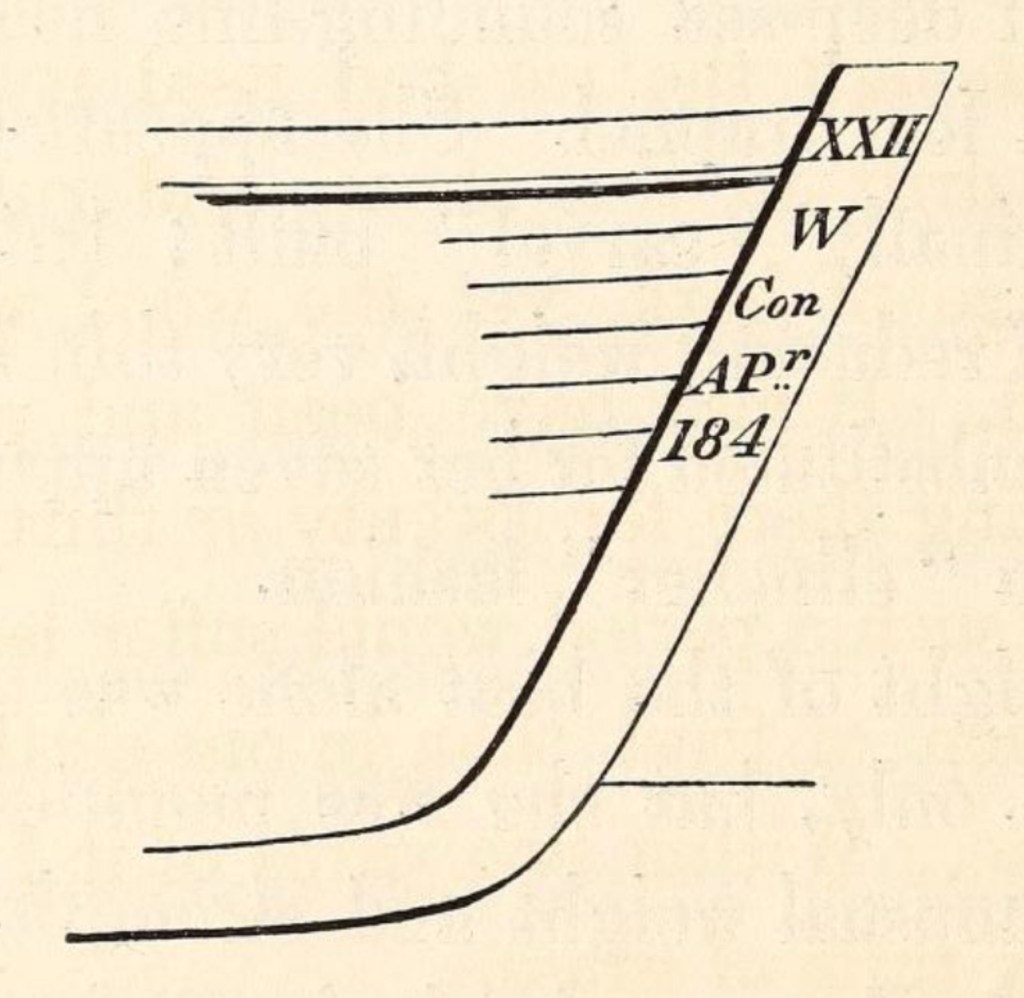
HNLMS Vulkaan, ca. 1948. built as HMS Beachy Head, before transfer to the Dutch Navy. She would later be transferred to the Canadian Navy as HMCS Cape Scott [cropped]. Credit: Nationaal Archief (Dutch National Archives) 902-5597 Snikkers / Anefo, CC0, via Wikimedia Commons
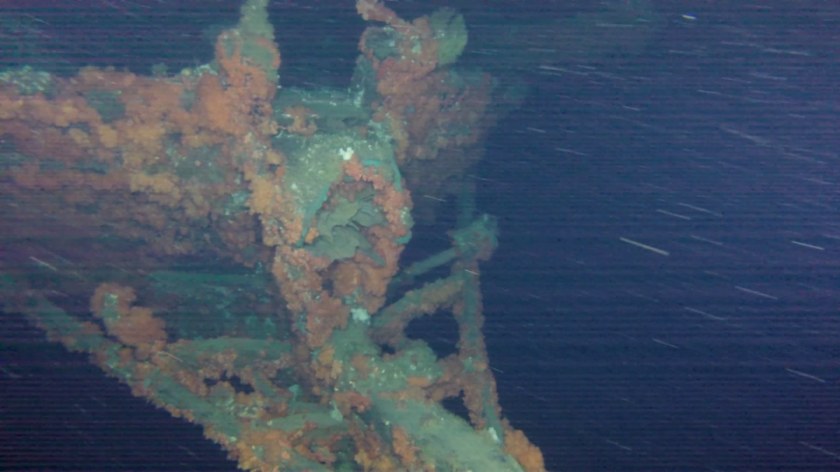
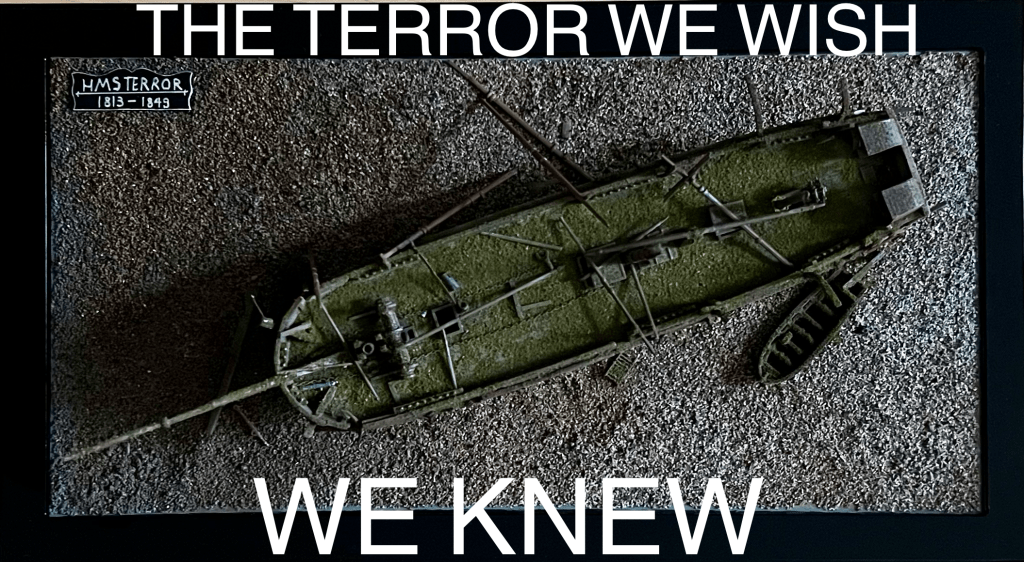
During the postwar era, she was updated several times. Starting out as an escort maintenance ship, she then served as an accommodation ship from 1972. She is most remembered for her time attached to the the naval establishment HMS Excellent, at Whale Island, near Portsmouth, berthed in the same location later occupied by HMS Bristol. She then spent many years laid up near Fareham, and was occasionally used by the Special Boat Service for assault training. With the 2001 sinking of the former HMCS Cape Breton (a very similar ex-RN repair ship originally named HMS Flamborough Head) to make a reef, Rame Head became the last Fort/Park class merchant ship in existence. By contrast, there are still three of the more numerous US-built Liberty ships (2 of which are museums), and one slightly larger Victory ship.

In early 2009, following a whole program of scrapping of retired Royal Navy ships, Rame Head was sold off to the Galloo shipbreaking group (Van Heyghen Recycling). The old hull was towed to Ghent, Belgium. A report by the Ministry of Defence outlines the major steps and challenges encountered during the dismantling of this old ship – more asbestos and more concrete ballast had to be carefully removed than was originally estimated. The report notes that only one group had put forward a proposal to save the ship. Dismantling proceeded swiftly. So went the last of the great and vital fleet of wartime Park and Fort ships.

  1. The title of this post was inspired by S.C. Heal’s book A great fleet of ships: The Canadian forts & parks ↩︎
  2. The same British J.L. Thompson & Sons design would later be used for the Liberty ships. ↩︎

Last Views of the Indian Navy / Royal Navy Carrier INS Viraat / HMS Hermes?

After more than a 50 years of service, is this the end for the Royal Navy and Indian Navy’s longtime flagship, and veteran aircraft carrier HMS Hermes / INS Viraat?

The list of decommissioned aircraft carriers preserved as museum ships or other attractions around the World is not an inspiring one. As of 2021, the only two nations which have successfully preserved carriers are the United States, and China (which has a knack for preserving Russian carriers). India operated the INS Vikrant R-11 as a museum ship at Mumbai from 2001-2012. For a time it looked like the larger INS Viraat R-22, with important service in two navies, could be preserved. Read on for the interesting history, and current status, of the INS Viraat / HMS Hermes.

INS Viraat Kochi 2015
A view we title “Viraat fading into history.” A Google splice error shows a combined view of Cochin Shipyards, Kochi in August 2015, when the INS Viraat was in for her last operational refit, and Nov. 2015.

The Centaur Class was a Second World War design meant to improve upon the earlier British Light Fleet Carriers (what became the Colossus and Majestic classes). As originally conceived, the planned class of eight ships would have had axial (or straight) flight decks. They were to be 45 feet longer and 10,000 tons heavier than their predecessors, with a length just under 740 feet and a total displacement of 28,000 tons.

HMS Hermes prewetting 1961 IWM
HMS Hermes, June 1961, with its water jets “pre-wetting” surfaces as part of the ship’s anti-nuclear fallout protection system: © IWM. A-34469

None of the ships were in service by the end of the War. Throughout the 1950s, four ships were gradually completed. HMS Hermes, which was intended originally to have been named “Elephant,” was the last finished, to the most modern upgrades, with a well-angled 743′ flight deck and powerful steam catapults to operate heavier, modern jet aircraft. These design changes gave her enhancements over her three sisters, and would result in her having a much, much longer service life.

HMS Hermes Sea Vixen trial 1961 IWM
A June 1961 demonstration of the Sea Vixen jet, one of the first generation of strike aircraft Hermes carried. This also shows the massive Type 984 “3-D” or ‘searchlight’ radar above the island:© IWM A 34466 

“Happy H,” as she was affectionately known by her crew, served in the Royal Navy from 1959 to 1984. She had a lengthy, varied career, operating in several roles. Completed as a strike carrier, in early 1970s her catapults were removed and her fixed-wing aircraft landed. First she was converted to a “Commando Carrier” with helicopters and LCVP Mk.2 landing craft to embark Royal Marine assault forces. Soon after she became an Anti-Submarine Warfare (ASW) carrier, with an air complement oriented around ASW helicopters. This new connversion was intended to counter the threat of Soviet submarines.

HMS Hermes IWM colour
HMS Hermes with the ship’s company and aircraft dressing ship, undated. This appears to depict the “Commando Carrier” phase of her career, when she operated a helicopter-only complement of Westland Wessex and Sea King Anti-Submarine helicopters, along with landing craft and vehicles for an assault force of Royal Marines. © IWM HU 101347

Her most significant modernization occurred in 1981, when in order to operate Sea Harrier STOVL (Short Take-off and Vertical Landing) jets, she was refitted with a prominent “ski jump” at the leading edge of the flight deck. She emerged from refit as a multi-role carrier, able to carry a flexible, well-rounded air complement of strike and ASW aircraft, while still being able to carry assault/landing forces.

HMS Hermes and Broadsword Falklands
HMS Hermes with HMS Broadsword, Apr.-June 1982, Falklands Conflict. Hermes shows the recently installed ski jump. Copyright: © IWM. MH-27508

Her service as flagship during the Falklands War stands out. Hermes left for the South Atlantic from HM Naval Dockyard Portsmouth 5 April, 1982, only 3 days after the Argentine landings on the Falklands. Hermes led a powerful task force which included the new carrier, HMS Invincible R-05, the nuclear-powered submarine HMS Conqueror, destroyers and frigates and other ships. This force eventually expanded to include more than 120 ships. During the conflict, she embarked an air complement of Sea Harriers, RAF GR.3 Harriers, and Westland Sea King Anti-Submarine Warfare helicopters, and also carried a troop of Special Air Service (SAS) and Royal Marines, who were forward-deployed to other ships for assault operations. The Harriers flew combat air patrols. Intended to operate nine Sea King and 5 Harriers, while in the South Atlantic, the ship carried as many as 37 aircraft! After the end of hostilities in mid-June, Hermes went back to the usual exercises, a refit, but then wound up in reserve status by late 1983. “Happy H” was decommissioned from the Royal Navy on 12 April 1984.*

Two years later the Indian government purchased the ship, which was reconditioned at Devonport Dockyard before her departure from British waters. INS Viraat commissioned into the Indian Navy during May 1987. The acquisition of the carrier was a major development for Indian naval aviation, being significantly larger than the first carrier, INS Vikrant. Viraat was the Indian Navy’s pride and joy, serving for 26 years as the navy’s flagship, mostly homeported at Mumbai. Numerous refits at the Cochin Shipyards, Kochi kept the ship operating well into the 21st Century.

INS Vikrant and Viraat Mumbai 2010
INS Viraat R-22 (top) and the former INS Vikrant R-11, which was serving as a museum ship. This May 2010 view represents a half-century of Indian naval aviation.

As happens to all active ships in modern navies, the vessel was eventually determined to have reached the end of its service, being uneconomical to continue to safely operate. The deactivation process gained momentum during 2014-2015 and culminated in drydock work at Kochi from Aug-Sep. 2016. INS Viraat was formally decommissioned 6 March, 2017, and remained outwardly intact at her usual berth at Mumbai.

INS Viraat Mumbai 2020

A vigorous public campaign to save the ship from scrapping gained media attention during 2018-2019.  There are several reasons for preserving this unique warship. She is the last non-US aircraft carrier of any pre-1975 Cold War design…anywhere. Her incredibly long period of service with two navies adds up to about the same time as the only comparable record: USS Enterprise CVN-65’s 55+ years of service. Hermes/Viraat is a substantially older ship, with portions of the lower hull dating from before the end of the Second World War; An important flagship for both British and Indian navies, she is also one of the last remaining combatants of either side from the Falklands War, and could usefully interpret events of that time to the public; Carriers are designed to be upgraded with new technologies to combat obsolescence, but the range of technological transformations of Hermes / Viraat is unique – A ship design intended to operate piston-engined aircraft instead wound up embarking generations of jets and helicopters.

050925-N-0413R-043
INS Viraat R-22 during Exercise MALABAR 2005, with a complement of Sea Harriers, and Sea King and HAL Chetak helicopters. NARA: USN 330-CFD-DN-SD-06-05771 (PH3 Shannon E. Renfroe)

Several British and Indian efforts to preserve Viraat as a museum ship or convert her to some other use, such as an entertainment complex or hotel, failed to secure the needed funds to purchase this ship. She was sold to shipbreakers at Alang during July, 2020, and moved there in late September. Satellite imagery shows the early stages of the end of the Viraat. This veteran warship was moved inshore in early October, amidst many large merchant ships, to be taken apart by the usual groups of torch-wielding labourers.

INS Viraat scrapping Alang 2020INS Viraat scrapping Alang2 2020

The breaking began in earnest in mid-December, with the dismantling of the flight deck over the bows. By late January 2021, the flight deck was removed back almost to the island superstructure, and the hull and forward compartments had been cut down.

ins-viraat-srap-alang-sentinel-2-l1c-image-on-2020-11-08
Sentinel imagery 2021/11/08 [Edited], slightly further out than the above Google imagery. She was still mostly intact at Alang, Gujarat.

ins-viraat-scrap-alang-sentinel-2-l1c-image-on-2021-02-06
Sentinel imagery 2021/02/06 [Edited] at Alang, Gujarat. Note the clear visual evidence of the forward flight deck and bow compartments being dismantled.
And that might have been the usual ending of any number of warships we have listed or found in scrapyards or shipbreakers in our many shipsearcher naval pages, but then things went haywire! In a very unusual development, India’s Supreme Court halted the dismantling of Viraat in early February, to consider a late proposal to save the carrier. Unfortunately, this “12th hour reprieve” seems to have come too late. It is unlikely that the hulk could be used for any purpose without very costly reconstruction (though at this point we would suggest cosmetic restoration using modern materials could be an option). The following tweet, by Vishnu Som, news anchor and journalist involved in the effort to save the carrier, shows the extent of the scrapping effort:

The Staff Naval Historian and all the less-relevant personnel attached to the Shipsearcher Identification Section (SIS) will continue to update this story when more information becomes available.

Additional Resources: For views of the the INS Viraat and India’s first carrier, the INS Vikrant R-11, see the pages for Indian Navy.

For our earlier work on the scrapping of the last 1942 Light Fleet Carrier Design ship, INS Vikrant, Viraat’s longtime companion see: Last views of the Indian Navy Aircraft Carrier Vikrant

For comparative views of the scrapping of US supercarriers, see our work on the dismantling of US aircraft carriers in a recent post and more detailed page.

For a detailed look at the plan for dismantling Viraat, see Avinash Nair “Explained: Here is how INS Viraat will be taken apart at the Alang shipyard” The Indian Express 6 Oct. 2021.

*There would not be a larger aircraft carrier in RN service until the December 2017 commissioning of HMS Queen Elizabeth.

**Normally we calculate service based on first date of commissioning, and last date of decommissioning, not focusing on periods out of service for major refits or modernizations. However, for Hermes / Viraat, it makes sense to consider the period fully out of service between RN decommissioning and entry into the Indian Navy as time out of the total. Some sources claim Viraat had the longest service of any warship, but, since we have listed many, many smaller warships that continue to serve in other navies from the Second World War, and even earlier, this is not accurate.

The Loneliest Minesweeper?

Shipsearcher staff share views of the last of the Algerine class minesweepers that served in vital roles in the Second World War: HMS Minstrel / HTMS Phosamton.

Shipsearcher Identification Section (SIS) staff search extensively for satellite views of some of the last survivors of famous classes of warships. During the Second World War, the British Algerine fleet or ocean-going minesweeper design formed an important class of Allied warship. At 225 feet long and about 1,300 tons displacement, they were larger than other designs, such as the Bangor or Bathurst sweepers.

This image has an empty alt attribute; its file name is img_2177.png
A tracing of major deck features of the Algerine Minesweeper class, created for recognition purposes.

This new class could be constructed by commercial shipyards – an important feature for speeding up wartime production of the vital hulls. More than half of the 110 ships were built in Canadian shipyards: Port Arthur Shipbuilding, Toronto Shipbuilding, and Redfern Construction. These ships were all powered by reciprocating engines, while some of the British-built ships were turbine-driven. In addition to regular minesweeping duties, ships were quickly pressed into service as ocean escorts, helping to bulk up protection for the vital transatlantic convoys. The dozen Royal Canadian Navy units spent most of their wartime duty in this role, providing important service alongside River class frigates and Flower class corvettes.

A lovely original colour 1943 photograph of HMCS Sault Ste. Marie,  a Canadian-built Algerine, built by the Port Arthur Shipbuilding Co. and similar to the original configuration of HMS Minstrel. Credit: Canada. Department of National Defence / Library and Archives Canada CT-247

HMS Minstrel J-445, was one of the last ships launched from the Toronto, Ontario shipyards of Redfern Construction Company in 1945, as the war ended. Minstrel was transferred to the Royal Thai Navy In 1947 as HTMS Phosamton (or “Phosampton” depending on the source). With most of her sister-ships scrapped in the 1960s, her service stretched on and on into the early 2000s. According to 1980s editions of Jane’s Fighting Ships, she was given an engineering upgrade and modified with a large classroom deckhouse over the quarterdeck, serving as a training vessel.

An Algerine under construction in a Toronto shipyard during 1944, showing the original appearance of the stern and minesweeping gear combined with depth-charge rails. Credit: National Film Board WRM 4986, Library and Archives Canada

Most online sources still call the Phosamton the last active Algerine, serving out of Samut Prakan naval base. However, the Navypedia entry notes it was stricken (removed from service) in 2017, with other sources suggesting it was retired in 2012. A Thai news source had a more accurate updated location that we were able to look up, and images online confirm the location. This minesweeper has been located nearby at Samet Ngam since at least 2013, and shipsearcher staff very much hope that it will be saved from scrapping. However, it has been languishing in a deteriorated condition. More recent views show a large barge moored alongside. As the ship is reported to be resting on the bottom at her berth, the barge may be alongside to commence dismantling the venerable sweeper in situ. Thailand has gone to lengths to preserve other contemporary warships, after their long second careers with the Royal Thai Navy, so there is still hope for this last Algerine.

We don’t often “confirm” ship views, as many ships are pretty obvious, and if we are wrong, very few visitors to our site have ever corrected us! In this case, we sketched out the outline of the satellite view, tracing major features of the ship. We then compared this with online sources and plans in Ken MacPherson’s excellent source book on the topic Minesweepers of the Royal Canadian Navy, 1938-1945, which were themselves made from plans now held by Library and Archives Canada. It is always exciting to identify even a single survivor of a bygone era, lingering on into the present, as this allows us to explore the history of the whole class of vessels, and pester the Shipsearcher staff historian to contextualize or interpret our finds!

This google earth capture has been overlaid with a hand-drawn plan of an Algerine class minesweeper. The outlines of the enlarged classroom on the quarterdeck can be seen in the satellite view extending towards the stern.

Check out our Royal Thai Navy pages for other views of the Phosamton, and other veteran ships, originally from a variety of navies, that are being preserved.

Navies Down Under!

Two new pages explore the past and present surface warships of the Royal Australian Navy (RAN) and the Royal New Zealand Navy (RNZN). For shipsearcher staff, it was particularly challenging to locate imagery of these vessels, as they were all loaded upside down (we hope you enjoyed that truly elevated piece of imagery-related humour)!

img_1113
HMAS Vampire D-11 ca. 1959 © Australian War Memorial 301609 https://creativecommons.org/licenses/by-nc/3.0/au/

Some of the more interesting features of these pages include the RNZN 1963 views of Devonport Naval Base, Auckland’s major naval facility. The aerial views make identification of early Cold War and long-service Second World War-built warships possible. As for the RAN, the range of ship classes depicted speaks to a diversified, potent force capable of undertaking a range of missions. As always, we have taken pains to track down long out of service or preserved warships.

Loch Class D Devonport 1963
Loch Class frigate and Bathurst Class corvettes, 1963 view of Devonport near Auckland, NZ

These posts complement pages on some of the other Commonwealth navies: Royal Navy and Royal Canadian Navy

Royal Navy Shipsearcher page now up!

“Heart of Oak are our ships, jolly tars are our men, we are always ready; Steady, boys, steady, We’ll fight and we’ll conquer again and again”…so goes the chorus of Heart of Oak, the official march of the Royal Navy, Royal Marines, and several Commonwealth navies [Youtube rendition here]. The oldest ship on this new shipsearcher page – Royal Navy Surface Units – Current and Retired – is HMS Victory.

HMS Victory portsmouth 1945
HMS Victory, raising the yards in August 1945 © IWM (A 30810)

This first-rate line of battle ship was being built when Heart of Oak first appeared on the London scene to commemorate the victories of 1759. Our Royal Navy page starts with Victory and spans 260 years to the newly commissioned and largest-ever British carrier, HMS Queen Elizabeth.

HMS Queen Elizabeth R08 Halifax 2019
HMS Queen Elizabeth R-08 in Halifax NS, Sep. 2019

Another unique feature of this page is the use of the Kent County Council Archives historical aerial mosaic photos (provided to Google Earth), which allow for Second World War-era captures of ships in Chatham Royal Dockyard. These views make ship identification of famous RN ship classes, such as County Class Cruisers, and aircraft carriers possible. For the first time, we also have a category for monitors, which during the first half of the twentieth century were tubby, short vessels that mounted a few battleship-sized guns! As always, we hope you appreciate the listing, and would be happy to hear about issues with any identification: help us identify our views of unknown ships!HM Monitor Chatham Kent SWW