Fury and Hecla: Parry’s Formidable Arctic Exploration Sisters

On March 31st, 1827, Captain William Edward Parry took leave of his friends, relations, and his young wife Isabella. He boarded his beloved exploration vessel, HMS Hecla. After five expeditions searching for a Northwest Passage in the Canadian Arctic – four of which he was in overall command of – he was setting out for a different destination: The North Pole. Onboard Hecla were the latest contingent of a long line of British officers who would write their names on geographic features across both Arctic and Antarctic regions.1 His crew well-understood the hazards of polar exploration. On Parry’s last expedition Hecla’s sistership and exploration consort, HMS Fury, had been destroyed. Parry – an evangelical Christian – must have wondered, as he moved north along the English coast, if Providence and his continuing good fortune would keep them all safe on this new foray towards the top of the World.
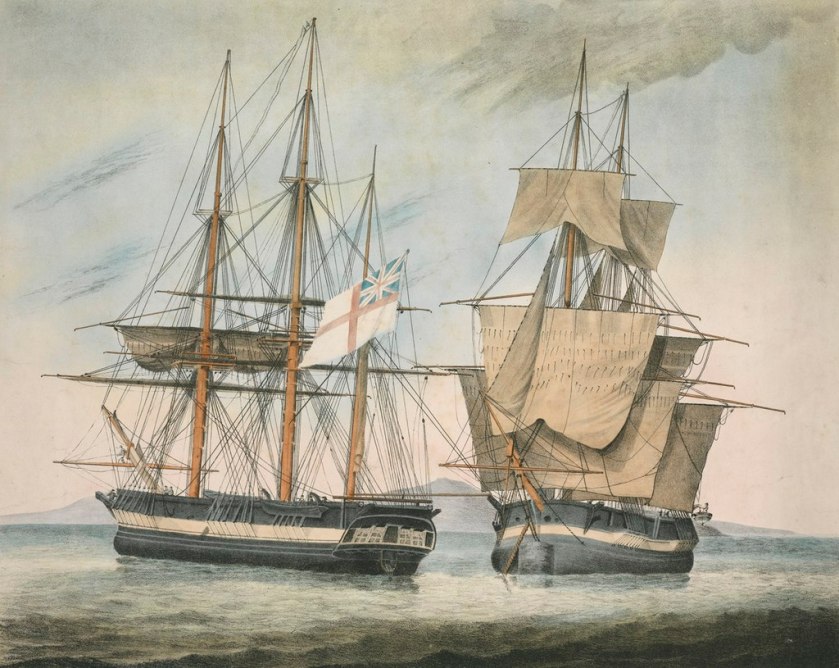
His Majesty’s Discovery ships, Fury and Hecla by Arthur Parsey (Artist & Engraver) Charles Joseph Hullmandel (Printer) in 1823. Both show “Parry scheme” modifications for Arctic service, with broadside armament and mortars removed, reinforced channels, and bow iceguards. credit: National Maritime Museum PAH9224.

Forty-five years elapsed from the Constantine Phipps North Pole Expedition until William Edward Parry’s 1819 Northwest Passage search again brought polar-modified bomb vessels back to the Arctic. The 1741 modifications to HMS Furnace had set a basic pattern for reinforcing bomb vessels to participate in polar exploration missions. The Phipps’ North Pole attempt had introduced yet more innovations.2 However, the “Parry scheme” – the identical strengthening of two sisterships – HM Ships Hecla and Fury – is the most relevant precedent for the modifications of the final, and ill-fated bombs, HM Ships Terror and then Erebus.

Both Hecla and Fury were laid down in 1813, and completed at the very twilight of the Napoleonic Wars. The Hecla class was a slight enlargement of the Vesuvius class bomb vessels.3 They were 105′ / 32m long on the gundeck, 28.5′ /8.7m in maximum beam, and displaced about 375 tons.4 Like the previous exploration bombs Furnace, Racehorse, and Carcass, these two sisterships had participated in a military campaign in their intended role: Firing bombs or carcasses (incendiary shells) from their main armament of a 10” and 13″ mortars. Both had been members of Admiral Edward Pellew’s fleet during the Bombardment of Algiers, 27 August 1816. They, along with the other bomb vessels Beelzebub and Infernal, fired hundreds of shells into the defences, harbour, and city, and were present the next day when the Dey of Algiers capitulated.
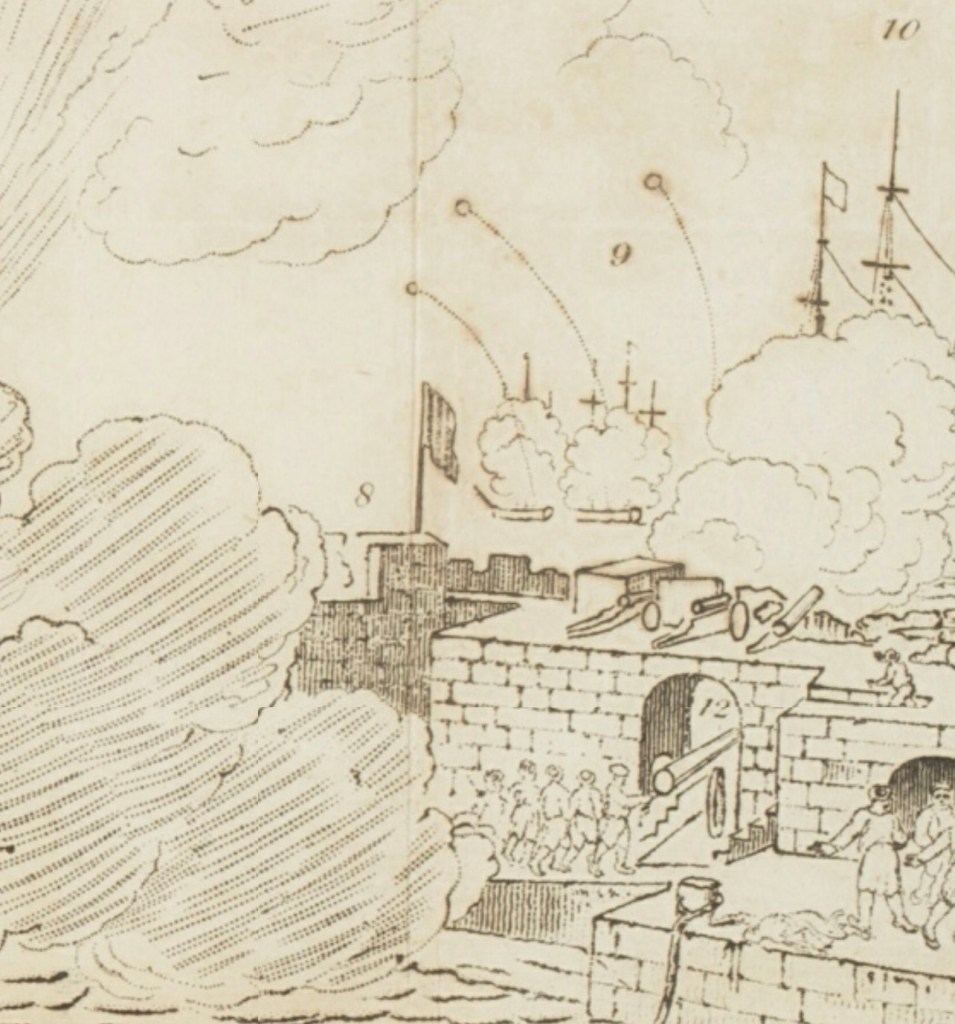
A detail of a panoramic illustration of the Bombardment of Algiers, showing Hecla, Fury and Belzebub firing bombs on a high trajectory. A section of the fortified harbour wall and a great gun are in the foreground. Panoramic views of various places : collection of pamphlets describing panoramas on exhibition in London, 1818 -1832 [detail of panoramic illustration] Credit: State Library of New South Wales DSM/791/PA1

Hecla’s first exposure to Arctic service involved conversion for a Northwest Passage expedition. This mission followed up on John Ross’s recent voyage, which had used two converted whaling ships, Isabella and Alexander, to revive the whole program of Admiralty polar exploration.5 Lieutenant William Edward Parry (who had commanded Alexander) would now make his own effort to solve the great cartographic mystery at the top of North America: was there a navigable passage from Baffin Bay through to the Western Arctic?6 Parry was also directed to try to resolve the cartographic confusion that John Ross’s mission had raised.7 His methodical approach to preparing for polar exploration involved thoughtful consideration of the unique environment his crews would operate in, an almost fanatical attention to technical details of the ships, equipment, and supplies, and careful planning for unanticipated situations.

Capt. William Edward Parry, Commander of the Polar Expeditions (on the print this is updated from 1819-1827). Credit: Credit: Library and Archives Canada, Acc. No. 1939-159-1.

Hecla was accompanied by HMS Griper (Matthew Liddon commanding). Griper was a gunbrig: a much smaller type that was about 85’/26m long on the gundeck and displaced only 180 tons. The pairing of a lead ship with a smaller consort had been a feature of prior expeditions. The reinforcement of the ships combined the best features of previous refits. Parry’s expedition made remarkable progress westwards into the uncharted Arctic Archipelago at the top of the North American landmass. The crews overwintered, in their carefully prepared and housed-over ships, in the midst of their discovery mission.8 This frozen pause, far north of the Arctic Circle, was a first for the Admiralty exploration program.

This image of Hecla on her first mission, housed over for overwintering at Melville Island with Griper nearby, is take from The frozen zone and its explorers; a comprehensive record of voyages, travels, discoveries, adventures and whale-fishing in the Arctic regions for one thousand years, an 1874 publication. Internet Archive Book Images, No restrictions, via Wikimedia Commons

Parry penetrated the Arctic as far west as Cape Providence at the southwestern tip of Melville Island (beyond 113° degrees longitude west of Greenwich). With the (brief) navigation season rapidly closing, he chose to winter at a suitable bay back along the southern coast. As the ice was setting in, they had to cut their way in to “Winter Harbour” using ice saws. Parry kept his ships safe and his crews relatively healthy during this 10-month period. He even continued the exploration mission overland by leading treks to survey the northern coast of Melville, where he discovered Hecla and Griper Bay. Early the next exploration season, he was turned back from further progress westwards by pack ice. The two ships arrived home to wild enthusiasm in October 1820.
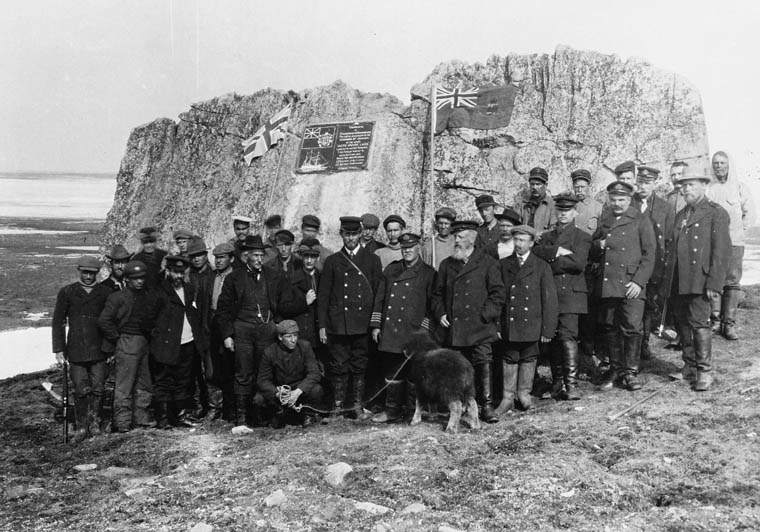
Captain Joseph-Elzéar Bernier and the crew of the CGS Arctic visit Parry’s rock at Winter Harbour, on 1 July 1909. They erected a commemorative plaque, alongside carvings made by Parry’s crew in 1819-1820, which would become important to Canadian sovereignty claims over the Arctic. This is now a National Historic Site of Canada. Credit: Library and Archives Canada C-001198

In preparation for Parry’s next mission to the Arctic, HMS Fury was reinforced to the same standard as Hecla, to become Parry’s lead ship in a new effort to locate a passage west. Hecla was commanded by George Francis Lyon. This dual refit, starting in late 1820 at Deptford Dockyard, represents the beginning of the classical age of the Admiralty’s program of strengthening ships for polar service: Here two sisterships were identically outfitted, to operate in tandem. In the event of the loss of one ship, both crews could be fully accommodated on the remaining ship.9 Parry described this important refit in detail in the published journal of his second expedition.10 In the wake of his first expedition, and frustrating experiences sailing in company with the slower Griper, he now rejected the convention that a lighter vessel, acting as a consort, could explore inshore waters more effectively than two evenly-matched ships. He emphasized that all inshore surveying could be completed by detached boat crews (who have the light vessels with minimal draft to best exploit inshore charting opportunities). He argued that ships of the same design could better survey a larger area (with independent charting of whole stretches of coastline a possibility). In order to ensure that sailing performance was as even as possible, he adopted what he called an “equalized rig” between ships. This went beyond merely ensuring that the three-masted barque rig of both ships was identical, because the fore and main masts were fitted with the exact same lengths of spar for a given sail type between both masts. This meant that four masts between two ships had the exact same spar dimensions for courses, topsails, and topgallant and studding sails – something that would greatly simplify repairs in case of damage to the top hamper.

The draught plans of the original Hecla class design of 1813 (upper ZAZ5687), and an internal arrangement plan of the modifications to Fury for the 1821 NW passage mission (lower ZAZ5696) © Crown copyright. National Maritime Museum, Greenwich, London

The original Admiralty plans, now preserved at the National Maritime Museum at Greenwich, show a more thorough conversion for Arctic service than any prior British vessel had undergone. In contrast to Racehorse and Carcass, Parry’s ships received a full weatherdeck, which united the quarterdeck, foc’sl, and the intervening space amidships. This decking enclosed a much larger internal space which could protect crews from foul weather and, more importantly, Arctic conditions. Fury and Hecla were the first bombs to be so heavily modified that no internal traces remained of their original mortar beds. They also were the first to have all gun-ports fully omitted (planked over). The fragile channels (where the shrouds connect down to the hull outboard of the rails) were filled in by ice chocks, as they had been on HMS Furnace in 1741. Massive timbers – Heavy bolsters and hooks – strengthened the bows. Parry’s ships had doubled planking on the exterior (which was thicker than what had been fitted to Hecla and Griper for the earlier mission). This ran all the way up to deck-level. The outer layer noticeably thickened at the waterline. Heavy iron strengthening bolted through the knees and keelson, spirketting (reinforced timbers) ran lengthwise, bolted into the frames at different levels. A full double layer of “footwailing” sheathed the area inside the frames of the lower hull (interior paneling in the hold which was laid diagonal for further strength). A sectional plan helps us further interpret the details of these massively strengthened vessels:

HMS Fury sectional plan, 1821 (ZAZ5700) © Crown copyright. National Maritime Museum, Greenwich, London

One of the most notable updates is the first use of diagonal deck planking on a discovery mission. This update can be seen in the uppermost layer of 3” thick decking, represented in the above plan as wider than the underlying fore-and-aft planking. The two layers made for a much stronger protective sheathing: 6” of wood, with a layer of waterproofing tar paper sandwiched in between. This strengthened decking was conventionally fastened to the underlying deck beams. The concept of diagonal decking appears to have been a recent novelty, and can be credited to a naval architect who was coming up with a whole system of new design elements to strengthen British warships: Sir Robert Seppings. Seppings had first installed diagonal decking to HMS Albion’s two gundecks in 1815. He had then arranged a comparative trial, where he had fitted it only to the port side decking of HMS Northumberland. This ship and its experimental deck were put to use from August to October 1815 to transport the deposed French Emperor, Napoleon Buonaparte, to his final exile on the island St. Helena.11 On Parry’s exploration ships, the diagonal sections flanked a central area of the deck, which had massively thickened decking – a full 6″ thick – running lengthwise. This reinforced and buttressed decking – visible today at the wreck sites of Erebus and Terror, created a structure of incredible solidity.12

A Sylvester warming oven (furnace) of an ingenious design circulated warm air to the newly-enclosed interior spaces by flues (it can be seen shaded blue in the second plan above). Relevant to air circulation and lighting below decks, Parry also noted in passing that his ships were fitted with “illuminators,” which, in this context, would appear to be a very early instance of the installation of Preston’s Patent illuminator (which also could be called a portable deck glass and ventilator).13
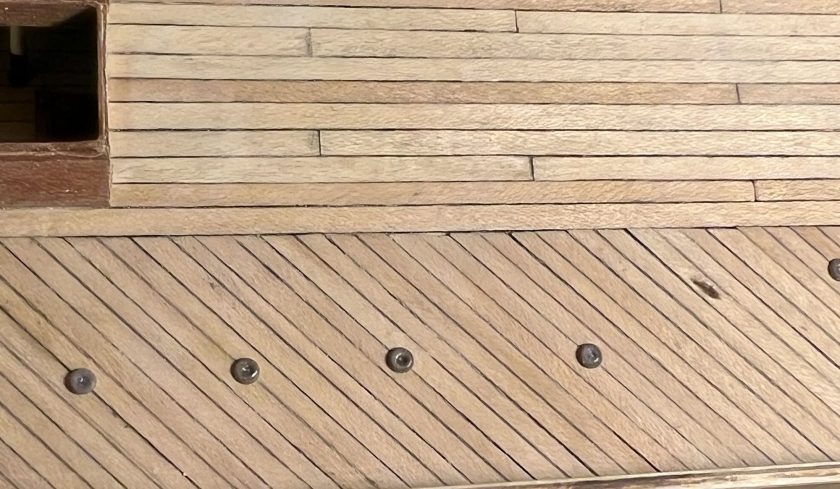
The reinforced diagonal decking and thicker central planks of a polar-modified bomb vessel looking from the main hatch forwards along the starboard side. Illuminators, which my research has established may have been fitted to Parry’s ships on his second polar expedition, and deck prisms also appear. (author’s photo of an incomplete model)

Parry’s second expedition in command (1821-1823) saw the ships overwinter first at Winter Island and then further north at Igloolik. This expedition had set yet another important polar precedent when the merchant vessel Nautilus was hired to transport some of the burden of coal and provisions across the Atlantic to Resolution Island (at the entrance to the Hudson Strait). Crew then discharged its cargo into the exploration vessels, to top up their supplies.14 No ice-free passage towards the west was located, but, in Foxe Basin, Parry did transit the Frozen Straits at the top of Southampton Island into Hudson’s Bay, finally proving the accuracy of Christopher Middleton’s 1742 surveying in HMS Furnace. Near Igloolik, he also discovered a frozen waterway stretching westwards out of the Basin, which he named Fury and Hecla Strait. Both his official publication and Lyon’s private journal (private yet officially approved to be published) include invaluable observations about local Inuit communities’ culture, social practices and daily life.15 All these decades later, Inuit communities on Igloolik Island and around the Melville Peninsula continue to preserve a rich oral tradition around the visit of Parry’s crews. In early 1823, Parry’s crews were beginning to show signs of the onset of that dreaded mariner’s disease: Scurvy. Hecla and Fury departed the Arctic in good condition for a safe return home. Despite Lyon’s remarkable ethnographic observations of Inuit community life, the actual cartographic results of the expedition could not compare to the incredible progress westwards of Parry’s first foray. Still, the public at home in Great Britain continued to be inspired by his exploration.
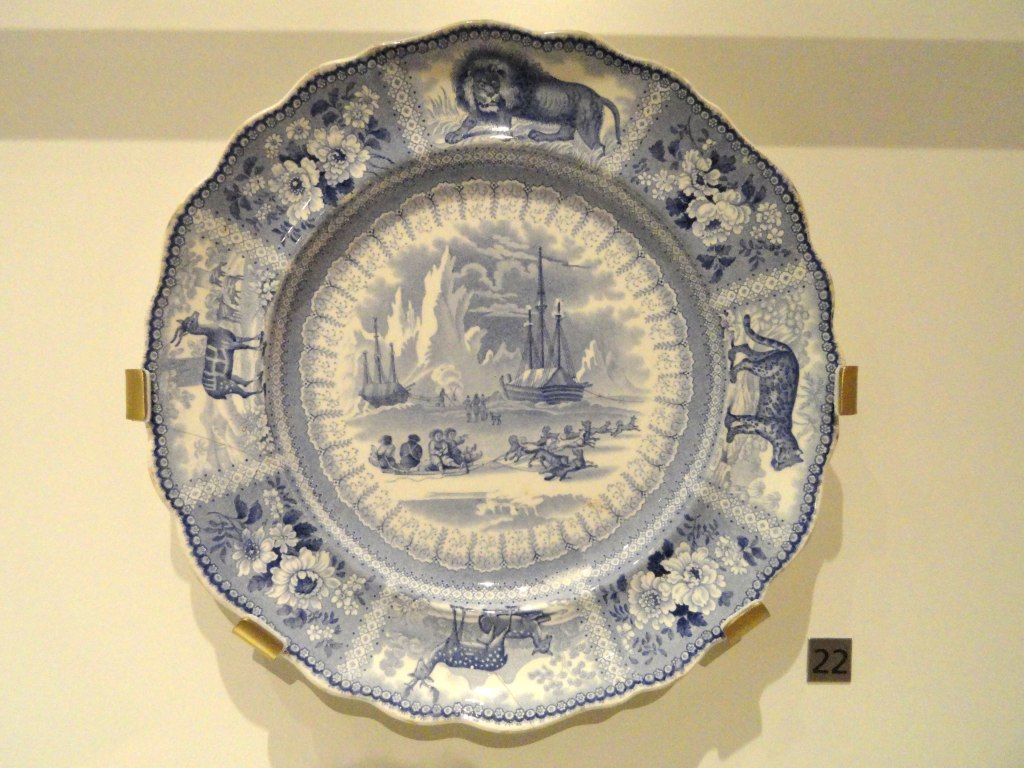
Parry’s Arctic expeditions led to widespread popular enthusiasm in Europe for depictions of Arctic adventures. A Staffordshire dish ca. 1835, shows an Arctic scene of Parry’s ships in the background, and Inuit community members with a sledge and dogs. This appears to be a inspired by a scene of Hecla and Griper at Winter Harbour, updated with events from later expeditions. Credit: Daderot, CC0, via Wikimedia Commons.

Parry immediately threw himself into the planning of yet another expedition. The discovery duo of Hecla and Fury would now look for a passage 500 km to the Northwest of Igloolik, down Prince Regent Inlet (a waterway which he had entered but not fully charted during his westward passage in 1819). Parry shifted back to Hecla. Henry Parkyns Hoppner (an experienced Arctic officer with service on all recent Parry-associated missions) took command of Fury.16 Departing England in May, 1824, the expedition again made use of a transport, the William Harris, which was unloaded at the Whalefish Islands, Greenland (now known as Kitsissut and Imerissoq). The exploration ships were delayed in crossing Baffin Bay, and had to winter at Port Bowen, on the eastern side of the Inlet. Officers and crew disliked the dreary winter site, and had misgivings about the mission to explore the Inlet.17 When finally released from the ice in late July 1825, the ships began navigating the western coast of North Somerset Land (Somerset Island’s insularity would not be proved until 1852), looking for some route to the west. It was along the dramatic cliffs of this coastline that disaster finally caught up with Parry’s crews.
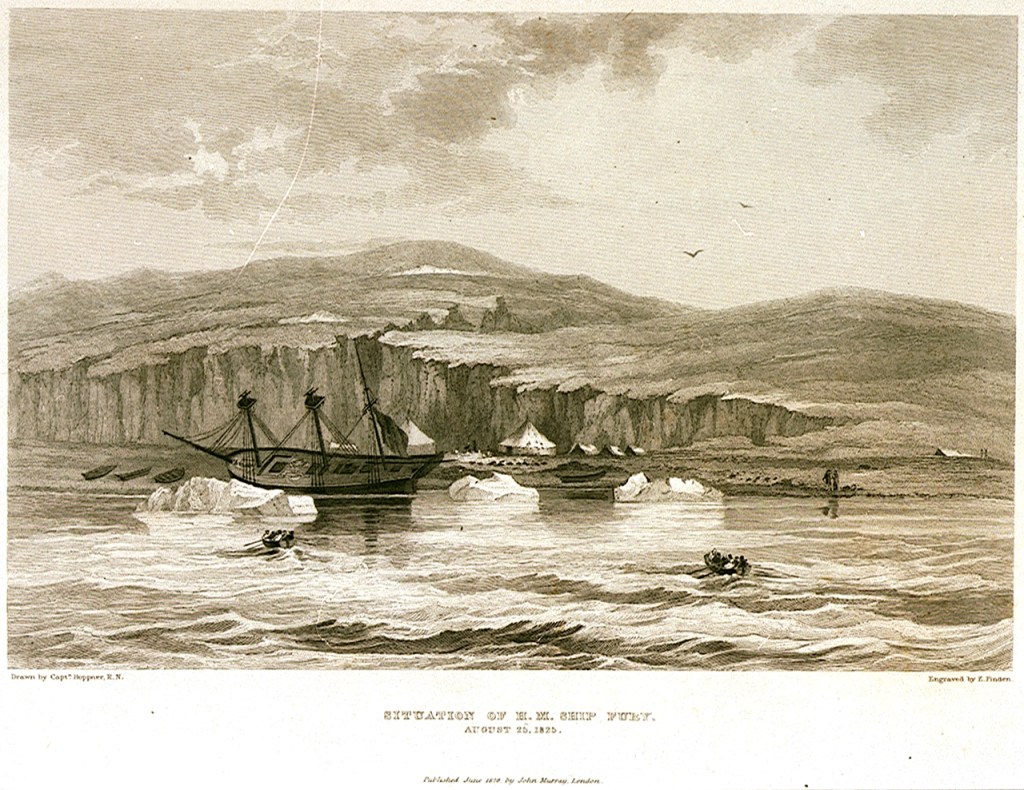
The appearance of HMS Fury on the day of her abandonment (taken from Parry’s Journal of his Third Expedition): Edward Francis Finden (engraver); Hoppner, Capt (artist); Murray, John (publisher), Public domain, via Wikimedia Commons

On the first of August, Fury and Hecla were both damaged by being nipped by ice as it crowded close in to the shores of Somerset Island. Unbeknownst to Parry, Fury was more severely wounded, and began taking on water at a prodigious rate. By the time Hoppner was able to report in, a third of the entire crew were required to work all four pumps just to keep the vessel afloat.18 A careful examination showed that, despite the phenomenal strengthening of the hull as noted above, the basic skeleton of the ship had been seriously damaged: Fury’s forefoot and sternpost were both mauled, and areas of the keel were effectively shattered.19 Parry’s published journal of the expedition relates the episodes of a worsening situation over the next week: Exhausting efforts to find a safe location to shelter the damaged vessel from further ice damage and unload her, to try and repair the hull, eventually failed when ice again crowded inshore and bodily heaved the ship up into the shallows of the beach. This further damaged the bilge areas on August 25th. Parry, returning onboard his former command, recognized the ship was doomed. He allowed Hoppner and his senior staff to carefully assess the ship. The verdict from Fury’s officers was clear: it was time to abandon their vessel and press on.20 A storage depot was created at Fury Beach, with anchors, anchor chains, spars, ships boats, and a vast supply of coal and provisions.21 Given the state of crowding and the reduction in provisions on Hecla, Parry turned aside from further exploration of the Inlet and hastened back to England. He concluded his official account of the protracted destruction of the Fury by stating “…it will be plain that an occurrence of this nature was at all times rather to be expected than otherwise, and that the only real cause for wonder has been our long exemption from such a catastrophe.”22

Remarkably, given the hazards of exploration and the amount of time he had been away from his home on these successive missions, Parry, newly-married, opted to lead one more Arctic expedition. The 1827 mission would see Hecla ordered towards a higher latitude than she had ever navigated to. Parry went from his old quest to complete a Northwest Passage to a mission aimed at the North Pole. This would revisit the site of both Constantine Phipps’ 1773 expedition, and the recent David Buchan and John Franklin 1818 journey towards the Pole: the Svalbard archipelago. The overall plan had actually been thought up by Franklin. John Barrow, Second Secretary at the Admiralty, forwarded it on to Franklin’s friend Parry.23 This time, his venerable exploration vessel would serve as a base ship for a further effort to push north, by carrying up two specially-constructed boats (named Enterprise and Endeavour). The 20′ long boats were fitted with conspicuous steel runners that reached down to the ice from the bilges, and could also be moved on wheels. They were ingeniously fortified, double-planked, and protected by inner layers of felt and Mackintosh waterproof canvas. Their design had been the result of a collaboration of expert naval architects Henry Peake and Oliver Lang.24 After Hecla reached Treurenberg Bay (Sorgfjorden), the two boat crews, commanded by Parry and James Clark Ross, John Ross’s nephew, sledged northwards from Hakluyt’s Headland on pack ice, in difficult conditions.25 Where the plan had envisioned a rapid sledge up to the Pole over smooth expanses of pack ice, the crews encountered a torturous, broken landscape. They reached a furthest north record of 82° 45′ before turning back, exhaused, for the shelter of their ship.26
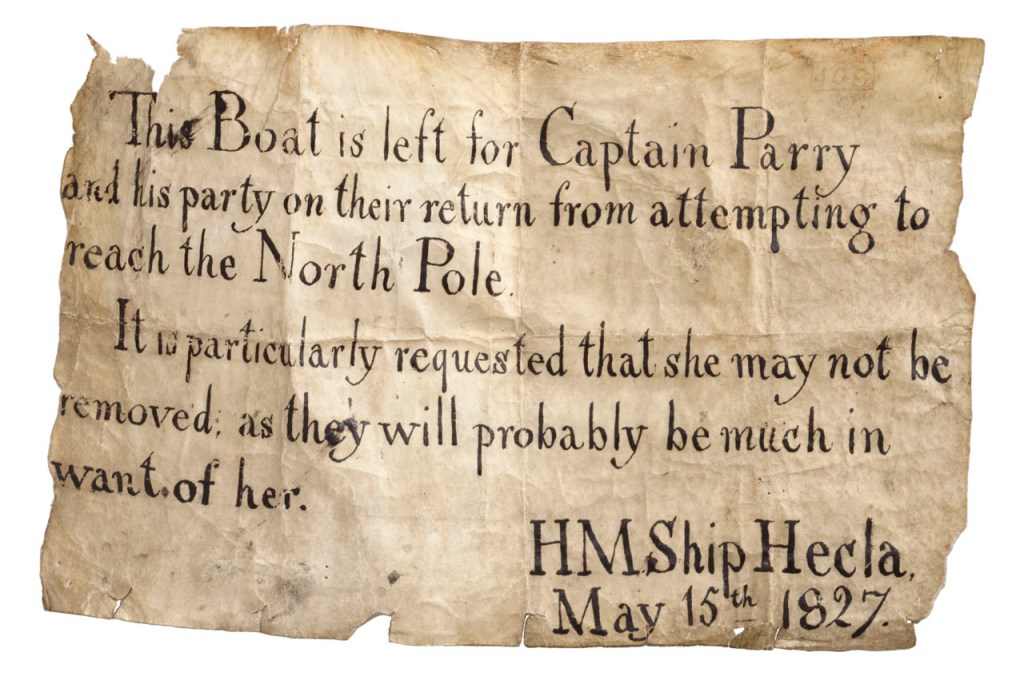
A note left by Parry’s crew, remaining with Hecla, to ensure that no one else absconded with a depot boat left to assist with the return from their polar mission. Credit: National Maritime Museum, Greenwich, London, Royal United Service Institution Collection (AAA3957)

And with her safe return to England from yet another record-setting mission – a highest north latitude that would stand for fifty years – Hecla reached the end of her Arctic exploration career. She was converted to the complimentary role of survey ship (to chart temperate waters, like several of the other surviving bomb vessels), and worked along the coasts of West Africa. Sold out of naval service in 1831, she was first used as a general cargo vessel and then converted to become a whaling ship for the 1835 season. Lloyd’s Register (LR) Foundation Archivist Max Wilson has located important documents to track the interesting history of Hecla’s commercial service. As Wilson notes: “Ironically Hecla was to hunt in the exact area she had opened up to whaling and explored in 1819.”27 She continued to endure Arctic punishment on annual whaling journeys to the familiar waters of the Davis Strait until she was wrecked there in 1840.28 Like her lost sister Fury, Hecla’s final resting spot has not yet been located.

With popular enthusiasm for exploration sustained by the published accounts of Parry’s exploits, the Admiralty turned to other modified bomb vessels to continue the exploration of polar regions. In late 1835, even as Hecla continued plying northern waters, there was a sudden need to rescue the crews of some of her fellow whaling ships: A dozen ships had become trapped in the pack ice of the Davis Strait. A slightly smaller, older bomb vessel, laid up at Portsmouth, was rushed into refit: HMS Terror.29 The scene was now set for the final conversions of the bomb vessel type to polar exploration ships.

This concludes our series of blog posts exploring the history of every bomb vessel that was converted to a polar discovery ship: HM Ships Furnace, Racehorse and Carcass, Hecla and Fury, Erebus and Terror.

Click for Endnotes
Christopher Middleton – the First Royal Navy Arctic Explorer – Crosses the Line in 1742

Traditionally, the Royal Navy’s program of Arctic exploration is represented as having commenced with the Constantine Phipps Expedition towards the North Pole in 1773.1 Phipps and his crews pushed north to above 80° latitude near Spitzbergen, before having to turn for home. Though the Phipps Expedition set many precedents for later polar exploration missions, it is Captain Christopher Middleton who deserves wider recognition for his trailblazing 1741-1742 Hudson’s Bay Expedition .2 This was the first Admiralty mission to search for a Northwest Passage.3 I will argue that Middleton also deserves credit for commanding the first Royal Navy expedition to explore an area north of the Arctic Circle.4 He had reached this far north in the first bomb vessel modified for northern exploration (which set the precedent for a century of discovery missions).5 During his time in Hudson’s Bay, he conducted a program of scientific research spanning several disciplines. After he arrived back in England, a dispute with Arthur Dobbs – his armchair-cartographer nemesis -marred his reputation and cast doubt upon his important discoveries.

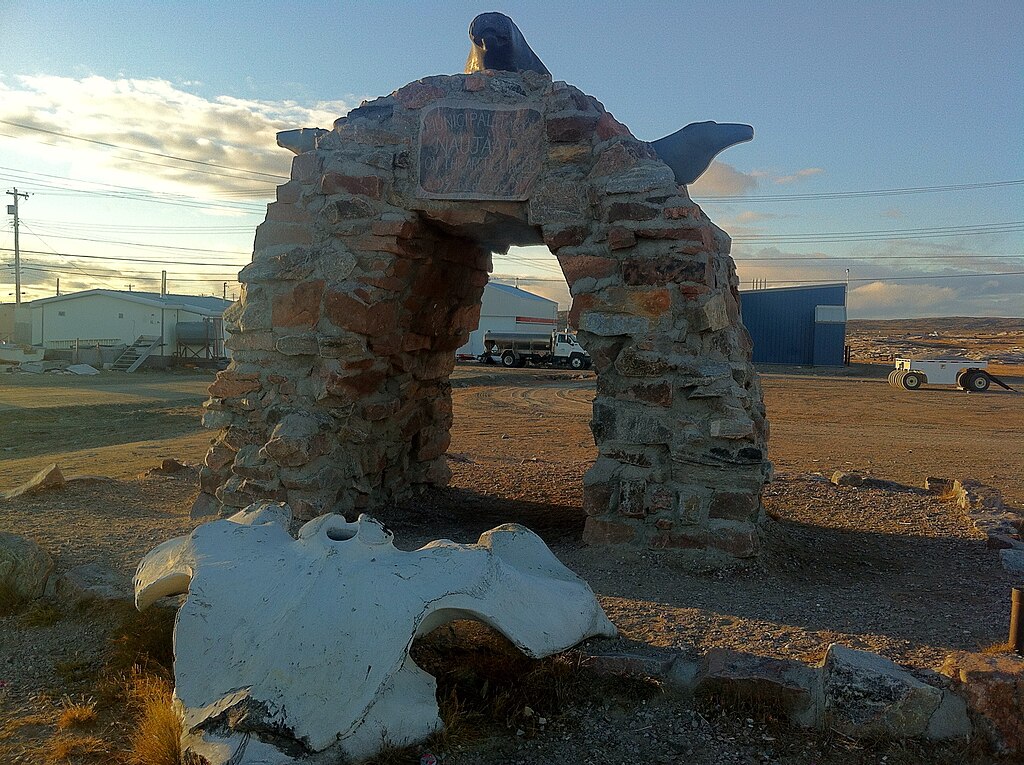
The Naujaat Arctic Circle Arch, a gateway to the Canadian Arctic. Credit: Wes Gill from Winnipeg, Canada, CC BY-SA 2.0 https://creativecommons.org/licenses/by-sa/2.0, via Wikimedia Commons

Early on the morning of August 7th, 1742, Captain Christopher Middleton nervously paced the quarterdeck of His Majesty’s Ship Furnace.6 He and his crew believed they were on the threshold of a historic discovery: A northwest passage towards the “South Sea” (the Pacific Ocean). These explorers had diligently clawed their way up Roes Welcome Sound, between the northwestern shores of Hudson’s Bay and Southampton Island. Standing into danger, they had picked their way around “islands of ice” (icebergs) and “ledges” (land floes). When they could find no favourable winds, they had even used cables anchored to the ice to haul the ships north from berg to berg.7

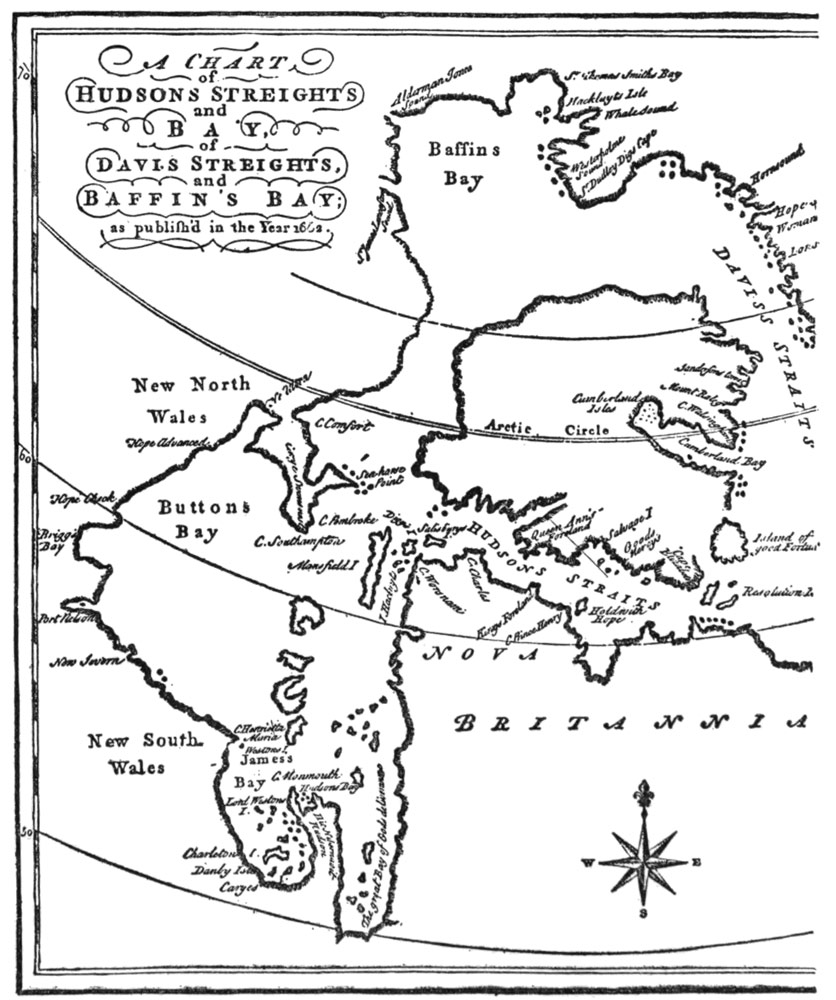
A Chart of Hudson’s Straits and Bay, of Davis Straits, and Baffin’s Bay; as published in the Year 1668. This shows the extent of knowledge about the Bay after the Henry Hudson, Thomas Button, Luke Foxe, and Thomas James expeditions of the first half of the seventeenth century. “Buttons Bay” and much of the NW and SW coasts of the Bay was conjectural.8

In the hazy morning twilight of those extended northern days, Furnace had been working around a promontory which Middleton had just named “Cape Hope.” He believed this could represent the “extreme part of America,” (or the northern most point of the North American continental landmass) a major milestone along the way of achieving his Admiralty mission to discover the fabled maritime route westwards.9

Zenith Point, Murchison Promontory, on the southern shores of the Bellot Strait, is the highest point of land of continental North America, or what Middleton would have called the “extreme part of America.” It was discovered in 1852 by William Kennedy and Joseph-René Bellot. It is an important waypoint on one of the main routes of the actual Northwest Passage through the Arctic Archipelago, and is located at 72’00’06” latitude north, 740 km NNW of Middleton’s Cape Hope. Photo by author, 5 Sep. 2025.

Middleton was a skilled navigator, who had outfitted his ships with the latest navigational devices. He employed these to survey under exceptionally challenging circumstances.10 His career had prepared him for the rigors of commanding a discovery mission in the Bay.11 After early service aboard a privateer in North American waters (during Queen Anne’s War, 1702-1713), he had worked for many seasons as a merchant captain with the Hudson’s Bay Company (HBC), sailing between England and the HBC factories of the Bay on yearly supply missions.12 His experiences commanding HBC sloops had led him to enthusiastically support a popular European belief that the undiscovered shores of the Bay concealed the beginnings of the Northwest Passage.13 In early 1741, with the support of an influential ally and confidant, Arthur Dobbs, he had left HBC service to secure the command of an official Royal Navy exploration mission.14 The crews of his two ships – Furnace and the small tender Discovery – were the first Europeans to navigate these waters (whose adjoining lands were the ancestral territory of the Aivilingmiut Inuit).15 They had endured many hardships since departing England on 8 June, 1741. A dozen of their mates had already perished.16 The dedicated assistance of both the HBC staff and local indigenous communities at and around the post at Churchill, over the winter of 1741-42, had prevented a much greater loss of life.17

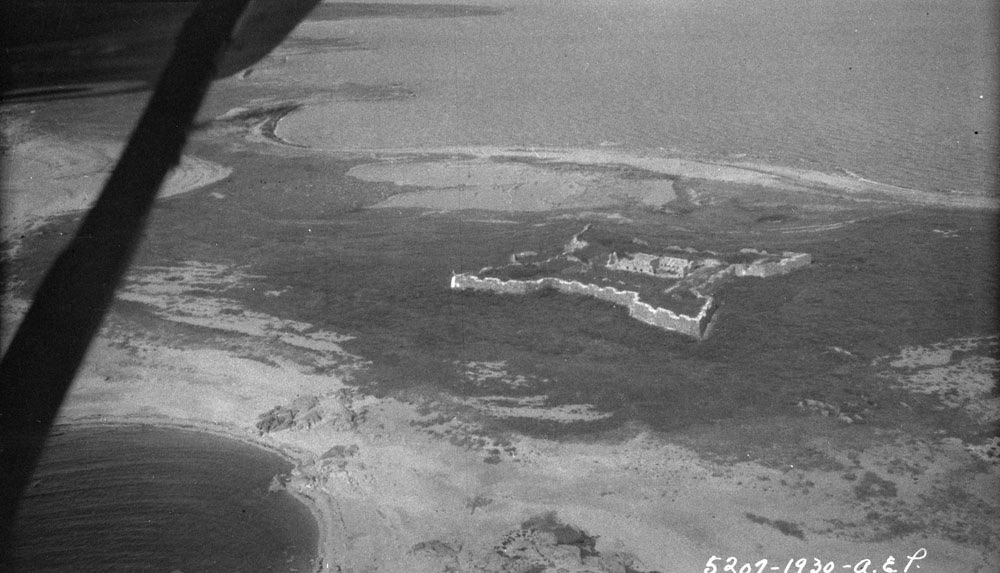
Prince of Wales Fort, aerial view from 1930. The fort sheltered the Middleton Expedition’s senior staff at Churchill, while the crew were lodged in the old, disused post upriver. Middleton, during his HBC career, had been involved in this massive fortification’s original design.18 Credit: Alf Erling Porsild / Department of Indian Affairs and Northern Development fonds / Library and Archives Canada / a101002-v8

As the sun burned off the haze, the watch on deck sighted high land continuing westwards from under the cape – So far, so good. But then a low shoreline materialized across Furnace’s stout bows. The land stretched around to the starboard beam. This day would bring no happy run far to the west – Christopher Middleton had discovered another bay.19 Disappointed at being “embayed” and turned away from his main objective, he named these waters “the Bay of Repulse” (the Inuktitut name for these enclosed waters is Aiviliup Tariunga). The next few days would see the expedition halted from further progress north by an impassable barrier of ice at the top of Southampton Island. The captain went ashore with two healthy crew members and an indigenous guide, climbed to the highest point he could find, and surveyed the distant shores. From this vantage he saw an iced-over passage extending towards the east, and named this the “Frozen Strait.”20 Given what would befall him upon his return home, Middleton may well have lived to regret ever having been up here in 1742. Today we can acknowledge that he started something in this northwest corner of Hudson’s Bay: An organized program of northern discovery that would eventually see the mapping of vast extents of what would become the Canadian Arctic.

The entry from Furnace’s ship’s log for 6 August 1742, illustrating the hopes and then disappointment of the crew. A selection of the log is reproduced in his Vindication. (Cited below) Middleton’s observed position for this day was 66°44’ north. 21
Click Here to Continue exploring Northwards

Where we poor sailors do sometimes dwell – The Middleton Northwest Passage Expedition Roll of Honour

This post commemorates the sailors who perished during Christopher Middleton’s Royal Navy exploration mission to Hudson’s Bay (1741-42).1 It can serve as a Roll of Honour for these early explorers. For the context to this effort to locate the fabled passage to the Pacific in the waters of Hudson’s Bay, please see our post on HMS Furnace‘s unique exploration design. Our next post will argue that Middleton’s ship crews should be considered the first Royal Navy polar explorers.

Throughout the many wars and infrequent peace of the eighteenth century, the Royal Navy expanded into a massive fleet sailing from establishments strategically located along the seaborne trade routes. This growth came at a tragic cost: the human toll of crewing this British “wooden world” was staggering.2 Amidst all this death, it may seem odd to commemorate a dozen seafaring explorers who died in an incredibly remote outpost of British Empire. These were some of the very first deaths in a program of British naval exploration of what is now Canada.3 They would not be the last.

Christopher Middleton’s Northwest Passage Expedition departed the Nore, 8 June 1741. He had experienced significant problems filling out the complements of both his small ships, at their anchorage of Gallions Reach, near Woolwich.4 The seamen who wound up crossing the Atlantic to go looking for a northwest passage in Hudson’s Bay included conscripted men.5 According to their commanding officer, these ninety men were a “crew of rogues.”6 After transiting the Hudson’s Straits into the Bay, a council of officers decided to head for the Churchill River (present-day Manitoba), to overwinter. They would commence their search mission early the next navigation season. At their arrival near the Hudson’s Bay Company (HBC) establishment, Fort Prince of Wales, crews laboriously cut both ships into secure docks to overwinter in Sloop Cove.

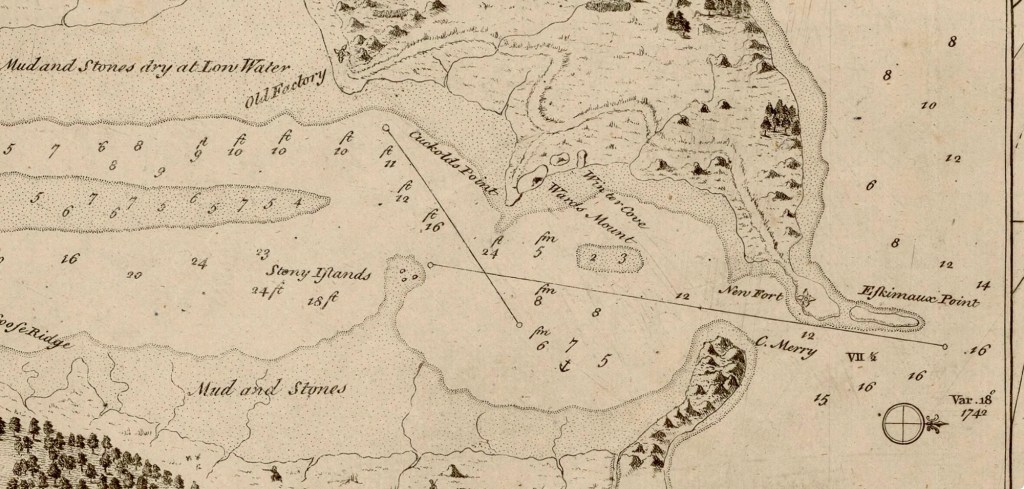
John Wigate’s map, “Chart of the seas thro which H. M. S. Furnace passed for discovering a passage from Hudson’s Bay to the South Sea.” Despite falsified sections of the NW coast of Hudson’s Bay (to support Arthur Dobbs’ spurious claims), this 1746 map includes this remarkably accurate inset plan of the mouth of Churchill River. On the northern shore, the “Old Factory,” Sloop Cove (“Winter Cove”), and the impressive Vauban-style “New Fort” are clearly indicated. If any of the crew were buried ashore, they should be located closer to the old factory. Credit:
Bibliothèque nationale de France, département Cartes et plans, GE SH 18 PF 123 DIV 3 P 6 via Wikimedia commons.

These northern explorers weren’t equipped with the types of cold weather gear that later expeditions would benefit from. While the officers were lodged at the new fort, crew spent a difficult winter billeted in the “Old Factory,” the former HBC trading post. Several members suffered from frost bite, and the naval surgeons were routinely called over to the old HBC factory to amputate damaged toes before gangrene spread. Worse still, scurvy made an early appearance in the Fall. This dreaded mariner’s disease continued to be a feature of the Expedition all the way back to the Thames, and would eventually claim ten lives. But for Middleton’s desperate attempts to secure fresh meat and vegetables, and the intervention of local indigenous hunters (from the Dene and Cree communities who traded near the HBC Fort and who supplied the expedition with huge quantities of foul), there would have been many more deaths.

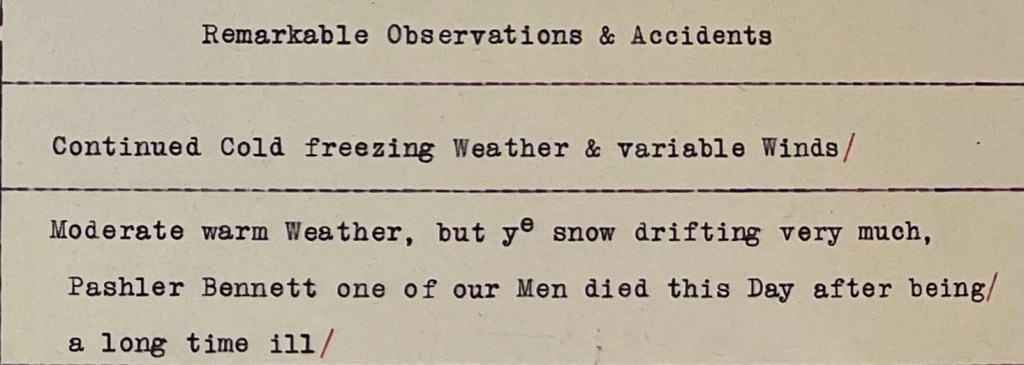
The transcribed page of the journal for 29 December 1741, recording P. Bennett’s death – the first Middleton Expedition death at Churchill. Credit: Library and Archives Canada, Arthur Dobbs fonds, LAC MG18-D-4 volume 4.

I feel it important to compile the names of these early explorers, their dates of death, and the causes, based on the original expedition journal entries and associated contextual documents found in William Barr and Glyndwr Williams’ edited Hakluyt Society publication:


William Clark, sailmaker Furnace 28 July 1741 drowned after a fall from fore shrouds in Hudson’s Straits7;

Pashler Bennett (or possibly “Paskler Bennet” 29 Dec. 1741 (scurvy at Churchill)8;

Christopher Row 13 February 1742 (scurvy at Churchill);

Edward Matthews 21 February 1742 (scurvy at Churchill);

Abraham Page 13 March 1742 (scurvy at Churchill);

John Blair 21 March 1742 (scurvy at Churchill);

Henry Spencer 26 March 1742 (scurvy at Churchill);

James Thrumshaw 28 March 1742 (scurvy at Churchill);

Ralph Pearce Carpenter’s Mate Discovery 9 April 1742 (scurvy at Churchill);

John Furnix 24 May 1742 (scurvy at Churchill)9;

Robert Rattery 31 May 1742 (scurvy at Churchill);

John Matthews Master’s Servant Furnace 20 June 1742 (drowned at Sloop Cove near Churchill)

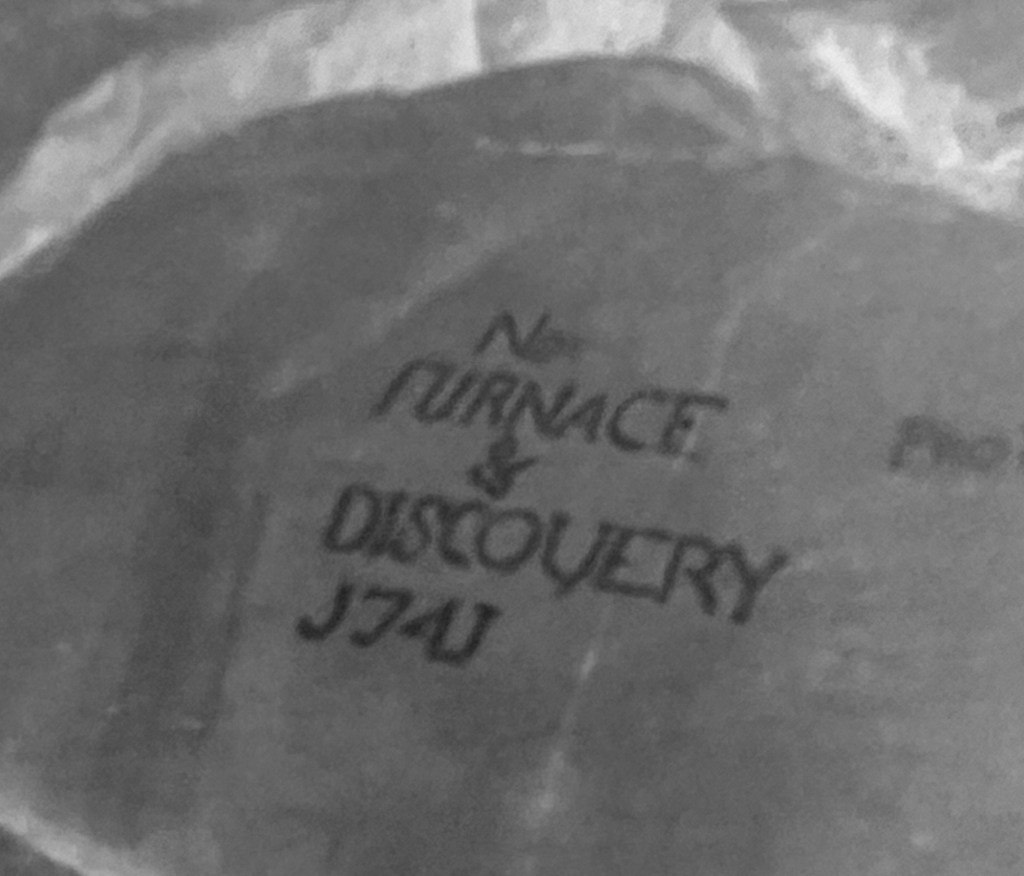
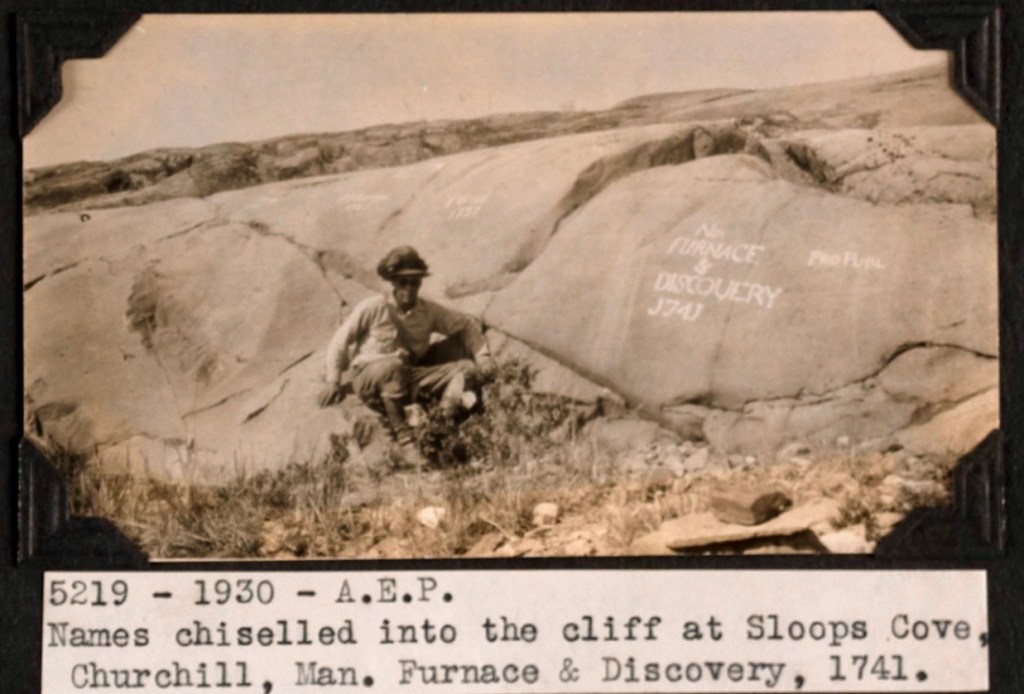
Sloop Cove rock inscriptions from 1741 overwintering of HMS Furnace and Discovery, as photographed in 1930. A series of inscriptions, including one by explorer Samuel Hearne, are preserved at the Sloop Cove National Historic Site. This may be the closest thing to a memorial the lost crew of the Middleton Expedition have. Credit: Northwest Territories (Album 31). Credit: A.E. Porild, Canada. Dept. Indian and Northern Affairs / Library and Archives Canada / e010983471

In some sources Middleton referred to two or three additional deaths. If anyone locates a reference to these other fatalities, or has any information about any known shore burials of the men who died near Churchill, please leave us a comment below.

Click for endnotes:

HMS Furnace- First Bomb to Blaze a Trail North

On that fateful day of May 19th, 1845, when the crews of Sir John Franklin’s last expedition in search of the Northwest Passage departed Greenhithe, England – never to return – they did so onboard two incredible vessels. Her Majesty’s Ships Erebus and Terror hadn’t originally been designed for polar exploration. Rather, these were both examples of a highly specialized type of warship called a “bomb vessel.” Why send a warship that was meant to bombard enemy positions on a polar exploration mission? This post briefly explores the history and design of the first bomb vessel that was sent north, HMS Furnace, which left England in 1741 on an earlier effort to locate that same illusive passage to the Pacific Ocean.1 Did Furnace blaze a trail across the frozen northern latitudes? Not exactly, but her modifications for exploration set an important precedent for a lineage of tough little ships which would be used on Arctic and Antarctic exploration missions.2

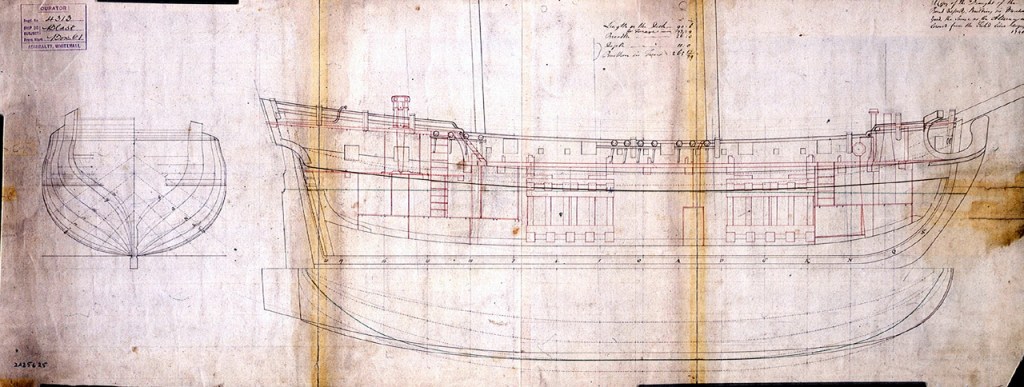
The Blast class, the original as-built configuration of Furnace from 1740, showing the two heavy mortar beds (cribbing) in the waist, the ketch rig (mainsail and a mizzen aft) a simple capstan perched high above the aft deck, and a windlass in the bow. Credit: © Crown copyright. National Maritime Museum, Greenwich, London ZAZ5625.

Maritime historian and former National Maritime Museum curator Chris Ware’s work on the history of bombs, The Bomb Vessel: Shore Bombardment Ships in the Age of Sail, explores the history of the Royal Navy’s bomb vessels, and highlights the careers of selected ships.3 The type had been created late in the 17th century to carry one or two heavy mortars amidships. Like many other great British naval developments, the idea had come from France, whose navy had built the first bomb vessels, galiotes à bombes, starting in 1681.4 The mortars (which had been developed originally for land warfare) fired types of fused shells called bombs (explosive) or carcasses (incendiary) on a high trajectory over the bulwarks. They were used against fortifications or cities and towns. The bombs would plunge downwards to explode against or over targets.

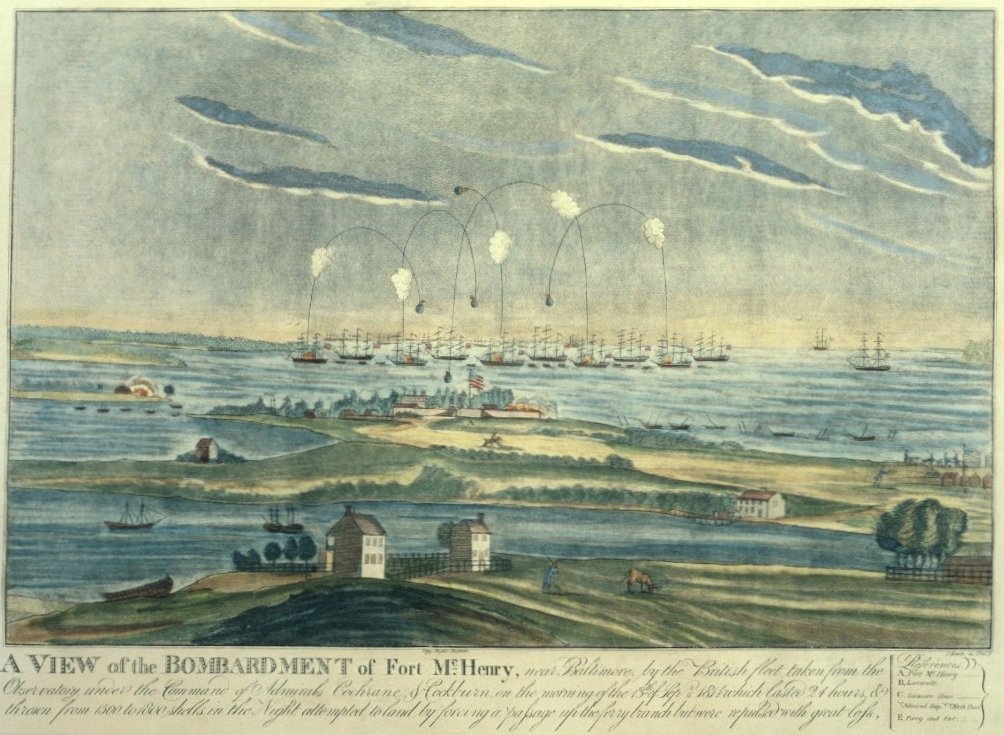
John Bower’s engraving of the Bombardment of Fort McHenry, near Baltimore, in September 1814 by the British fleet, including HMS Terror and an earlier generation of HMS Erebus, and several other bombs. Credit: Dr.frog at en.wikipedia, Public domain, via Wikimedia Commons

To carry the massive mortars and handle their powerful recoil, which was transmitted down from their carriage directly into the wooden timbers of the vessel, bombs had to be very strongly built: They were framed, decked, and reinforced much more stoutly than other ships of their relatively small size. While the first English bombs resembled small coastal craft, by the 1730s new designs appeared that were closer to naval sloops.5 There were usually only a handful of bombs active at any given time. Most spent the vast majority of their careers out of commission or converted to other roles. The Board of Ordnance, which had responsibility for both the guns and the specialist personnel to work them, would unship and land the mortars to help preserve these valuable weapons. When being used as patrol vessels, a stronger battery of cannon was installed along the gundeck.

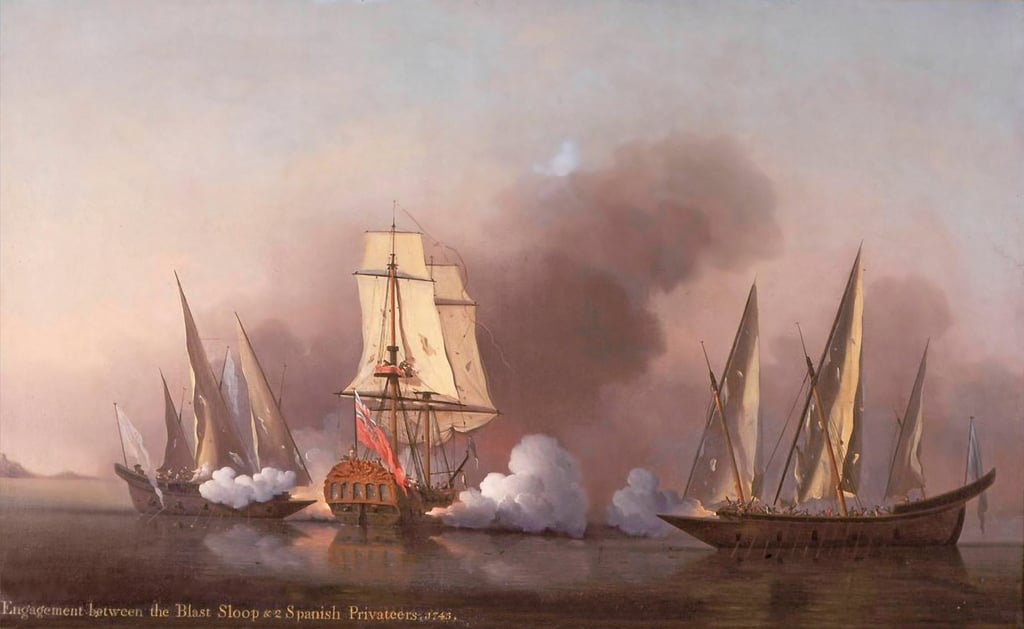
This painting by Samuel Scott is a rare representation of a mid-18th Century bomb vessel. It depicts the capture of HMS Blast, lead ship of Furnace’s class, in 1745. Blast was captured while serving as a sloop, and would have been armed without the mortars but with ten 4-pounder cannon when captured by two Spanish privateers. Blast appears to have a full 5-light (windowed) stern, and the additional armament has been added to the stern cabin (seen in the lower siting of the gunports aft). Oddly, the ship is now depicted rigged in the reverse of a ketch, as a brig or a snow. Credit: Samuel Scott, (Earl of Pembroke. Paul Mellon Centre for Studies in British Art) Public domain, via Wikimedia Commons

In contrast to the great and tragic expeditions that came both before and after, Christopher Middleton’s Northwest Passage Expedition of 1741 is rarely mentioned, even in exploration literature. This bid to locate the storied Passage, or “Straits of Anian” deserves more attention. Middleton was an experienced ship’s captain and a skilled navigator who had conducted a variety of scientific observations (including magnetic studies) while sailing to and from Hudson’s Bay, on annual supply missions for the Hudson’s Bay Company. He had an early enthusiasm for exploration, the search for the Northwest Passage, and also an interest in establishing the fate of the vanished James Knight expedition of 1719.6 Middleton had been nearby at the HBC Factory at the Churchill River (present-day Churchill, Manitoba) when, unbeknownst to anyone, the crews of Knight’s two small ships were marooned on Marble Island.7 In recognition of his scientific publications, Middleton was elected a Fellow of the Royal Society in 1737. In 1741, having left the employ of the HBC, the Royal Navy appointed him to command HMS Furnace. His orders were to seek a Northwest Passage somewhere along the Western coasts of the Bay. In reviewing the available units of the fleet, this new and rugged generation of bombs must have seemed ideal candidates for an exploration mission, where ships were in danger of colliding with icebergs, grounding, or being forced ashore out in Baffin Bay or the Hudson Strait, or being damaged or crushed by pack or land ice. Furnace would be accompanied by a hired collier, HMS Discovery, which was commanded by Middleton’s cousin, William Moor. The Admiralty optimistically believed that, a Passage having been located and exploited, the ships might link up with Commodore George Anson’s 1740-44 circumnavigation of the World, somewhere in the Pacific.

After crossing the Atlantic, the officers spent the winter at Prince of Wales Fort to get an early start to the season. Expedition crew meanwhile stayed ashore in a disused wooden fort.8 They first prepared the ships for being iced into the harbour – with Furnace becoming the first bomb to overwinter. It was a long and difficult winter, and several crew died of scurvy. Once the exploration work commenced in July 1742 they quickly discovered that a promising inlet did not in actuality offer any corridor to the west (Middleton thought this a river and named it “Wager” after Sir Charles Wager, First Lord of the Admiralty, but it was later determined to be a bay). Other useful exploration work included the discovery of Repulse Bay (the community is now known as Naujaat) and the assessment that the Frozen Straits offered no likely passage to the west. With the crew weakening again from scurvy, and the major exploration work having led to dead-ends, Middleton hastened back to England.9

Middleton’s surveying work was attacked after his return, with Arthur Dobbs (a wealthy and influential Irish landowner who has supported Middleton’s original appointment) and Moor both coming around to the view that not enough had been done to rule Hudson’s Bay out as the beginning of a passage towards the Pacific.10 Moor departed on another expedition which explored more of the same coasts of the Bay. Future expeditions would take other reinforced bomb vessels further north to continue the search for a navigable passage amongst the Arctic islands. As William Barr has pointed out, the criticisms Middleton was subjected to were baseless, and the accuracy of his surveying was eventually confirmed.11

HMS Furnace was a Blast class bomb vessel, completed in October 1740 by Quallett (presumably the commercial yard of John Quallett of Rotherhithe in South London, which built other Royal warships such as HMS Chesterfield and several sloops). She was 91.5 feet long on the gundeck and 26’4” broad, with an 11-foot draft. All told she was almost 273 tons burthen.12 This new class of six bomb vessels were rushed into service as war broke out again against Spain in late 1739. As the War of the Austrian Succession (1740-1748) spread across Europe, a second group of five almost identical sisterships were constructed the next year. Among them was the second bomb vessel to be named HMS Terror.13

Like most early bomb vessels, Furnace was rigged as a ketch, with a tall mainmast and a shorter mizzen aft. This rig proved to be problematic for the complicated laying, or aiming of the mortars, as it left only a small arc of fire unimpeded by the masts, yards, rigging and shrouds. When it came to the deck machinery, earlier bombs had been fitted with windlasses (horizontal drums) to assist in heavy tasks such as lifting the anchor cables, or the complex effort of warping the ship around on the anchor cables to precisely aim the mortars. The Blast ships, by contrast, were also fitted with the more powerful capstan (vertical drum) on the quarterdeck.14

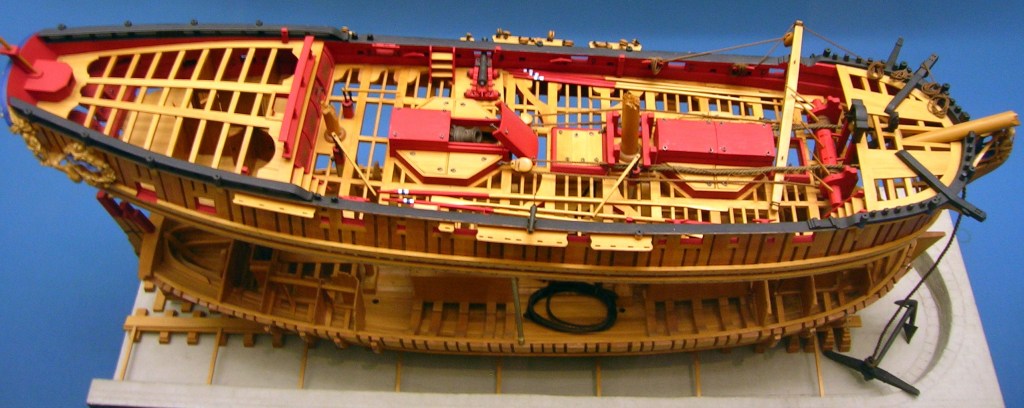
HMS Grenado, a near-contemporary of Furnace, is depicted in a superb sectional model at the National Maritime Museum, Greenwich, which helps us explore the peculiarities of the design:

HMS Grenado model showing both octagonal mortar pits, the new trunnioned mortars, and the exposed deck beams and hull framing. Credit: Rémi Kaupp, CC BY-SA 3.0, via Wikimedia Commons the original model was built by Robert A. Lightley and is catalogued at National Maritime Museum as SLR0331.

We can observe a robust, wide hull, with closely-spaced frames. The solid construction continued into heavy knees supporting the deck beams. In Grenado and Furnace, the mortars were originally sited forward and aft of the mainmast, while the mizzen mast rises above the deck just forward of the break on the quarterdeck. A new type of mortar had been developed, which could elevate and depress on trunnions, and rotate in its octagonal pit. The mortars could be lowered and covered over with sliding hatches, and protected from the elements.

A contemporary mid-eighteenth century French mortar. This is a 13” mortar and has trunnions to change the elevation. This mortar was used by French defenders of Louisbourg during the British siege of 1758, and is displayed at the Canadian War Museum in Ottawa.

The long run of the open waist amidships was necessary to provide the room needed to work the mortars. These ships, like the later Franklin vessels, were originally armed with a 13″ and a 10″ mortar. The secondary weapons, a battery of six light 4-pounder cannon, created a modest broadside for defensive purposes. Additional empty gunports, evenly spaced along the gundeck, allowed for the augmentation of these cannon when the mortars were unshipped. The officers’ cabins were tucked aft under a small quarterdeck, on a deck stepped slightly lower than the main run of the gundeck. There was a very small covered foc’sl forward of the large windlass, and between those was the usual belfry with ship’s bell.

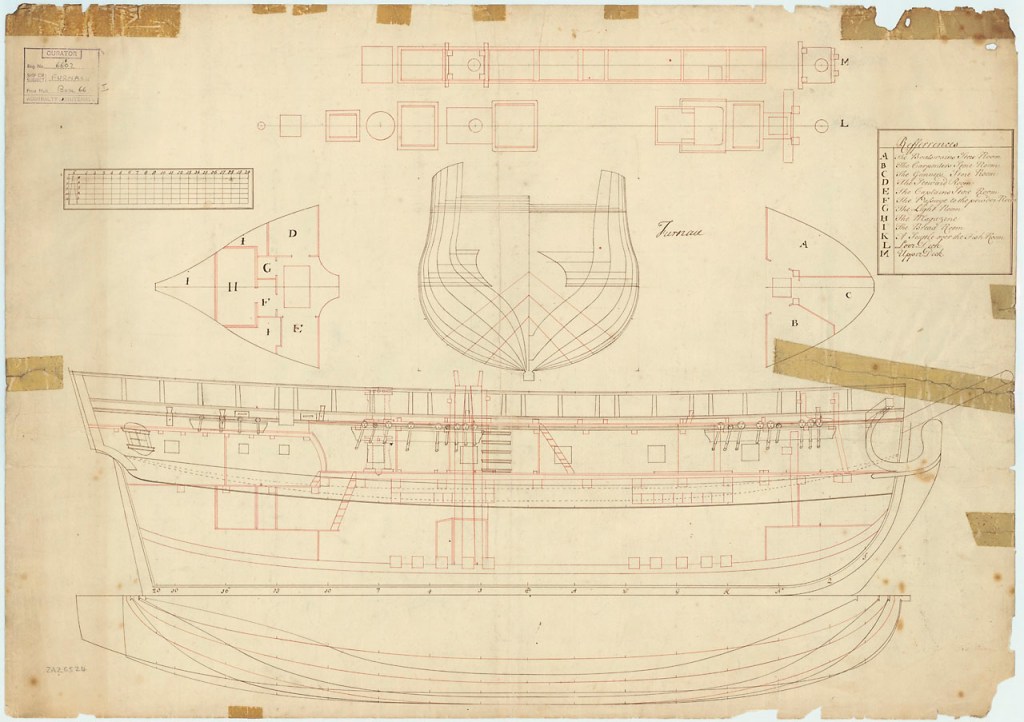
HMS Furnace as converted for the Middleton Expedition in 1741. Credit: © Crown copyright. National Maritime Museum, Greenwich, London ZAZ6524.

As can be seen by comparing the above Admiralty plans, preserved at the National Maritime Museum in Greenwich, with the Grenado model or the plans at the beginning of this post, Furnace was extensively modified for exploration. The masts were relocated, with a third mast making the vessel a sloop.15 There are many elements of the design that set the pattern for the Admiralty modifying ships for polar exploration, right down to those final modifications to Franklin’s two ships. Middleton’s input on this refit – reflecting his HBC service in the Company sloops – was important. Compared to the unmodified bomb vessels, this ship now has a shorter, less vulnerable stem, and higher sides. The open waist where the two mortars were once sited has been decked-over. The mortars, beds, and cribbing have been removed down to the keel. Furnace even has channels that have been reinforced with ice chocks to make them less vulnerable.16 The ship now has a larger double capstan, installed further forwards between the mizzen and mainmast, which could be worked by crew on both weather and lower decks. The windlass near the bows has apparently been removed.17 Middleton was able to influence the Admiralty into equipping Furnace with a complement of boats he wanted. He was even able to secure an “ice boat” for this mission, which was a specialized craft that HBC sloops used, but that had not previously been on the establishment of any British warship.18

Once the crews were wintering ashore at Churchill, Middleton held a council with his officers to discuss further modifications to Furnace. His journal, reproduced in Barr and Williams’ edited Hakluyt Society publication, provides detailed information about the March-April 1742 design modifications.19 The carpentry work that Spring optimized the bomb-exploration conversion. The quarterdeck was now built up to the level of the new main deck, to make a continuous weatherdeck. This fixed an issue where the oddly stepped-down aft deck shipped too much water during foul weather. Middleton also recognized the limitations of steering the ship in adverse conditions with an old-style tiller. He supervised the construction and fitting of a ship’s wheel, with the old curving iron tiller bar straightened out. All subsequent bomb-derived exploration vessels would be equipped with ship’s wheels.

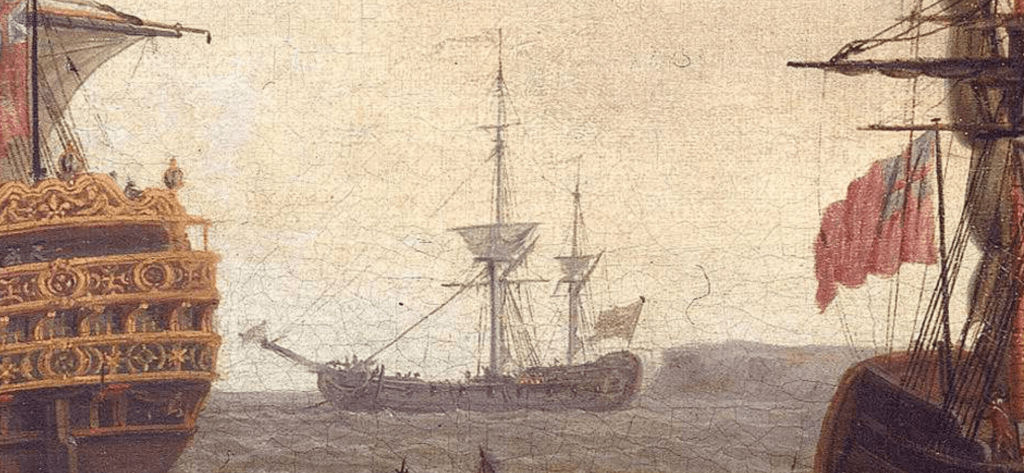
HMS Furnace or sistership Firedrake at the bombardment of Gorée, 1758. [detail of] Attack on Goree, 29 December 1758 by Dominique Serres the Elder. National Maritime Museum, Greenwich, London, Caird Collection BHC0386.

Upon the expedition’s return to England, Furnace was modified back to her original design. The overwintering and exploration work do not appear to have shortened her career: She served longer than all the other 1740-constructed bombs, being eventually decommissioned in 1763, after participating in several bombardments during the Seven Years War.20 HMS Furnace’s 1741 refit, – and Middleton’s expert 1742 modifications at Churchill – set the pattern for the modification of six other bomb vessels to be sent on future Arctic and Antarctic missions.21 This era ended more than a century later when the last two serviceable exploration bombs disappeared into the Canadian Arctic.

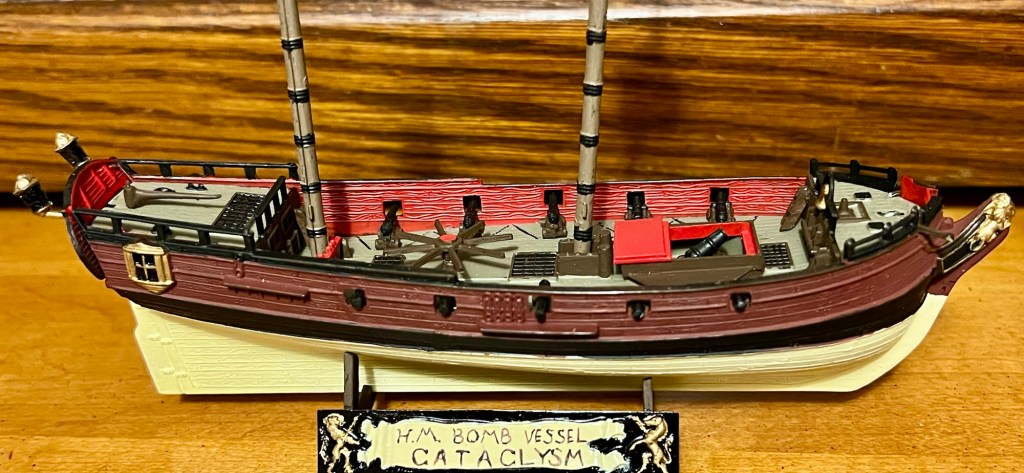
A model I worked on years ago, a modified Pyro British Bomb Vessel in (tiny) 1/150 scale. The design seems to be a simplification of a mid-eighteenth century bomb, which I modified as a fictional HM Bomb Vessel Cataclysm.
ENDNOTES: