The Travelling Tombstone of an Arctic Explorer

Early on the morning of April 15th, 1823, veteran explorer Alexander Elder drew his last breath, far from his kin, north of the Arctic Circle. Two days later, his comrades gathered near a shallow grave, set off from Igloolik’s rocky shore by a carefully-carved headstone. The stone was destined to depart on its own remarkable Arctic journey. Many years later, it returned. Today, a rich Inuit oral tradition considers it a haunted or even cursed artifact. This post continues our series exploring Arctic explorer memorials/monuments and cenotaphs.
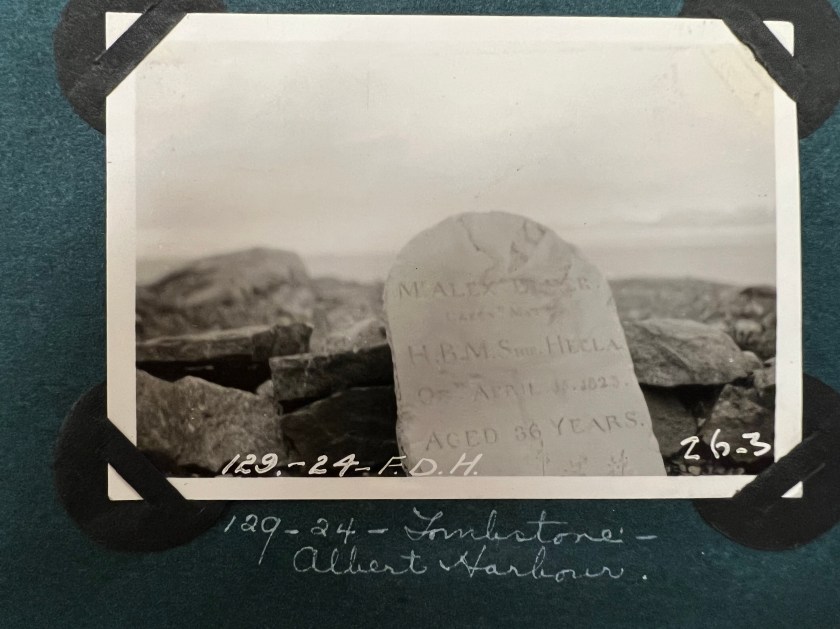
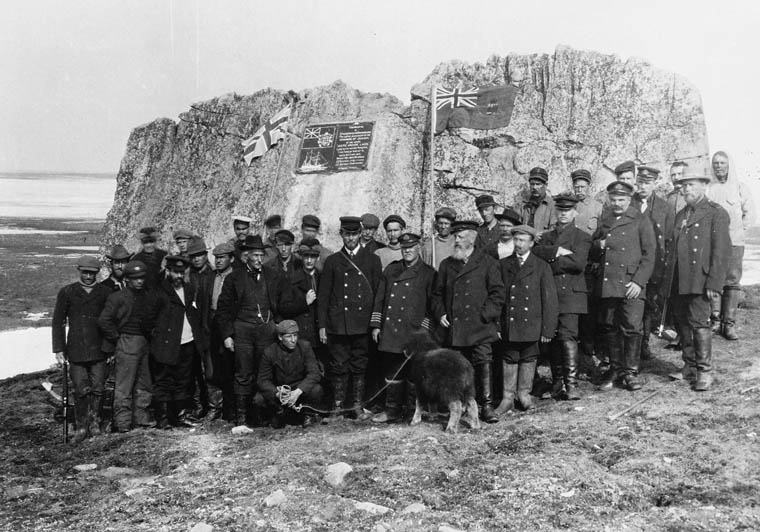
Alexander Elder’s tombstone at Albert Harbour (Qurtaq) near Pond Inlet (Mittimatalik), as encountered during Joseph Bernier’s CGS Arctic expedition in 1923. The century-old stone is in remarkable condition, having travelled more that 400 km from Igloolik. Credit: Library and Archives Canada (Arctic Album 6 P103 4870949).

Alexander Elder was a Ship’s Mate serving onboard the exploration vessel HMS Hecla, during Captain William Edward Parry’s 1821-23 expedition to the Canadian Arctic.1 This important Royal Navy Discovery Service mission was continuing the long-standing British effort to locate a Northwest Passage above Hudson’s Bay. The crews of Hecla and sistership HMS Fury were spending the winter frozen-in at Turton Bay (now Ikpiarjuk), near Igloolik, in the Foxe Basin. Before his untimely passing, Elder had been an experienced Arctic hand – a valued member of a fraternity of experienced British polar explorers.2 Now 36 years old, he was one of the “originals,” having served with Parry on HMS Alexander during the 1818 Arctic Expedition.3 That voyage – led by John Ross in HMS Isabella – had revived a whole program of British polar exploration.4 Elder sailed north again in the small gun-brig HMS Griper during Parry’s first expedition in overall command (1819-1820). Griper accompanied the larger bomb-vessel Hecla.5 This phenomenally successful expedition saw both ships explore deep into the Arctic Archipelago and overwinter far to the west, at Melville Island.6
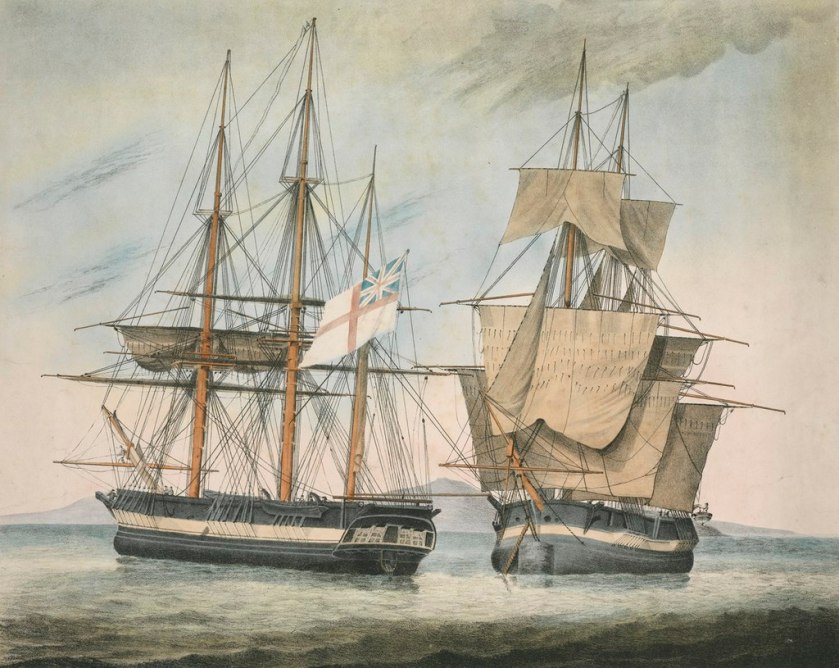
His Majesty’s Discovery ships, Fury and Hecla by Arthur Parsey (Artist & Engraver) Charles Joseph Hullmandel (Printer) in 1823 PAH9224. National Maritime Museum, Greenwich, London.

Elder was described by Parry in his first two published expedition journals as the “Greenland Mate.” The Greenland Masters and Mates were positions outside of the regular naval establishments of units of the British battlefleet. These special ratings were intended to furnish Arctic navigational and pilotage expertise to the senior officers.7 The Greenland Mates were senior Petty Officers charged with important duties: They could stand watch, being placed in charge of the routine operation of the ship; they could also lead detached boating expeditions as well as over-ice or overland sledging expeditions; the mates also had the important duty of maintaining an official logbook of their observations. Elder’s own book – whose entries end only a month before his death – is preserved in the custody of the National Maritime Museum.8

Capt. William Edward Parry, Commander of the Polar Expeditions (on the print this is updated from 1819-1827). Credit: Credit: Library and Archives Canada, Acc. No. 1939-159-1.

As the new polar expedition crews readied their ships for departure in April 1821, there was mounting public enthusiasm for the project of finding a navigable northwest passage. While Parry led the expedition from the newly-refitted HMS Fury, Elder would be serving onboard Hecla, commanded by George F. Lyon. Parry clearly had great faith in his team of ice navigators as all four positions were staffed by the exact same four members as had served on his last mission. The first months saw crews shift supplies from the merchant vessel Nautilus, enter the Foxe Basin, resolve longstanding cartographic confusion about the Frozen Strait and Repulse Bay, and begin to chart previously unexplored (by Europeans) territory.9 More encouraging still, the officers had important interactions with Inuit communities in this area, who supplied local knowledge of the region, to help guide the expedition’s efforts. It was at this moment, seemingly on the threshold of great new discoveries, that Elder’s body started to fail him. That first winter of 1821-22, with the shops frozen-in at Winter Harbour, he required medical attention for a heart condition. He seemed to recover as the brief polar summer set in, and was even able to resume his duties. Once on the move again, the expedition attempted to transit a strait that Parry named after both ships, in the northwest extremity of the Basin. When the ships encountered an impassable ice barrier, Fury and Hecla had to turn back to find protected waters. Parry made the decision to overwinter at Igloolik.
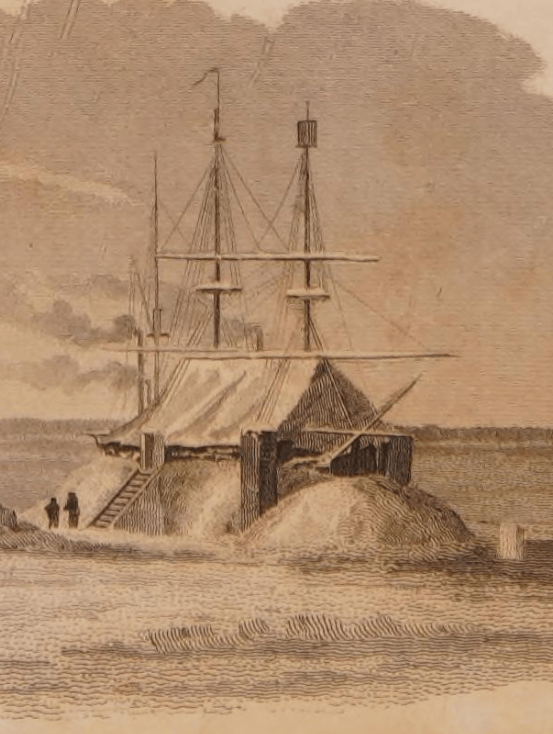
Elder’s last abode – the transformed appearance of HMS Hecla in winter quarters at Turton Bay (at Igloolik) on Dec. 2nd, 1822, on the last day of sunshine of the year. Drawn by Capt. Lyon and Engr. by E. Finden. Taken from G.F. Lyon’s publication [detail of] cited below.

It was here that Elder’s health collapsed, and his condition – now diagnosed by the surgeons as a fully-fledged dropsy – became terminal. His death in April deeply affected his comrades.10 In the official account of this expedition, Parry included a moving passage, highlighting his deceased shipmate’s contributions to this and prior polar expeditions:

“It is now once more my painful duty to record an afflicting visitation of Providence which took place among us on the morning of the 15th, in the death of Mr. Alexander Elder, Greenland mate of the Hecla. He had complained, on several different occasions in the course of this and the preceding winter, of pulmonary affections, to which perhaps a full habit of body may in some degree have contributed. His disease was now, however, a confirmed dropsy, which having attacked the region of the heart, rapidly terminated his existence.11 Mr. Elder had served in the three successive Expeditions employed for the discovery of a North-West Passage, and as a reward for his good conduct, had been raised from the situation of leading-man to that of mate, in which last capacity he served both in the Griper and the Hecla. He died much regretted by many of the officers and men, who had known him several years, and by none more deeply than by myself. Most sincerely indeed do I lament the occasion which demands from me this tribute, due to the memory of an active and valuable seaman, as well as an honest and upright man. His remains were committed to the ground near the Observatory, with all the solemnity that the occasion demanded, and a tomb of stones, with a handsome tombstone, raised over the grave.”12

Lyon provided also praised Elder. He noted that “The deceased had been leading man with Captain Parry on Captain Ross’s voyage, and for his good conduct had been made mate of the Griper on the last expedition […] He was a thorough good steady seaman, and solely by his own merit had risen to the station which he filled at the time of his death.”13 Lyon also provided more context surrounding the events of Elder’s interment: A burial party had spent all of the 16th of April trying to dig a suitable grave, but – after breaking many pickaxes trying to excavate the frozen ground – they had to halt the effort about three feet down.14
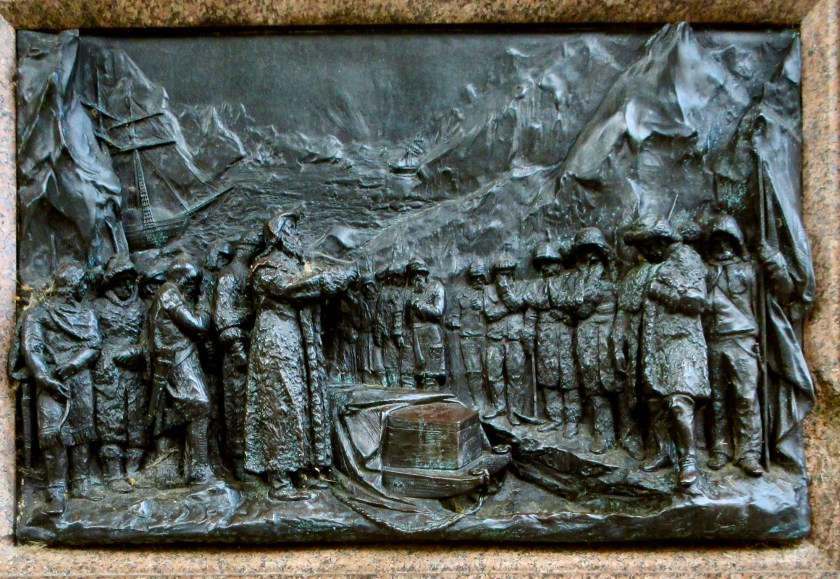
The burial of Sir John Franklin as interpreted on his monument at Waterloo Place, London. Given the known details of Elder’s burial, set against the continuing mystery of where Franklin’s remains were laid to rest, Matthew Noble’s 1866 bas-relief bronze can serve as a useful stand-in for Elder’s funeral service. Credit: AndyScott [modified], CC0, via Wikimedia Commons

Early the next morning, the crews of both ships gathered ashore to pay their respects. Besides Parry and Lyon, those gathered by the graveside included naval officers who would be involved in future exploration work and Arctic tragedy: James Clark Ross, Francis R.M. Crozier, Joseph Nias, and Edward Joseph Bird. Parry conducted the funeral service, even as a fierce northern gale set in. After two musket volleys were fired overhead – a final salute to their comrade – crew hastened back to the shelter of the ships. The “handsome tombstone” that was erected at the spot seems unusual. According to Scientist Emeritus Dr. Marc St. Onge, of the Geological Survey of Canada, it is most likely composed of white marble. This would have had to have been quarried from a location hundreds of kilometers away from Igloolik. There is even a possibility that it was carried onboard the ships from England.15 It had been skillfully carved with deeply-incised lettering:

Mr. Alexr. Elder
Greend. Mate
H.B.M. SHIP. HECLA
OBt. APRIL. 15. 1823.
AGED 36 YEARS.

Four months later, the bay thawed enough for Parry to resume his mission. As Elder’s grave receded in the distance, the crews of Fury and Hecla could not have imagined that the grave marker of their dearly-departed comrade would one day embark on its own exceptional journey of the polar regions. The stone’s wandering began modestly enough: It was apparently set in gradual movement away from the burial site by the heaving motions of the seasonal shore ice.16 Although the Inuit continued to occupy Igloolik to hunt the abundant colonies of seals and walrus, there were very few visits by Europeans for the remainder of the nineteenth century. According to the oral traditions from the region, this was because of a terrible curse that had been cast upon Parry’s departing ships by an angry shaman, who wanted to prevent other ships visiting.17

When in early 1867 Charles Francis Hall trekked to Igloolik – questing after any scrap of information that could help locate Sir John Franklin’s missing crew members – he visited Parry’s old site at Turton Bay. He appears to have foregone a visit to Elder’s grave, to instead explore the site a flagstaff Parry erected nearby on the Melville Peninsula.18 In early 1913 Alfred Tremblay, a geologist associated with Captain Joseph-Elzéar Bernier’s commercial trading venture, travelled to Igloolik.19 Having reached the Island, he proceeded to wander around and discharge his pistol towards various features. This odd behaviour appears to have been intended to convince his Inuit hosts that he had the power to dispel the curse which still lingered over the island.20
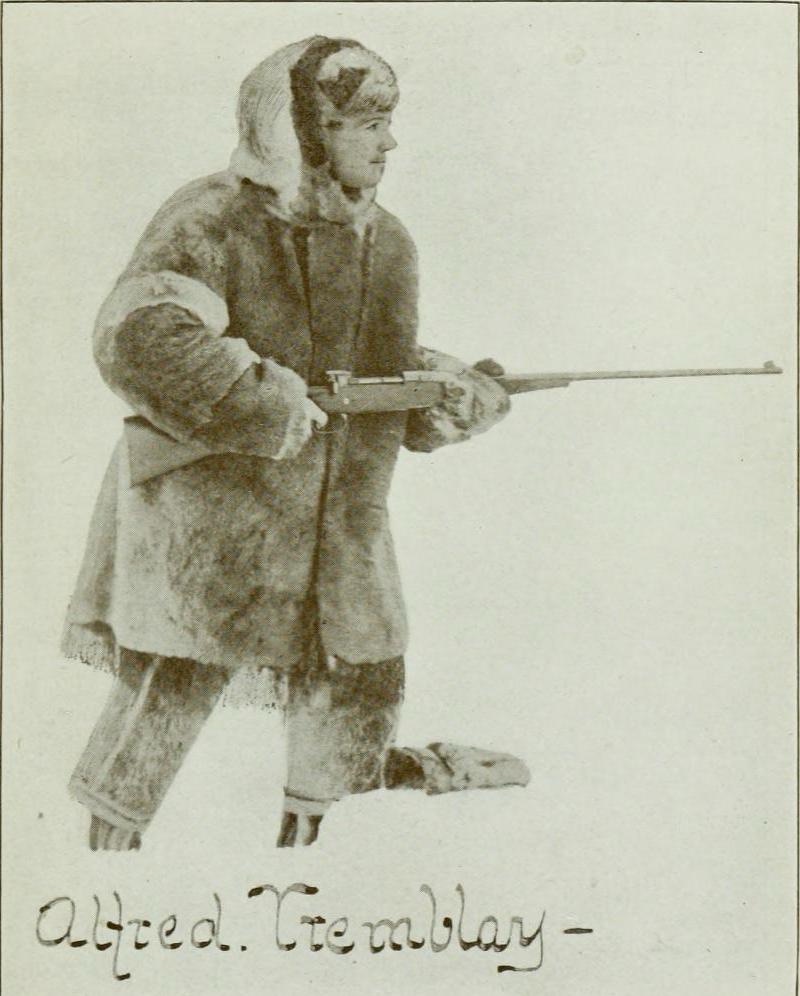
Alfred Tremblay in his Arctic travelling attire. Public domain via Wikimedia commons (which was taken from his work Cruise of the Minnie Maud cited below).

On March 23rd, while walking along the southern shore, he observed a conspicuous stone near the shore. When he flipped the stone over, he was surprised to discover Elder’s perfectly legible inscription. Looking around, Tremblay was unable to locate the original burial site, and speculated that the object must have moved a considerable distance.21 Soon after this rediscovery, it was transported about 400 kilometers northeast, to Albert Harbour (Qurtaq – just west of Pond Inlet/Mittimatalik), where it was incorporated into a graveyard of whaling ship crewmembers who had perished nearby. Dorothy Harley Eber, in her book about Inuit oral history, Encounters on the Passage : Inuit Meet Explorers, mentions that community members from Igloolik maintain an oral tradition that it was moved by Tremblay’s own guide, Nuqallaq (who was subsequently involved in the infamous Robert Janes shooting/trial).22 Tremblay doesn’t mention this in own account, while Kenn Harper’s 2013 article in Nunatsiaq News on the Tremblay visit notes that he was guided on his 1913 journey by Piunngittuq and his wife, Tuutalik.23 However the stone reached Albert Harbour, a decade later, Captain Bernier was back in the Arctic with his old ship, the CGS Arctic. His crew encountered the century-old stone in its new placement. The photograph at the beginning of this post was taken while Arctic visited Pond Inlet.24
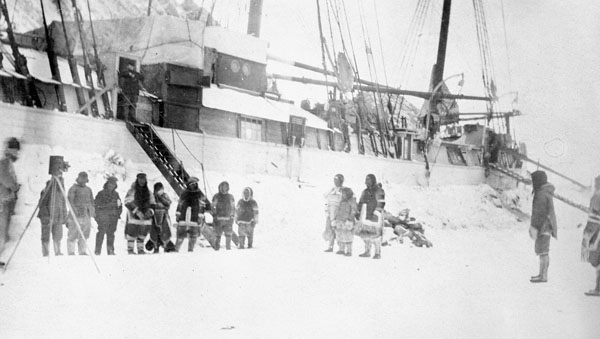
CGS Arctic overwintering at Pond Inlet years before, in April 1907. Inuit families from Igloolik are visiting Bernier and the crew. Paul LeVasseur fonds / Library and Archives Canada / PA-165646

The stone itself had one more (known) journey to complete. In 1948, the missionary priest, anthropologist, and amateur archaeologist Father Guy-Mary Rousselière decided to return it to Igloolik.25 After its round-trip Arctic journey of 800 kilometers, it rests once more near Parry’s old site, off a road leading from the townsite towards Igloolik Point.26
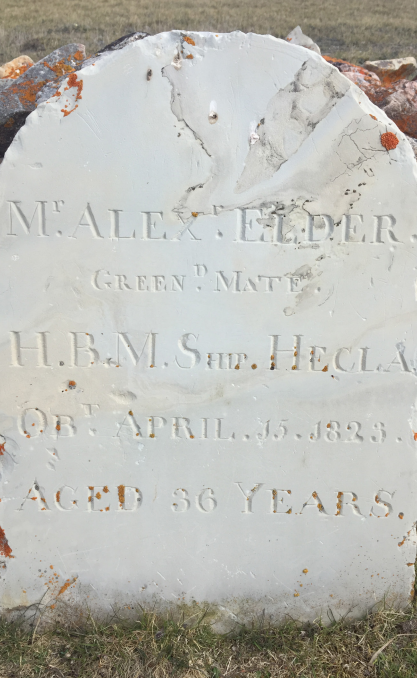
Alexander Elder’s two-hundred-year-old gravestone in its current location, adorned by a lovely dusting of golden and reddish lichen. Credit: Carolyn Gennari uploaded to findagrave.com.27

The rediscovery of the stone had made a strong impression on Alfred Tremblay. He chose to name an island at the eastern entrance to Fury and Hecla Strait – just north of Simialuk Island (formerly Ormonde Island) – after Elder.28 This was later confirmed as the official geographic name and today this location – 50 kilometers northwest of his tombstone – continues to commemorate Alexander Elder’s life. Given the stone’s unusual history, it is not surprising that rumours of the site’s haunting have persisted down to the present.29 Since Elder’s earthly remains no longer rest under the stone, it now memorialized him as a type of cenotaph. As we’ve explored in several recent posts, Arctic memorials can indeed be powerful sites of memory. They continue to haunt us, in the best possible way!

With thanks to Dr. Marc St-Onge.

Click for ENDNOTES
Fury and Hecla: Parry’s Formidable Arctic Exploration Sisters

On March 31st, 1827, Captain William Edward Parry took leave of his friends, relations, and his young wife Isabella. He boarded his beloved exploration vessel, HMS Hecla. After five expeditions searching for a Northwest Passage in the Canadian Arctic – four of which he was in overall command of – he was setting out for a different destination: The North Pole. Onboard Hecla were the latest contingent of a long line of British officers who would write their names on geographic features across both Arctic and Antarctic regions.1 His crew well-understood the hazards of polar exploration. On Parry’s last expedition Hecla’s sistership and exploration consort, HMS Fury, had been destroyed. Parry – an evangelical Christian – must have wondered, as he moved north along the English coast, if Providence and his continuing good fortune would keep them all safe on this new foray towards the top of the World.

His Majesty’s Discovery ships, Fury and Hecla by Arthur Parsey (Artist & Engraver) Charles Joseph Hullmandel (Printer) in 1823. Both show “Parry scheme” modifications for Arctic service, with broadside armament and mortars removed, reinforced channels, and bow iceguards. credit: National Maritime Museum PAH9224.

Forty-five years elapsed from the Constantine Phipps North Pole Expedition until William Edward Parry’s 1819 Northwest Passage search again brought polar-modified bomb vessels back to the Arctic. The 1741 modifications to HMS Furnace had set a basic pattern for reinforcing bomb vessels to participate in polar exploration missions. The Phipps’ North Pole attempt had introduced yet more innovations.2 However, the “Parry scheme” – the identical strengthening of two sisterships – HM Ships Hecla and Fury – is the most relevant precedent for the modifications of the final, and ill-fated bombs, HM Ships Terror and then Erebus.

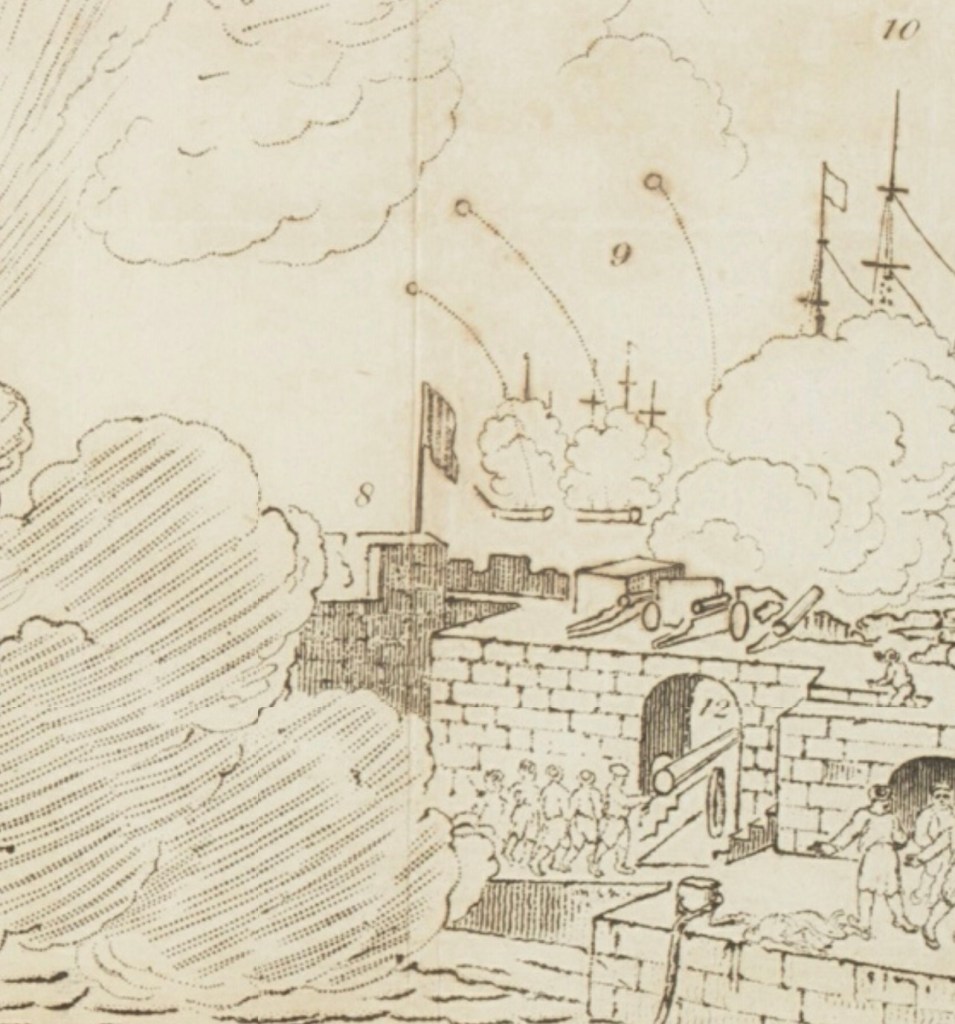
Both Hecla and Fury were laid down in 1813, and completed at the very twilight of the Napoleonic Wars. The Hecla class was a slight enlargement of the Vesuvius class bomb vessels.3 They were 105′ / 32m long on the gundeck, 28.5′ /8.7m in maximum beam, and displaced about 375 tons.4 Like the previous exploration bombs Furnace, Racehorse, and Carcass, these two sisterships had participated in a military campaign in their intended role: Firing bombs or carcasses (incendiary shells) from their main armament of a 10” and 13″ mortars. Both had been members of Admiral Edward Pellew’s fleet during the Bombardment of Algiers, 27 August 1816. They, along with the other bomb vessels Beelzebub and Infernal, fired hundreds of shells into the defences, harbour, and city, and were present the next day when the Dey of Algiers capitulated.

A detail of a panoramic illustration of the Bombardment of Algiers, showing Hecla, Fury and Belzebub firing bombs on a high trajectory. A section of the fortified harbour wall and a great gun are in the foreground. Panoramic views of various places : collection of pamphlets describing panoramas on exhibition in London, 1818 -1832 [detail of panoramic illustration] Credit: State Library of New South Wales DSM/791/PA1

Hecla’s first exposure to Arctic service involved conversion for a Northwest Passage expedition. This mission followed up on John Ross’s recent voyage, which had used two converted whaling ships, Isabella and Alexander, to revive the whole program of Admiralty polar exploration.5 Lieutenant William Edward Parry (who had commanded Alexander) would now make his own effort to solve the great cartographic mystery at the top of North America: was there a navigable passage from Baffin Bay through to the Western Arctic?6 Parry was also directed to try to resolve the cartographic confusion that John Ross’s mission had raised.7 His methodical approach to preparing for polar exploration involved thoughtful consideration of the unique environment his crews would operate in, an almost fanatical attention to technical details of the ships, equipment, and supplies, and careful planning for unanticipated situations.

Capt. William Edward Parry, Commander of the Polar Expeditions (on the print this is updated from 1819-1827). Credit: Credit: Library and Archives Canada, Acc. No. 1939-159-1.

Hecla was accompanied by HMS Griper (Matthew Liddon commanding). Griper was a gunbrig: a much smaller type that was about 85’/26m long on the gundeck and displaced only 180 tons. The pairing of a lead ship with a smaller consort had been a feature of prior expeditions. The reinforcement of the ships combined the best features of previous refits. Parry’s expedition made remarkable progress westwards into the uncharted Arctic Archipelago at the top of the North American landmass. The crews overwintered, in their carefully prepared and housed-over ships, in the midst of their discovery mission.8 This frozen pause, far north of the Arctic Circle, was a first for the Admiralty exploration program.

This image of Hecla on her first mission, housed over for overwintering at Melville Island with Griper nearby, is take from The frozen zone and its explorers; a comprehensive record of voyages, travels, discoveries, adventures and whale-fishing in the Arctic regions for one thousand years, an 1874 publication. Internet Archive Book Images, No restrictions, via Wikimedia Commons

Parry penetrated the Arctic as far west as Cape Providence at the southwestern tip of Melville Island (beyond 113° degrees longitude west of Greenwich). With the (brief) navigation season rapidly closing, he chose to winter at a suitable bay back along the southern coast. As the ice was setting in, they had to cut their way in to “Winter Harbour” using ice saws. Parry kept his ships safe and his crews relatively healthy during this 10-month period. He even continued the exploration mission overland by leading treks to survey the northern coast of Melville, where he discovered Hecla and Griper Bay. Early the next exploration season, he was turned back from further progress westwards by pack ice. The two ships arrived home to wild enthusiasm in October 1820.

Captain Joseph-Elzéar Bernier and the crew of the CGS Arctic visit Parry’s rock at Winter Harbour, on 1 July 1909. They erected a commemorative plaque, alongside carvings made by Parry’s crew in 1819-1820, which would become important to Canadian sovereignty claims over the Arctic. This is now a National Historic Site of Canada. Credit: Library and Archives Canada C-001198

In preparation for Parry’s next mission to the Arctic, HMS Fury was reinforced to the same standard as Hecla, to become Parry’s lead ship in a new effort to locate a passage west. Hecla was commanded by George Francis Lyon. This dual refit, starting in late 1820 at Deptford Dockyard, represents the beginning of the classical age of the Admiralty’s program of strengthening ships for polar service: Here two sisterships were identically outfitted, to operate in tandem. In the event of the loss of one ship, both crews could be fully accommodated on the remaining ship.9 Parry described this important refit in detail in the published journal of his second expedition.10 In the wake of his first expedition, and frustrating experiences sailing in company with the slower Griper, he now rejected the convention that a lighter vessel, acting as a consort, could explore inshore waters more effectively than two evenly-matched ships. He emphasized that all inshore surveying could be completed by detached boat crews (who have the light vessels with minimal draft to best exploit inshore charting opportunities). He argued that ships of the same design could better survey a larger area (with independent charting of whole stretches of coastline a possibility). In order to ensure that sailing performance was as even as possible, he adopted what he called an “equalized rig” between ships. This went beyond merely ensuring that the three-masted barque rig of both ships was identical, because the fore and main masts were fitted with the exact same lengths of spar for a given sail type between both masts. This meant that four masts between two ships had the exact same spar dimensions for courses, topsails, and topgallant and studding sails – something that would greatly simplify repairs in case of damage to the top hamper.

The draught plans of the original Hecla class design of 1813 (upper ZAZ5687), and an internal arrangement plan of the modifications to Fury for the 1821 NW passage mission (lower ZAZ5696) © Crown copyright. National Maritime Museum, Greenwich, London

The original Admiralty plans, now preserved at the National Maritime Museum at Greenwich, show a more thorough conversion for Arctic service than any prior British vessel had undergone. In contrast to Racehorse and Carcass, Parry’s ships received a full weatherdeck, which united the quarterdeck, foc’sl, and the intervening space amidships. This decking enclosed a much larger internal space which could protect crews from foul weather and, more importantly, Arctic conditions. Fury and Hecla were the first bombs to be so heavily modified that no internal traces remained of their original mortar beds. They also were the first to have all gun-ports fully omitted (planked over). The fragile channels (where the shrouds connect down to the hull outboard of the rails) were filled in by ice chocks, as they had been on HMS Furnace in 1741. Massive timbers – Heavy bolsters and hooks – strengthened the bows. Parry’s ships had doubled planking on the exterior (which was thicker than what had been fitted to Hecla and Griper for the earlier mission). This ran all the way up to deck-level. The outer layer noticeably thickened at the waterline. Heavy iron strengthening bolted through the knees and keelson, spirketting (reinforced timbers) ran lengthwise, bolted into the frames at different levels. A full double layer of “footwailing” sheathed the area inside the frames of the lower hull (interior paneling in the hold which was laid diagonal for further strength). A sectional plan helps us further interpret the details of these massively strengthened vessels:

HMS Fury sectional plan, 1821 (ZAZ5700) © Crown copyright. National Maritime Museum, Greenwich, London

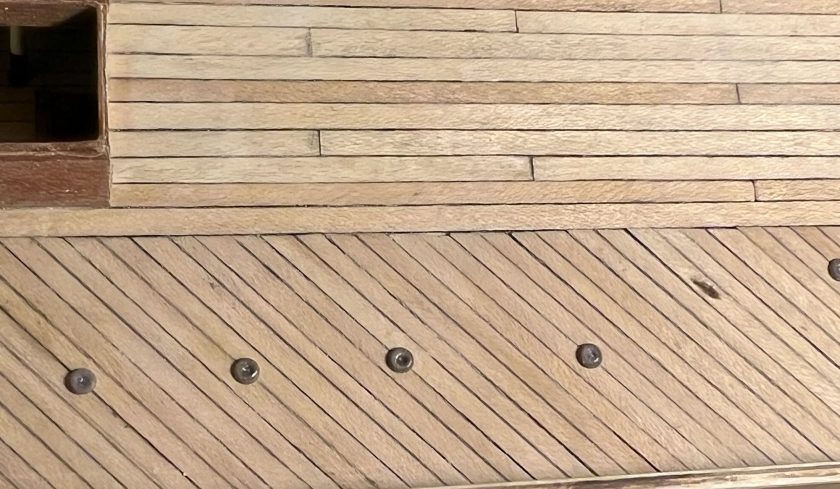
One of the most notable updates is the first use of diagonal deck planking on a discovery mission. This update can be seen in the uppermost layer of 3” thick decking, represented in the above plan as wider than the underlying fore-and-aft planking. The two layers made for a much stronger protective sheathing: 6” of wood, with a layer of waterproofing tar paper sandwiched in between. This strengthened decking was conventionally fastened to the underlying deck beams. The concept of diagonal decking appears to have been a recent novelty, and can be credited to a naval architect who was coming up with a whole system of new design elements to strengthen British warships: Sir Robert Seppings. Seppings had first installed diagonal decking to HMS Albion’s two gundecks in 1815. He had then arranged a comparative trial, where he had fitted it only to the port side decking of HMS Northumberland. This ship and its experimental deck were put to use from August to October 1815 to transport the deposed French Emperor, Napoleon Buonaparte, to his final exile on the island St. Helena.11 On Parry’s exploration ships, the diagonal sections flanked a central area of the deck, which had massively thickened decking – a full 6″ thick – running lengthwise. This reinforced and buttressed decking – visible today at the wreck sites of Erebus and Terror, created a structure of incredible solidity.12

A Sylvester warming oven (furnace) of an ingenious design circulated warm air to the newly-enclosed interior spaces by flues (it can be seen shaded blue in the second plan above). Relevant to air circulation and lighting below decks, Parry also noted in passing that his ships were fitted with “illuminators,” which, in this context, would appear to be a very early instance of the installation of Preston’s Patent illuminator (which also could be called a portable deck glass and ventilator).13

The reinforced diagonal decking and thicker central planks of a polar-modified bomb vessel looking from the main hatch forwards along the starboard side. Illuminators, which my research has established may have been fitted to Parry’s ships on his second polar expedition, and deck prisms also appear. (author’s photo of an incomplete model)

Parry’s second expedition in command (1821-1823) saw the ships overwinter first at Winter Island and then further north at Igloolik. This expedition had set yet another important polar precedent when the merchant vessel Nautilus was hired to transport some of the burden of coal and provisions across the Atlantic to Resolution Island (at the entrance to the Hudson Strait). Crew then discharged its cargo into the exploration vessels, to top up their supplies.14 No ice-free passage towards the west was located, but, in Foxe Basin, Parry did transit the Frozen Straits at the top of Southampton Island into Hudson’s Bay, finally proving the accuracy of Christopher Middleton’s 1742 surveying in HMS Furnace. Near Igloolik, he also discovered a frozen waterway stretching westwards out of the Basin, which he named Fury and Hecla Strait. Both his official publication and Lyon’s private journal (private yet officially approved to be published) include invaluable observations about local Inuit communities’ culture, social practices and daily life.15 All these decades later, Inuit communities on Igloolik Island and around the Melville Peninsula continue to preserve a rich oral tradition around the visit of Parry’s crews. In early 1823, Parry’s crews were beginning to show signs of the onset of that dreaded mariner’s disease: Scurvy. Hecla and Fury departed the Arctic in good condition for a safe return home. Despite Lyon’s remarkable ethnographic observations of Inuit community life, the actual cartographic results of the expedition could not compare to the incredible progress westwards of Parry’s first foray. Still, the public at home in Great Britain continued to be inspired by his exploration.

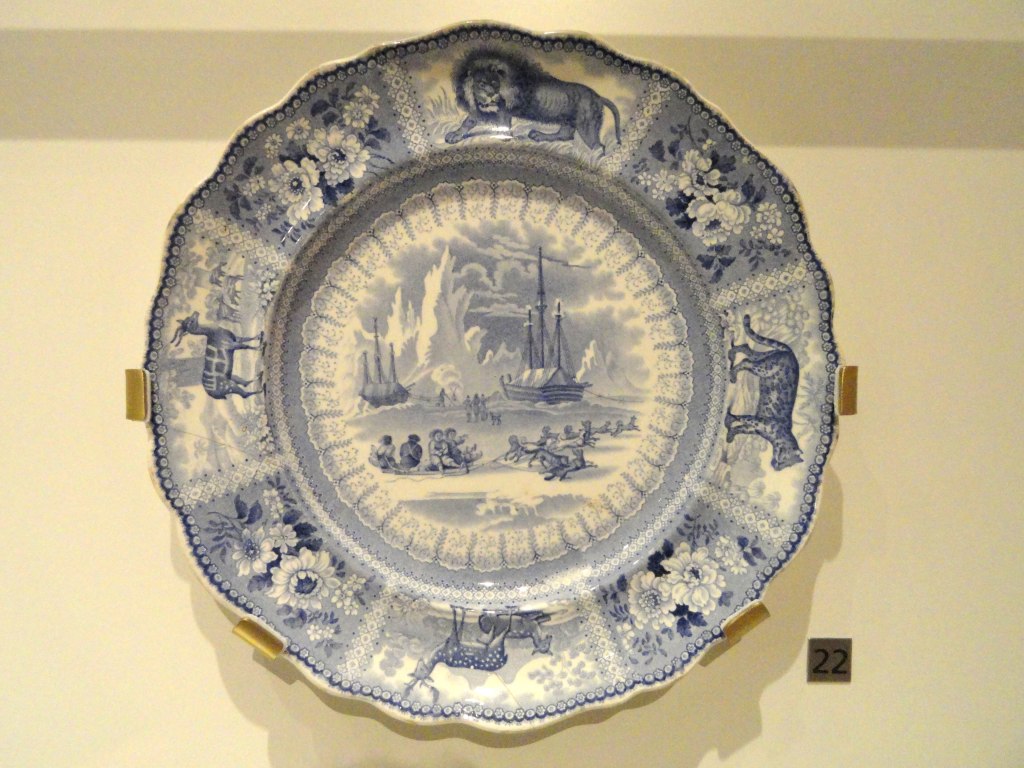
Parry’s Arctic expeditions led to widespread popular enthusiasm in Europe for depictions of Arctic adventures. A Staffordshire dish ca. 1835, shows an Arctic scene of Parry’s ships in the background, and Inuit community members with a sledge and dogs. This appears to be a inspired by a scene of Hecla and Griper at Winter Harbour, updated with events from later expeditions. Credit: Daderot, CC0, via Wikimedia Commons.

Parry immediately threw himself into the planning of yet another expedition. The discovery duo of Hecla and Fury would now look for a passage 500 km to the Northwest of Igloolik, down Prince Regent Inlet (a waterway which he had entered but not fully charted during his westward passage in 1819). Parry shifted back to Hecla. Henry Parkyns Hoppner (an experienced Arctic officer with service on all recent Parry-associated missions) took command of Fury.16 Departing England in May, 1824, the expedition again made use of a transport, the William Harris, which was unloaded at the Whalefish Islands, Greenland (now known as Kitsissut and Imerissoq). The exploration ships were delayed in crossing Baffin Bay, and had to winter at Port Bowen, on the eastern side of the Inlet. Officers and crew disliked the dreary winter site, and had misgivings about the mission to explore the Inlet.17 When finally released from the ice in late July 1825, the ships began navigating the western coast of North Somerset Land (Somerset Island’s insularity would not be proved until 1852), looking for some route to the west. It was along the dramatic cliffs of this coastline that disaster finally caught up with Parry’s crews.

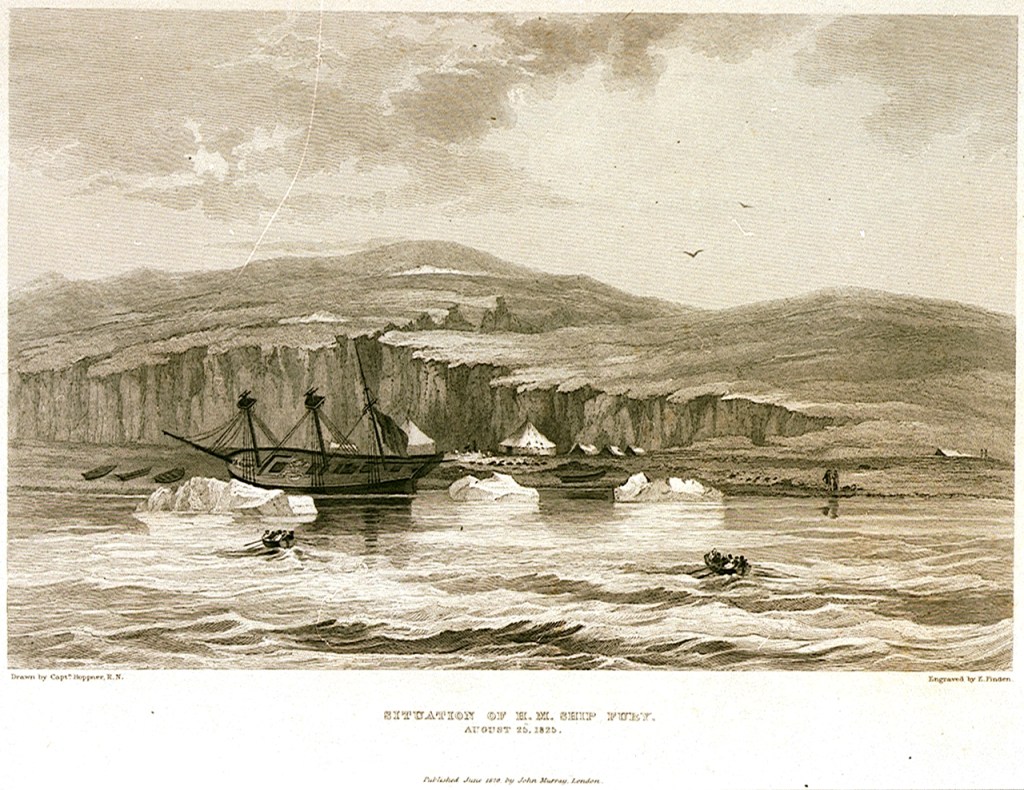
The appearance of HMS Fury on the day of her abandonment (taken from Parry’s Journal of his Third Expedition): Edward Francis Finden (engraver); Hoppner, Capt (artist); Murray, John (publisher), Public domain, via Wikimedia Commons

On the first of August, Fury and Hecla were both damaged by being nipped by ice as it crowded close in to the shores of Somerset Island. Unbeknownst to Parry, Fury was more severely wounded, and began taking on water at a prodigious rate. By the time Hoppner was able to report in, a third of the entire crew were required to work all four pumps just to keep the vessel afloat.18 A careful examination showed that, despite the phenomenal strengthening of the hull as noted above, the basic skeleton of the ship had been seriously damaged: Fury’s forefoot and sternpost were both mauled, and areas of the keel were effectively shattered.19 Parry’s published journal of the expedition relates the episodes of a worsening situation over the next week: Exhausting efforts to find a safe location to shelter the damaged vessel from further ice damage and unload her, to try and repair the hull, eventually failed when ice again crowded inshore and bodily heaved the ship up into the shallows of the beach. This further damaged the bilge areas on August 25th. Parry, returning onboard his former command, recognized the ship was doomed. He allowed Hoppner and his senior staff to carefully assess the ship. The verdict from Fury’s officers was clear: it was time to abandon their vessel and press on.20 A storage depot was created at Fury Beach, with anchors, anchor chains, spars, ships boats, and a vast supply of coal and provisions.21 Given the state of crowding and the reduction in provisions on Hecla, Parry turned aside from further exploration of the Inlet and hastened back to England. He concluded his official account of the protracted destruction of the Fury by stating “…it will be plain that an occurrence of this nature was at all times rather to be expected than otherwise, and that the only real cause for wonder has been our long exemption from such a catastrophe.”22

Remarkably, given the hazards of exploration and the amount of time he had been away from his home on these successive missions, Parry, newly-married, opted to lead one more Arctic expedition. The 1827 mission would see Hecla ordered towards a higher latitude than she had ever navigated to. Parry went from his old quest to complete a Northwest Passage to a mission aimed at the North Pole. This would revisit the site of both Constantine Phipps’ 1773 expedition, and the recent David Buchan and John Franklin 1818 journey towards the Pole: the Svalbard archipelago. The overall plan had actually been thought up by Franklin. John Barrow, Second Secretary at the Admiralty, forwarded it on to Franklin’s friend Parry.23 This time, his venerable exploration vessel would serve as a base ship for a further effort to push north, by carrying up two specially-constructed boats (named Enterprise and Endeavour). The 20′ long boats were fitted with conspicuous steel runners that reached down to the ice from the bilges, and could also be moved on wheels. They were ingeniously fortified, double-planked, and protected by inner layers of felt and Mackintosh waterproof canvas. Their design had been the result of a collaboration of expert naval architects Henry Peake and Oliver Lang.24 After Hecla reached Treurenberg Bay (Sorgfjorden), the two boat crews, commanded by Parry and James Clark Ross, John Ross’s nephew, sledged northwards from Hakluyt’s Headland on pack ice, in difficult conditions.25 Where the plan had envisioned a rapid sledge up to the Pole over smooth expanses of pack ice, the crews encountered a torturous, broken landscape. They reached a furthest north record of 82° 45′ before turning back, exhaused, for the shelter of their ship.26

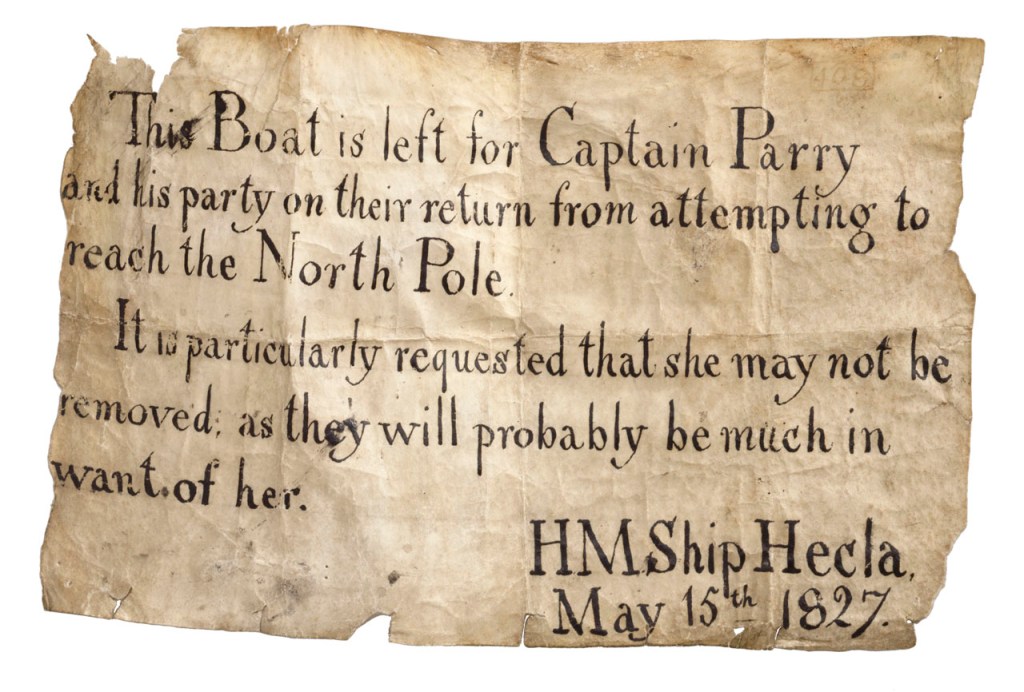
A note left by Parry’s crew, remaining with Hecla, to ensure that no one else absconded with a depot boat left to assist with the return from their polar mission. Credit: National Maritime Museum, Greenwich, London, Royal United Service Institution Collection (AAA3957)

And with her safe return to England from yet another record-setting mission – a highest north latitude that would stand for fifty years – Hecla reached the end of her Arctic exploration career. She was converted to the complimentary role of survey ship (to chart temperate waters, like several of the other surviving bomb vessels), and worked along the coasts of West Africa. Sold out of naval service in 1831, she was first used as a general cargo vessel and then converted to become a whaling ship for the 1835 season. Lloyd’s Register (LR) Foundation Archivist Max Wilson has located important documents to track the interesting history of Hecla’s commercial service. As Wilson notes: “Ironically Hecla was to hunt in the exact area she had opened up to whaling and explored in 1819.”27 She continued to endure Arctic punishment on annual whaling journeys to the familiar waters of the Davis Strait until she was wrecked there in 1840.28 Like her lost sister Fury, Hecla’s final resting spot has not yet been located.

With popular enthusiasm for exploration sustained by the published accounts of Parry’s exploits, the Admiralty turned to other modified bomb vessels to continue the exploration of polar regions. In late 1835, even as Hecla continued plying northern waters, there was a sudden need to rescue the crews of some of her fellow whaling ships: A dozen ships had become trapped in the pack ice of the Davis Strait. A slightly smaller, older bomb vessel, laid up at Portsmouth, was rushed into refit: HMS Terror.29 The scene was now set for the final conversions of the bomb vessel type to polar exploration ships.

This concludes our series of blog posts exploring the history of every bomb vessel that was converted to a polar discovery ship: HM Ships Furnace, Racehorse and Carcass, Hecla and Fury, Erebus and Terror.

Click for Endnotes