Early on the morning of April 15th, 1823, veteran explorer Alexander Elder drew his last breath, far from his kin, north of the Arctic Circle. Two days later, his comrades gathered near a shallow grave, set off from Igloolik’s rocky shore by a carefully-carved headstone. The stone was destined to depart on its own remarkable Arctic journey. Many years later, it returned. Today, a rich Inuit oral tradition considers it a haunted or even cursed artifact. This post continues our series exploring Arctic explorer memorials/monuments and cenotaphs.
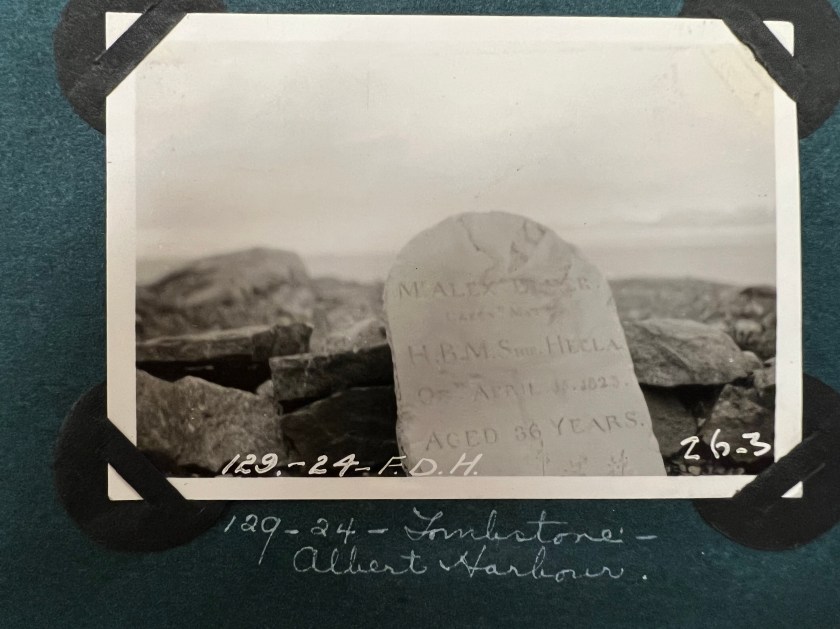
Alexander Elder was a Ship’s Mate serving onboard the exploration vessel HMS Hecla, during Captain William Edward Parry’s 1821-23 expedition to the Canadian Arctic.1 This important Royal Navy Discovery Service mission was continuing the long-standing British effort to locate a Northwest Passage above Hudson’s Bay. The crews of Hecla and sistership HMS Fury were spending the winter frozen-in at Turton Bay (now Ikpiarjuk), near Igloolik, in the Foxe Basin. Before his untimely passing, Elder had been an experienced Arctic hand – a valued member of a fraternity of experienced British polar explorers.2 Now 36 years old, he was one of the “originals,” having served with Parry on HMS Alexander during the 1818 Arctic Expedition.3 That voyage – led by John Ross in HMS Isabella – had revived a whole program of British polar exploration.4 Elder sailed north again in the small gun-brig HMS Griper during Parry’s first expedition in overall command (1819-1820). Griper accompanied the larger bomb-vessel Hecla.5 This phenomenally successful expedition saw both ships explore deep into the Arctic Archipelago and overwinter far to the west, at Melville Island.6
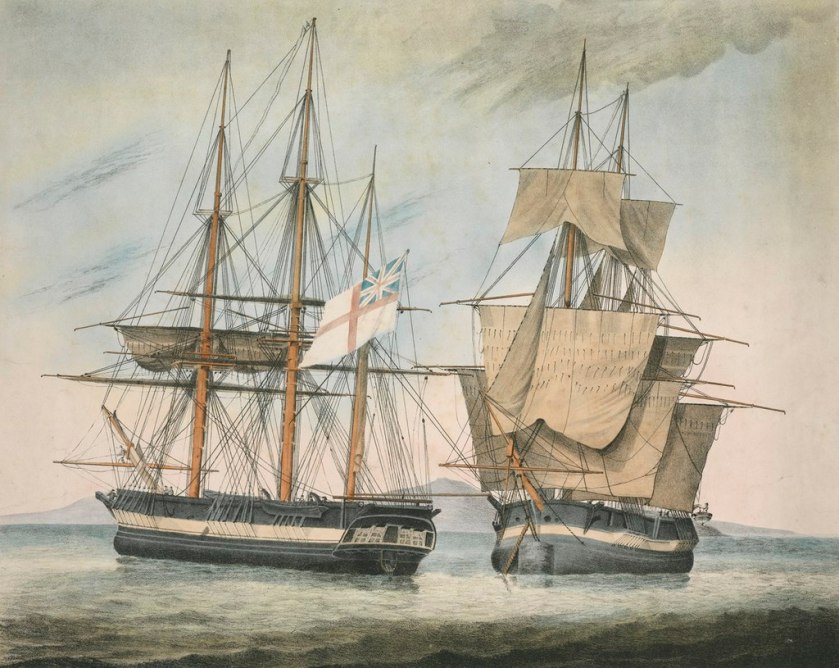
Elder was described by Parry in his first two published expedition journals as the “Greenland Mate.” The Greenland Masters and Mates were positions outside of the regular naval establishments of units of the British battlefleet. These special ratings were intended to furnish Arctic navigational and pilotage expertise to the senior officers.7 The Greenland Mates were senior Petty Officers charged with important duties: They could stand watch, being placed in charge of the routine operation of the ship; they could also lead detached boating expeditions as well as over-ice or overland sledging expeditions; the mates also had the important duty of maintaining an official logbook of their observations. Elder’s own book – whose entries end only a month before his death – is preserved in the custody of the National Maritime Museum.8

As the new polar expedition crews readied their ships for departure in April 1821, there was mounting public enthusiasm for the project of finding a navigable northwest passage. While Parry led the expedition from the newly-refitted HMS Fury, Elder would be serving onboard Hecla, commanded by George F. Lyon. Parry clearly had great faith in his team of ice navigators as all four positions were staffed by the exact same four members as had served on his last mission. The first months saw crews shift supplies from the merchant vessel Nautilus, enter the Foxe Basin, resolve longstanding cartographic confusion about the Frozen Strait and Repulse Bay, and begin to chart previously unexplored (by Europeans) territory.9 More encouraging still, the officers had important interactions with Inuit communities in this area, who supplied local knowledge of the region, to help guide the expedition’s efforts. It was at this moment, seemingly on the threshold of great new discoveries, that Elder’s body started to fail him. That first winter of 1821-22, with the shops frozen-in at Winter Harbour, he required medical attention for a heart condition. He seemed to recover as the brief polar summer set in, and was even able to resume his duties. Once on the move again, the expedition attempted to transit a strait that Parry named after both ships, in the northwest extremity of the Basin. When the ships encountered an impassable ice barrier, Fury and Hecla had to turn back to find protected waters. Parry made the decision to overwinter at Igloolik.
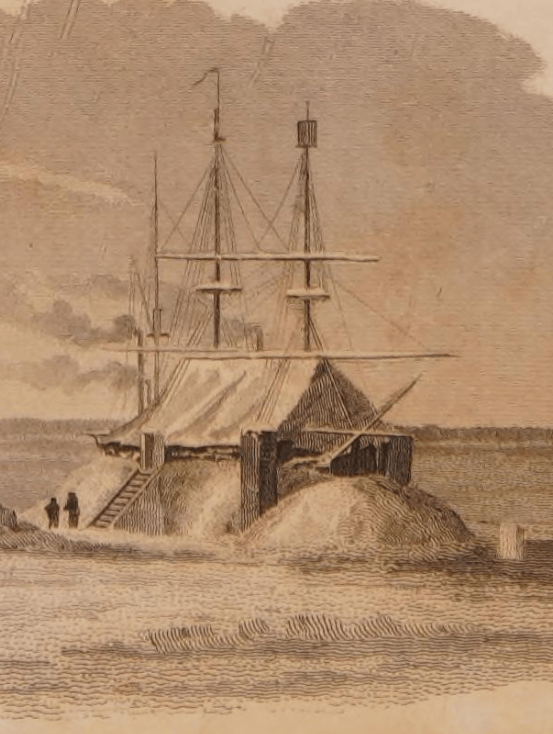
It was here that Elder’s health collapsed, and his condition – now diagnosed by the surgeons as a fully-fledged dropsy – became terminal. His death in April deeply affected his comrades.10 In the official account of this expedition, Parry included a moving passage, highlighting his deceased shipmate’s contributions to this and prior polar expeditions:
“It is now once more my painful duty to record an afflicting visitation of Providence which took place among us on the morning of the 15th, in the death of Mr. Alexander Elder, Greenland mate of the Hecla. He had complained, on several different occasions in the course of this and the preceding winter, of pulmonary affections, to which perhaps a full habit of body may in some degree have contributed. His disease was now, however, a confirmed dropsy, which having attacked the region of the heart, rapidly terminated his existence.11 Mr. Elder had served in the three successive Expeditions employed for the discovery of a North-West Passage, and as a reward for his good conduct, had been raised from the situation of leading-man to that of mate, in which last capacity he served both in the Griper and the Hecla. He died much regretted by many of the officers and men, who had known him several years, and by none more deeply than by myself. Most sincerely indeed do I lament the occasion which demands from me this tribute, due to the memory of an active and valuable seaman, as well as an honest and upright man. His remains were committed to the ground near the Observatory, with all the solemnity that the occasion demanded, and a tomb of stones, with a handsome tombstone, raised over the grave.”12
Lyon provided also praised Elder. He noted that “The deceased had been leading man with Captain Parry on Captain Ross’s voyage, and for his good conduct had been made mate of the Griper on the last expedition […] He was a thorough good steady seaman, and solely by his own merit had risen to the station which he filled at the time of his death.”13 Lyon also provided more context surrounding the events of Elder’s interment: A burial party had spent all of the 16th of April trying to dig a suitable grave, but – after breaking many pickaxes trying to excavate the frozen ground – they had to halt the effort about three feet down.14
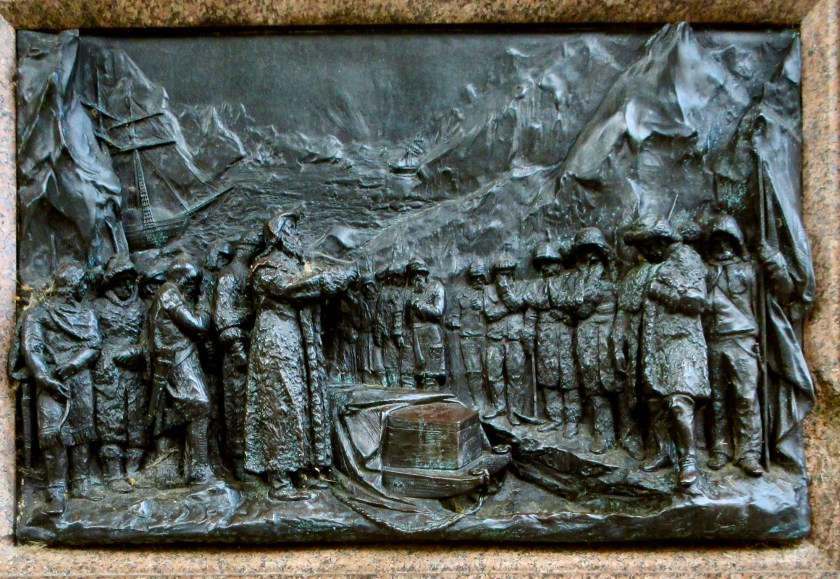
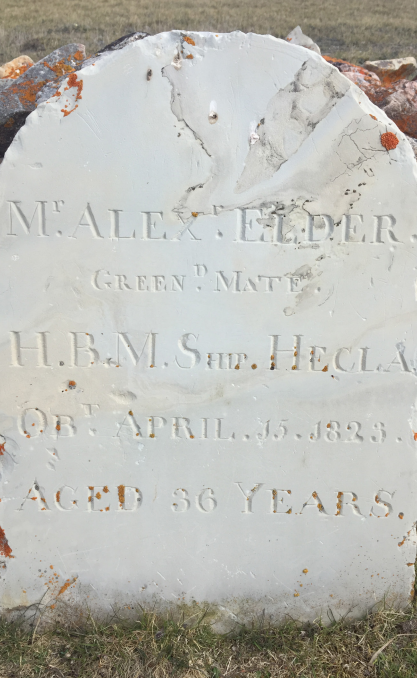
Early the next morning, the crews of both ships gathered ashore to pay their respects. Besides Parry and Lyon, those gathered by the graveside included naval officers who would be involved in future exploration work and Arctic tragedy: James Clark Ross, Francis R.M. Crozier, Joseph Nias, and Edward Joseph Bird. Parry conducted the funeral service, even as a fierce northern gale set in. After two musket volleys were fired overhead – a final salute to their comrade – crew hastened back to the shelter of the ships. The “handsome tombstone” that was erected at the spot seems unusual. According to Scientist Emeritus Dr. Marc St. Onge, of the Geological Survey of Canada, it is most likely composed of white marble. This would have had to have been quarried from a location hundreds of kilometers away from Igloolik. There is even a possibility that it was carried onboard the ships from England.15 It had been skillfully carved with deeply-incised lettering:
Mr. Alexr. Elder
Greend. Mate
H.B.M. SHIP. HECLA
OBt. APRIL. 15. 1823.
AGED 36 YEARS.
Four months later, the bay thawed enough for Parry to resume his mission. As Elder’s grave receded in the distance, the crews of Fury and Hecla could not have imagined that the grave marker of their dearly-departed comrade would one day embark on its own exceptional journey of the polar regions. The stone’s wandering began modestly enough: It was apparently set in gradual movement away from the burial site by the heaving motions of the seasonal shore ice.16 Although the Inuit continued to occupy Igloolik to hunt the abundant colonies of seals and walrus, there were very few visits by Europeans for the remainder of the nineteenth century. According to the oral traditions from the region, this was because of a terrible curse that had been cast upon Parry’s departing ships by an angry shaman, who wanted to prevent other ships visiting.17
When in early 1867 Charles Francis Hall trekked to Igloolik – questing after any scrap of information that could help locate Sir John Franklin’s missing crew members – he visited Parry’s old site at Turton Bay. He appears to have foregone a visit to Elder’s grave, to instead explore the site a flagstaff Parry erected nearby on the Melville Peninsula.18 In early 1913 Alfred Tremblay, a geologist associated with Captain Joseph-Elzéar Bernier’s commercial trading venture, travelled to Igloolik.19 Having reached the Island, he proceeded to wander around and discharge his pistol towards various features. This odd behaviour appears to have been intended to convince his Inuit hosts that he had the power to dispel the curse which still lingered over the island.20
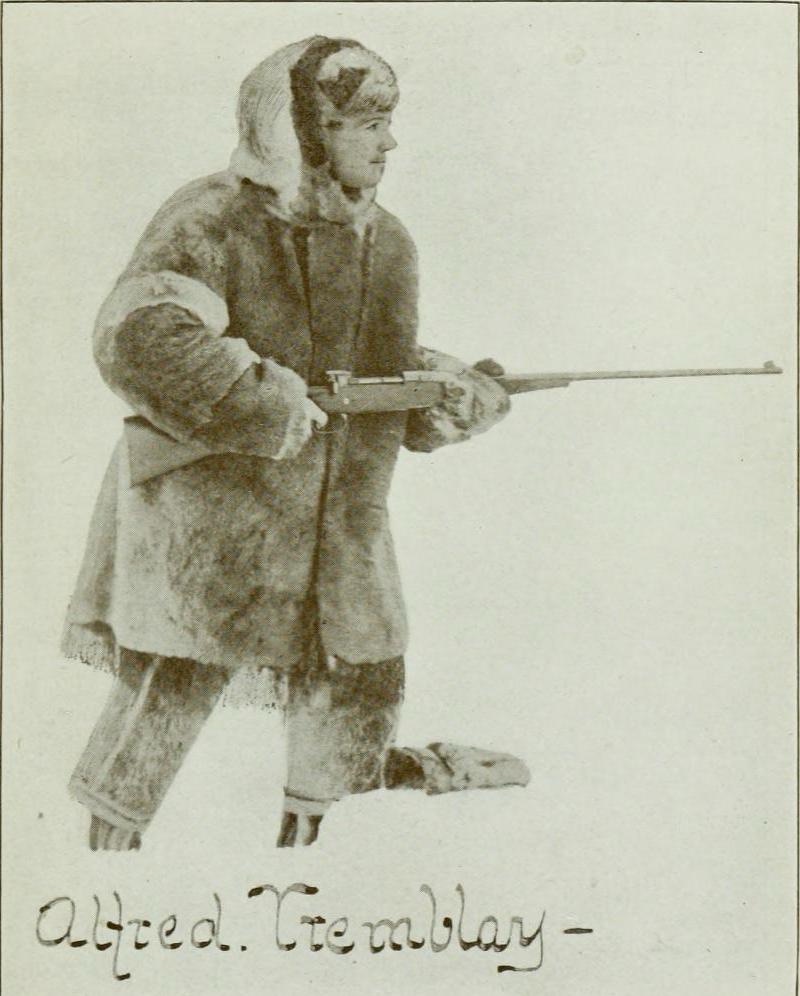
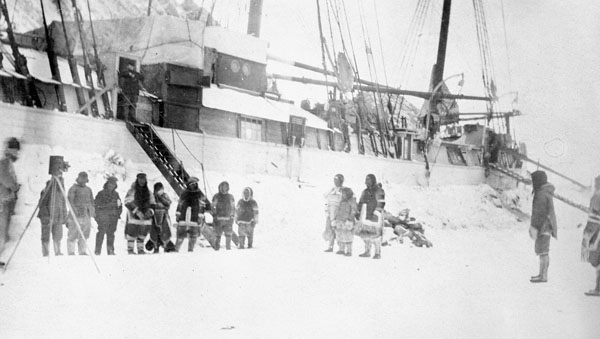
On March 23rd, while walking along the southern shore, he observed a conspicuous stone near the shore. When he flipped the stone over, he was surprised to discover Elder’s perfectly legible inscription. Looking around, Tremblay was unable to locate the original burial site, and speculated that the object must have moved a considerable distance.21 Soon after this rediscovery, it was transported about 400 kilometers northeast, to Albert Harbour (Qurtaq – just west of Pond Inlet/Mittimatalik), where it was incorporated into a graveyard of whaling ship crewmembers who had perished nearby. Dorothy Harley Eber, in her book about Inuit oral history, Encounters on the Passage : Inuit Meet Explorers, mentions that community members from Igloolik maintain an oral tradition that it was moved by Tremblay’s own guide, Nuqallaq (who was subsequently involved in the infamous Robert Janes shooting/trial).22 Tremblay doesn’t mention this in own account, while Kenn Harper’s 2013 article in Nunatsiaq News on the Tremblay visit notes that he was guided on his 1913 journey by Piunngittuq and his wife, Tuutalik.23 However the stone reached Albert Harbour, a decade later, Captain Bernier was back in the Arctic with his old ship, the CGS Arctic. His crew encountered the century-old stone in its new placement. The photograph at the beginning of this post was taken while Arctic visited Pond Inlet.24
The stone itself had one more (known) journey to complete. In 1948, the missionary priest, anthropologist, and amateur archaeologist Father Guy-Mary Rousselière decided to return it to Igloolik.25 After its round-trip Arctic journey of 800 kilometers, it rests once more near Parry’s old site, off a road leading from the townsite towards Igloolik Point.26
The rediscovery of the stone had made a strong impression on Alfred Tremblay. He chose to name an island at the eastern entrance to Fury and Hecla Strait – just north of Simialuk Island (formerly Ormonde Island) – after Elder.28 This was later confirmed as the official geographic name and today this location – 50 kilometers northwest of his tombstone – continues to commemorate Alexander Elder’s life. Given the stone’s unusual history, it is not surprising that rumours of the site’s haunting have persisted down to the present.29 Since Elder’s earthly remains no longer rest under the stone, it now memorialized him as a type of cenotaph. As we’ve explored in several recent posts, Arctic memorials can indeed be powerful sites of memory. They continue to haunt us, in the best possible way!
With thanks to Dr. Marc St-Onge.
Click for ENDNOTES
