On June 4th, 1773, HM Ships, Racehorse and Carcass set off from the Royal Navy’s Nore anchorage, in the Thames Estuary. While observers on nearby ships might have quipped about the unusual names of these vessels, what was most incredible was the mission the crews were being sent on: Commander Constantine John Phipps (the future Baron Mulgrave) was ordered to “proceed up to the North Pole, or as far towards it as possible…”1 In the words of crew member Olaudah Equiano, a self-emancipated former African slave: “I was roused by the sound of fame, to seek new adventures, and to find, towards the North Pole, what our Creator never intended we should, a passage to India.”2 The Phipps Expedition members would indeed have many Arctic adventures, and these were especially remarkable because – in spite of what sounds like an insane plan – the crews made it home!3
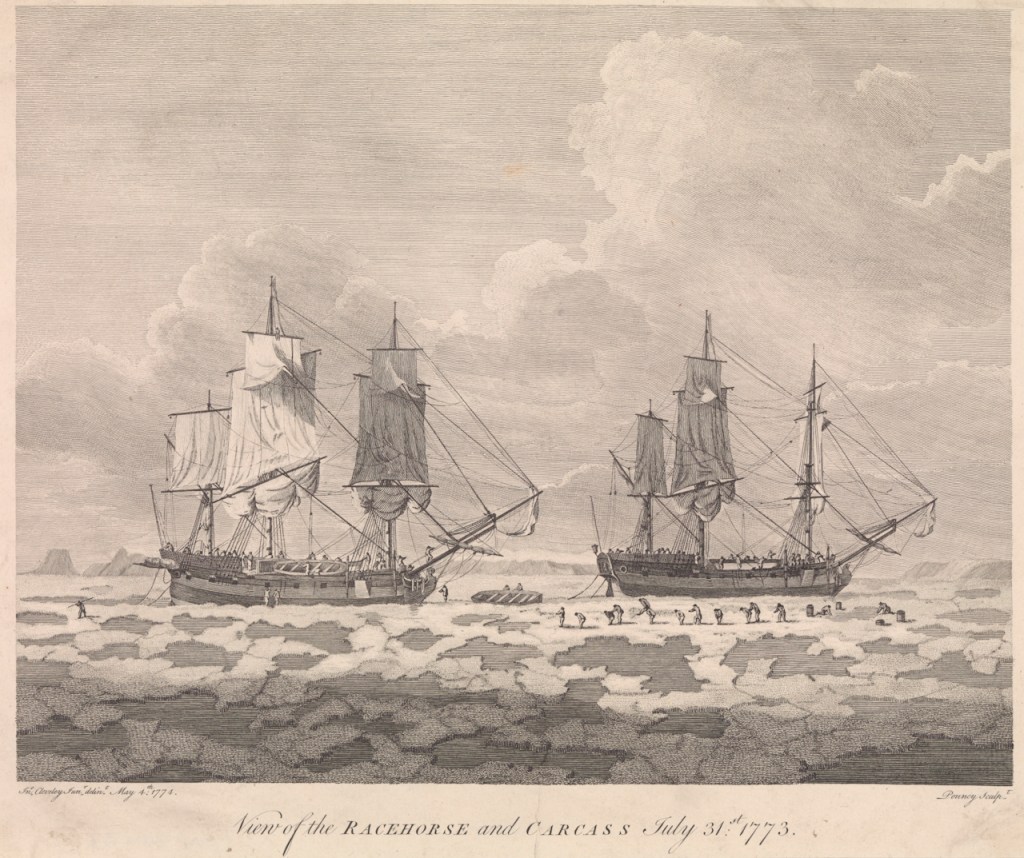
This post will continue our series exploring the design and service of the Royal Navy’s polar-modified bomb vessels. For a description of their general design and an account of how they wound up serving as polar exploration ships, starting with HMS Furnace’s 1741 conversion, see our recent post. The Phipps Expedition is mostly mentioned today because of the presence onboard the junior ship, Carcass, of a young midshipman fated for great things: Horatio Nelson.4 This incredible Arctic journey has several interesting connections to the disastrous events of the 1845 Sir John Franklin Expedition.
Thirty years after the 1741-42 Christopher Middleton Northwest Passage Expedition reached the high latitudes of Hudson’s Bay, the next major Admiralty polar exploration mission, the 1773 Constantine Phipps Expedition, saw two ships depart England towards a radically different destination: The North Pole.5 The mission benefitted from the patronage of King George the Third and had the enthusiastic support of the Royal Society (RS). Royal Navy Commander and RS member Constantine John Phipps was appointed to lead the expedition from Racehorse, while Skeffington Lutwidge continued his earlier command of the junior ship, Carcass. RS Vice President Daines Barrington hoped the crews would discover an open polar sea to lead towards the “South Sea” (Pacific Ocean).6 The rationale for this mission tied in to eighteenth century speculation about easily-navigable shortcuts to the Orient over the Pole, or through Northwest or Northeast Passages.7 In his published journal -an important source for this blog- Phipps tapped into this wellspring of speculative geography and summarized more than two centuries of exploration history to the Arctic regions, and the “North Passage.”8
Admiralty officials had learned valuable lessons from previous discovery missions. The Earl of Sandwich, First Lord of the Admiralty, took a keen interest in the preparations. Peter Goodwin’s invaluable account of the Expedition includes a chapter of biographical information on the officers and crews.9 His research shows that the Phipps expedition personnel were a carefully selected group, led by exceptional officers, accompanied by civilians with wide-ranging scientific expertise. The “young gentlemen” – midshipmen on the journey – included Horatio Nelson and Philippe d’Auvergne. Nelson became the coxswain of one of Carcass’s boats, while d’Auvergne worked up a fine visual record of events of the expedition.10 The crews were of a higher professional standard than in 1741, when – in the midst of war – Middleton had had to resort to impressment to fill his manning requirements.11 One notable Able Seaman, whose skill led him to serve as one of the coxswains of the boats, was Nicholas Biddle. Biddle went on to become one of the early captains of the Continental (United States) Navy, serving with distinction. Like his fellow coxswain Nelson, he died at the height of a naval battle.12
The scientific establishment on the Expedition included the Ship’s Surgeon, Dr. Charles Irving. The ships were equipped with a desalination machine he had invented. Phipps, Irving and his assistant, Olaudah Equiano, worked diligently to ensure the machine produced a supply of potable water.13 . The board charged with questions of longitude selected Dr. Israel Lyons to proceed in Racehorse. Lyons excelled as both a mathematician and botanist.14 Phipps had also sought out the advice of naturalist Dr. Joseph Banks, who had furnished him with instructions about what types of natural specimens to collect.15
To mitigate the risk that the destruction of one ship would result in the loss of the entire expedition, two reinforced bomb vessels were prepared. The ships received significant modifications for northern service, in an incredibly short period of time in early 1773.16 The Admiralty’s original intention was to equip, crew, and provision the ships identically. Given that they did not share a common design origin, this appears to have left Carcass dangerously overloaded. In late May, Lutwidge was permitted to land six cannon and reduce his establishment of crew by ten members.17 Even so, the disparity between the hull types and rig meant that Racehorse lived up to her name, by surging far ahead of Carcass. The entries in Phipps’ journal and from other primary sources are remarkably similar to reports of Terror struggling to keep pace with Erebus on Sir James Clark Ross’s Antarctic Expedition of 1839-1843, and the reason is also similar: these ships did not have the same hull lines.18
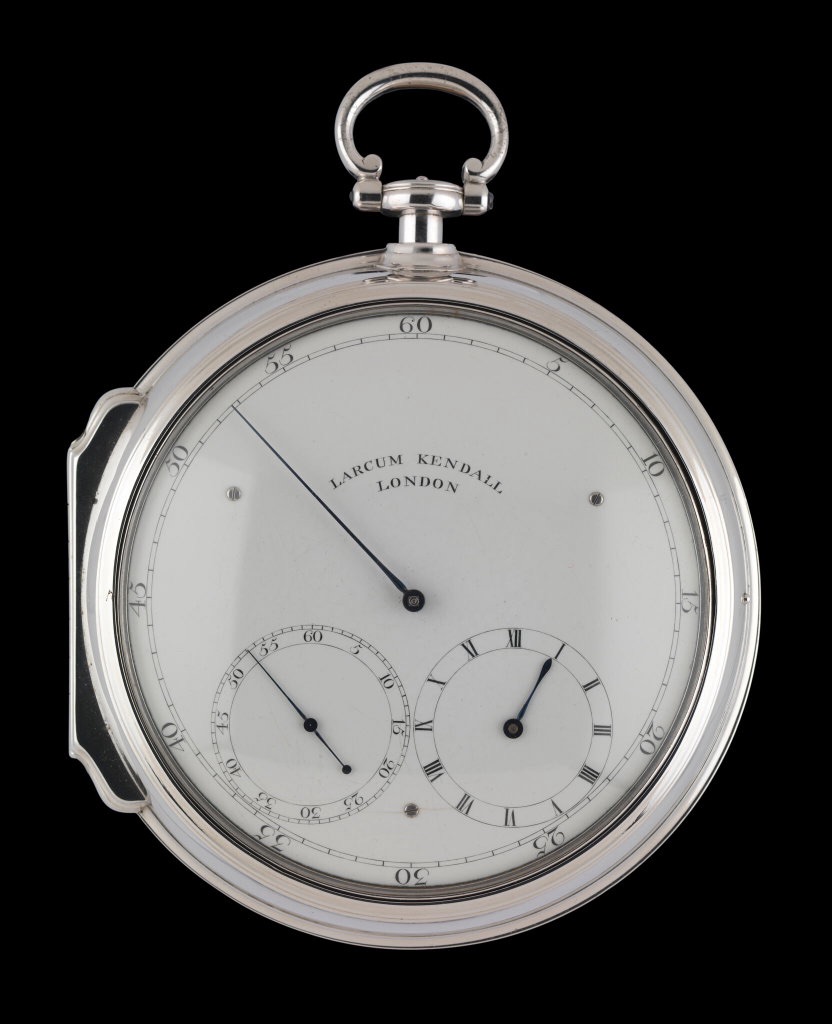
The expedition members were issued with proper cold weather gear (in contrast to the general sailing slops that had been allotted to Middleton’s personnel). Another first was the hiring on of a pair of Greenland pilots for each ship.19 These were experienced merchant ship’s masters, who had navigated “Greenlander” ships in northern waters.20 They would assist the officers and regular ships’ masters to help navigate local conditions in this unusual environment. Officers were equipped with a wide variety of updated navigational instruments and scientific devices. Like James Cook’s contemporary exploration of the Pacific, the ships carried updated timekeeping instruments, which employed John Harrison’s principles. These Larcum Kendall designs would allow for more accurate calculations of longitude than had previously been possible.
The Expedition vessels’ conversion for polar service have a basic similarity to the 1741 modification to HMS Furnace. The hulls were double-planked for strength. Vessels received capstans amidships, instead of the windlass in the bows.21 Smaller-sized vessels of the Royal Navy now were provided with (steering) wheels, unlike Furnace at the beginning of the 1741 journey. In contrast to later conversions, the gunports were not planked over. One important new modification was that the bows were reinforced internally with heavy buttressing timbers, to better withstand the force of collisions with ice or the strain of being beset in it. From surviving illustrations, the bow areas also appear to have received some external wooden sheathing, much like contemporary whaling ships. Both vessels received a varied complement of boats, intended to be able to accommodate the entire crew should their vessel be destroyed (we had mentioned the modification to the boats for over-ice hauling in a previous post). As events would show, this was a sensible precaution.
The open waist area of the ships was not enclosed (merging the quarterdeck and foc’sl deck into one unified weather deck). The Admiralty had partially decked in this space on Furnace, on Middleton’s advice. They should have repeated this modification.22 A unified weather deck protects ships’ stores and important equipment, and also enhances crew comforts in Arctic conditions. This would have greatly improved conditions on the journey home, when both vessels almost foundered in a series of terrible gales. Close interpretation of surviving artistic depictions also suggest that the channels (where the masts’ shrouds attach to the hull) were not fortified or chocked (filled-in) as they had been in Furnace, leaving these projecting channels vulnerable to ice damage.23
The northwards-bound vessels encountered ice starting on July 7th.24 The expedition charted the islands of the Svalbard Archipelago, and recorded various observations (astronomical, magnetic, depth sounding) as they went. No easy path towards – much less over – the Pole was discovered. The officers and scientists described what flora and fauna they encountered on the islands, and marine life they could dredge up from the depths. Phipps’ journal records the first scientifically-based descriptions of polar bears, which were shot and brought aboard for study. The expedition reached its highest northern latitude of 80°48′ on July 27th. The vessels and crew were severely tested in early August, when the ships could find no more open water leads to advance to the northwards, and were beset in thickening ice. This experience – while mercifully brief – was terrifying. It is one of the most relevant polar precedents for when Sir John Franklin’s crews of HMS Erebus and Terror had to abandon their iced-in vessels in late April, 1848.
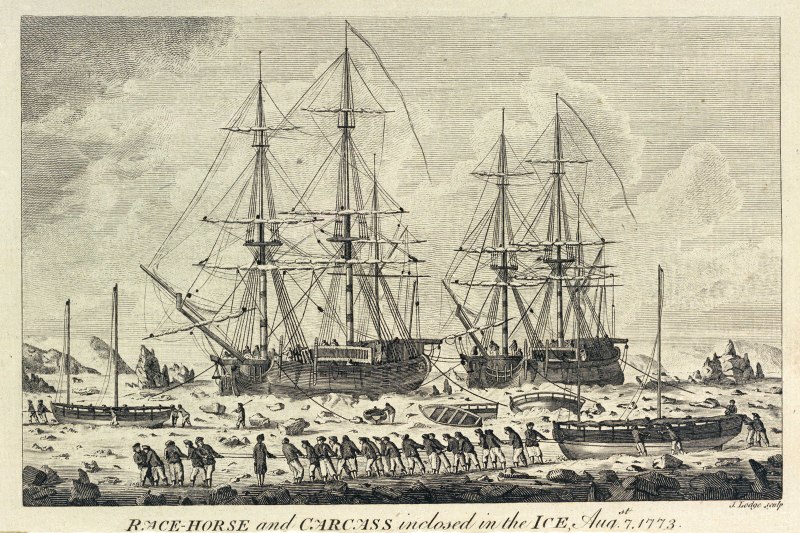
On August 6th – with the ships trapped – Phipps took stock of his remaining provisions, and estimated that the health of the crews would decline rapidly if they were forced to overwinter out on the ice in this unprepared spot. The carpenters were instructed to modify the boats in order to have crew haul them across the ice in an effort to try to reach open water. They would then put to sea to locate Dutch whaling ships that were known to be anchored nearby at Smeerenburg, an abandoned settlement on Amsterdam Island. The next day, with the water shoaling, and the ice carrying the ships inexorably towards some rocks to the northwest, Phipps left Racehorse to lead a crew hauling the launch (the largest size of boat brought along) westwards over the ice. Crew also remained on the ships, which made slow progress westwards behind the boats. All parties remained in contact. As the crew hauled the boats along the broken, treacherous ice, favourable winds sprang up and the ships started to advance. Soon the exhausted crews returned onboard and the boats were swung back on deck. By the 10th the ships had driven through the remaining ice (with what sounds like some actual precedent-setting icebreaking), and were able to safely anchor at Smeerenburg (where there were indeed Dutch ships preparing to depart for the year). A mobile observatory was installed ashore. The officers described a nearby glacier, while Philippe D’Auvergne worked up another of his well-executed sketches of the scene.25 When the ships raised anchor, a few other attempts to make more northing came to nothing, as the season advanced and the ships came across a wall of ice. Phipps decided to turn for home on August 22nd.
In common with other polar expedition accounts, the voyage home was horrendous. By the second week of September, both crews were fighting for their lives in a series of terrible storms. The ships were both damaged in the gales that started the second week of September, and lost sight of each other. Each crew believed the other ship had likely foundered. The open waist area of the ships became a liability at this point.26 The vessels sighted each other again on the 25th of September off the coast of Suffolk.
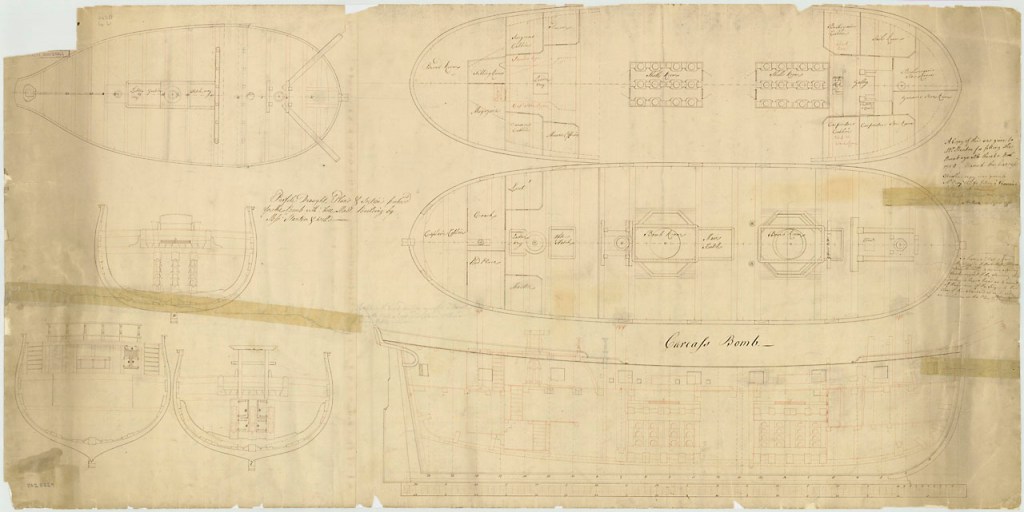
In the years after Phipps and his crews returned, the Admiralty had to shelve further plans for Arctic discovery missions as it found itself embroiled in a series of wars that expanded to include the majority of the World’s oceans. It took until the final defeat of Emperor Napoleon Buonaparte, in 1815, for the polar exploration program to be revived (with Second Secretary of the Admiralty, John Barrow, taking a leading role). In contrast to the divisive legacy of the Middleton Expedition, Constantine Phipps’ Expedition was remembered in favourable terms. The modification of Racehorse and Carcass set many precedents for the next two bomb vessels to go north to the Arctic: Hecla and then Fury. Please consult the “Design Dossier” below for more technical information about Racehorse and Carcass.
HM Ships Racehorse and Carcass Design Dossier and Endnotes:
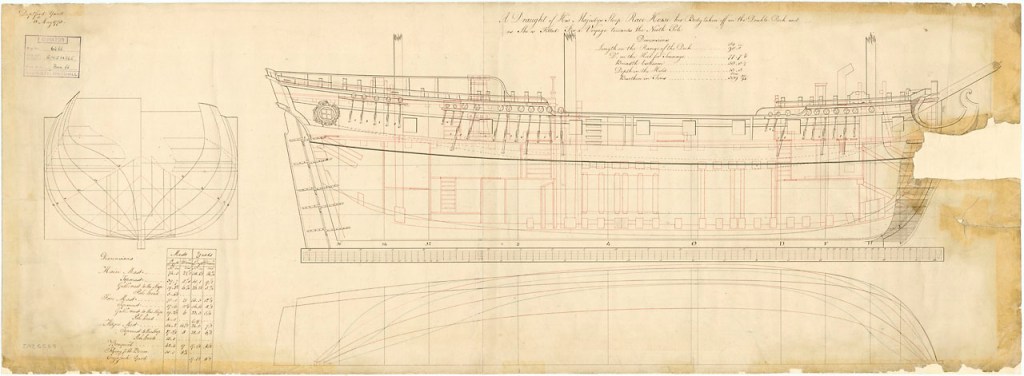
HMS Racehorse had a unique origin. The ship had been a French 18-gun privateering sloop named Marquis de Vaudreuil.27 She was 97 feet long with a broad 31-foot beam and a deep hull. After her 1757 capture, she was first modified to become a fireship – which much like bomb vessels was another terrifying weapon in the Royal Navy’s fleet.28 Fireships also spent much of their careers serving as auxiliary cruisers. Racehorse’s first conversion would have involved a reduction in the broadside armament, with a much smaller establishment of crew. The gunports would have been modified to be downward hinged (to help draw in more air to fan the flames when the vessel was set alight).29
Soon after this, Racehorse was converted to a bomb vessel. This involved radical alterations to carry the mortars. Looking at the plans in the National Maritime Museum collection, it is clear that almost everything was modified. The ship’s sides were extensively cut down, the masts were repositioned, gunports were moved or planked over, and the old stern galleries were simplified, with the quarter galleries removed in favour of a simple quarter badge round light. The resulting hull was still larger than the purpose-built bombs and displaced 389 tons.30 Remarkably, Racehorse was about the same size as the ultimate bomb-exploration vessel: Sir John Franklin’s HMS Erebus. Her new role saw her participate in the 1759 campaigns against the French in New France. After the Fall of Quebec City, Racehorse’s crew got a first experience of overwintering in a harsh climate, when the ship was beset in ice.31
Racehorse was again modified – now for polar service – at Deptford dockyards in early 1773. Uniquely amongst all converted bomb vessels, the aft bomb shell room and supporting cribbing was left in place, to stabilize the hull. According to Goodwin, this was likely because Racehorse’s original construction, as a light French-built privateer, was considered too slight for the rigors of northern service.32 The establishment grew to 90 crewmembers.33 Surviving illustrations by John Cleveley the Younger of the Expedition indicate she may have been fitted with some type of simplified equestrian bust as a figurehead. After the Phipps Expedition, Racehorse was converted back to a bomb, and was renamed to become Thunder in 1775. Three years later Thunder was captured (back) by a powerful force of French warships off Sandy Hook. Peter Goodwin notes that after her capture she was burnt.34
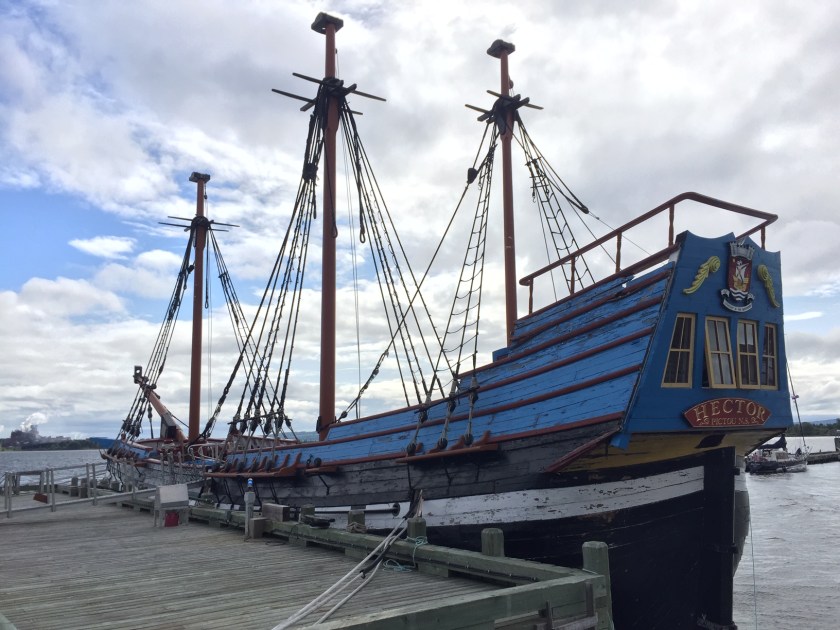
HMS Carcass was an Infernal class bomb vessel, displacing about 310 tons, and was 92 feet long with a 28-foot beam. She was built in Rotherhithe, near London, by a Mr. Stanton at his yard, and completed in 1759.35 A “carcass” was a type of incendiary shell the mortars could fire. The class had been designed by noted naval architect Sir Thomas Slade, who would go on to draft out the plans for HMS Victory, especially famous as Lord Horatio Nelson’s flagship at the 1805 Battle of Trafalgar, and currently preserved at Portsmouth.36 Like all bombs which would be used on northern discovery from 1741 until 1845, the primary armament had originally been a 13″ and a 10″ mortar. Four of the class units, including Carcass, were completed with a full three-masted ship rig – the first bombs rigged as such from the outset. The mortar beds were situated before and abaft of the mainmast. When fitted for discovery at Sheerness dockyard, the ship had a crew of about 80. Carcass was built with an old-fashioned, rounded stern similar to Dutch fluyts of the seventeenth century. Aft, the hull rounded up to the sternpost, much like it did to the stem at the bows.37 Considering the damage that later polar discovery ships would suffer to their stern posts whilst beset in ice, this actually may have been a superior design.38
Endnotes:
- Constantine John Phipps A voyage towards the North Pole : undertaken by His Majesty’s command, 1773 (London : Printed by W. Bowyer and J. Nichols for J. Nourse 1774), 20. Available at the Internet Archive, digitized from the copy at Marine Biological Laboratory (MBL) and Woods Hole Oceanographic Institution (WHOI). For an interesting summary of this work, see: Alma Dean (Maynooth University) A 1773 Voyage to the North Pole – MU Library Treasures. ↩︎
- The Interesting Narrative of the Life of Olaudah Equiano, or Gustavus Vassa, The African | Project Gutenberg. Olaudah Equiano is the first crewmember of African descent we have ever heard of that was participating in a Royal Navy polar exploration mission. He assisted Dr. Charles Irving, inventor of the desalination machine and ship’s surgeon. Equiano was performing highly specialized work assisting Irving and Phipps to create potable water for both ships. ↩︎
- Despite references to the whole expedition crew survived, in fact, there was at least one fatality: On the 27th of July Able Seaman Swin Christian from Gothenburg (Sweden), 30 years old, died (cause not stated). Crews paused the next morning to commit his body to the deep. This appeared in Phipps’ journal for Racehorse, not his published account. See Peter Goodwin Nelson’s Arctic Voyage – The Royal Navy’s First Polar Expedition 1773 (London: Adlard Coles, 2018) 184-185. ↩︎
- See for example Terry Coleman’s The Nelson Touch: The Life and Legend of Horatio Nelson (Oxford: Oxford University Press 2002) 13-14. ↩︎
- See our recent post on the Middleton Expedition’s highest northing, where we advance a geographic argument for HMS Furnace having reached the Arctic Circle on an official Admiralty mission in August 1742, thus becoming the first British Royal Navy polar exploration mission: “Christopher Middleton – the First Royal Navy Arctic Explorer – Crosses the Line in 1742.” ↩︎
- A detailed summary of the Constantine Phipps Expedition can be found at Ann Savours Shirley “A very interesting point in geography”: The 1773 Phipps Expedition towards the North Pole Arctic Journal 37:4 (December 1984) 402-428. https://pubs.aina.ucalgary.ca/arctic/Arctic37-4-402.pdf The enduring belief in a “north” or “over pole” passage through an open polar sea involved an assumption that salt water did not freeze into pack ice. ↩︎
- For a fulsome treatment of the remarkable persistence of these two beliefs – temperate sea at the pole and NW Passage leading from Hudson’s Bay straight to Pacific coast, see Glyn Williams Voyages of Delusion : The quest for the Northwest Passage (London: Yale Univ. Press, 2002). ↩︎
- Phipps, “Introduction” 1-15. ↩︎
- I think it worth considering what these carefully-crewed and magnificently refitted exploration ships might have accomplished had they been sent in Christopher Middleton’s wake, to seek a Northwest Passage, or down towards the frozen South. ↩︎
- Later mythology around Lord Horatio Nelson’s precocious bravery has resulted in an accounting of events involving him that read like a boy’s own adventure! He may have taken an unauthorized excursion on the ice (with a fellow Midshipman, Harvey) to hunt his own polar bear (the subject of the famous Richard Westall painting). As one of the coxswains of the boats, he was also sent to help another boat’s crew who had wound up fighting a pitched battle against a herd of walrus. He is not mentioned by name a single time in Phipps’ account. ↩︎
- Goodwin’s Chapter 7 describes in great detail the process of manning the vessels. ↩︎
- Biddle died when his command, USS Randolph, then engaged in a running battle with the larger HMS Yarmouth, exploded and sank. ↩︎
- Phipps devoted an appendix of his published account of the voyage to the workings of the desalination machine. Crews starting using this remarkable machine on June 20th. Phipps, 28. ↩︎
- Goodwin, 33. ↩︎
- Phipps, 12-13. ↩︎
- Since the time of HMS Furnace’s foray to Hudson’s Bay, looking for a NW Passage, HMS Dolphin had circumnavigated the World two times, first under John Byron (1764-1766) and later under Samuel Wallis (1766-1768). Dolphin was accompanied for some of that second voyage by HMS Swallow, under Philip Carteret. Captain James Cook had completed his first circumnavigation and was at this time sailing on his second great voyage. He was using the first accurate Kendall chronometer, K1 – a near copy of Harrison’s H4 – which was enabling him to make highly accurate longitude calculations. In August 1773 he reached Tahiti. ↩︎
- Phipps, 20. ↩︎
- Phipps begins recording Carcass’s difficulty keeping pace in early July. See also Goodwin, who had access to Lutwidge’s and Midshipman Floyd journals, discussed the variable sailing performance of the ships, 313-314. ↩︎
- Phipps 10-12. ↩︎
- Glyndwr Williams’ The British Search for the Northwest Passage in the Eighteenth Century (London: Longman’s, 1962) P165. Christopher Middleton had not required special pilots in 1741, as he had extensive experience in the waters of Hudson’s Bay. ↩︎
- By this time, sloops and larger ships were fitted with ship’s steering wheels, so there was no need to install a wheel, as Christopher Middleton had resorted to while overwintering his ship in Churchill, Hudson’s Bay. ↩︎
- As noted in our recent post on HMS Furnace’s modifications, Middleton held a council while overwintering in Churchill, and the carpenters and crews then optimized the ship for northern exploration, including by further extending the weather deck. ↩︎
- According to Phipps’ journal, on August 10th ice struck the ship with enough force to shear off one of the shanks from the heaviest bower anchor, which was then in its usual position near or hooked into the forward chains. Had this ice struck anywhere closer in, it might well have destroyed the chains or other projections, which is why the ice-chocks which filled in this space were important protection for polar discovery ships. ↩︎
- This summary of the Expedition in the next four paragraphs is drawn, except where noted, entirely from the July-September daily entries in Phipps’ published account, Pages 38-76. ↩︎
- Philippe D’Auvergne had a distinguished career, and retired as a Vice-Admiral, after service as a spymaster on the Channel Islands during the French Revolutionary Wars. He was a gifted mathematician and artist, and many of his sketches were worked up by John Cleveley the Younger into the engravings and watercolours that survive about the Expedition, while a few of his coastal views and technical drawings were reproduced throughout the pages of Phipps published journal. ↩︎
- Goodwin P236-248. The storm made a shambles of the lower decks, and the open waist meant crew, whose accommodation spaces were dreadfully soaked, had to frantically clear away all loose provisions and spare yards stored on deck, tossing items overboard. The boats were either destroyed in their cradles or deliberately stove in (with axes) by the crew to avoid filling with water, and cannon even had to be frantically jettisoned (240). ↩︎
- The careers of both ships are summarized under their entries at threedecks.org, which usefully cross-referenced with secondary and archival entries. See British sloop ‘Racehorse’ (1757) and British bomb vessel ‘Carcass’ (1759). ↩︎
- Fireships were a type of – terrifying – warship that was either converted from a merchant ship, or purpose-built. Once packed with inflammable materials, a skeleton crew would trim the sails and fasten the wheel to hold a course towards an enemy fleet formation or enclosed harbour. After flammable materials were lit, they would rapidly escape into a waiting boat from an enlarged boarding port. The burning sails would turn the vessel into an wind-borne unguided incendiary pyre. The ships’ yards were even fitted with grapples to better and foul the rigging of enemy vessels. Instead of clapped-out merchant hulls, the purpose-built vessels from the later eighteenth century, such as the Tisiphone or Thais classes, were well-balanced designs akin to corvettes. ↩︎
- One port on either quarter would have also likely been enlarged (important as a “sudden exit” port to help the crew rapidly abandon the ship once it was alight). ↩︎
- This tonnage is referenced in the National Maritime Museum as-modified 1773 plan, NMM reference ZAZ6569. ↩︎
- Goodwin, 49. ↩︎
- Goodwin, 61. ↩︎
- Phipps, 3. ↩︎
- Goodwin, 269. ↩︎
- Chris Ware The Bomb Vessel: Shore Bombardment Ships in the Age of Sail (Annapolis: Naval Institute Press 1994) 42-43. This new vessel replaced a previous Carcass, which had been a sistership to Christopher Middleton’s exploration vessel, Furnace. ↩︎
- For a quick account of HMS Victory’s career, and other British/English three-deck line of battle ships, see our post on the topic. ↩︎
- This double-ended appearance (from lower deck plans) prefigures later polar designs such as Roald Amundsen’s ship Fram. ↩︎
- This fluyt-like design could also be described, like the replica Nova Scotian tall ship Hector is, as a bootschip. An example of the devastating effect overwintering in ice could have on a vessel’s sternpost is readily seen in HMS Terror’s 1836 ordeal during George Back’s Frozen Strait Expedition, where the post was shattered and the vessel crossed the Atlantic in sinking condition, miraculously reaching Lough Swilly, Ireland. ↩︎


Very interesting and well written.