HMS Furnace- First Bomb to Blaze a Trail North

On that fateful day of May 19th, 1845, when the crews of Sir John Franklin’s last expedition in search of the Northwest Passage departed Greenhithe, England – never to return – they did so onboard two absolutely incredible vessels. Her Majesty’s Ships Erebus and Terror hadn’t originally been designed for polar exploration. Rather, these were both examples of a highly specialized type of warship called a “bomb vessel.” Why send a warship that was meant to bombard enemy positions on a polar exploration mission? This post briefly explores the history and design of the first bomb vessel that was sent north, HMS Furnace, which left England in 1741 on an earlier effort to locate that same illusive passage to the Pacific Ocean.1 Did Furnace blaze a trail across the frozen northern latitudes? Not exactly, but her modifications for exploration set an important precedent for a lineage of tough little ships which would be used on Arctic and Antarctic exploration missions.2
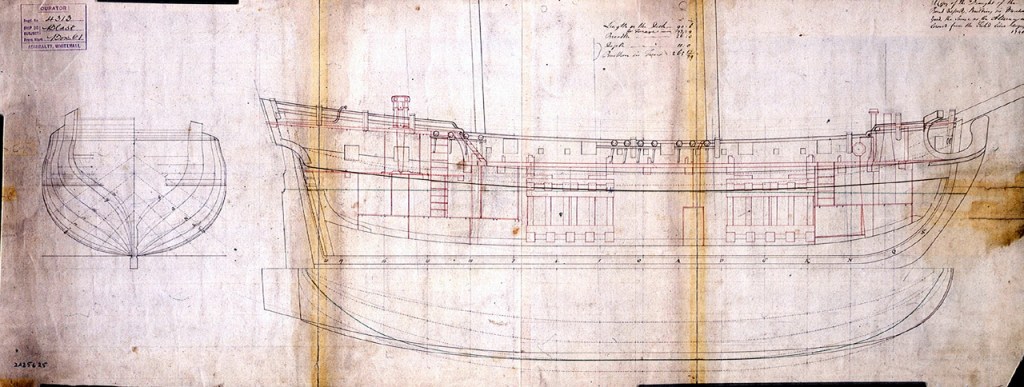
The Blast class, the original as-built configuration of Furnace from 1740, showing the two heavy mortar beds (cribbing) in the waist, the ketch rig (mainsail and a mizzen aft) a simple capstan perched high above the aft deck, and a windlass in the bow. Credit: © Crown copyright. National Maritime Museum, Greenwich, London ZAZ5625.

Maritime historian and former National Maritime Museum curator Chris Ware’s work on the history of bombs, The Bomb Vessel: Shore Bombardment Ships in the Age of Sail, provides the development history of the Royal Navy’s bomb vessels, and highlights the careers of selected ships.3 The type had been created late in the 17th century to carry one or two heavy mortars amidships. Like many other great British naval developments, the idea had come from France, whose navy had built the first bomb vessels, galiotes à bombes, starting in 1681.4 The mortars (which had been developed originally for land warfare) fired a type of fused shell called bombs (explosive) or carcasses (incendiary) on a high trajectory over the bulwarks. They were used against fortifications or cities and towns. The bombs would plunge downwards to explode against or over targets. These were terrifying weapons, with destruction and fire plummeting down from the skies.
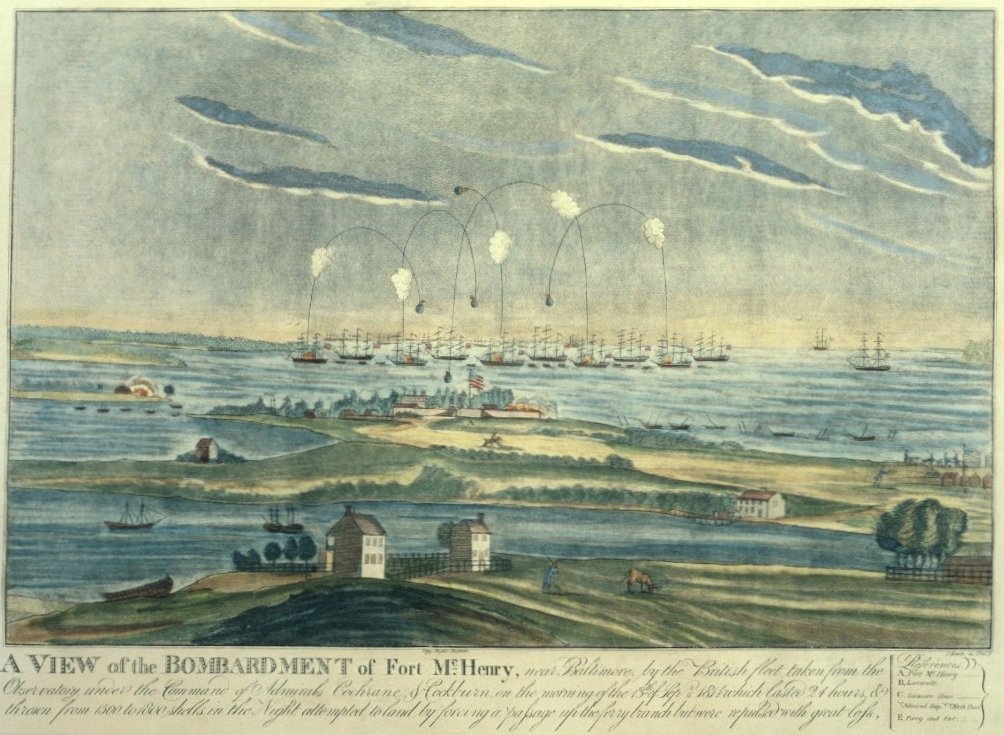
John Bower’s engraving of the Bombardment of Fort McHenry, near Baltimore, in September 1814 by the British fleet, including HMS Terror and an earlier generation of HMS Erebus, and several other bombs. Credit: Dr.frog at en.wikipedia, Public domain, via Wikimedia Commons

To carry the massive mortars and handle their powerful recoil, which was transmitted down from their carriage directly into the wooden timbers of the vessel, bombs had to be very strongly built: They were framed, decked, and reinforced much more stoutly than other ships of their relatively small size. While the first English bombs resembled small coastal craft, by the 1730s new designs appeared that were closer to naval sloops.5 There were usually only a handful of bombs active at any given time. Most spent the vast majority of their careers out of commission or converted to other roles. The Board of Ordnance, which had responsibility for both the guns and the specialist personnel to work them, would unship and land the mortars to help preserve these valuable weapons. When being used as patrol vessels, a stronger battery of cannon was installed along the gundeck.
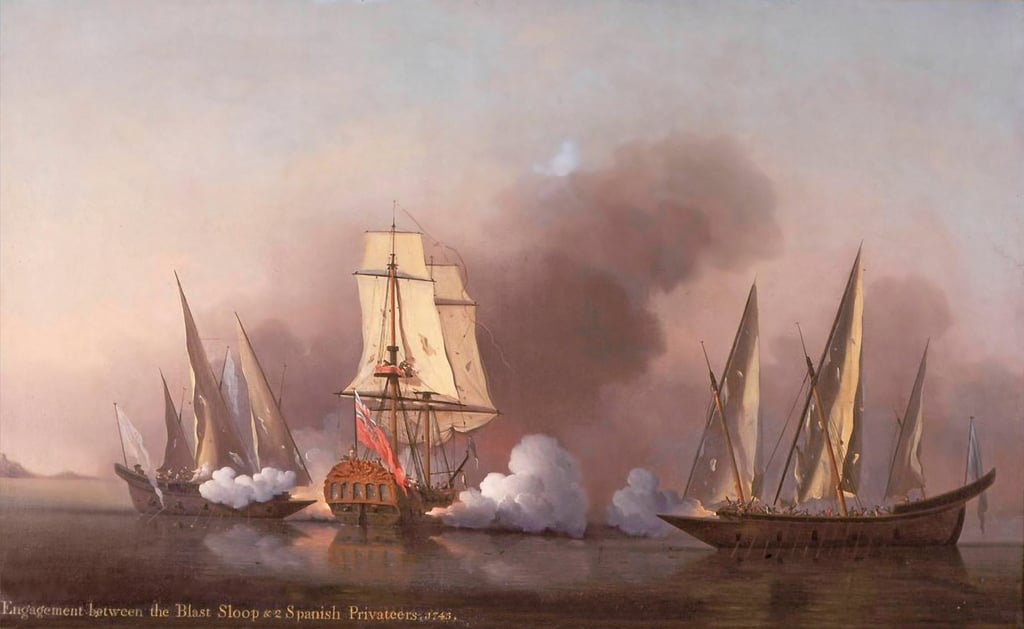
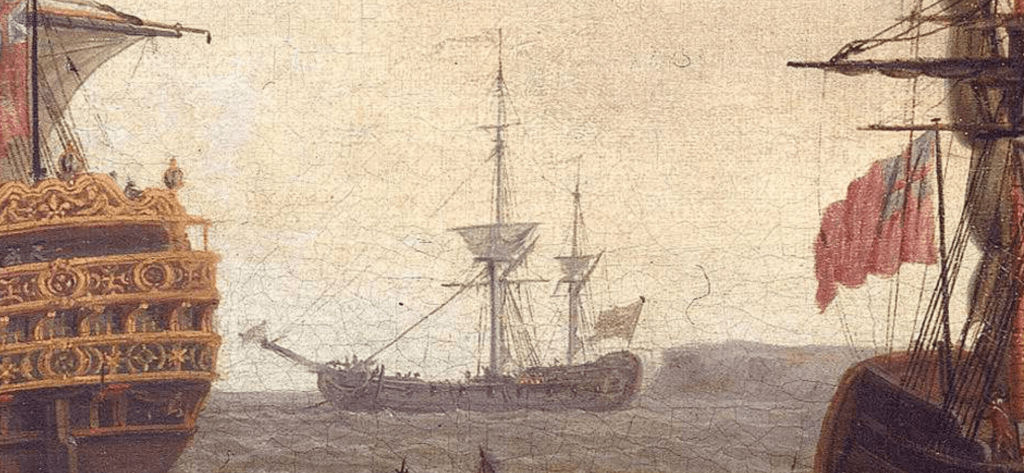
This painting by Samuel Scott is a rare representation of a mid-18th Century bomb vessel. It depicts the capture of HMS Blast, lead ship of Furnace’s class, in 1745. Blast was captured while serving as a sloop, and would have been armed without the mortars but with ten 4-pounder cannon when captured by two Spanish privateers. Blast appears to have a full 5-light (windowed) stern, and the additional armament has been added to the stern cabin (seen in the lower siting of the gunports aft). Oddly, the ship is now depicted rigged in the reverse of a ketch, as a brig or a snow. Credit: Samuel Scott, (Earl of Pembroke. Paul Mellon Centre for Studies in British Art) Public domain, via Wikimedia Commons

In contrast to the great and tragic expeditions that came both before and after, Christopher Middleton’s Northwest Passage Expedition of 1741 is rarely mentioned, even in polar exploration literature. Middleton was an experienced ship’s captain and a skilled navigator who had conducted a variety of scientific observations (including magnetic studies) while sailing to and from Hudson’s Bay, on annual supply missions for the Hudson’s Bay Company. He had an early enthusiasm for exploration, the search for the Northwest Passage, and also an interest in establishing the fate of the vanished James Knight expedition of 1719.6 Middleton had been nearby at Prince of Wales Fort (present-day Churchill, Manitoba) when, unbeknownst to anyone, the crews of Knight’s two small ships were marooned on Marble Island in 1721-22.7 In recognition of his scientific publications, Middleton was elected a Fellow of the Royal Society in 1727. In 1741, having left the employ of the HBC, the Royal Navy appointed him to command HMS Furnace. His orders were to seek a Northwest Passage somewhere along the Western coasts of the Bay. In reviewing the available units of the fleet, the new and rugged generation of bombs must have seemed ideal candidates for an exploration mission, where ships were in danger of colliding with icebergs, grounding, or being forced ashore out in Baffin Bay or the Hudson Strait, or being damaged or crushed by pack or land ice. Furnace would be accompanied by a hired collier, HMS Discovery, which was commanded by Middleton’s cousin, Lt. William Moor. The Admiralty optimistically believed that, a Passage having been located and exploited, the ships might link up with Commodore George Anson’s 1740-44 circumnavigation of the World, somewhere in the Pacific.

After crossing the Atlantic, the crews spent a terrible winter at Prince of Wales Fort to get an early start to the season. Expedition members stayed ashore in a disused wooden fort.8 They would have first prepared the ships for being iced into the harbour – with Furnace becoming the first bomb to overwinter. Once the exploration work commenced in July 1742 they quickly discovered that a promising inlet did not in actuality offer any corridor to the west (Middleton thought this a river and named it “Wager” after Sir Charles Wager, First Lord of the Admiralty, but it was later determined to be a bay). Other useful exploration work included the discovery of Repulse Bay (now known as Naujaat) and the assessment that the Frozen Straits offered no likely passage to the west. With the crew weakening from scurvy, and the major exploration work having led to dead-ends, Middleton hastened back to England.9

Middleton’s surveying work was attacked after his return, with Arthur Dobbs (a wealthy and influential Irish landowner who has supported Middleton’s original appointment) and Moor both coming around to the view that not enough had been done to rule Hudson’s Bay out as the beginning of a passage towards the Pacific.10 Moor departed on another expedition which explored more of the same coasts of the Bay. This privately-funded expedition served to underline that there was no reason to keep exploring the shores of Hudson’s Bay for a Northwest Passage. Future expeditions would take other reinforced bomb vessels further north to continue the search for a navigable passage amongst the Arctic islands. As William Barr has pointed out, the criticisms Middleton was subjected to were baseless, and the accuracy of his surveying was eventually confirmed.11

HMS Furnace was a Blast class bomb vessel, completed in October 1740 by Quallett (presumably the commercial yard of John Quallett of Rotherhithe in South London, which built other Royal warships such as HMS Chesterfield and several sloops). She was 91.5 feet long on the gundeck and 26’4” broad, with an 11-foot draft. All told she was almost 273 tons burthen.12 This new class of six bomb vessels were rushed into service as war broke out again against Spain in late 1739. As the War of the Austrian Succession (1740-1748) spread across Europe, a second group of five almost identical sisterships were constructed the next year. Among them was the second bomb vessel to be named HMS Terror.13

Like most early bomb vessels, Furnace was rigged as a ketch, with a tall mainmast and a shorter mizzen aft. This rig proved to be problematic for the complicated laying, or aiming of the mortars, as it left only a small arc of fire unimpeded by the masts, yards, rigging and shrouds. When it came to the deck machinery, earlier bombs had been fitted with windlasses (horizontal drums) to assist in heavy tasks such as lifting the anchor cables, or the complex effort of warping the ship around on the anchor cables to precisely aim the mortars. The Blast ships, by contrast, were fitted with a windlass and the more powerful capstan (vertical drum) on the quarterdeck.14

HMS Grenado, a near-contemporary of Furnace, is depicted in a superb sectional model at the National Maritime Museum, Greenwich, which helps us explore the peculiarities of the design:
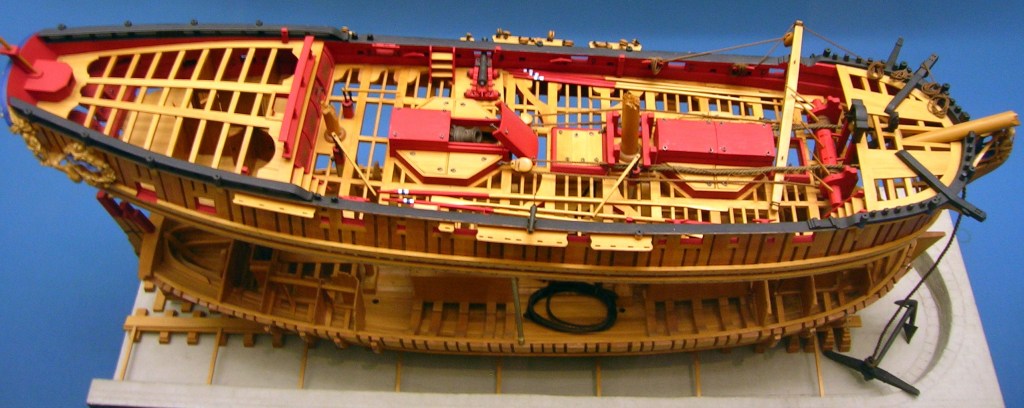
HMS Grenado model showing both octagonal mortar pits, the new trunnioned mortars, and the exposed deck beams and hull framing. Credit: Rémi Kaupp, CC BY-SA 3.0, via Wikimedia Commons the original model was built by Robert A. Lightley and is catalogued at National Maritime Museum as SLR0331.

We can observe a robust, wide hull, with closely spaced frames. The solid construction continued into heavy knees supporting the deck beams. In Grenado and Furnace, the mortars were originally sited forward and aft of the mainmast, while the mizzen mast rises above the deck just forward of the break on the quarterdeck. A new type of mortar had been developed, which could elevate and depress on trunnions, and rotate in its octagonal pit. The mortars could be lowered and covered over with sliding hatches, and protected from the elements. The long run of the open waist amidships was necessary to provide the room needed to work the mortars. These ships, like the later Franklin vessels, were originally armed with a 13″ and a 10″ mortar. The secondary weapons, a battery of six light 4-pounder cannon, created a modest broadside for defensive purposes. Additional empty gunports, evenly spaced along the gundeck, allowed for the augmentation of these cannons when the mortars were unshipped. The officers’ cabins were tucked aft under a small quarterdeck, on a deck stepped slightly lower than the main run of the gundeck. There was a very small covered foc’sl forward of the large windlass, and between those was the usual belfry with ship’s bell.
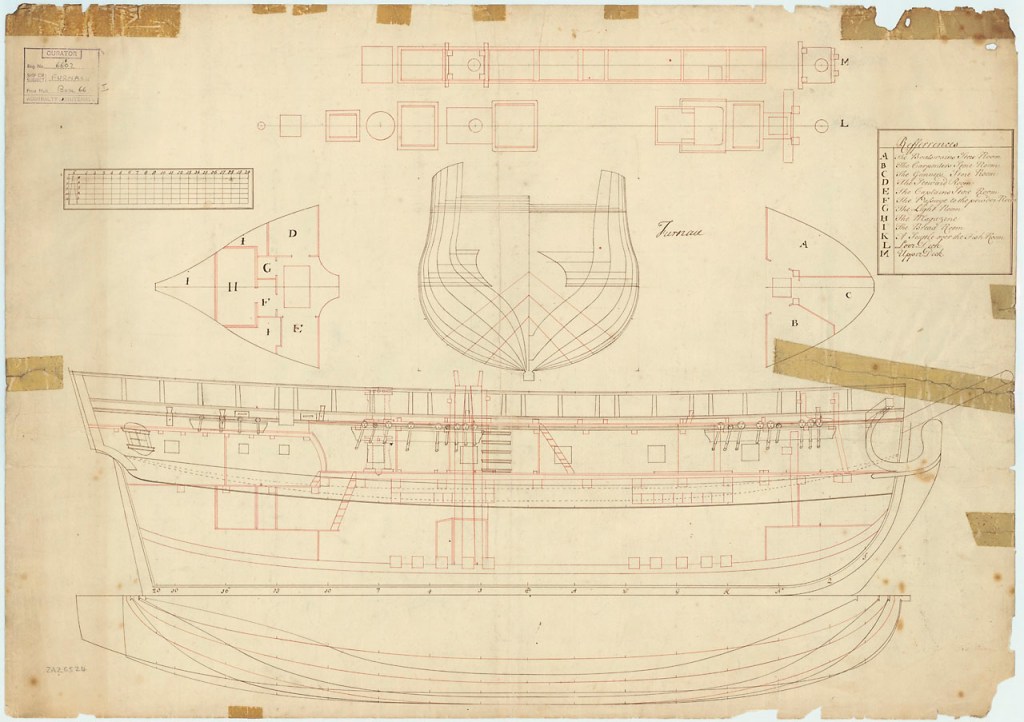
HMS Furnace as converted for the Middleton Expedition in 1741. Credit: © Crown copyright. National Maritime Museum, Greenwich, London ZAZ6524.

As can be seen by comparing the above Admiralty plans, preserved at the National Maritime Museum in Greenwich, with the Grenado model or the plans at the beginning of this post, Furnace was extensively modified for exploration. The masts were relocated, with a third mast making the vessel a sloop.15 There are many elements of the design that set the pattern for the Admiralty modifying ships for polar exploration, right down to those final modifications to Franklin’s two ships. Compared to the unmodified bomb vessels, this ship now has a shorter, less vulnerable stem, and higher sides. The open waist where the two mortars were once sited was fully decked-over by a continuous weather deck. The mortars, beds, and cribbing have been removed down to the keel. Furnace even has channels that have been reinforced with ice chocks to make them less vulnerable.16 The ship now has a larger double capstan, installed further forwards between the mizzen and mainmast, which could be worked by crew on both weather and lower decks. The windlass near the bows has apparently been removed. Furnace appears to be the only bomb to have gone north steering a course with the old-fashioned tiller bar controlling the rudder. All subsequent bomb-derived exploration vessels would have ship’s wheels aft.

Upon Middleton’s return, Furnace was modified back to her original design. Although we could expect that the overwintering in the Bay and the exploration work could have shortened her career, in actuality, she served longer than all the other 1740-constructed bombs. She was eventually decommissioned in 1763. HMS Furnace’s 1741 refit set the pattern for the modification of six other bomb vessels to be sent on future Arctic and Antarctic missions.17 This era ended more than a century later when the last two serviceable bombs disappeared into the Canadian Arctic.
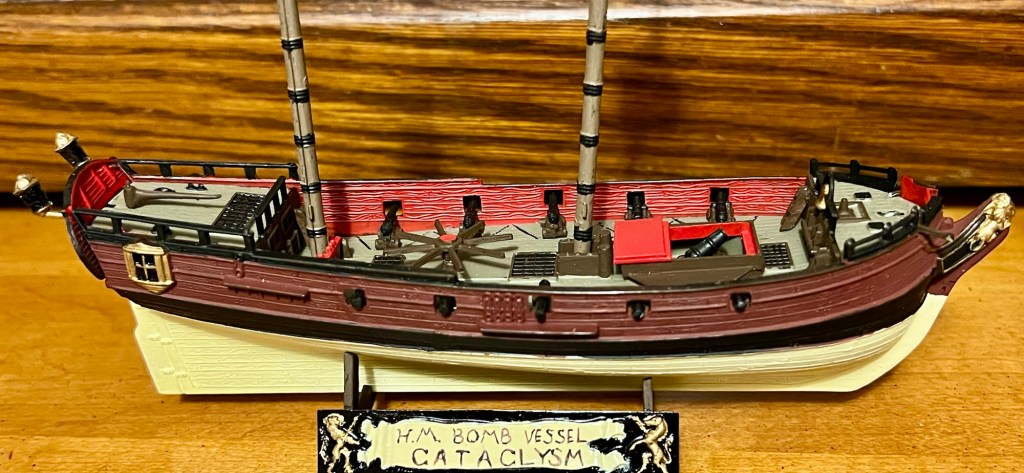
A model I worked on years ago, a modified Pyro British Bomb Vessel in (tiny) 1/150 scale. The design seems to be a simplification of a mid-eighteenth century bomb, which I modified as a fictional HM Bomb Vessel Cataclysm.
ENDNOTES:

HMS Terror (1916-1941)-Queen of Bombardments

24 February 1941 – HMS Terror, a veteran warrior, slipped beneath the waves of the Mediterranean Sea, off the Libyan coast.

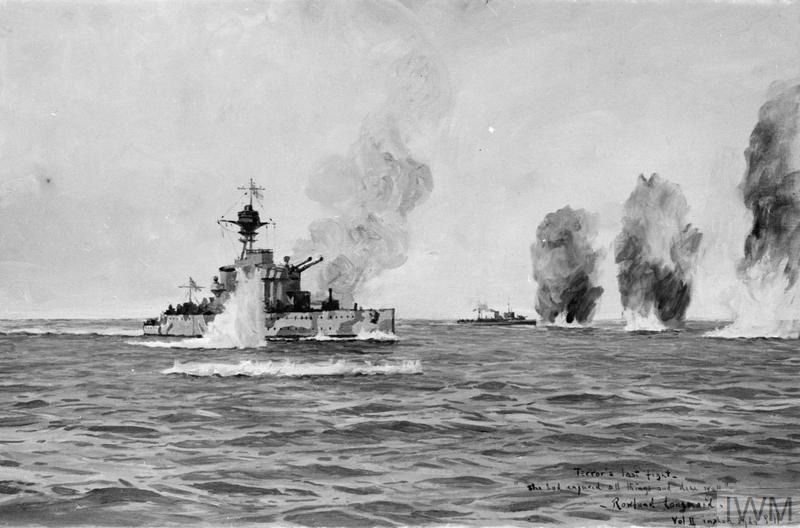
Terror’s Last Fight. Photograph by Lt. E.E. Allen of a painting by Lt. Cmdr. Rowland Langmaid, Official Fleet Artist depicting the 23 February 1941 air attacks by German JU-88 bombers that contributed to Terror’s abandonment the next day. © IWM A 13648

This site has posted on topics related to the wreck of HMS Terror (1813-1849ish), Sir John Franklin’s second ship on the doomed 1845 Expedition to chart a Northwest Passage at the top of North America. That long-lost wreck, which began life more than three decades earlier as a bomb-vessel, was discovered September 2016 in a bay at King William Island, Nunavut. There have been several other commissioned Royal Navy ships named Terror, and at least one of these is also wrecked on the seabed today. This later British warship has not been explored, or even located, in the very different waters of the Mediterranean Sea north of the Libyan coast.1 This namesake should not be forgotten: She upheld the reputation of her famous predecessor as an incredibly tough warship. A fierce combatant in two global conflicts, she was scuttled eighty-three years ago today.

Terror, an Erebus class monitor, was built by the firm Harland & Wolff (known as the builders of several White Star liners, including RMS Titanic), at Belfast and completed in mid-1916. A monitor performed the traditional function a bomb vessel did during the age of sail –shore bombardment–albeit with a level of destructiveness that would have been barely imaginable when the 1813 Terror first tasted water. Of all twentieth-century monitors, the Erebus sisters were the only ones to continue the historic lineage of bomb vessel names. They also paid tribute to the memory of the specific Franklin ships. The lead ship, HMS Erebus, remained in commission until 1946.

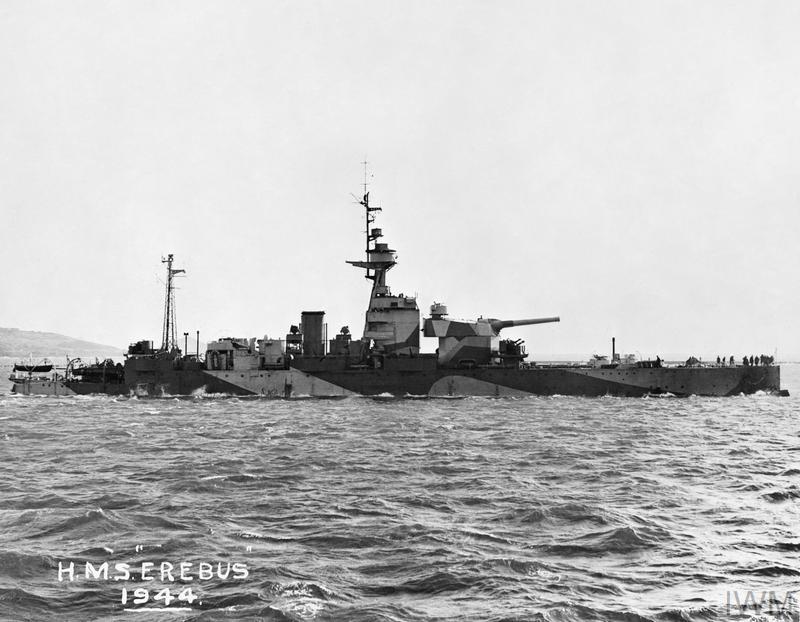
HMS Erebus (FL 693) At a buoy in Plymouth Sound, 1944, around the time of her participation in bombarding targets during the D-day landings. Copyright: © IWM. Original Source: http://www.iwm.org.uk/collections/item/object/205120082

A brief comparison of the 1813 and 1916-built Terrors: where the 1813 wooden sailing vessel was armed with two heavy mortars—a 13” and a 10” variety – and some light cannon, the 1916 armoured monitor was fitted with two 15” rifled battleship guns that fired a variety of explosive and armour-piercing ammunition. Secondary armament included anti-aircraft guns. Length: 1813- 100’ on deck, 1916-405’. Breadth: 1813-30’; 1916- 88’. Displacement 1813-330 tons; 1916-8,450 tons, (larger by the Second World War). 1813-wood, later reinforced for Arctic service with a heavy wood ice chock encircling the hull. 1916-High tensile steel armour up to 13” thick on the turret, with a large anti-torpedo bulge encircling the hull. Lastly, the installed power: HMS Terror (1813) was fitted with a single steam locomotive boiler in 1845, generating 25 horsepower for one retractable two-bladed screw – 4 knots maximum speed while under steam. 1916-four large oil-fired boilers generating 6,000 horsepower for the twin screws – 12 knots maximum speed.

The monitors were a novel way of fitting the 15″ guns of a more conventional design of British battleships, such as the Queen Elizabeth (1912) class – with four turrets and eight 15″ guns – to a smaller, lighter, shallower hull. Brassey’s Naval Annual, 1923 edition, artist not identified, Public domain, via Wikimedia Commons

Early in the First World War, a new design evolved for monitors. With Belgium in enemy hands, there was a role for heavy coastal bombardment of land targets. Battleships, with their deep draughts, could not work close enough inshore to strike deep into occupied territory with their 12′ or larger guns. A boxy, very wide, shallow hull was required to accommodate a rotating turret with what – to most observers – would look like absurdly oversized guns.

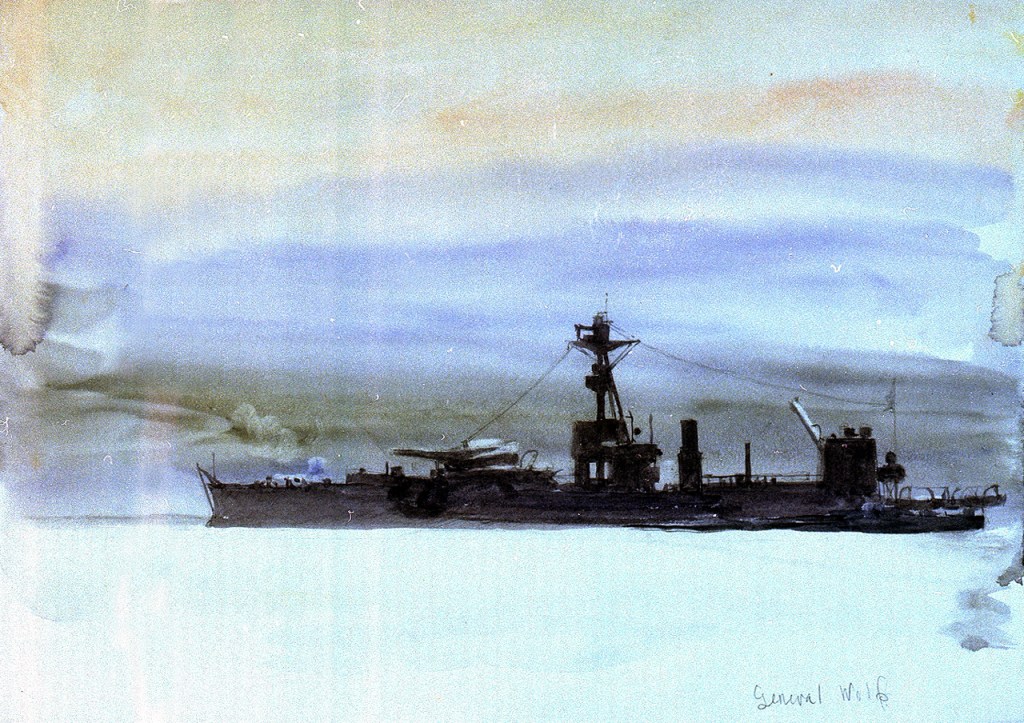
HMS General Wolfe, an earlier Lord Clive class monitor. In addition to the regular forward turret armed with twin 12″ guns, she was one of only two monitors to receive a single 18″ gun, the largest fitted to a warship until the Second World War Japanese Yamato battleships. This massive gun was fitted aft, in a fixed structure pointing off to starboard. Wolfe achieved the longest accurate bombardment in Royal Navy history: A target at Snaeskerke, Belgium, 32.2 km distant. Credit: William Lionel Wyllie, Royal Museums Greenwich PAE2675

As monitors went, the Erebus class pair of ships were enormous. They were a significant improvement on the preceding Marshal Ney class, and the design remedied shortcoming of all previous British monitors with heavy guns.2 Their length of 405′ was similar to the battleships of the 1890s that were still serving in the fleet. Their breadth (width) was proportionally even greater – on par with newest dreadnought battleships. This ensured the ships were stable firing platforms for their formidable armament: a rotating turret armed with twin 15” BL MkI guns with 42 caliber barrel lengths. These were the premier Royal Navy capital ship armament, and equipped generations of the Grand Fleet’s battlewagons, from 1915 to 1959. Where the 1813 Terror could lob a 13”, 200-pound explosive or incendiary shell about 3.8 kilometers, the 15” gun could fire a 1,940 pound shell out to about 24 km.

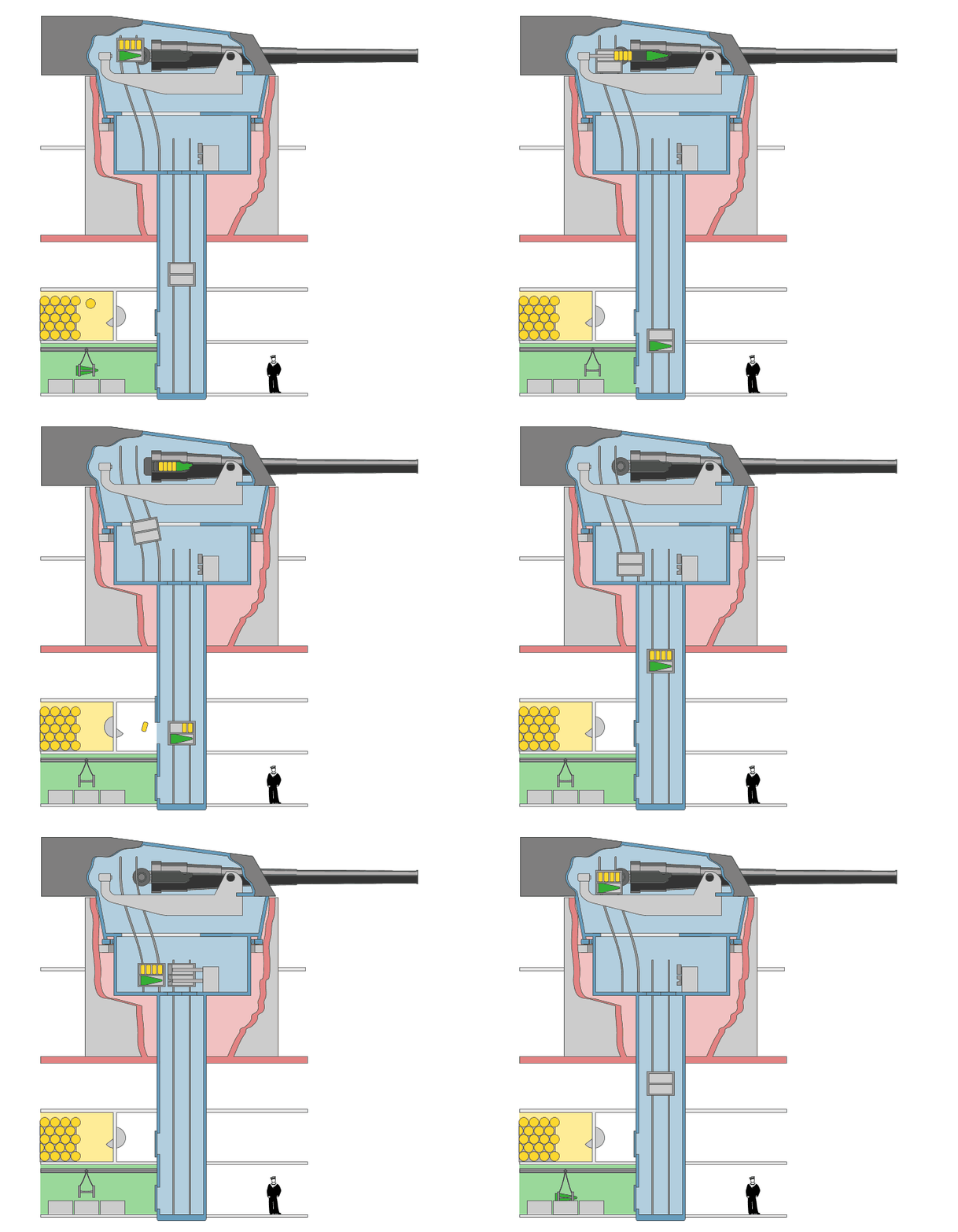
Animation of loading process of a 15” BL MK1 gun. This model of gun delivered one of the longest hits in battleship history when HMS Warspite struck the Italian battleship Guilio Cesare 23.8 km away in July 1940. Via wikimedia commons CC-BY SA

During their First World War service, the Erebus sisters bombarded targets in German-occupied Belgium, as units of the Dover Patrol, and assisted the Allied land armies in bombardments during the Fifth Battle of Ypres (28 Sep-2 Oct. 1918). On October 19, 1917, while operating off Dunkirk, against several German torpedo boats, Terror was torpedoed three times, and was severely damaged, with much of the bows blown off. After an agonizingly-slow tow from Dover to Portsmouth – with some of it backwards to try and keep the forward bulkheads from giving way – the ship was rebuilt. Back to the Dover Patrol to participate in famous April 1918 Raid on Zeebrugge, the Erebus sisters and Marshal Soult – another monitor – bombarded targets. Following the November 1918 Armistice, many of the monitors were decommissioned, laid up in reserve, converted to other purposes, or scrapped. Terror continued in commission on various peacetime assignments, and was assigned to HMS Excellent, the gunnery school at Whale Island near Portsmouth. She was used as a testbed for different artillery, firing on targets which included worn-out battleships.

With the outbreak of the Second World War, the sisters were again required for the bombardment of enemy fortifications and positions. Terror was under long refit in Singapore. Her anti-aircraft defences were upgraded-they would become vitally important to Terror’s survival. Returning to Europe in 1940 by way of the Mediterranean, the monitor became implicated in defending Malta, under siege from Italian air and naval forces. She endured aerial attacks, helping to defend the beleaguered garrison from Italian bombing. Her massive guns bulked up the Island’s coastal batteries. After a stint in Greece, her next assignment was to proceed to the North African coast in early 1941 to assist in the opening of the Libyan campaign against occupied North Africa.

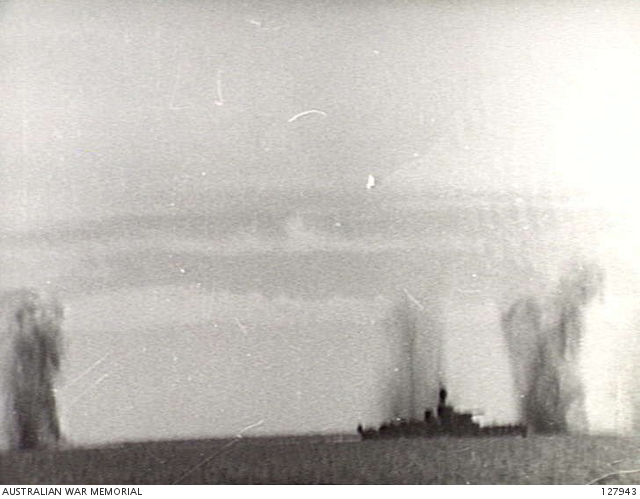
HMS Terror under aerial attack 2 January 1941 off Bardia, Libya, in the lead up to the Australian assault on Italian fortifications: Operation Compass. Terror’s accurate bombardment caused the partial collapse of a cliff, which took Italian short fortifications and artillery positions with it. Credit: Damien Peter Parer, Australian War Memorial 127943

During mid-February the vessel was at Benghazi. On the 22nd, while leaving the port, Terror was damaged by two nearby mine explosions. The damage was not significant enough to delay the departure. The next day, off the African coast, a lone Hurricane fighter covering the embattled monitor had to turn back to refuel. Terror was soon under air attack from three German Junkers JU-88 bombers. Though there had been no single decisive hit, flooding from the accumulated damage was becoming uncontrollable. Though destroyers were coming to Terror’s aid, the help did not come soon enough to save the vessel. Lt- Cmdr John Kellar made the difficult decision to scuttle the ship.3 The entire crew of 300 were evacuated to nearby escorts and Terror sank at position 32.04N 24.05E. A careful perusal of the Commonwealth War Graves Commission’s site reveals that this Terror remained a lucky vessel: in both World Wars, despite torpedoing, air attacks, and mine damage, almost no one died while serving in Terror.4

We have not heard of any effort to locate and survey this wreck. Nor, happily, is there evidence it has been quietly found and salvaged for the significant metal content. The amount of information about the search for and exploration of HMS Terror (1813) effectively hampers research into this topic! The Terror (1916) wreck would be an outstanding example of an unusual type of warship. She had an important record of service with substantive contributions to First and Second World War campaigns. As we eagerly follow the archaeological study of the earlier ship, it is worth sparing a thought for this other Terror shipwreck.

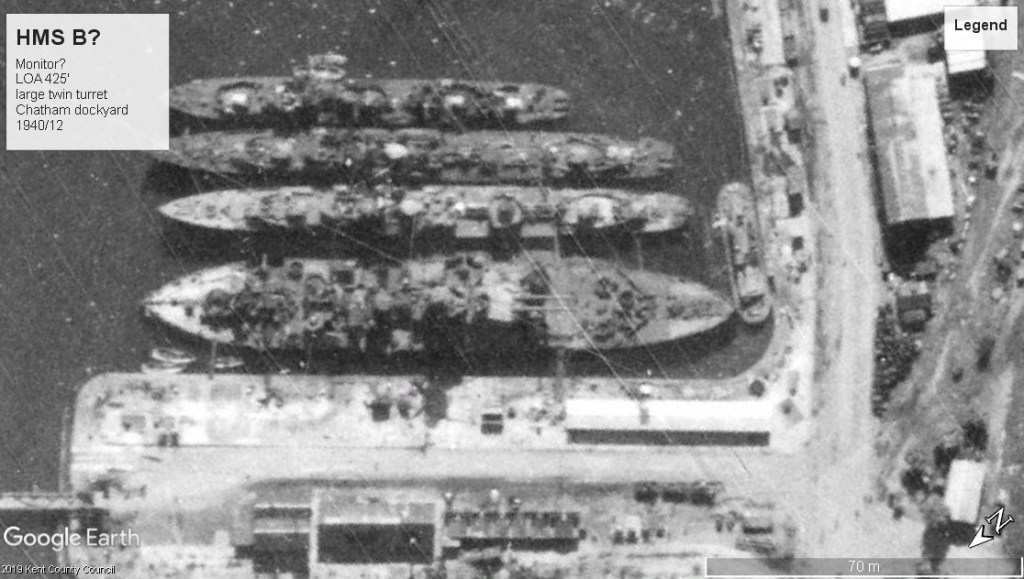
A monitor at Chatham dockyard during the Second World War that we titled “target B”. The elevated large turret can be seen just to the right of midships, while the circular features show the powerful secondary and AA armament. This is one of the oldest captures in Google Earth catalogue. From identifying features, this is Erebus.

  1. We have been unable to locate any sources suggesting the wreck location has been surveyed, or the wreck has been visited. Please let us know if it has! ↩︎
  2. Though the primary role of a monitor at this time was to fit large guns for shore bombardment, there were several more balanced designs that were armed with 9.2″ or 6″ guns. One monitor of this type, HMS M-33 is preserved at Portsmouth. ↩︎
  3. Naval History.net entry with additional information about scuttling: https://www.naval-history.net/xGM-Chrono-03Mon-HMS_Terror.htm ↩︎
  4. This Commonwealth War Graves Commission website search show the incredibly low fatal casualties of Terror’s crew while serving in two World Wars. ↩︎

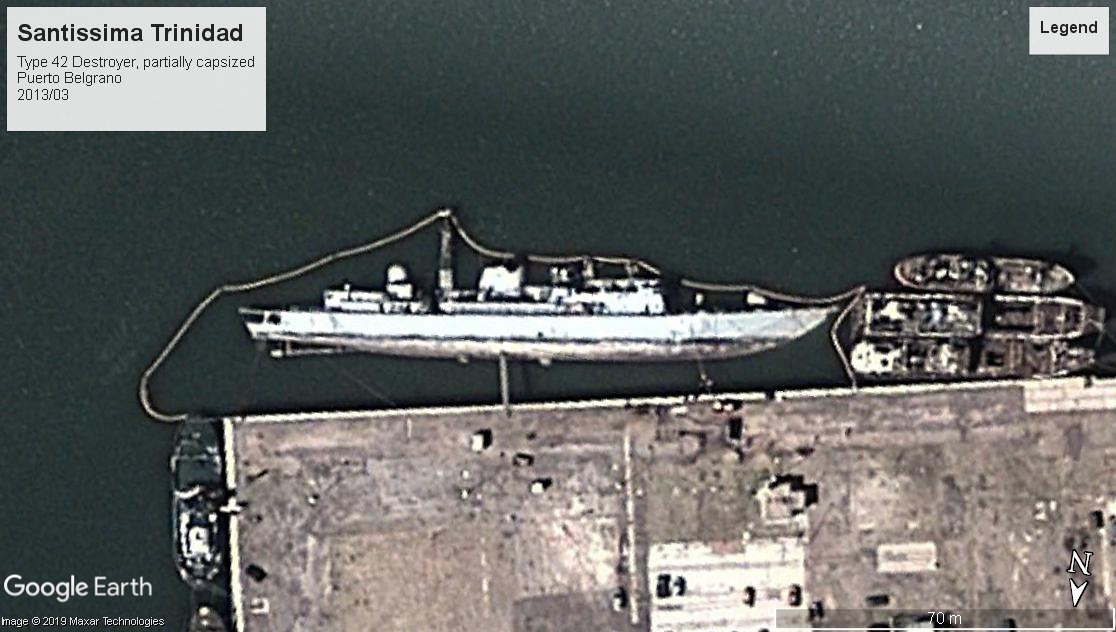
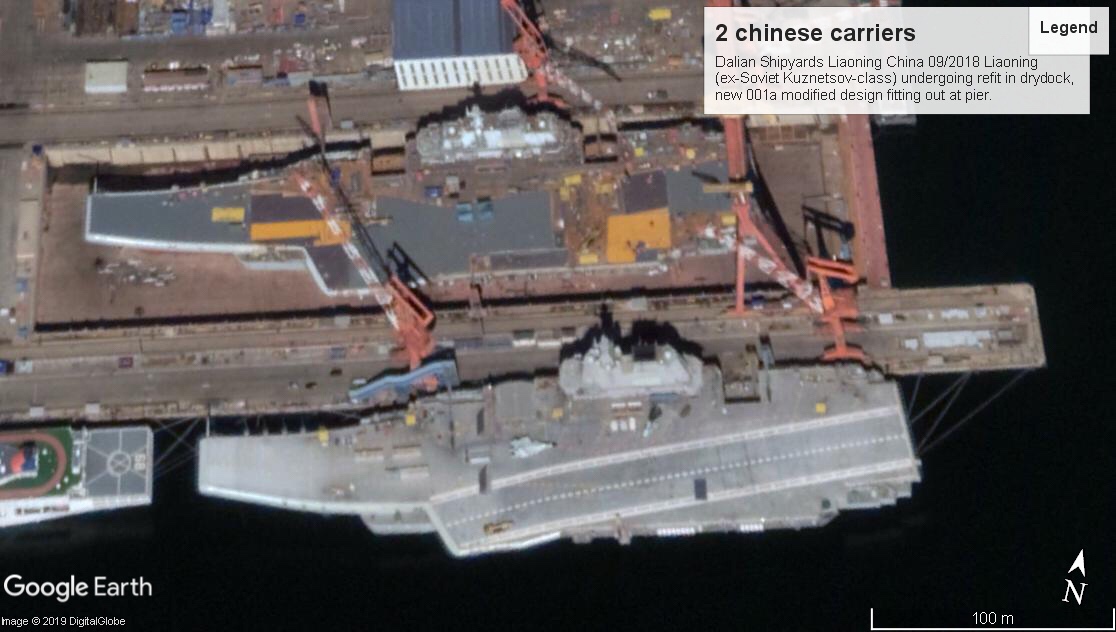
Shipsearcher launches!

Find the warships!

The first pages of Shipsearcher have now been released. This summer, a break-away faction of Warsearcher staff began honing their ship identification skills. It started as background research for our R & D programs, but it quickly snow-balled to absorb resources from war trophies research and postcard collecting sections.

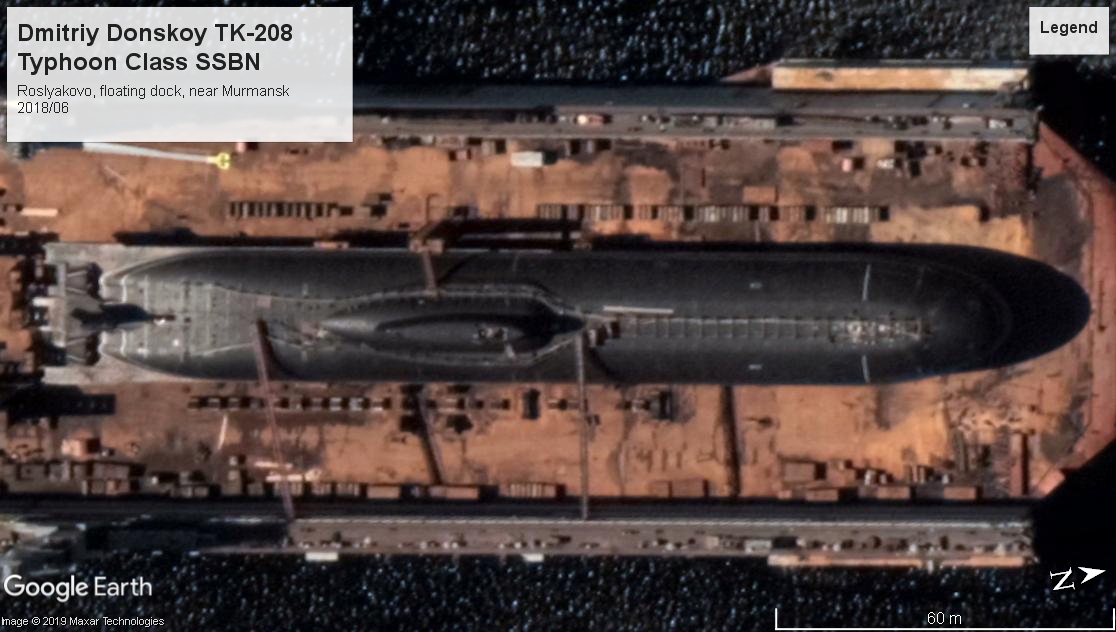
Could the new Ship Identification Directorate (SID) identify warships from various captures of satellite imagery? With the amount of contextual information and photographs proliferating online, we believe the current pages, and those to come, are an interesting, original record of warships. As of October, 2019, there are pages up for US Navy current surface units, US Navy retired/historic, Royal Canadian Navy. The imagery in this post is a sneak peak at some that will appear in pages still building. We also have a page up about sources and the ID process.