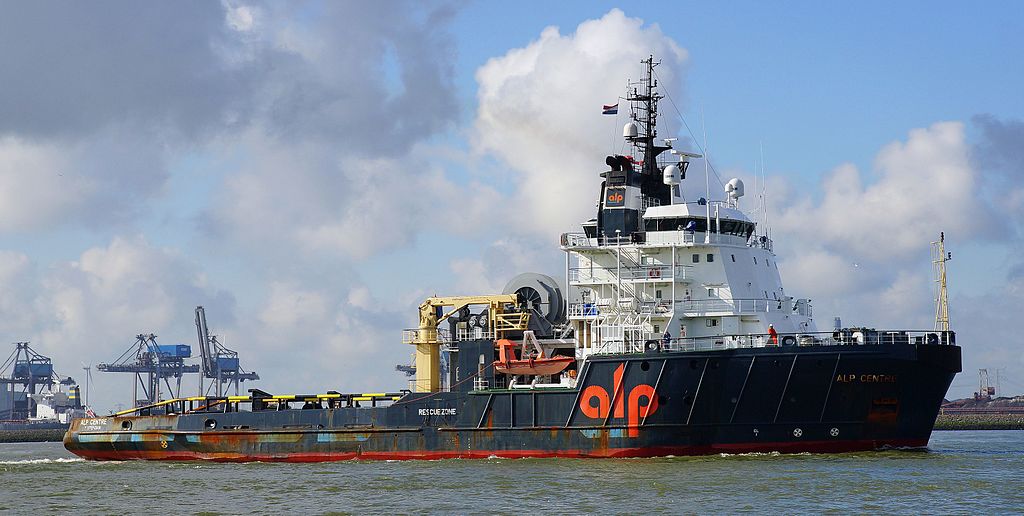
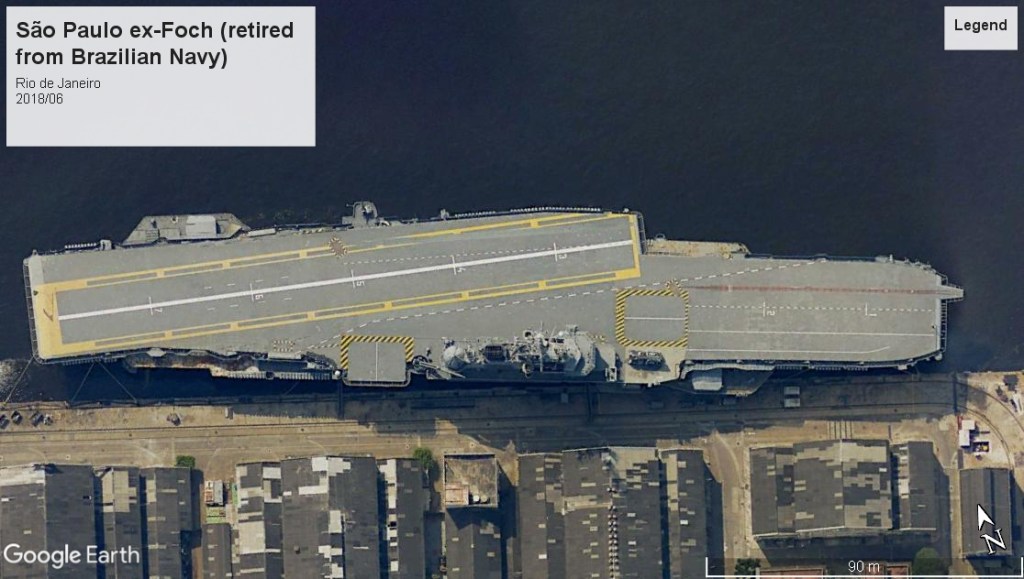
The crew of the Dutch deep-sea tug ALP Centre must be thoroughly tired of their latest charge, the 60-year old French aircraft carrier Foch, which served a second career in the Marinha do Brasil (Brazilian Navy) as the NAe São Paulo. Towing decommissioned carriers is always a demanding task. But the tow of this 870-foot long/270 m, 33,000-ton hulk started in controversy, which snowballed into a SNAFU of impressive proportions off the coast of Africa. Now back in Brazilian waters, and tethered to what some groups describe as a contaminated, environmental “time-bomb,” the crew must feel that they have been well and truly “Foched” this time.

The ALP Centre, one of a fleet of eight similar ships, was supposed to deliver the giant hulk to the shipbreakers at Aliaga, Turkey. Commencing towing operations, it left the carrier’s longtime home port of Rio de Janeiro, Brazil, 4 August, 2022 on a planned 6,000 mile/ 9,650 km journey.
Even as the tug and its charge left port, forces were mobilizing to halt this delivery. A court injunction attempted to prevent the former flagship from leaving Brazilian waters. The story is fairly complicated, but there is concern that the old carrier is riddled with asbestos, PCBs, and other contaminants, and that the hull may still be irradiated from the ship’s presence at the 1966 series of nuclear tests in French Polynesia. The Turkish shipbreaking corporation that now owns the carrier also reportedly did not file the right documents inventorying hazardous waste, and the hulk’s maritime insurance may also have lapsed. Groups in Brazil, Turkey, and across the Mediterranean are protesting that this is a violation of several international agreements restricting transboundary shipments of hazardous materials, notably the Basel and Barcelona Conventions.
Later that month, the tug was nearing the coast of West Africa, when, on 26 August, the Turkish government announced the carrier was barred from its waters, for the time being, and that the vessel should have returned from international waters to Brazil, based on the injunction. The federal Brazilian agency that had approved the shipment, the Brazilian Institute of Environment and Renewable Natural Resources (IBAMA), had to order an immediate return. The ALP Centre was moving North through the Canary Islands and approaching the Straits of Gibraltar, seeking to enter the Mediterranean Sea. It also seemed unlikely that they would be permitted to transit the territorial waters of Spain, Morocco, or Great Britain at the Straits. The tug slowly turned back 8 September.
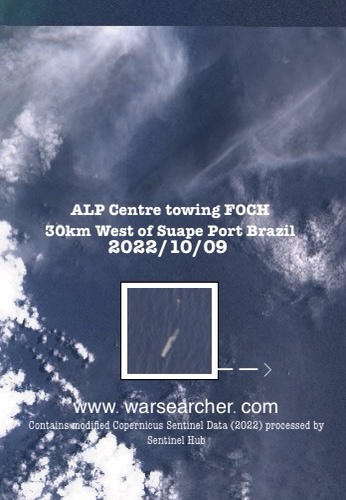
The course initially set would have taken the pair all the way back to Rio. At the end of September, the tug turned North near the remote Ilha Martin Vaz islands. We were able to locate the pair with some effort a few days later, with the tow line stretching about 1200 meters / 0.75 of a mile between the ships.
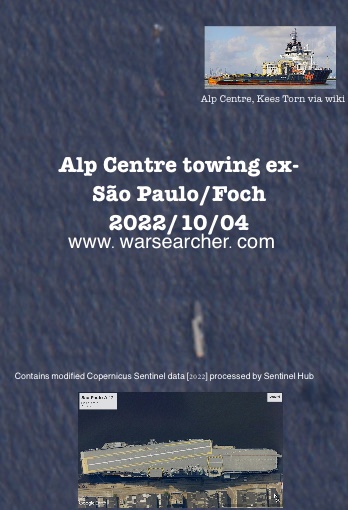
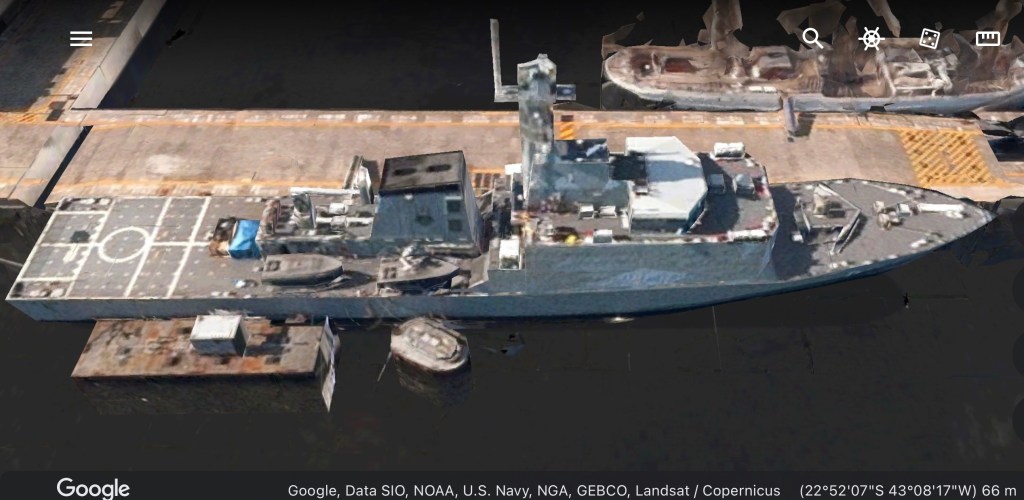
The new destination was Suape Port, near Recife, Pernambuco State, Brazil, 1,850 kilometers / 1,150 miles NNW of Rio. For a time it was also escorted North by the Brazilian Navy’s Amazonas class corvette NPAoC Apa (P-121). ALP Centre arrived off the port 4 October.
As we have illustrated elsewhere, the process of dismantling the World’s largest warships is often full of protests, conflict, drama, and bankruptcies. Still, this botched transit is eerily similar to what occurred seventeen years ago when French authorities attempted to dispose of Foch’s sistership, Clemenceau.
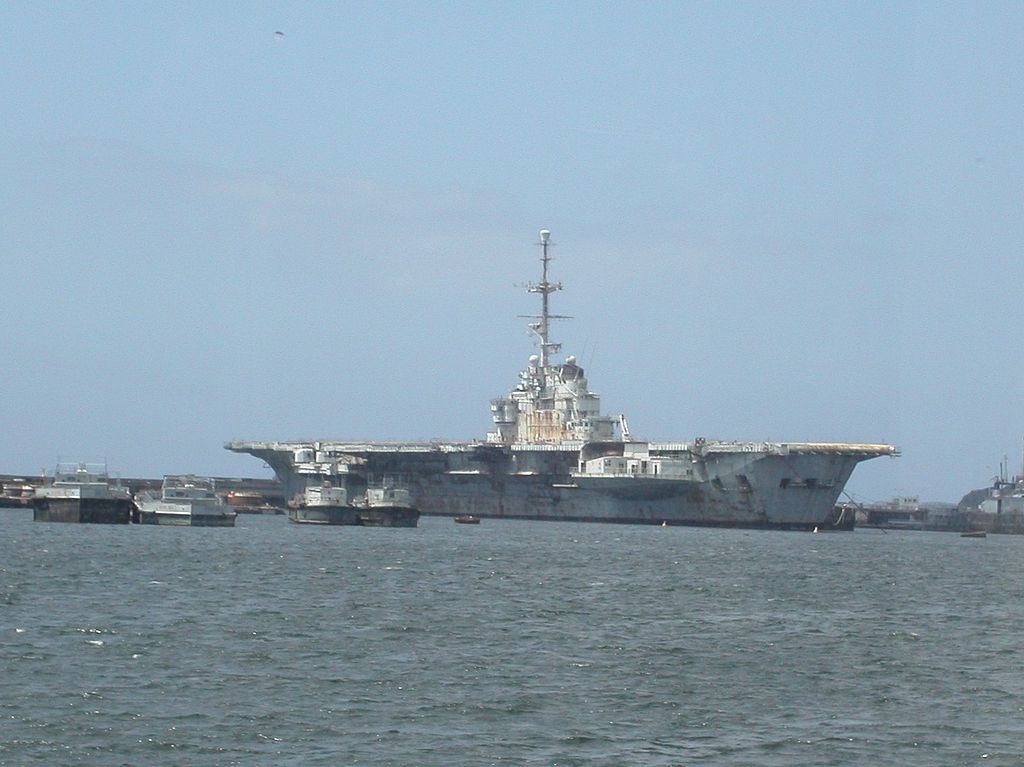
The decommissioned Clemenceau had been sold in 2005 to an Indian company to be dismantled at the massive shipbreaking operation at Alang. The Indian Government had concerns about hazardous materials onboard. Protests erupted around the early 2006 voyage from Toulon, France, to India. Greenpeace and anti-asbestos groups raised concerns about discrepancies in the total amount of tons of asbestos removed in earlier decontamination efforts. The tow was briefly halted by Egyptian authorities, concerned about it transiting the Suez Canal. It was also boarded by activists. After all this, denied entry to Indian waters, while it was in the Arabian Gulf, France’s State Council ordered the ship back. It returned to Brest by rounding Africa. Despite similar community fears of an impending environmental or public health catastrophe, Clemenceau was safely scrapped 2009-2010 near Hartlepool, UK, by the specialized firm Able UK. However, the outcry about the ship’s asbestos appears to have been justified, as hundreds of tons of asbestos was indeed remediated during the dismantling.
Now, three months in to this tow, ALP Centre is waiting for permission to enter the port, and a pilot to guide it in. It is tracking slowly through enormous loops and figure-eights, just barely making headway outside the breakwater. The crew are keeping the tow of their enormous and troublesome charge, São Paulo/Foch, manageable.
We are awaiting details of the next disposal plan. Suape is a busy port, with large shipyards, repair facilities and berths that could probably host the dismantlement of the old flagship. If the fate of Clemenceau is the precedent, safe dismantlement will be a costly process requiring a specialized workforce.
Continue reading “All “Foched up” with No Place to Go? The Troubled Tow of the Aircraft Carrier São Paulo/Foch”

 The Searchers