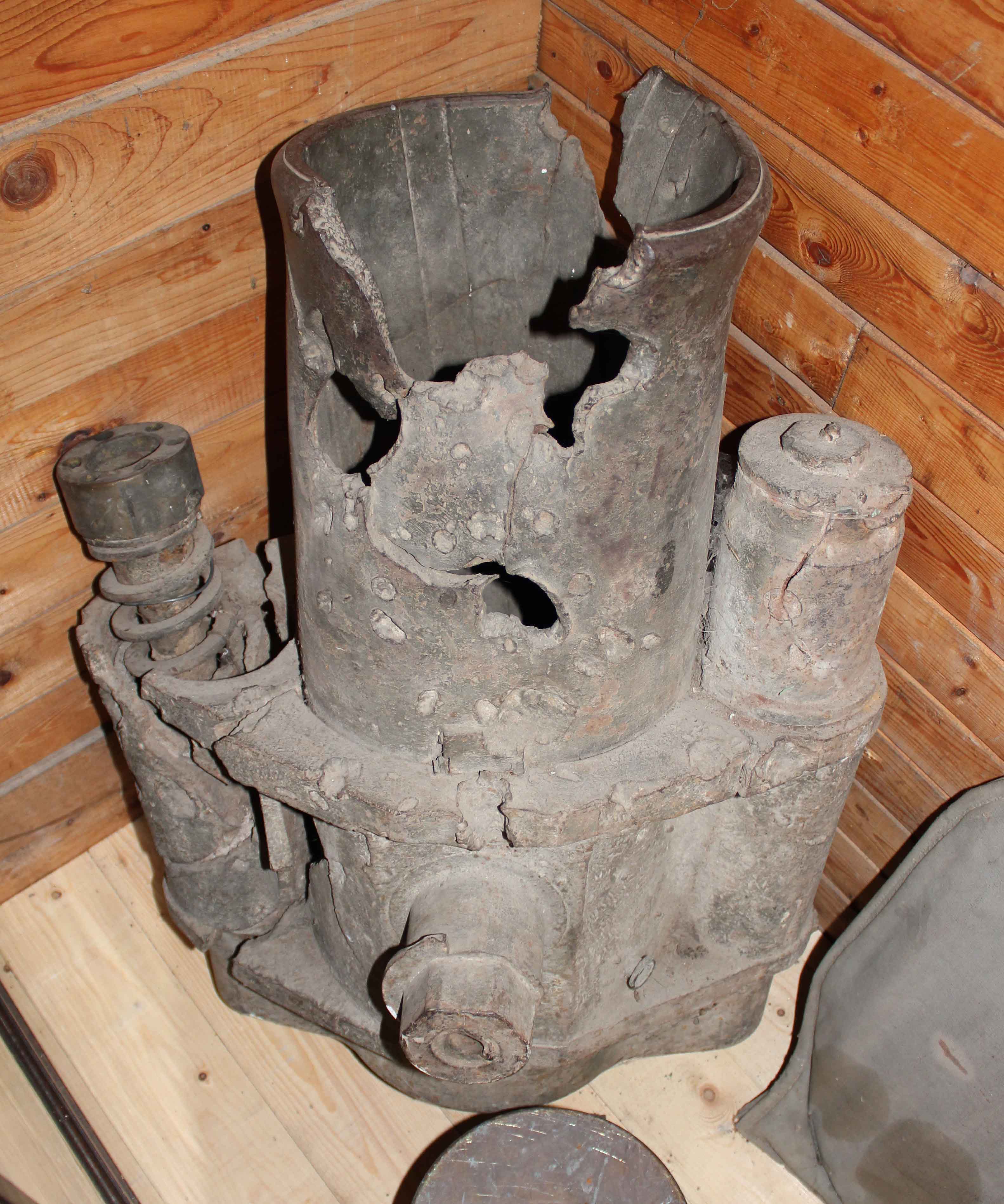
HMS Terror (1916-1941)-Queen of Bombardments

24 February 1941 – HMS Terror, a veteran warrior, slipped beneath the waves of the Mediterranean Sea, off the Libyan coast.
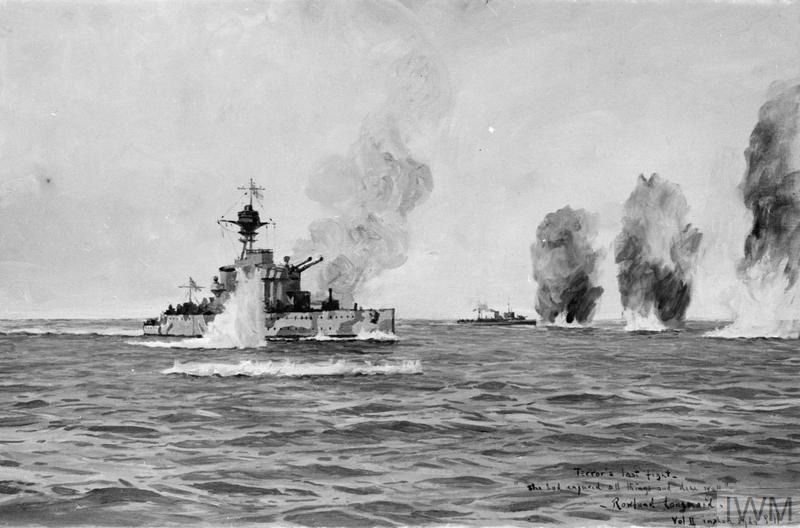
Terror’s Last Fight. Photograph by Lt. E.E. Allen of a painting by Lt. Cmdr. Rowland Langmaid, Official Fleet Artist depicting the 23 February 1941 air attacks by German JU-88 bombers that contributed to Terror’s abandonment the next day. © IWM A 13648

This site has posted on topics related to the wreck of HMS Terror (1813-1849ish), Sir John Franklin’s second ship on the doomed 1845 Expedition to chart a Northwest Passage at the top of North America. That long-lost wreck, which began life more than three decades earlier as a bomb-vessel, was discovered September 2016 in a bay at King William Island, Nunavut. There have been several other commissioned Royal Navy ships named Terror, and at least one of these is also wrecked on the seabed today. This later British warship has not been explored, or even located, in the very different waters of the Mediterranean Sea north of the Libyan coast.1 This namesake should not be forgotten: She upheld the reputation of her famous predecessor as an incredibly tough warship. A fierce combatant in two global conflicts, she was scuttled eighty-three years ago today.

Terror, an Erebus class monitor, was built by the firm Harland & Wolff (known as the builders of several White Star liners, including RMS Titanic), at Belfast and completed in mid-1916. A monitor performed the traditional function a bomb vessel did during the age of sail –shore bombardment–albeit with a level of destructiveness that would have been barely imaginable when the 1813 Terror first tasted water. Of all twentieth-century monitors, the Erebus sisters were the only ones to continue the historic lineage of bomb vessel names. They also paid tribute to the memory of the specific Franklin ships. The lead ship, HMS Erebus, remained in commission until 1946.
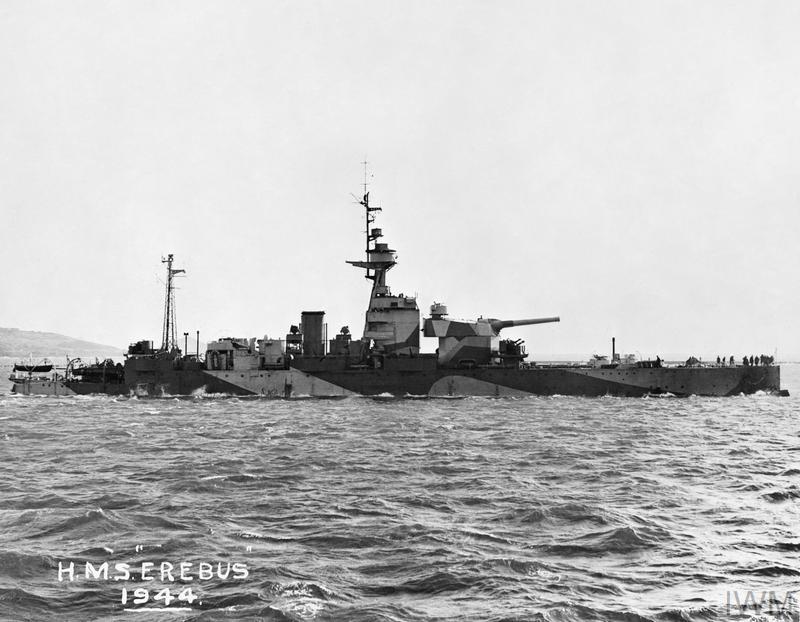
HMS Erebus (FL 693) At a buoy in Plymouth Sound, 1944, around the time of her participation in bombarding targets during the D-day landings. Copyright: © IWM. Original Source: http://www.iwm.org.uk/collections/item/object/205120082

A brief comparison of the 1813 and 1916-built Terrors: where the 1813 wooden sailing vessel was armed with two heavy mortars—a 13” and a 10” variety – and some light cannon, the 1916 armoured monitor was fitted with two 15” rifled battleship guns that fired a variety of explosive and armour-piercing ammunition. Secondary armament included anti-aircraft guns. Length: 1813- 100’ on deck, 1916-405’. Breadth: 1813-30’; 1916- 88’. Displacement 1813-330 tons; 1916-8,450 tons, (larger by the Second World War). 1813-wood, later reinforced for Arctic service with a heavy wood ice chock encircling the hull. 1916-High tensile steel armour up to 13” thick on the turret, with a large anti-torpedo bulge encircling the hull. Lastly, the installed power: HMS Terror (1813) was fitted with a single steam locomotive boiler in 1845, generating 25 horsepower for one retractable two-bladed screw – 4 knots maximum speed while under steam. 1916-four large oil-fired boilers generating 6,000 horsepower for the twin screws – 12 knots maximum speed.

The monitors were a novel way of fitting the 15″ guns of a more conventional design of British battleships, such as the Queen Elizabeth (1912) class – with four turrets and eight 15″ guns – to a smaller, lighter, shallower hull. Brassey’s Naval Annual, 1923 edition, artist not identified, Public domain, via Wikimedia Commons

Early in the First World War, a new design evolved for monitors. With Belgium in enemy hands, there was a role for heavy coastal bombardment of land targets. Battleships, with their deep draughts, could not work close enough inshore to strike deep into occupied territory with their 12′ or larger guns. A boxy, very wide, shallow hull was required to accommodate a rotating turret with what – to most observers – would look like absurdly oversized guns.
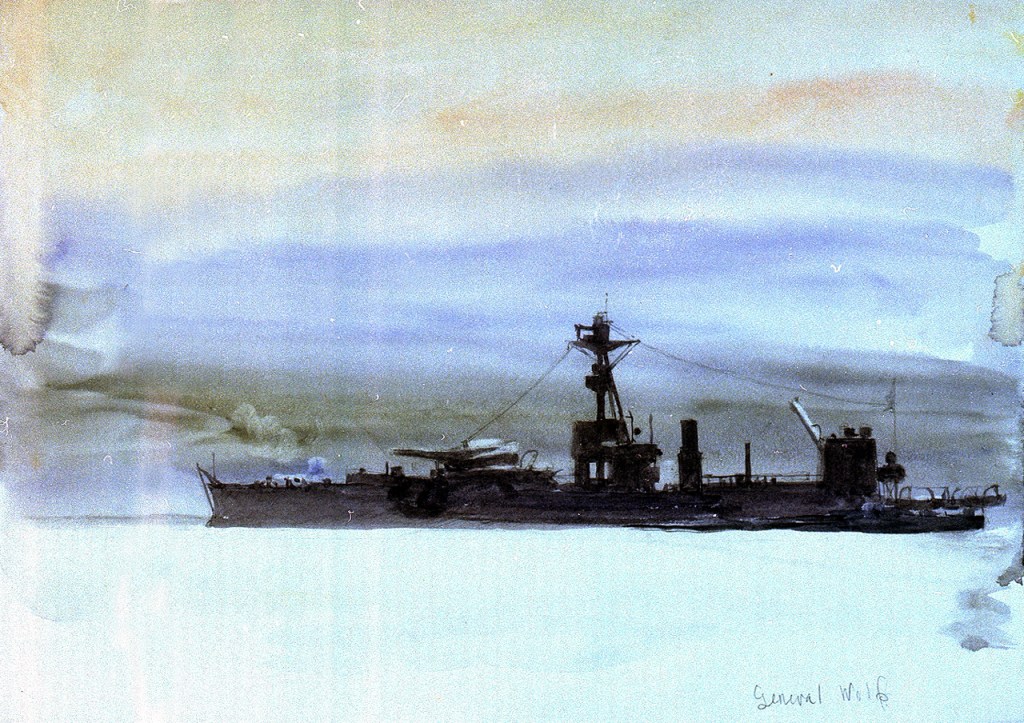
HMS General Wolfe, an earlier Lord Clive class monitor. In addition to the regular forward turret armed with twin 12″ guns, she was one of only two monitors to receive a single 18″ gun, the largest fitted to a warship until the Second World War Japanese Yamato battleships. This massive gun was fitted aft, in a fixed structure pointing off to starboard. Wolfe achieved the longest accurate bombardment in Royal Navy history: A target at Snaeskerke, Belgium, 32.2 km distant. Credit: William Lionel Wyllie, Royal Museums Greenwich PAE2675

As monitors went, the Erebus class pair of ships were enormous. They were a significant improvement on the preceding Marshal Ney class, and the design remedied shortcoming of all previous British monitors with heavy guns.2 Their length of 405′ was similar to the battleships of the 1890s that were still serving in the fleet. Their breadth (width) was proportionally even greater – on par with newest dreadnought battleships. This ensured the ships were stable firing platforms for their formidable armament: a rotating turret armed with twin 15” BL MkI guns with 42 caliber barrel lengths. These were the premier Royal Navy capital ship armament, and equipped generations of the Grand Fleet’s battlewagons, from 1915 to 1959. Where the 1813 Terror could lob a 13”, 200-pound explosive or incendiary shell about 3.8 kilometers, the 15” gun could fire a 1,940 pound shell out to about 24 km.
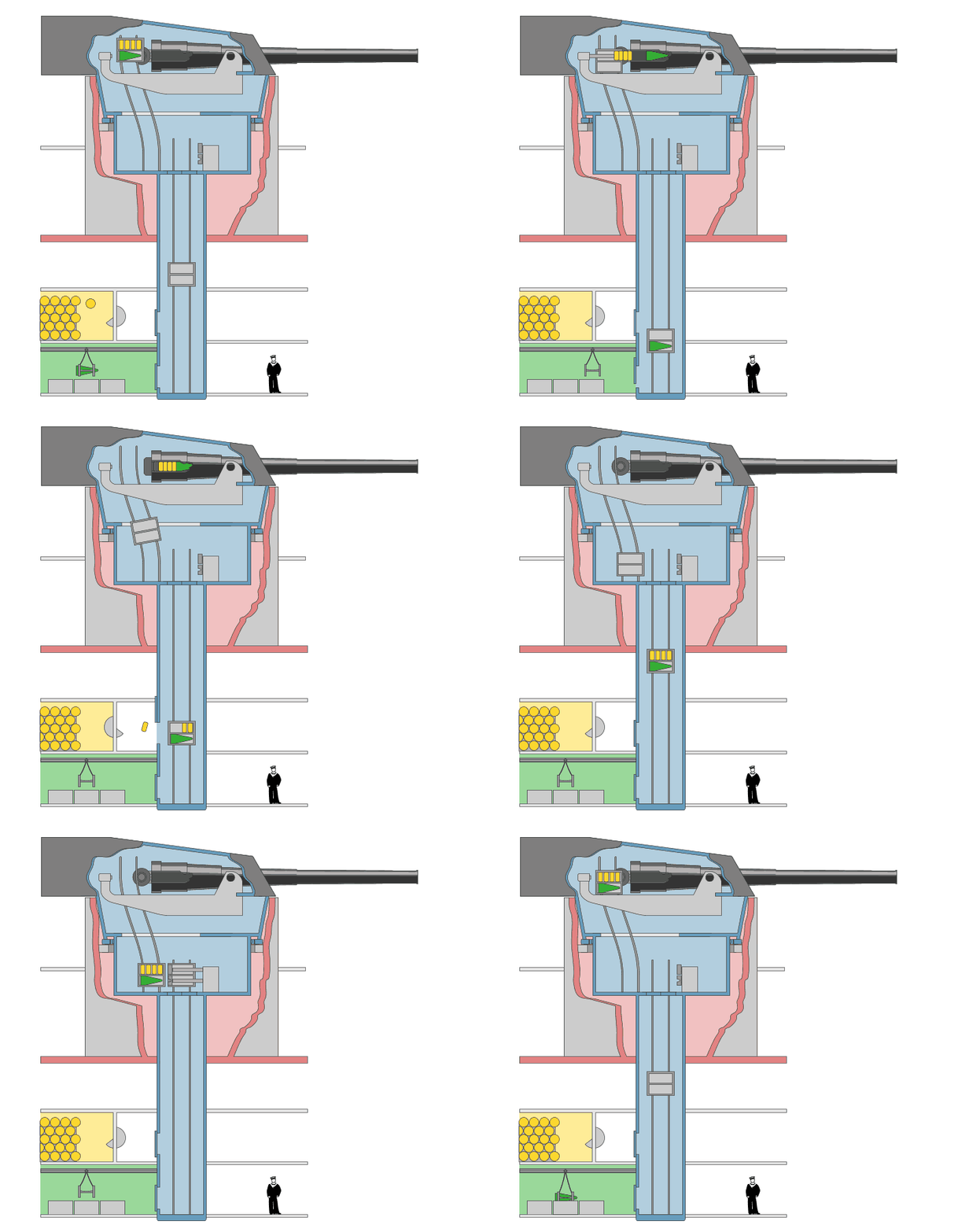
Animation of loading process of a 15” BL MK1 gun. This model of gun delivered one of the longest hits in battleship history when HMS Warspite struck the Italian battleship Guilio Cesare 23.8 km away in July 1940. Via wikimedia commons CC-BY SA

During their First World War service, the Erebus sisters bombarded targets in German-occupied Belgium, as units of the Dover Patrol, and assisted the Allied land armies in bombardments during the Fifth Battle of Ypres (28 Sep-2 Oct. 1918). On October 19, 1917, while operating off Dunkirk, against several German torpedo boats, Terror was torpedoed three times, and was severely damaged, with much of the bows blown off. After an agonizingly-slow tow from Dover to Portsmouth – with some of it backwards to try and keep the forward bulkheads from giving way – the ship was rebuilt. Back to the Dover Patrol to participate in famous April 1918 Raid on Zeebrugge, the Erebus sisters and Marshal Soult – another monitor – bombarded targets. Following the November 1918 Armistice, many of the monitors were decommissioned, laid up in reserve, converted to other purposes, or scrapped. Terror continued in commission on various peacetime assignments, and was assigned to HMS Excellent, the gunnery school at Whale Island near Portsmouth. She was used as a testbed for different artillery, firing on targets which included worn-out battleships.

With the outbreak of the Second World War, the sisters were again required for the bombardment of enemy fortifications and positions. Terror was under long refit in Singapore. Her anti-aircraft defences were upgraded-they would become vitally important to Terror’s survival. Returning to Europe in 1940 by way of the Mediterranean, the monitor became implicated in defending Malta, under siege from Italian air and naval forces. She endured aerial attacks, helping to defend the beleaguered garrison from Italian bombing. Her massive guns bulked up the Island’s coastal batteries. After a stint in Greece, her next assignment was to proceed to the North African coast in early 1941 to assist in the opening of the Libyan campaign against occupied North Africa.
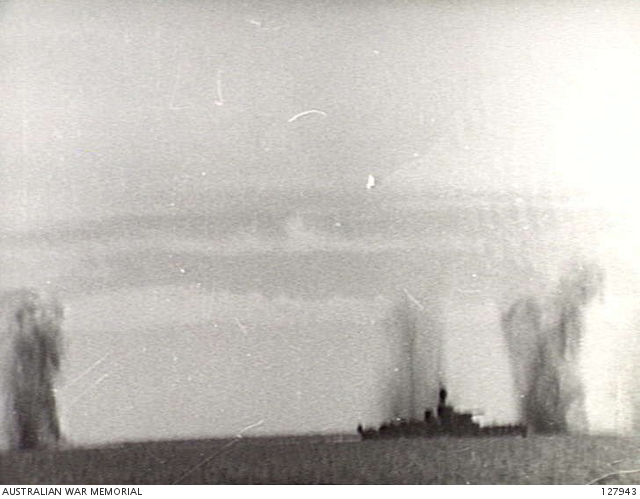
HMS Terror under aerial attack 2 January 1941 off Bardia, Libya, in the lead up to the Australian assault on Italian fortifications: Operation Compass. Terror’s accurate bombardment caused the partial collapse of a cliff, which took Italian short fortifications and artillery positions with it. Credit: Damien Peter Parer, Australian War Memorial 127943

During mid-February the vessel was at Benghazi. On the 22nd, while leaving the port, Terror was damaged by two nearby mine explosions. The damage was not significant enough to delay the departure. The next day, off the African coast, a lone Hurricane fighter covering the embattled monitor had to turn back to refuel. Terror was soon under air attack from three German Junkers JU-88 bombers. Though there had been no single decisive hit, flooding from the accumulated damage was becoming uncontrollable. Though destroyers were coming to Terror’s aid, the help did not come soon enough to save the vessel. Lt- Cmdr John Kellar made the difficult decision to scuttle the ship.3 The entire crew of 300 were evacuated to nearby escorts and Terror sank at position 32.04N 24.05E. A careful perusal of the Commonwealth War Graves Commission’s site reveals that this Terror remained a lucky vessel: in both World Wars, despite torpedoing, air attacks, and mine damage, almost no one died while serving in Terror.4

We have not heard of any effort to locate and survey this wreck. Nor, happily, is there evidence it has been quietly found and salvaged for the significant metal content. The amount of information about the search for and exploration of HMS Terror (1813) effectively hampers research into this topic! The Terror (1916) wreck would be an outstanding example of an unusual type of warship. She had an important record of service with substantive contributions to First and Second World War campaigns. As we eagerly follow the archaeological study of the earlier ship, it is worth sparing a thought for this other Terror shipwreck.
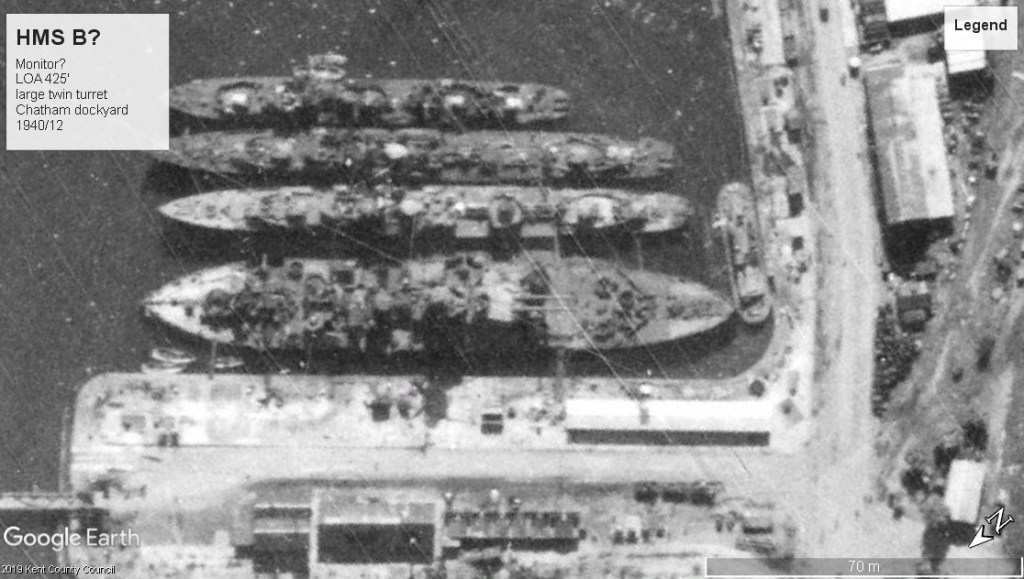
A monitor at Chatham dockyard during the Second World War that we titled “target B”. The elevated large turret can be seen just to the right of midships, while the circular features show the powerful secondary and AA armament. This is one of the oldest captures in Google Earth catalogue. From identifying features, this is Erebus.

  1. We have been unable to locate any sources suggesting the wreck location has been surveyed, or the wreck has been visited. Please let us know if it has! ↩︎
  2. Though the primary role of a monitor at this time was to fit large guns for shore bombardment, there were several more balanced designs that were armed with 9.2″ or 6″ guns. One monitor of this type, HMS M-33 is preserved at Portsmouth. ↩︎
  3. Naval History.net entry with additional information about scuttling: https://www.naval-history.net/xGM-Chrono-03Mon-HMS_Terror.htm ↩︎
  4. This Commonwealth War Graves Commission website search show the incredibly low fatal casualties of Terror’s crew while serving in two World Wars. ↩︎
Royal Navy Shipsearcher page now up!

“Heart of Oak are our ships, jolly tars are our men, we are always ready; Steady, boys, steady, We’ll fight and we’ll conquer again and again”…so goes the chorus of Heart of Oak, the official march of the Royal Navy, Royal Marines, and several Commonwealth navies [Youtube rendition here]. The oldest ship on this new shipsearcher page – Royal Navy Surface Units – Current and Retired – is HMS Victory.

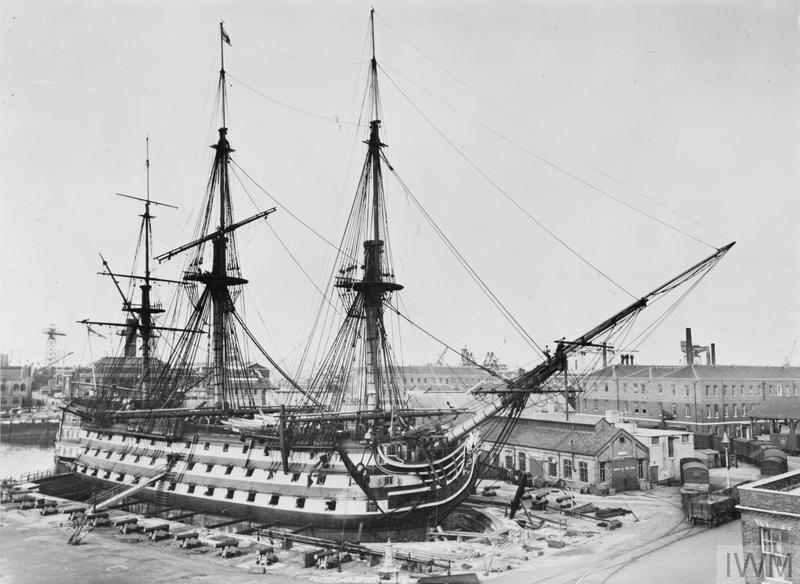
HMS Victory portsmouth 1945
HMS Victory, raising the yards in August 1945 © IWM (A 30810)

This first-rate line of battle ship was being built when Heart of Oak first appeared on the London scene to commemorate the victories of 1759. Our Royal Navy page starts with Victory and spans 260 years to the newly commissioned and largest-ever British carrier, HMS Queen Elizabeth.

HMS Queen Elizabeth R08 Halifax 2019
HMS Queen Elizabeth R-08 in Halifax NS, Sep. 2019

Another unique feature of this page is the use of the Kent County Council Archives historical aerial mosaic photos (provided to Google Earth), which allow for Second World War-era captures of ships in Chatham Royal Dockyard. These views make ship identification of famous RN ship classes, such as County Class Cruisers, and aircraft carriers possible. For the first time, we also have a category for monitors, which during the first half of the twentieth century were tubby, short vessels that mounted a few battleship-sized guns! As always, we hope you appreciate the listing, and would be happy to hear about issues with any identification: help us identify our views of unknown ships!HM Monitor Chatham Kent SWW

Updated Lozenge Camouflage fabric on CASM Fokker DVII

New lozenge camo on FWW German Fokker DVII!

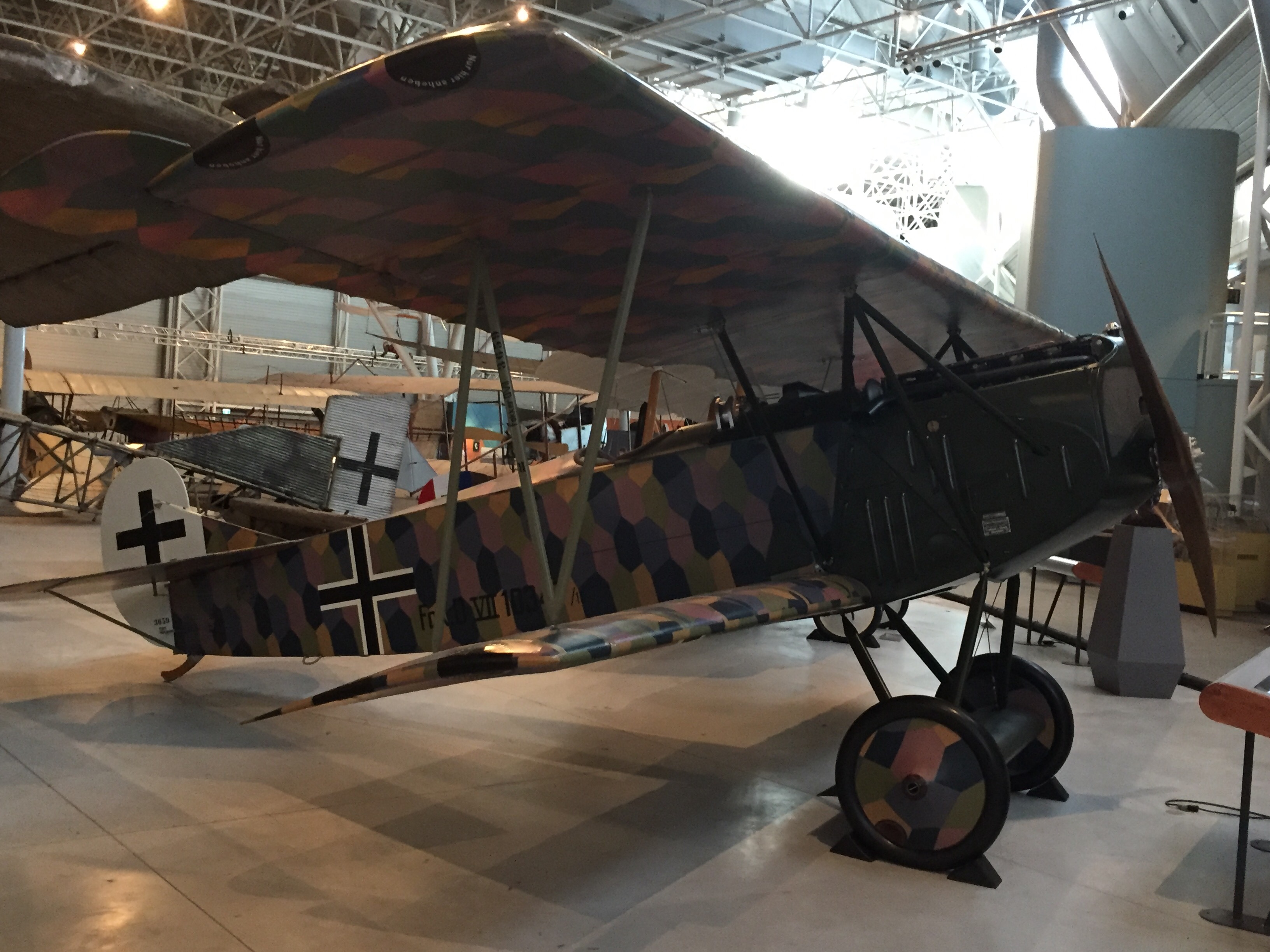
With Spring comes the budding out of blossoms, and bright hues to succeed the drabness of a long Ottawa winter. At the Canadian Aviation and Space Museum, the German First World War Fokker DVII biplane is wearing a new motley coat of distinctive camouflage.

New lozenge camouflage fabric on Canadian Aviation and Space Museum’s Fokker DVII. (author’s photo)

To revisit some relevant posts, the only other complete Fokker DVII in Canada is at the Brome County Historical Society in Knowlton QC. That aircraft is in 4-colour lozenge camo, (called “Knowlton” pattern or Vierfarbiger), while this Fokker wears a 5-colour (“Canberra” or Fünffarbiger) scheme. The CASM now has the AEG German bomber in night lozenge camouflage, this Fokker in daytime lozenge, and the Junkers J1 in junky lozenge!

(editor’s note – the contributing author of this piece thought a lozenge camo joke was appropriate here, despite the editorial board’s recommendation otherwise)

Private G.L. Price, Last Combat Death – 11 November 1918

GL_Price_CWGC
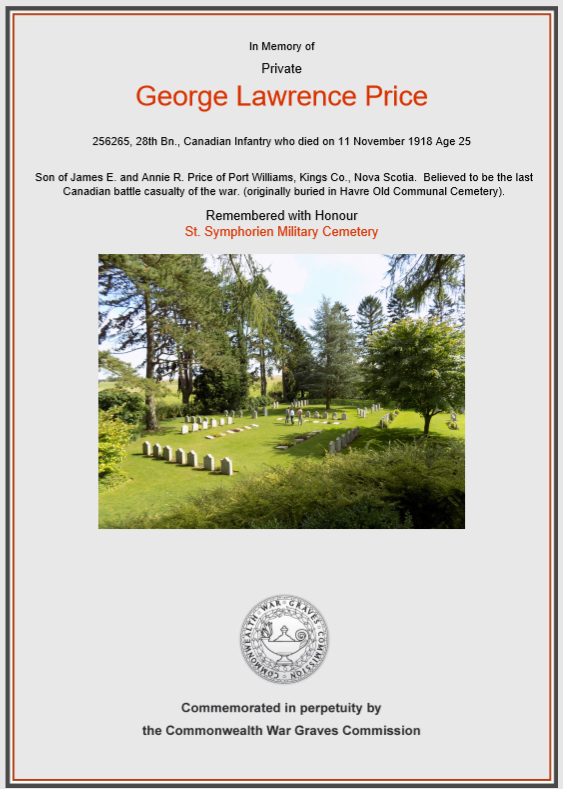
Commonwealth War Graves Commission commemorative certificate for Pvt. G.L. Price.

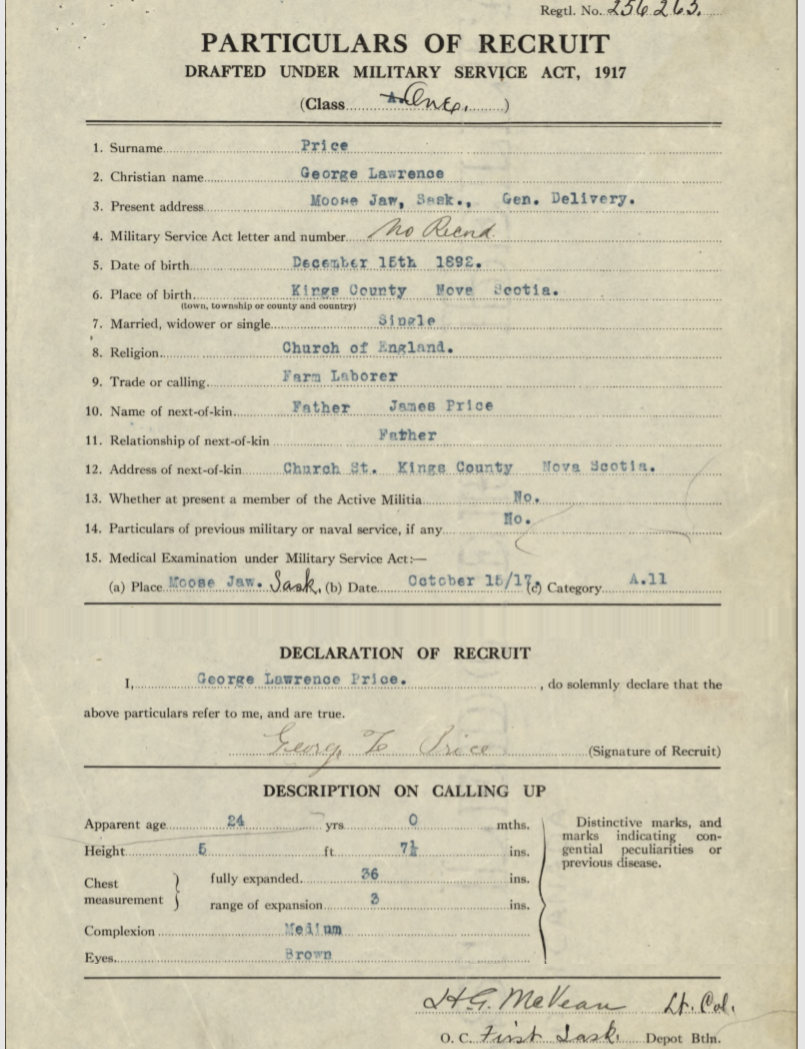
Pvt. George Price, “A” Company, 28th Canadian Infantry Battalion (Northwest) is reported as the last CEF soldier to die before the 11AM Armistice that ended the First World War. Units of the Canadian Expeditionary Force had been ordered to resume the advance, and keep pushing German forces beyond Mons, Belgium. By mid-morning most soldiers knew of the Armistice coming into effect at 11. The 28th Battalions “A” and “B” Companies were pursuing a retreating enemy East of Mons, through the woods and village of Havré. George Price, a 25 year old originally from Kings County, NS, who had been working in Saskatchewan, had just crossed the canal into Ville-sur-Haine.

ATT_GL_Price_
G.L. Price draft form, conscripted under the 1917 Military Service Act. Library and Archives Canada CEF Service File, RG 150 1992-93/166, Box 7974.

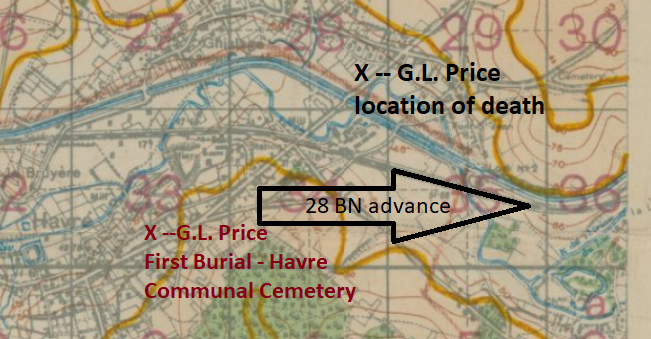
While other units were standing-to, his small team were working their way into the village, with Germans units withdrawing to the North-East. Pvt. Price was struck in the chest by a rifle or machine-gun bullet. Help from his comrades and Belgian civilians could not save him. At his death, church bells in Mons and the surrounding villages were ringing out in celebration of the end of hostilities.

GL price McMaster Trench
Modified detail of Sheet 45, Edition3. Series: GSGS 2743. H.B. Stuart Collection, McMaster University. This shows rough locations, as referenced in records below. The location stated for his death accurately maps to the location of a plaque at Ville-sur-Haine.

The Commonwealth War Graves Commission’s site shows that, although Price was the only CEF soldier killed-in-action advancing in Belgium that day, 38 others, and one soldier from the Dominion of Newfoundland, died at various locations in France, Britain and Canada, on this last day of the Great War. Here is a small selection of documents that help tell the story of Price and the events of a hundred years ago:

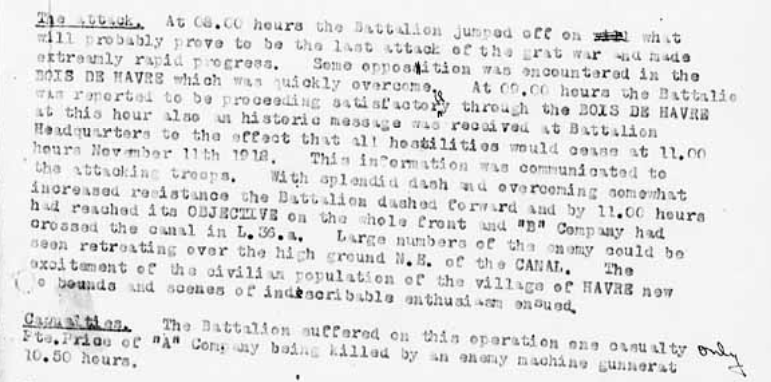
Detail_report on ops 28 CIB NOv 1918
Library and Archives Canada 28 CIB War Diary Report on Operations Nov. 1918 RG9-III-D-3. Volume/box number: 4936.

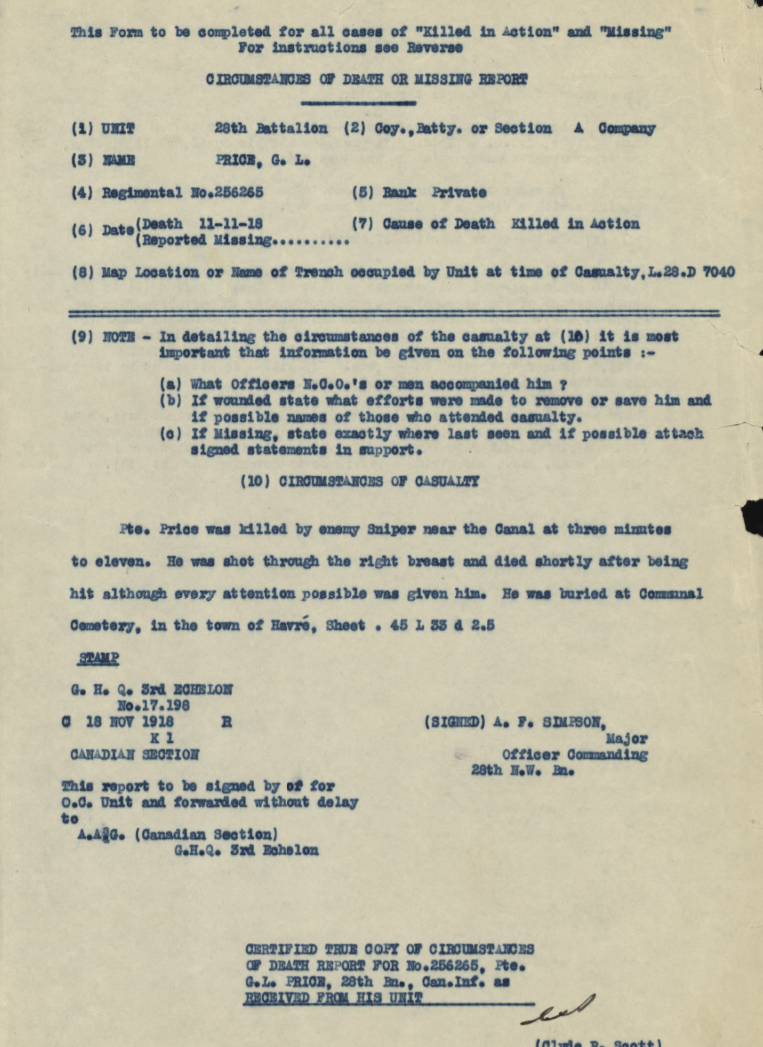
CIRCPERSFILE_GL_Price_
G.L. Price Circumstances of Death form on his CEF file. Library and Archives Canada CEF Service File, RG 150 1992-93/166, Box 7974.
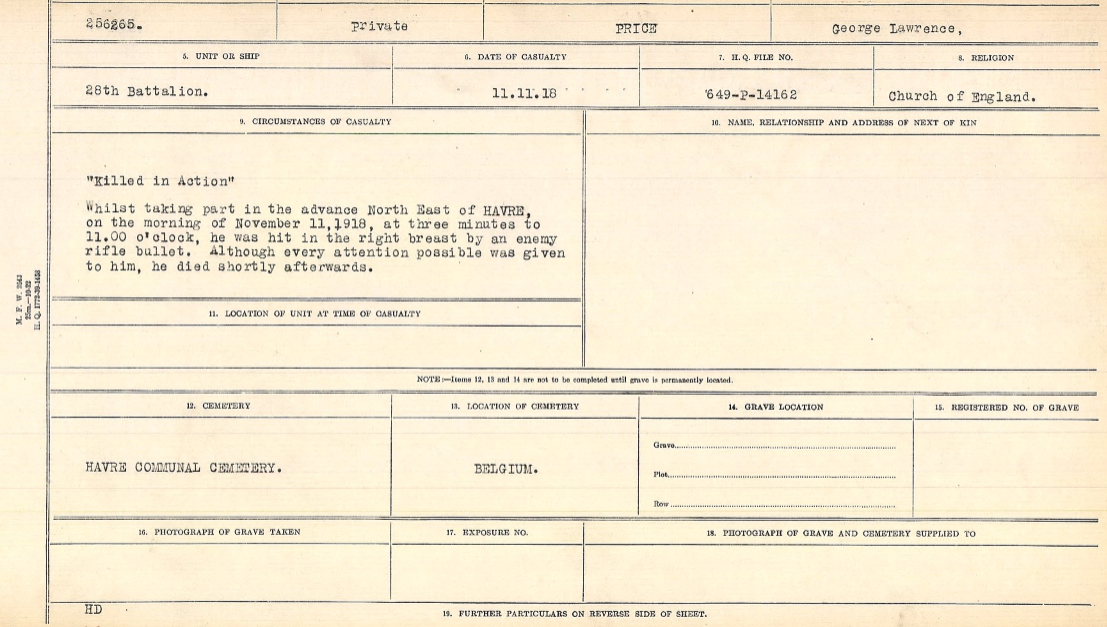
GL_Price_CircofDeath
G.L. Price Circumstances of Death register entry. Library and Archives Canada RG150, 1992-93/314, Vol. 230.
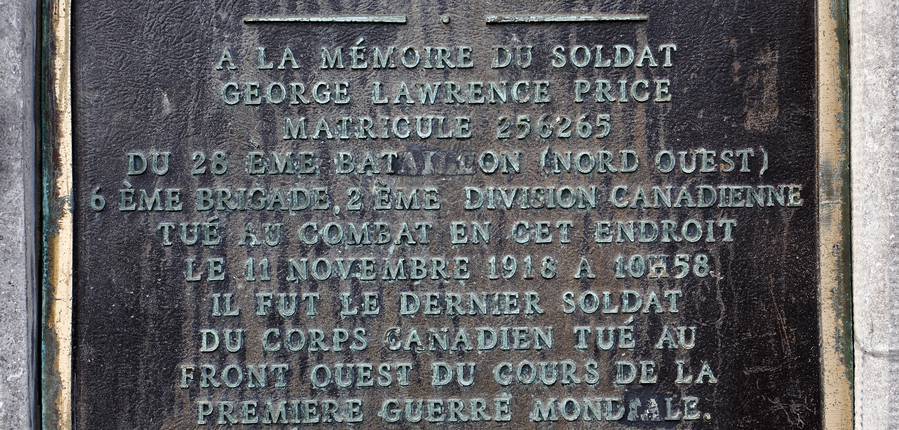
ville-sur-haine01
Plaque marking the place Price fell at Ville-sur-Haine, courtesy of http://www.visitmons.co.uk.

Lest we Forget.

Lost War Trophies of Canada – 8 August 1918 – Amiens to Richmond QC

The history of German 15cm Howitzer no.813, captured 100 years ago this morning, during the great advance.

On this centenary of the first day of the Amiens Offensive (8-12 August 1918), I focus on 15 cm Howitzer no. 813, captured by the 43rd Canadian Infantry Battalion (Cameron Highlanders of Canada) a hundred years ago this morning. Canadian units made astonishing gains this day, and captured thousands of enemy prisoners and a whole range of German weapons.

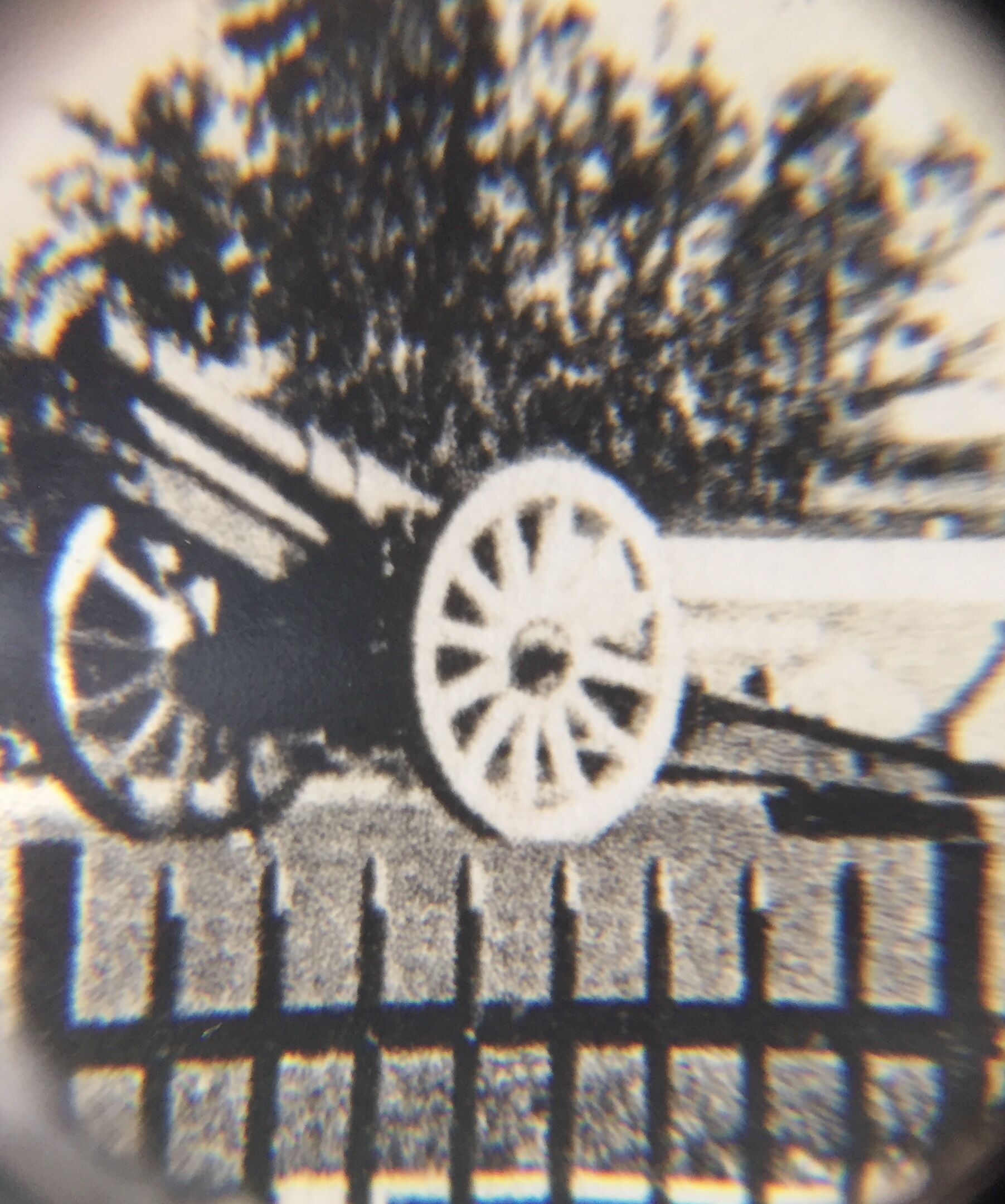
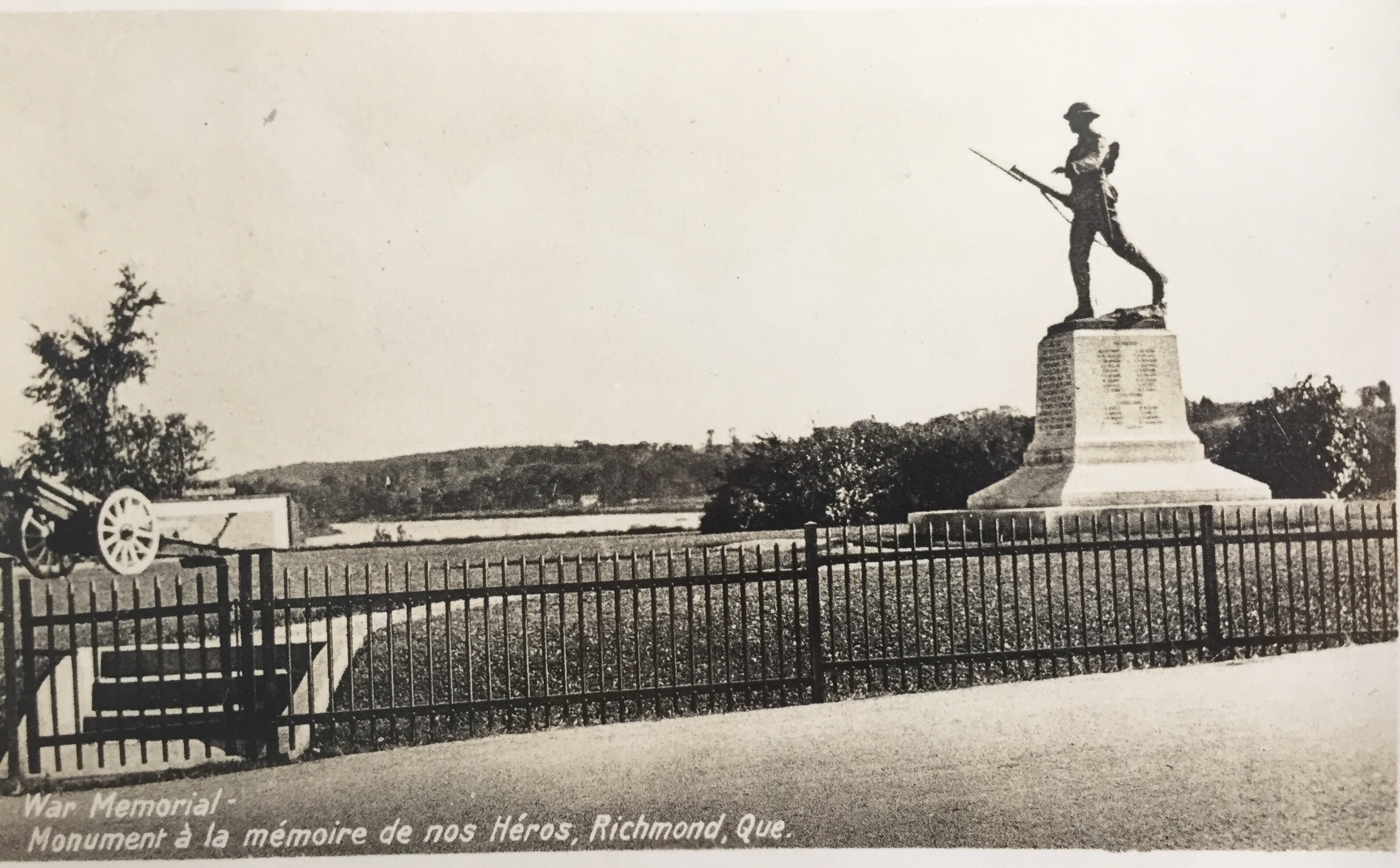
Detail of Richmond QC view of War Memorial, Warsearcher Postcard Collection

Early on the morning of the 8th, the 43rd Battalion, 9th Infantry Brigade, was making progress south-eastwards having just cleared out Dodo Wood, along the Amiens – Roye Road, south of Demuin. “C” Company was tasked with taking Hollan Wood on the right. Mk V heavy tanks of “A” Company, 5th Battalion, Tank Corps (British), lumbered alongside Canadians, providing support and attacking fortified defences.

LAC_3522405_O-a003668-v8
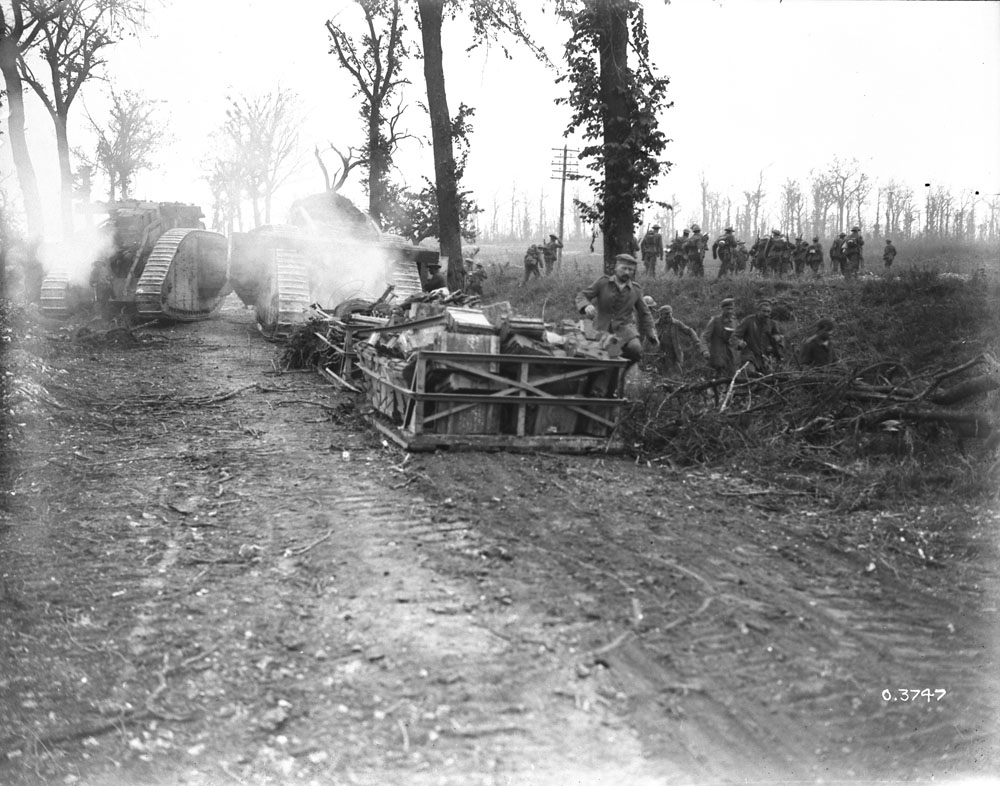
Canadian units and British tanks advancing in a similar situation during the Amiens advance, Aug. 1918. Canada. Dept. of National Defence/Library and Archives Canada/ PA-003668

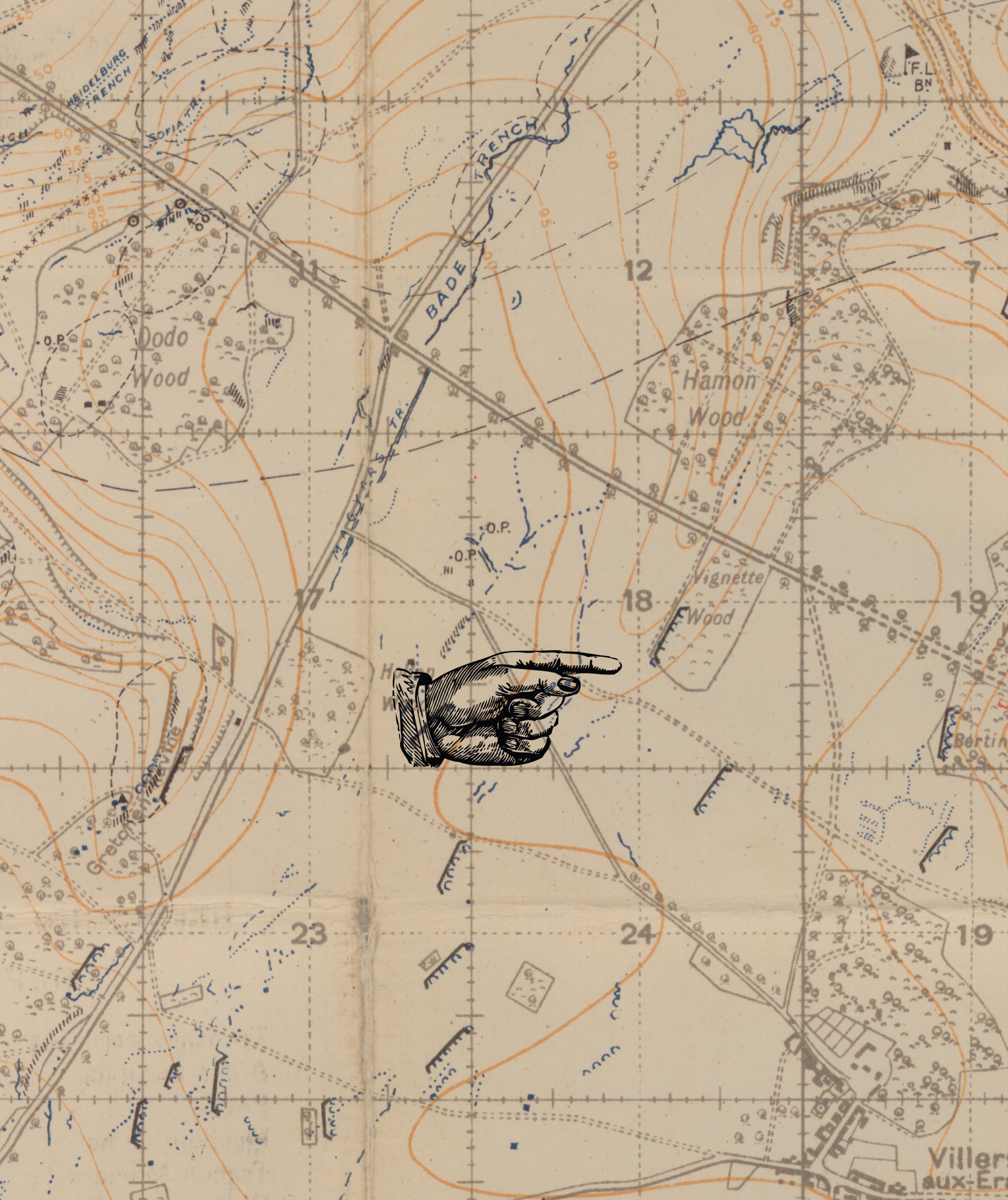
At 07:30 “D” Company pushed on over open ground towards Vignette Wood, with a major objective being the elimination of a battery of guns that were known to be sited there.

McMaster University Trench Maps: Demuin, Intelligence Log Target Map July 1918, scale 1:20,000 Great Britain. War Office. Geographical Section, General Staff (Detail)

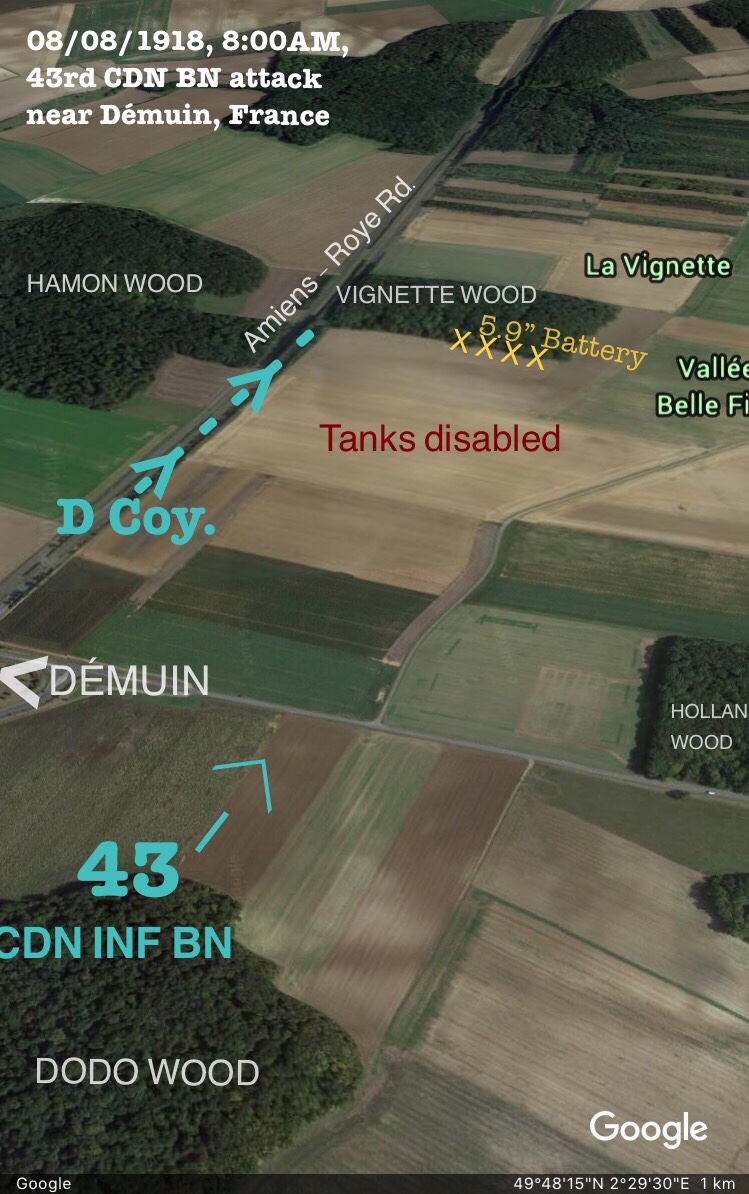
On the southern boundary of the wood, four “5.9s” (15cm howitzers) and another nearby battery of “Whiz-bangs” (77mm field guns) opened up on the advancing units. In short order the guns knocked out the British tanks. “D” company, led by Capt. J.D. Verner, M.C., managed to advance along a cut in the road, and brought the battery under accurate enfilading fire, with the gun crews promptly surrendering and the guns captured intact. The Battalion rested in Vignette Wood as the 7th Battalion came up and continued the advance.

Modified Google Earth 3D view showing direction of advance of 43rd CIB to Vignette Wood.

Gun 813, along with many other trophies, was eventually shipped on to Canada, in a process I describe elsewhere. Visual evidence suggests this was a 15cm sFH 02 Howitzer.

img_6888
Warsearcher Postcard Collection
It was allocated to Richmond QC and shipped there Dec 8th, 1920 by Grand Trunk Railways. It wound up on display in front of the new community War Memorial. I have no further information on its fate. You can see my other posts about surviving captures by searching this site by “Amiens,” or visiting the newly upgraded database loaded at this link. The 43rd Battalion’s advance is described in the unit War Diary for August, 1918, and in the associated Report on Operations, Library and Archives Canada, RG9-III-D-3 vol. 4939, available online here.

The Lost War Trophies of Canada – From Vimy to East Angus QC

In this exciting new thread, we restore information about lost war trophy cannon.

This is the much-anticipated debut of a new series of posts! The extensive Warsearcher postcard archive has been mined to restore a visual record of military artifacts that have been lost from communities across Canada. Why? Because we can’t let the non-existence of an artifact hamper our interpretation of it!

Detail of postcard, East Angus QC Post Office and War Memorial. Warsearcher postcard collection

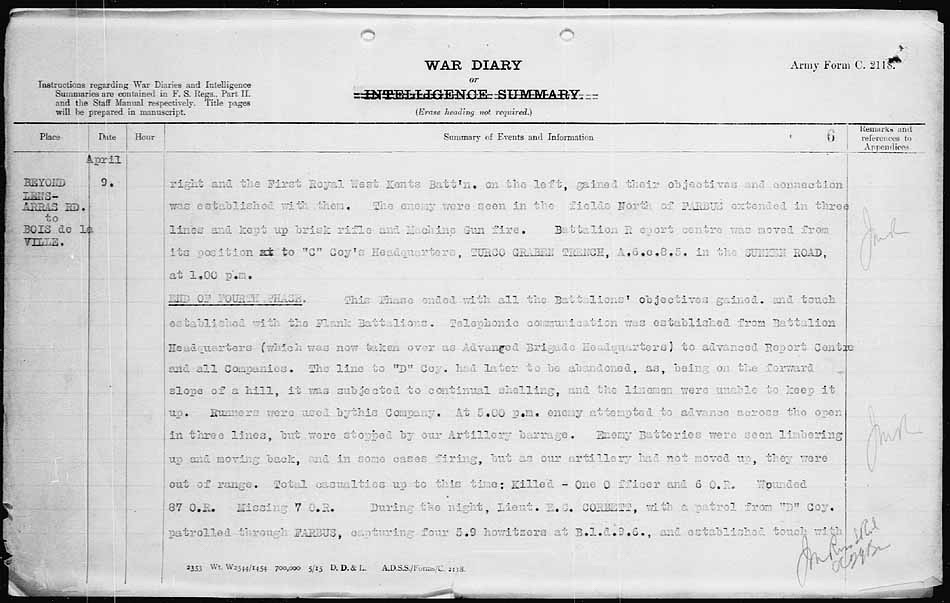
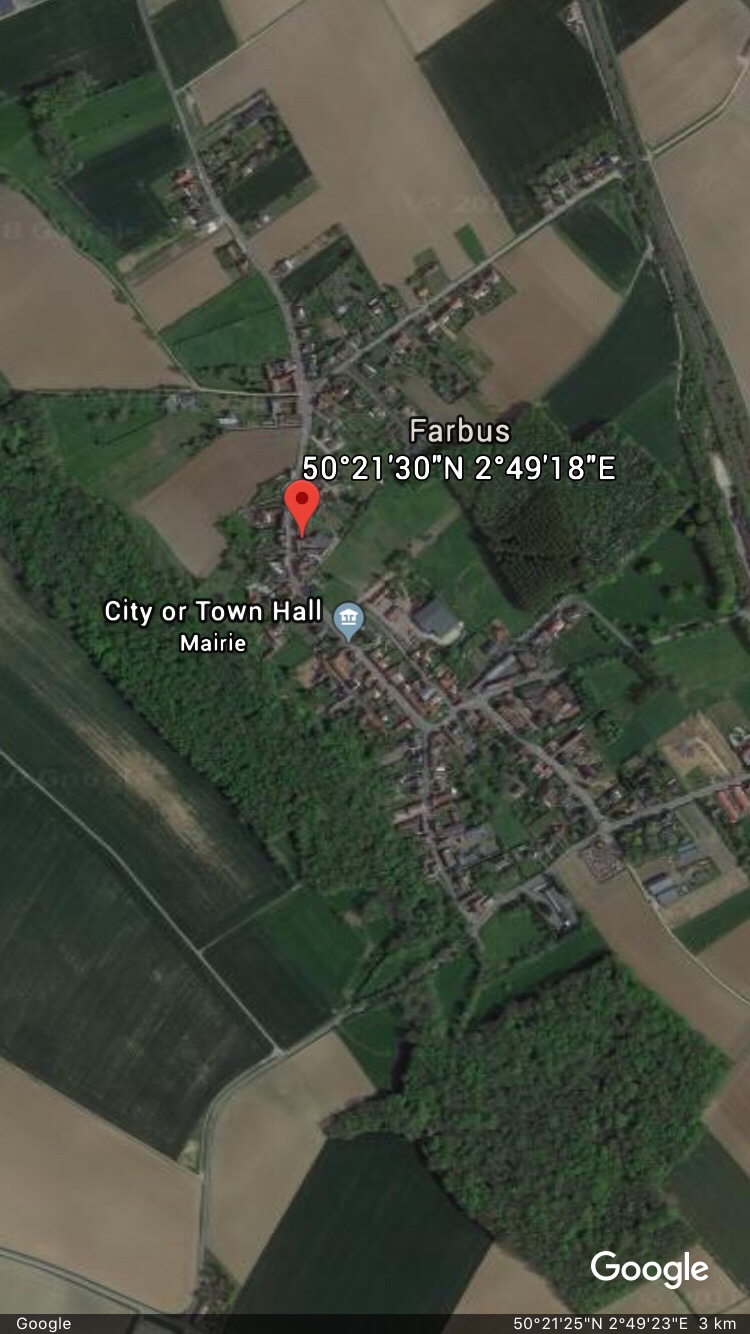
German 15 cm Howitzer no. 249 was captured by the 29th Canadian Infantry Battalion, at Station Wood, near Vimy. This gun was likely one of the four “5.9 inch” howitzers (the British name for these guns) captured by Lt. E.C. Corbett (service file hyperlinked) and a patrol of D company late in the day of 9 April 1917. This action, and accurate map references, appear in the War Diary.

29th Canadian Infantry Battalion War Diary entry for 9 April 1917. Library and Archives Canada RG9-III-D-3 Vol. 4936.

29th Canadian Infantry Battalion War Diary entry for 9 April 1917. Library and Archives Canada RG9-III-D-3 Vol. 4936.

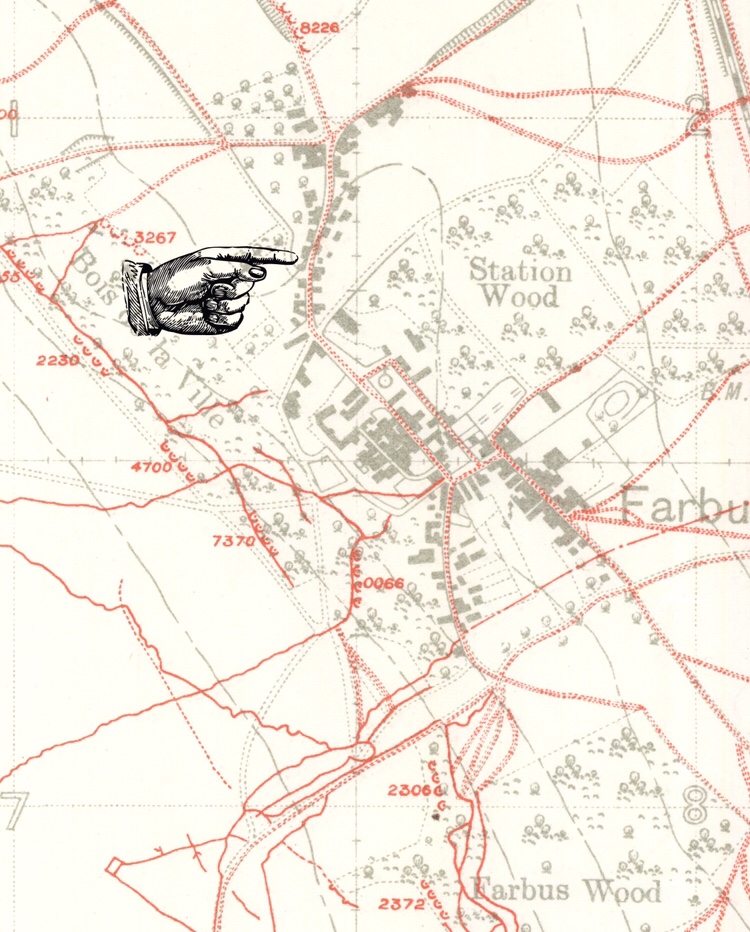
Detail from sheet 51B 1:10,000 scale, McMaster University Trench Map collection. Map reference 51B.1.d.9.6., near Station Wood, Farbus, France, indicated.

Rough location using Google maps.

One of a vast collection of captured German trophies sent by the government to Canada, It was shipped to East Angus via Grand Trunk Railways 10 December 1920;

Extract of War Trophies Allocation Ledger, War Trophis Commission, Library and Archives Canada, RG37D vol.388

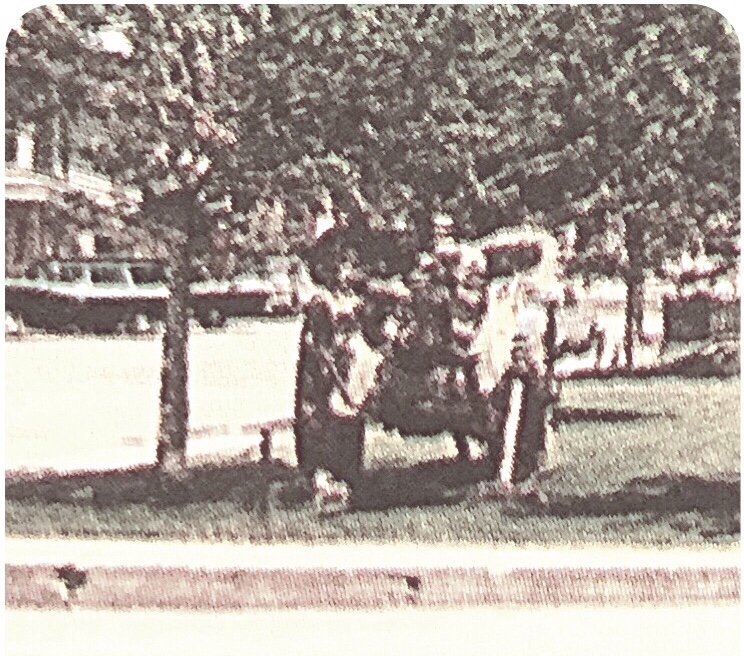
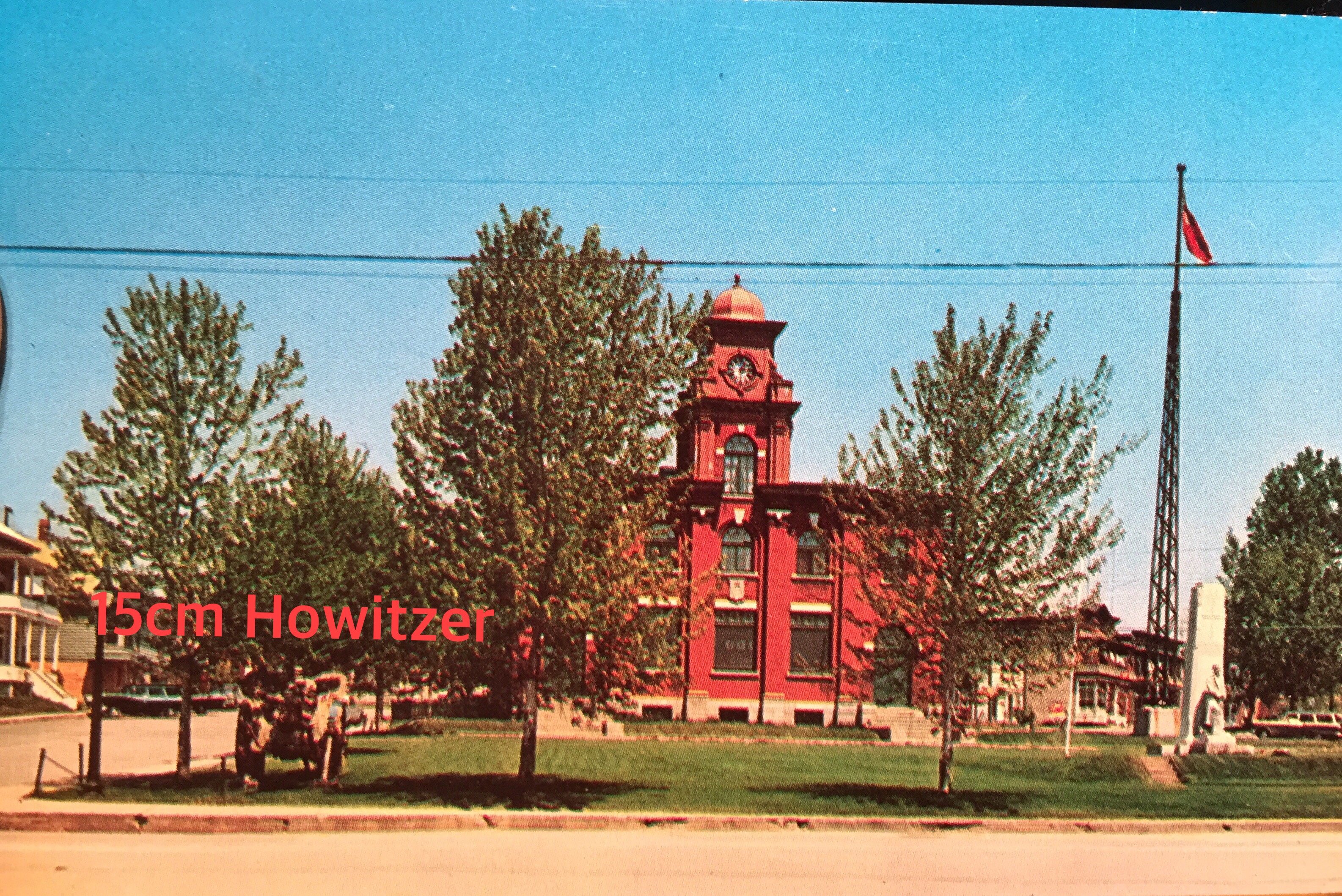
Here is a late 1950s postcard view of the East Angus Post Office and War Memorial, which shows what looks like the 15cm schwere Feldhaubitze model 13:

Warsearcher postcard collection

Though it seems to have survived the scrap drives of the Second World War, its later fate is unknown. Any readers with information on this trophy are welcome to comment!

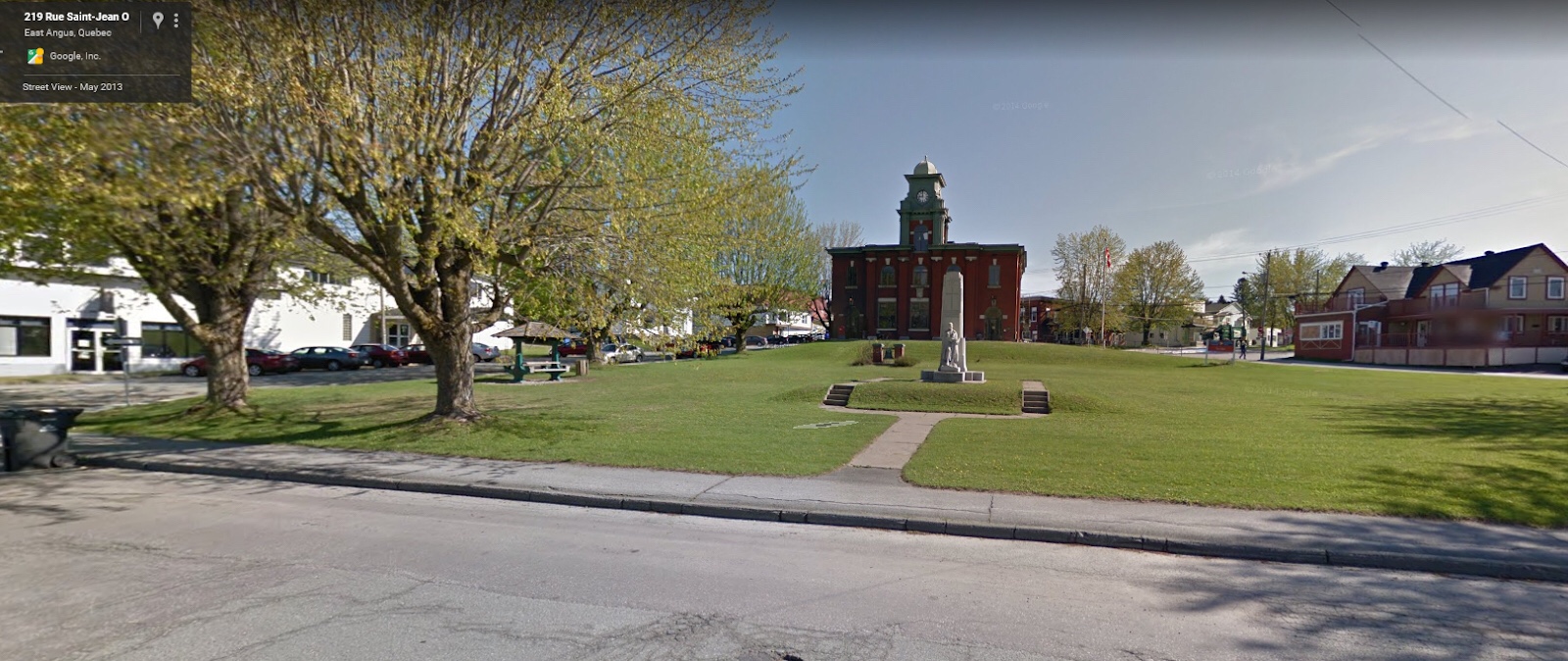
2018 Google street view of same location.

Brome County Historical Society’s top collection of War Trophies

Today, the Brome County Historical Society, in Knowlton, Quebec, has one of the strongest collections of First World War military artifacts in Canada.

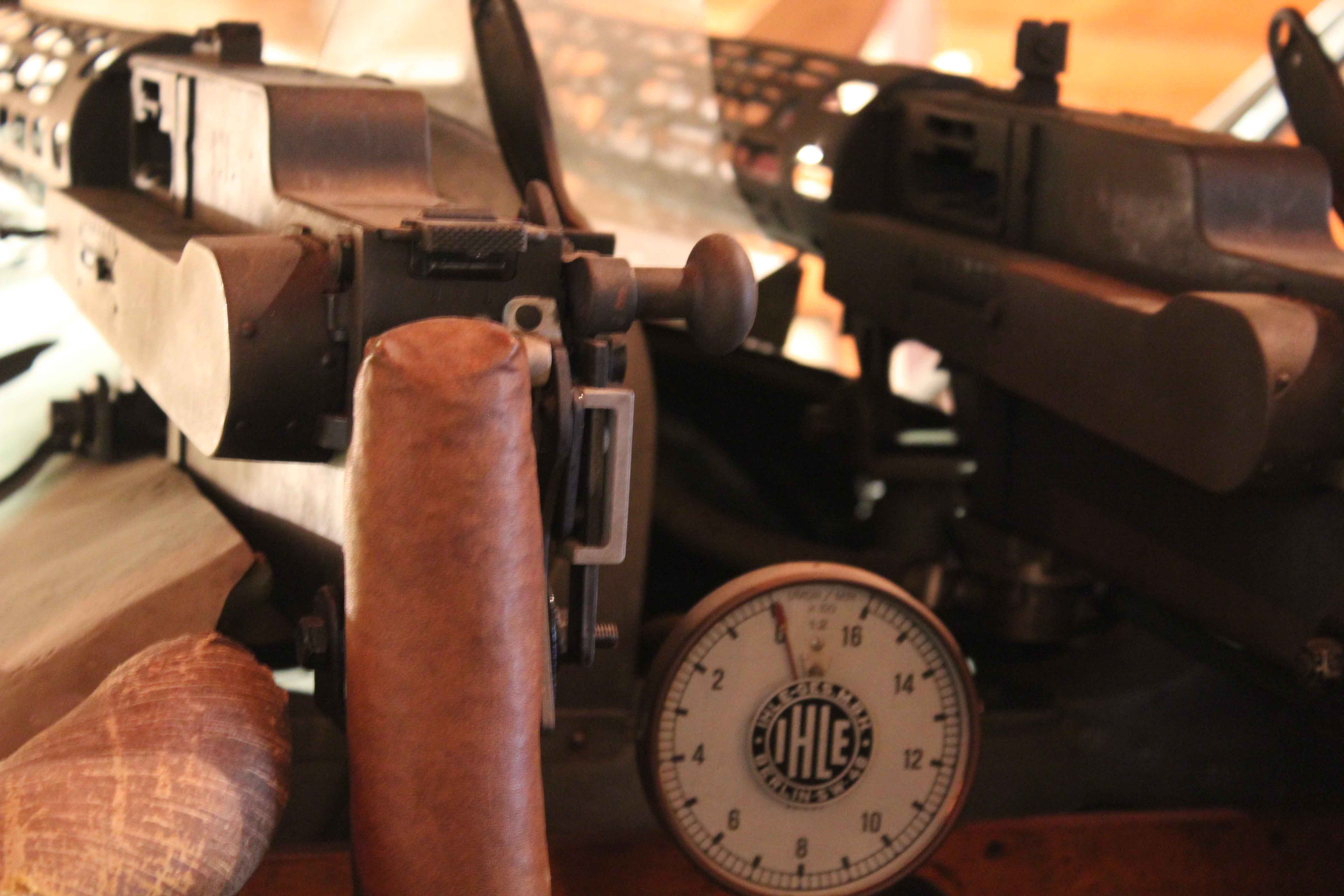
View looking forward in the cockpit of the Fokker DVII, German First World War biplane, with two LMG 08/15 Machine Guns.
View looking forward in the cockpit of the Fokker DVII, First World War German biplane, with two LMG 08/15 Machine Guns. (Author’s Photo)

This is largely due to the efforts of Senator George Foster, who petitioned the Dominion Archivist and Comptroller of War Trophies Arthur Doughty for a quality collection. In addition to the spectacular Fokker DVII German biplane with original fabric covering including camouflage (with a good write up about it by a BCHS member here), the BCHS has a diverse collection of German trench mortars and a range of German machine-guns. Since Sep. 2013, work with Ross Jones, the museum’s militaria specialist, has established the battlefield provenance of many of these items using the War Trophies Commission records at Library and Archives Canada. We have poked around pieces, trying to discern key numbers, and any matches have added to the number of surviving pieces in my database. Some of the trophies also have capture info painted on by hand. The range of items, from machine-gun belt fillers (which look like a pasta grinder) to trench periscopes, to aerial bombs, gives a good idea of the variety of small trophies that once accompanied many of the larger artifacts out to sites across Canada. A very significant find was had when Ross managed to man-handle the destroyed barrel of a 25cm heavy Minenwerfer trench mortar around to discover the serial number. The 102nd Canadian Infantry Battalion captured mortar no. 1524 (along with 119 German prisoners) on Vimy Ridge, April 9th, 1917. The barrel, bearing heavy shrapnel pitting and shell damage, is a powerful relic of the Vimy victory. This is only a small sample of the varied collection of the BCHS, a small museum worth a visit!

Destroyed 25cm Minenwerfer, captured by 102nd Battalion, CEF, Vimy Ridge. (Author's Photo)
Destroyed 25cm Minenwerfer, captured by 102nd Battalion, CEF, Vimy Ridge. (Author’s Photo)