Wrecking the Terror: Recreating an Epic Tale of Old Loss and New Discovery

With a shipwreck…you are dealing with a single instant in which everything was pitched onto the seabed; and, because water can be a wonderful preservative, in the right circumstances, the wreck and almost everything within will still be there. A wreck can be a perfect time capsule.” (Mensun Bound The Ship Beneath the Ice p.280).
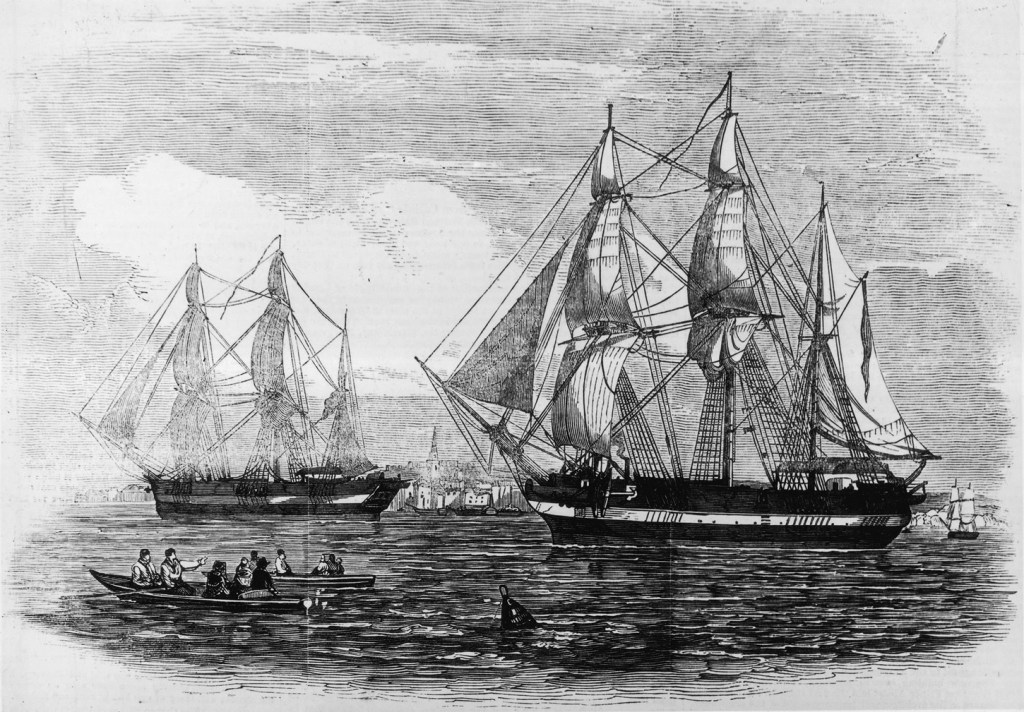
The Franklin expedition ships, HMS Erebus and Terror, setting out with fanfare in late May 1845 from Greenhithe. This was originally published for the 24 May 1845 edition of the Illustrated London News. (Via wikimedia commons)

In 1845, Her Majesty’s Ships Erebus and Terror sailed into the unknown. Sir John Franklin, commander of the expedition, was instructed to chart the last remaining sections of the Northwest Passage and return via the Pacific. The British Admiralty expected that this modern, lavishly-equipped official effort would survey the remaining portions of a sea route along the top of the North American landmass. Hopes ran high that this expedition would be a crowning achievement to decades of British exploration of the Arctic.
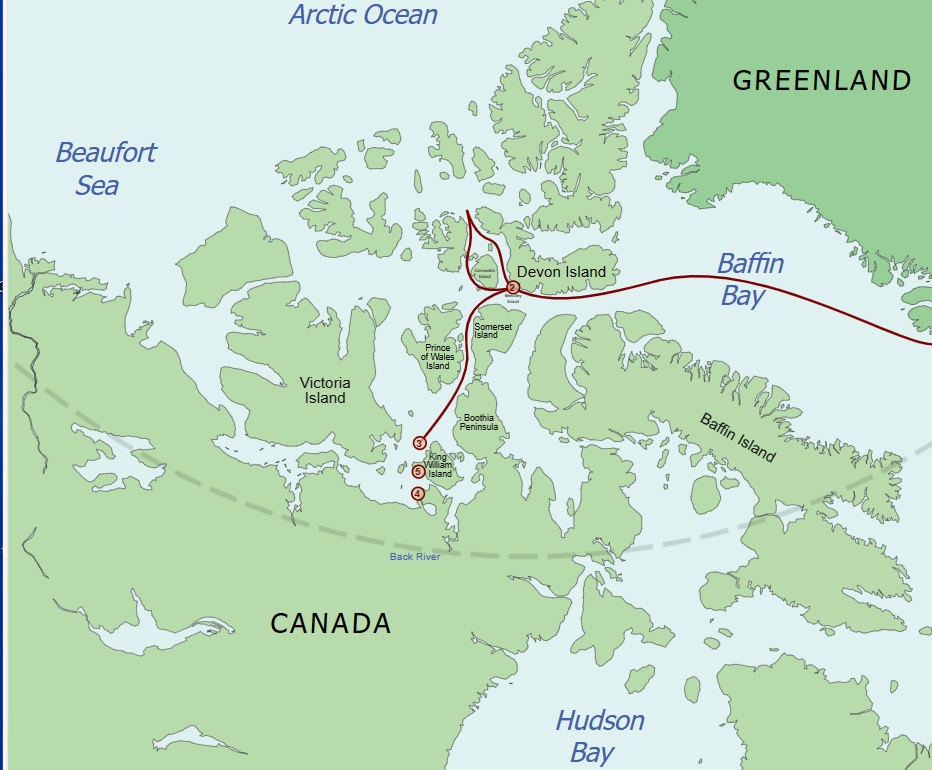
Reconstruction of Franklin’s route from 1845-1848 Locations are: 1. (off map, right) Disko Bay, Greenland, site of departure from towing and supply ships 2. Beechey Island, site of the 1845-46 wintering and artifacts; 3. NW of King William Island 1847 position of the Victory Point “All is Well” message and the 1848 addendum of “we are deserting the ships”; 4. Erebus found 2014;5. Terror found 2016. Base map: Kennonv, after CIA’s World Fact BookFranklin’s route: Own work, CC BY-SA 3.0 https://creativecommons.org/licenses/by-sa/3.0, via Wikimedia Commons

Instead, the 129 men disappeared. It would take a decade and a half for the outcome of the expedition to be reported, and decades more for the majority of the grim tale to be uncovered: No survivors, no repository of useful information collected, both ships utterly vanished, and presumed to have sunk. The witnesses, local Inuit who were recalling events from years before, provided oral testimony to parts of the tragedy. So many questions remained unanswered about how this great expedition met its end.

The wreck of HMS Terror, Captain Francis Crozier’s lost ship, was discovered seventeen decades later, in early September 2016, by the crew of the Arctic Research Foundation’s vessel, RV Martin Bergmann. The ARF had already participated in several Government of Canada searches, and had been involved in the discovery of HMS Erebus, Franklin’s flagship, two years earlier.
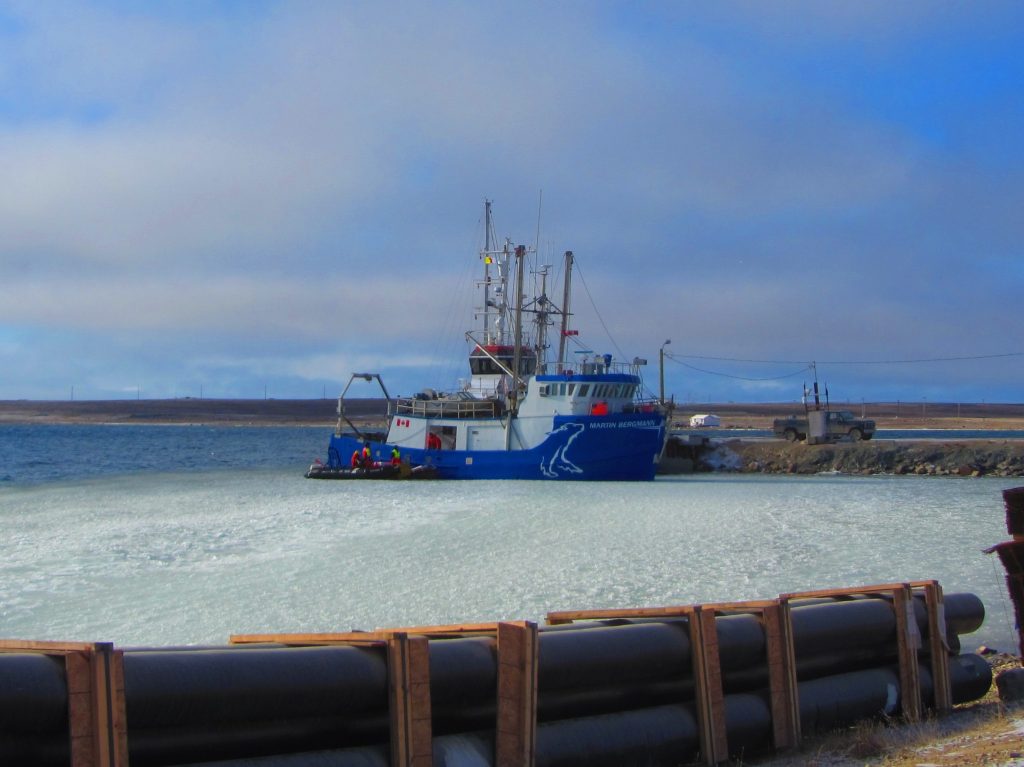
RV Martin Bergmann at Cambridge Bay, her longtime homeport. Image Courtesy of Gloria Song, who retains copyright.

While at Gjoa Haven, ARF members received a tip from local resident and Canadian Ranger Sammy Kogvik, and decided to divert from the searching area off the western coast of King William Island to enter Terror Bay. After an initial sonar search did not return any likely sonar targets, the Martin Bergmann turned to resume its journey. The course to exit the Bay took the research ship right over a well-defined sonar image of a wreck on the seabed, in about 80 feet (24m) of water.
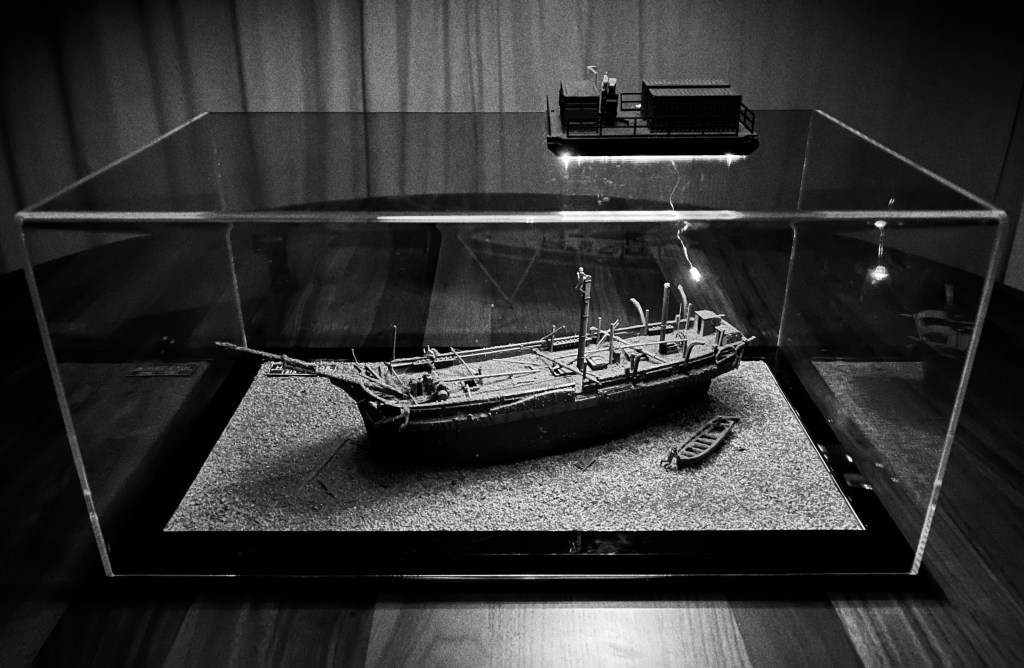
Our representation of the Terror wrecksite with the Parks Canada dive barge over top, at 80′ scale depth. Credit:www.warsearcher.com for our updated wreck interpretation from 2024, please see: The Great Terror Wreck Repair[2024]

Parks Canada’s Underwater Archaeology Team confirmed that the identity of the wreck was indeed Terror a few weeks later. It was an astonishing find: A barely-wrecked ship, almost frozen in time! The hull stands proud of the seafloor, and the weather deck is in exceptional condition. Sections of the masts and the bowsprit are still standing! Unlike Erebus, Terror’s site appears to have little scattered debris. Everything related to the wreck seems to be adjacent to the hull, or has fallen off it in close proximity.
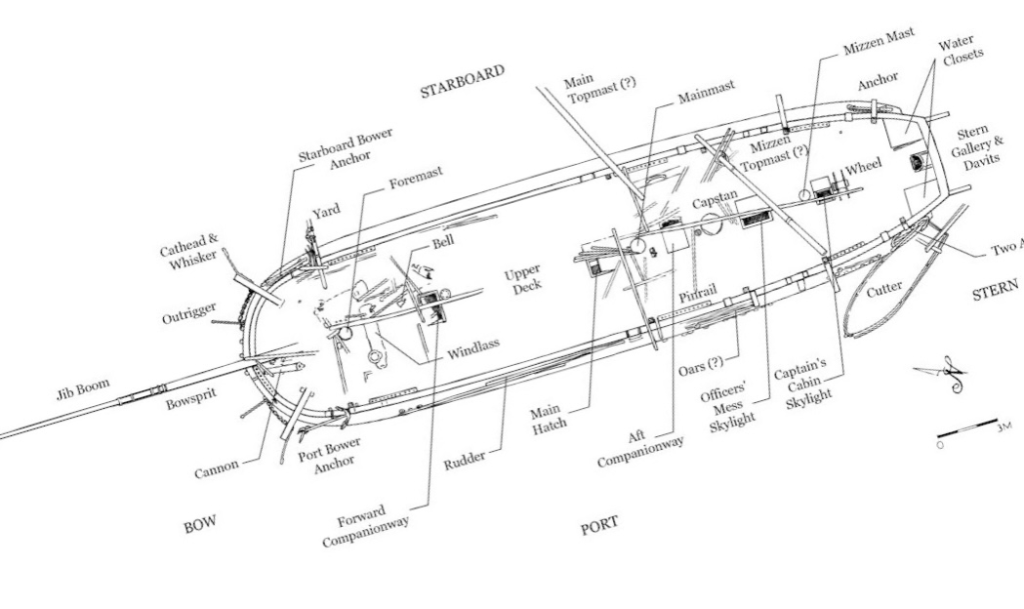
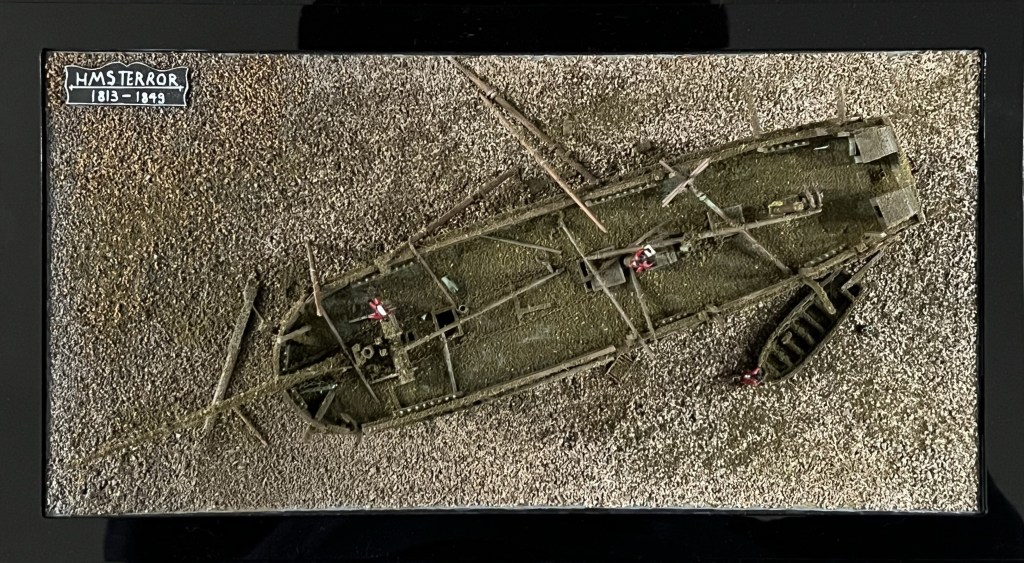
HMS Terror site sketch, 2017 copyright Parks Canada 2021 [modified by rotating]. Source.
North is to the left, and the three-dimensional nature of the diorama introduces some positional discrepancies with the above schematic two-dimensional site plan. Credit:www.warsearcher.com

HMS Terror lies in a quiet resting spot, with few obvious signs of damage, and no immediately observable evidence of what brought her to this watery grave, in a bay later named -in a stunning coincidence-after her. She appears to have been abandoned in winter quarters, closed up with topgallant masts removed. The enormous rudder is unshipped from the stern and mounted on the port ice channels amidships. The ship is gently listing to starboard.1 The state of preservation appears outstanding – Almost everything required to operate a mid-19th Century sailing ship with auxiliary steam propulsion is still there. It is as if departing crew members left Terror in good working order as they abandoned ship.
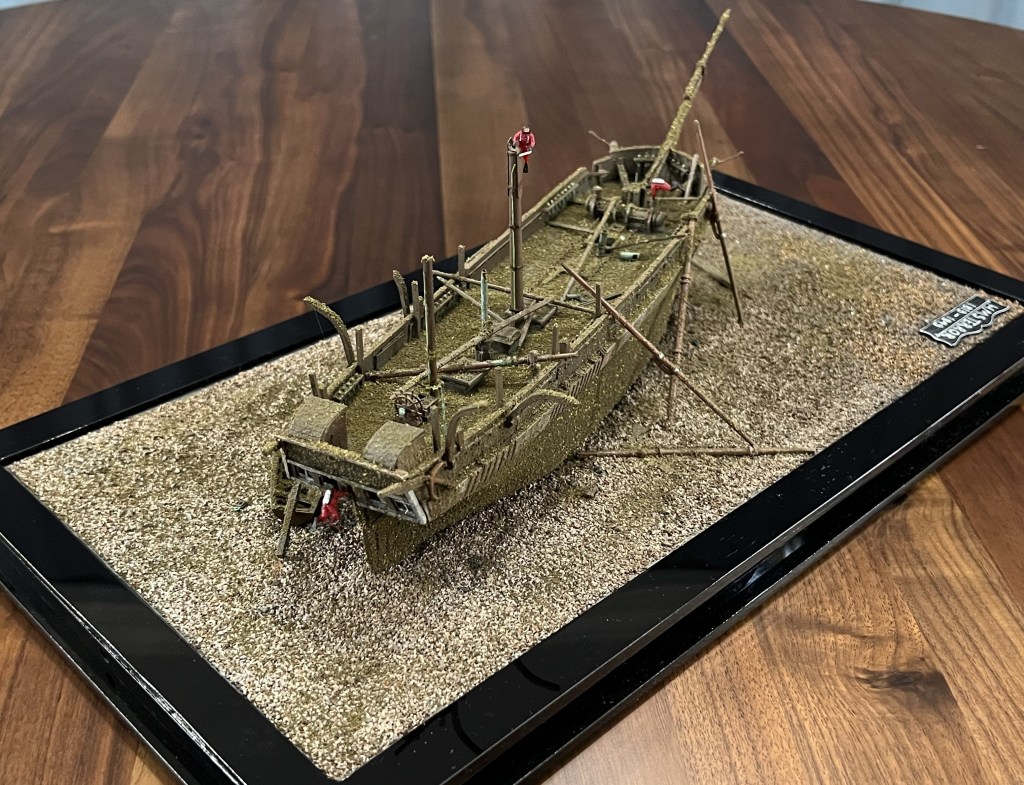
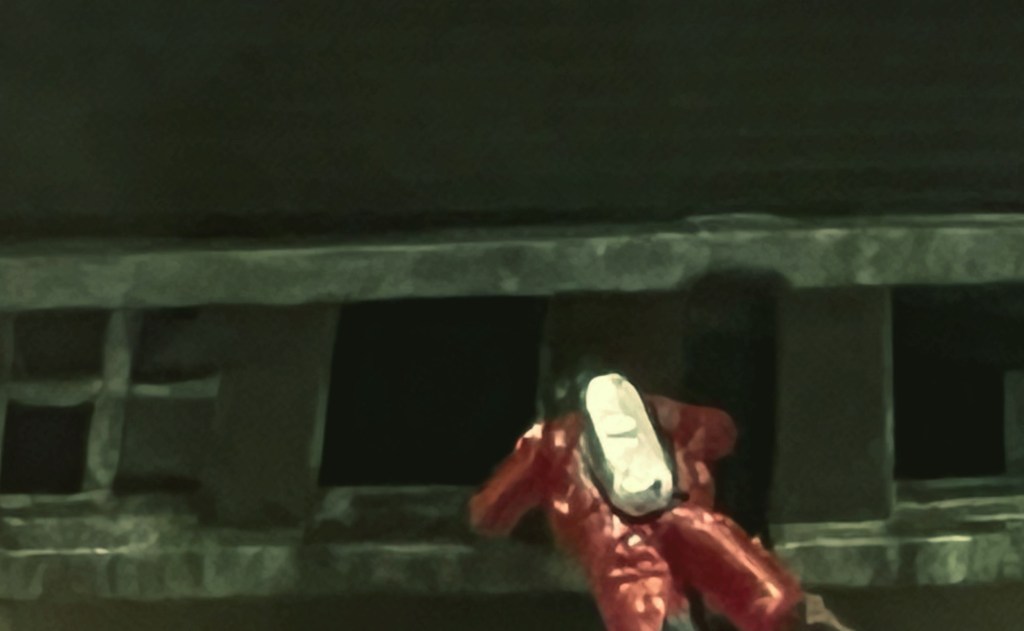
The diorama depicts underwater archaeologists examining sections of the wreck. Credit: http://www.warsearcher.com

With the historic discovery of both Franklin vessels, a methodical exploration of the wrecks by Parks Canada underwater archaeologists, over many seasons, may yet answer important questions about the tragedy: why are the wrecks located further south than many expected; were they reoccupied; did the plan of the retreat, as described in the Victory Point note, evolve; what halted the ships further progress, and caused their final abandonment; when did this happen; how much longer did they remain afloat; is there anything onboard to help point to terrestrial archaeological sites; do the remaining supplies or preserved records help explain what maladies the crews were suffering from, and how these were impacting command decisions; were local Inuit groups able to salvage much from either of the wrecks; are there remains of either of Franklin’s crews still entombed in their ships?2 For now, Terror is keeping her secrets close below decks.
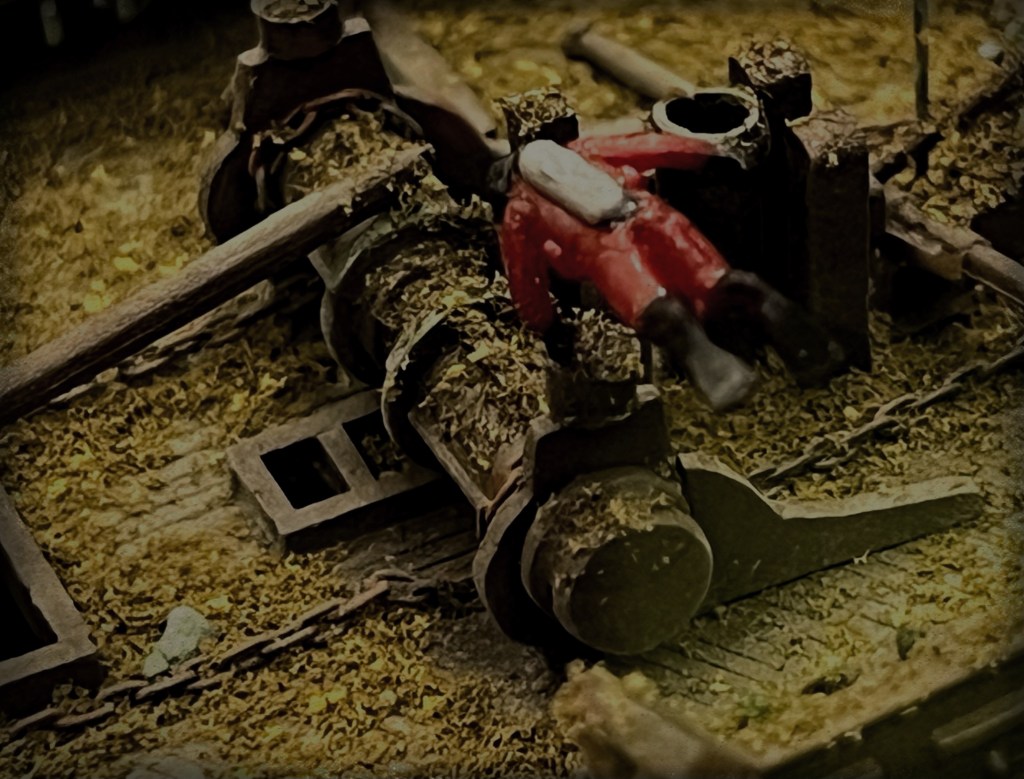
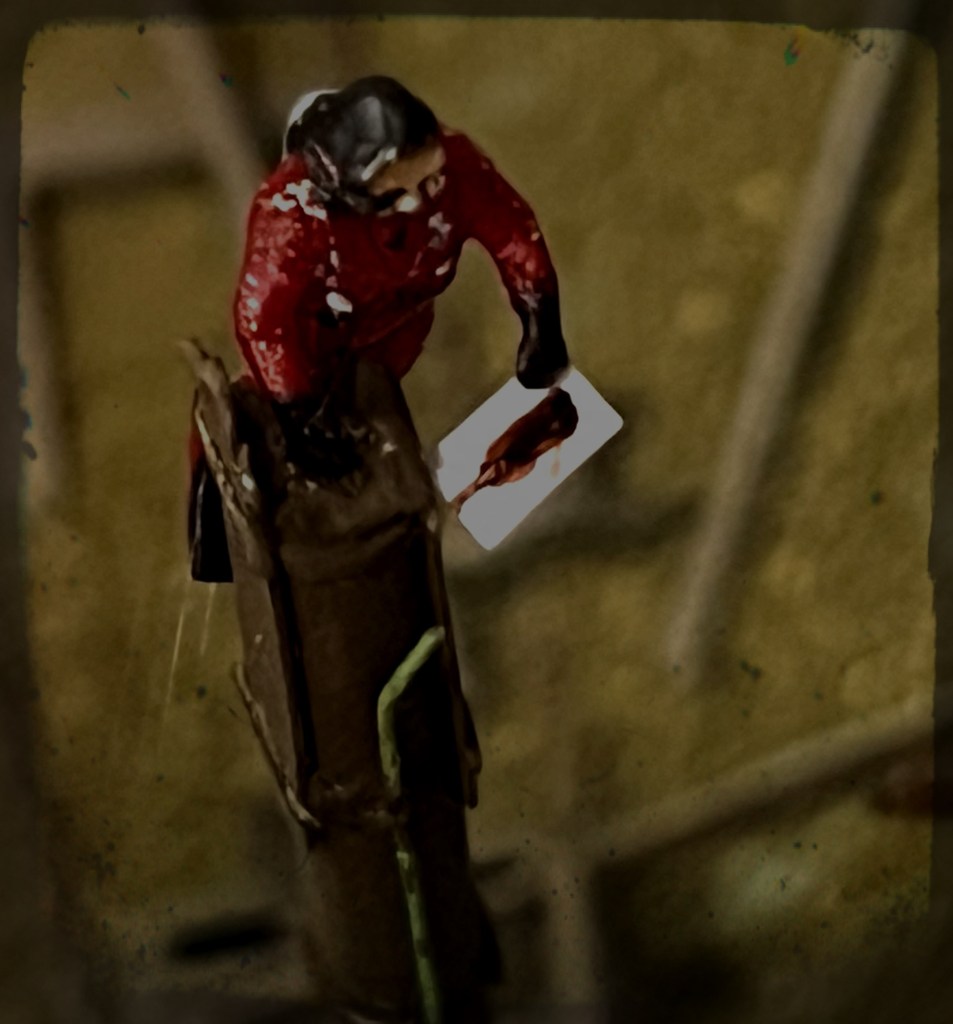
We built a model in 2022 to help us interpret the history of the wreck. We used every scrap of information, including the wreck plan on Parks Canada’s website, the Arctic Research Foundation 2016 video, the Parks Canada 2017 exploration of the wreck video. Matthew Betts’ blog site, Building the Terror where he built a large, extensively researched model of the ship, was also an important resource. He followed this with HMS Terror: The Design, Fitting and Voyages of a Polar Discovery Ship, which came out just as we finished the model. Until more information is released by Parks, this is an essential source for interpreting Terror. Parks Canada Underwater Archaeology staff generously shared information about the archaeological program and assisted us in gathering further information about the ship. Their expertise, professionalism, and concern for the wrecks they conduct archaeological investigations of is remarkable.
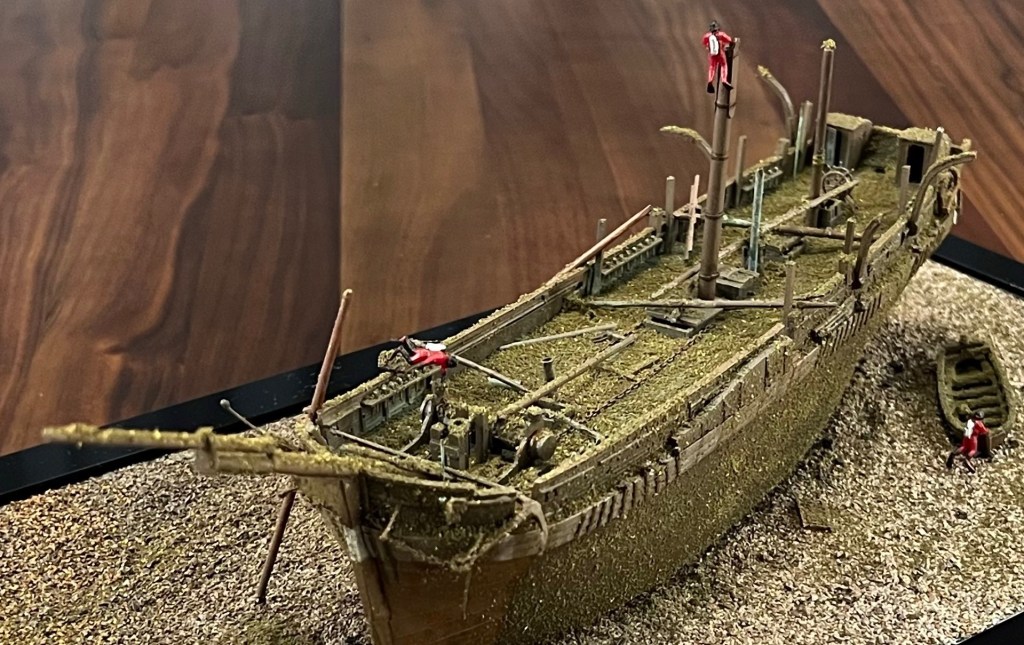
This interpretation of the site won’t be the last or the most accurate wreck diorama. So far as we know, it is the first. Credit: http://www.warsearcher.com

  1. The 2017 Parks tour of the wreck video shows, when the ROV reaches the aft cabin, the degree of list to starboard. ↩︎
  2. We don’t yet know if or when crew reoccupied Terror. If she was reoccupied and brought to her present location, we also don’t know if she sank unexpectedly or was abandoned in orderly fashion as the crew marched westwards along the King William Island coast, to cross to the mainland. ↩︎
Raise the Terror Boat!

Raise the Terror? Raise the Terror’s Boat! Why? Read on!

Since the incredible discovery of HMS Terror in September, 2016, there has been keen interest in the archaeology taking place at the wreck. Terror was Sir John Franklin’s second ship from the ill-fated 1845 search for the Northwest Passage, and was discovered almost exactly two years after the lead ship, HMS Erebus. The 2023 archaeological season has concluded, but announcements of new discoveries by Parks Canada archaeologists remain weeks or months away. We are years from a full archaeological assessment of Terror, though a tantalizing vision has formed of an astonishingly well-preserved site, 80-feet under the waters of Terror Bay, King William Island, Nunavut. An international community of “Franklinites” – those interested in all things Franklin Expedition- continues to speculate: What was discovered this year; what new information helps explore the last days of the Expedition; are there connections to known or as yet undiscovered terrestrial archaeological sites? Is either ship an actual tomb to some of its crew?

The ship’s boat immediately to port at the stern of the Terror wreck, as represented in our 1/125 scale wreck diorama. Credit: http://www.warsearcher.com

Over the years, there have been posts on the very active “Remembering the Franklin Expedition” Facebook group, proposing to “RAISE THE TERROR” from her current location. Other members, just as passionately, dismiss the idea as premature, ruinously expensive, and potentially destructive to an artifact group members care very much about. In this post we’d like to focus on what we think would be a less contentious project. We remind readers that we are not archaeologists or marine salvage experts.

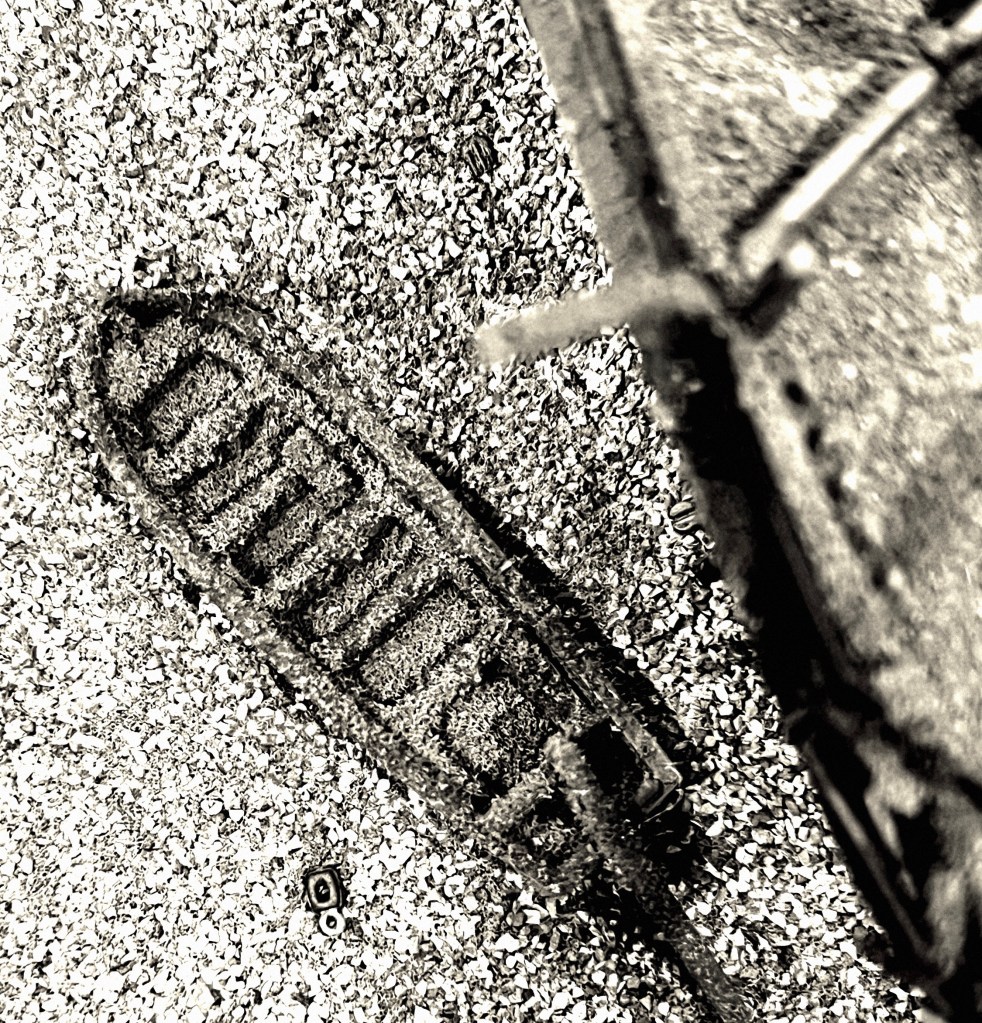
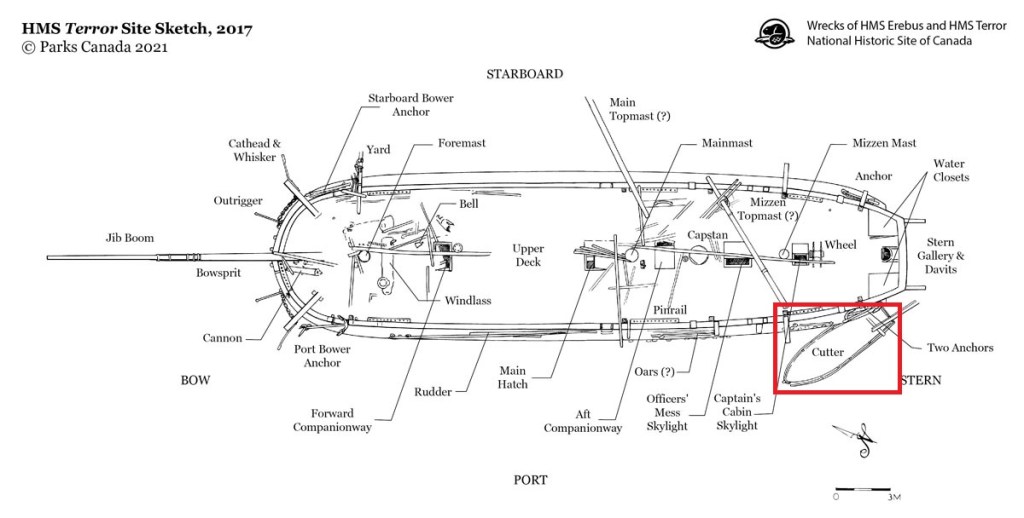
What we are proposing is to recover one artifact: RAISE TERROR’S BOAT! It is located on the seabed off the port quarter of the wreck, under a pair of davits. It can be readily seen on the site plan that was prepared by Parks’ archaeology staff in 2017 and released on their website two years later. Like the ship, this boat-wreck appears to be in very good condition after almost 175 years of frigid immersion.

HMS Terror site plan, ca. 2017, modified to emphasize the location of the ship’s boat. Credit: Parks Canada source.

The boat appears to be a standard 23-foot ship’s cutter, about 7-feet at its broadest part. It is clinker-built (overlapping boards) and has recessed slots for rowing with eight or so oars. It has several thwarts for crew and passengers, and could also be fitted with two small masts to sail it. Some upper sections of the gunwales appear to be damaged or rotted through, and it is unclear to us if it still has some type of fabric cover or is instead almost completely filled with sediment. A fallen section of davit or post rests at the squared-off stern, overhanging the transom. The rudder is not installed.1

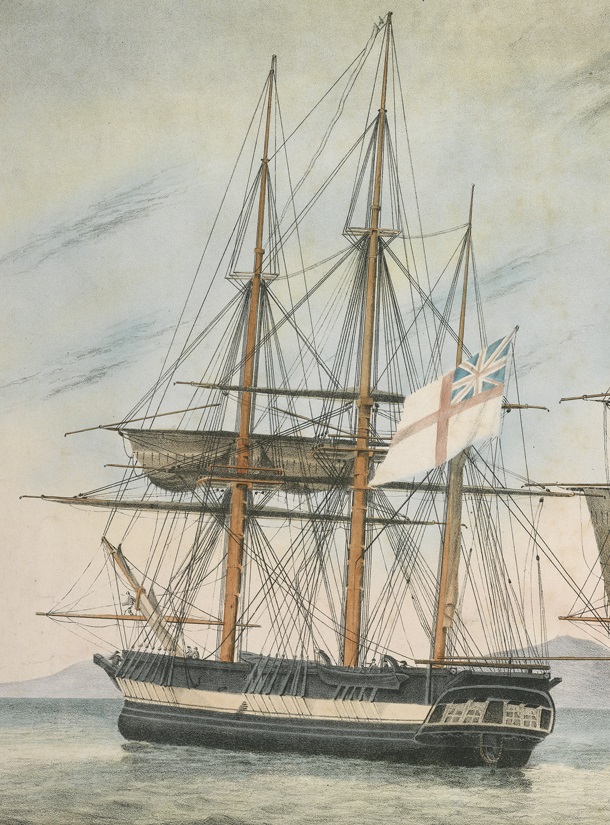
HMS Fury, carrying a similar cutter in the same position, as depicted before the second William E. Parry Expedition searching for a NW passage. Fury was very similar to both Franklin ships, and had been wrecked in the Arctic at Somerset Island, two decades before. Detail of His Majesty’s Discovery ships, Fury and Hecla by Arthur Parsey (Artist & Engraver) Charles Joseph Hullmandel (Printer) in 1823 PAH9224.

Raising this small vessel should not compromise other areas of the wreck. The operation would not upset precious artifacts or records inside Terror, as they await systematic archaeological study. Based on the Parks Canada tour of HMS Terror film, the boat is not deeply embedded in the hard, gravel-like seabed. Compared to the complex overall sites of either Terror or Erebus, a thorough survey of the boat and its immediate surroundings should not be a multi-year operation. The full survey would ensure that no artifact, no matter how small, was overlooked.

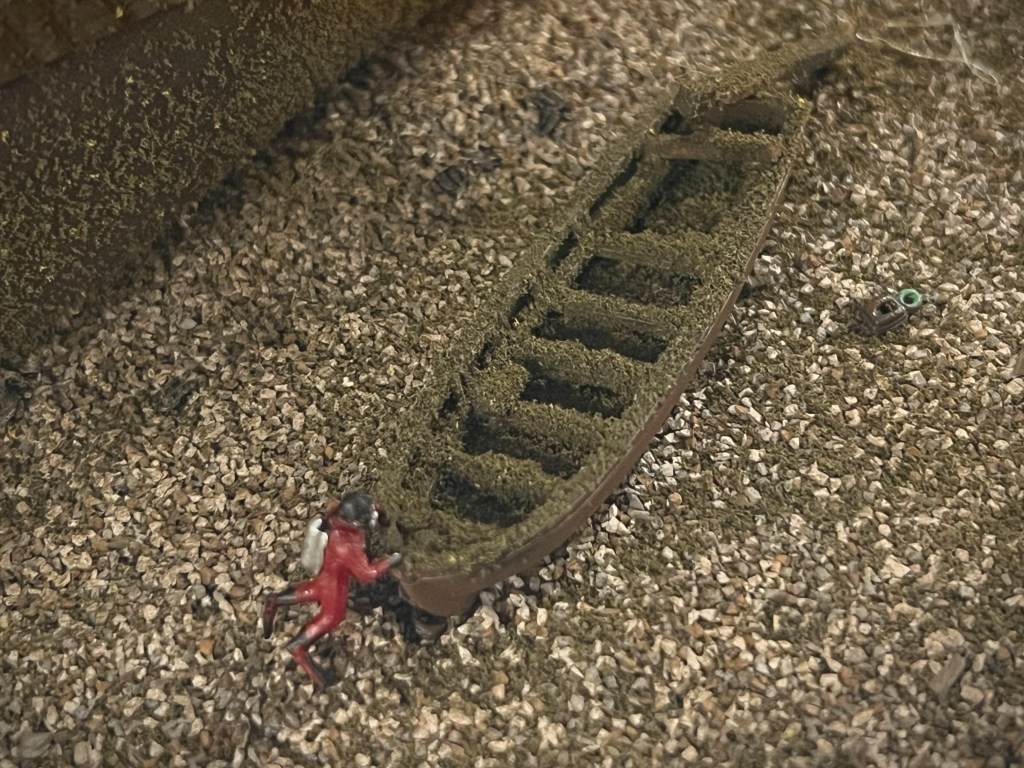
An underwater archaeologist examines the boat near the HMS Terror wreck diorama. Credit: http://www.warsearcher.com

Once recovered and conserved, the artifact could serve a variety of purposes, helping to interpret the history of the Expedition, and its grim denouement. This cutter is a tangible link to its companion boats–the sledge-bound boats that crew members dragged along the coasts until they could go no further. It could also help explore less tragic polar exploration voyages and other searches for a Northwest Passage.2

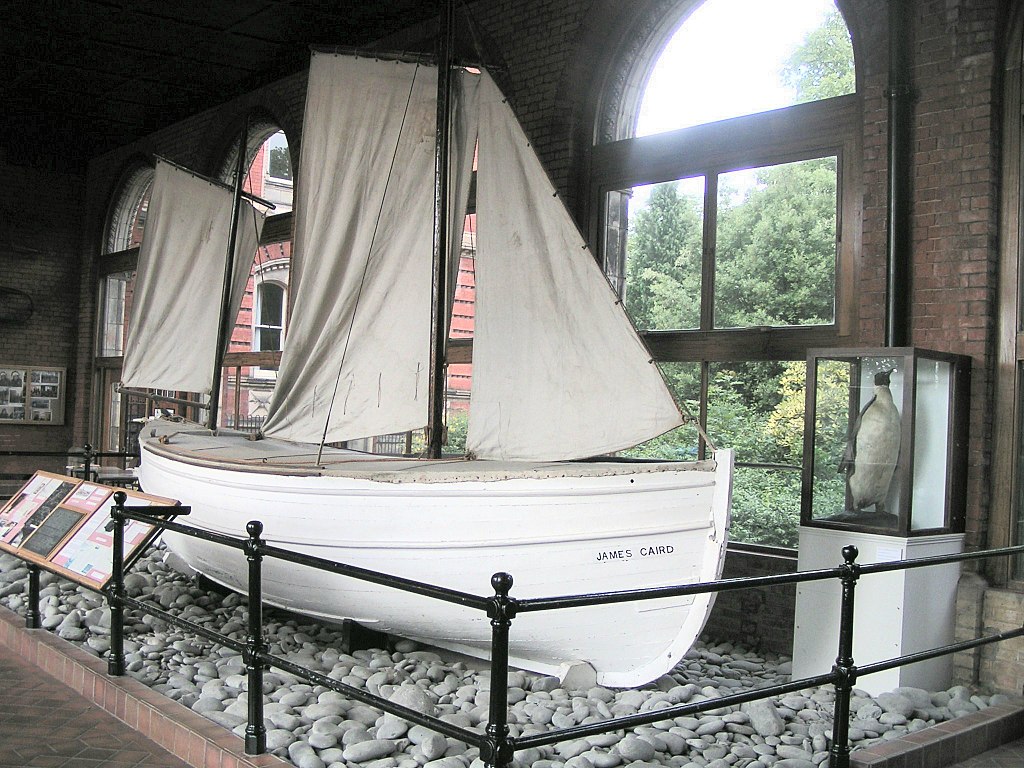
A comparative example is the display of the famous James Caird, a 22.5-foot reinforced ship’s boat from Sir Ernest Shackleton’s expedition ship, Endurance. After the Endurance was crushed by ice in the Weddell Sea, in November 1915, the boats allowed the crew to escape to Elephant Island. Shackleton and two companions pushed on in the James Caird to South Georgia, where they were able to organize a rescue party to return to for the whole crew. The boat is now on display at Dulwich College, South London. Credit: Rumping, Public domain, via Wikimedia Commons

Raising the Terror’s boat is only half of the ambitious plan, though! The cutter is a character-defining element of the overall Terror site. If it is raised to the surface for conservation and display, it would create an absence at the wreck site. Why not replace it with a replica that also memorializes the lost crews? A traditional boatworks in Great Britain, the Canadian Maritimes, or New England could be contracted to create a faithful copy of the craft, to be deposited (or sunk) in situ in the same exact position. It would gradually silt up and decay alongside the wreck, becoming more integrated into the environment and benthic marine ecosystem as the years pass. This new boat could also serve as a kind of benchmark or “canary in the coal mine” for identifying more rapid changes to the site, which may be less evident on the original structures. In the (hopefully distant) future, when the Terror decays, the boat could remain as one of the last wooden elements at the Terror wrecksite. Beechey Island has memorials and the replica wooden gravestones currently marking the earthly remains of three Franklin expedition crewmembers. It seems fitting that HMS Terror could have a replica boat to mark her resting spot. There are also precedents for this. Replica objects deposited at famous wrecks mark removals, and can restore an aesthetic appearance to the site.3 A suitable plaque affixed to the replica boat could help memorialize the lost crews–an underwater cenotaph to the lost men of the Franklin Expedition in an incredibly powerful location. RAISE THE TERROR’S BOAT INDEED!

So, have we persuaded you? Let us know by leaving a comment or sharing!

  1. This description is drawn from the Parks Canada Terror dive tour video linked to above, Matthew Betts’ work HMS Terror: the Design, Fitting, and Voyages of the Polar Discovery Ship, archaeological field reports about Terror prepared by Parks Canada’s Underwater Archaeology Team, and comparative examples of other Royal Navy cutters. ↩︎
  2. A 23-foot boat could also help interpret more positive events, such as when HMS Fury‘s abandoned boats were instrumental in saving Sir John Ross’s entire expedition crew, after the abandonment of their own ship Victory. Elsewhere, it is also the same basic size as the HMAV Bounty’s launch. ↩︎
  3. One example is a proposal to sink a sculpture of a 55-foot long Sea King Maritime Patrol Helicopter on the deck of the artificial reef, the former Canadian HMCS Annapolis, to reincorporate a representation of the destroyer’s helicopter detachment to the site. ↩︎