Raise the Terror? Raise the Terror’s Boat! Why? Read on!
Since the incredible discovery of HMS Terror in September, 2016, there has been keen interest in the archaeology taking place at the wreck. Terror was Sir John Franklin’s second ship from the ill-fated 1845 search for the Northwest Passage, and was discovered almost exactly two years after the lead ship, HMS Erebus. The 2023 archaeological season has concluded, but announcements of new discoveries by Parks Canada archaeologists remain weeks or months away. We are years from a full archaeological assessment of Terror, though a tantalizing vision has formed of an astonishingly well-preserved site, 80-feet under the waters of Terror Bay, King William Island, Nunavut. An international community of “Franklinites” – those interested in all things Franklin Expedition- continues to speculate: What was discovered this year; what new information helps explore the last days of the Expedition; are there connections to known or as yet undiscovered terrestrial archaeological sites? Is either ship an actual tomb to some of its crew?
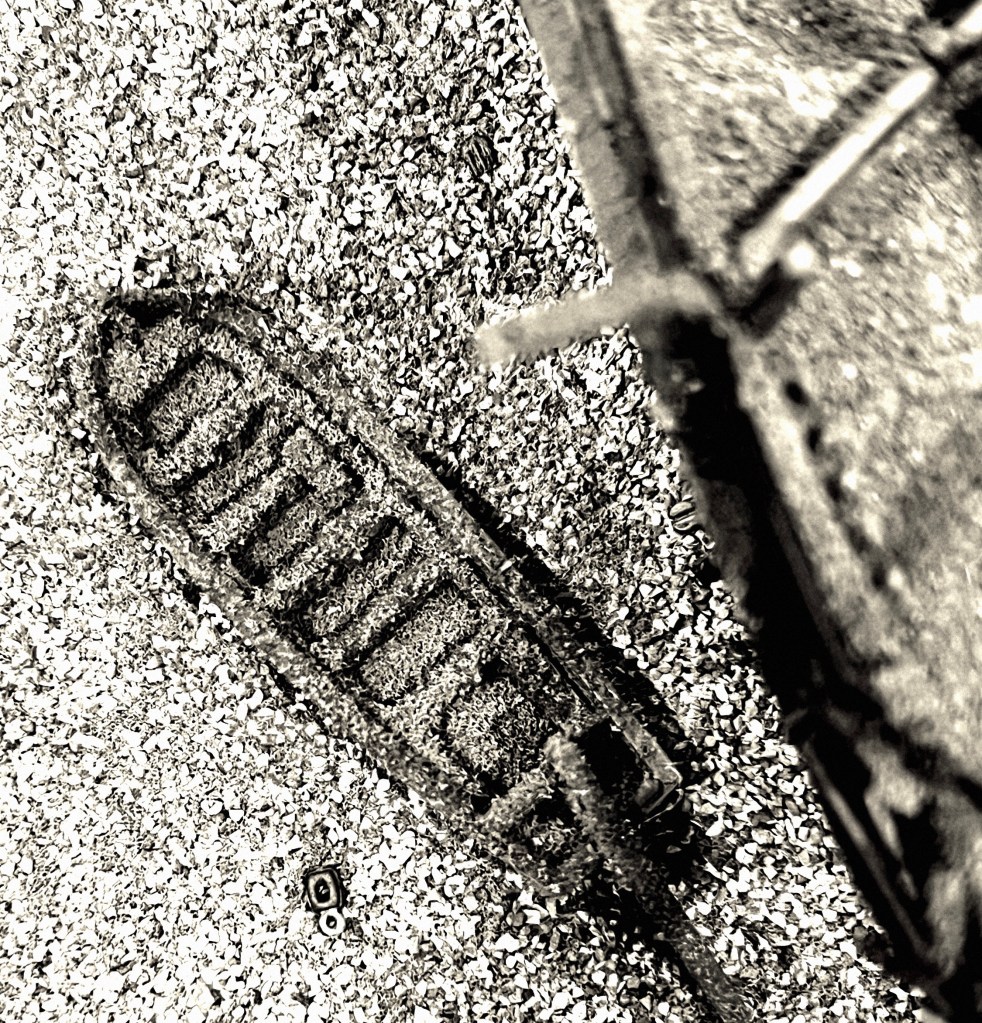
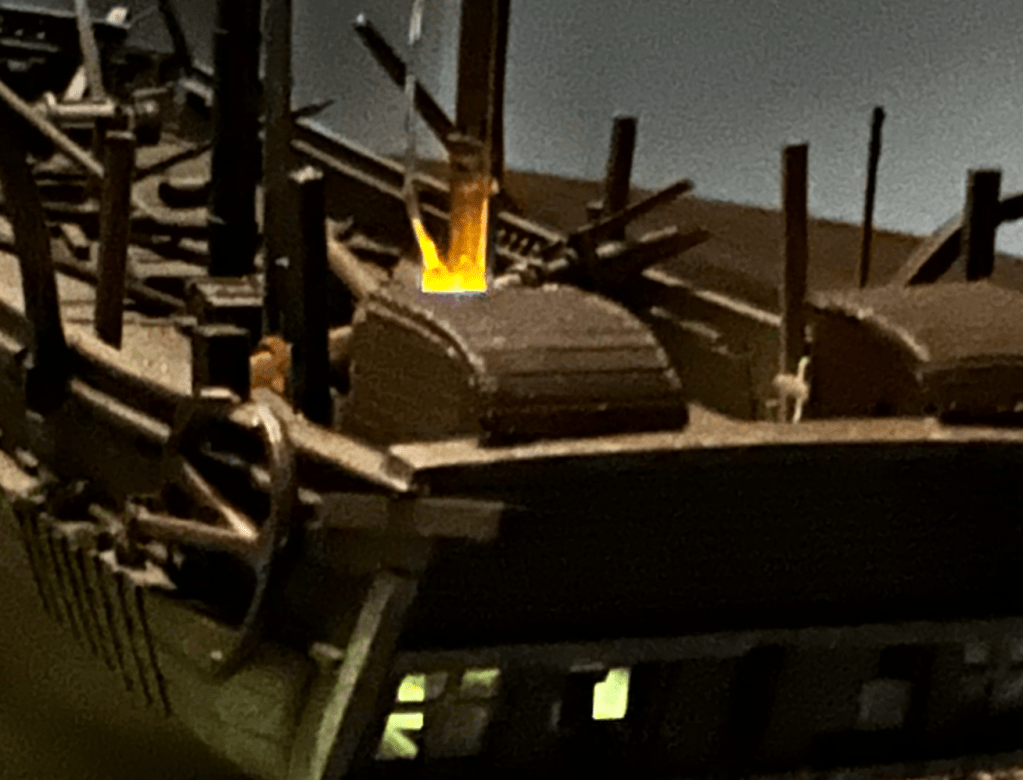
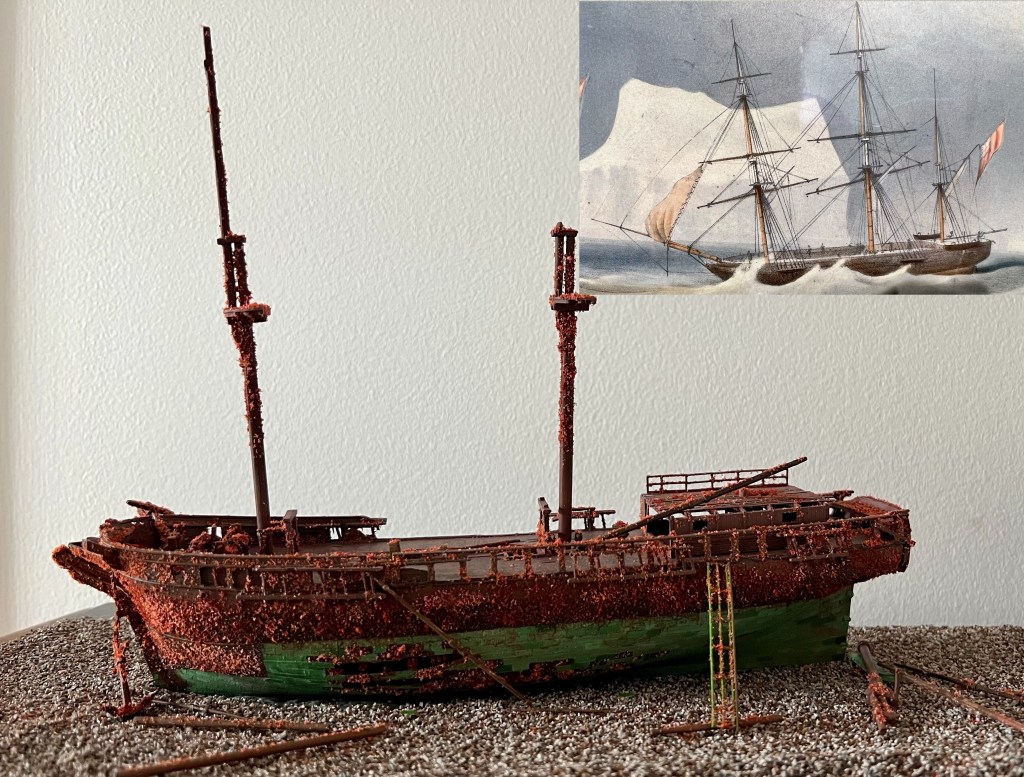
The ship’s boat immediately to port at the stern of the Terror wreck, as represented in our 1/125 scale wreck diorama. Credit: http://www.warsearcher.com
Over the years, there have been posts on the very active “Remembering the Franklin Expedition” Facebook group, proposing to “RAISE THE TERROR” from her current location. Other members, just as passionately, dismiss the idea as premature, ruinously expensive, and potentially destructive to an artifact group members care very much about. In this post we’d like to focus on what we think would be a less contentious project. We remind readers that we are not archaeologists or marine salvage experts.
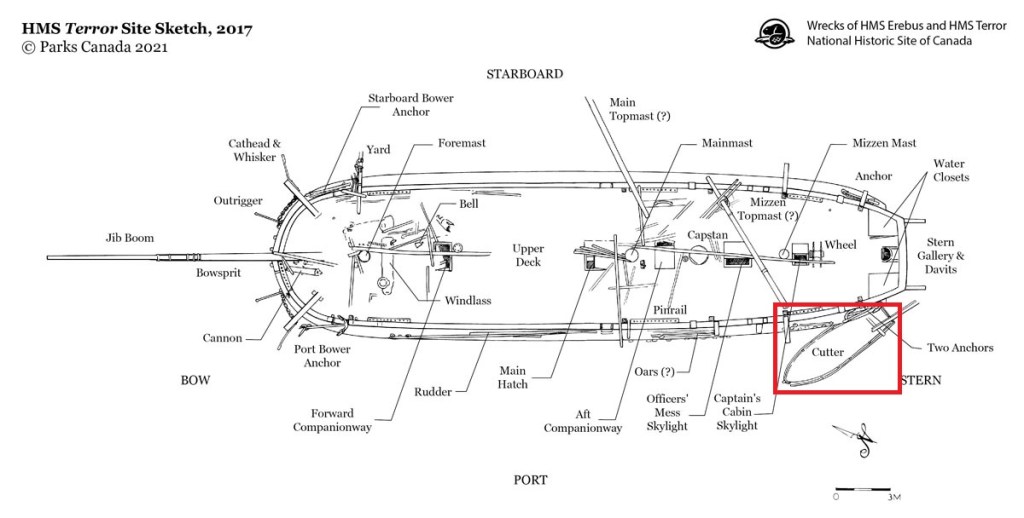
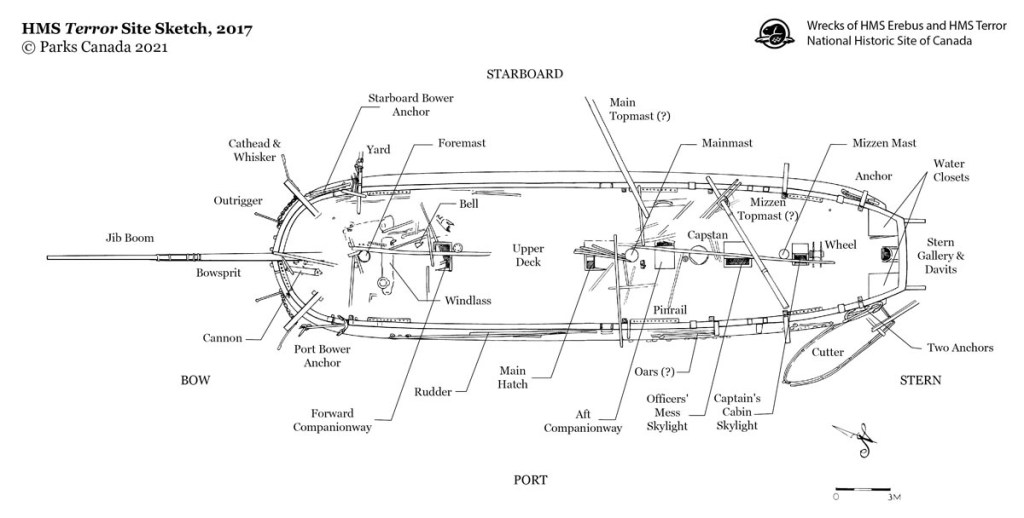
What we are proposing is to recover one artifact: RAISE TERROR’S BOAT! It is located on the seabed off the port quarter of the wreck, under a pair of davits. It can be readily seen on the site plan that was prepared by Parks’ archaeology staff in 2017 and released on their website two years later. Like the ship, this boat-wreck appears to be in very good condition after almost 175 years of frigid immersion.
HMS Terror site plan, ca. 2017, modified to emphasize the location of the ship’s boat. Credit: Parks Canada source.
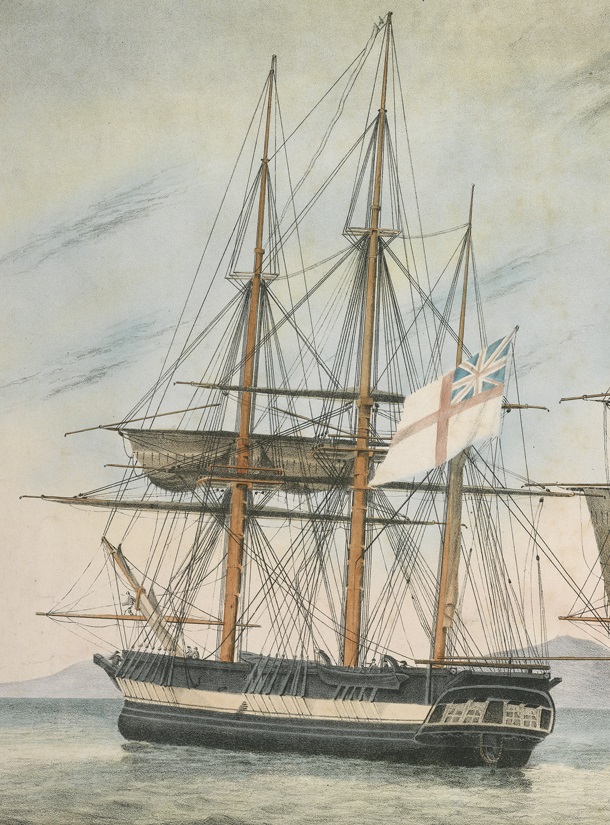
The boat appears to be a standard 23-foot ship’s cutter, about 7-feet at its broadest part. It is clinker-built (overlapping boards) and has recessed slots for rowing with eight or so oars. It has several thwarts for crew and passengers, and could also be fitted with two small masts to sail it. Some upper sections of the gunwales appear to be damaged or rotted through, and it is unclear to us if it still has some type of fabric cover or is instead almost completely filled with sediment. A fallen section of davit or post rests at the squared-off stern, overhanging the transom. The rudder is not installed.1
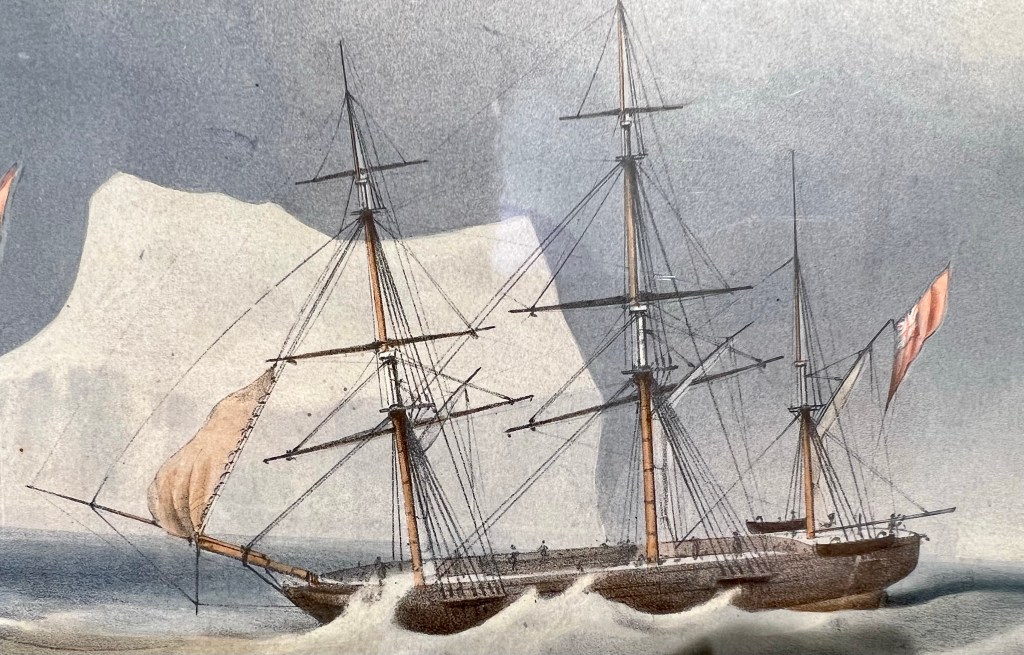
HMS Fury, carrying a similar cutter in the same position, as depicted before the second William E. Parry Expedition searching for a NW passage. Fury was very similar to both Franklin ships, and had been wrecked in the Arctic at Somerset Island, two decades before. Detail of His Majesty’s Discovery ships, Fury and Hecla by Arthur Parsey (Artist & Engraver) Charles Joseph Hullmandel (Printer) in 1823 PAH9224.
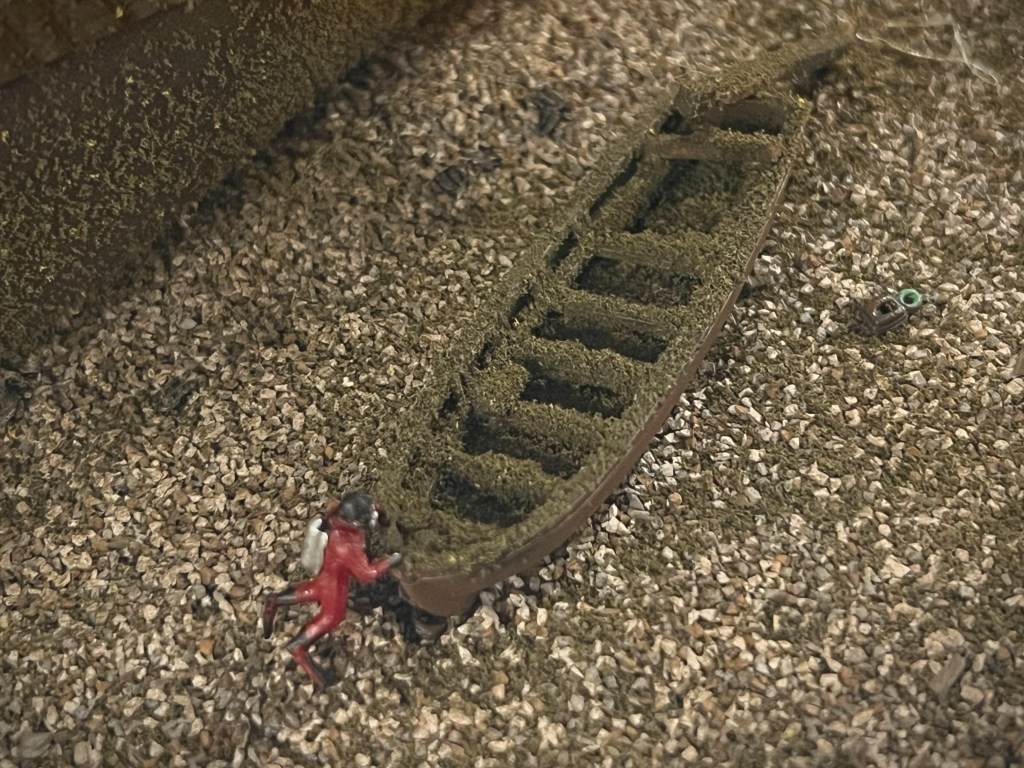
Raising this small vessel should not compromise other areas of the wreck. The operation would not upset precious artifacts or records inside Terror, as they await systematic archaeological study. Based on the Parks Canada tour of HMS Terror film, the boat is not deeply embedded in the hard, gravel-like seabed. Compared to the complex overall sites of either Terror or Erebus, a thorough survey of the boat and its immediate surroundings should not be a multi-year operation. The full survey would ensure that no artifact, no matter how small, was overlooked.
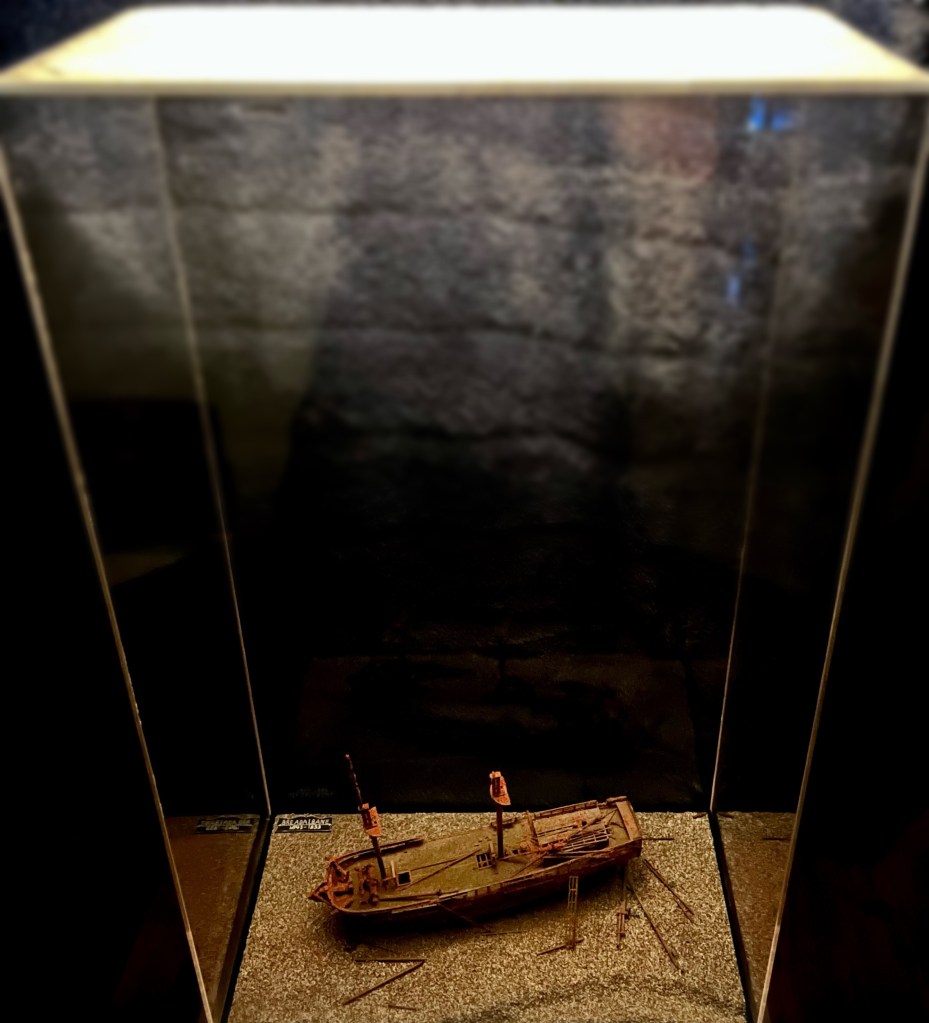
An underwater archaeologist examines the boat near the HMS Terror wreck diorama. Credit: http://www.warsearcher.com
Once recovered and conserved, the artifact could serve a variety of purposes, helping to interpret the history of the Expedition, and its grim denouement. This cutter is a tangible link to its companion boats–the sledge-bound boats that crew members dragged along the coasts until they could go no further. It could also help explore less tragic polar exploration voyages and other searches for a Northwest Passage.2
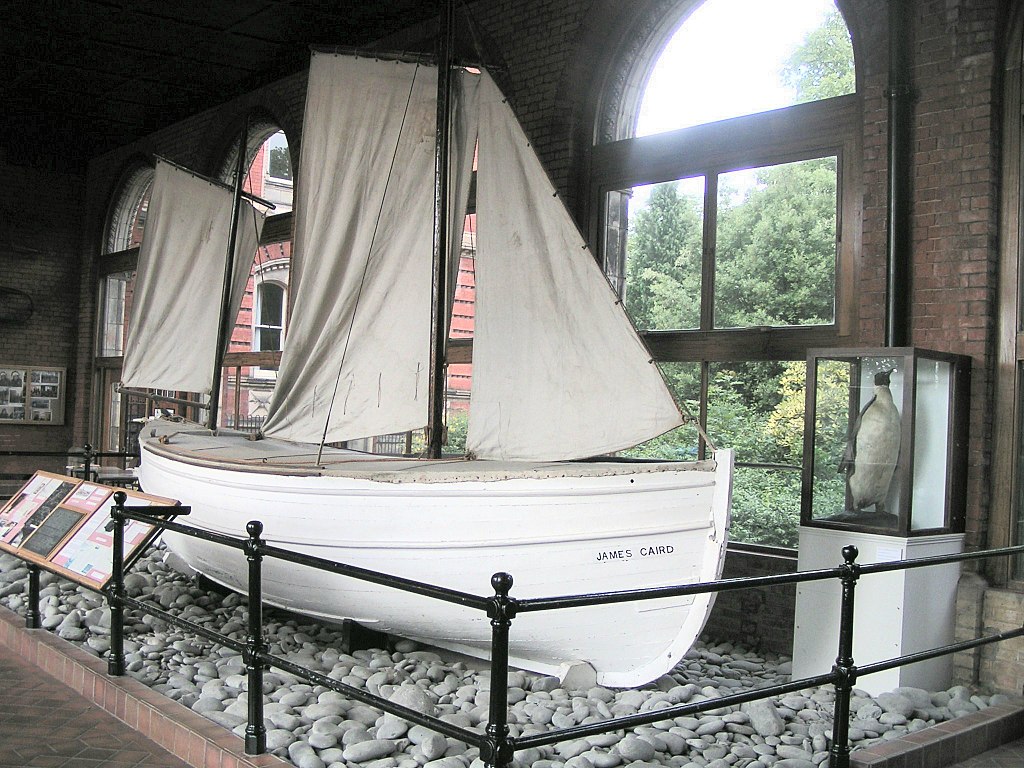
A comparative example is the display of the famous James Caird, a 22.5-foot reinforced ship’s boat from Sir Ernest Shackleton’s expedition ship, Endurance. After the Endurance was crushed by ice in the Weddell Sea, in November 1915, the boats allowed the crew to escape to Elephant Island. Shackleton and two companions pushed on in the James Caird to South Georgia, where they were able to organize a rescue party to return to for the whole crew. The boat is now on display at Dulwich College, South London. Credit: Rumping, Public domain, via Wikimedia Commons
Raising the Terror’s boat is only half of the ambitious plan, though! The cutter is a character-defining element of the overall Terror site. If it is raised to the surface for conservation and display, it would create an absence at the wreck site. Why not replace it with a replica that also memorializes the lost crews? A traditional boatworks in Great Britain, the Canadian Maritimes, or New England could be contracted to create a faithful copy of the craft, to be deposited (or sunk) in situ in the same exact position. It would gradually silt up and decay alongside the wreck, becoming more integrated into the environment and benthic marine ecosystem as the years pass. This new boat could also serve as a kind of benchmark or “canary in the coal mine” for identifying more rapid changes to the site, which may be less evident on the original structures. In the (hopefully distant) future, when the Terror decays, the boat could remain as one of the last wooden elements at the Terror wrecksite. Beechey Island has memorials and the replica wooden gravestones currently marking the earthly remains of three Franklin expedition crewmembers. It seems fitting that HMS Terror could have a replica boat to mark her resting spot. There are also precedents for this. Replica objects deposited at famous wrecks mark removals, and can restore an aesthetic appearance to the site.3 A suitable plaque affixed to the replica boat could help memorialize the lost crews–an underwater cenotaph to the lost men of the Franklin Expedition in an incredibly powerful location. RAISE THE TERROR’S BOAT INDEED!
So, have we persuaded you? Let us know by leaving a comment or sharing!
This description is drawn from the Parks Canada Terror dive tour video linked to above, Matthew Betts’ work HMS Terror: the Design, Fitting, and Voyages of the Polar Discovery Ship, archaeological field reports about Terror prepared by Parks Canada’s Underwater Archaeology Team, and comparative examples of other Royal Navy cutters. ↩︎
A 23-foot boat could also help interpret more positive events, such as when HMS Fury‘s abandoned boats were instrumental in saving Sir John Ross’s entire expedition crew, after the abandonment of their own ship Victory. Elsewhere, it is also the same basic size as the HMAV Bounty’s launch. ↩︎
One example is a proposal to sink a sculpture of a 55-foot long Sea King Maritime Patrol Helicopter on the deck of the artificial reef, the former Canadian HMCS Annapolis, to reincorporate a representation of the destroyer’s helicopter detachment to the site. ↩︎
HMS Terror, Sir John Franklin’s second exploration vessel, was discovered in Sept. 2016. Captain Francis Crozier’s sturdy little ship had vanished seventeen decades earlier. HMS Erebus, the flagship of the lost 1845 expedition, was located in 2014, about 70km south. Franklin’s mission was to have taken them into uncharted waters, to finish surveying a Northwest Passage across the top of North America. Where they went, none could follow.
So many questions about Terror and her lost crew remain unanswered. Archaeology on the incredibly well-preserved wreck is still in the early stages. The yearly dive season is all too short – late August to mid-September on a good year. Underwater Archaeologists are up there right now (2023/09).1 See our earlier post for possible Terror-related archaeological priorities. Here are some questions we have about this fascinating shipwreck:
A. When, why, and how did Terror actually sink? How did Terror get from the point of original Apr. 1848 abandonment by Crozier and the crew, Northwest of King William Island, to a resting spot under the waters of Terror Bay?
B. What documents or artifacts are in the great cabin desk? What other objects are along the shelves there? What is in Capt. Crozier’s bedchambers (behind the only blocked door on the lower deck)?
C. Is Terror’s screw propeller deployed in its trunk, or raised up? Since we know the massive rudder is unfitted and mounted on the ship’s port side channels, this info could help understand Terror’s last movements near Terror Bay, King William Island.
D. What did the stern gallery (windows at stern of ship) really look like and was there any transom decoration?
E. What else is on the seabed, besides the 23-foot ship’s cutter (boat) off the port quarter. The original Arctic Research Foundation 2016 wreck discovery film showed a variety of weird and interesting objects on the seabed.
F. How high do the remains of the masts project above the weather deck? We know the foremast is entirely missing (most likely on the seabed under the bowsprit – see link to last post’s multibeam sonar video clip)
G. Since the wreck and debris are highly localized, are there any significant timbers or structures missing, that suggest damage or removal by the crew?
H. What condition are the lowest decks in? How much provisions and fuel remain aboard?
I. Are there any human remains on the ship? (either the wreck is a tomb to members of its crew, or it is a powerful site of remembrance of those departed explorers)
It’s seventeen long decades since these ships of fame Brought my Lord Franklin across the main, To Baffin Bay where the whale fish blow The fate of Franklin no man may know. (Adapted Lady Franklin’s lament trad.)
Early indications suggest the balance of September 2023 archaeology has again prioritized Erebus. ↩︎
“Who knows what lies behind that closed door!” (R. Harris, Parks Canada, 5 Sept. 2019) As this year’s underwater archaeological season commences on the Sir John Franklin 1845 Expedition shipwrecks, HMS Erebus and Terror, we highlight what we believe to be an important description of the incredible condition of the shipwreck of Terror, discovered September, 2016.
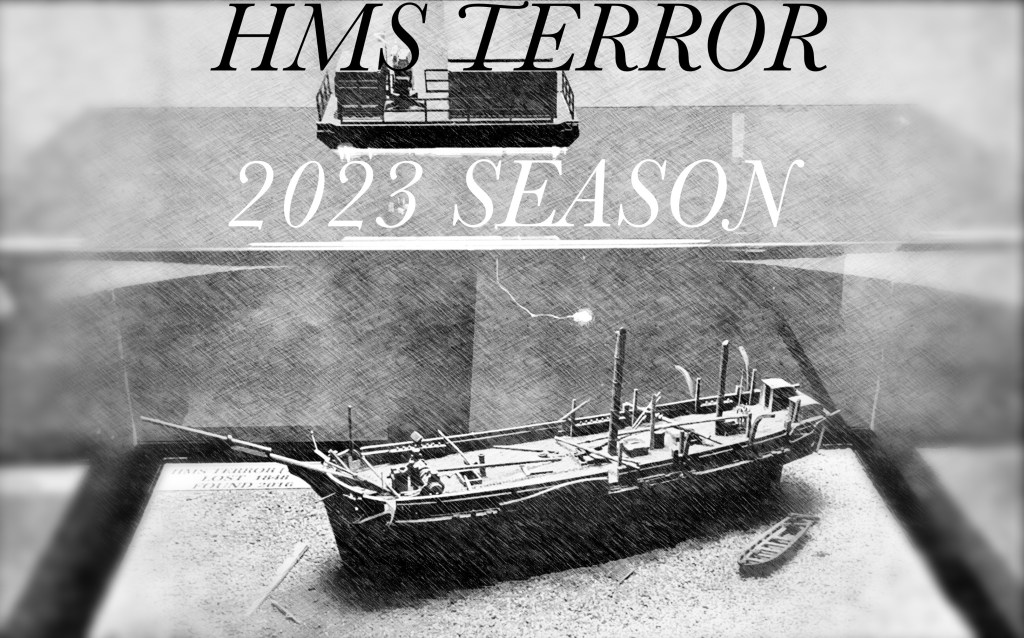
Model diorama we constructed during 2022 which was inspired by the sources of information discussed below.
The most detailed public statement regarding the condition and archaeological plan for HMS Terror that we are aware of remains Ryan Harris’s 5 September 2019 comments to visitors onboard Parks Canada’s Research Vessel, David Thompson.1 It is an authoritative and concise description of Terror, from an experienced underwater archaeologist who has significant dive time on both Franklin wrecks. (There is more context about the vessels mentioned in this post from our 2022 update)
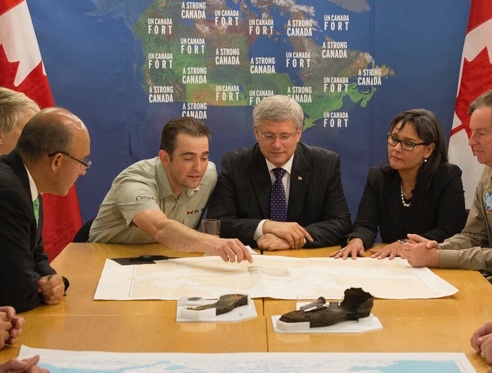
Ryan Harris (left), Parks Canada project lead, alongside Prime Minister Stephen Harper (center) and Minister of the Environment Leona Aglukkaq, announcing the discovery of HMS Erebus 9 Sep. 2014 [cropped]. Credit: Jason Ransom Library and Archives Canada R16093-50252-9-E.
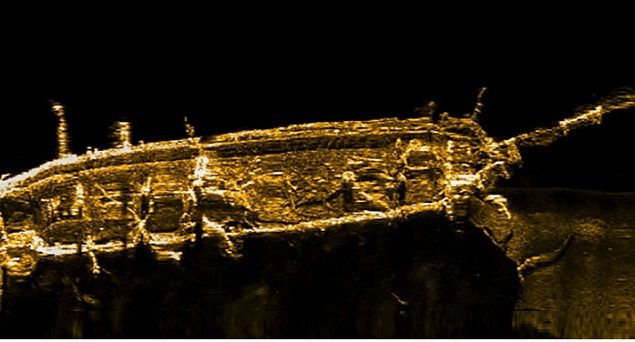
Harris was recorded by Adventure Canada crew members or passengers during the first (and thus far only) visit of members of the general public to the Wrecks of HMS Erebus and HMS Terror National Historic Site. This was included in a remarkable video with other clips featuring Marc-André Bernier, veteran underwater archaeologist, and other Underwater Archaeology Team (UAT) members. Site sketches and multi-beam sonar of both wreck sites made jaw-dropping cameo appearances.
A sonar image of the HMS Terror wreck, ca. 2017, which was similar to one of the images in the film. credit: Parks Canada, Crown Copyright source.
The film was uploaded to the company’s YouTube account and was also featured in Bunny Laden’s blog post “A Visit to the Wrecks of the HMS Erebus and HMS Terror National Historic Site of Canada” released on Adventure Canada’s site eleven months later. The lucky participants from the Northwest Passage cruise onboard MS Ocean Endeavour had been able to board the dive support barge, Qiniqtiryuaq, which was anchored near the wreck of Erebus. They also explored David Thompson. Harris spoke candidly about Terror, and also the plans for the 2020 archaeology season. After the heady days of 2019, events (The Covid-19 Pandemic and an increasing concern about Erebus’s fragility) caused the postponement of these best-laid plans. Rumours have circulated that this year’s archaeological season, which appears to have started, may involve asignificant return of the archaeologists to Terror.
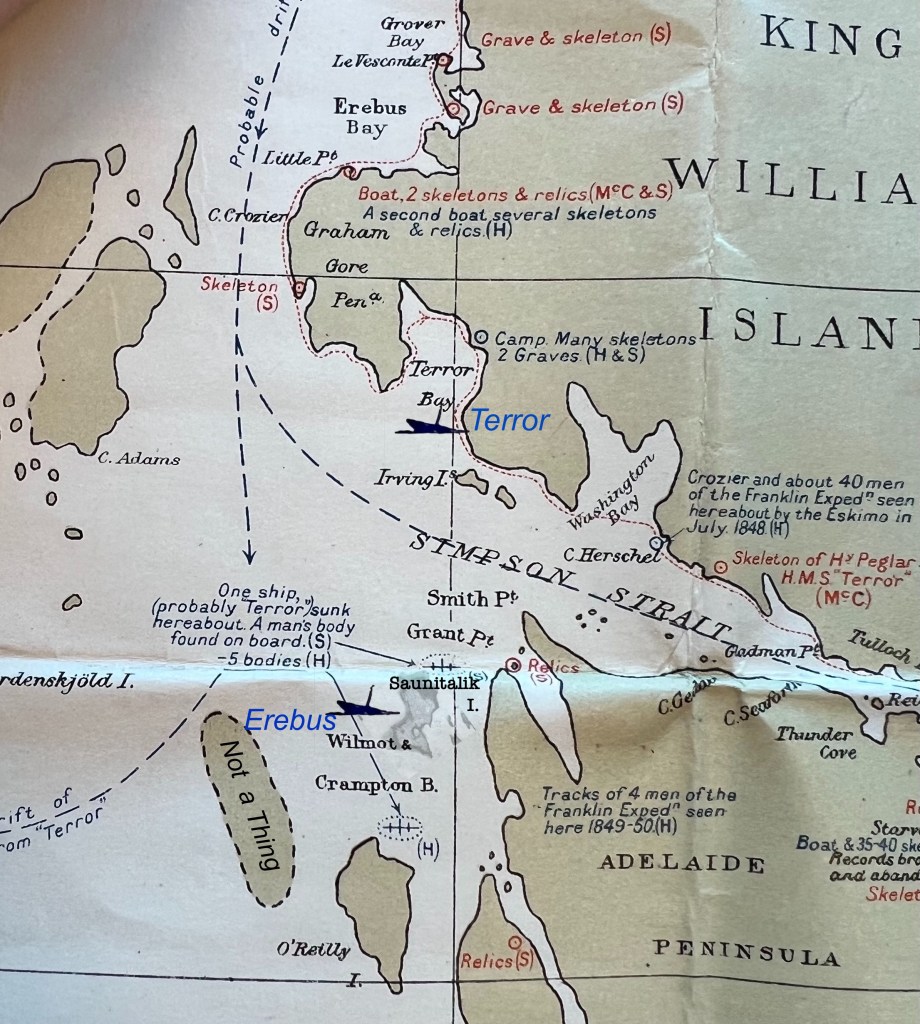
1927 Gould Admiralty Map, which listed Franklin-related discoveries and conjecture about the ships up to that time [modified with several updated locations, including the approximate wreck locations and geographic features]. Credit: Library and Archives Canada May Fluhmann fonds MG31-C3 vol.1
Harris’s statement is important, so we transcribed it to the best of our ability, and encourage readers to visit the hyperlinks to see what he was referencing:
This is another multibeam image that we collected just a few days ago in Terror Bay. This is the other ship, HMS Terror, and you can probably readily see that this is in really really good condition, even better than the Erebus. It’s essentially completely intact. So it has all kinds of structures sticking up, including davits, these suspended the various boats, and raised and lowered them over the side. We still see masts standing to a certain height, sheared off about 10 feet in the case of the mainmast, above the deck. And along the centerline are various openings in the upper deck, including the forward companionway down to the focs’l. (BREAK)
And those openings, even though they are sometimes skylights with all the panes of glass still intact, we’re able to insert that Remotely Operated Vehicle you may have seen on the dining room table here, into, on several different occasions, and we’ve explored 90% of the lower deck just a few days ago. If you have seen the Youtube video [link], a lot of that footage – some of the good stuff!
The only cabin or compartment we couldn’t access was Captain Crozier’s bedchamber. So tantalizing – behind the only closed door on the ship that we haven’t seen – so who knows what lies behind that closed door! But you peer down the corridor with the ROV and you can see the list of the ship, because the ROV rights itself naturally…and through the darkness you see the lights penetrating, and then a succession of cabin doors, all sliding doors all open, and we went in one after the other…probably twenty different times -every single cabin except for that one – open. And you could see an incredible array of artifacts all in situ, chamber pots below the beds, washbasins on the shelves, muskets attached to the wall ready for action, ceramics, the plates for the different mess groups, showing different ceramic patterns mess group by mess group…little cradles that are in the sick bay, which are the sick beds…just a wondrous array of artifacts that are going to be documented in the years to come.
So the plan for next year is to basically take that barge, anchor it over the Terror, and do the same thing but with the surface-supply diving equipment, the hats and umbilicals and we’ll go inside and we’ll go cabin by cabin and learn what we can.
Ryan Harris, Parks Canada, Adventure Canada 5 Sep. 2019 interview (loaded on Youtube).
A 2017 plan of HMS Terror wreck site released by Parks Canada and uploaded to their site in late 2021. Credit: Parks Canada, Crown Copyright source.
We hope that that plan comes to fruition in the next few weeks and that this is a productive season for exploring the always astonishing, barely-wrecked ship of wonder, HMS Terror!
Another essential description of the wreck is the epilogue “The Discovery Vessel Herself Discovered” that concludes Matthew Betts’ recent book, HMS Terror; the Design Fitting and Voyages of a Polar Discovery Ship (Pen & Sword 2022). The authors of the foreword, Ryan Harris and Jonathan Moore, UAT Manager, note that Betts provides a summary of Parks Canada’s findings up to publication. ↩︎
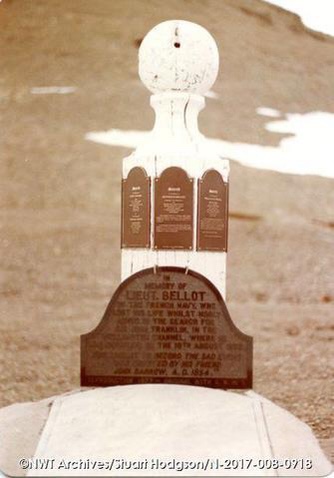
One of the remarkable monuments at Beechey Island, connected with the searches for the Sir John Franklin 1845 expedition, is the “Franklin Cenotaph.” It may be the oldest cenotaph – an incredibly early example of a memorial that commemorates sailors individually by name – in Canada. This distinctive monument is located inland of the ruins of Northumberland House and the fallen mast of Sir John Ross’s yacht Mary. Beechey Island is an isolated, barren place, just off the southwest coast of Devon Island, in the High Arctic, in present-day Nunavut. It had been the site of the Franklin Expedition’s first winter encampment, when HM ships Erebus and Terror had sought shelter here in 1845 and been frozen-in. In 1846, before the ice released the ships, three members of the Expedition were buried just up the beach. The area later became prominent as a staging base/supply depot in the expeditions sent to try and ascertain the fate of Franklin and his crews. Today, this incredibly remote 170-year old cenotaph serves as a lasting memorial to the human cost of these efforts.
The monument, ca. 1978. Credit: NWT Archives/Stuart M. Hodgson fonds/N-2017-008: 0918
A brief description of the monument could be: A column now white but sometimes black, in the form of an octagonal piece of ships’ machinery, affixed with plaques, with a larger one predominating, surmounted by a large finial (ball), the column is preceded by a marble slab on an angled concrete base, with the whole raised on a small platform of cemented limestone. The Belcher column, Bellot’s monument AND Lady Franklin’s memorial plaque have a unique history, like many other relics, ruins, graves, and wrecks at Beechey. This composite monument, often simplified to “the Franklin Cenotaph,” was begun in June 1854 by the crew of HMS North Star, under the command of W.J.S. Pullen. Its original intent was to honour sailors who had perished in the great efforts to locate the crews of Franklin’s vanished ships. North Star was serving as a depot and stores vessel for the larger Royal Navy search effort, Sir Edward Belcher, commanding.
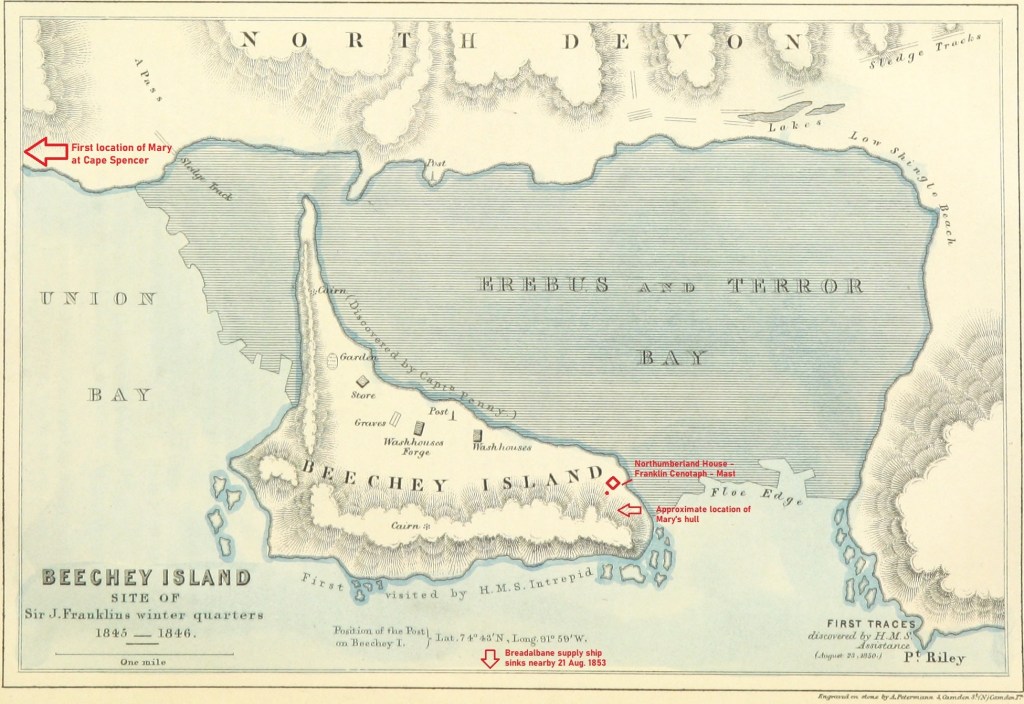
Map of the 1845-46 Franklin Expedition sites, and a record of their discovery[annotated with approximate locations of some sites mentioned in this post, including the cenotaph, located just behind the square Northumberland House] The British Library, “Papers and Despatches relating to the Arctic Searching Expeditions of 1850-51. Together with a few remarks as to the probable course pursued by Sir John Franklin, etc. [Compiled by James Mangles. With maps.(London: 1851)] No restrictions, via Wikimedia Commons
This new “Belcher column” adhered to the classical definition of a cenotaph: It memorialized the dead without being a burial site. By commemorating enlisted personnel – sailors and marines – it was also incredibly rare for its time.1 Small plaques on each face of the column identify 13 deceased members of HM ships Investigator, Resolute, Assistance, Intrepid, whose remains were buried elsewhere.2 These men are not all commemorated in the same manner; some entries are descriptive, some employ religious passages, some are brief.
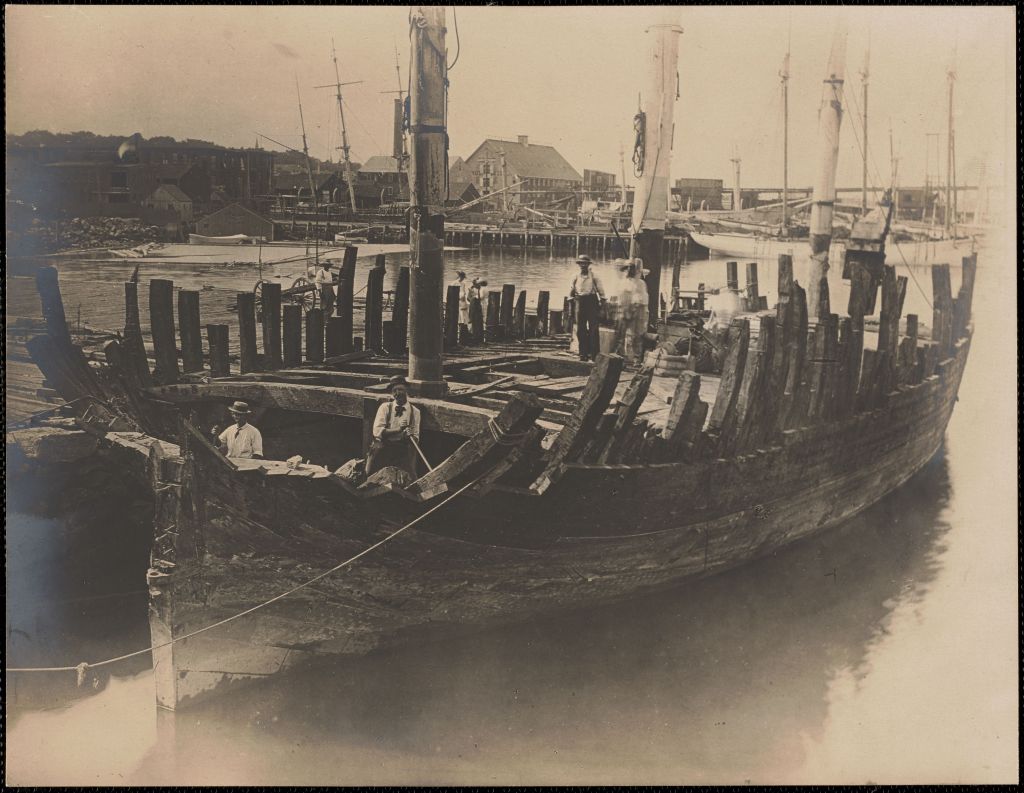
The column was reportedly made out of the interior section (the spindle) of the capstan of the American whaling ship McLellan. McLellan had been lost two years previously, on 8 July 1852 on the way to Arctic whaling grounds, in Melville Sound, when it and a fleet of British whaling ships had been frozen in pack ice, alongside Belcher’s small Royal Navy squadron, then journeying up to begin the search. McLellan had run afoul of North Star. It was then crushed by fast moving ice. The vessel must have remained on the surface or pinned to the ice for some time, as much seems to have been salvaged. McLellan’s spars would also be a source of timbers used to construct Northumberland House, the large storehouse constructed soon after the ships got to Beechey.3
Dismantling the very old whaling ship Rousseau at New Bedford MA, ca. 1893. This shows many of the spars, masts, timbers, and other materials that would have been sourced from the similar ship McLellan, that were used in Beechey Island construction projects. note the crews are down to the level of the lower deck, and the vessel is still afloat with intact coppering! Credit: Joseph G. Tirrell 2012.008.0055, Digital Commonwealth (CC BY-NC-ND)
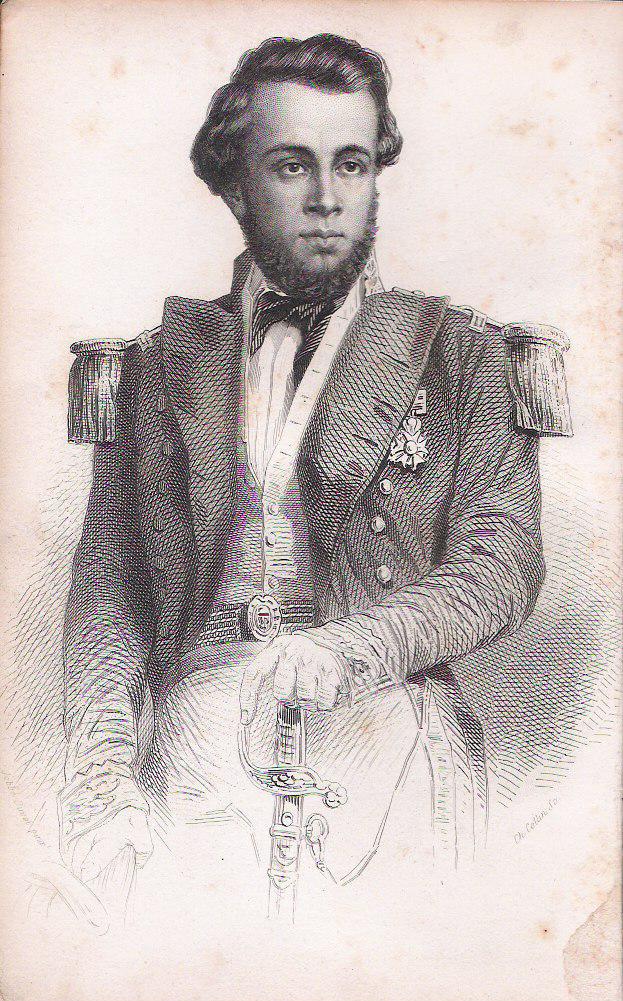
The second major component of the monument was added later that summer to memorialize Lt. Joseph-René Bellot. Bellot, an officer of the French Navy, had accompanied Captain Edward Augustus Inglefield, commanding HMS Phoenix, on the same 1853 journey to resupply Belcher’s ships that resulted in the loss of the Breadalbane supply ship nearby.
Portrait gravé sur acier de l’explorateur français Joseph-René Bellot (1826-1853), en tête de son ouvrage Journal d’un voyage aux mers polaires à la recherche de Sir John Franklin, introduction de Paul Boiteau, Paris, Perrotin, 1866.Credit: Wikinade, CC0, via Wikimedia Commons
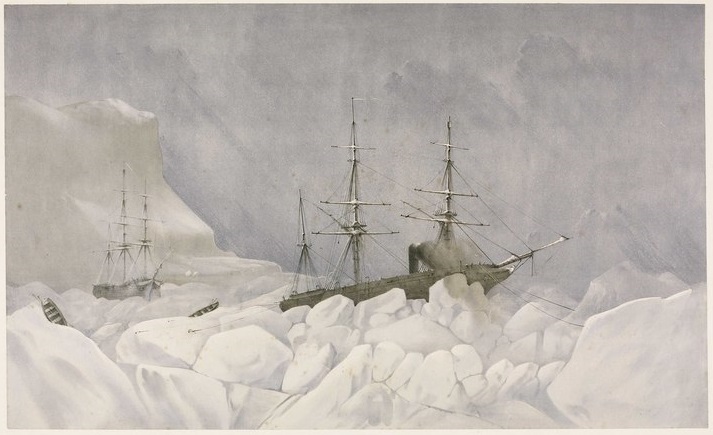
Bellot was a seasoned Arctic explorer who had already been out as second in command on the 1851 William Kennedy expedition. He was respected and admired by his comrades. As Phoenix and Breadalbane were driven away from Beechey, in a gale, he had volunteered to brave the ice and elements to carry despatches north to Wellington Channel, to deliver them to Belcher. Bellot disappeared 18 August, when the ice suddenly opened around him. This loss was felt deeply by the searchers in the Arctic.
HMS Phoenix, with Breadalbane supply ship behind on 18 Aug. 1853, in the same perilous conditions that Bellot, transporting despatches, was lost in. Credit: Admiral Sir Edward Augustus Inglefield, Public domain, via Wikimedia Commons
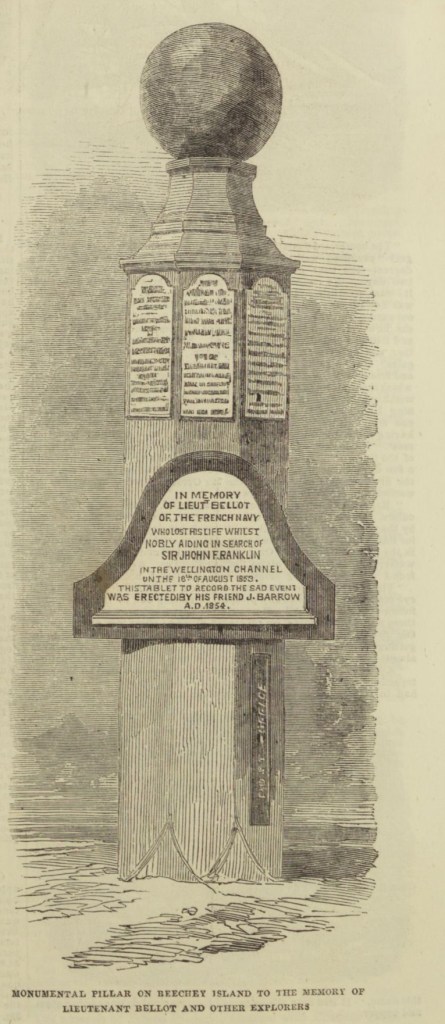
In August 1854, when Inglefield returned to the Arctic on the next resupply effort, he brought up a plaque dedicated to the memory of Bellot to be added to the Belcher column. The plaque had been commissioned by an important friend, Sir John Barrow, (Second Secretary at the Admiralty and the second Barrow heavily involved in polar exploration) and was cast in a headstone-like shape.
The monument as it appeared soon after construction, with the Bellot plaque, whose text is legible here, mounted low on the front face. The Illustrated London News, 28 October 1854[detail of] Unidentified engraver, Public domain, via Wikimedia Commons
Francis Leopold McClintock’s search expedition of 1858 brought up the last major addition to the monument: A large marble slab commissioned by Lady Jane Franklin, Sir John Franklin’s widow. The marble was inscribed with text dedicating it “To the Memory of Franklin, Crozier, Fitzjames, and all their gallant brother officers and faithful companions…” This, aptly, concluded the memorialization program on the monument by incorporating the lost explorers into the monument to the lost searchers of those explorers. The marble was to have been brought north in 1855 by an American expedition looking for Dr. Kane, commanded by Lt. Henry J. Hartstene. That expedition turned back when they located Kane, so the plaque waited at Disko, Greenland, for three years. McClintock’s expedition routed it on up (with an additional small plaque added to reference this) and deposited the marble flat on the ground in front of the column.
One of the original oddities of the monument is the metal “Post Office” letterbox panel affixed to a rear surface. Despite the prevalence of seances in Victorian England, this was not intended as a correspondence box to the lost, to communicate with the spirit world. According to an October 1854 London Illustrated News article, which featured a sketch of the monument, this letterbox was actually functional, intended for future visitors to leave letters as a receipt of having visited the Island.
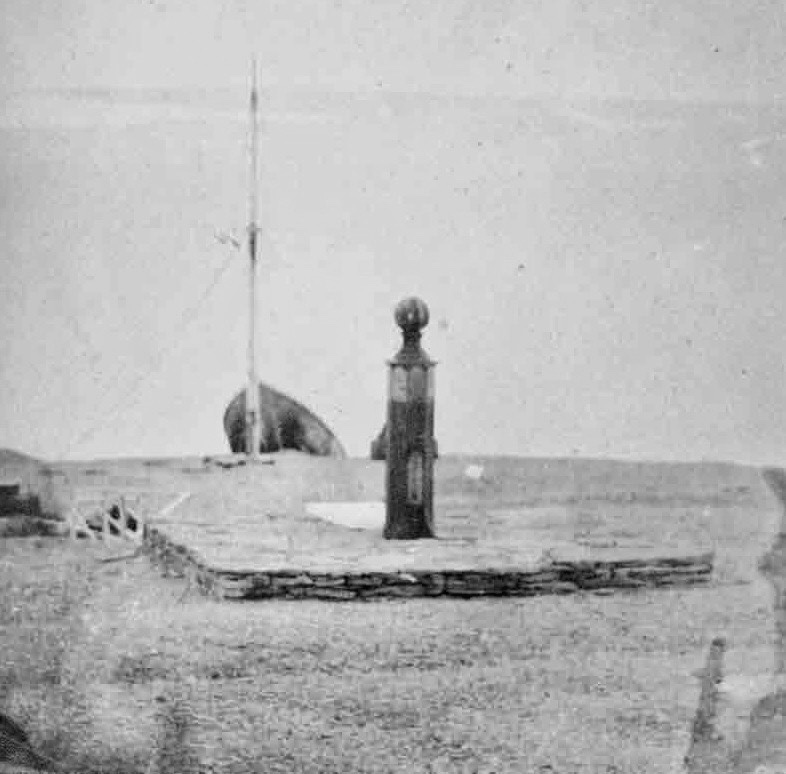
Lt. Allen Young’s 1876 photograph of the monument, looking towards the beach at Beechey, with Lady Franklin’s marble on the ground and the post office plaque on the lower rear face. Credit: Allen Young “Cruise of the Pandora” (London, 1876) Page 43. Public domain via Library and Archives Canada 1984-109 NPC
In 1876, Allen Young, in HMS Pandora, revisited Beechey’s lonely shores. He had last been there while serving as Navigator on Fox, McClintock’s ship. He took a valuable photographic record of the site that was incorporated into his published journal.4 At this time the monument was painted black. Young described opening the letterbox on the monument to retrieve a single document. Pen pals were in short supply at Beechey, and the only contents were a memo left by Belcher more than two decades before.
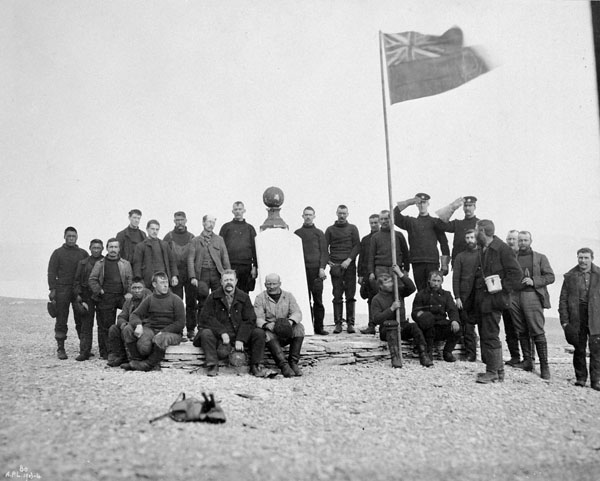
The cenotaph, like so many other relics, wrecks, and remains at Beechey, seems to have mostly escaped the ravages of time. A half-century after its installation, in August 1904, the Canadian ship DGS Neptune visited Beechey, as part of the Dominion Government Expedition, A.P. Low commanding. This visit saw expedition members raise the marble plaque for a photograph and then reorient it to face upwards (Low’s interesting description of Beechey and the cenotaph is in this 1906 report). At this time a flagpole may have been installed at the rear or very near the monument.
The Dominion Government expedition’s visit to the memorial, 15 August 1904. A.P. Low describes how they found a note from the previous year in a sealed case attached to the rear of the cenotaph, left by Roald Amundsen, whose ship Gjoa was unlocated at this time. The note was forwarded to the Norwegian government. Credit: Albert Peter Low / Library and Archives Canada / PA-053580
During the 1922-23 visit to the monument, on one of Captain J.E. Bernier’s yearly voyages/sovereignty patrols north in CGS Arctic, the marble appears to have been set into a more secure and aesthetically pleasing angled concrete base. The head of the marble now rested just under the Bellot plaque. Other than the removal of the flagpole, and the application of white paint, the memorial has remained substantially unaltered since then. It continues to stand tall in a lonely vigil at Beechey, down through the decades. Today, the Franklin Cenotaph is a powerful site of memory connected with the search for the Northwest Passage, and an important tribute to the men who died far from home looking for lost comrades.
Capt. Bernier, CGS Arctic, with other crew at the Franklin Cenotaph, 1923. Credit: Library and Archives Canada R216, Vol. 14946, p54.
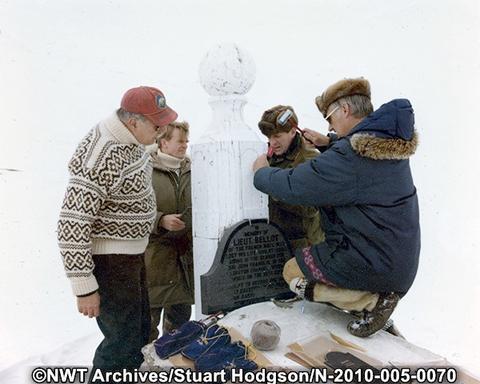
Northwest Territories Commissioner Stuart Hodgson (at left – the creator of the Franklin Probe, a maritime historian and a Canadian naval veteran) and others help replace the Cenotaph plaques with replicas during a July 1978 visit.
This cenotaph may even be unique on Canada. We have never heard of one that commemorates not just senior officers but the regular sailors and marines of military ships, erected before the 20th century. A hundred years earlier, the terrible loss of more than a thousand officers and enlisted men, when HMS Victory (1737-1744) sank in the English Channel, had resulted in the kind of traditional commemoration to the leader, Admiral Sir John Balchen, at Westminster Abbey. The oldest naval monument now located in Canada is Montreal’s Lord Horatio Nelson column (constructed 1809).↩︎
Thomas Morgan of HMS Investigator, who died 1854-05-22 onboard North Star, is buried nearby with the three original Franklin crewmembers. Aside from Morgan and Bellot (who is commemorated twice on this monument), the other members of search crews memorialized on the column (with their ships and dates of death) are: William Cutbush HMS Assistance 1853-02-27; Isaac Barnett HMS Assistance 1854-01-28; George Harris HMS Assistance 1854-01-09, John Ames, HMS Investigator 1853-04-11; John Boyle HMS Investigator 1853-04-05; H.H. Sainsbury HMS Investigator 1853-11-14; Thomas Mobley HMS Resolute 1852-10-19; George Drover HMS Intrepid 1852-12-12; John Coombs HMS Intrepid 1853-05-12; Thomas Hood HMS Intrepid 1854-01-02; John Kerr HMS Investigator 1853-04-13; James Wilkie HMS Intrepid 1854-02-2. These names can be verified at Maritime Memorials at RMG.↩︎
Brian D. Powell Polar Record 42 Issue 4 provides a detailed summary of the construction of this and other monuments at Beechey, and there is still more work to do on the commemorative intent of the various monuments. Other evidence for the source of the Belcher column, the whaling ship McLellan, is found in Barr and Stein’s January 2017 article “Frederick J. Krabbé, last man to see HMS Investigator afloat, May 1854” Journal of the Hakluyt Society. We have usually encountered spindles with ten or more sides as part of naval capstans.↩︎
Young had been sent in HMS Pandora to aid the 1875-76 British Arctic Expedition, which encountered many difficulties. Young’s ship, a reinforced gunboat, would be acquired as USS Jeanette for the Grealy expedition, which ended in more shipwreck and tragedy. His account The Two Voyages of the Pandora ; 1875-76 has a chapter (pp. 43-46) about Beechey with a brief description of the letter box, Northumberland House, the Mary yacht left by Sir John Ross, and other boats on the site: https://archive.org/embed/cu31924091208565↩︎
One-hundred-and-seventy years ago today, a ship was dying, incredibly far North. Early on 21 August, 1853, ice suddenly penetrated the Breadalbane’s cargo holds, where vital supplies had been stored a few days previously. The crew scrambled away to safety. The ship sank like a stone in 330’ of water. All these years later, what remains of this relic of the great searches to find the lost Sir John Franklin Expedition? What if today we had the technology to “Drain the Barrow Strait” (to borrow a National Geographic-inspired dramatic device) and check up on Breadalbane? Well, on this important day, we are doing just that – in reduced scale!
“A ship above and a ship below”–The wreck diorama accompanied by a contemporary view. E.A. Inglefield’s illustration of HMS Phoenix towing the ship, Credit Library and Archives Canada mikan 2837866 AND http://www.warsearcher.com
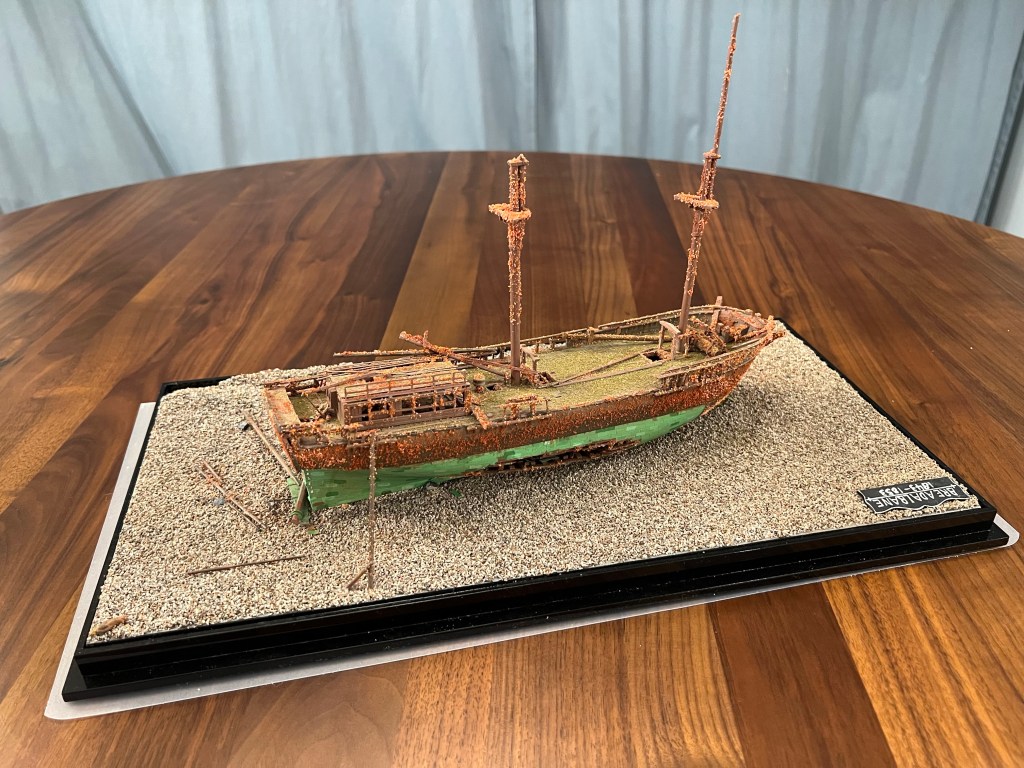
This third post will show our construction of an archaeologically-inspired scale diorama of the Breadalbane wreck site–part of the Beechey Island National Historic Site of Canada. The first post summarized the loss of this supply ship in the High Arctic in Aug. 1853, while provisioning search expeditions looking for the Franklin Expedition. The second post described the original 1980s discovery and exploration of the wreck. A fourth post continues to explore the wreck based on Parks Canada’s 2014 visit.
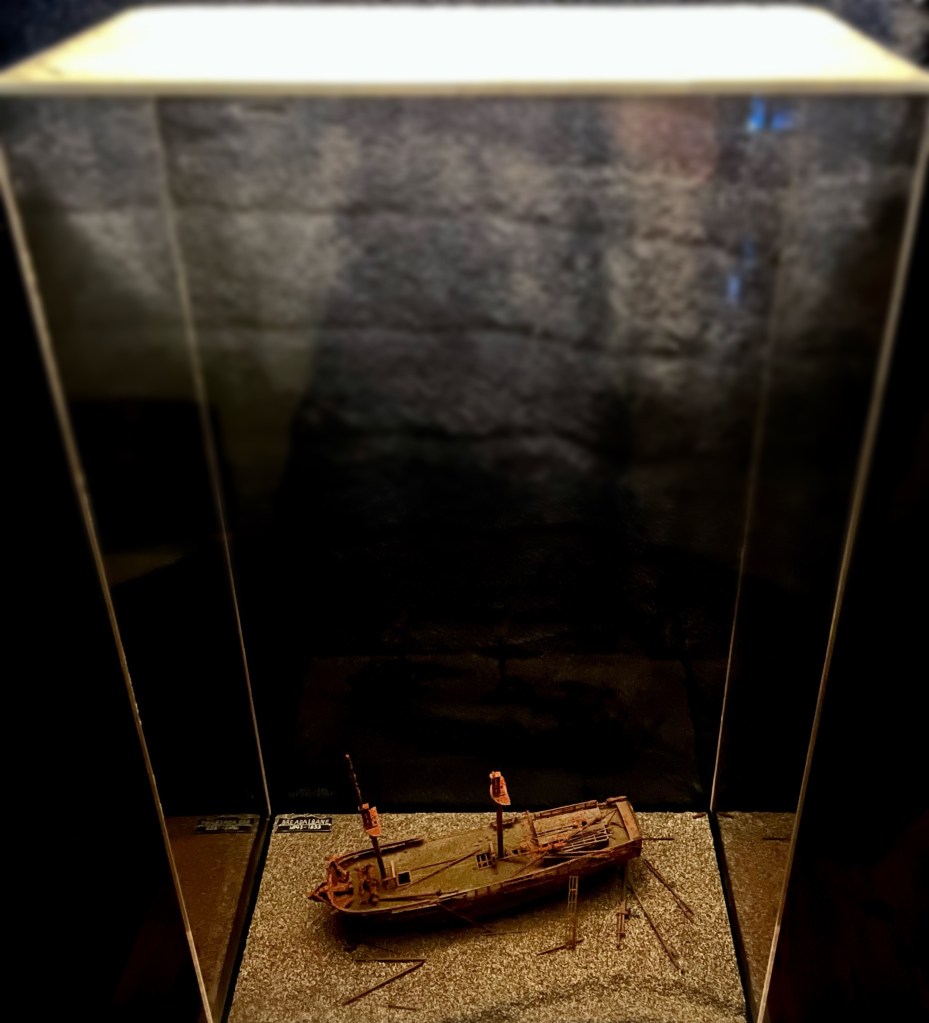
330” scale feet–or 28 inches–under snow and ice, lies the Breadalbane model, represented at her 1980 moment of discovery. Credit: http://www.warsearcher.com
Following on from our work on an HMS Terror diorama during 2022, we had the idea to build Breadalbane after seeing the state of preservation and the incredible marine life populating this remote spot, south of Beechey Island, Nunavut. Photos and video from the original 1983 expedition and the 2014 check-up (the 1984 National Film Board documentary and the contemporary Canadian Broadcasting Corporation 2014 coverage and clips) show a riot of colour in the dark, freezing waters off Beechey.
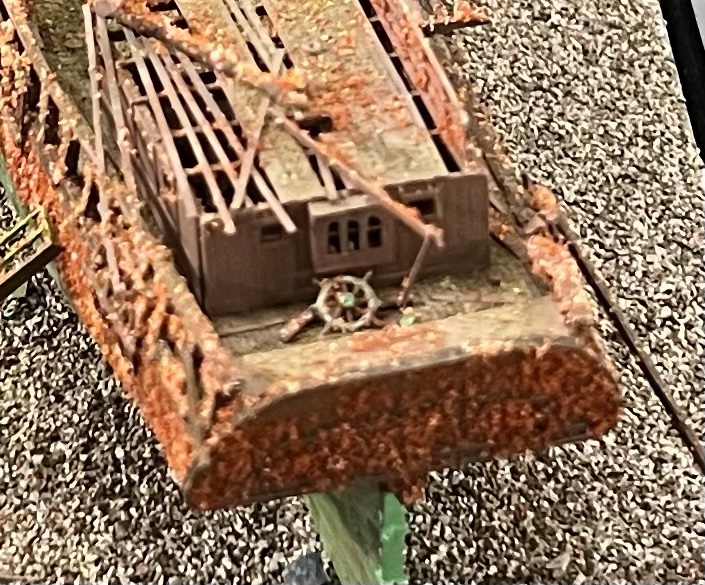
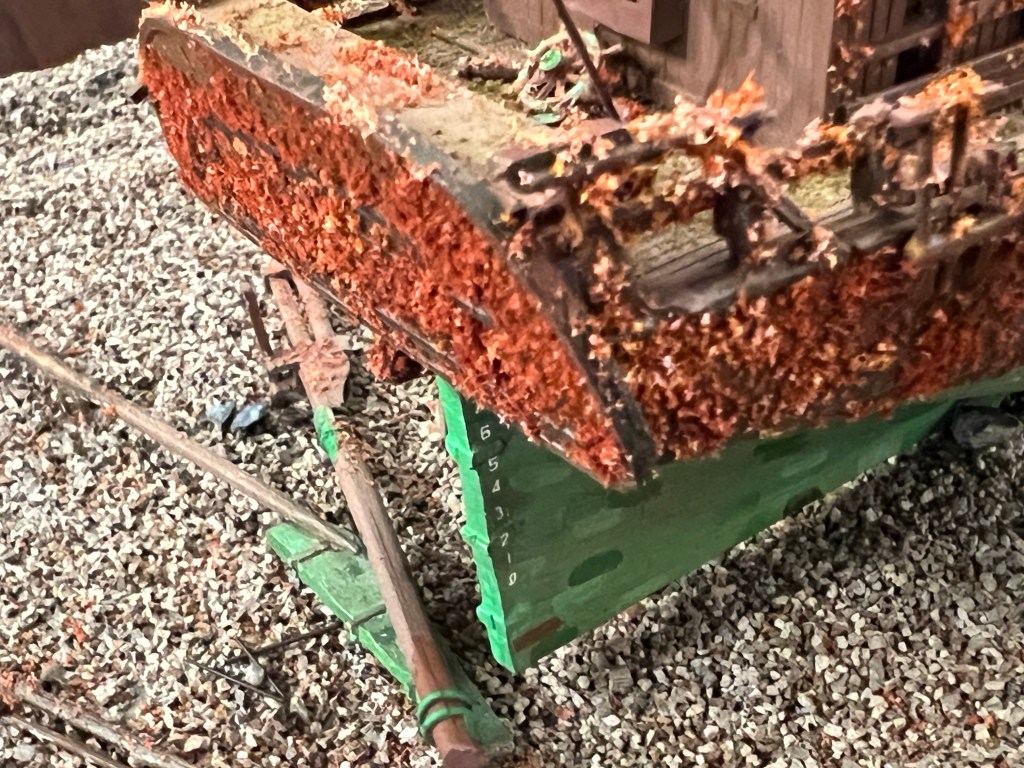
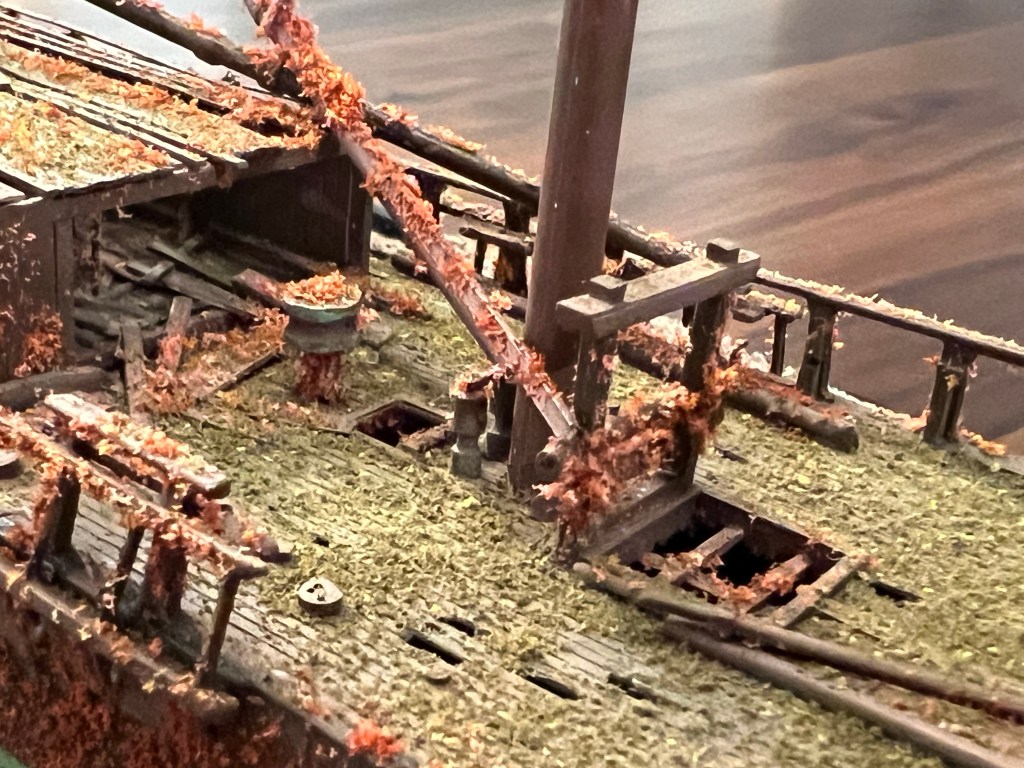
In addition to the binnacle cabinet and ship’s wheel, a site of importance to the 1980s explorations, the transom has been represented with three closed scuttles, which both C.A. Inglefield’s and another contemporary illustration of the sinking show. Credit:www.warsearcher.comDraft marks are present climbing up the stern post, with the fallen rudder and lower mizzen mast underneath. The stern post is perched a few feet off the hard bottom. Credit: http://www.warsearcher.com.The main cargo hatch, mainmast, pumps, companionway leading down to the aft portion of the lower deck, the ship’s capstan, and the open forward face of the deckhouse. The model also has detailed interior areas of both the lower deck and main hold, which may be explored in a future post. Credit: http://www.warsearcher.com
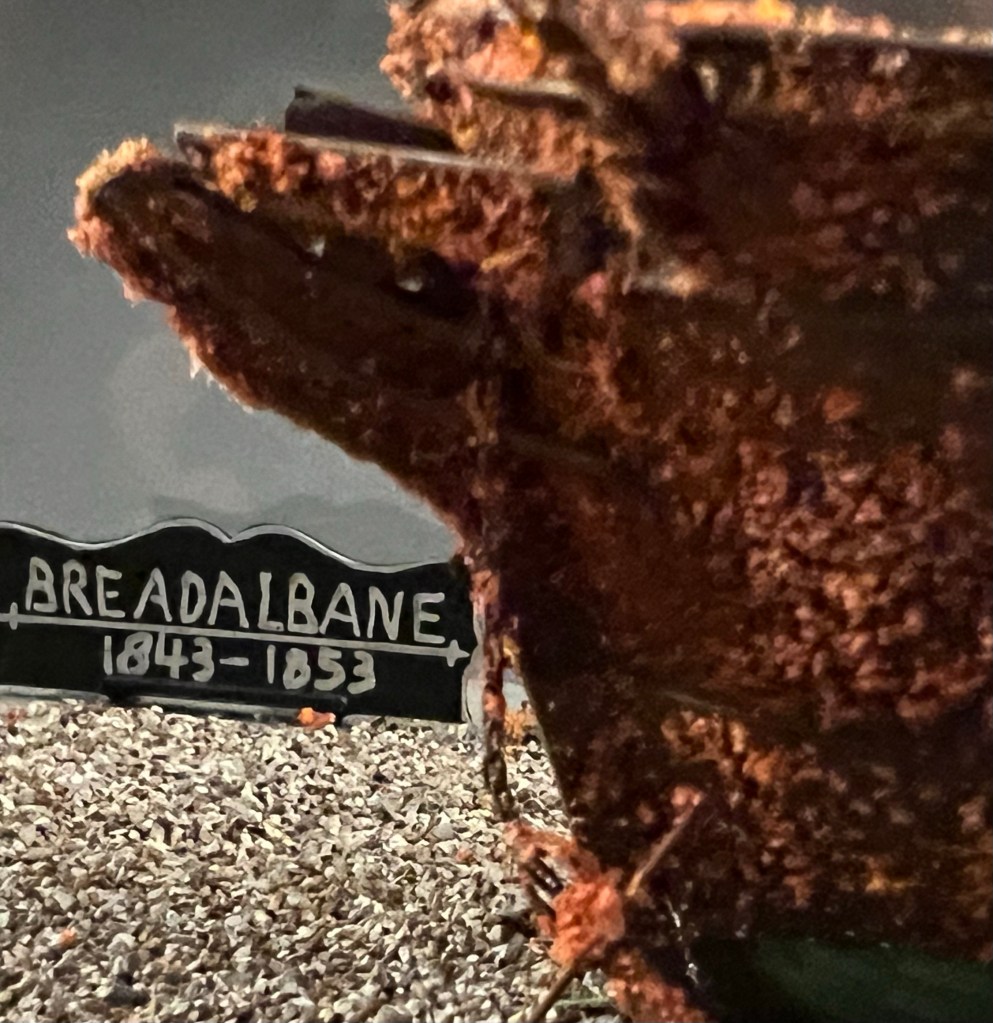
The Breadalbane was a casualty of Beechey Island’s local conditions, like the three Franklin crewmembers (and one HMS Investigator member) buried nearby, so we gave the diorama a nameplate inspired by the original 1840s-1850s appearance of the Beechey gravestones: Black board with white lettering.
The model’s bows, showing the placement of the port Bower anchor, and the damaged bowsprit and head rails. The beginnings of the copper cladding are damaged at where the stem meets the keel. Credit: http://www.warsearcher.com
The diorama was originally conceived of as an engaging way of interpreting the information gathered about the wreck by Dr. Joe MacInnis’s 1980s team and by Parks Canada’s visits to the wreck site 2012-2014. We owe both teams a debt of gratitude for supplying us information, and would like to reiterate the acknowledgements from the first post. We are not done with Beechey, or rather Beechey is not nearly done with us. Spare this sunken, beautiful barque a thought today, and stay tuned!
-September 2025 update: This diorama placed First in the category of Maritime Dioramas at the Scale Plastic Model Contest in Ottawa, Canada.
The starboard side, showing the deckhouse, and the enormous hole in the ship’s bilges. At the very left corner of the diorama, we chose to represent Breadalbane’s female figurehead, resting on the seafloor. This feature appears to have been sheared off during the sinking, and has not been found. Credit:www.warsearcher.com
This second post will focus on the 1980s discovery and explorations of the incredibly intact wreck of Breadalbane off Beechey Island, Nunavut. The first post summarized the loss of this supply ship in the High Arctic in Aug. 1853, while resupplying search expeditions looking for the Franklin Expedition. The third post shows our construction of an archaeologically-based scale diorama of this National Historic Site of Canada.A fourth post explores the wreck based on Parks Canada’s 2014 visit.
The Breadalbane wreck diorama, built in 2023, represents the wreck at a scale depth of 330’ as it appeared before its 1980 discovery. This will be the subject of a future post. Credit:www.warsearcher.com
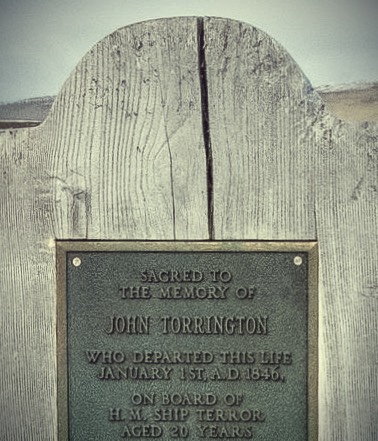
On August 17th, 1984, Anthropologist Owen Beattie, looking for evidence of what went so terribly wrong with the 1845 Franklin Expedition, exhumed the body of John Torrington, a stoker from HMS Terror who had been buried almost fourteen decades before at Beechey Island, in the Canadian Arctic. Torrington had been one of the first to perish, on New Year’s Day, 1846. He was buried at the site of the first winter encampment of HM Ships Erebus and Terror. When photos were released of his body, newly exhumed from a frozen coffin, the public was shocked, fascinated, and a little horrified. This early-Victorian sailor appeared to have barely decayed!
John Torrington’s grave marker. This is a replica placed here in 1993 when the original marker was moved to the Prince of Wales Northern Heritage Centre. Credit: Gordon Leggett via wikimedia commons [cropped and edited]
The state of preservation should not have been so surprising: remains and relics of Arctic exploration located at Beechey just don’t seem to deteriorate as we would expect! A few years earlier the wreck of the supply ship Breadalbane had been discovered nearby. Like Torrington and the shipmates buried alongside him, Breadalbane was also “Frozen in Time.”1
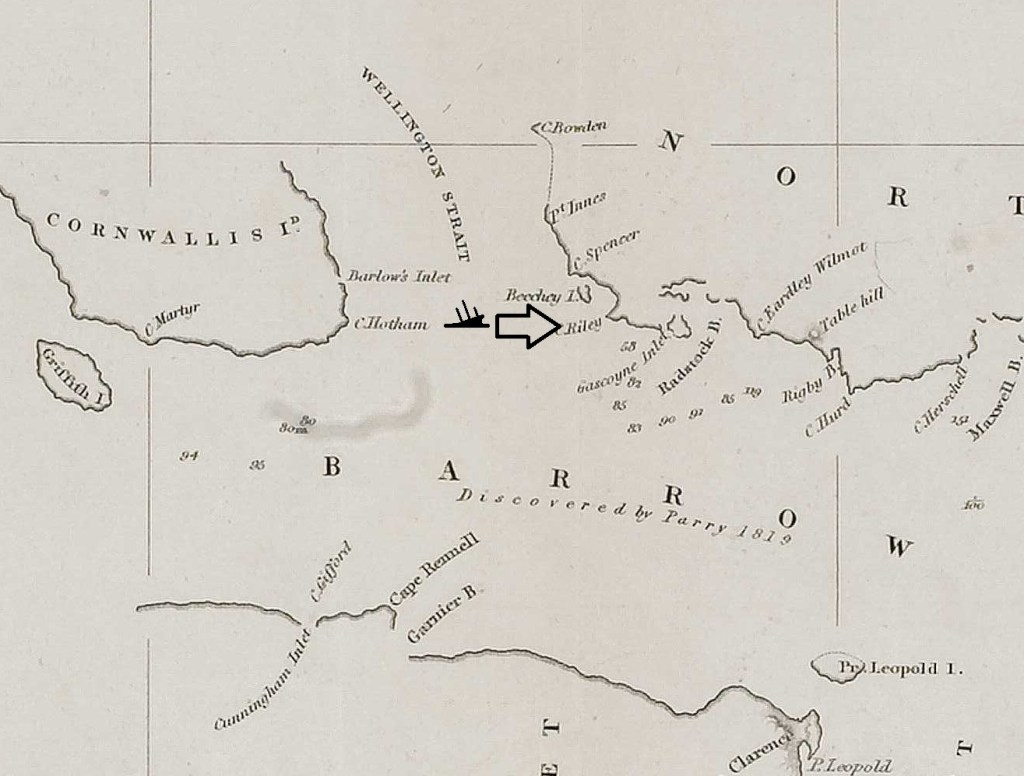
Map of the Arctic portion of North America, with the state of surveying just before the Franklin Expedition set off. [cropped and annotated with rough location of Breadalbane sinking] HM Admiralty; J. & C. Walker, Public domain, Royal Museums Greenwich via Wikimedia Commons
In most other bodies of water on Earth, a 130-year old wooden shipwreck would be a pile of debris and ballast stones, with scattered cannon, decayed timbers and remnants of cargo, copper and rusted metal left to hint at its past size and shape. The naval shipworm (toredo navalis – a pernicious little species of clam) devastates wood, devouring wooden hulls, masts, and deck structures within a dozen or so years. In the High Arctic, as in the waters around Antarctica, and a few inland lakes and seas, the shipworm has no dominion, and wrecks remain as silent sentinels of past eras of trade, warfare, or exploration.
As the lost ships and vanished 129-man crew of the Franklin Expedition lived on in the popular memory, the related story of the ship that sank at Beechey in 1853 was completely forgotten. During the 1970s, Dr. Joe MacInnis, a Canadian who was pioneering new undersea medicine and diving technologies, began looking into Arctic shipwrecks, with the idea of a search that could also be a test bed for new undersea equipment. Using archival sources from the Scott Polar Research Institute, the National Maritime Museum in Greenwich, and elsewhere, he eventually seized on the idea of a search for the Breadalbane. He had high hopes of locating the wreck based on the reasonably accurate statement about where the ship was lost south of Beechey Island. He led a multidisciplinary team, supported by Canadian Coast Guard icebreakers, starting in 1979. Weather and ice conditions limited the search to a few short weeks and the team was forced to wait to return to the waters off Beechey until August 1980. That year, they discovered a wreck in about 330’ of water, two kilometres south of the Island’s imposing cliffs.
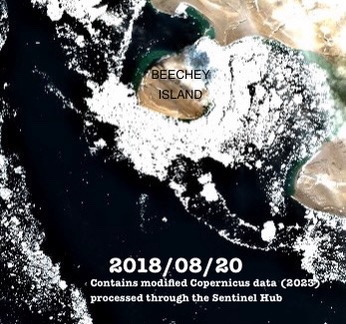
Annotated Sentinel Playground image of the conditions around Beechey Island 165 years after the sinking, showing dangerous ice pans and floes south of Beechey. These conditions in mid-August both caused the original 1853 loss of Breadalbane, and made any summer search or exploration efforts on the wreck difficult.
While noting enormous iceberg scour trails snaking their way across the seafloor of the Barrow Strait, a clear image of a wreck came across the sonar print-out. The images were interpreted by expert sonar technician Garry Kozak on the bridge of the Canadian icebreaker CCGS Sir John A. McDonald. Surprisingly, the scans clearly showed two masts pointing towards the surface. They had located a large sailing ship! A sonar image, though, does not constitute a confirmed shipwreck identification. For that, the team needed “eyes on the prize.” That came soon after, as the team were able to descend a camera on a line to the wreck, which filmed some portion of the ship’s gunwales or deck.
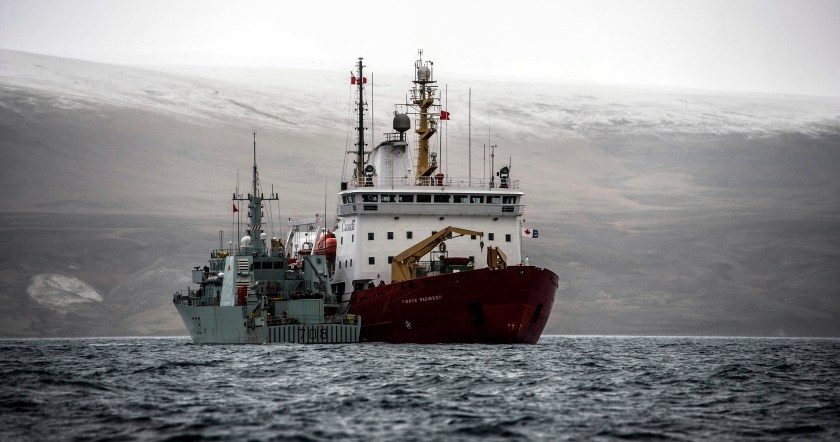
CCGS Pierre Radisson (at right) refuels HMCS Moncton during the Sep. 2015 Operation QIMMIQ in Nunavut, related to the search for HMS Terror. Pierre Radisson was involved, early in her career, in the Breadalbane exploration. Credit: Department of National Defence (Corporal Felicia Ogunniya) SW2015-0226-1306
After delays and an unfavourable season, the team returned in September 1982 with a Benthos Remote Piloted Vehicle (RPV). This advanced robotic vehicle had been developed by Chris Nicholson, who was present to skillfully pilot it (Nicholson would be involved in many other robotic explorations, including on RMS Titanic and the US warships Hamilton and Scourge in Lake Ontario). The RPV captured a rich visual record that helped survey the wreck’s condition-it was shockingly intact! During April 1983 they were back over Breadalbane with more funding and an incredibly audacious plan that MacInnis had put together: To establish a camp on the ice over the wreck using flown-in supplies; to continue to survey the Breadalbane with RPVs; and to tractor in equipment to enable the team to perform crewed-dives to inspect the wreck and surroundings. The frigid depths the wreck lay at were beyond the limit of safe scuba diving or surface-supplied diving. The team had been planning for this. They would operate the WASP suit, a newly developed atmospheric diving suit that was safe to operate beyond Breadalbane’s depth. It was basically a heavy diving-suit-like one-person submersible, with claw-like hands emerging from articulated arms, a dome to look through, and a single lower section.2 The WASP pilots propelled themselves by marine thrusters.
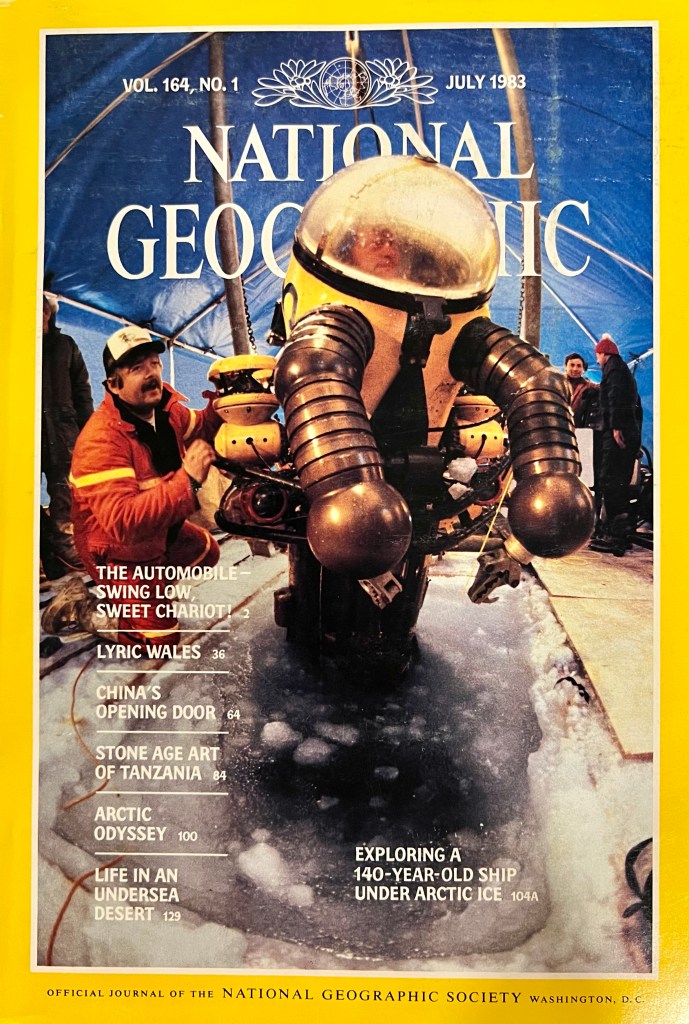
The cover of the July 1983 edition of National Geographic showed the recovery of a WASP-suited pilot who had been exploring the wreck. The National Geographic photographer most involved in shooting some incredible imagery was Emory Kristof, longtime underwater photographer.
This might all seem standard procedure in the third decade of the 21st Century. Similar dives have now been performed on other Franklin Expedition-associated sites, and an ice camp was also an option in the recent find of Sir Ernest Shackleton’s exploration ship Endurance under the Weddell Sea, Antarctica; however, in 1983 this was pushing the limits of technology. Looking back at the concurrent RPV filming and diving, and the as-it-happens filming of a National Film Board documentary, directed by Bill Mason, the logistical and technological efforts in an environment of -20*C, and the “cowboy” atmosphere at the ice camp…the whole effort was bonkers!3 Somehow, the program stayed on track, and things came together just when they had to. The dives were an incredible success. WASP pilots Phil Nuytten (a Canadian engineer heavily involved in the design of the suits) and Doug Osborne have been the only humans to ever visit the site. Nuytten was quoted as saying ”It looked like you could sail it away, if you could somehow make the water vanish, you could probably repair it in a couple of weeks and sail it back to England. It looked great.”4
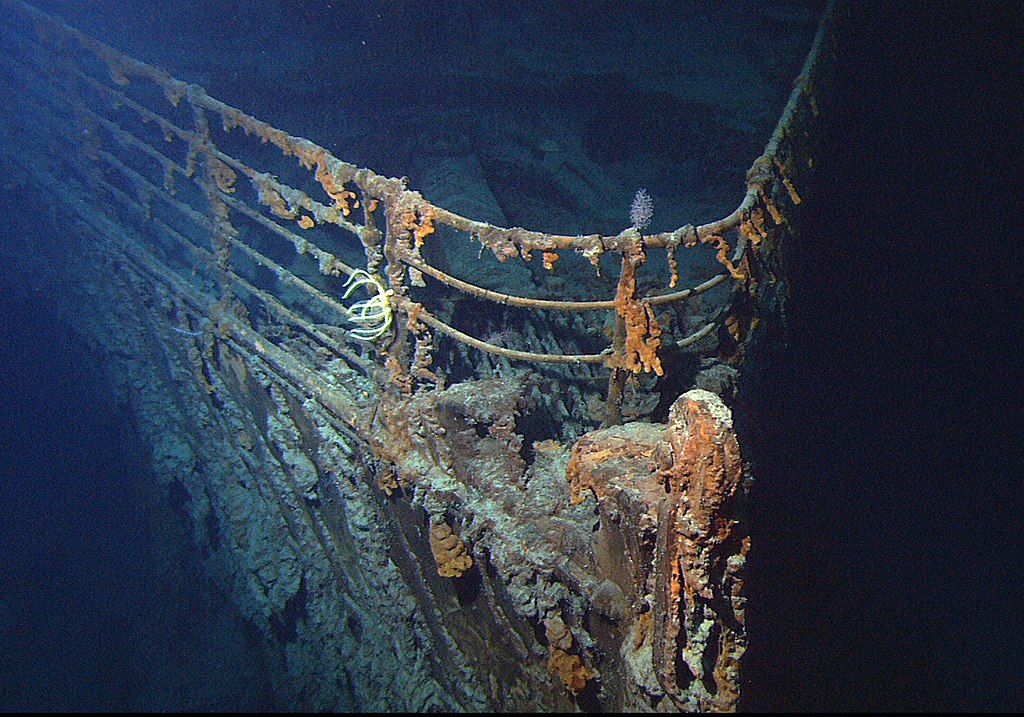
As Dr. MacInnis relates in his book on the topic, The Search for the Breadalbane, news of the 1980 Breadalbane discovery was eclipsed by false reports of the discovery of RMS Titanic, which would not actually be located until five years later (iconic bow section view). Courtesy of NOAA/Institute for Exploration/University of Rhode Island (NOAA/IFE/URI)., Public domain, via Wikimedia Commons
Compared to the barrenness of Beechey’s landscapes, Breadalbane was found to be host to thriving communities of marine life. Anemones and bright white basket stars blended with vibrant pink, orange and red coral growths on the upper hull and topsides. Everywhere there was silt, heaps of growth, and decades of deposited phytoplankton and algae, which floated down on the wreck like green snow. Below this abundance, her lower hull was found to be clad in a minty-green cloak of beautifully-preserved copper sheathing.
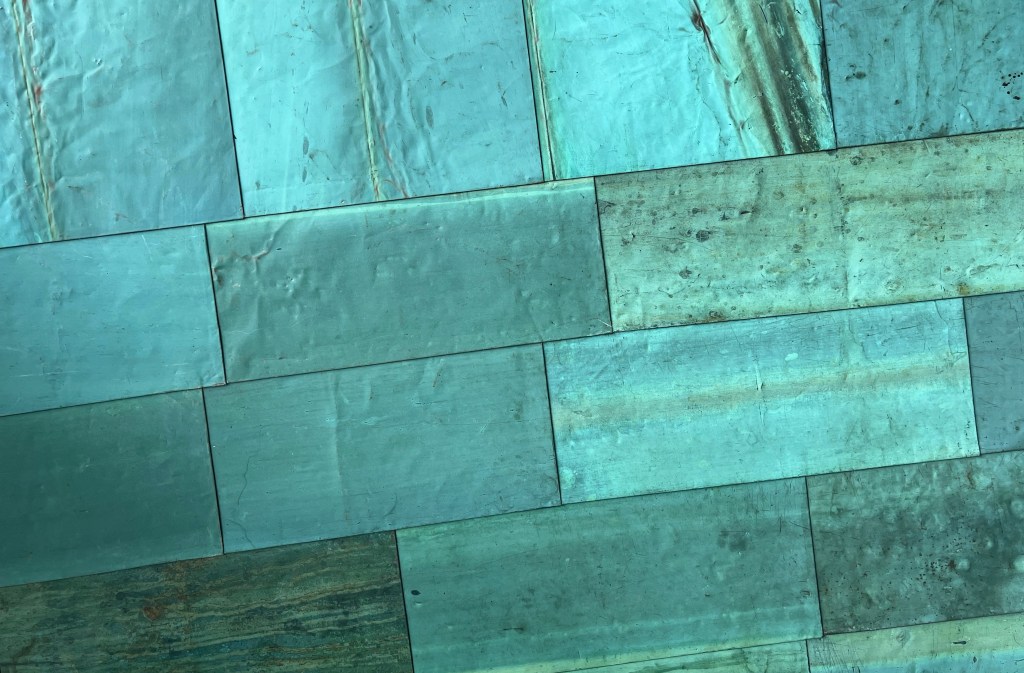
Copper roof sheets originally removed from the roof of the Canadian Parliament Buildings in Ottawa, now a wall in the lobby of the Canadian War Museum. These approximate the sizes and shades of verdigris on the Breadalbane’s hull. (Author’s photo)
A brief summary of the archaeological discoveries and major features of the wreck would highlight the exceptionally large and early example of a deckhouse. It survived mostly intact on the ship’s quarterdeck, and was packed with artifacts such as tables, chairs, and a ship’s stove. Elsewhere, deck furniture included the large windlass forward and the capstan aft. Open hatches provided glimpses of the chaotic damage on the lower deck. The ship’s wheel and a binnacle cabinet were located with navigating instruments, on the small after deck.
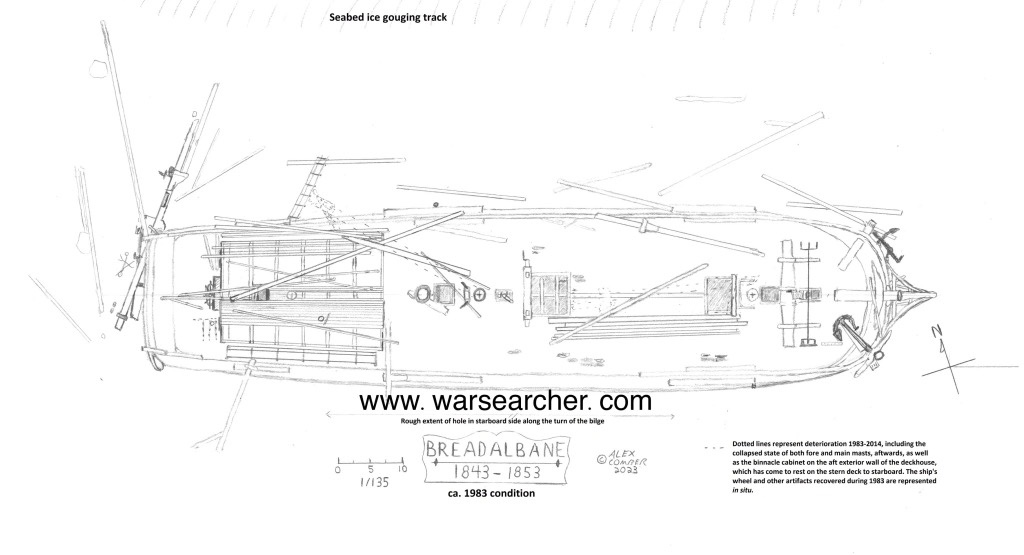
Site plan of Breadalbane as discovered in the early 1980s, drawn in 2023 relying on 1980s and 2012-2014 ROV and dive footage, sonar scans, artistic reconstructions, and other sources. Credit: http://www.warsearcher.com, who retain copyright
The lower hull was marked by a massive extent of ice damage, particularly running along the starboard bilge. This marred otherwise pristine copper sheathing. A well-preserved bower anchor of the stockless variety was discovered on the seafloor, on the Portside of the stem, with a heavy hawser still leading up to a hawsehole. The rudder was located on the seabed just aft of the sternpost, while the fallen mizzen mast stretched from it off to port. White draft marking climbed up the sternpost (these would have originally helped load, ballast, or trim the ship, filling it to a safe, even, waterline level). Debris and spars stretched along the port side on the seabed, with a railing, originally on the deckhouse roof, running like an angled ladder from the seabed to the ship’s sides. The bowsprit was shattered, the figurehead could not be discerned through the growth, and the ship’s bell (a focal point of any shipwreck) was not found.
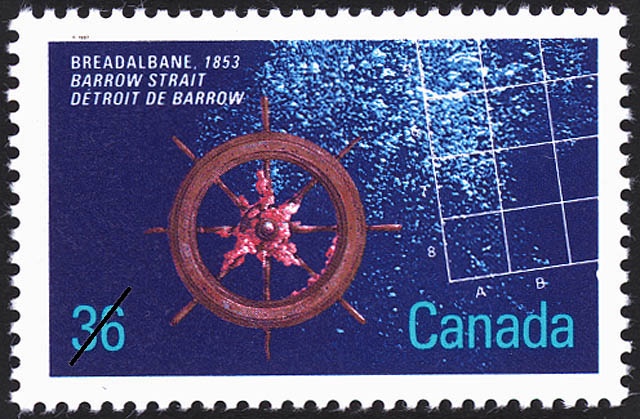
A 1987 issued Canada Post 36 cent stamp commemorating the Breadalbane find, which shows the wheel with colourful marine growth. Credit: Credit: Library and Archives Canada; Copyright: Canada Post Corporation
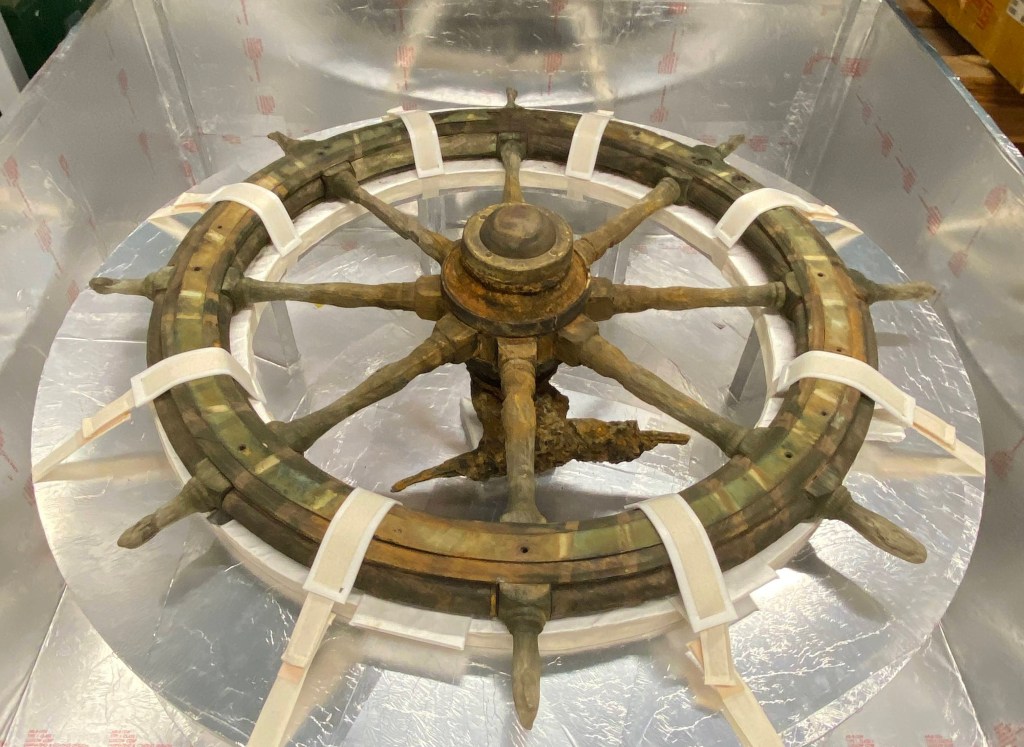
During the 1983 RPV and WASP operations, a small number of artifacts, and notably the ship’s wheel, were brought to the surface. Parks Canada underwater archaeologist Robert Grenier did not support the recovery of items from the site – a process that requires additional permits and permissions. Once the objects were at the surface, he worked diligently to safeguard the preservation of these wooden artifacts and prepare them for transportation.
After the recovery, the team worked quickly to wrap up the season, tearing down the ice camp. The fabulously expensive equipment was shipped south. Joe gave interviews and presentations and wrote his book, The Search for the Breadalbane, Bill Mason produced the NFB documentary Land that Devours Ships, the National Geographic photo crew moved to other assignments, Chris Nicholson continued to design and operate improved robotic systems, and Garry Kozak was involved in new sonar searches for other famous shipwrecks. Robert Grenier returned south to continue the massive archaeological excavations at Red Bay, Labrador. When the last plane lifted off the ice-strip in the shadows of Beechey Island’s imposing cliffs, Breadalbane was again left as a time capsule waiting under the ice.
John Geiger and Owen Beattie’s 1987 book Frozen in Time: The Fate of the Franklin Expedition laid out a hypothesis that lead poisoning had contributed to the destruction of the Franklin Expedition, which had originated out of the 1984 exhumation of Torrington, and John Hartnell and William Braine the next year. The grave of sailor Thomas Morgan, of HMS Investigator, located beside the three Franklin graves, has not be excavated. The author, as a young boy, first saw the Torrington image in Owen Beattie and John Geiger’s 1991 young readers book Buried in Ice: The Mystery of a Lost Arctic Expedition, and has been trying for thirty-two years now to unsee it. ↩︎
Readers may recall a different type of atmospheric diving suit, the JIM suit, making an appearance in the 1981 James Bond film For Your Eyes Only.↩︎
The NFB film “Land that Devours Ships” (1983) is an incredible visual record of these expeditions to the Breadalbane, that can be fully viewed on the NFB website. The author would like to acknowledge the continued assistance of Jonathan Moore, Parks Canada, whose expertise has substantially complemented the visual record of the 198os expeditions. ↩︎
“Divers find old ship intact in the Arctic,” New York Times 27 May 1983 A12. ↩︎
Arctic Album #7 (trip of SS Beothic 1926-1927) Credit : Department of Indian and Northern Affairs Canada / Library and Archives Canada, Accession 1974-366 R 216 Vol. 14948.
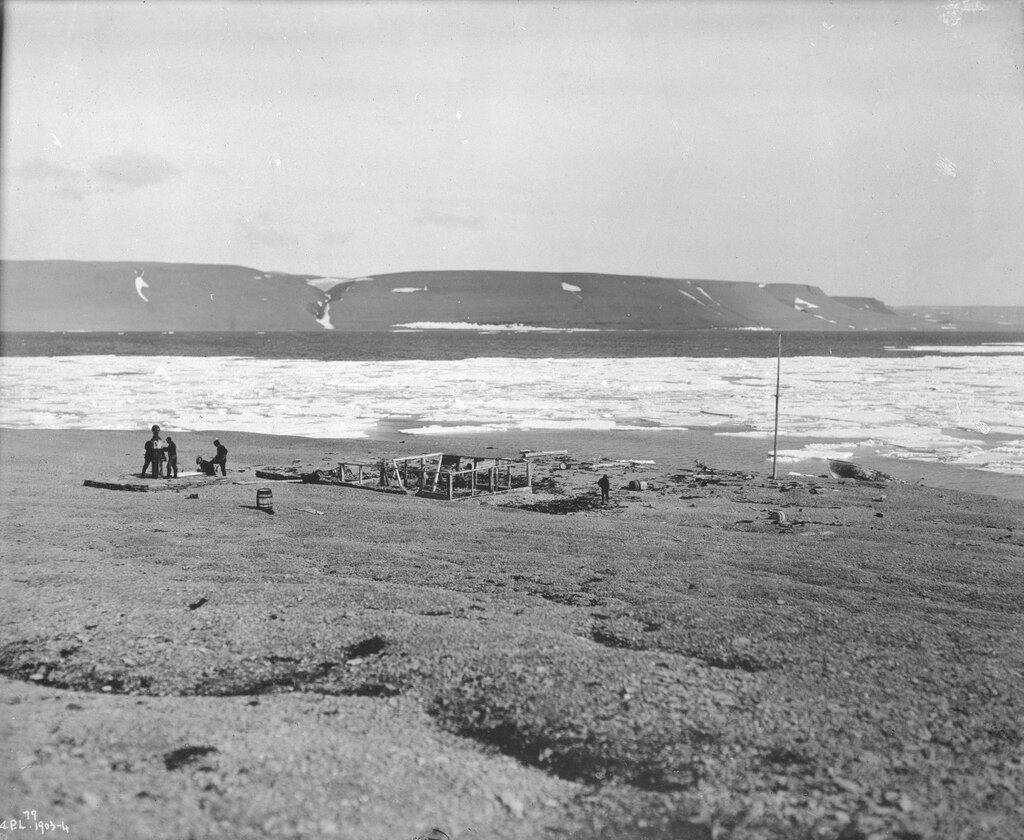
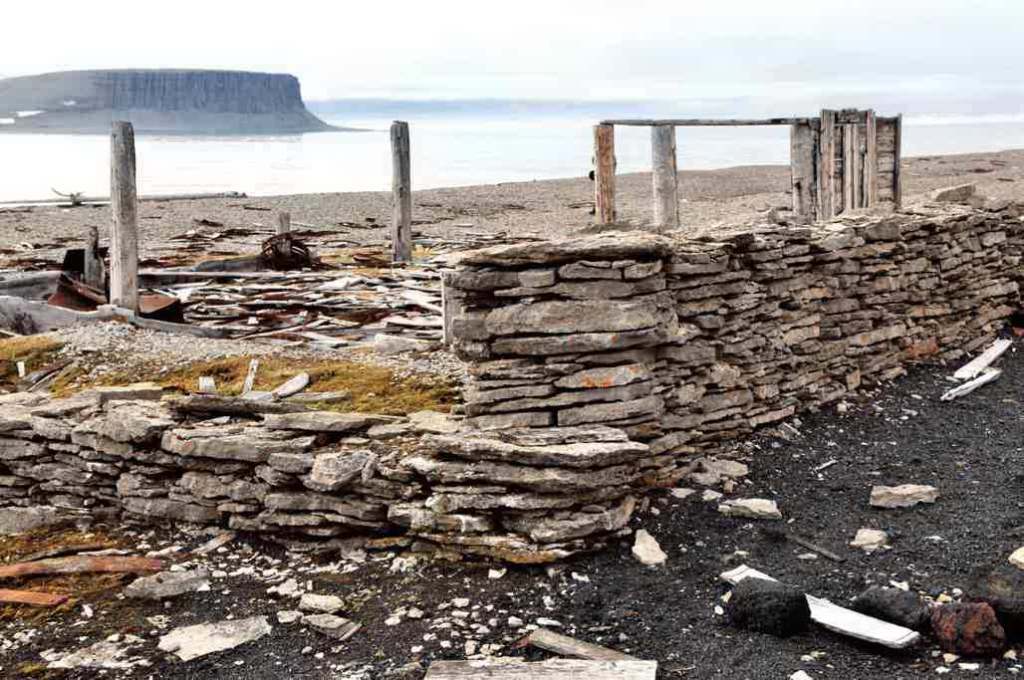
One of the remarkable relics at Beechey Island, connected with the searches for the Sir John Franklin 1845 expedition, is a large mast which has collapsed along the beach, pointing out to Erebus and Terror Bay. This stood for years in front of the ruins of Northumberland House and a motley collection of memorials. Beechey Island is an isolated, barren place, just off the southwest coast of Devon Island, in the High Arctic, in present-day Nunavut. It had been the site of the Franklin Expedition’s first winter encampment, when HM ships Erebus and Terror had sought shelter here in 1845 and been frozen-in. In 1846, before the Bay released the ships, three members of the Expedition were buried just up the beach. The island and surroundings later became prominent as a staging base/supply depot in the expeditions sent to try and ascertain the fate of Franklin and his crews. More searchers would die at and around Beechey, and the Breadalbane supply ship would be wrecked nearby in 1853. Today, burials, monuments, ruins and shipwrecks remain.
Beechey’s Erebus Harbour as it appeared in 1903. The Belcher Column and Bellot monument is at left (Painted black here but later white, with Lady Franklin’s white marble plaque on the ground), with the ruins of Northumberland House and an erect mast standing nearest Erebus and Terror Bay. Credit: Albert Peter Low collection at the Canadian Museum of History, CC BY-SA 4.0 https://creativecommons.org/licenses/by-sa/4.0, via Wikimedia Commons
The mast is a significant artifact with an important story.1 It is reputed to be the last large remnant of the Mary, Sir John Ross’s yacht. This trim little 12-ton cutter-rigged craft had been brought North by Ross, and accompanied his much larger yacht, the brig Felix. It had been built for the trip out, and both it and 70-foot, 100-ton Felix (sometimes referred to as a brig, sometimes a schooner) were reinforced for polar service with strong hulls and iron or zinc hull sheathing. Felix was Ross’s search ship, but Mary was intended for a different purpose.
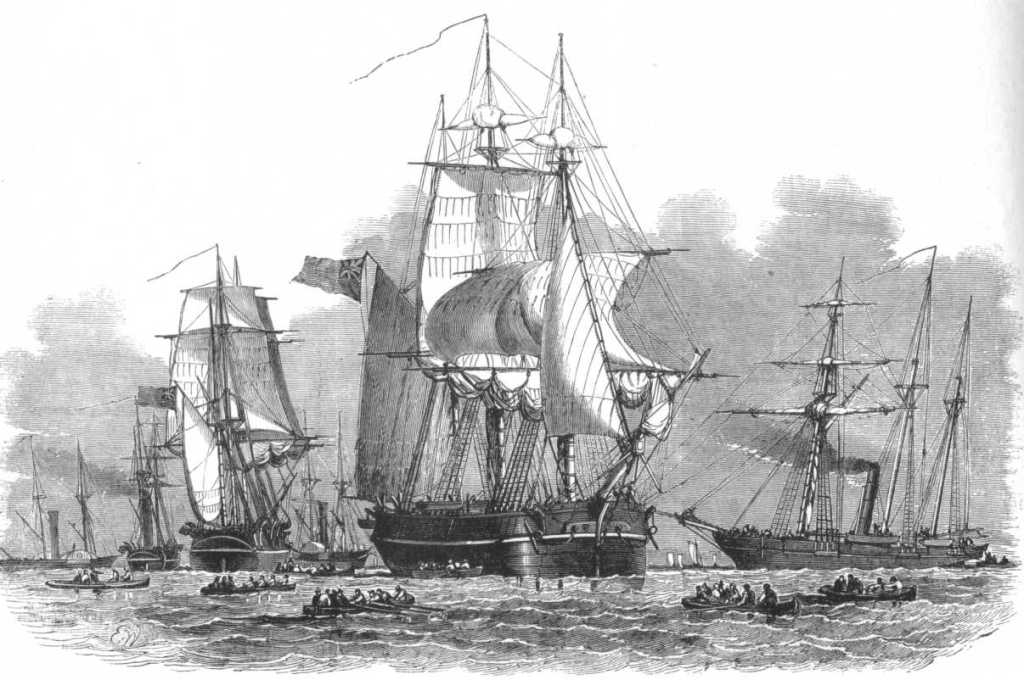
In August 1850, Sir Horatio Austin’s crews of HMS Resolute and Assistance (accompanied by HM Steamships Pioneer and Intrepid) and Captain William Penny’s ships Lady Franklin and Sophia made exciting discoveries at and around Beechey Island.2 These first traces of the lost expedition invigorated search efforts.
The heavies form up! “Captain Austin’s Arctic Expedition; HMS Resolute and squadron.” Illustrated London News 11 May 1850. Credit: Edwin Weedon, Public domain, via Wikimedia Commons
Ross arrived days later in Felix, honouring a promise he had made to come to the aid of Franklin. He was 72 years old, and his sense of duty and concern for his friend brought him out of retirement. When the Admiralty declined his offer to lead an expedition, the Hudson’s Bay Company funded the expedition. His plan, should the lost expedition not be located or turn up, was to leave Mary behind.
Map of the 1845-46 Franklin Expedition sites, and a record of their discovery[annotated with approximate locations of some sites mentioned in this post] The British Library, “Papers and Despatches relating to the Arctic Searching Expeditions of 1850-51. Together with a few remarks as to the probable course pursued by Sir John Franklin, etc. [Compiled by James Mangles. With maps.(London: 1851)] No restrictions, via Wikimedia Commons
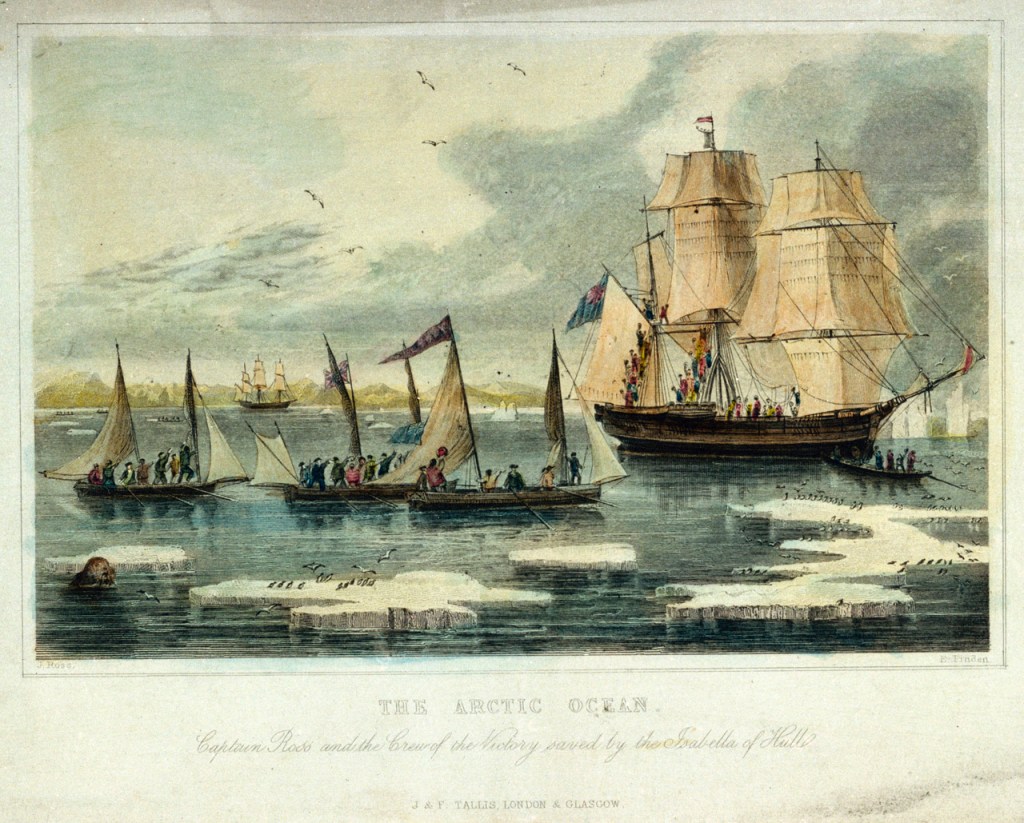
Ross knew better than anyone the value of a cache of food and stores and a serviceable boat. On his 1829 expedition, accompanied by his nephew James Clark Ross, his ship Victory had been trapped in ice. Three years later they were forced to abandon their refuge. They retreated to Fury Beach, where they had to spend yet another long, dark winter frozen-in. But Fury Beach was their salvation: Parry’s 1825 expedition had left a cache of supplies and three boats from their wrecked ship, HMS Fury. The boats and supplies allowed an expedition, which had been widely assumed to have ended in death and disaster, to escape to Prince Regent Inlet and rescue. Ross hoped that some similar depot and boat could help Franklin Expedition survivors, or anyone else trapped in the area.
Edward F. Finden’s engraving (John Tallis & Co) of John Ross’s crew, sailing in some of HMS Fury’s old boats, encountering the whaling ship Isabella, his old ship, in 1833 after four years. Ross hoped that Mary would be involved in a similar mission. PAD6090 Courtesy of the National Maritime Museum.
With larger Admiralty-supported expeditions scouring the Arctic, it was time for Ross to return home. Mary was initially left west of Beechey at Cape Spencer, packed with a good store of provisions. The boat was moved soon after to Erebus Harbour when the Edward Belcher expedition incorporated it into new construction. The crew of HMS North Star, the depot ship supplying the Belcher search ships, dragged Mary up the beach and deposited her under Beechey’s soaring cliffs. The yacht was intended as a companion to Northumberland House, which was packed with useful supplies and provisions. Stranded crews that came to Beechey, once they had sheltered and replenished their stocks, could strike off in the yacht in the very short navigation season that those high latitudes allow. Mary and Northumberland House functioned together as their own extraordinarily remote lifesaving establishment. Robert McClure informed the crew of his long-trapped ship, HMS Investigator, that one group would travel to Cape Spencer to board Mary.3 As every one of the Belcher search ships would later need to be abandoned, with their crews completing harrowing marches to safety, the idea had merit.
In 1876, Allen Young, on his second Arctic expedition in the retired gunboat Pandora, found Mary to be in very good shape, still tight and dry and with mast up and sails stowed onboard, in a mostly dry cabin.4 Northumberland House, by comparison, had been damaged and ransacked (reportedly by bears). Young had been one of the last to see this same spot from the Fox, as the navigator on the Capt. Francis Leopold McClintock’s 1858 expedition. With the Pandora’s departure, Mary was again left to her lonely fate.
Mary as the yacht appeared in 1876, still substantially intact. The placement appears to have been up the beach from most of the sites, closer to Cape Riley. Credit: Allen Young “Cruise of the Pandora” (London, 1876) Page 41. Public domain via Library and Archives Canada 1984-109 NPC
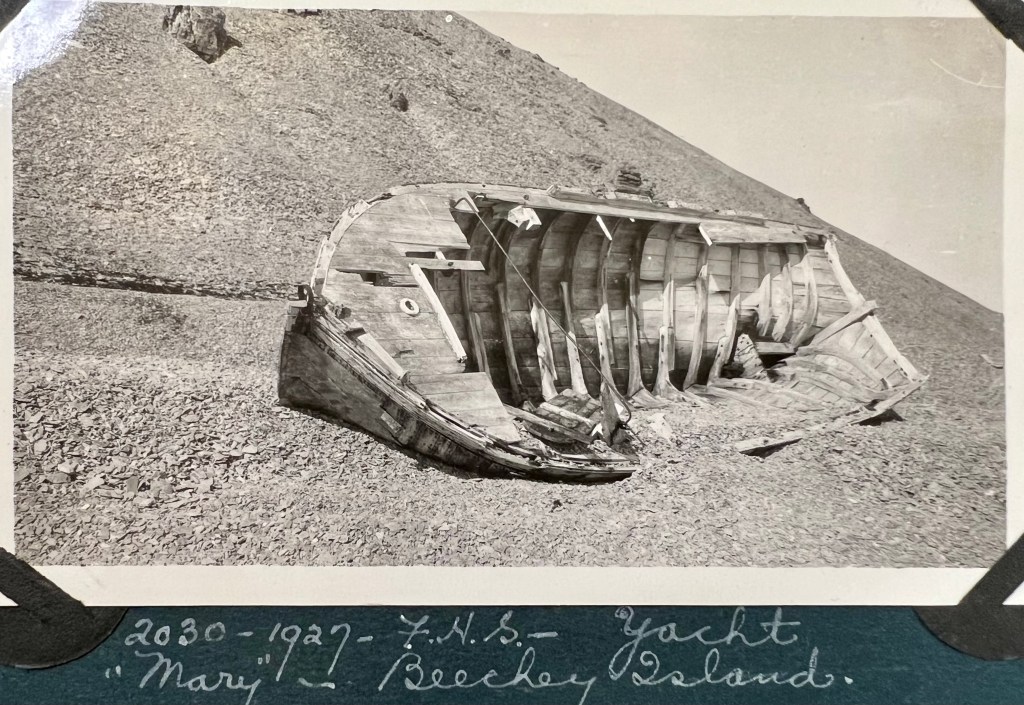
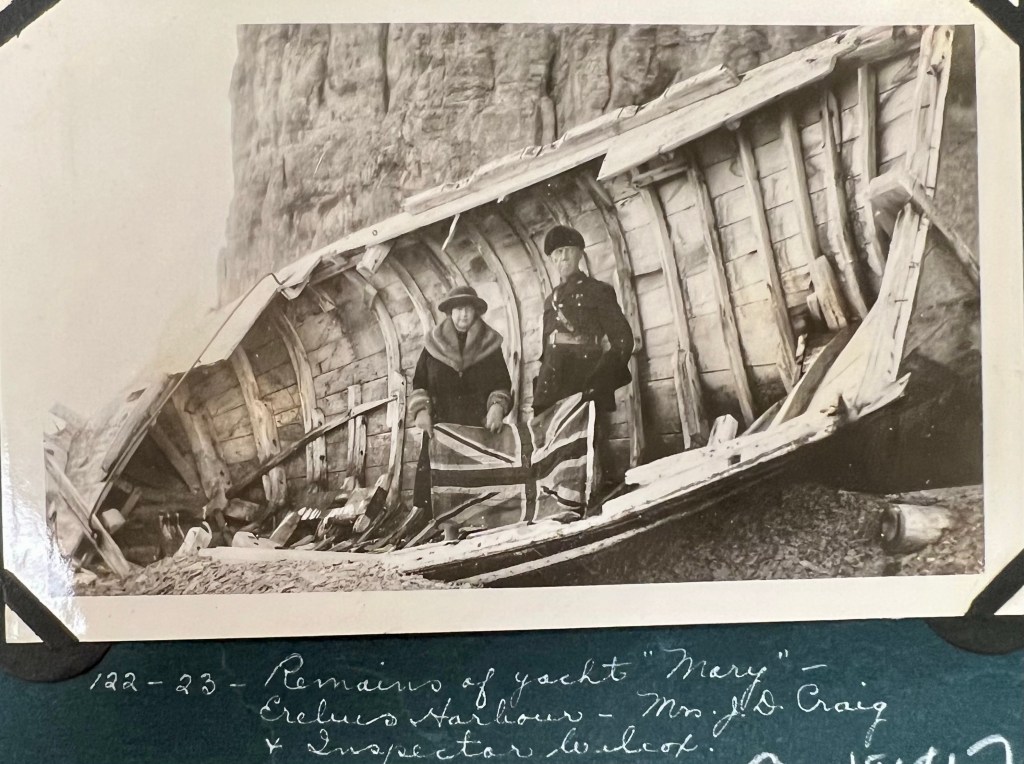
Occasional visits by notable Arctic explorers continued into the 20th Century. Mary sustained more damage and deterioration and at some point the mast was taken from near the hull and erected in front of Northumberland House, near a large whale boat.5 The hull assumed a prominent list, and the decking deteriorated. Visitors also speeded deterioration by taking a few choice souvenirs. The derelict vessel was photographed in 1923 and 1927, during annual trips to the Arctic by Canadian government ships.
Inspector C.E. Wilcox and Mrs. Craig standing in the remains of the yacht Mary, 1923. Credit: John Davidson Craig / Canada. Dept. of Indian and Northern Affairs / Library and Archives Canada / PA-186867 Arctic Album #5, trip of CGS Arctic 1923 R 216 Vol. 14946.
During the 1970s and 80s, the mast leaned at an increasingly rakish angle, until it fell to the ground sometime before 1992. Like everything else at Beechey, the mast is undergoing a very gradual deterioration. We conclude our brief account of a yacht that was intended to serve as a rescue vessel with an important takeaway: If you plan to be shipwrecked in the high latitudes of the Canadian Arctic somewhere around Beechey Island, you can no longer depend on Mary to yacht away from it!
Season Osborne’s detailed history of Mary “What Happened to the Mary? A Historic Site ravaged through time” (Above and Beyond – Canada’s Arctic Journal 2015/2 pp. 23-27) helped sort out many contradictions. It is available at https://issuu.com/arctic_journal/docs/above_n_beyond_marchapril_2015/↩︎
This is a simplified account of discoveries, for a more fulsome treatment of the moment of the first discoveries at Cape Riley (by Capt. Ommanney of HMS Assistance) and Capt. Penny’s team, including R.A. Goodsir, finding the graves at Beechey, please see Alison Freebairn’s finger-post blog and Logan Zachary’s Illuminator blog on the topic. ↩︎
George F. McDougall “The Eventful Voyage of H.M. discovery ship “Resolute”…(London: Longman et. al. 1857) P216. McClure ended up encountering the HMS Resolute party sent to look for him under Lt. Pim and evacuating everyone to Resolute). Available at Babel.hathitrust. ↩︎
The above source refers to the mast as having been moved sometime around the Second World War, but the 1903 photo seems to show a similar mast in front of Northumberland House, which is more substantial than the flag pole that had been on the site during the 1870s. ↩︎
This section is drawn from Lt. Allen Young’s Cruise of the Pandora; from the private journal kept by Allen Young commander of the expedition (1876; republished by Cambridge University Press 2012). The illustrations are from a copy of the original at Library and Archives Canada. ↩︎
One-hundred-and-seventy years ago, the Breadalbane supply ship was proceeding North to a rendezvous in Greenland. This merchant ship had been built on the Clyde River, Scotland, in 1843. Ten years later, the crew succeeded in an important mission, but Breadalbane would not return from her Arctic service. Her shipwreck was located 130 years later by Dr. Joseph B. MacInnis and his colleagues. Currently, she is the most northerly identified Canadian Arctic wreck, and one of the most northerly in the World.1 She remains one of the most intact ships from the great era of polar exploration. Breadalbane’s wreck is a vibrant oasis of marine life in a brutally harsh environment.
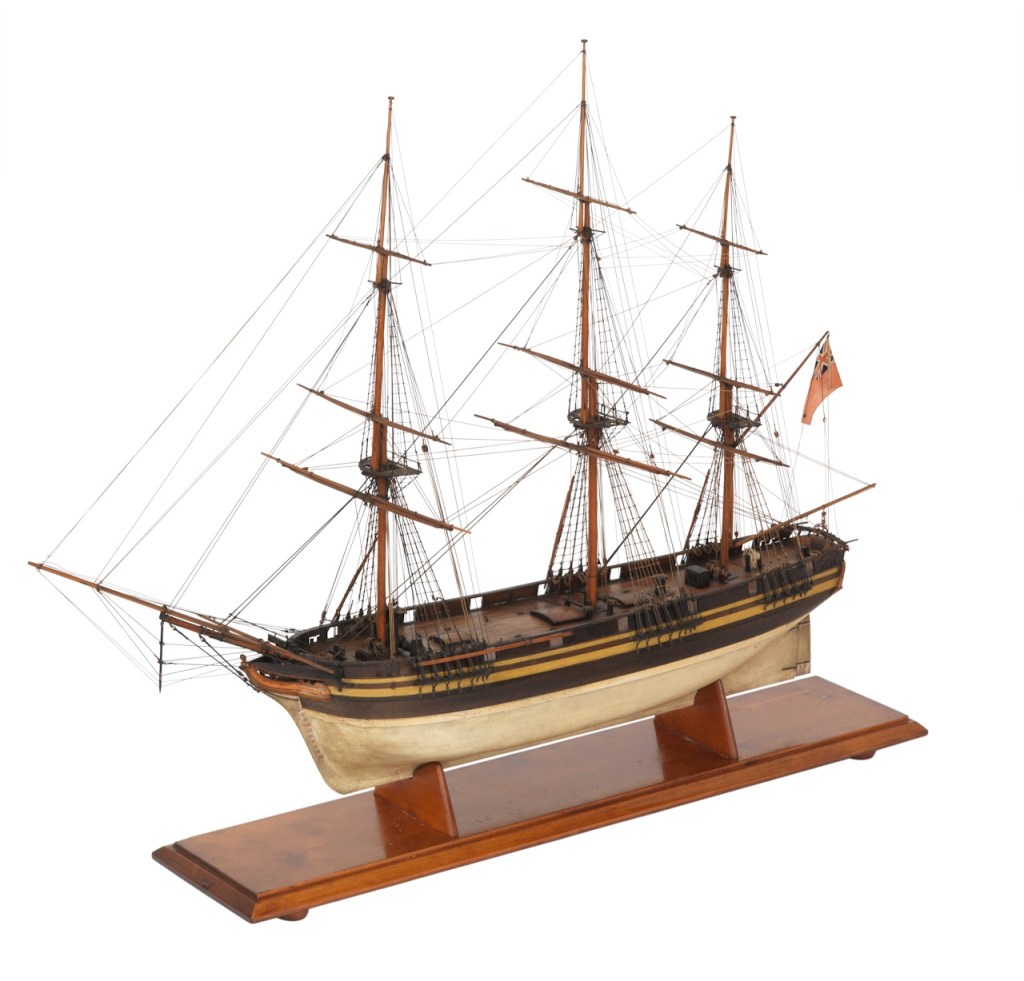
Of all our attempts to locate imagery and plans of Breadalbane, we have settled on this National Maritime Museum model of an 1830s merchant ship as best representing Breadalbane as she appeared before Admiralty modifications for Arctic service. Even the paint scheme appears similar to that found on the wreck. Credit: Royal Museums Greenwich SLR0726
Breadalbane was built by the firm of Hedderwick and Rankin in 1842-1843 near Glasgow, and was typical of hundreds of other merchant ships. She was roughly 125 feet from bow to stern (according to the Lloyd’s of London survey report for 1843, she was 117.8 feet, which could be a stem-to-sternpost dimension), and displaced about 430 tons, her moulded breadth was about 24 ‘, suggesting her overall width was greater. She was sturdily built, of a bewildering variety of woods, from all over the British Empire and beyond: African and American Oak, Quebec Rock Elm, Red and Yellow pine. Well-squared English and Welsh oak predominated. Unlike the later clipper ships, she was designed for economical transportation of goods, not speedy passages. Her bows were bluff, her proportions were generous (to incorporate capacious cargo holds) and her lines were simple. She was rigged as a barque–that is to say square sails on the fore and mainmast and a simpler fore-and-aft rigged mizzen mast near the stern. Compared to a fully-rigged ship, this simplified rig had only a small impact on the ship’s performance before the wind, while requiring less crew members.
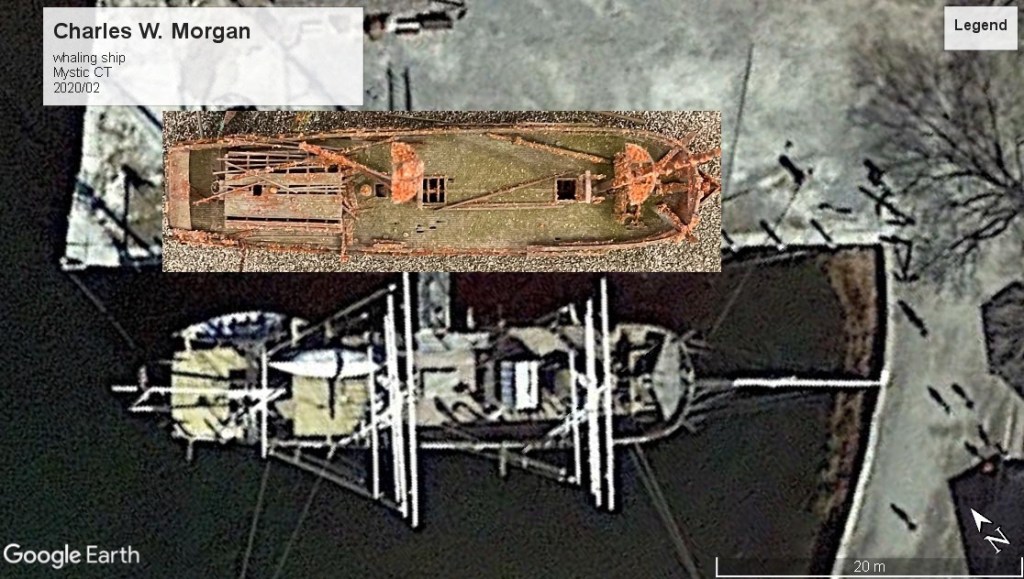
The Charles W. Morgan whaling ship, a museum ship at Mystic CT, barque-rigged and the most similar surviving vessel to Breadalbane. She was built two years earlier, and is slightly smaller, with the specialized features of a whaler-tryworks stoves for melting down blubber and davits for more whale-catching boats. Credit: Ken Mist, CC BY 2.0 https://creativecommons.org/licenses/by/2.0, via Wikimedia Commons
Breadalbane’s career thus far had involved routine voyages to transport goods to and from British India. She had been meticulously maintained. Upon an 1848 return from one such voyage, she had to be set right after a minor accident in Calcutta. She was repaired with teak sections and classed again at the highest level of Lloyd’s of London assessment, A1 for ten years, with the surveyor writing ” The barque is in good condition and eligible for the safe conveyance of dry and perishable cargos to and from all parts of the World.”2
Taken up for Admiralty service in March 1853 and given a refit and modifications for Arctic service (which we will describe in a future post), Breadalbane departed from the Thames Estuary 19 May 1853, fully loaded with provisions for the search expeditions, commanded by Captain Edward Belcher, which were then scouring the Arctic for traces of the Franklin Expedition and HM Ships Erebus and Terror. It was eight years to the day since Franklin’s ships had started off on their own fateful passage. Breadalbane arrived off Disko Island, Greenland, 8 July. After meeting up with her powerful consort, HMS Phoenix, a steamship, she proceeded along the western coast of Greenland and on up the Davis Strait. Breadalbane was not updated with steam engines and screw propellers like Erebus and Terror had been in 1845. Instead, she was towed through adverse winds and dangerous ice by Phoenix.
Breadalbane under tow off Disko, Greenland. This is the only representation we have ever seen that shows both the figurehead and the deckhouse at the base of the mizzen. Detail of E.A. Inglefield’s view of HMS Phoenix towing the ship, with HMS Diligence store ship aft. Credit Library and Archives Canada mikan 2837866.
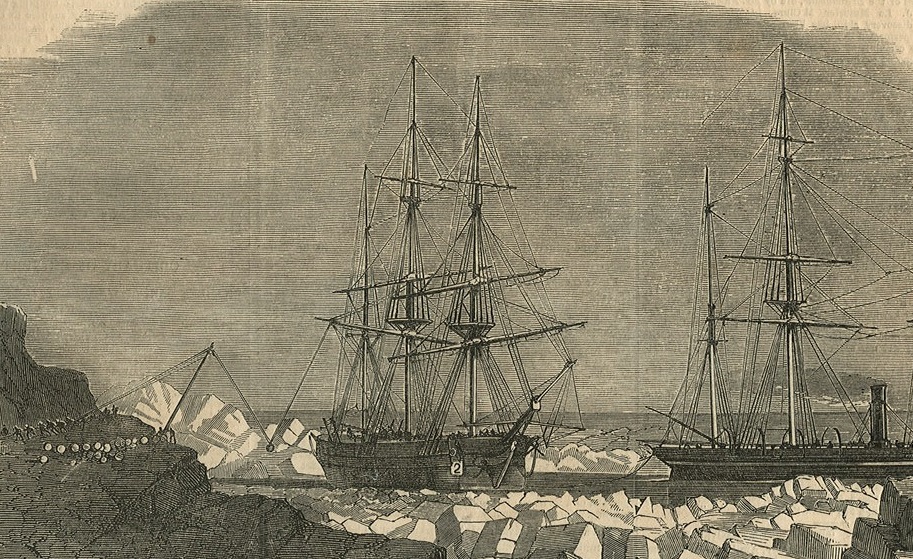
Phoenix’s Captain, Edward A. Inglefield, commanded the resupply effort. He also kept a visual record, in the form of well-executed sketches of the major events of the 1853 passage. Despite worsening ice conditions, the ships continued to make progress with Phoenix in the lead, employing her steam power and reinforced bows in the novel role of icebreaking, cutting a path for Breadalbane while simultaneously towing her.
Inglefield took a photographic record of a later resupply mission, in mid-1854, which saw HMS Phoenix (right) again leading a storeship, HMS Diligence, to resupply the Belcher expedition (1852-1854) looking for Franklin. They were photographed at Godhavn, (Qeqertarsuaq) Disko Island, Greenland. Diligence was a similar barque to Breadalbane, but of earlier vintage. It appears that Diligence had been upgraded with partially reinforced ice channels under the fore, main and mizzen chains. Credit: Captain Edward Augustus Inglefield, Public domain, via Wikimedia Commons.
The ships arrived near Beechey Island off the southwest coast of Devon Island, 8 August. Beechey already had a special significance, as the spot where the Franklin crews had spent their first winter of 1845-46, onboard their frozen-in ships. It was now being used as a staging base for the Belcher expedition ships, with HMS North Star depot ship victualling the widely-dispersed search ships. For the isolated Royal Navy crews confined to Beechey for many months, Breadalbane and Phoenix’s arrival was a joyous time. News of home, new faces, and new supplies boosted spirits. Breadalbane’s goods were sustaining the largest of the Franklin searches.
Beechey is an island of lost explorers, graves, monuments, shipwrecks, and house wrecks made from shipwrecks. These are the ruins of Northumberland House, constructed in 1852-53 under the direction of HMS North Star‘s Captain, Cmdr. W.J.S. Pullen. It was provisioned with supplies in case Franklin’s crews or others returned. The mast of a whaling ship (still standing in the 1980s), whose timbers also wound up incorporated into the house, can just be seen on the beach, with a view out to Cape Riley, Devon Island, across Erebus and Terror Bay. Credit: Ansgar Walk, CC BY-SA 3.0 , via Wikimedia Commons
Navigating the ice-chocked waters off Beechey proved to be challenging, so the next day the ship manoeuvred across Erebus and Terror Bay and in close to the bluffs at Cape Riley on Devon Island. Crew members begun shifting coal ashore. Ice remained a hazard, but the transport worked back inshore to discharge more cargo on 16 August.
Breadalbane’s crew shifting supplies ashore at Cape Riley, Devon Island, in company with HMS Phoenix (at right). (Detail of) Illustrated London News 22 Oct. 1853. Credit: Frederick James Smyth, Public domain, via Wikimedia Commons
Unlike the events leading to final abandonment of Erebus and Terror, the details of Breadalbane’s loss, on 21 August 1853, are well-established. Descriptions by both Inglefield, and Breadalbane’s Second Master, William Fawckner, help chronicle the ship’s end. When most supplies had been unloaded, drifting ice began to descend on the area. The decision was taken to again evacuate the inshore area on the 20th. Sledging trips continued to remove more supplies to North Star. By midnight, Phoenix had worked her way to a position about a half-mile South of Beechey Island. Both ships were moored to a large flow. The ice crowded in, and the crew worked to save boats and to help Phoenix, which was thought to be in more imminent peril.
Edward Inglefield (1820-1894), HMS Breadalbane and HMS Phoenix caught in ice off Beechey Island, 1853. Breadalbane was a supply ship to an expedition that had the aim of recovering Sir John Franklin’s ill fated voyage in the Arctic. For sale in marine show in Oct. #history#navalpic.twitter.com/CDjzfSc6za
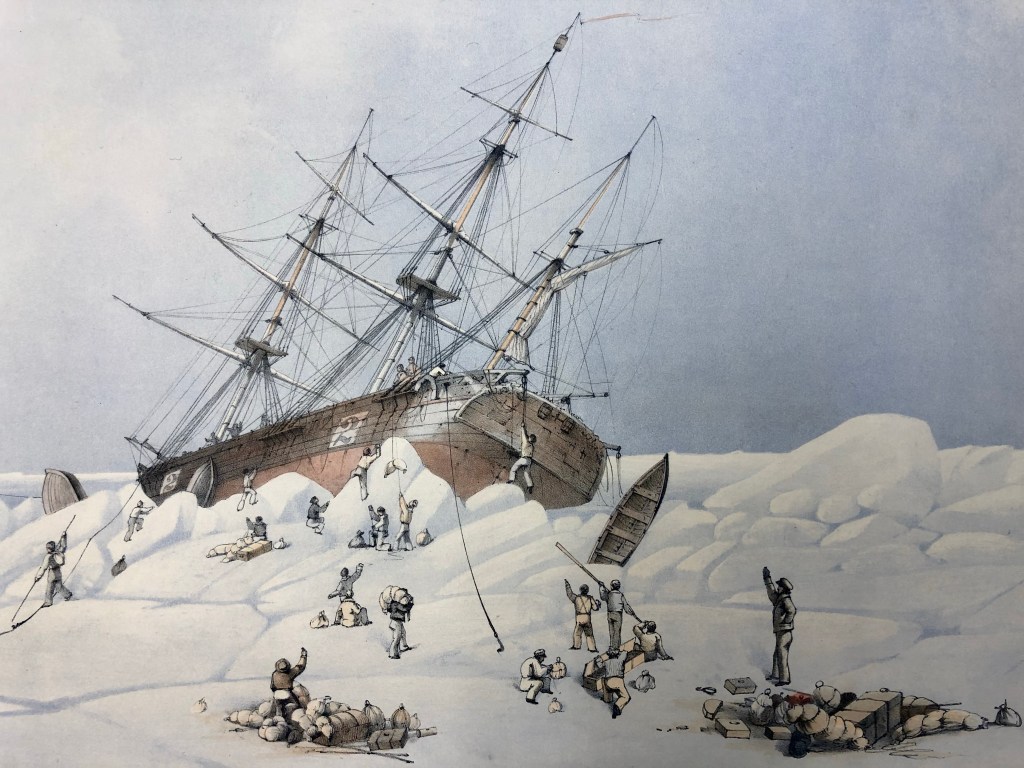
This remarkable work came up for auction a few years ago. It seems unlikely it was actually sketched by Inglefield, as it contrasts quite strikingly with his other depiction of the sinking. Here Breadalbane is shown heaved up on the ice, with HMS Phoenix nearby. This depiction has some unique features: A more ornate stern with three lights and false galleries (not depicted anywhere else), and lines which seem to indicate the bow sheathing.
The worst of the ice passed aft of Phoenix, smashed the boats, and brutalized Breadalbane, which would have been sitting high in the water, in ballast trim. The ice first pinched the ship, sending tremors throughout, before crashing straight through the lower hull. This opened an enormous gash along the starboard side at the same time as it ground a smaller rent in the port bows. Interior spaces, particularly around the ship’s bows, were devastated, with decks and partitions snapping like matchsticks.
The moment when Breadalbane was crushed by ice, 21 Aug. 1853, by EA Inglefield, who witnessed the events from his command, Phoenix, ahead of Breadalbane. Close visual inspection of the transom seems to indicate that there is indeed a third sealed scuttle or light across the stern, matching a detail of the auction house sketch. Evidence does suggest that Breadalbane had two enormous “2”s painted on each side, to mark her role as a supply ship. Nothing of these markings has been located on the wreck. Credit: Edward Augustus Inglefield, Library and Archives Canada [detail of] mikan 2837463
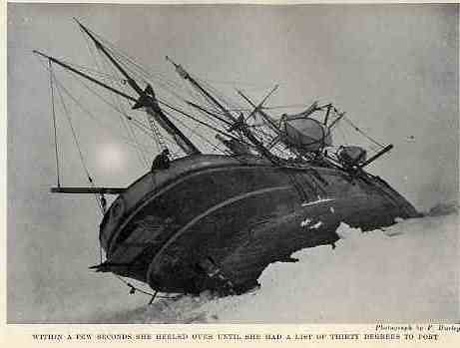
Inglefield arrived on scene and ordered Fawckner to assess the damage, as the ship settled lower by the bows. A cursory glance down the hatches into the main hold showed him that the ship was doomed. The 21-member crew worked to save a few possessions as the ice momentarily let up. Moments after all crew members had escaped over the ice, the ship plunged straight down with a rapidity that shocked all who witnessed the sorry end of Breadalbane.3 The process may have looked a bit like a sped-up version of Frank Hurley’s 1915 footage of Shackleton’s Endurance sinking in the Weddell Sea, Antarctica.
A World away, the most Southerly shipwreck, Sir Ernest Shackleton’s barquentine RRS Endurance, being gradually crushed by ice during the 1915 Imperial Trans-Antarctic Expedition. Endurance was located deep under the Weddell Sea in 2022. Credit: Frank Hurley via wikimedia commons.
The shipwrecked crew joined some of the crew of HMS Investigator (one of the search ships that had been beset and had been abandoned at Mercy Bay in April) and were soon on their way back to England on Phoenix. Breadalbane had served the Admiralty’s purpose. The ships of Britain’s far flung merchant marine were routinely lost in seas all over the World, and Breadalbane’s story seemed set to fade into obscurity, amidst the greater drama of the continued disappearance of the Franklin expedition, and the loss of many of the search ships.
A teaser for a future post. Here the model of Breadalbane’s wreck, which we will extensively interpret, is compared to satellite imagery of the Charles W. Morgan…BECAUSE WE CAN!
I would like to acknowledge the assistance and expertise of Jonathan Moore, Underwater Archaeology Team, Parks Canada, and Dr. Joe MacInnis, original team lead of the late 1970s and early 80s efforts to locate and explore Breadalbane.
Jonathan Dore (Facebook group Remembering the Franklin Expedition) and David Mearns (FB group Sir E.H. Shackleton Appreciation Society) have supplied information about the remains of Benjamin Leigh Smith’s exploration ship Eira, in Franz Joseph Land, 6 degrees of latitude higher North. Eira was lost 18 years to the day after Breadalbane, 21 Aug. 1881. Breadalbane was the World’s most northerly located wreck from her discovery by Dr. Joe MacInnis in 1980 until 2018, when substantial evidence was recovered from the Eira wrecksite. Eira’s archaeological assessment is ongoing. ↩︎
The Lloyd’s of London survey reports for Breadalbane from 1843,1844,1849,1853 are a valuable resource for describing her construction, repairs, and substantial modification in early 1853 for Northern service. ↩︎
A detailed description of the sinking is provided by Fawckner, extensively excerpted in Joe MacInnis’s 1983 book: The Search for the Breadalbane. Many of the details of Breadalbane’s journey are taken from this source. I would like to thank Fabiënne Tetteroo for providing me with a copy of the Illustrated London News of 22 Oct. 1853 that excerpted Fawckner’s report. ↩︎
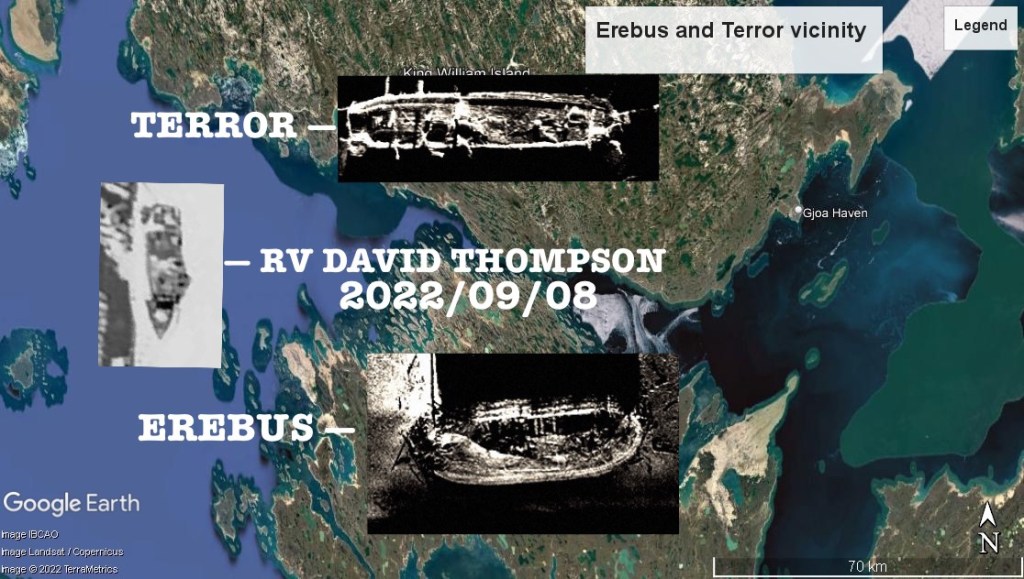
What a cast of characters, what a mise en scène! Since arriving off King William Island, Nunavut, in late August, 2022, the Parks Canada Research Vessel David Thompson has remained near the famous Sir John Franklin expedition shipwrecks longer than previous seasons. What amazing discoveries must the Underwater Archaeology Team (UAT) be making at these incredible mid-19th Century exploration ships right now?! Will the dive team working from David Thompson or the specialized dive barge, Qiniqtiryuaq, uncover new information about the last days of this ill-fated effort to locate the Northwest Passage?
Composite Google Earth image, with RV David Thompson superimposed from below GE capture, and sonar images of wrecks of HM ships Erebus and Terror modified from Parks Canada images. Date and location of all ships indicated is only an approximation.1
There has not yet been any official reporting about the 2022 Parks Canada work. It is a safe bet that the balance of research is focusing on the fragile or “dynamic” site: HMS Erebus (discovered by Parks during the Sep. 2014 search in Wilmot and Crampton Bay, after years of searches which followed up on Inuit oral history of a wreck in this area).2 In the long 165-years that Erebus remained unlocated, there must have been decades where the wreck, in the frigid waters of Wilmot and Crampton Bay, would have appeared almost untouched by time’s passage. Unfortunately, her condition has worsened in the last years, as ice or ocean swells take their toll on upper surfaces, such as the weather deck and supporting structures. The wreck is only in about 11 M of water. There is real urgency to conduct a thorough survey.
HMS Terror is located about 60 km North, somewhere in the aptly named Terror Bay (discovered Sep. 2016 by the Arctic Research Foundation’s ship Martin Bergmann, following up on a tip from Gjoa Haven resident and Canadian Ranger Sammy Kogvik). The seabed is about 24 M deep, and the wreck’s depth and location seem to be working to better shelter it. We hope at some point that the team are able to shift the archaeological exploration to Terror. Previous Remote Operated Vehicle surveys of the interior have shown a wealth of artifacts requiring further study.
The ships (and shipwrecks) of the 2022 Franklin Fleet:
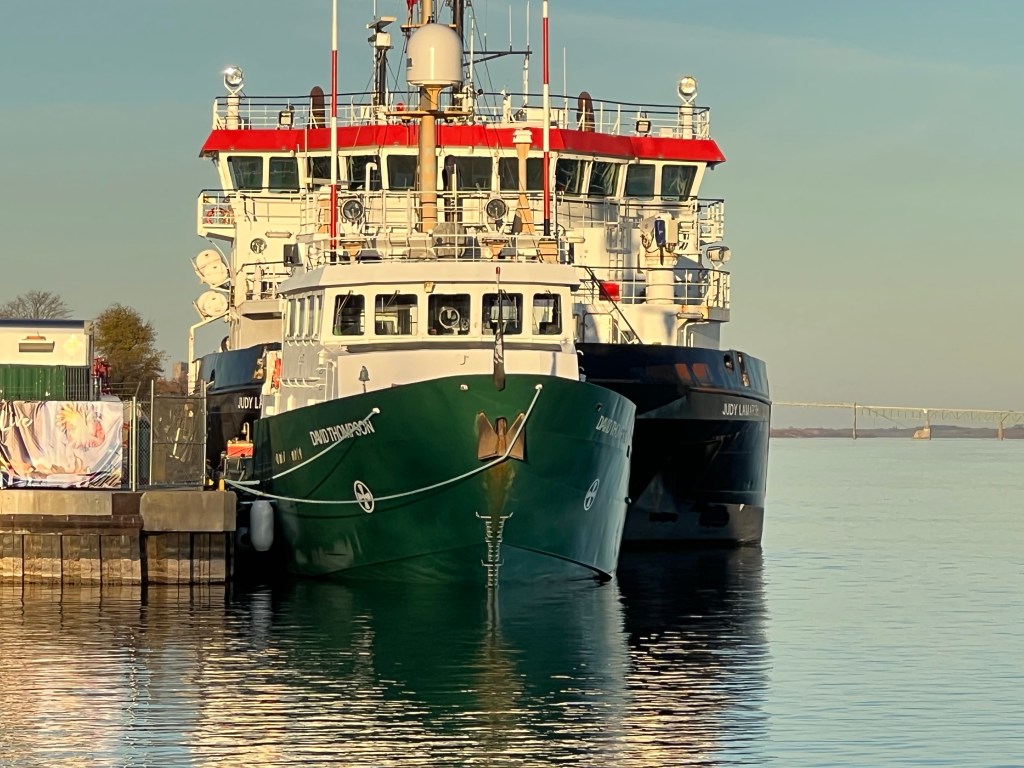
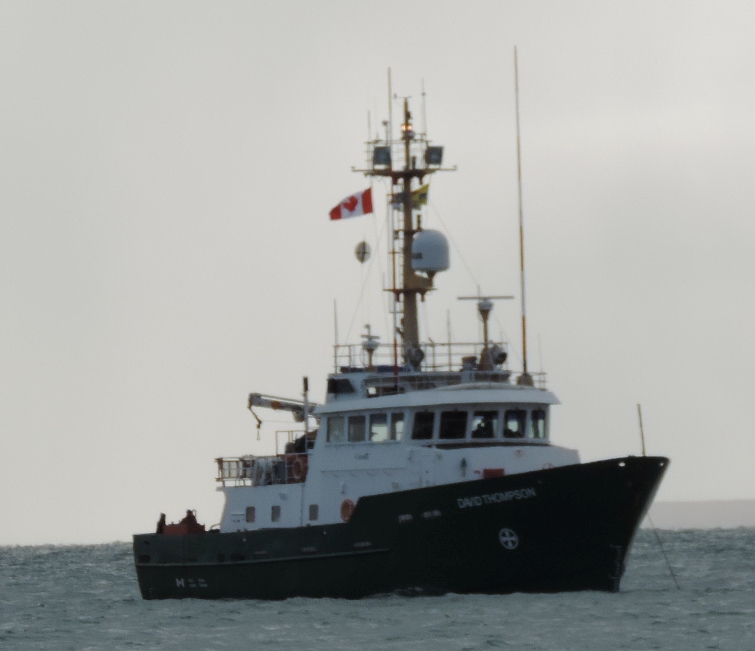
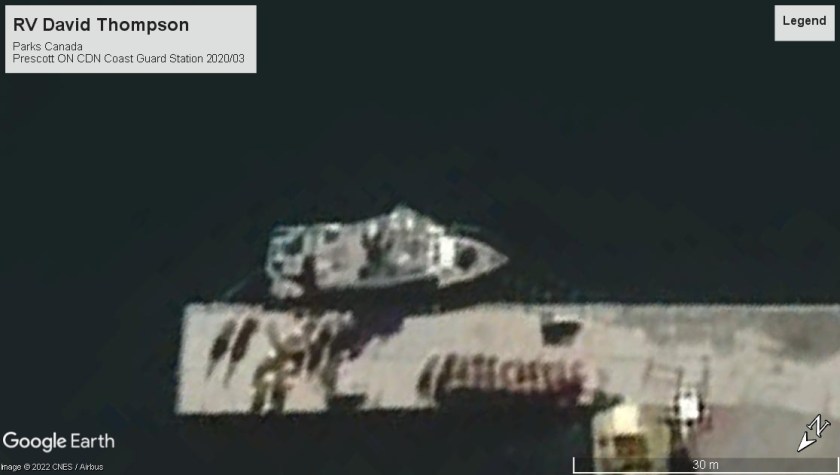
RV David Thompson (2017) LOA 95’ / 29m TDISP 228 tons. Originally Canadian Coast Guard Fisheries Patrol vessel CCGS Arrow Post (1992-2016) before transfer to Parks Canada. Now equipped with up to two Rigid Inflatable Boats and a hydraulic crane. RV David Thompson made a brief transit back through the Simpson Strait to Gjoa Haven 7 September, but appears to have returned to the vicinity of Erebus the next day.
RV David Thompson, a day after her return to the Coast Guard station at Prescott, ON. 1 November 2022, after a busy archaeology season at the Franklin wrecks and elsewhere. Credit http://www.warsearcher.comRV David Thompson during the 2019 expedition to the wreck sites. Credi: Kerry Raymond, CC BY 4.0 https://creativecommons.org/licenses/by/4.0, via Wikimedia Commons
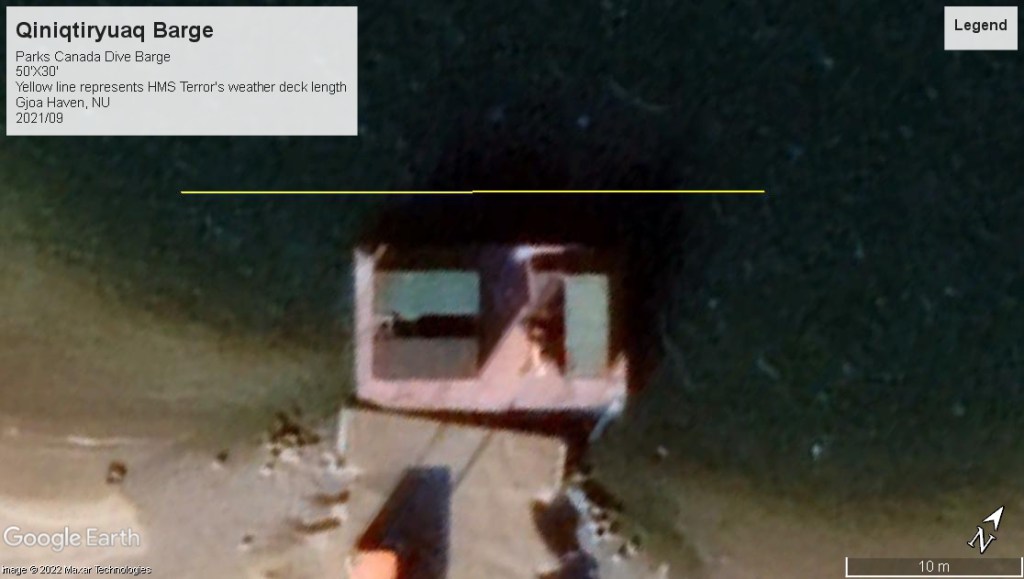
Parks Canada Dive Barge “Qiniqtiryuaq” (2017) approximately 50’X 30’ / 15.3 X 9.3 m displacement unknown. Fitted with three 20’ converted sea containers with a tool shop/archaeological lab, a meeting space, a decompression chamber. During 2018 the barge received a powerful hydraulic crane.
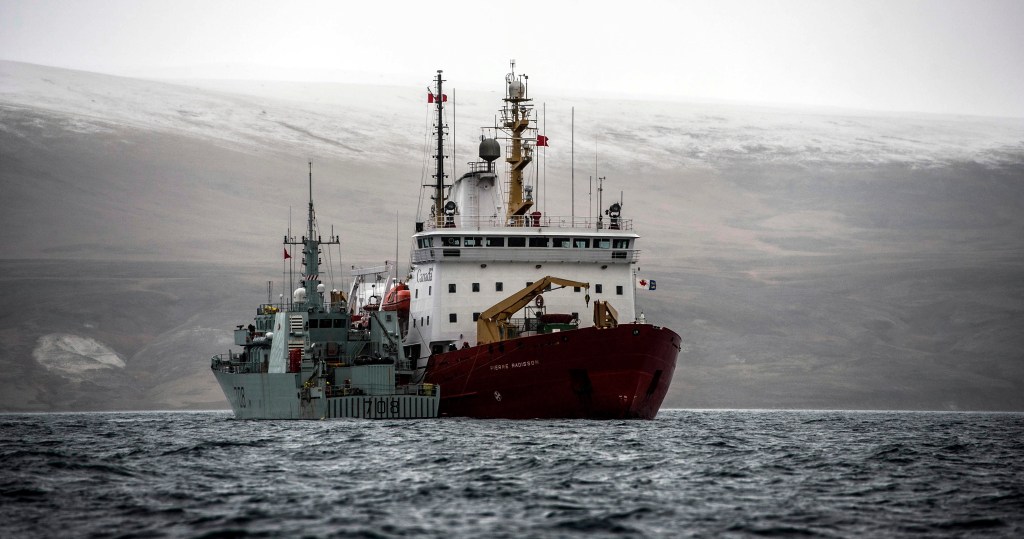
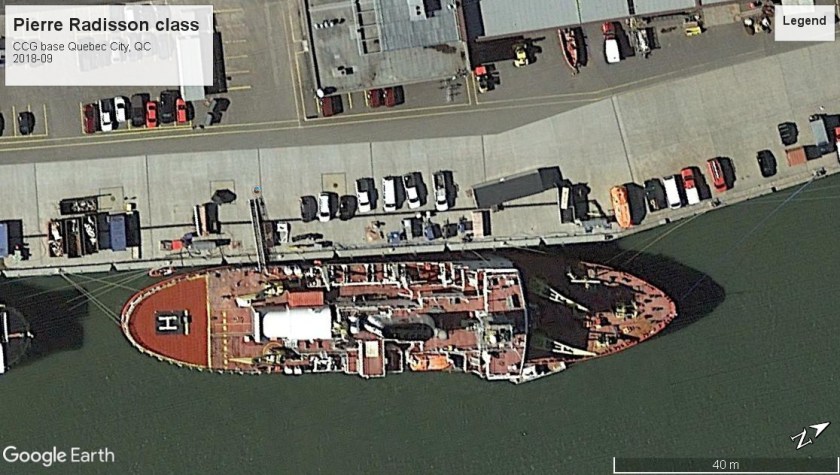
CCGS Pierre Radisson Icebreaker (1977) LOA 323’ / 98.3 m TDISP 8,200 tons Arctic class 3 breaker. Early in its career, this was the base of operations of Dr. Joseph B. MacInnis’s 1981 search effort for the Beechey Island wreck Breadalbane, supply ship to the 1853 Franklin search effort. This year it assisted or escorted RV David Thompson on the journey to Gjoa Haven. It can help to replenish and refuel the Parks Canada vessels, be called upon to ensure the security of the sites, and be involved in towing the dive barge.
CCGS Pierre Radisson (at right) refuels HMCS Moncton during the Sep. 2015 Operation QIMMIQ in Nunavut. Credit: Department of National Defence (Corporal Felicia Ogunniya) SW2015-0226-1306
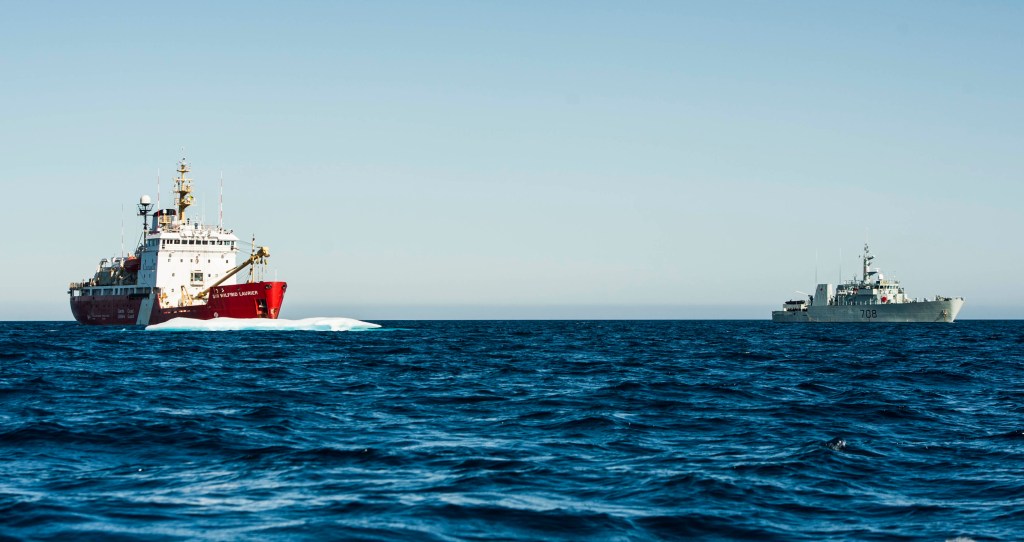
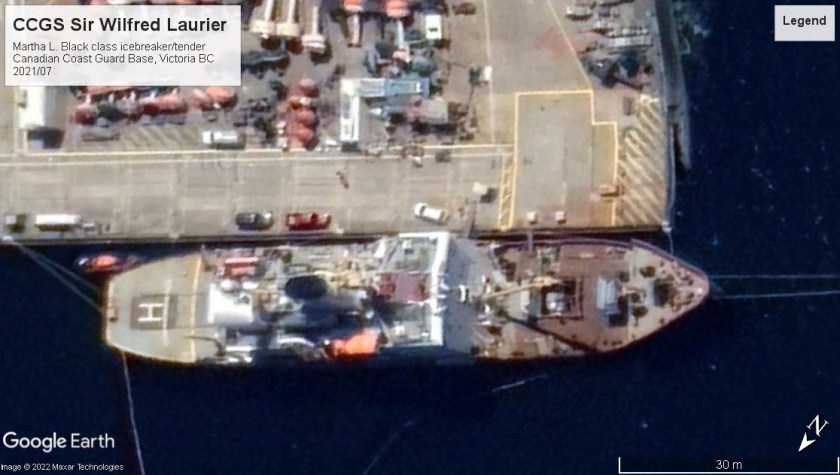
CCGS Sir Wilfred Laurier (1986) LOA 262’ / 83M TDISP 4,600 tons Arctic Class 2 Light Icebreaker and tender. This ship is a veteran of previous Franklin Expedition search efforts and Parks Canada archaeology efforts. During the 2019 season, Laurier contributed anchors to help tether the barge Qiniqtiryuaq above Erebus. Based on recent marine traffic information (2022/09/20), and the onset of colder weather off King William Island, we believe the Laurier is helping to conclude the dive season. CCGS Pierre Radisson has moved on to Hudson’s Bay. Laurier’s last positions showed it stationary near Ambush Rock after having moved westward from Gjoa Haven through the Simpson Strait and Storis Passage, towards the vicinity of the Erebus site. The ship appears to be accompanied by an 8m, 15 ton light Coast Guard Boat which may be ferrying supplies back from the actual wreck site to the Laurier.
CCGS Sir Wilfred Laurier (left) and HMCS Moncton in search of HMS Terror as part of Operation QIMMIQ on September 2, 2015. Credit: Department of National Defence (Photo: Corporal Felicia Ogunniya) SW2015-0226-980
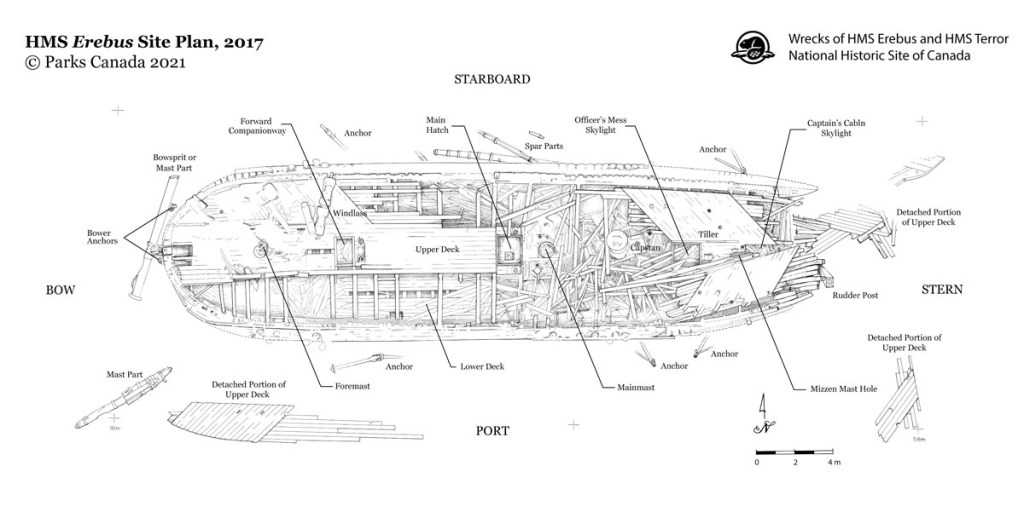
HMS Erebus (1826-ca.1849) Hecla class bomb vessel extensively modified for polar expeditions. For the 1845 expedition to locate the Northwest Passage, the massively reinforced vessel was fitted with an auxiliary method of propulsion (steam railroad engine) and a retractable screw propeller. Lead ship of expedition, carrying Sir John Franklin, officer commanding and Erebus’s captain, James Fitzjames. LOA ca. 120’ / 36.6 m davits on transom to stem knee, sparred length unknown TDISP 370 tons
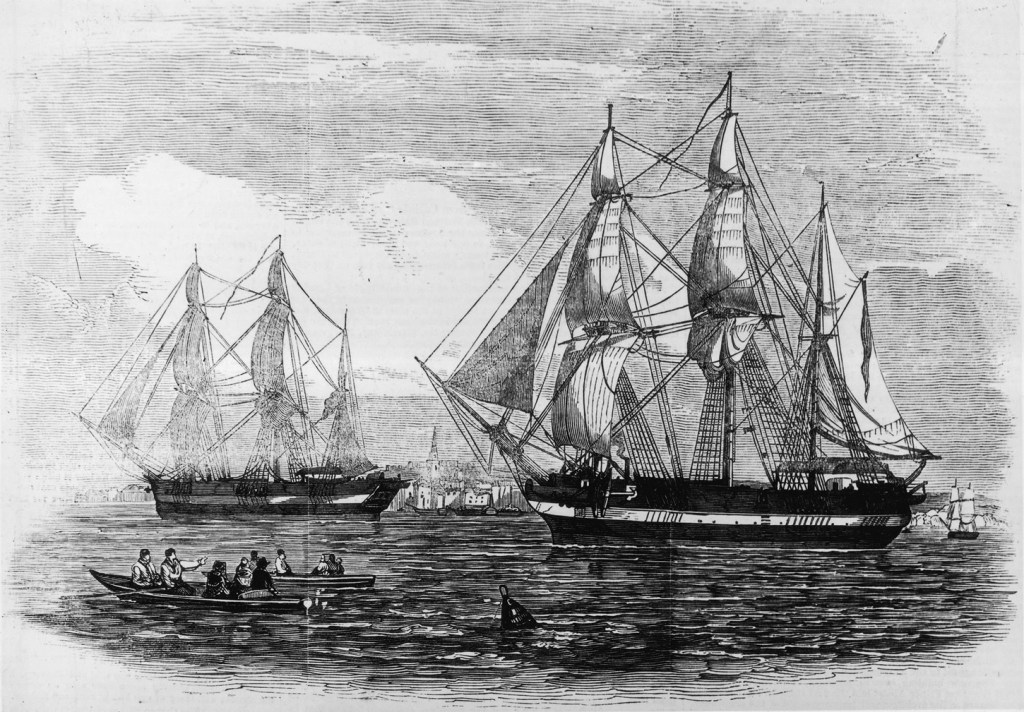
The Franklin expedition ships, HMS Erebus and Terror, setting out with fanfare in late May 1845 from Greenhithe. This was originally published for the 24 May 1845 edition of the Illustrated London News. (Via wikimedia commons) The two ships, from separate classes of bomb vessels, were virtually indistinguishable after many updates for polar expeditions.
Credit: Parks Canada, Crown Copyright.
HMS Terror (1813-ca.1849) Vesuvius class bomb vessel extensively modified for polar expeditions. War of 1812 veteran. For the 1845 expedition to locate the Northwest Passage, the massively reinforced vessel was fitted with an auxiliary method of propulsion (steam railroad locomotive) and a retractable screw propeller. Commanded by Captain Francis Crozier, second-in-command of expedition. LOA ca. 120’ / 36.6 m davits on transom to stem knee, sparred length unknown. TDISP 320 tons
A sonar image of the HMS Terror wreck, ca. 2017. credit: Parks Canada, Crown Copyright.
Credit: Parks Canada, Crown Copyright.
The precise location of the Franklin ships has not been released, and the general vicinity of each site is protected and not accessible to the public. ↩︎
We most likely won’t hear for months about this season’s work, or a reported April or May site visit (which would have involved an ice camp over either wreck site) ↩︎



 The Searchers