HMS Furnace- First Bomb to Blaze a Trail North

On that fateful day of May 19th, 1845, when the crews of Sir John Franklin’s last expedition in search of the Northwest Passage departed Greenhithe, England – never to return – they did so onboard two incredible vessels. Her Majesty’s Ships Erebus and Terror hadn’t originally been designed for polar exploration. Rather, these were both examples of a highly specialized type of warship called a “bomb vessel.” Why send a warship that was meant to bombard enemy positions on a polar exploration mission? This post briefly explores the history and design of the first bomb vessel that was sent north, HMS Furnace, which left England in 1741 on an earlier effort to locate that same illusive passage to the Pacific Ocean.1 Did Furnace blaze a trail across the frozen northern latitudes? Not exactly, but her modifications for exploration set an important precedent for a lineage of tough little ships which would be used on Arctic and Antarctic exploration missions.2
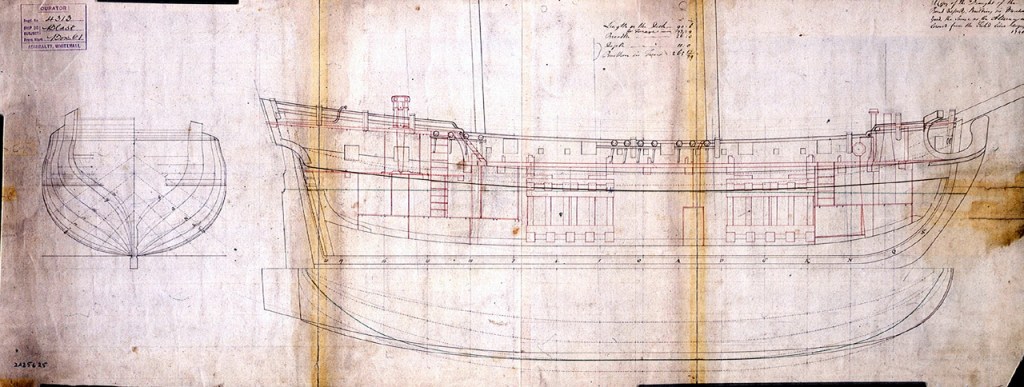
The Blast class, the original as-built configuration of Furnace from 1740, showing the two heavy mortar beds (cribbing) in the waist, the ketch rig (mainsail and a mizzen aft) a simple capstan perched high above the aft deck, and a windlass in the bow. Credit: © Crown copyright. National Maritime Museum, Greenwich, London ZAZ5625.

Maritime historian and former National Maritime Museum curator Chris Ware’s work on the history of bombs, The Bomb Vessel: Shore Bombardment Ships in the Age of Sail, explores the history of the Royal Navy’s bomb vessels, and highlights the careers of selected ships.3 The type had been created late in the 17th century to carry one or two heavy mortars amidships. Like many other great British naval developments, the idea had come from France, whose navy had built the first bomb vessels, galiotes à bombes, starting in 1681.4 The mortars (which had been developed originally for land warfare) fired types of fused shells called bombs (explosive) or carcasses (incendiary) on a high trajectory over the bulwarks. They were used against fortifications or cities and towns. The bombs would plunge downwards to explode against or over targets.
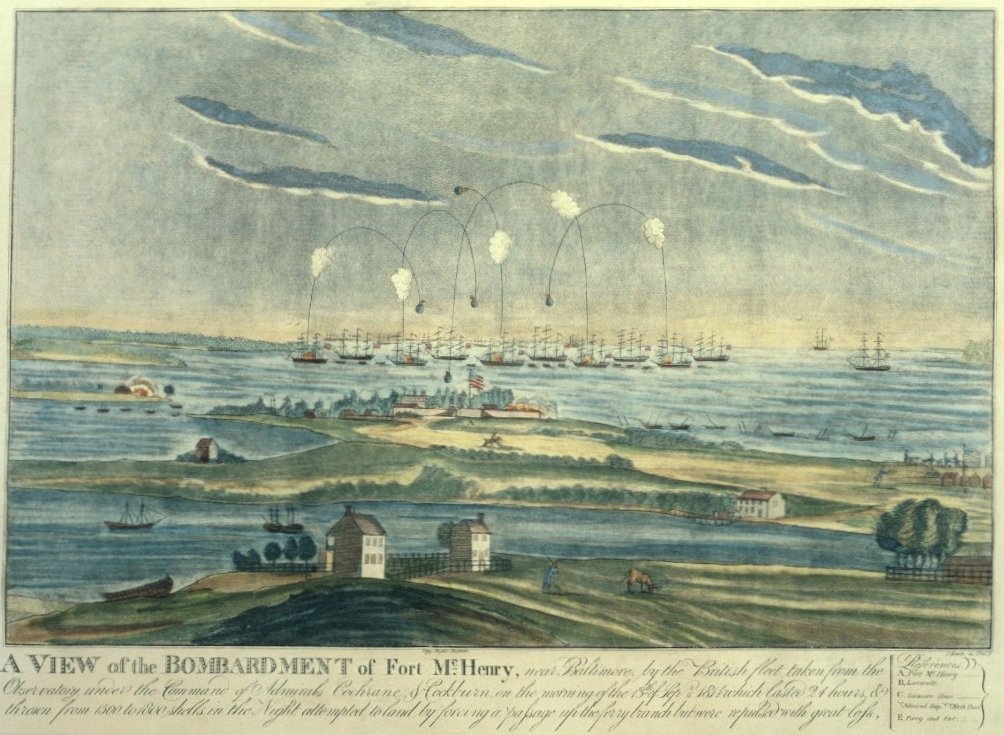
John Bower’s engraving of the Bombardment of Fort McHenry, near Baltimore, in September 1814 by the British fleet, including HMS Terror and an earlier generation of HMS Erebus, and several other bombs. Credit: Dr.frog at en.wikipedia, Public domain, via Wikimedia Commons

To carry the massive mortars and handle their powerful recoil, which was transmitted down from their carriage directly into the wooden timbers of the vessel, bombs had to be very strongly built: They were framed, decked, and reinforced much more stoutly than other ships of their relatively small size. While the first English bombs resembled small coastal craft, by the 1730s new designs appeared that were closer to naval sloops.5 There were usually only a handful of bombs active at any given time. Most spent the vast majority of their careers out of commission or converted to other roles. The Board of Ordnance, which had responsibility for both the guns and the specialist personnel to work them, would unship and land the mortars to help preserve these valuable weapons. When being used as patrol vessels, a stronger battery of cannon was installed along the gundeck.
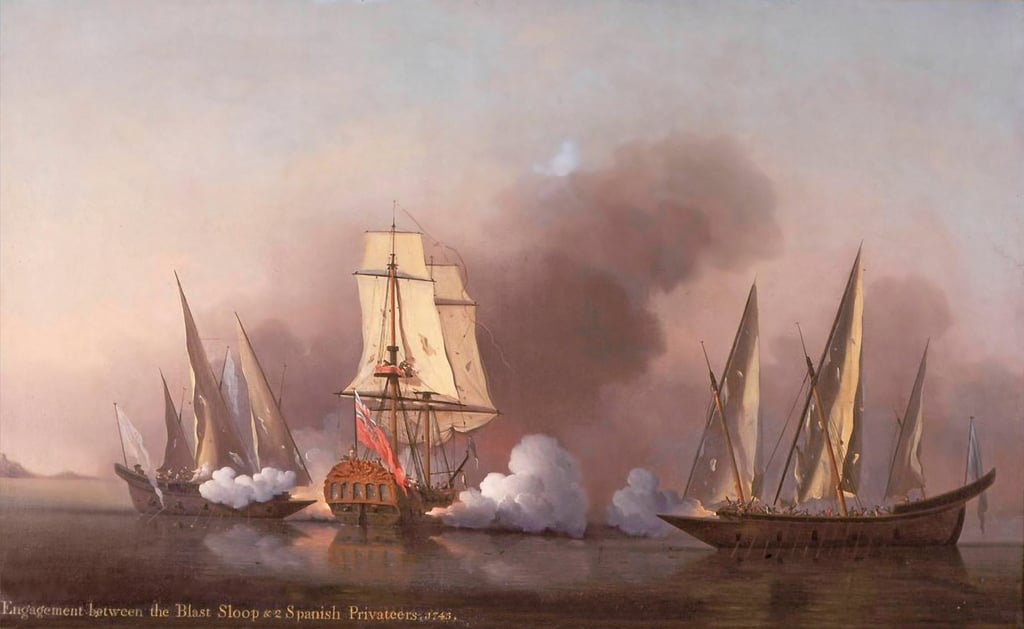
This painting by Samuel Scott is a rare representation of a mid-18th Century bomb vessel. It depicts the capture of HMS Blast, lead ship of Furnace’s class, in 1745. Blast was captured while serving as a sloop, and would have been armed without the mortars but with ten 4-pounder cannon when captured by two Spanish privateers. Blast appears to have a full 5-light (windowed) stern, and the additional armament has been added to the stern cabin (seen in the lower siting of the gunports aft). Oddly, the ship is now depicted rigged in the reverse of a ketch, as a brig or a snow. Credit: Samuel Scott, (Earl of Pembroke. Paul Mellon Centre for Studies in British Art) Public domain, via Wikimedia Commons

In contrast to the great and tragic expeditions that came both before and after, Christopher Middleton’s Northwest Passage Expedition of 1741 is rarely mentioned, even in exploration literature. This bid to locate the storied Passage, or “Straits of Anian” deserves more attention. Middleton was an experienced ship’s captain and a skilled navigator who had conducted a variety of scientific observations (including magnetic studies) while sailing to and from Hudson’s Bay, on annual supply missions for the Hudson’s Bay Company. He had an early enthusiasm for exploration, the search for the Northwest Passage, and also an interest in establishing the fate of the vanished James Knight expedition of 1719.6 Middleton had been nearby at the HBC Factory at the Churchill River (present-day Churchill, Manitoba) when, unbeknownst to anyone, the crews of Knight’s two small ships were marooned on Marble Island.7 In recognition of his scientific publications, Middleton was elected a Fellow of the Royal Society in 1737. In 1741, having left the employ of the HBC, the Royal Navy appointed him to command HMS Furnace. His orders were to seek a Northwest Passage somewhere along the Western coasts of the Bay. In reviewing the available units of the fleet, this new and rugged generation of bombs must have seemed ideal candidates for an exploration mission, where ships were in danger of colliding with icebergs, grounding, or being forced ashore out in Baffin Bay or the Hudson Strait, or being damaged or crushed by pack or land ice. Furnace would be accompanied by a hired collier, HMS Discovery, which was commanded by Middleton’s cousin, William Moor. The Admiralty optimistically believed that, a Passage having been located and exploited, the ships might link up with Commodore George Anson’s 1740-44 circumnavigation of the World, somewhere in the Pacific.

After crossing the Atlantic, the officers spent the winter at Prince of Wales Fort to get an early start to the season. Expedition crew meanwhile stayed ashore in a disused wooden fort.8 They first prepared the ships for being iced into the harbour – with Furnace becoming the first bomb to overwinter. It was a long and difficult winter, and several crew died of scurvy. Once the exploration work commenced in July 1742 they quickly discovered that a promising inlet did not in actuality offer any corridor to the west (Middleton thought this a river and named it “Wager” after Sir Charles Wager, First Lord of the Admiralty, but it was later determined to be a bay). Other useful exploration work included the discovery of Repulse Bay (the community is now known as Naujaat) and the assessment that the Frozen Straits offered no likely passage to the west. With the crew weakening again from scurvy, and the major exploration work having led to dead-ends, Middleton hastened back to England.9

Middleton’s surveying work was attacked after his return, with Arthur Dobbs (a wealthy and influential Irish landowner who has supported Middleton’s original appointment) and Moor both coming around to the view that not enough had been done to rule Hudson’s Bay out as the beginning of a passage towards the Pacific.10 Moor departed on another expedition which explored more of the same coasts of the Bay. Future expeditions would take other reinforced bomb vessels further north to continue the search for a navigable passage amongst the Arctic islands. As William Barr has pointed out, the criticisms Middleton was subjected to were baseless, and the accuracy of his surveying was eventually confirmed.11

HMS Furnace was a Blast class bomb vessel, completed in October 1740 by Quallett (presumably the commercial yard of John Quallett of Rotherhithe in South London, which built other Royal warships such as HMS Chesterfield and several sloops). She was 91.5 feet long on the gundeck and 26’4” broad, with an 11-foot draft. All told she was almost 273 tons burthen.12 This new class of six bomb vessels were rushed into service as war broke out again against Spain in late 1739. As the War of the Austrian Succession (1740-1748) spread across Europe, a second group of five almost identical sisterships were constructed the next year. Among them was the second bomb vessel to be named HMS Terror.13

Like most early bomb vessels, Furnace was rigged as a ketch, with a tall mainmast and a shorter mizzen aft. This rig proved to be problematic for the complicated laying, or aiming of the mortars, as it left only a small arc of fire unimpeded by the masts, yards, rigging and shrouds. When it came to the deck machinery, earlier bombs had been fitted with windlasses (horizontal drums) to assist in heavy tasks such as lifting the anchor cables, or the complex effort of warping the ship around on the anchor cables to precisely aim the mortars. The Blast ships, by contrast, were also fitted with the more powerful capstan (vertical drum) on the quarterdeck.14

HMS Grenado, a near-contemporary of Furnace, is depicted in a superb sectional model at the National Maritime Museum, Greenwich, which helps us explore the peculiarities of the design:
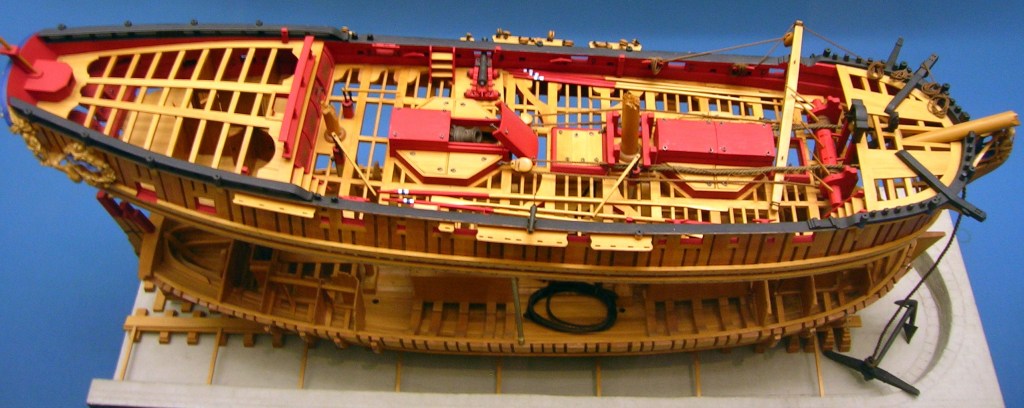
HMS Grenado model showing both octagonal mortar pits, the new trunnioned mortars, and the exposed deck beams and hull framing. Credit: Rémi Kaupp, CC BY-SA 3.0, via Wikimedia Commons the original model was built by Robert A. Lightley and is catalogued at National Maritime Museum as SLR0331.

We can observe a robust, wide hull, with closely-spaced frames. The solid construction continued into heavy knees supporting the deck beams. In Grenado and Furnace, the mortars were originally sited forward and aft of the mainmast, while the mizzen mast rises above the deck just forward of the break on the quarterdeck. A new type of mortar had been developed, which could elevate and depress on trunnions, and rotate in its octagonal pit. The mortars could be lowered and covered over with sliding hatches, and protected from the elements. The long run of the open waist amidships was necessary to provide the room needed to work the mortars. These ships, like the later Franklin vessels, were originally armed with a 13″ and a 10″ mortar. The secondary weapons, a battery of six light 4-pounder cannon, created a modest broadside for defensive purposes. Additional empty gunports, evenly spaced along the gundeck, allowed for the augmentation of these cannon when the mortars were unshipped. The officers’ cabins were tucked aft under a small quarterdeck, on a deck stepped slightly lower than the main run of the gundeck. There was a very small covered foc’sl forward of the large windlass, and between those was the usual belfry with ship’s bell.
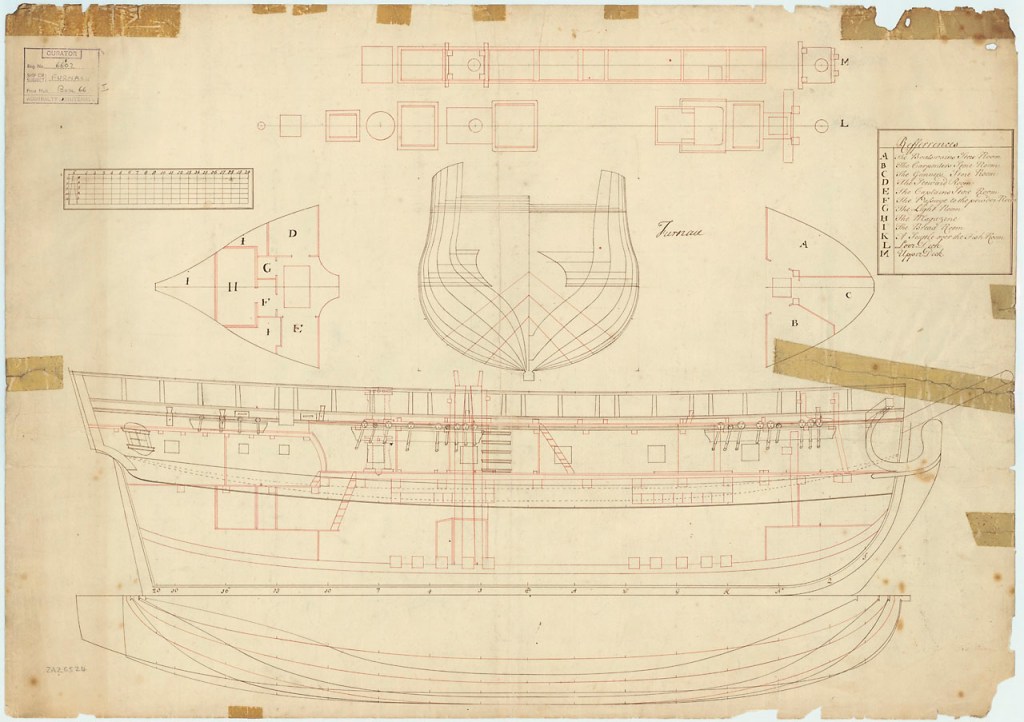
HMS Furnace as converted for the Middleton Expedition in 1741. Credit: © Crown copyright. National Maritime Museum, Greenwich, London ZAZ6524.

As can be seen by comparing the above Admiralty plans, preserved at the National Maritime Museum in Greenwich, with the Grenado model or the plans at the beginning of this post, Furnace was extensively modified for exploration. The masts were relocated, with a third mast making the vessel a sloop.15 There are many elements of the design that set the pattern for the Admiralty modifying ships for polar exploration, right down to those final modifications to Franklin’s two ships. Middleton’s input on this refit – reflecting his HBC service in the Company sloops – was important. Compared to the unmodified bomb vessels, this ship now has a shorter, less vulnerable stem, and higher sides. The open waist where the two mortars were once sited has been decked-over. The mortars, beds, and cribbing have been removed down to the keel. Furnace even has channels that have been reinforced with ice chocks to make them less vulnerable.16 The ship now has a larger double capstan, installed further forwards between the mizzen and mainmast, which could be worked by crew on both weather and lower decks. The windlass near the bows has apparently been removed.17 Middleton was able to influence the Admiralty into equipping Furnace with a complement of boats he wanted. He was even able to secure an “ice boat” for this mission, which was a specialized craft that HBC sloops used, but that had not previously been on the establishment of any British warship.18

Once the crews were wintering ashore at Churchill, Middleton held a council with his officers to discuss further modifications to Furnace. His journal, reproduced in Barr and Williams’ edited Hakluyt Society publication, provides detailed information about the March-April 1742 design modifications.19 The carpentry work that Spring optimized the bomb-exploration conversion. The quarterdeck was now built up to the level of the new main deck, to make a continuous weatherdeck. This fixed an issue where the oddly stepped-down aft deck shipped too much water during foul weather. Middleton also recognized the limitations of steering the ship in adverse conditions with an old-style tiller. He supervised the construction and fitting of a ship’s wheel, with the old curving iron tiller bar straightened out. All subsequent bomb-derived exploration vessels would be equipped with ship’s wheels.
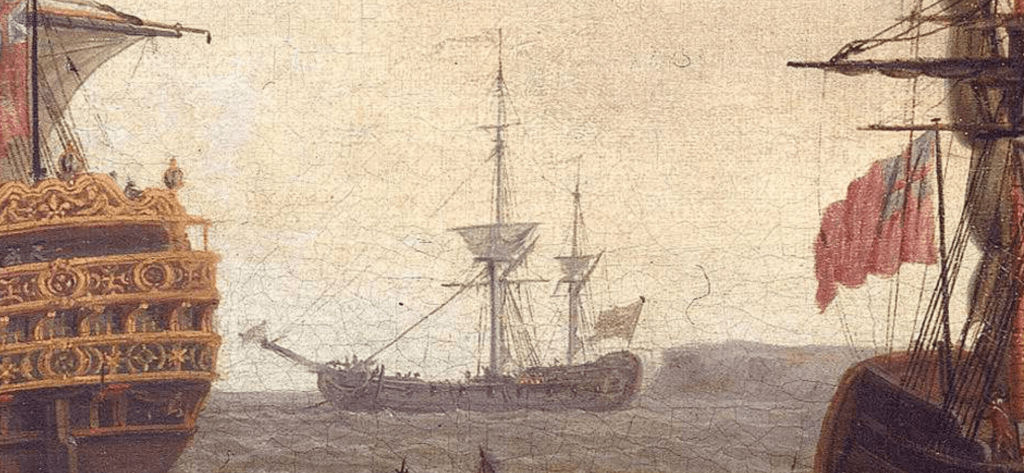
HMS Furnace or sistership Firedrake at the bombardment of Gorée, 1758. [detail of] Attack on Goree, 29 December 1758 by Dominique Serres the Elder. National Maritime Museum, Greenwich, London, Caird Collection BHC0386.

Upon the expedition’s return to England, Furnace was modified back to her original design. The overwintering and exploration work do not appear to have shortened her career: She served longer than all the other 1740-constructed bombs, being eventually decommissioned in 1763, after participating in several bombardments during the Seven Years War.20 HMS Furnace’s 1741 refit, – and Middleton’s expert 1742 modifications at Churchill – set the pattern for the modification of six other bomb vessels to be sent on future Arctic and Antarctic missions.21 This era ended more than a century later when the last two serviceable exploration bombs disappeared into the Canadian Arctic.
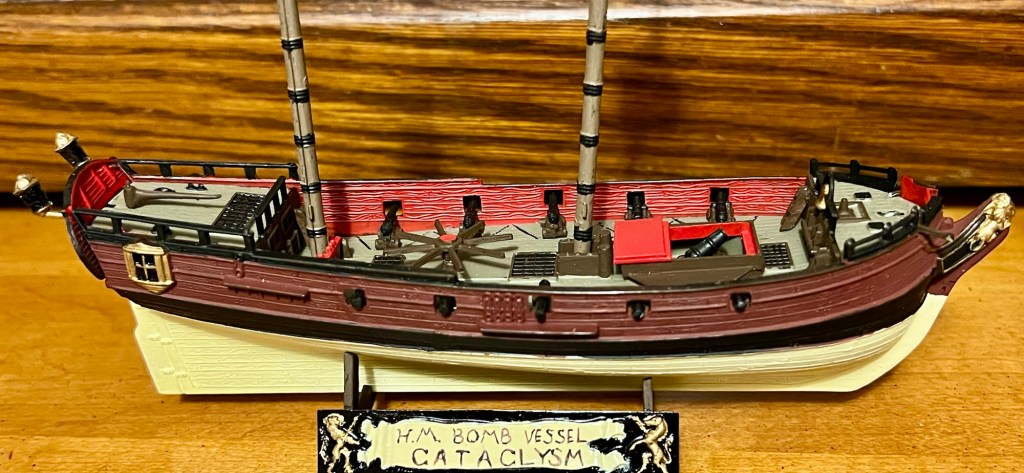
A model I worked on years ago, a modified Pyro British Bomb Vessel in (tiny) 1/150 scale. The design seems to be a simplification of a mid-eighteenth century bomb, which I modified as a fictional HM Bomb Vessel Cataclysm.
ENDNOTES:

Propelling the Terror – modelling a lost Franklin Expedition Ship’s “Steampunk” Victorian Stern

I recently wrote “Could I contemplate a scenario where new information would compel me to get back to work revising my Terror diorama?”1 Well, that situation happened almost immediately! In this post, I focus on what may seem a minor discovery – HMS Terror’s 1845 screw propeller. I argue that it is one of the outstanding finds at either Franklin Expedition wreck site. I will explore the history of this well-preserved artifact and situate it in a revolutionary program of naval ship design. I will conclude by showing how I incorporated the propeller into my diorama of the wreck site.

One hundred and eighty years ago, a visitor to Her Majesty’s Dockyard, Woolwich, near London, would have been treated to a memorable sight: one of Queen Victoria’s warships – under refit to explore the Arctic – was up on the stocks in dry-dock. This was one of a pair of bomb vessels (a type of specialized mortar-armed bombardment ship) which had been converted years before for polar missions. These tough ships had more than proved their mettle during James Clark Ross’s wildly successful expedition to Antarctica. Now the duo – each painted in severe black with a broad white strake stretching along the hull – had been selected for a new “Discovery Service” mission, to be commanded by Sir John Franklin: Complete a Northwest passage across the top of North America. Walking around the dock to the ship’s stern, that visitor would have seen something unusual: a strange cavity low down at the swollen stern post. This was just inboard from an enormous rudder. The hole opened clear through to the other side, like some casemated gun embrasure. Set into this void was a metal monstrosity: A cylindrical shaft with two broad blades twisting away from it. The visitor may have recognized this as a screw propeller – a marvel of the age. When coupled by a long shaft to a steam engine mounted in the bowels of the ship, the rotating screw could propel the vessel – all without a single sail of the lofty three-masted rig drawing a favourable breeze. If that same visitor had returned later, they may have felt the dupe of some trick: the machinery could have completely disappeared, leaving the man-sized hole. As if by some further sleight of hand, the whole cavity could have also appeared closed up, with only a faint rectangular outline now in evidence. What category of navy ship was this anyways? A sometimes-steamer with a propeller that unscrewed right off?! Indeed, here was something completely new: The first auxiliary screw-propelled polar exploration vessel!

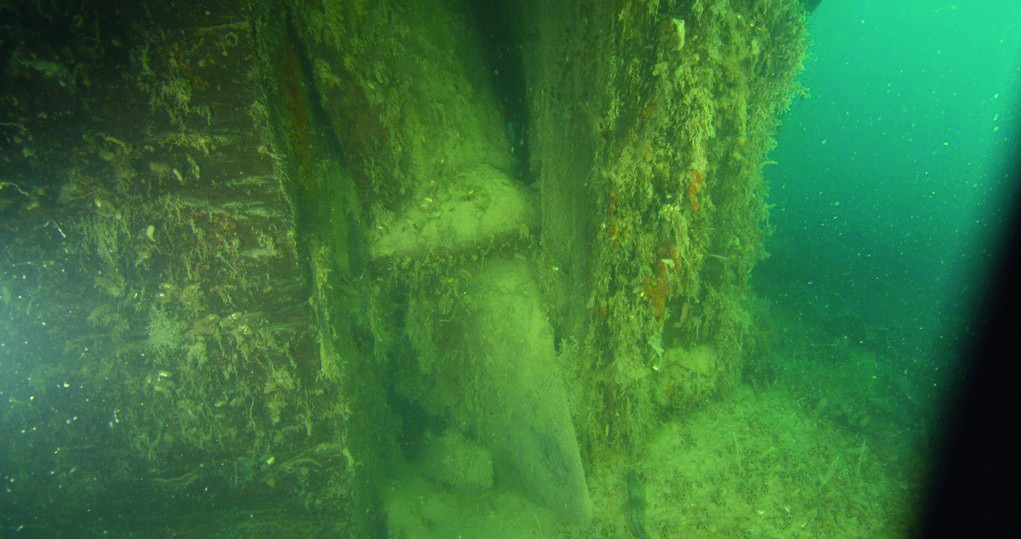
The propeller, lowered and possibly installed in its aperture at the stern of the HMS Terror wreck, as photographed by the Underwater Archaeology Team during the late summer of 2019. Credit: used with written permission of Parks Canada, who retain copyright. Scroll down to the next page to see my model of this area.

Early this year I was searching for information about the 2024 Parks Canada program of archaeology on the Sir John Franklin shipwrecks, HM Ships Erebus and Terror in Nunavut, Canada. Instead, I stumbled upon a new post “Anchors and Propellers” by Franklin Expedition scholar and veteran searcher David Woodman on his site: Aglooka.2 This update assembled interesting information about the ships’ complement of anchors, and also their propellers. Reading on, I encountered a previously unpublished image from the Parks Canada Underwater Archaeology Team (above). I was stopped dead in my wake! Here we see Terror’s screw propeller, installed in its aperture! With this photograph, we have the first visual confirmation that a marvelous piece of Victorian maritime technology has survived relatively intact after more than 175 years of immersion at Terror Bay.3

This simple two-bladed screw is one of the most important artifacts existing at either Franklin shipwreck site. The Commemorative Integrity Statement relating to this National Historic Site of Canada specifically identifies the marine screw propulsion as a character-defining aspect of the sites, demonstrating the 1845 technological innovation of the Expedition.4 From the waterline up, both ships looked much like they had during J.C. Ross’s expedition to Antarctica (1839-1843). Erebus and Terror were also not the first ships with an auxiliary steam engine to go north: In 1829 Ross’s uncle, Sir John Ross, had taken Victory north with an experimental – and mostly useless – steam engine.5 However, the idea of fitting a removable screw propeller into a Discovery Service exploration vessel was truly original. The suggestion came from a superstar in polar exploration. As Dr. Matthew Betts relates in his book HMS Terror – The Design, Fitting and Voyages of the Polar Discovery Ship, the seasoned Arctic explorer Sir William E. Parry – who now had an official role in investigating the optimal methods of steam propulsion in the Royal Navy – believed that the new propulsion technology could give vessels operating in the Arctic Archipelago a big advantage: The ability to navigate tight passages free from any dependence on the vagaries of the winds.6 Having auxiliary steam propulsion available to the Expedition captains could help force a constricted passage, position the vessels to better meet the rigors of overwintering in ice (for example by allowing them to get to a safe harbour or a more sheltered section of coast), or get them clear of an immediate hazard, such as an errant iceberg or a perilous lee shore. Parry’s experience commanding similar vessels in the Arctic provided him with an invaluable perspective on how screw propulsion could support this new attempt to transit the Northwest Passage. The Admiralty endorsed Parry’s idea.

Oliver Lang, Master Shipwright at Woolwich, was responsible for working up a technical plan to meet this new requirement. A half-century after he had begun drafting designs, he remained at the forefront of marine technological innovation. During the early 1840s, the military strength of the Royal Navy still rested on the line of battle ships of the sailing navy, those wind-powered “wooden walls” whose broadsides of cannon had allowed Great Britain to dominate the World’s sea lanes. Lang applied new technologies to both mercantile and Royal Navy vessels. He strengthened the basic structure of warships, packed their hulls with new innovations, and enhanced crew comforts onboard, especially to improve lighting and circulation of air. His innovations helped equip the fleet with larger, stronger, and safer warships. He had recently turned to incorporating steam technology into his designs. There had been experiments with steam engines and, since the early 1820s, some small naval units had been propelled by paddle-wheel. The Admiralty was conducting a series of trials of steamers to test a variety of newly-designed screw propellers against paddle-wheel propulsion.7

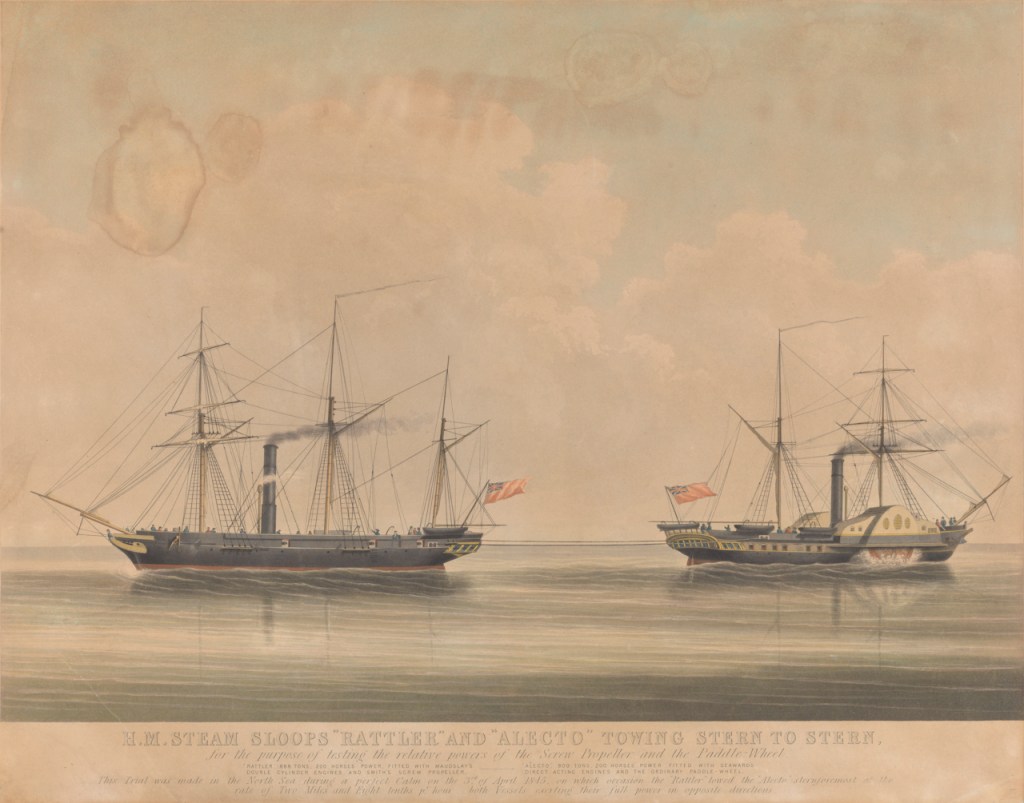
The famous trial of H.M. Steam sloops Rattler and Alecto, 3 April 1845 (artist unknown). Rattler (left) displays Lang’s newly-installed mizzen mast. PAH0923 Credit: National Maritime Museum, Greenwich

Lang’s own treatise Improvements in Naval Architecture (1853) is an important source for understanding his remarkable career. In his own words he “Arranged and fitted the first SCREW propeller to ship and unship in a TRUNK, so as to be taken up on deck in the ships “Erebus” and “Terror” on the late Arctic Expedition for Sir John Franklin.”8 The years 1844-46 were a busy period for Lang, which saw him embark on an ambitious campaign of propeller experimentation, design, and installation. He had first improved upon Rattler’s recently-installed propeller by re-rigging this steamer with a new mizzen mast, which could be used to lift the propeller in its frame straight upwards through a slot which communicated with the steamer’s weather deck. This allowed the crew to ship and unship the propeller, without specialized dockyard facilities.

While building the large steam frigate HMS Terrible (1845 – fitted with paddle wheels), he moved on to designing and fitting his first complete naval propeller assembly. HMS Phoenix (1832) was modified from a paddle-wheeler to a screw steamer. Most of the essential elements of a Lang screw-fitted stern were now in place: propeller aperture, screw propeller, false stern or rudderpost behind the sternpost, a passage for lifting the screw upwards to the weather deck, and the means for lifting it out. The modifications to the Phoenix were underway when he got the “rush order” for the work on the two Northwest Passage exploration vessels.9

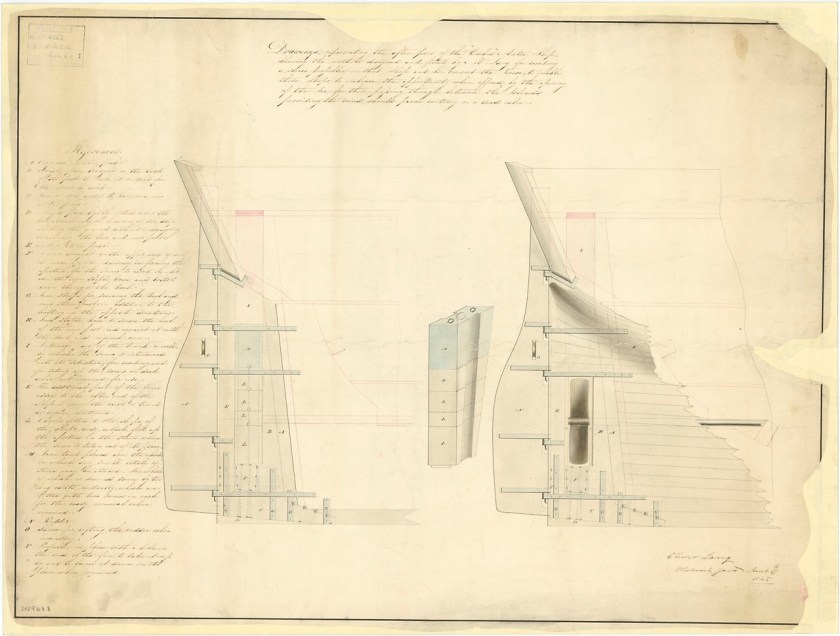
March 1845-dated plan of the modifications to the stern of both HMS Erebus and Terror, showing the massive rudder and stout construction. At left the screw propeller is raised and the full chock fills the aperture, while at right the simple two-bladed screw is installed and connected to the shaft which leads forward to the railroad steam locomotive that was installed in the hold. © Crown copyright. National Maritime Museum, Greenwich, London ZAZ5683, CC BY-NC-ND

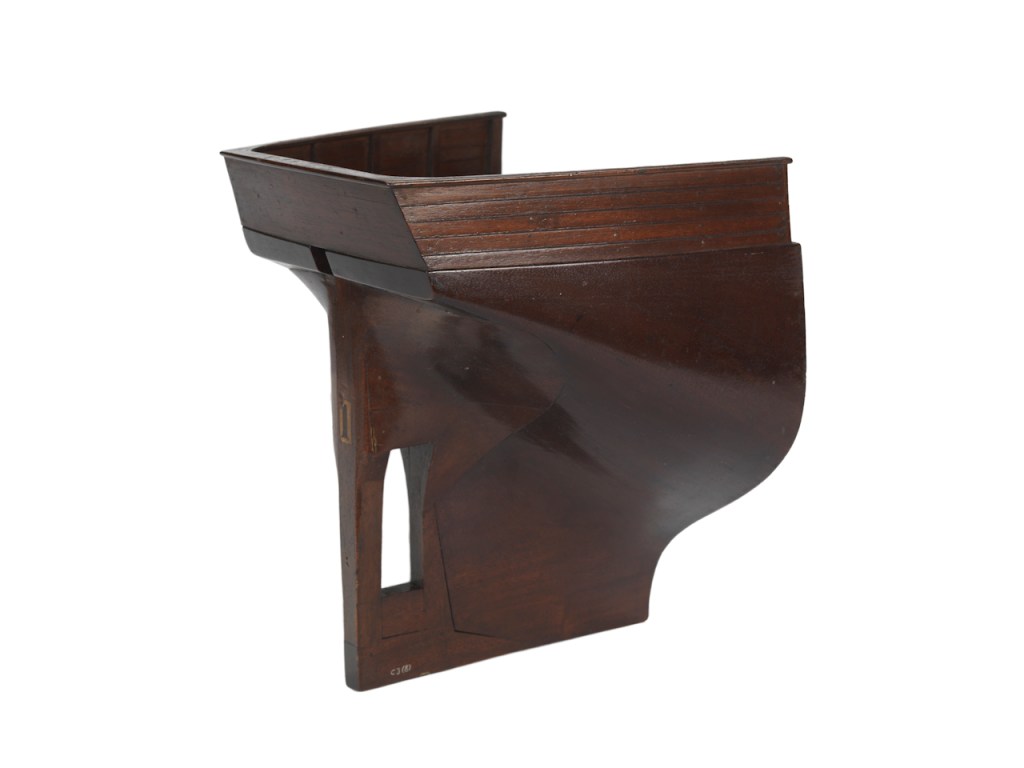
The main difference in modifying Erebus and Terror with auxiliary propulsion (with much less powerful steam engines converted from railway locomotives) was that the screws would only be fitted during occasional steaming, and chocks would fill each ship’s propeller aperture most of the time. This filler needed to streamlined into the lines of the hull to not weaken a vulnerable area, and to continue to guide the flow of water aft to the rudder. Lang’s other designs had the propeller fitting into its own iron frame, with the entire assembly lifted through a narrow passage to the deck, or lowered back in place. Erebus and Terror, by contrast, had rails that guided the propeller, which was lifted on its own.

A model of the stern of the Arctic ships as modified by Lang in 1845, showing the propeller aperture, and the bracing of both the stern post and new rudder post to permit the propeller to be hauled up into the trunk and on deck. A view from above shows the almost square passage for lifting or lowering the screw and installing the chock, and the smaller opening for the head of the rudder. Like at the wreck-site, the enormous rudder that would normally project aft is absent. SLR2253 Credit: National Maritime Museum, Greenwich, London.

Phoenix was ready in February 1845, and Lang moved to the design of HMS Niger, which would go on to be used in a more balanced round of evaluations of screw-versus-paddle propulsion (with Niger and Basilisk a closer match than Rattler and Alecto had been). During April, the Franklin ships were modified with their unique combination of adapted railway steam locomotive – installed deep down in the after hold – and auxiliary propeller. Woolwich dockyards had its own highly specialized engineering facility – the “Steam Factory” – with the equipment and docking slips to install the new steam systems. Lieutenant Henry T.D. Le Vesconte of HMS Erebus provided a contemporary description of the work. Writing to his father on 2 April 1845 – after he discussed the excellent prospects for promotion that would come his way by serving with the Franklin Expedition – he noted: “The ships are at present in dock where we are rigging each and stowing them while the shipwrights are altering their sterns by bracing on abaft the stern posts an large mass of timber of the same thickness in which to work the screw propellers the engines will be put in next week[…].”10 After the engines and propellers were tested, and the ships finished provisioning, the Expedition departed from Greenhithe, 19 May 1845. (Continue to explore Terror’s screw propeller on the next page)

Interpreting that “Melancholy Relic” – the Erebus Bay Boatwreck

In this post I will describe the “boat place” boat at Erebus Bay that searchers looking for the lost Sir John Franklin 1845 Expedition came across in 1859. A later post will show my effort to construct a small model of this unique and sadly-fated boat, and propose some likely dimensions of the full complement of Franklin boats.

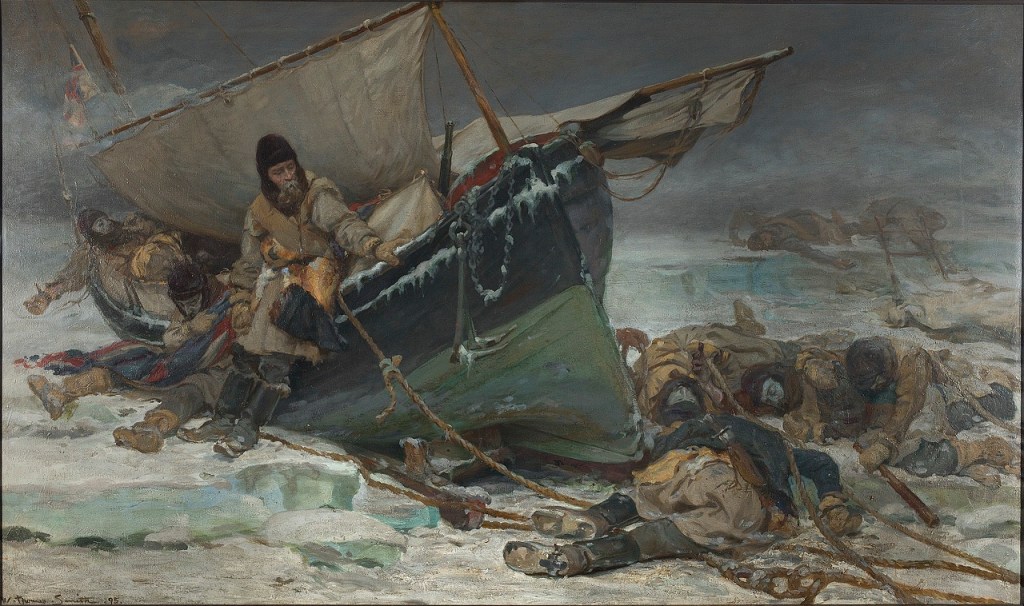
William Thomas Smith’s powerful 1895 work “They forged the last link with their lives: HMS Erebus and Terror, 1849-50.” The boat has several well-researched components, such as the washcloth around the gunwale and the ice grapnel. It also appears rigged for sailing with full masts stepped. (CC-BY-NC-ND) copyright: National Maritime Museum, Greenwich London

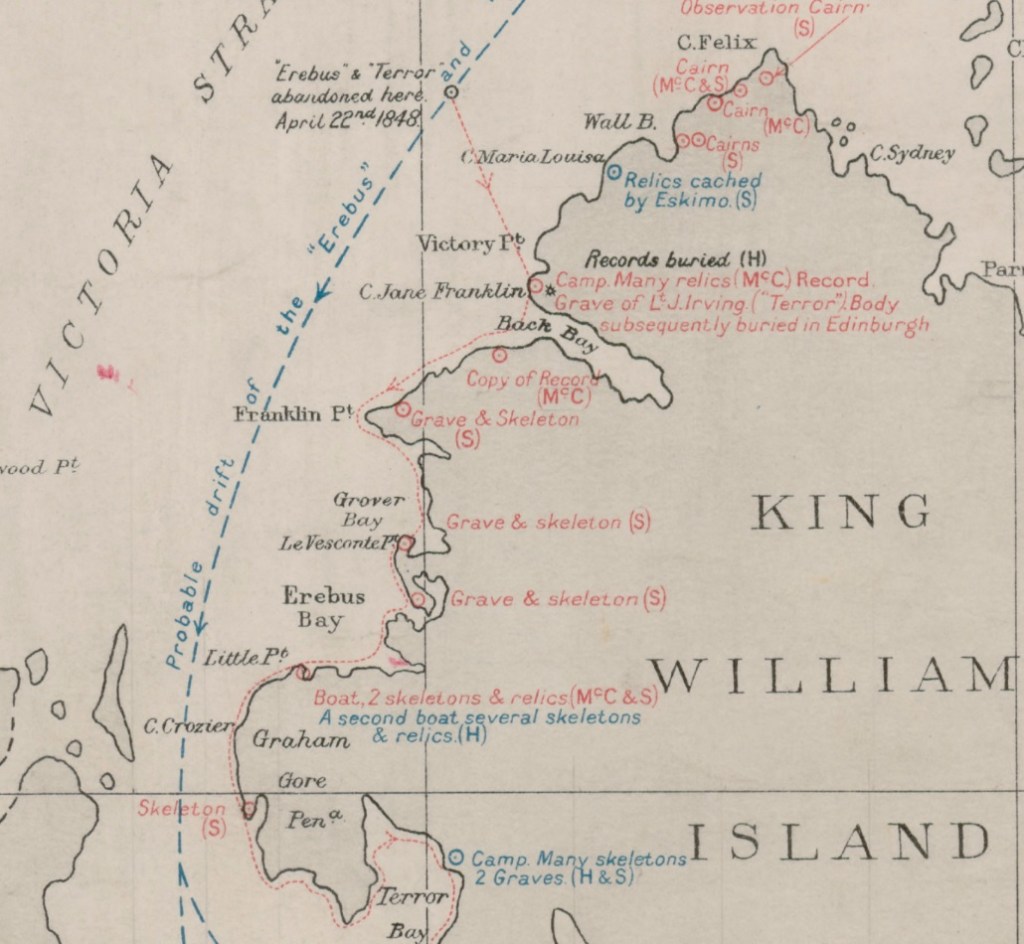
On May 23rd, 1859, at a wide bay on the frozen western shores of King William Island, a group looking for the lost Franklin Expedition found something incredible: A large boat on a sledge. Fourteen years after Franklin’s two ships had left Greenhithe, England, searchers had finally arrived at “ground zero” of the Franklin Expedition escape saga. They were a decade too late. Quartermaster Henry Toms and Carpenter’s Mate George Edwards – both members of Lt. William Hobson’s detached sledge party searching the coast as part of Francis Leopold McClintock’s Franklin search expedition – first spotted something odd projecting out of the snow as they scouted ahead of their mates.1 Closer examination revealed it to be a wooden stanchion, hanging like a beacon over the curved outlines of a gunwale in the high drifts of snow – beneath their feet was the ghostly outline of a large boat.

Chart showing the vicinity of King William Island with the various positions in which relics of the Arctic expedition under Sir John Franklin have been found / compiled by Lieut.-Cmdr. R.T. Gould, R.N [detail of]. “Boat Place” is indicated in red text at the base of Erebus Bay. Credit: Library and Archives Canada 3674742

The next morning Hobson’s group began in earnest a two-day process of clearing out the site and inventorying an unusual assortment of artifacts. That stanchion also marked a gravesite – the resting place of at least two unidentified Royal Navy crewmembers who were entombed within the hull. McClintock’s sledge team arrived a few days after Hobson had departed. His published description of what he called this “melancholy relic” is the standard account of the site.2 But Hobson had also drafted a report on his sledge team’s discoveries, which included a detailed description of the boat. We are indebted to archaeologist Dr. Douglas Stenton’s work resuscitating Hobson’s report about his journey from obscurity. Stenton’s publication of the report provides important additional details to help explore the boat place.3 Since Hobson’s team had excavated the snow from the boat and examined the objects found therein, the site had already been altered before McClintock’s party reached it. For a detailed list of the interesting and unusual contents of the boat, please see Russell Potter’s Visions of the North blog “The Boat” on the topic. My interest here remains focused on the boat itself.

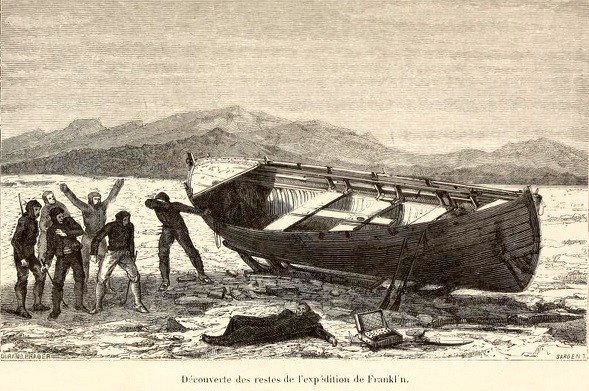
This early 1860s illustration represents some of the major relics accurately, and shows the double-ended appearance and large proportions of the vessel. Credit: Durand-Brager, from Arthur Mangin, Voyages et Découvertes outre-mer au XIXe siècle, illustrations par Durand-Brager, 1863 ː Découverte des restes de l’expédition Franklin. Public domain, via Wikimedia Commons

The Erebus Bay find remains the only Franklin Expedition boat and sledge, originally encountered reasonably intact, whose appearance and contents were described in detail. Its importance is tied to the slightly earlier discovery by Hobson’s party of the Victory Point record, in a sealed cylinder in a cairn about 60 km northeast. An update to a routine Admiralty form mentioned the abandonment of the long-beset ships, and recorded captains Crozier and Fitzjames’s intention to mount a desperate trek with their ailing crews towards Back’s Great Fish River. The note had no specific information about how they planned to cross the vast distances involved. The Boat Place discovery seemed to illustrate the mechanism of the evacuation plan: Crew members would use drag ropes to man-haul boat/sledge combinations down and around the coastline of King William Island. They would then unship the sledges and navigate the boats to the mainland and down a treacherous river towards a still-distant fur trading post. We don’t know how this plan changed as they struggled along, losing more men, and abandoning more boats. Some of the last of a group of weary men laid down to die, under another boat, on the mainland at Starvation Cove.

Back at Erebus Bay, the 28’/8.5 m boat was found just above the frozen shoreline. It listed dramatically down to starboard. A hole may have allowed wildlife – bears or scavenging foxes – access on the low side. Both boat and heavy sledge were oriented back towards the northeast, though if that was by intent (to return towards the ships), or by happenstance, no one can say. McClintock commented on both the boat’s lightness, and the sledge’s weight. He estimated the weight of the boat to be about 700-800 lbs while the sledge could have been as much as 650 lbs (the average weight of a 28-foot whaling boat, by contrast, was about 1,000 lbs).4 His observations were informed by his great expertise in sledging, acquired during his participation on this and earlier expeditions.

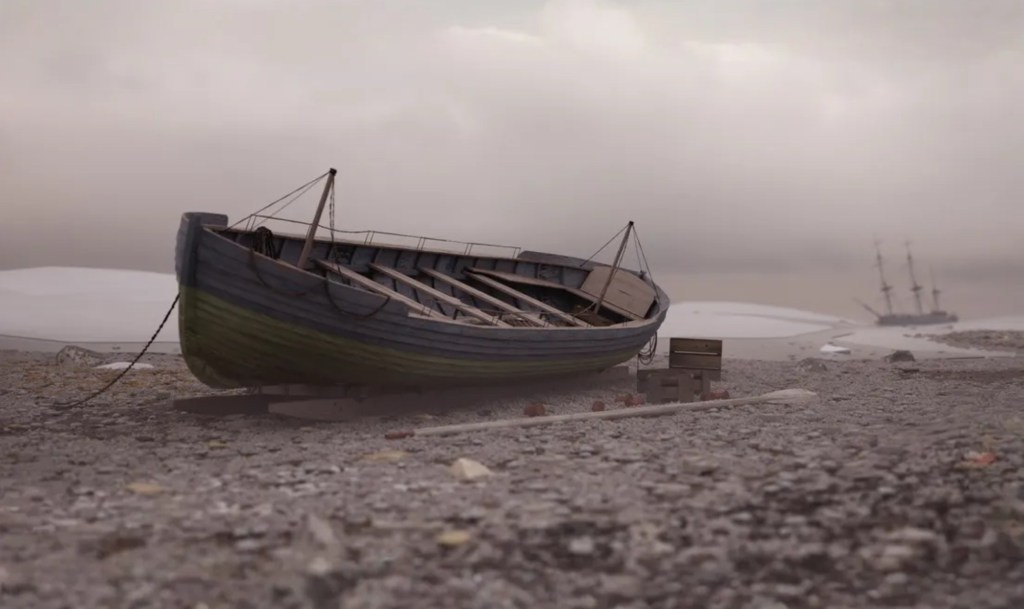
A remarkable 3D interpretation of “Boat Place.” This well-researched depiction of the boat and sledge is a recent and valuable addition to the artistic reconstructions of Erebus Bay. It was inspired by Matthew Betts’ reconstruction (see notes). The outlines of one of the ships in the distance heightens the pathos of this bleak scene. Certainly, the ships did transit by the Bay at some point after April 1848. Used with written permission of Case Western, who maintains a site with 3D printing models.

The boat had been modified by the ships’ carpenters – the square transom at the stern had been removed and the boat was now pointed or “sharp” at both ends, with a curving stem and sternpost, like a broader, deeper version of the two ships’ whale boats. The “carvel” planking (flush-edge-to-edge) of the top strakes of the hull had been replaced and lighter fir “clinker” planks (overlapping) re-laid in their place. An ingenious washcloth design of canvas was fitted in the place of the heavier washstrake boards. The set of six paddles – cut-down oars converted with larger “add-on” blades – indicate that the boat had been converted for inland/river navigation.

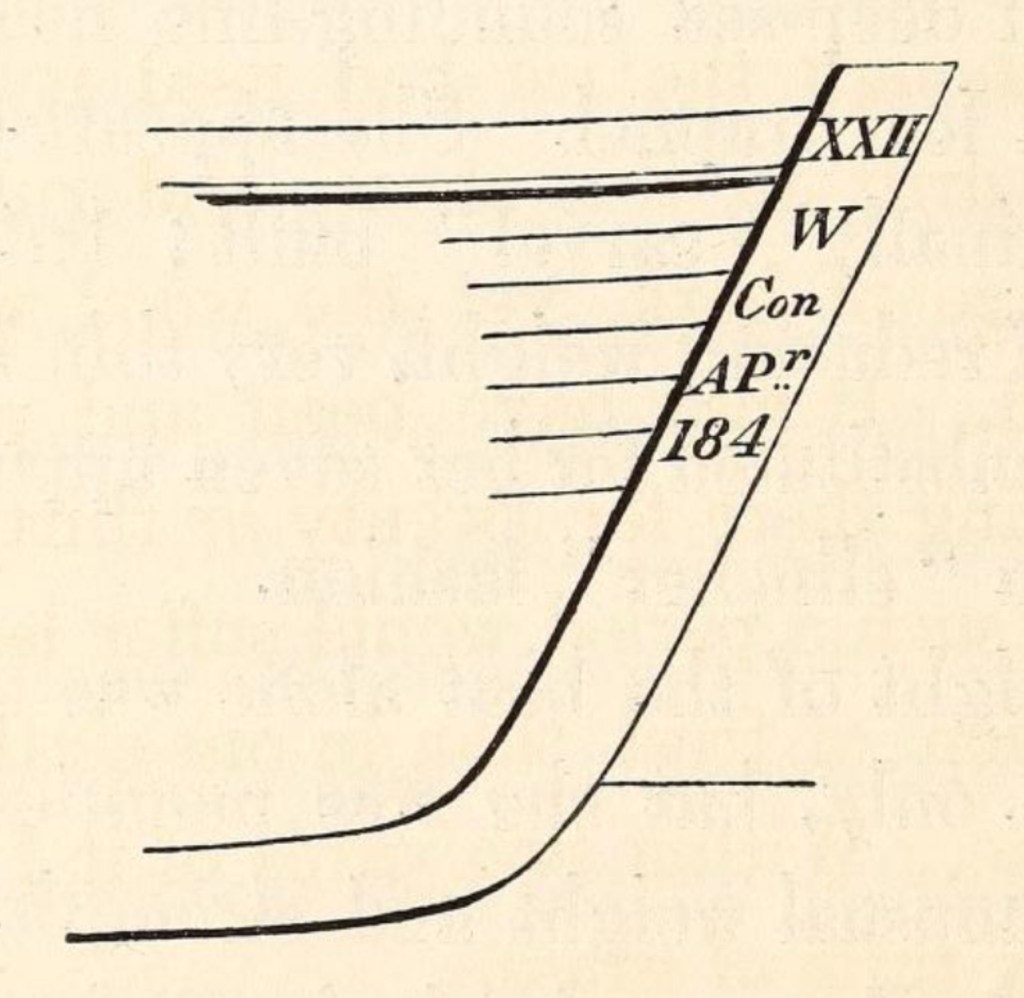
The stem, as drawn by McClintock in his 1859 edition of The voyage of the ‘Fox’ in the Arctic seas: A narrative of the discovery of the fate of Sir John Franklin and his companions (P 292) see notes section for link.

The distinctive stem of the boat was sketched by McClintock. This was recovered two decades later by American Franklin searcher Frederick Schwatka, who, while looking for records, was leading the first expedition on King William Island that encountered the sites in the summer, not under cover of snow and ice.

According to Inuit oral testimony, there was at least one other abandoned boat with many more skeletal remains that was located nearby.5 Both boats were dismantled in the early 1860s for their useful materials and fittings. Following the initial recovery of some artifacts, the dismantling, and Schwatka’s later removals, only archaeological traces and a memorial with bone fragments remain at the site – the last vestiges of a melancholy relic.

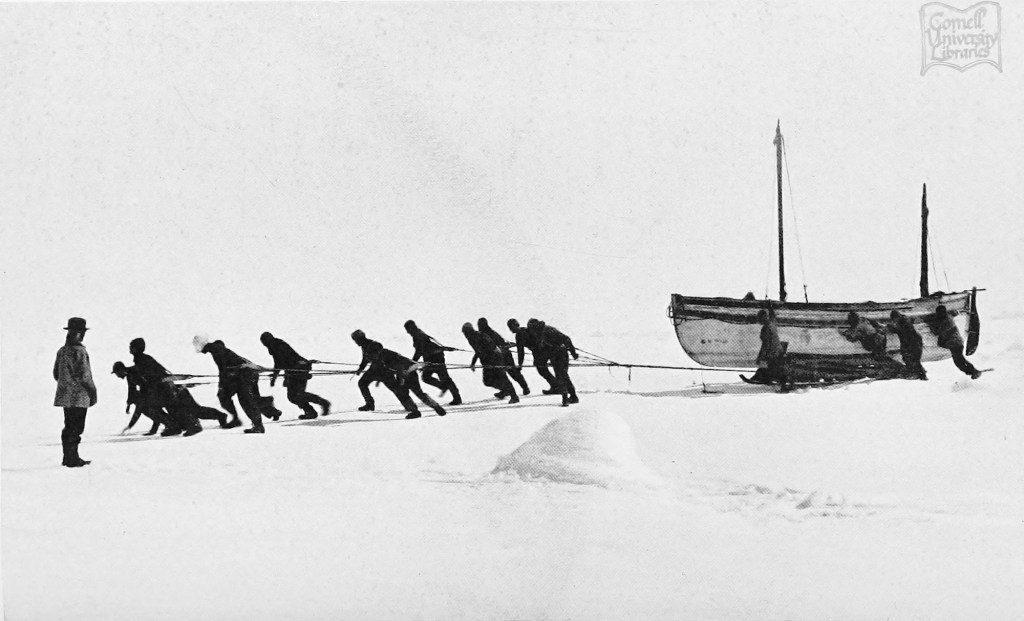
Another famous boat/sledge with a less tragic outcome, the James Caird, originally one of Sir Ernest Shackleton’s 22.5’/6.9m boats from his exploration ship Endurance, being dragged across the sea ice in Antarctica, Dec. 1915. Credit: Frank Hurley : via wikimedia commons.
The Design Dossier and References (click here):

Erebus Emerges from the Shadows

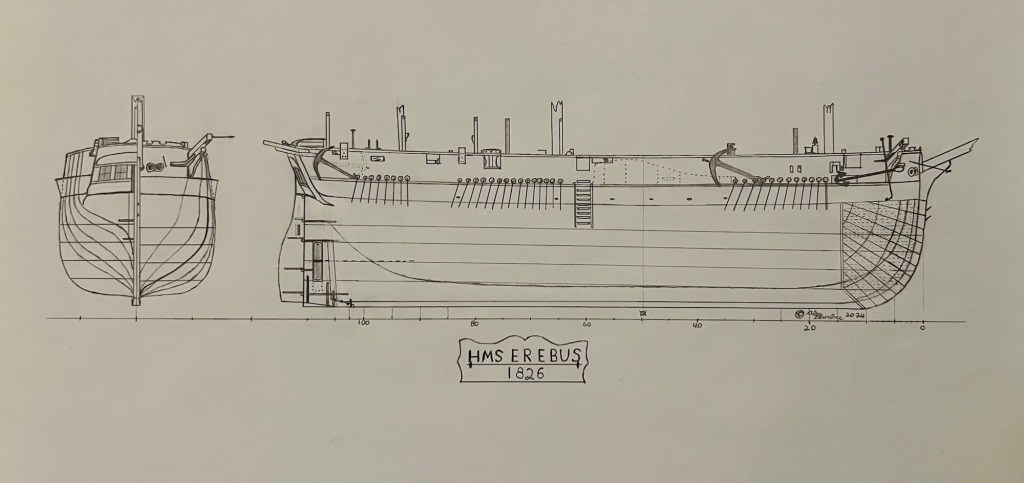
Ten years ago, the sea gifted us back a legendary ship, lost for almost seventeen decades: HMS Erebus. As visitors to our site know, there is a lot of Terror talk on this blog! HMS Terror, was the “other ship” on Sir John Franklin’s ill-fated 1845 expedition to discover a Northwest Passage. We had been neglecting Erebus, and are now trying to make amends! Interpreting a variety of archival sources, we decided to attempt a simplified set of plans of this incredible ship to mark the important anniversary of Erebus being back in our World:

Our reconstruction of HMS Erebus in her 1845 (final) configuration: stern/bow and side elevation. Credit:www.warsearcher.com adapted from National Maritime Museum plan ZAZ5673 and other technical info and used with written permission of NMM staff. Dotted lines represent features documented on Terror wreck, which could just as well have been located on Erebus, while anchor positions are from 1845 artistic representations of both vessels at sea, click the “design dossier” link at bottom for more information on this reconstruction.

On 7 September 2014, Parks Canada, a key member of the Victoria Strait Expedition – a consortium of government and private partners – definitively located one of Sir John Franklin’s lost ships. A promising sonar target had been identified in Wilmot and Crampton Bay, Nunavut, on 2 September, after archaeological finds on a nearby island had redirected the search. The Parks Canada Underwater Archaeology Team (UAT) deployed a Remotely Operated Vehicle aroung the well-preserved remains of a shipwreck, located in only 11 meters / 36 feet of water. By the afternoon of the 7th, it was clear to the team that the vessel was one of Franklin’s elusive ships. The UAT informed Canadian Prime Minister Stephen Harper’s Office. Further investigation by the UAT dive team allowed them to definitively identify the ship on 1 October as HMS Erebus.1 The discovery tied into a rich tradition of Inuit oral history, which had suggested, down through the 166-years of searching, that one of the lost ships had come to grief on the western coast of the Adelaide Peninsula.

The moment had finally come for Erebus, that personification of darkness, of gloom, of the unseen World, to come back into the light; it was time for Sir John Franklin’s lost flagship to be restored to the public consciousness. The discovery was an immediate sensation, and ten years on, the yearly program of archaeology – of surveying, imaging, artifact recovery and conservation – continues to be followed with great enthusiasm.

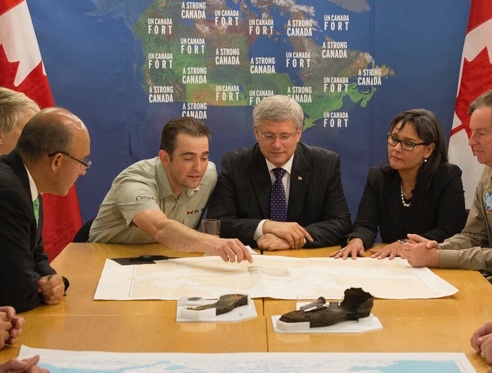
Ryan Harris (left), Parks Canada project lead, alongside Prime Minister Stephen Harper (center) and Minister of the Environment Leona Aglukkaq, announcing the discovery of HMS Erebus 9 Sep. 2014 [cropped]. Credit: Jason Ransom Library and Archives Canada R16093-50252-9-E.

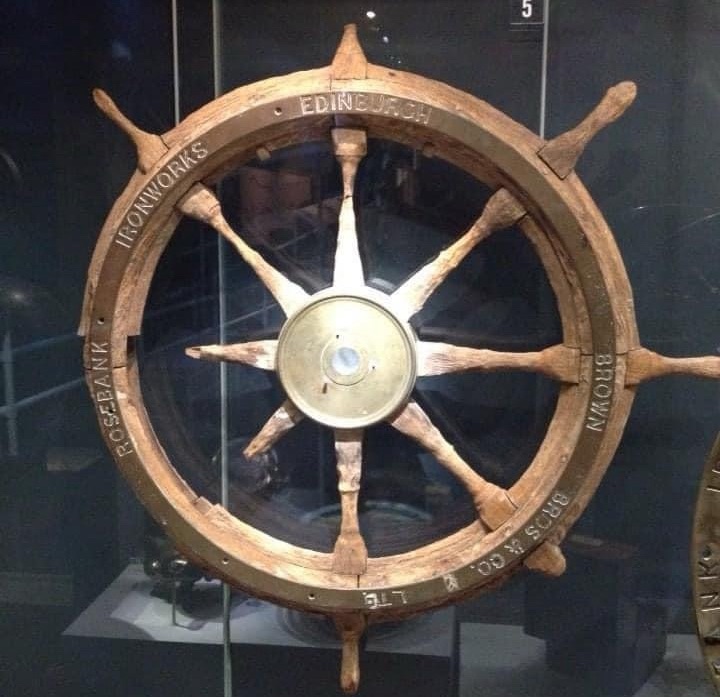
On the day the find was announced, 9 September 2014, as media reports appeared on my device, I was staring at a damaged ship’s wheel and a bell recovered from another famous shipwreck – and one of Canada’s worst maritime disasters – RMS Empress of Ireland. These were on display in the exhibit Empress of Ireland: Canada’s Titanic at the Canadian Museum of History in Gatineau. I bought a commemorative bell, walked across the Alexandra Bridge to stand under the statue of explorer Samuel de Champlain – wielding his famous astrolabe over Nepean Point (now Kìwekì Point) – which looks out over the Canadian capital – and rang the bell to celebrate the discovery! It doesn’t have to make sense, it just felt right.

RMS Empress of Ireland wheel, recovered from the wreck off from Pointe-au-Père QC. Taken 9 Sep. 2014 at the Canadian Museum of History (centenary of the sinking) exhibit.

HMS Erebus was a Hecla class bomb vessel completed in 1826, long after the conflict the “bombs” were designed for had terminated. This small warship was about 370 tons burthen, about 105′ / 32m on the gundeck (later considered the lower deck), with a beam (width) of about 28′ / 8.5m. The class was originally armed with two massive mortars – 10” and 13” varieties – housed in rotating carriages in firing beds overtop of reinforced cribbing, that also stored their massive shells. The mortars were located along the centerline of the deck between the fore and main masts. A few cannon installed along the gundeck rounded out the armament, and enabled the ships to defend themselves and perform auxiliary service as a convoy escorts – a useful secondary role during the Napoleonic Wars, when enemy warships and privateers were a constant worry to keeping merchant sea lanes open. The first Heclas were completed at the very twilight of the Wars, and took no active role. Hecla and Fury did participate in the August 1816 Bombardment of Algiers, firing hundreds of shells into the fortified city. In 1819, to lead William Edward Parry’s first exploration mission north, Hecla was converted to the radically different role of polar discovery vessel. For Parry’s next two exploration missions (1821-1825), Fury accompanied Hecla. This revived a tradition of the crews of two reinforced bombs working together on polar missions.2

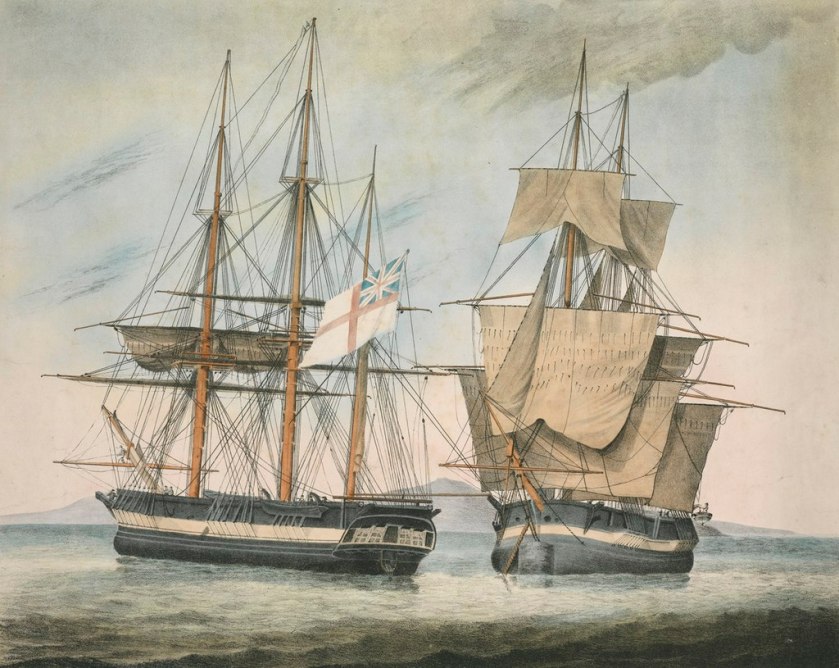
His Majesty’s Discovery ships, Fury and Hecla by Arthur Parsey (Artist & Engraver) Charles Joseph Hullmandel (Printer) in 1823. Both show early “Parry scheme” modifications for Arctic service, with broadside armament and mortars removed, reinforced channels, and bow iceguards. credit: National Maritime Museum PAH9224.

Erebus, completed the next year at the Royal Navy’s Pembroke, Wales, dockyard, remained in ordinary (out of commission), awaiting a day when the Royal Navy would have need of this compact, incredibly specialized warship. Her first missions saw her employed in the Mediterranean making ports-of-call visits and showing the flag, the typical peacetime routines of the “wooden walls” – the ships of Britain’s massive naval fleet.3 In 1839, Erebus’s moment came to be modified, but it was for an entirely new theatre of polar operations: The exploration of Antarctica. Erebus was selected to be the lead ship in James Clark Ross’s expedition south. The older and smaller Terror (commanded by Francis Crozier) accompanied her. The waist was decked over in a continuous weather deck, as the mortars were unshipped and the massive beds were removed. The ship’s basic skeleton – keel, frames and knees – was reinforced, hull planking was doubled, and this new weather deck was overlayed with diagonal planking. An enormous ice channel or chock now extended from bows to the stern, girdling the hull more completely than earlier exploration ships. The elaborate seven-light (windowed) stern with overhanging quarter galleries was reduced to five lights across the transom, in a simplified design. The entire underbody of the ship was clad in a shining layer of copper plating, but certain areas, such as the bows and waterline, were reinforced with special thickened copper. The vessel that emerged from refit looked less like a pint-sized frigate from the Wars, and more like a bulked-up whaling ship.4

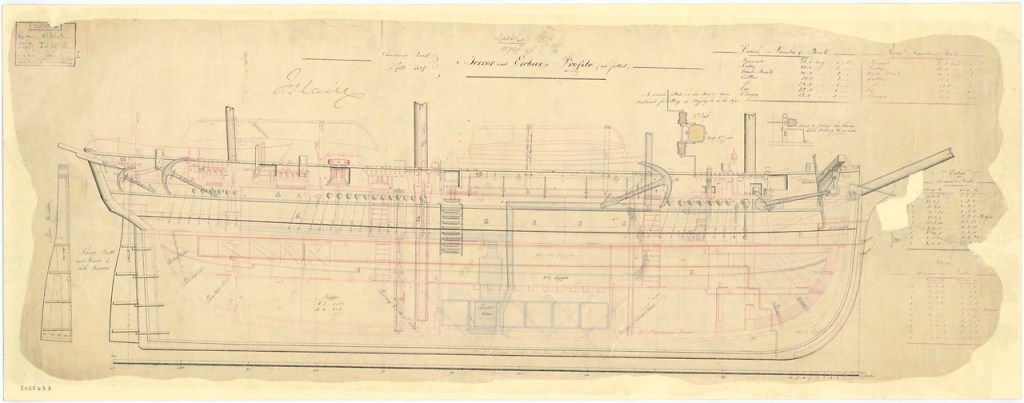
HMS Erebus as fitted for the 1839 Ross Antarctic expedition. (ZAZ5673) © Crown copyright. National Maritime Museum, Greenwich, London

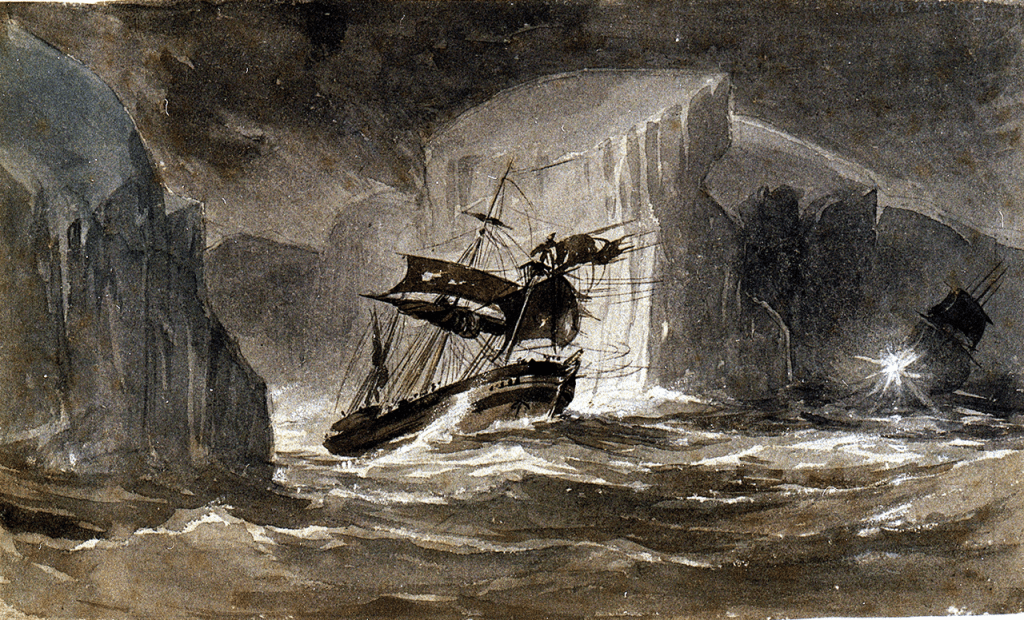
The crews of both vessels succeeded brilliantly on their four-year surveying odyssey, charting vast coastal expanses and ice shelves of the most southern continent, and making important scientific discoveries in biology, zoology, and magnetism. Operating in totally uncharted waters was perilous work, with Erebus and Terror both being damaged in an almost fantastical collision while dodging icebergs. Despite the hazardous environment, casualties on the voyage were incredibly light.

“The Erebus passing through the chain of bergs, 13 Mar. 1842” by John Edward Davis (who was Second Master in HMS Terror) depicts the moments after the collision of the two ships when the damaged Erebus sought refuge in the lee of an Iceberg to make emergency repairs. As Terror maneuvers in the distance, Erebus has lost some of her rig, her bowsprit, and her starboard cathead. Crew are frantically trying to save the bower anchor. PAF0593 Credit: National Maritime Museum, Greenwich, London

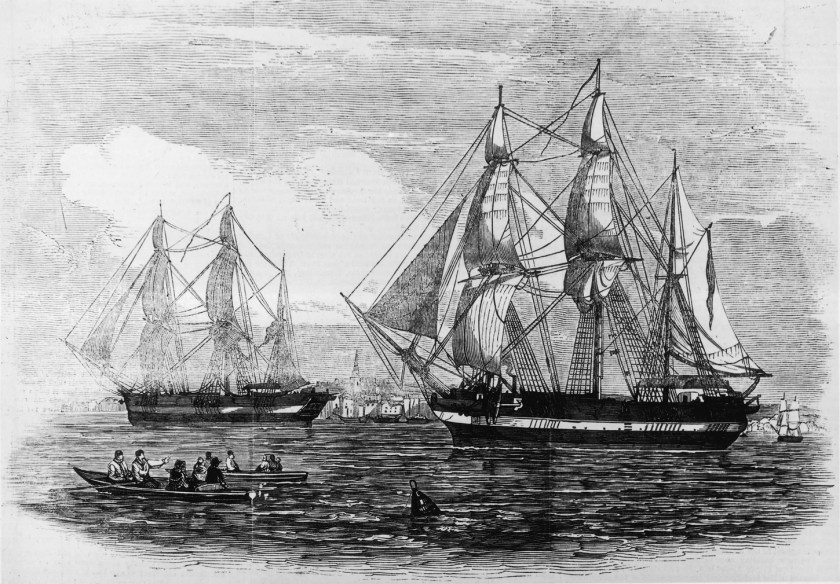
After repairs and a brief lay-up, the “Discovery Duo” was selected for the next major polar effort: Sir John Franklin’s 1845 bid to chart the last section of the Northwest Passage along the top of the North American landmass. Another major rebuild followed. A reinforced iceguard of massive iron plates was fitted to the stem and forefoot under the bows. A radical alteration to the stern timbers allowed each ship to operate a screw propeller, powered by a converted railway steam locomotive (please see our subsequent post about HMS Terror’s screw propeller to explore this interesting technological update). When not in use, the screw could be uncoupled from the drive shaft, and raised into a protective cavity that hung inside the stern. These small engines, with a very limited supply of coal for fuel, were intended to help the ships navigate in the challenging Arctic environment without being fully dependent on the wind’s vagaries.

The Franklin expedition ships, HMS Erebus and Terror, setting out with fanfare in late May 1845 from Greenhithe. This was originally published for the 24 May 1845 edition of the Illustrated London News. (Via wikimedia commons) The location of the prominent scuppers along the ice chock of Erebus (in white) seems to indicate Erebus is at right.

Franklin, installed on Erebus, would lead the expedition. James Fitzjames commanded the flagship, while Crozier, Second-in-Command of the effort, remained in his familiar Terror. As most visitors to this site likely are aware, this was to be a one-way trip for ships and crew, that ended in disaster, shipwrecks, boatwrecks, and a trail of abandoned items, burials and bones. Of the lost 129 expedition members, 67 had served on Erebus. The hulk somehow wound up wrecked in Wilmot and Crampton Bay, south of King William Island. Just like the wrecking of HMS Terror nearby, the exact details of the Erebus sinking have yet to be established.

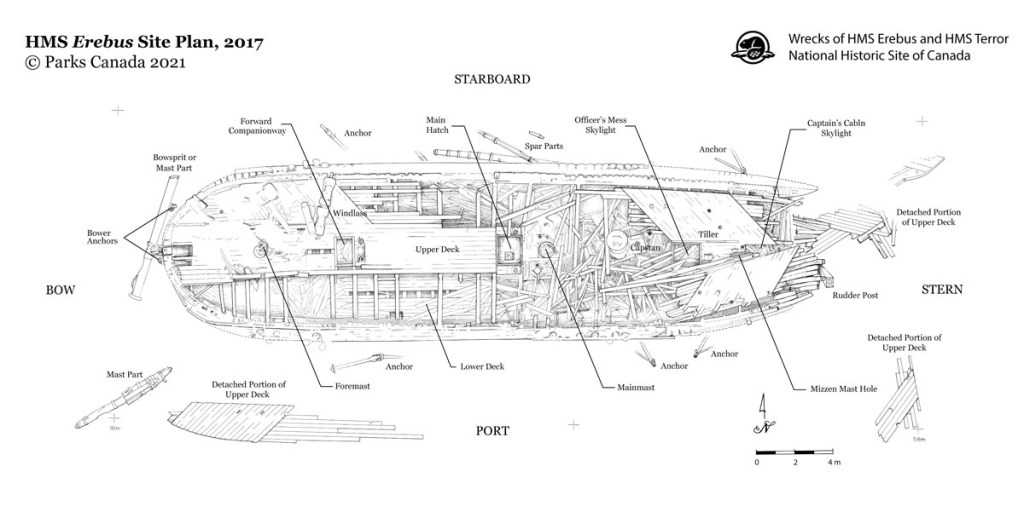
Archaeological reconstruction of the wreck, discovered ten years ago. The site plan was completed in 2017 and shared online in 2021. Credit: Parks Canada, under Crown Copyright

What were the main differences between Terror (Vesuvius class) and Erebus (Hecla class)? These were not sisterships, though they appeared so similar most observers may have thought they were. Both ships were tubby, and very similar to merchant designs, with their bluff bows and broad hulls. The differences were summarized by Dr. Matthew Betts, an expert in HMS Terror’s design and history, in his blog post “What’s the Difference – Franklin’s ships compared“. Henry Peake’s original 1813 design for the Hecla class emerged iteratively out of his earlier design for the Vesuvius class. The enlargement of 50 tons displacement and deepening of the hull are less visible than the overall impression the original plans provide: Terror’s lines harkened back to a time of more elaborate decoration and sweeping sheer (sheer being the lengthwise curvature up by the bows and stern, down at the waist); Erebus was more upright, with stem and stern posts that dropped from the ship’s built-up rails almost straight down, and a flatter sheer. The very bottom of the ship, out from the massive keel, was broader in Erebus, while Terror had a noticeably more “V” shaped lower hull.5

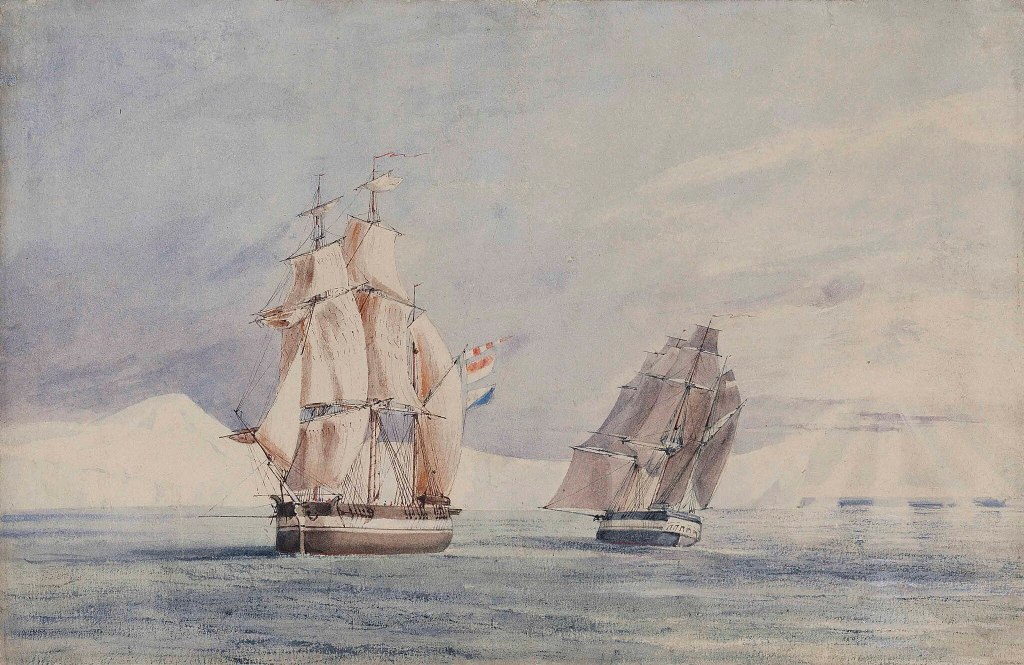
HMS Erebus and Terror in the Ross Sea. Erebus is at left. John Edward Davis, R.N. (1815-1877), Public domain, via Wikimedia Commons

During the 1845 refit, Terror’s bowsprit was seated much further aft, so that this heavy mast angled out forwards at the level of the rails. Erebus’s bowsprit remained in its traditional location, piercing the bow lower down, between the anchor hawse holes, and just above the visible ledge of the ice channel. As detailed in the “Design Dossier” link below, what is revealed from a close interpretation of plans and depictions of these vessels through their lengthy service is that Erebus, and the Heclas, had upper counters beneath their stern windows, whereas Terror and her two Vesuvius class sisters did not. Erebus also had six large scuppers a side that discharged via pipes halfway down the ice channel. These drained the weatherdeck. Terror had four large scuppers that discharged higher up, level with the deck and above the channel. Thus, by the time of their departure from Greenhithe on 19 May 1845, the ships featured distinctive elements to sort one out from the other at the bows, amidships, and aft.

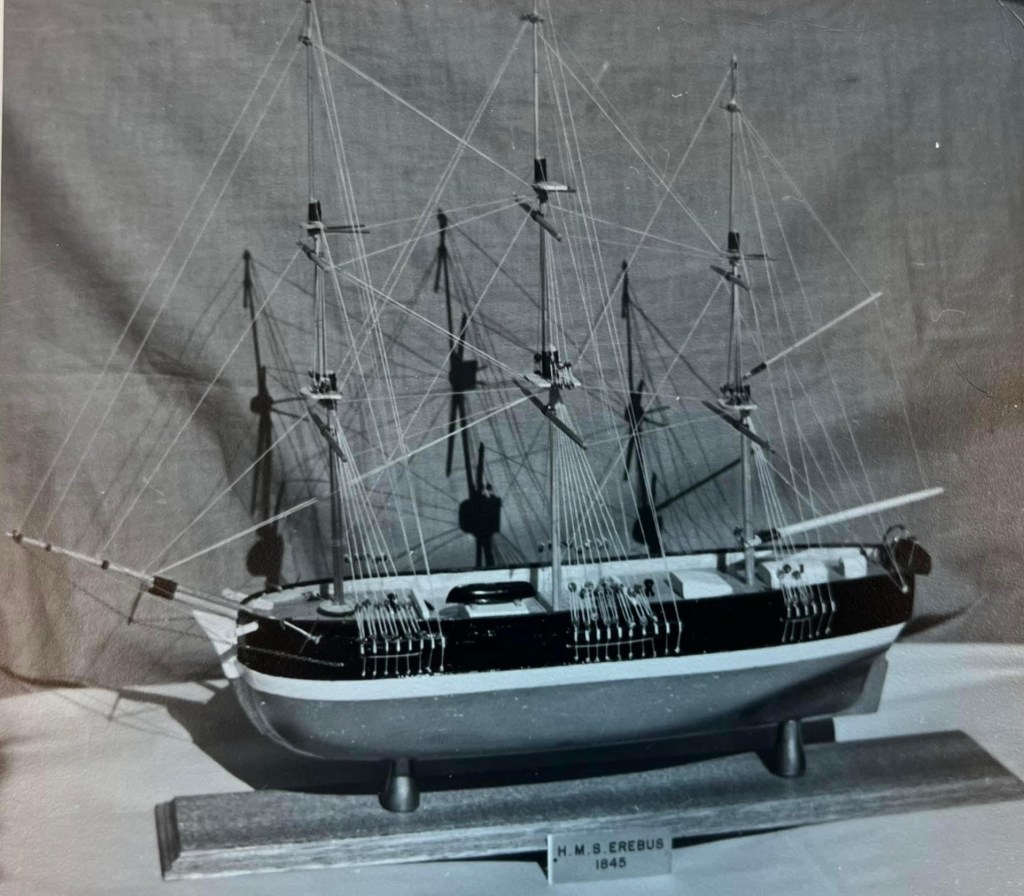
May Fluhmann (1906-1985), a notable Franklin researcher, commissioned this model of Erebus during the mid-1950s. We know based on her archival records at Library and Archives Canada that she worked diligently to secure the ship’s plans. We now also know it to not be a strong likeness, of the indicated 1845 appearance. Credit: Library and Archives Canada May Fluhmann fonds.

To conclude, when it comes to the design of these two incredibly unique vessels, we are still very much on a voyage of discovery! It has been a decade since the heady days of the Victoria Straits Expedition’s location of Franklin’s lost flagship, HMS Erebus. Much has been discovered, and much remains to be found at both Erebus and Terror sites. Along with artifacts that allow us to explore the human tragedy – the loss of two shiploads of exceptional individuals – our knowledge about the exact design and advanced technology of both ships will continue to expand over the next decades. Parks Canada’s Underwater Archaeology Team is at the Franklin ships at this exact moment! What will they find this year?

“Westward from the Davis Strait, tis’ there twas’ said to lie; the sea route to the Orient, for which so many died. Seeking gold and glory, leaving weathered broken bones, and a long-forgotten lonely cairn of stones” (S. Rogers Northwest Passage – 1981)

CLICK HERE to read the “Design Dossier” for HMS Erebus, and Acknowledgments

The Design Dossier: To create my reconstruction and simplified plans, I had to interpret a variety of sometimes contradictory sources. This project followed on from the reconstruction of HMS North Star, Franklin search ship, and HMS Ontario historic shipwreck. This may only interest a few readers, so I will summarize this research. It adds up to a unique perspective on HMS Erebus. My starting point was the excellent archival collection of plans held at the National Maritime Museum (NMM), Greenwich. My simplified reconstruction omits some frame lines along the midships section for clarity, and because I drew the plans at a small but consistent scale of 1:125. A particularly fine set of technical drawings that show the body plans or hull lines exist at the NMM for Erebus sisters Meteor (1823) and Fury. These made it possible for me to reconstruct both the overall hull lines, and also the bow and stern elevations and body plans for Erebus. Without close adherence to these plans it would be virtually impossible to reconstruct these ships, absent more information from the wreck archaeology. Another guide in this reconstruction was the artistic works that Lt. Graham Gore [Scott Polar Research Institute item 35195957] and Capt. Owen Stanley [National Library of Australia collection item 2484731] created in 1845, as the squadron moved north. I am privileging their first-hand observations over certain other technical evidence. Gore, as First Lieutenant, would have had direct involvement with readying the vessels for sea in 1845, whereas Stanley had sailed in Terror during the 1836 Frozen Strait Expedition, and temporarily accompanied the squadron northwards while commanding HMS Blazer, a steamship towing Erebus. Gore sent his artistic depictions back for Lady Jane Franklin while the expedition members posted their final letters from Disko Bay, Greenland (Qeqertarsuup tunua).

  1. Erebus had a large -almost hemispherical- iron iceguard fitted to the bows. Parks Canada’s archaeology has documented iron plating extending from the stem all the way back to be level with the foremast. Their commissioned wrecksite diorama (built by professional model builder Fred Werthman) also demonstrates this expanse of plating. This appears to be larger than any polar-modified ship from before the Expedition and any of the search vessels that followed in the wake of the lost ships. Correspondence with Parks Canada’s Underwater Archaeology Team and Dr. Matthew Betts have substantiated this feature.
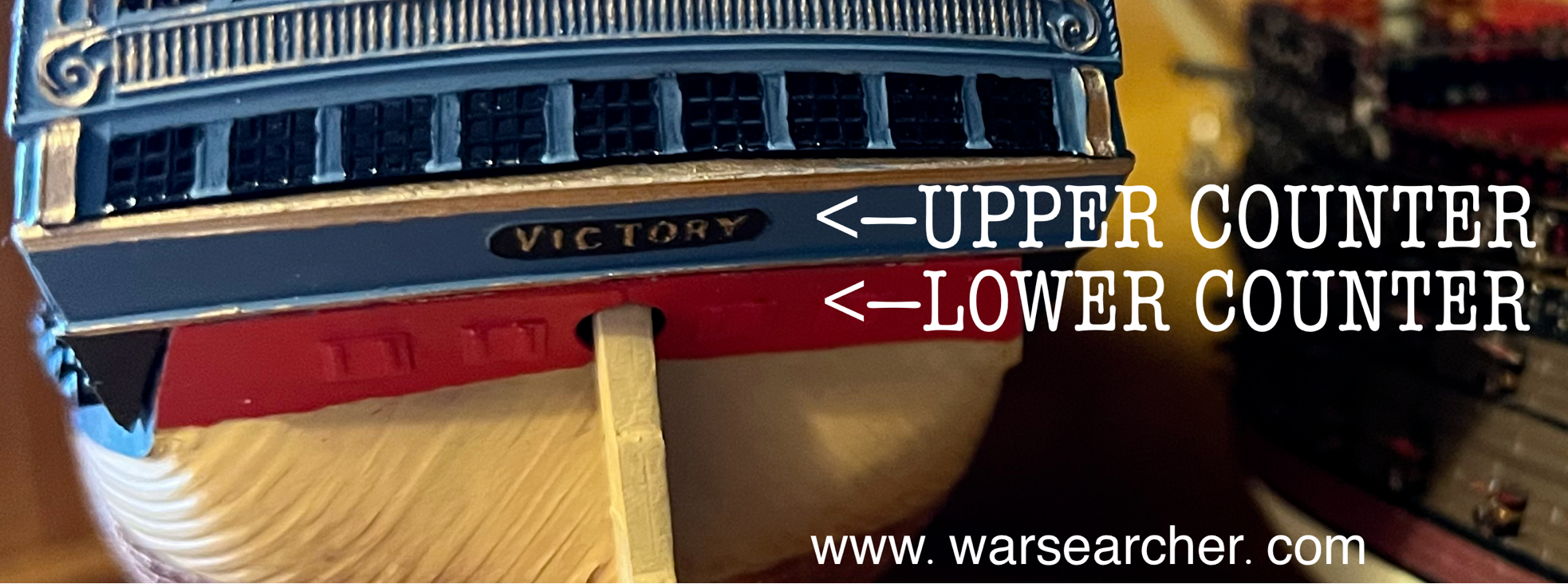
  2. A distinctive difference in the sterns of the ships is that Erebus always had an upper counter, whereas Terror never had one. An upper counter (see below HMS Victory model) is a space traditionally found under the lowest level of lights (windows) on the stern of a vessel, which also often has the nameplate or lettering identifying the ship. Developing to its classical appearance in the early 18th century, the design of the upper counter was mostly aesthetic, and made a visual transition to the more concave space of the lower counter (where the ship’s rudder usually enters the stern, and stern chase ports, if they exist, are located):This small feature can be readily seen under the stern windows of Parry’s ships in the illustration of Hecla and Fury at top. Terror and her two Vesuvius class sisters (RMG ZAZ5615), by contrast, were more constricted aft and had less deck height in the great cabin, so no upper counter existed under the lights, even when the ship had full, frigate-like stern and quarter galleries. Terror lacked the upper counter in 1813, in 1836, and again in 1845, according to the NMM collections of plans, and a variety of depictions. The upper counter is documented for Erebus on Meteor and Fury‘s 1823 plans and her own 1839 plans as rebuilt for the James Clark Ross Antarctica mission.
  3. This era saw a lot of experimentation in naval architecture around the stern, to establish the most optimal means of fitting a screw propeller into an existing wooden warship. Oliver Lang (the shipwright for the 1845 modifications to both ships) was at the very heart of this innovative furor, and was involved in the design of the stern of revolutionary new types of steam sloops, frigates, and line-of-battle ships, all modified or designed from the ground up to fit the new models of screw propellers. I believe, when he came to modify these two veteran exploration ships with new propulsion, he omitted the traditional lower counter design from under the transom/stern galleries of both ships, rounding the tuck up, or carrying and uniting the hull planking upwards to meet the transom timbers. His 1845 technical drawing for the stern of both ships (RMG ZAZ5683) is an approximation, even when overlaid to produce the June 1845 “green ink” updates on the 1836 Terror plan (RMG ZAZ5672). The plan had to work for both ships, which had some significant differences in dimensions and stern post orientation. This plan’s inaccuracy can easily be observed when it was traced over to the 1836 Terror plan: The 1845 updates create lines at the level of the ship’s upper rail that have no sheer and terminate hanging in space! Those lines are a simple tracing of the left side sectional stern plan from the 1845 technical drawing, not the right side exterior elevation. This means they are a sectional view imposed inaccurately over Terror’s 1836 lines, with nothing added about what this all looked like from the outside! My interpretation is one of three possible options for the 1845 stern: Round the tuck up to the level of the upper counter in Erebus and the transom/stern galleries in Terror; round the tuck up to the level of the galleries and also remove Erebus’s upper counter; deviate from Lang’s 1845 technical drawing and retain the lower counter in both ships, with Erebus likely also retaining her existing upper counter. As I hope I have indicated with linked examples above, the green tracing on the 1836/45 Terror plans are not accurate – but especially not for the larger Erebus! Only the wreck archaeology will determine the true dimensions and precise geometry of either ship’s 1845 stern configuration. I believe that Lang, familiar with what had happened to Terror’s old-style traditional stern during her 1836 Frozen Straits Expedition ordeal – the near fatal damage to the stern timbers – would have followed his general program of propeller installations, and planked the strongest stern he could have into the two ships- to give the vessels the best chance of not being destroyed by Arctic ice. In my plan, I drew in a “quarter badge” element which tails downwards and which would have flanked the original lower counter in Erebus. This is a stylistic decision and also allows me to easily pencil in a lower counter dividing line towards the stern post if I end up being wrong!

ACKNOWLEDGMENTS: We would like to acknowledge the assistance of staff at the National Maritime Museum / Royal Museums Greenwich, as well as HMS Terror expert Dr. Matthew Betts, and Jonathan Moore at the Parks Canada Underwater Archaeology Team, both of whom generously corresponded with me about elements of Erebus’s design over the course of my often-ambling 2022-24 correspondence. Their assistance does not imply that they endorse the above interpretations.

Notes:

  1. This summary of events is drawn from several chapters of John Geiger and Alanna Mitchell Franklin’s Lost Ship: The Historic Discovery of HMS Erebus (Toronto: HarperCollins Pub. 2015). Ryan Harris, Parks Canada’s project lead on Erebus, provided an incredible guided tour of the wreck in October 2014: https://youtu.be/ZxH18XKqt-k?si=OCrC1XHYZa6AfpvC ↩︎
  2. Earlier expeditions of the 19th Century had used converted whaling ships, but Captain Christopher Middleton’s 1741-42 Northwest Passage Expedition featured the converted bomb vessel HMS Furnace, while Constantine Phipps 1773 Expedition “towards the North Pole” (which a young Horatio Nelson journeyed on) used a pair of bombs, HMS Racehorse and Carcass. Fury did not survive her Arctic ordeal, and, it is hoped, one day this near-sister of Erebus, with earlier Arctic modifications, will be discovered near Fury Beach, Somerset Island, Nunavut. ↩︎
  3. Michael Palin’s book, Erebus: The Story of a Ship (Random House: 2019), is an essential source for information about all periods of the vessel’s service. The equivalent work for Terror is Dr. Matthew Betts’ HMS TERROR: The Design, Fitting and Voyages of a Polar Discovery Ship (Seaforth pub.: 2023) ↩︎
  4. Hecla was in fact sold for conversion to a whaling vessel in 1831, and a very good whaler was she! ↩︎
  5. In technical parlance, Terror had slightly more steep-rising floors. A useful description of the changes to sterns, bows, and sheer in the first half of the nineteenth century can be found in Dr. Frank Howard’s Sailing Ships of War 1400-1860 (Greenwich: Conway Maritime Press, 1971) P271. Howard also mentions an interesting and cautionary issue about interpreting contemporary 19th C. naval plans: The ability to draft accurate technical depictions to represent new design elements on paper lagged behind the innovations themselves. ↩︎