Ships in desolation, in dire straits, in peril, beset, with icebergs the size of fortresses barreling down upon them. William Mumford painted what he saw, and what he saw was a lot of natural forces conspiring to destroy his ship, HMS Resolute. He was the ship’s carpenter, an important position, onboard a wooden ship surrounded by frigid water, ice, and barren rock.1
Here is more of the remarkable William T. Mumford collection of watercolours now in the custody of Library and Archives Canada.2 Please visit our recent post “A Resolute Perspective – What Mumford the Carpenter saw while searching for Franklin” for context, and the first group of artwork. Today, his little-known watercolours are a fine visual record of his 1852-1854 experiences on board Resolute, a member of the Sir Edward Belcher Expedition looking for the lost crews of Sir John Franklin. This instalment documents the transit up to Greenland and the early period of the searches. Mumford’s keen eye for detail will feature in several upcoming posts! Additional information has been supplied, mainly from passages in Mumford’s shipmate, George F. McDougall’s published journal The eventful voyage of H.M. discovery ship “Resolute” to the Arctic regions: in search of Sir John Franklin and the missing crews of H.M. discovery ships “Erebus” and “Terror.”3
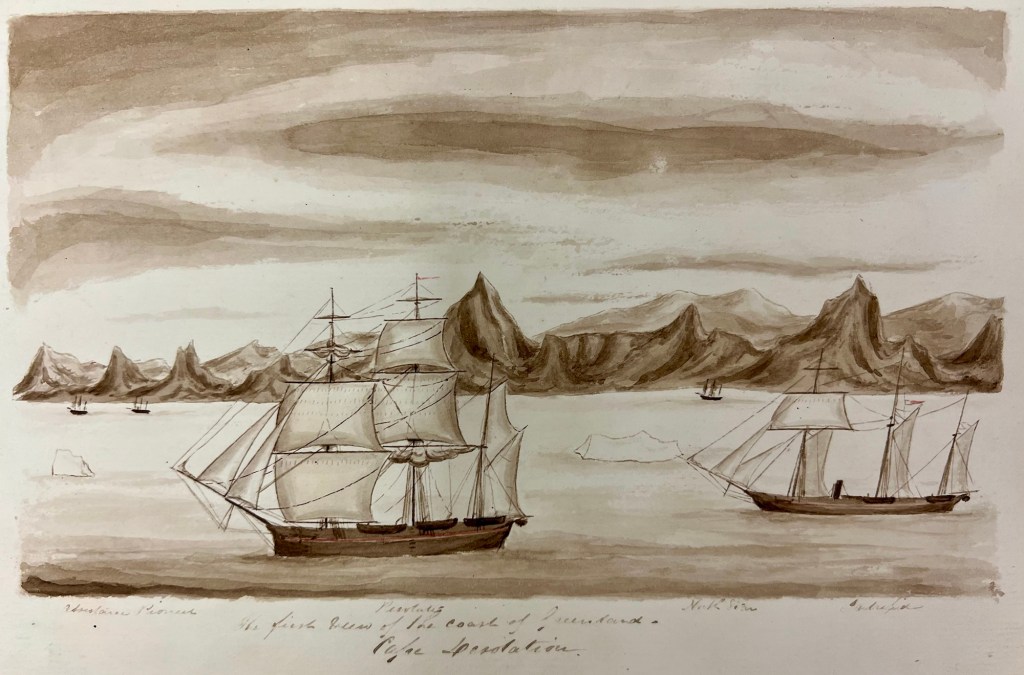
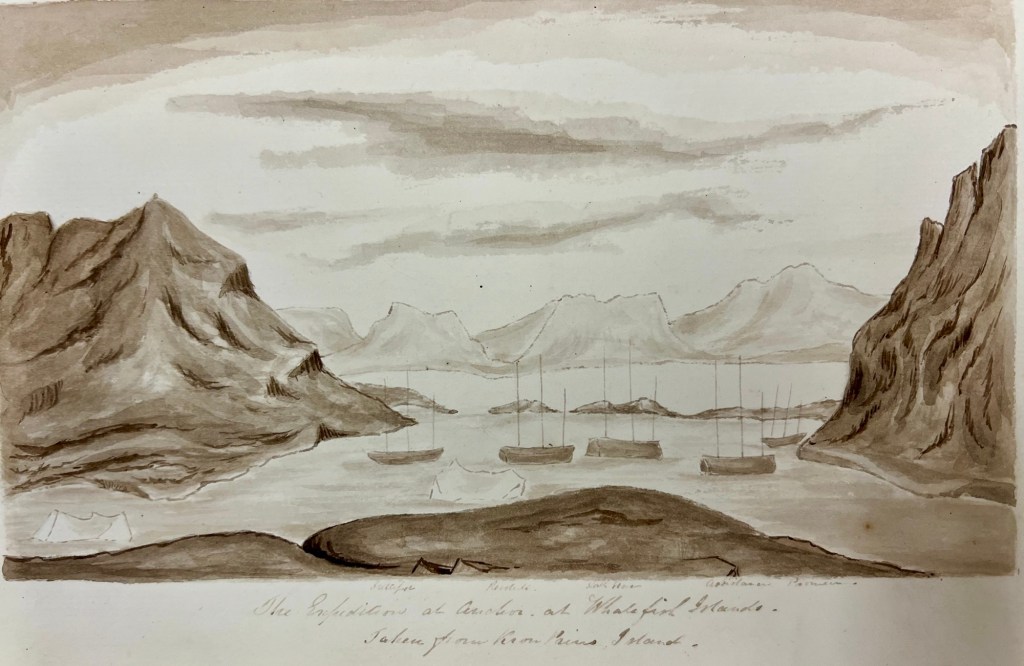
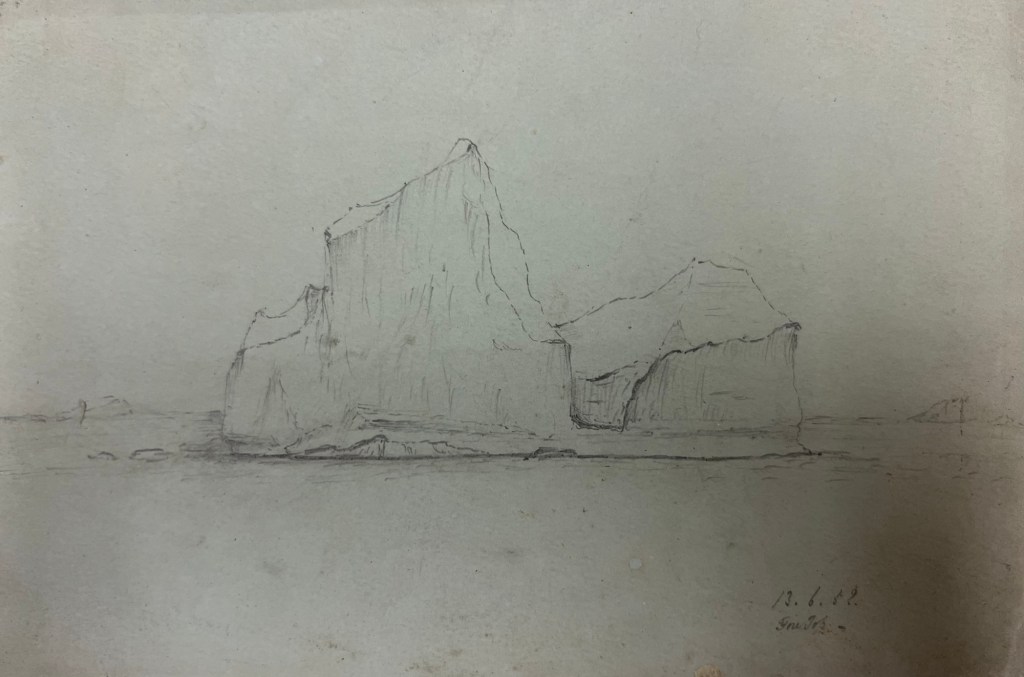
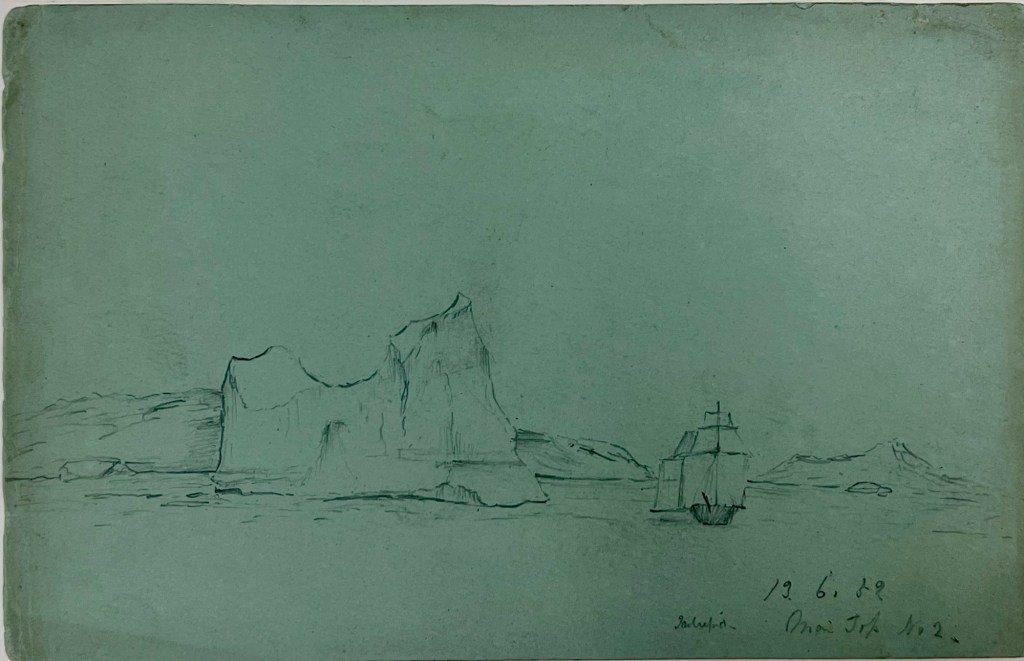
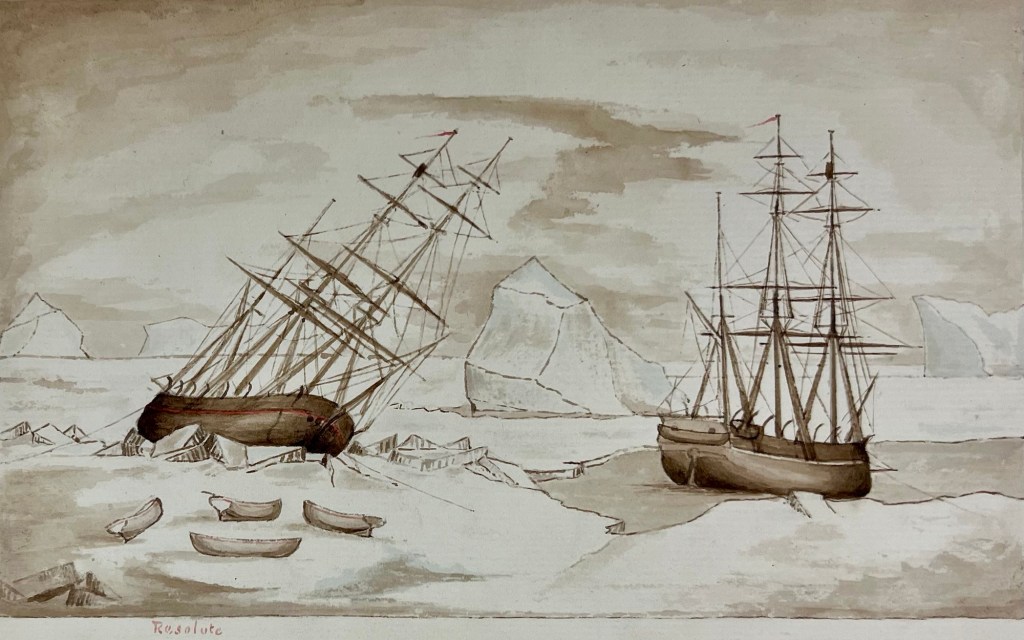
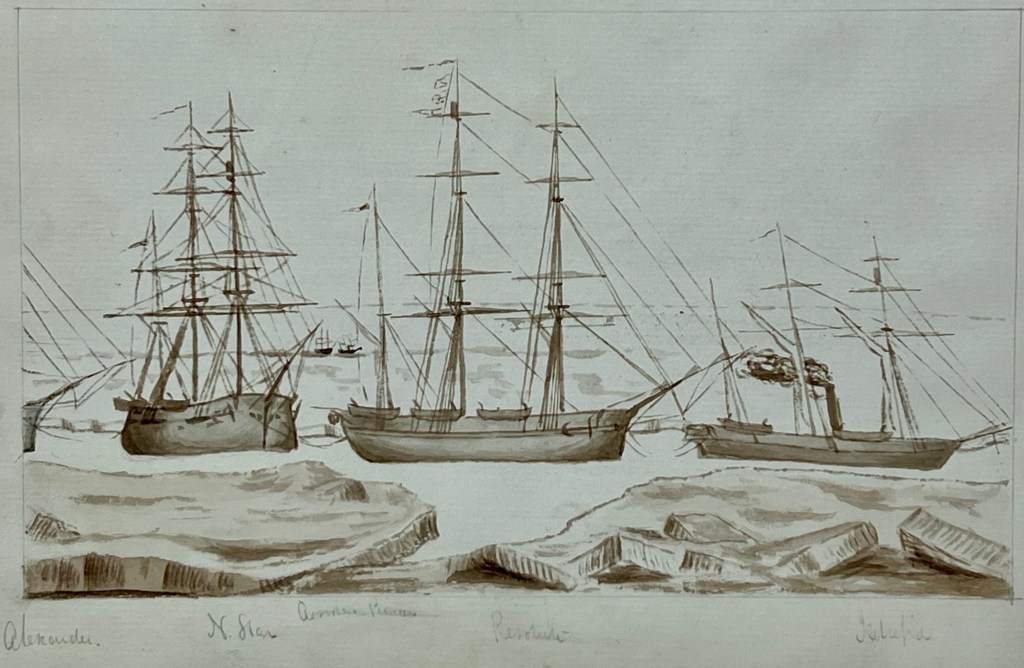
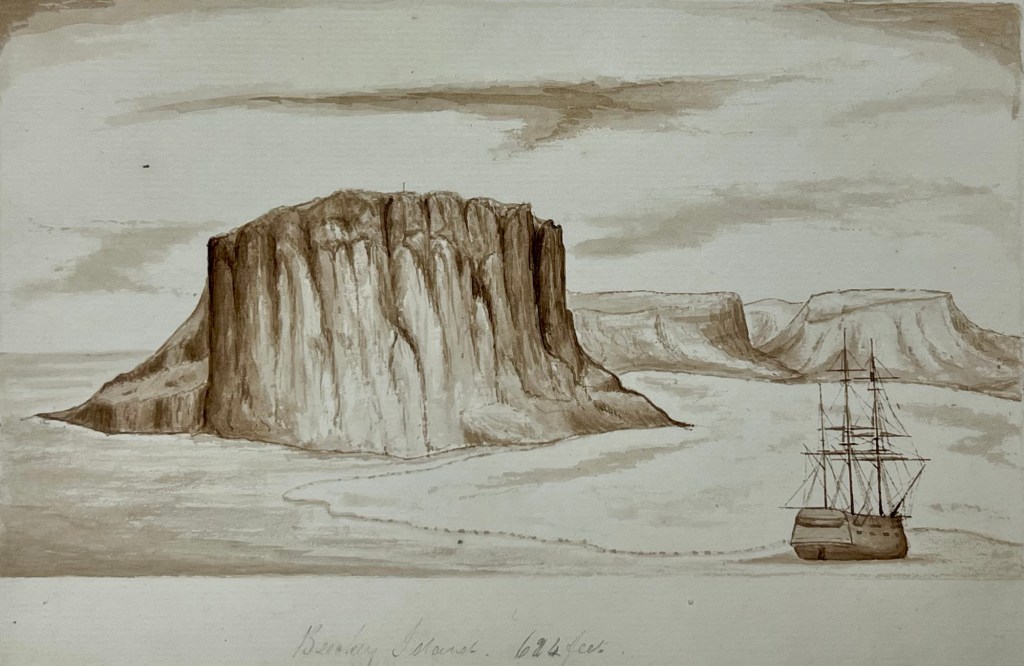
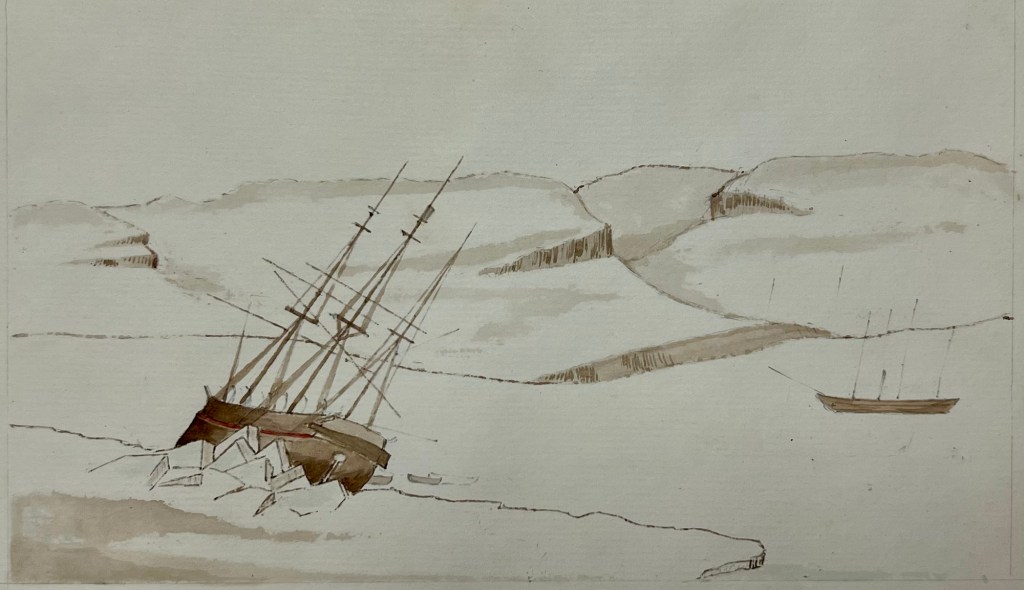
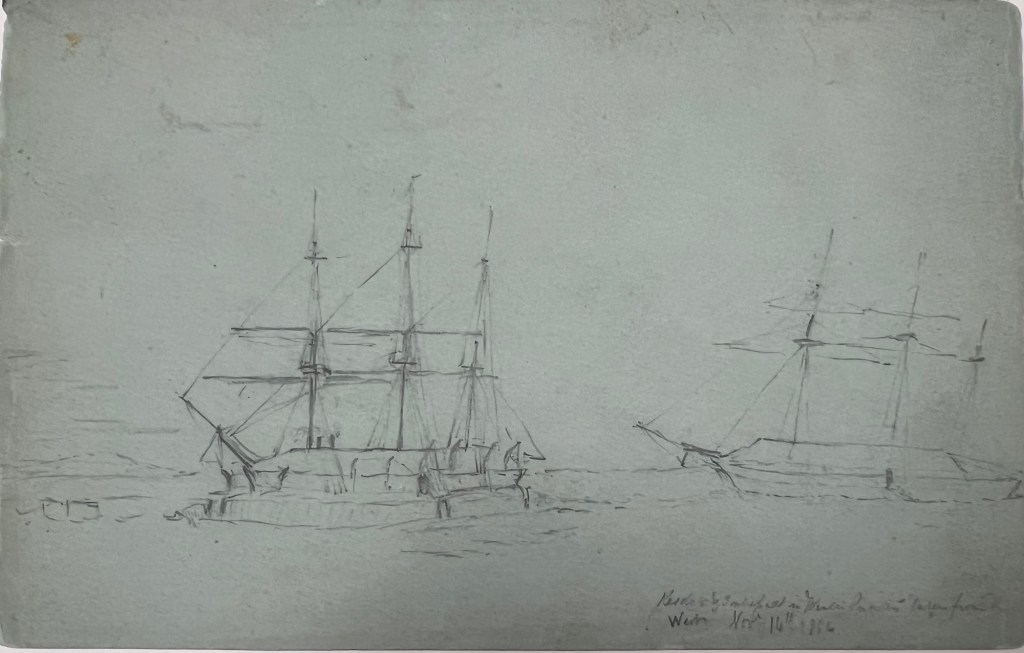
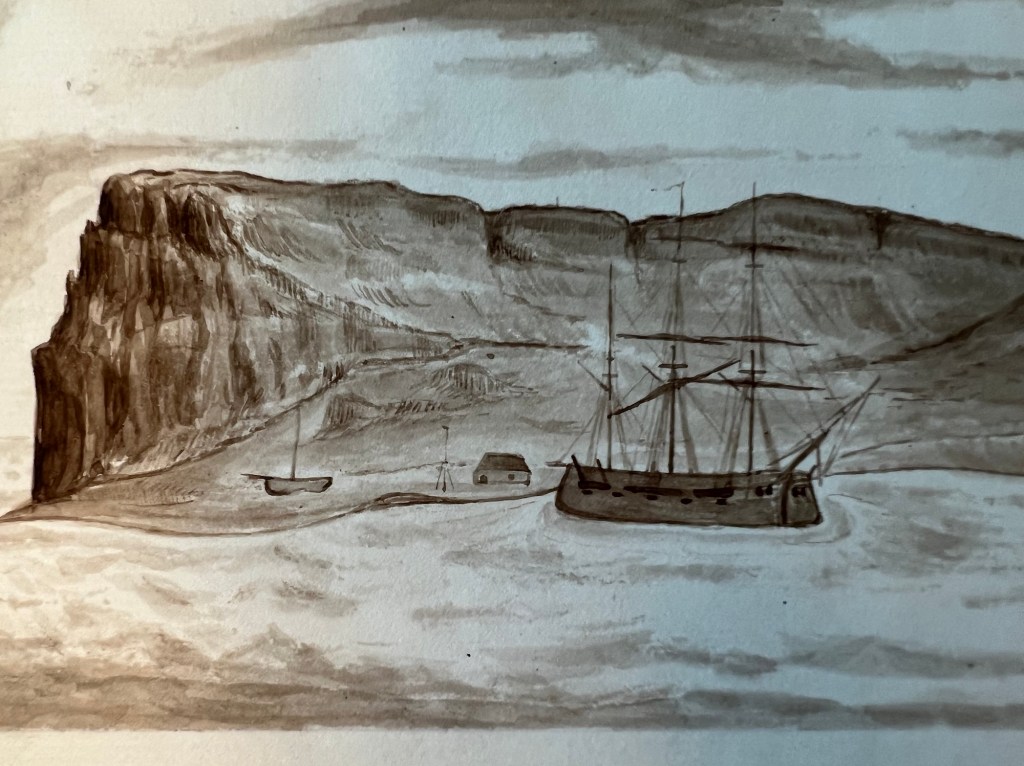
“The first view of Greenland, Cape Desolation 21 May 1852” the squadron is all depicted, with Resolute and Intrepid in the foreground, passing some bergy bits. Credit: LAC 86-18-3“The expedition at Anchor, Whalefish Islands. Taken from Kron Prins Island, Greenland May 1852.” The ships are identified (from left to right) HMS Intrepid, Resolute, North Star, Assistance, Pioneer. This view appears very similar to a calotype that Dr. William Domville, Resolute’s surgeon, captured somewhere on the Expedition. (Today in the custody of Royal Museums Greenwich P36CAL) Credit: LAC 86-18-4“Four Top Iceberg, Wargal Straits, Greenland June 13th 1852.” These impressive bergs were encountered in Waygat or Waygate Channel. Credit: LAC 86-18-5“Main Top Iceberg, Wargal Straits, Greenland June 13th 1852.”Credit: LAC 86-18-6“The Resolute [left] and another ship in Perilous Position in the Ice, Melville Bay, Greenland” ca. 26 June 1852. Mumford has added some colour by showing Resolute with her distictive red band around the ice channels. George F. M’Dougall relates in his published journal that on the 26th Resolute was badly nipped between a moving flow and land ice. The ship’s bell rung on its own, the boats were dragged out to the ice, and the rudder was destroyed. The vessel at right should be Assistance, which had a single white band, was nearby, and was cutting in to an ice dock. Mumford would have been heavily involved in setting up the spare rudder. Credit: LAC 86-18-7“The Alexander, North Star, Assistance[distant], Intrepid[distant], Resolute, Pioneer off Melville Bay, Greenland July 1852.” Given the complete absence of McLellan, a whaling ship which damaged Alexander and North Star, and the freeing of the ships, we can speculate that this is later in July. Alexander (a whaler from Dundee) accompanied the naval ships longest of the whalers. Credit: LAC 86-18-8“Beechey Island, 629 feet” [ca. 10 Aug. 1852] Our ID of this vessel would be HMS North Star. With Erebus and Terror Bay not yet clear of ice, she is waiting on the 10th or 11th to take up her inshore position off Beechey as the expedition’s longtime depot ship. Credit: LAC 86-18-10“The Resolute (?) in a Dreadful Position in the ice off Beechey Island (?) 16 August 1852” From M’Dougall’s diary we know that, while near Assistance Harbour on an errand to drop a whaler off at Cape Hotham, Resolute was again in peril of receiving a nip, with Intrepid nearby. Resolute (red band) and her crew has sensibly unshipped her rudder and hung it over the stern. Credit: LAC 86-18-12“Resolute and Intrepid in Winter Quarters, Melville Island November 16th 1852” Resolute’s first overwintering location. Credit: LAC 86-18-13
HMS Assistance (flagship), Intrepid, Pioneer were crushed in ice or otherwise foundered. As related in the previous Mumford post, Resolute, incredibly, drifted to discovery by whaling ships 1,900 km East. North Star survived her Beechey Island ordeals to help evacuate the other crews. Considering the marine casualties, and compared to Franklin’s two-ship Expedition, very few crew members died. ↩︎
William T. Mumford (1830 – 1908) was a young apprentice carpenter when he volunteered for service with HMS Resolute–captained by Henry Kellett–to scour the Arctic for Sir John Franklin and the missing crews of HMS Erebus and Terror (last seen by Europeans in 1845). Resolute was one of five vessels in a squadron commanded by Sir Edward Belcher. As Ship’s Carpenter, Mumford was rated a warrant officer. He kept a diary and other records of this 1852-1854 expedition. He also created a detailed visual record. He documented the Belcher ships, mostly during their long imprisonment in ice, their Beechey Island staging base, and important or perilous moments. Once Resolute was abandoned, he kept up with his diary and continued to illustrate his difficult journey back. Today, these interesting records are in the collection of Library and Archives Canada.
Mumford was an active participant to the important events of this phase of Arctic exploration. The two main search parties, Belcher in Assistance, Kellett in Resolute, respectively accompanied by their steam tenders, Pioneer and Intrepid, left their depot ship, North Star, at Beechey Island, to push further north and west. Once the ships were beset in ice, crews conducted further searches using sledges. Though they found virtually no new information out about the fate of the Franklin crews, they surveyed large swaths of the Arctic archipelago. A happy discovery was the location of the long-beset HMS Investigator at Mercy Bay. Kellett ordered Robert McClure, Investigator’s captain, to abandon his command and bring in his ailing crew. During June 1853 McClure sledged to Resolute. The next Spring, with his ships still firmly seized in ice, Belcher made the difficult decision to abandon all primary expedition vessels (still tightly frozen in), and retreat to Beechey to seek passage home. Kellett’s whole party, including the Investigators, were doing quite well after all this time, but Belcher ordered them to go.
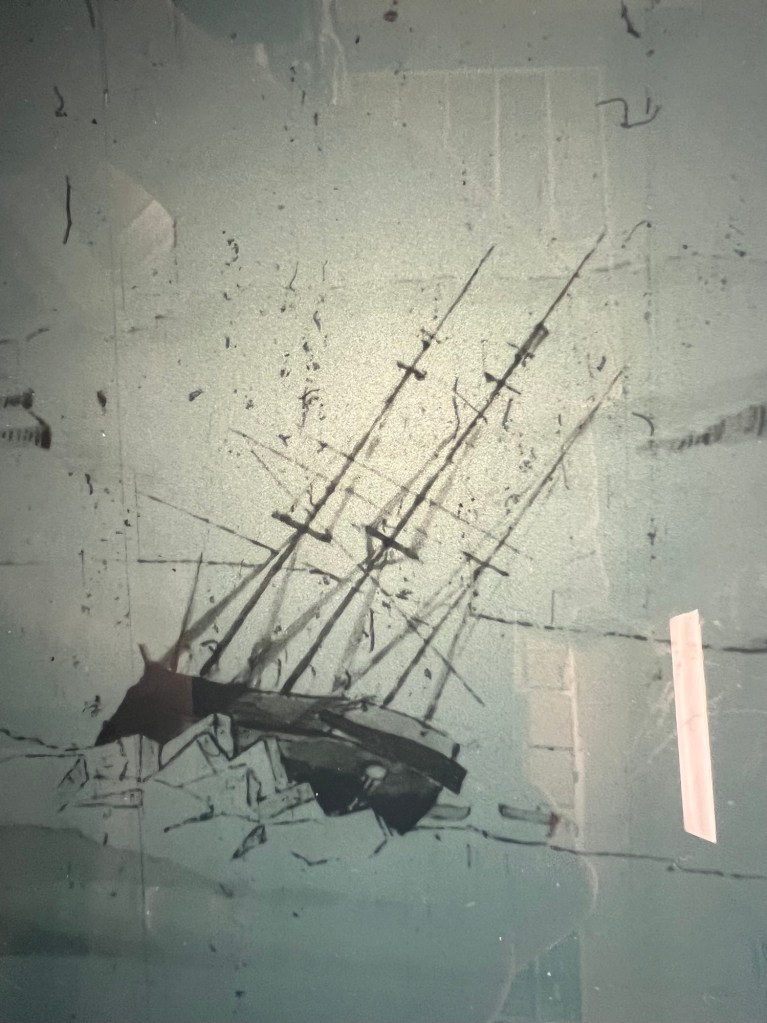
HMS Resolute beset, with ship’s boats on the ice and her rudder swung out over the stern. The joys of consulting microfilm from a vintage reader! Credit: Library and Archives Canada, Acc. No. 1986-18
The Mumford collection was acquired by the National Archives of Canada in 1984 with the assistance of a grant from the Government of Canada under the Cultural Property Export and Import Act.1 In contrast to many of the official works and the officers’ records documenting the search efforts, Mumford’s archival fonds provides a different perspective: what a warrant officer with a keen eye for details witnessed of this great era in Arctic exploration. Mumford went on to have an important career with Lloyd’s of London, as a surveyor of ships from 1857-1889.2 He knew his ships, and so his depictions can be considered an accurate visual record. The diary was microfilmed soon after acquisition, and copies passed to Cambridge University and the National Maritime Museum. Interleaved with the text of some 150 pages were watercolours and drawings of ships and topographical scenes, maps, printed poster playbills for onboard theatrical entertainments, and some later correspondence (mostly a curated collection of press clippings that show Mumford to have kept up on developments in Canada’s distant North). After filming, the watercolours were removed and housed separately for long-term conservation. Of Mumford’s diary, we viewed the microfilm copy at LAC last October, and we failed spectacularly to decipher most entries! We hope the fine visual record, presented in chronological order with additional context, are of interest:
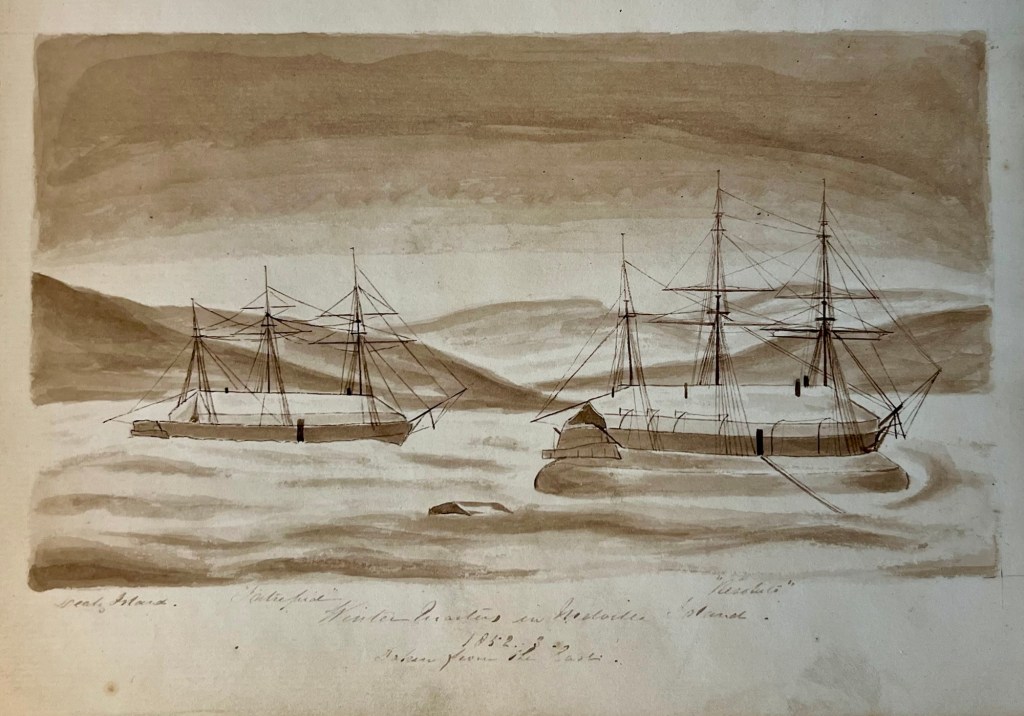
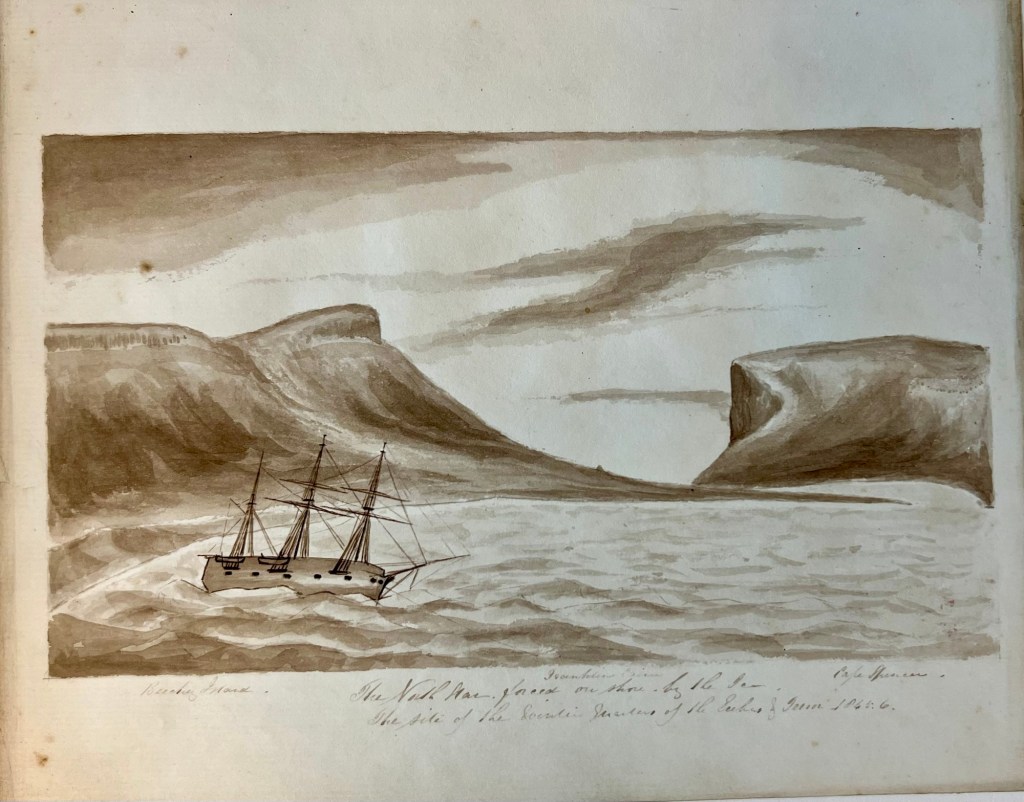
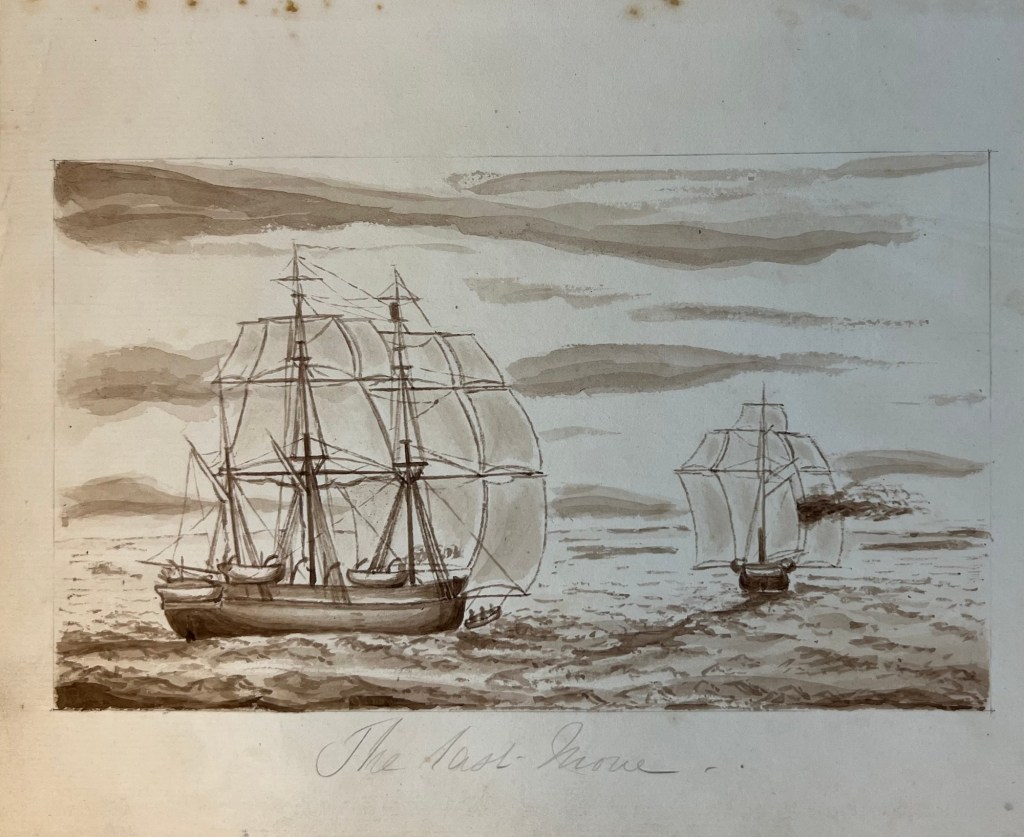
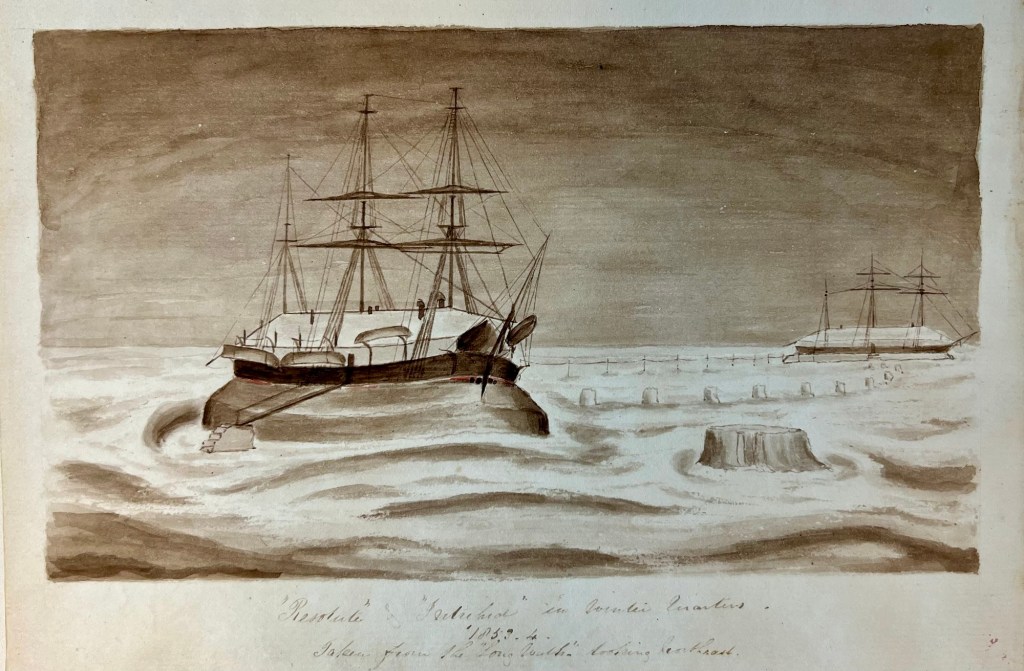
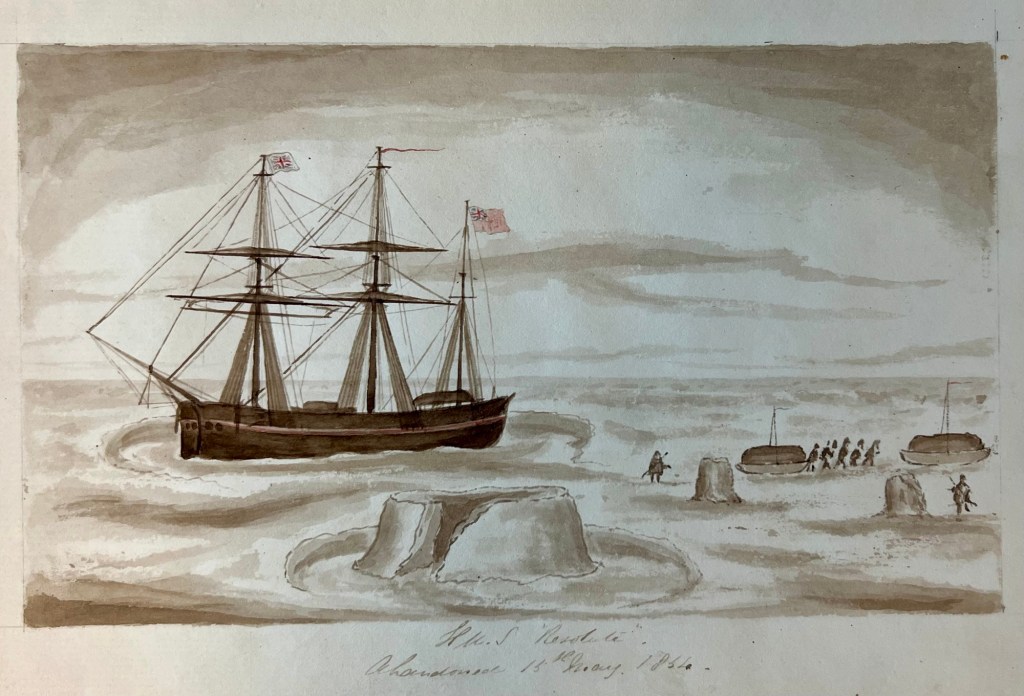
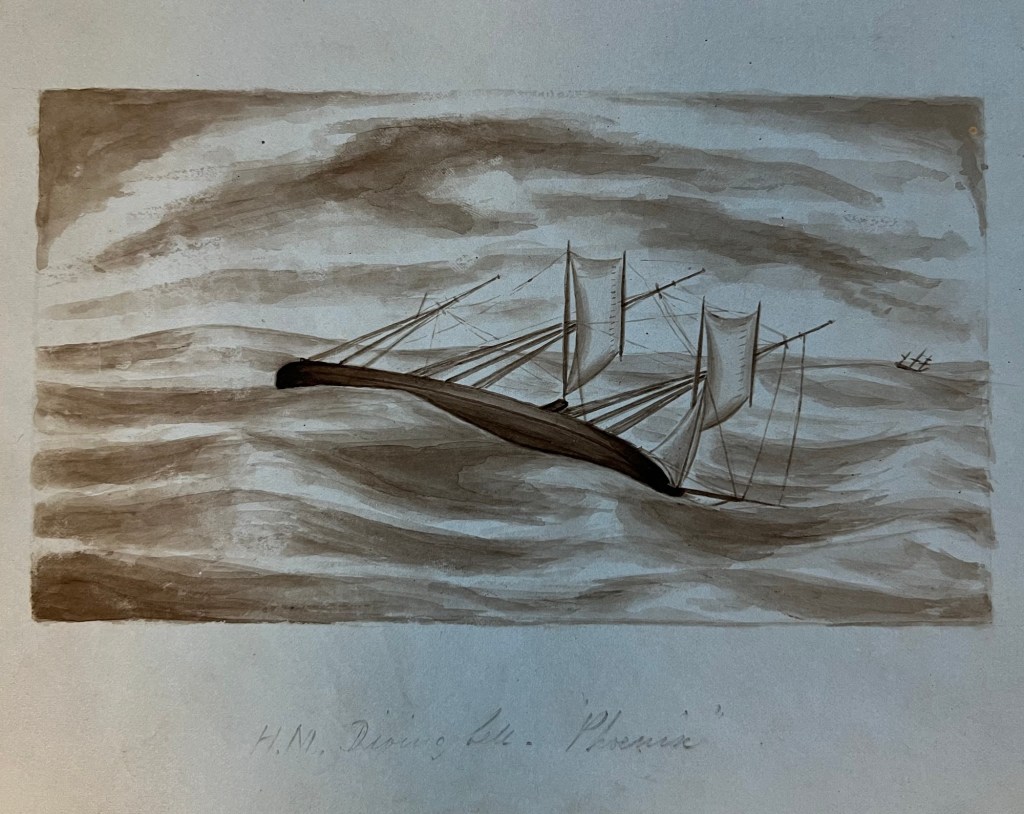
“Winter quarters at Melville Island, taken from the East” Feb. 1853. Even fitted for overwintering and bulwarked with snow, the contrast between the doughty search vessel Resolute, (right) and the rakish, fine lines of Intrepid, is notable. Credit: LAC 86-18-18“HMS North Star forced on shore by the ice at Beechey, near Cape Spencer”, This dramatic June 1853 view shows HMS North Star, the Belcher Expedition’s depot ship, located at Beechey Island, the site of the Franklin Expedition’s first wintering. Credit: LAC 1986-18-20“The Last Move” September 1853. HMS Intrepid, the steam tender, is leading Resolute with sail and steam up. Credit: LAC 1986-18-22“The Resolute and Intrepid in winter quarters, 1853-1854, taken from the ‘Long Walk’ looking East” Ca. Dec. 1853. This shows the two ships now wintering at their second encampment, located (in the moving pack) off Dealy Island. LAC 86-18-25“HMS Resolute abandoned May 15, 1854.” A depiction of the beginnings of the sledging trip of the combined crew of the Resolute and Investigator (Robert McClure’s ship, abandoned earlier at Mercy Bay) making a start towards Beechey Island, with Resolute and Intrepid still beset. Resolute was abandoned in good order with flags nailed to the mast trucks.3 Credit: LAC 1986-18-26HMS North Star, still at Beechey. Dated May 1854, this remarkable view shows Beechey’s imposing and bleak cliffs. Ashore, Northumberland House, the storehouse the Belcher crews built, and a large boat which is likely Sir John Ross’s rescue yacht Mary, are visible. [Detail of] LAC 1986-18-27“HMS Diving Bell, Phoenix” This dramatic watercolour appears to show Edward A. Inglefield’s command, HMS Phoenix, in a perilous situation. September 1854. At this time Inglefield was engaged in returning Robert McClure and the crew of Investigator to England. The distant vessel could be the accompanying HMS Talbot or North Star. Credit: LAC 1986-18-29
Mumford’s ship would eventually free itself from the ice, to drift on an incredible journey. Salvaged by American whalers in 1855, Resolute would be presented back to Great Britain in 1856. For a detailed summary see the online HMS Resolute project: https://www.hms-resolute.co.uk/the-nutshell/↩︎
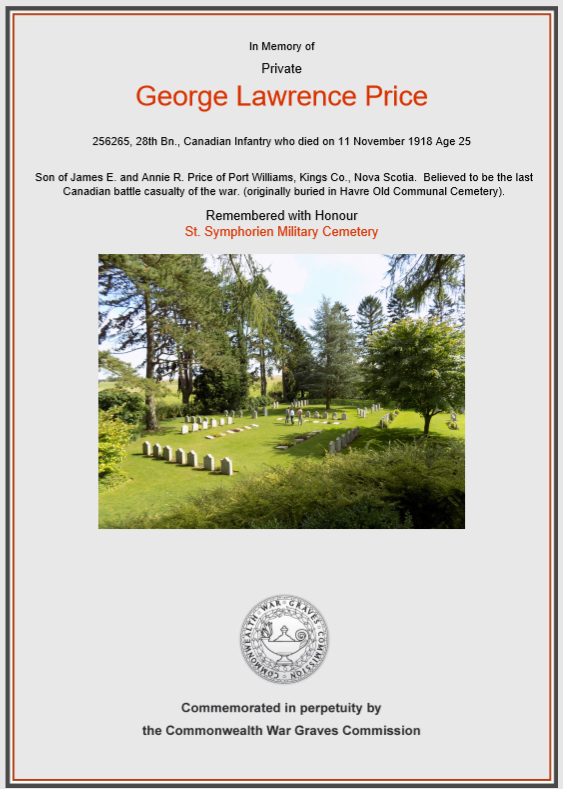
Commonwealth War Graves Commission commemorative certificate for Pvt. G.L. Price.
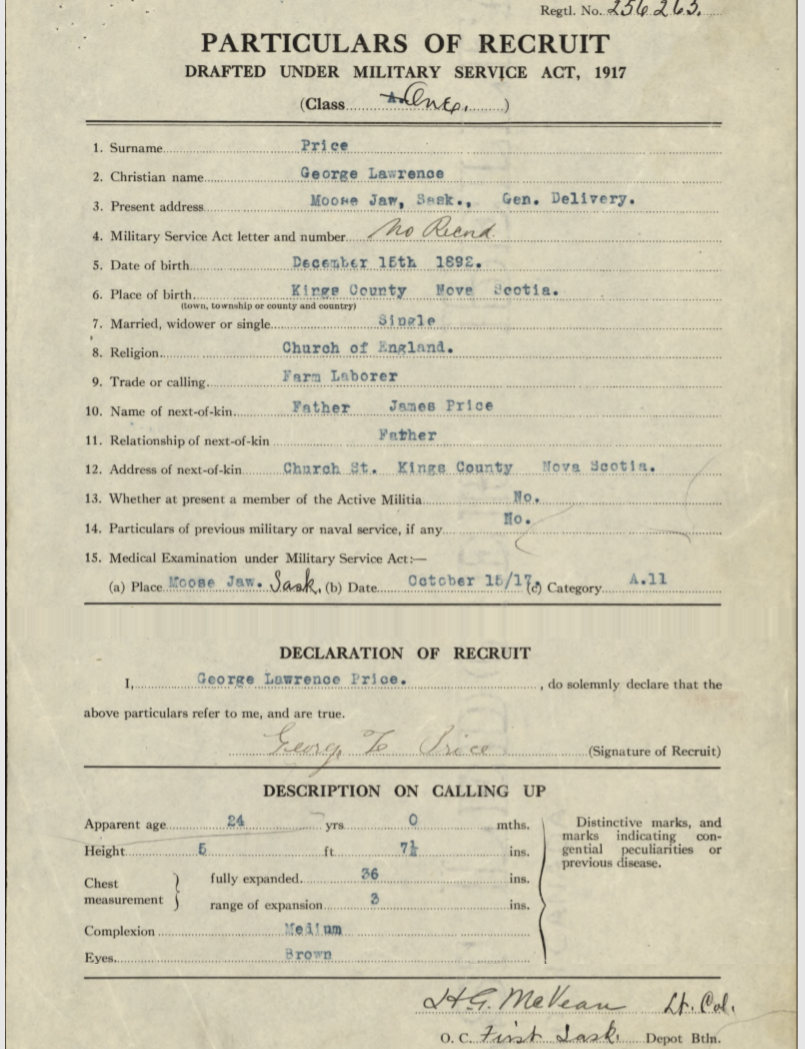
Pvt. George Price, “A” Company, 28th Canadian Infantry Battalion (Northwest) is reported as the last CEF soldier to die before the 11AM Armistice that ended the First World War. Units of the Canadian Expeditionary Force had been ordered to resume the advance, and keep pushing German forces beyond Mons, Belgium. By mid-morning most soldiers knew of the Armistice coming into effect at 11. The 28th Battalions “A” and “B” Companies were pursuing a retreating enemy East of Mons, through the woods and village of Havré. George Price, a 25 year old originally from Kings County, NS, who had been working in Saskatchewan, had just crossed the canal into Ville-sur-Haine.
G.L. Price draft form, conscripted under the 1917 Military Service Act. Library and Archives Canada CEF Service File, RG 150 1992-93/166, Box 7974.
While other units were standing-to, his small team were working their way into the village, with Germans units withdrawing to the North-East. Pvt. Price was struck in the chest by a rifle or machine-gun bullet. Help from his comrades and Belgian civilians could not save him. At his death, church bells in Mons and the surrounding villages were ringing out in celebration of the end of hostilities.
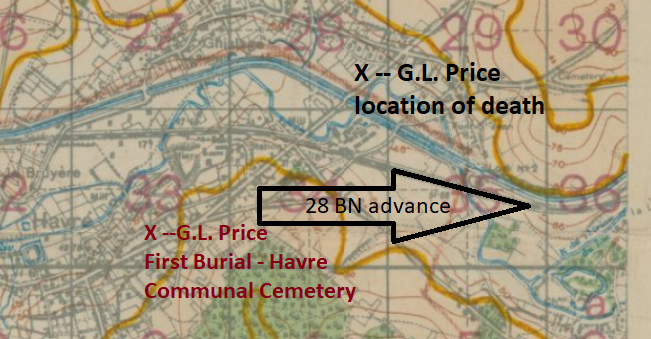
Modified detail of Sheet 45, Edition3. Series: GSGS 2743. H.B. Stuart Collection, McMaster University. This shows rough locations, as referenced in records below. The location stated for his death accurately maps to the location of a plaque at Ville-sur-Haine.
The Commonwealth War Graves Commission’s site shows that, although Price was the only CEF soldier killed-in-action advancing in Belgium that day, 38 others, and one soldier from the Dominion of Newfoundland, died at various locations in France, Britain and Canada, on this last day of the Great War. Here is a small selection of documents that help tell the story of Price and the events of a hundred years ago:
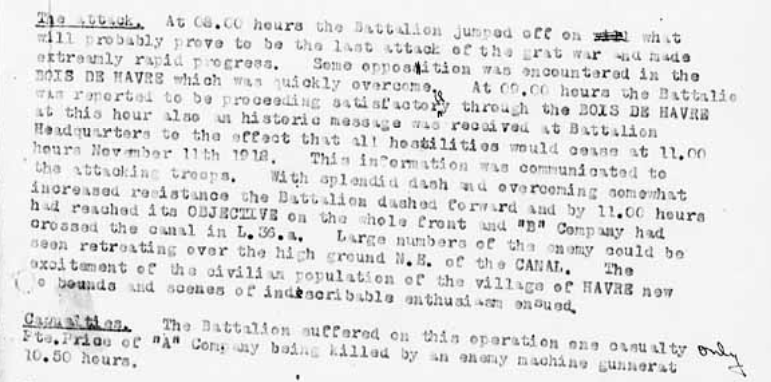
Library and Archives Canada 28 CIB War Diary Report on Operations Nov. 1918 RG9-III-D-3. Volume/box number: 4936.
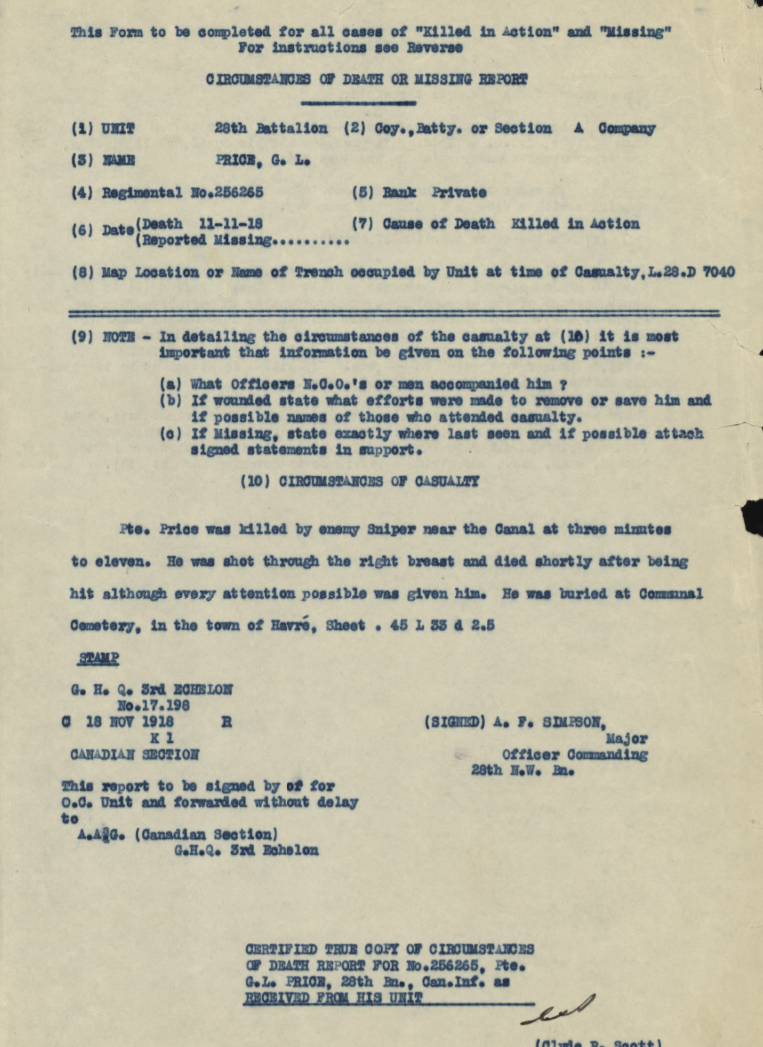
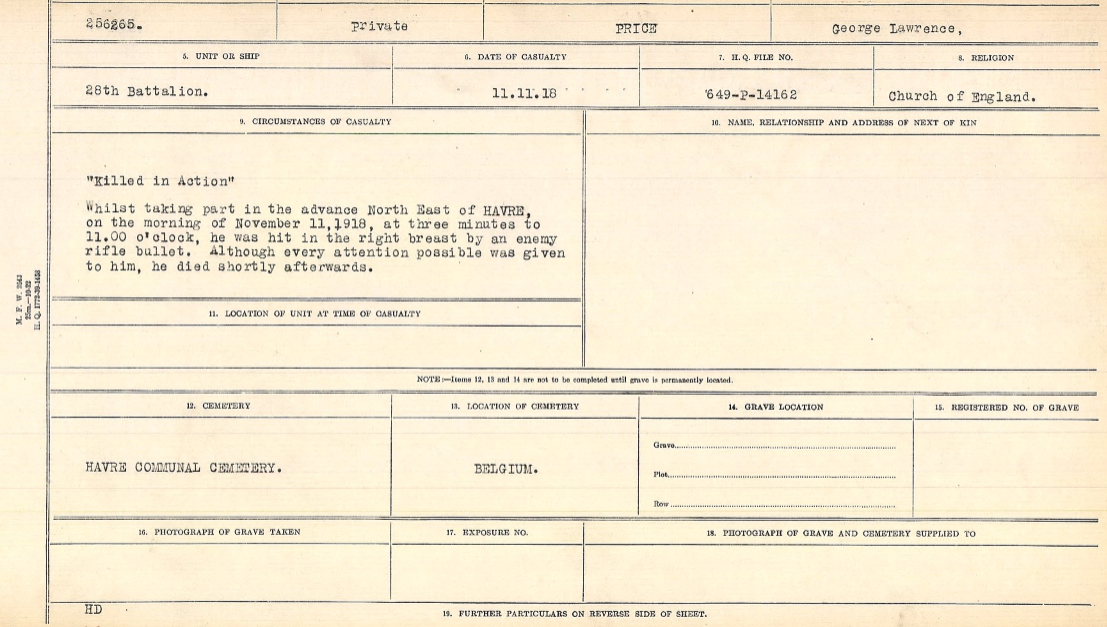
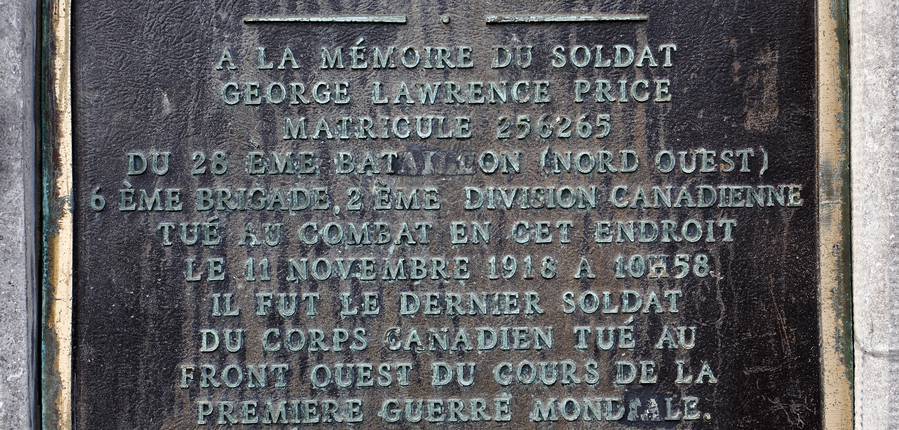
G.L. Price Circumstances of Death form on his CEF file. Library and Archives Canada CEF Service File, RG 150 1992-93/166, Box 7974. G.L. Price Circumstances of Death register entry. Library and Archives Canada RG150, 1992-93/314, Vol. 230. Plaque marking the place Price fell at Ville-sur-Haine, courtesy of http://www.visitmons.co.uk.
The history of German 15cm Howitzer no.813, captured 100 years ago this morning, during the great advance.
On this centenary of the first day of the Amiens Offensive (8-12 August 1918), I focus on 15 cm Howitzer no. 813, captured by the 43rd Canadian Infantry Battalion (Cameron Highlanders of Canada) a hundred years ago this morning. Canadian units made astonishing gains this day, and captured thousands of enemy prisoners and a whole range of German weapons.
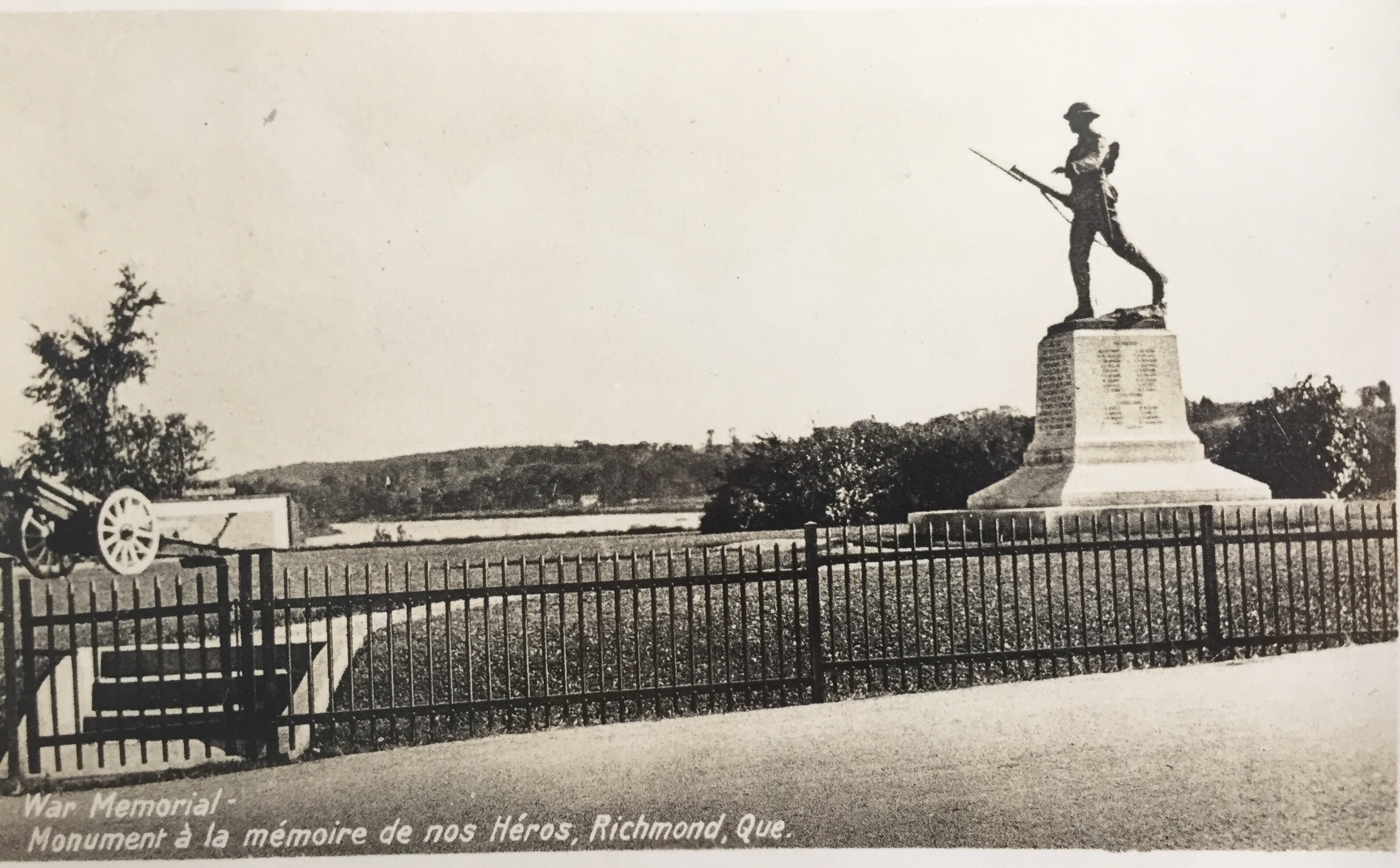
Detail of Richmond QC view of War Memorial, Warsearcher Postcard Collection
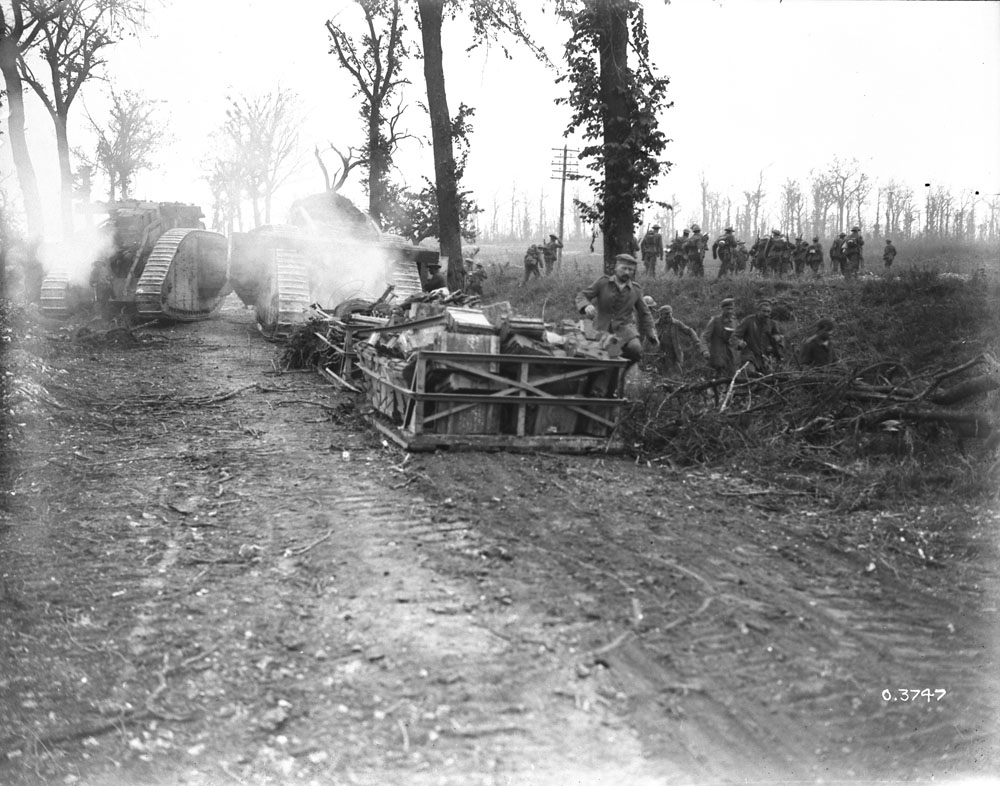
Early on the morning of the 8th, the 43rd Battalion, 9th Infantry Brigade, was making progress south-eastwards having just cleared out Dodo Wood, along the Amiens – Roye Road, south of Demuin. “C” Company was tasked with taking Hollan Wood on the right. Mk V heavy tanks of “A” Company, 5th Battalion, Tank Corps (British), lumbered alongside Canadians, providing support and attacking fortified defences.
Canadian units and British tanks advancing in a similar situation during the Amiens advance, Aug. 1918. Canada. Dept. of National Defence/Library and Archives Canada/ PA-003668
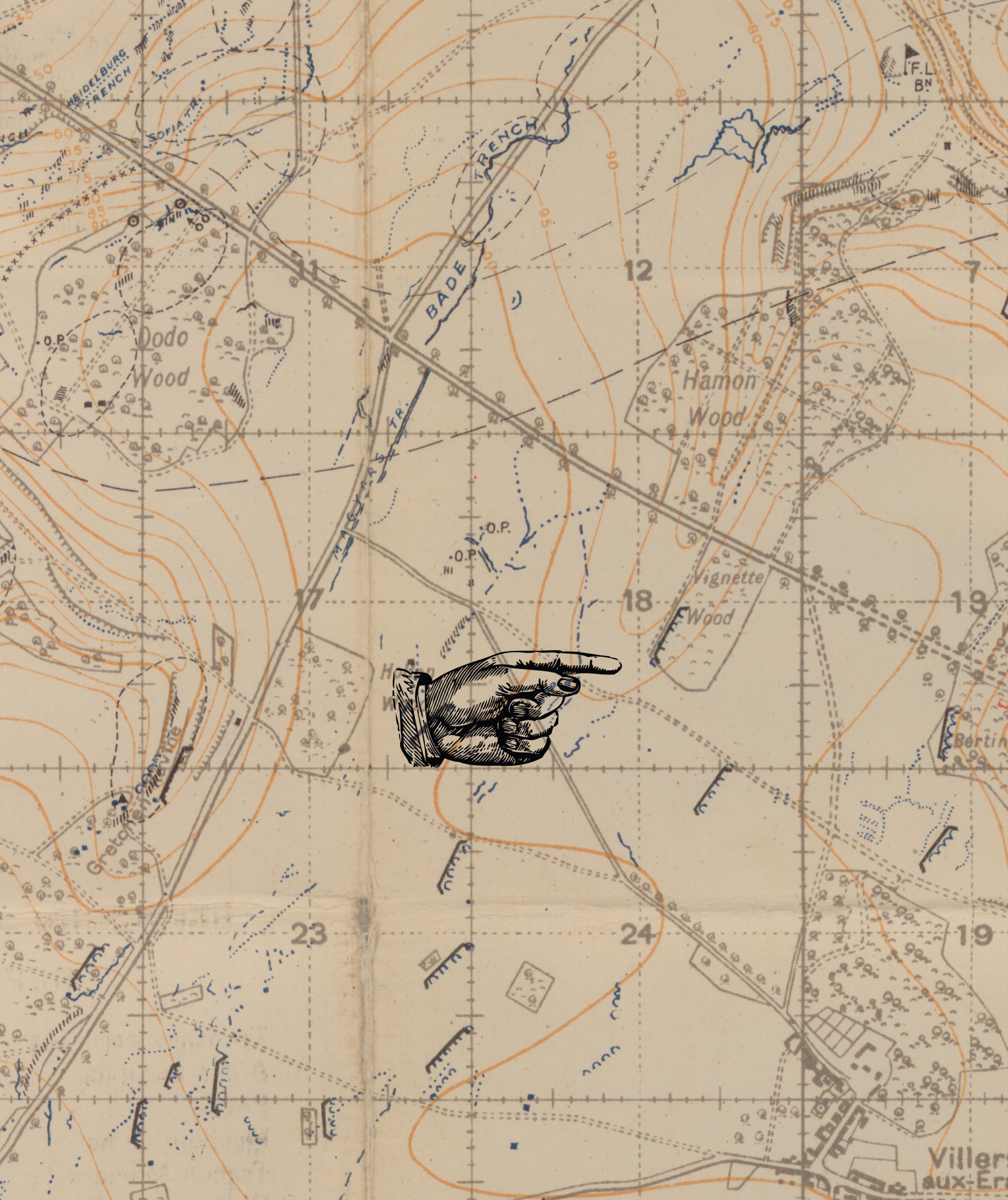
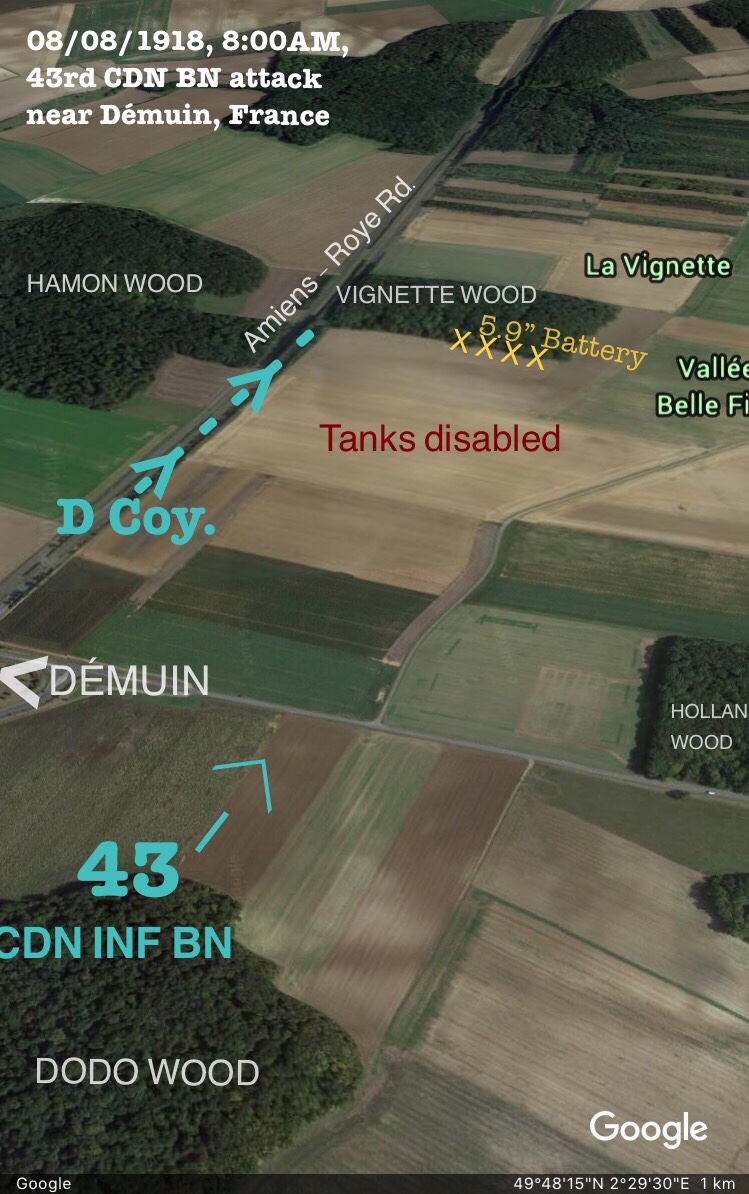
At 07:30 “D” Company pushed on over open ground towards Vignette Wood, with a major objective being the elimination of a battery of guns that were known to be sited there.
McMaster University Trench Maps: Demuin, Intelligence Log Target Map July 1918, scale 1:20,000 Great Britain. War Office. Geographical Section, General Staff (Detail)
On the southern boundary of the wood, four “5.9s” (15cm howitzers) and another nearby battery of “Whiz-bangs” (77mm field guns) opened up on the advancing units. In short order the guns knocked out the British tanks. “D” company, led by Capt. J.D. Verner, M.C., managed to advance along a cut in the road, and brought the battery under accurate enfilading fire, with the gun crews promptly surrendering and the guns captured intact. The Battalion rested in Vignette Wood as the 7th Battalion came up and continued the advance.
Modified Google Earth 3D view showing direction of advance of 43rd CIB to Vignette Wood.
Gun 813, along with many other trophies, was eventually shipped on to Canada, in a process I describe elsewhere. Visual evidence suggests this was a 15cm sFH 02 Howitzer.
Warsearcher Postcard CollectionIt was allocated to Richmond QC and shipped there Dec 8th, 1920 by Grand Trunk Railways. It wound up on display in front of the new community War Memorial. I have no further information on its fate. You can see my other posts about surviving captures by searching this site by “Amiens,” or visiting the newly upgraded database loaded at this link. The 43rd Battalion’s advance is described in the unit War Diary for August, 1918, and in the associated Report on Operations, Library and Archives Canada, RG9-III-D-3 vol. 4939, available online here.
A century ago, soldiers of the Canadian Expeditionary Force (CEF) were into their second day holding newly-won positions on Hill 70, near Lens, France. Counter-attacks by German units, desperate to regain this strategic position, were increasing. At 4:25 AM the previous morning, on August 15th, 1917, they had left their jumping-off positions to advance on this important high-point near the industrial city of Lens, France. The intent of the operation was to force German military planners to divert forces away from the Passchendaele operations, by mounting an attack on Lens. Sir Arthur Currie, recently promoted to command the Canadian Corps, reconnoitered the positions and crafted a plan to seize the heights to the North of city, after first convincing his superiors to modify the main objectives. Lens was to be attacked next.
Map of the training grounds, battlefield models and recreations of the territory around Hill 70 helped familiarize troops with major objectives before the assault. (from an appendix to the 22nd Battalion War Diary, August, 1917, Library and Archives Canada)Meticulous planning built on recent successes, such as the Vimy Ridge operations. A massive preparatory bombardment presaged the attack. Special batteries of artillery under the command of A.G.L. McNaughton were employed in counter-battery fire, and managed to silence many German guns before the infantry went in.
A Canadian 18-pounder field gun camouflaged and in a reinforced position amidst the ruined houses and industrial buildings of Lens. Camouflaging positions was essential to protect batteries from enemy observation and counter-battery fire (Library and Archives Canada CWRO O-1889, Mikan 3395293)Initially, the attack was a success, with rapid advances. Clearing up entrenched defenders in the Chalk Pit, and in the ruins of Lens’ suburbs, was no easy task, and positions changed hands several times. The operation dragged on for 10 days, and beleaguered and exhausted troops had to drive off relentless enemy counter-attacks. Accurate and prompt artillery support was instrumental in breaking up German concentrations of troops and keeping the Canadians from a general withdrawal. From 15 August until the 25th, Roughly 8,700 CEF soldiers became casualties with almost two-thousand killed, while estimates of German losses run much higher. The planned operation to capture Lens was eventually called off.
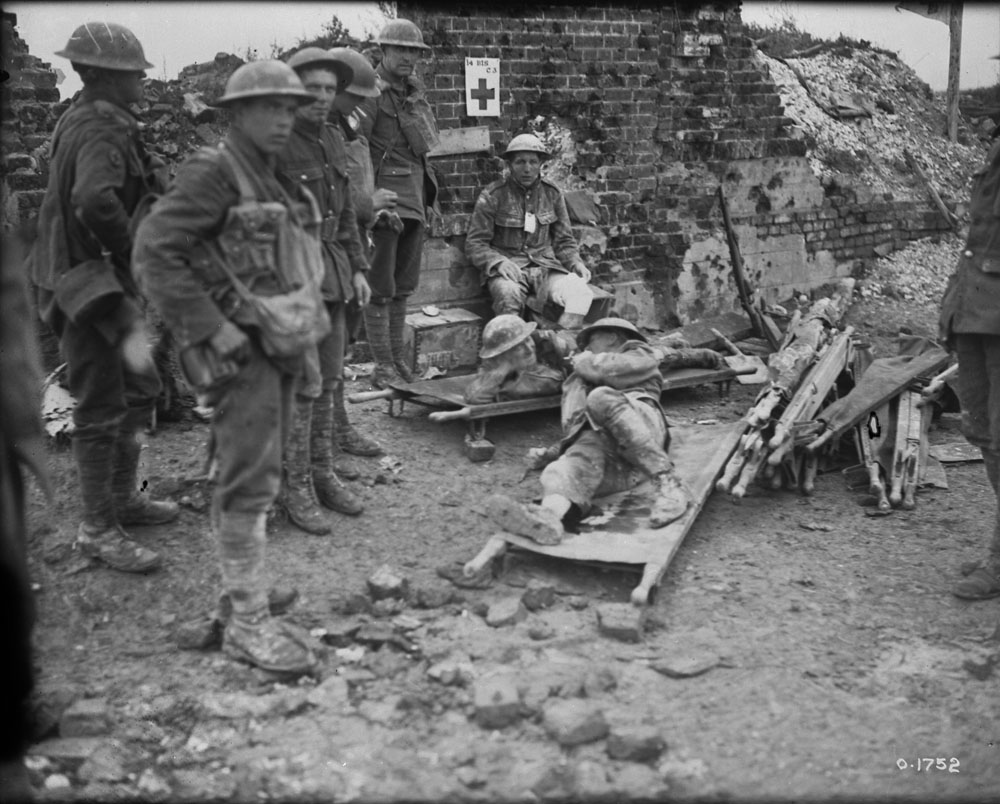
A badly wounded Canadian giving another wounded soldier a light during the recent push to Hill 70.(Library and Archives Canada CWRO O-1752, Mikan 3397017)Somewhat surprisingly, until the recent opening of the new Battle of Hill 70 Memorial Park in France, the only memorial that focused on commemorating Hill 70 was located in Mountain Ontario, a small community South of Ottawa. This memorial was originally built during the height of memorial construction in the 1920s.
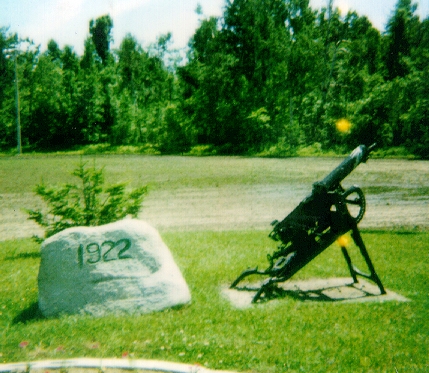
The pre-2011 Mountain Memorial to the Battle of Hill 70. Originally, an electric lamp on a tall flagstaff was also an important element (source “War Monuments in Canada” site: https://www.cdli.ca/monuments/on/hill70.htm)For the 2011 work on the memorial, local groups struggled with what to do with the rusted machine gun, that had been a feature of the original 1920s layout. Some wanted to scrap it. A recent Globe and Mail article explores the various proposals. A local resident who was heavily involved in the rehabilitation project, Mr. Johnston, is quoted as saying “I struggled with the gun. Why would we want a German machine gun that was used to kill these boys?” This sentiment has been expressed many times over the years about trophies, and ties in with evolving public memory on the meaning of the First World War. In the 1930s and Second World War-era many pieces were indeed destroyed because of similar community sentiments. For the purposes of this project I am relieved to say that the gun remains a focal point of the memorial.
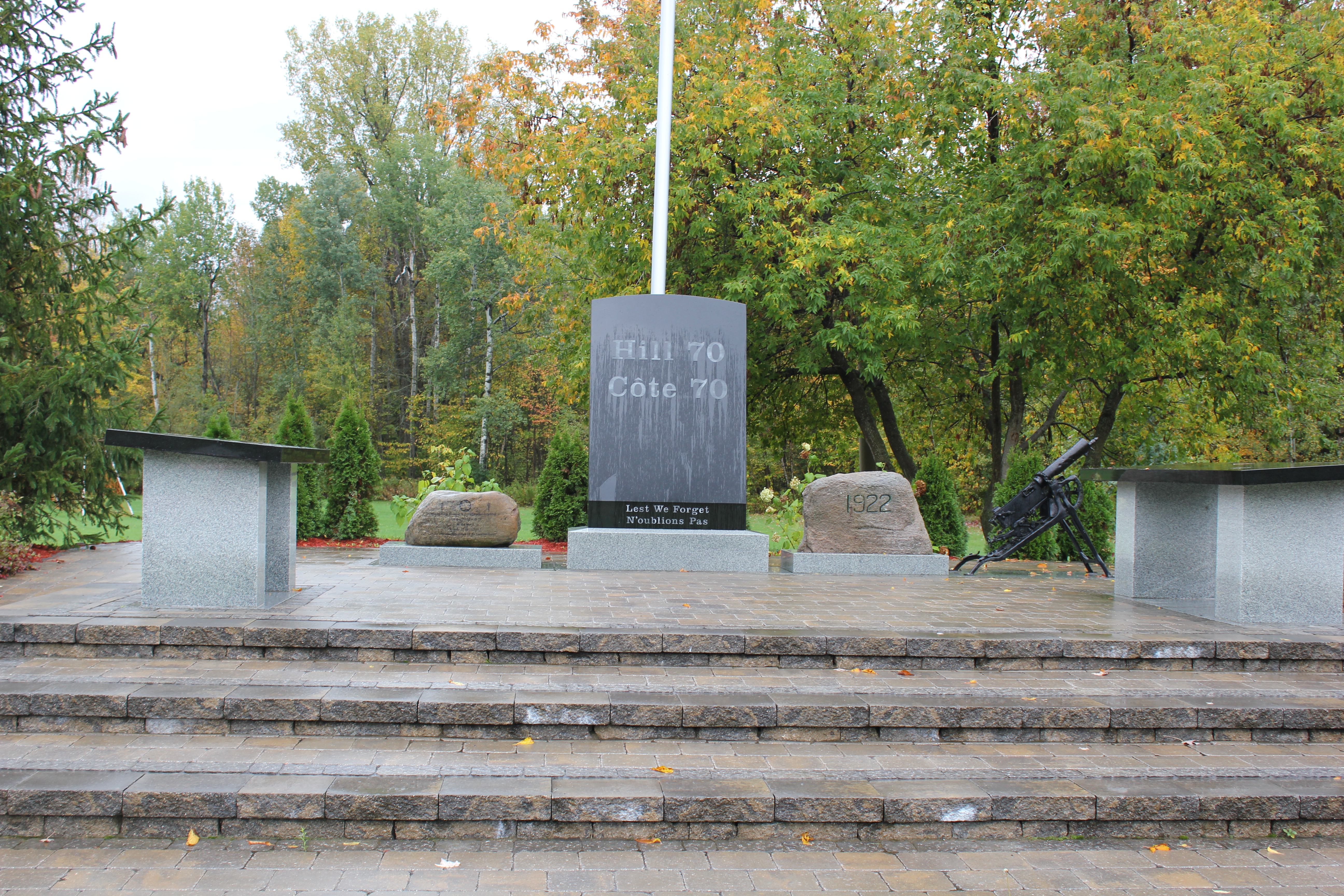
Mountain ON. Battle of Hill 70 Memorial site (author’s photo)
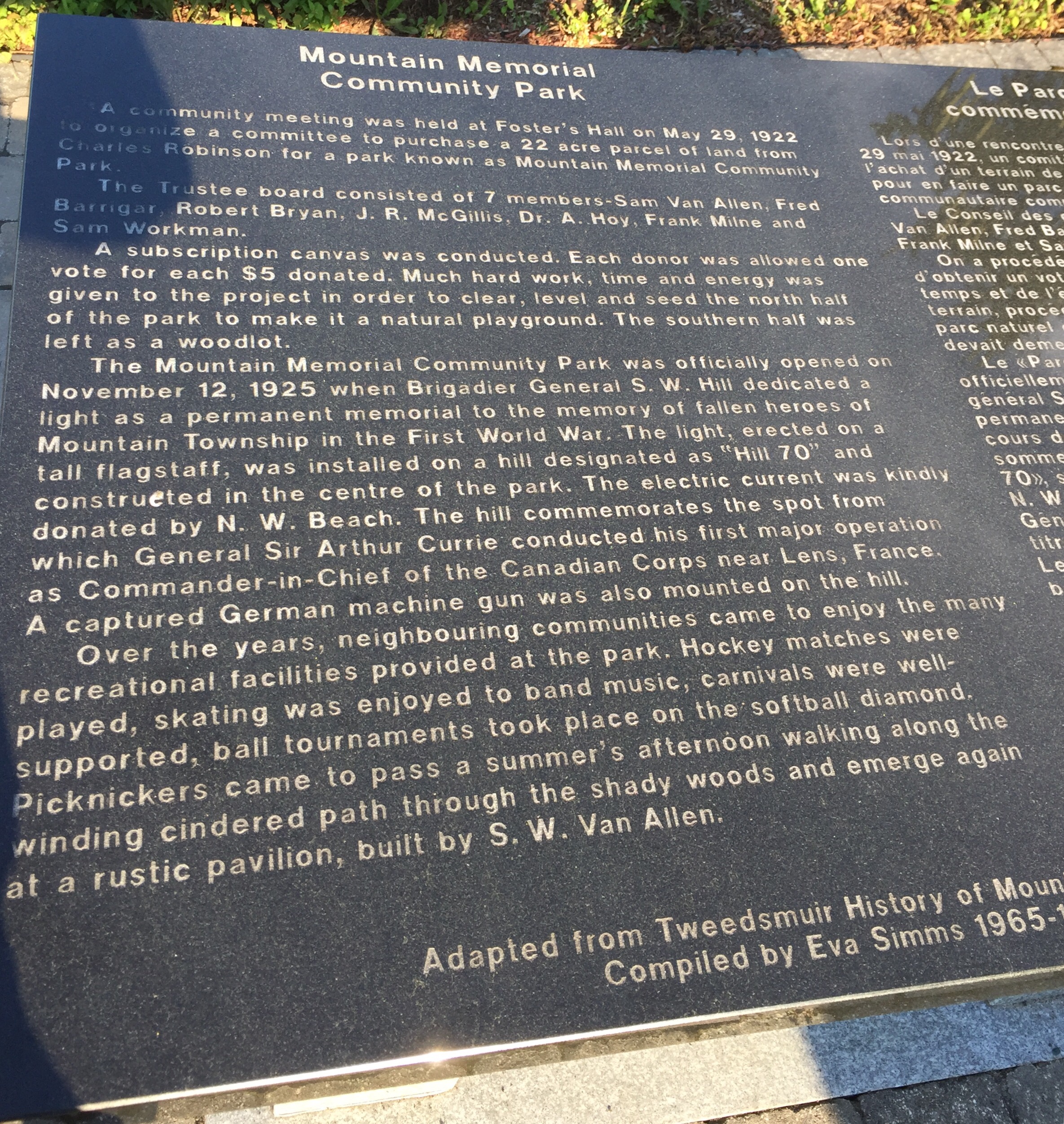
One of the tablets of the Hill 70 memorial explains the unique origins of this commemoration in Mountain, ON. (author’s photo)According to War Trophy Commission records at Library and Archives Canada, two captured German guns were shipped to Mountain in September 1920 via Canadian Pacific Railways. The captured German machine gun now at the memorial is most likely MG08 no. 2946b (the serial numbers have substantial corrosion), seized by the 22nd Battalion at Catapult Trench, Hill 70, 15 August 1917. This gun would have been used against Canadian soldiers in the initial assault.
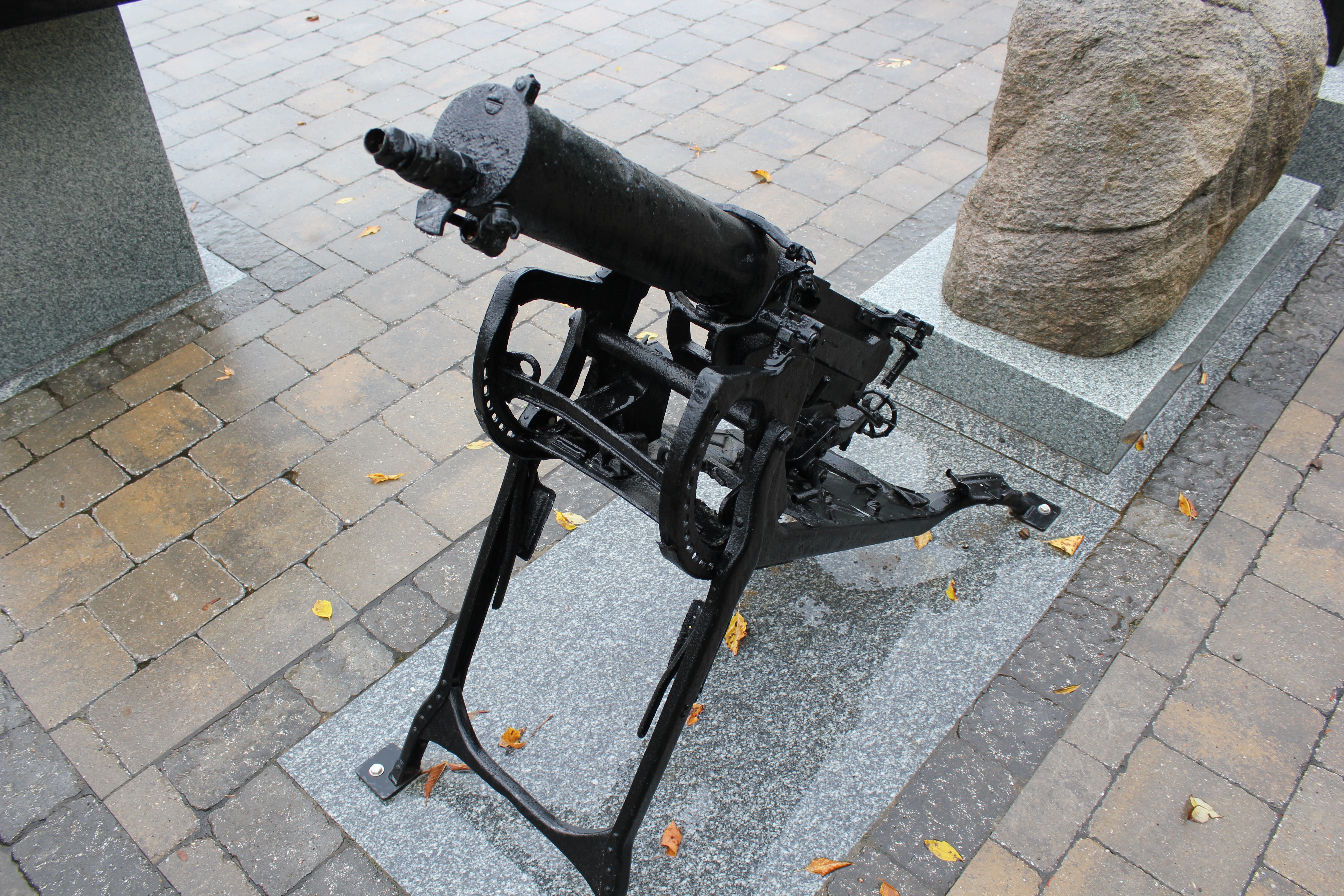
Captured war trophy MG08 German machine gun, Battle of Hill 70 Memorial, Mountain ON.(author’s photo)The 22nd Battalion’s War Diary “Report on Operations” notes that 4 similar guns were captured. Particular mention is given to the capture of one by Lt. Henri de Varennes (who was killed early in the morning on 16 August) and Sgt. Eugene Keller, who would later receive the Distinguished Conduct Medal for this action (The First World War service files of Keller and de Varennes are available digitized from LAC). Interestingly, recent talks with local residents have indicated they are convinced this is indeed a gun captured by the 22nd Battalion at Hill 70.
For many reasons, Hill 70 has not been accorded the same attention as other CEF operations that Canadians are familiar with. In contrast to the range of captured relics that remain from the Vimy operations (which I recently posted on) this gun, and a 75mm Trench Mortar in the collection of the Brome County Historical Society in Knowlton, Quebec, may be the only monuments that remain of this important Canadian operation.
A lifesaving Bren Gun carrier wrecked on Sable Island?!
Sable Island is frequently called “the Graveyard of the Atlantic,” because of centuries of shipwrecks that have piled up on its shoals. This island, a remote sliver of dunes and scrub far off the Nova Scotian coast, is Canada’s newest national park. Recently I became aware of a curious relic on the island, close to the West Light.
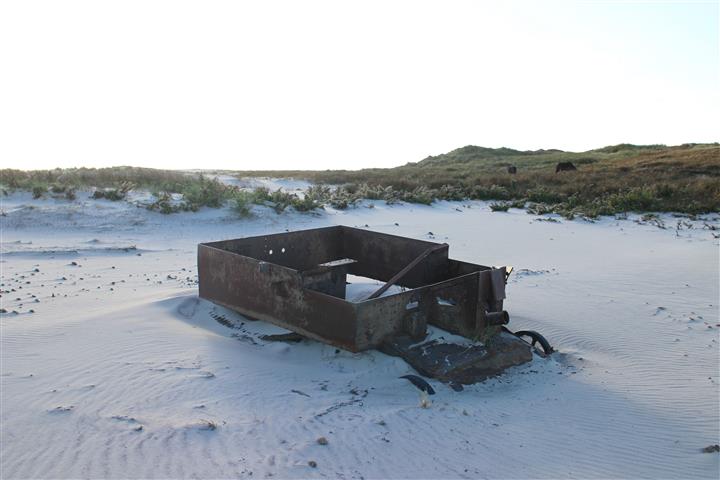
“Lifesaving” Universal Carrier, Sable Island. (courtesy of A. Taylor) note inventive “barrel” some wag has stuck in the front armoured plate where the Bren Light Machine Gun would have been fitted!
Familiar with Second World War vehicles, the photo, sent to me by a relative currently on the Island, clearly showed the low silhouette of a Universal Carrier, a light tracked-vehicle used for many roles by the Canadian Army from the early years of the War until the mid-1960s. My first reaction was astonishment, but there was an image or two online of the wreck, and a “Motor Museum” enthusiastic online article about building a miniature of this vehicle which explains:
“Our model represents a Universal carrier which was used to tow lifeboats, a job previously been done by horses, up and down the coast to launching positions suitable for the crisis at hand. Little is known about it but it is our tribute to the brave souls who saved countless lives and to a weapon of war that ended it’s days saving lives not taking them.”
A fan of Sable Island lore, I decided to see what I could find out at Library and Archives Canada. At least some of the story comes out in 1946-1952 Department of Transportation reports about the equipment on the Island. Shortly after the War, the DOT, then responsible for the facilities on the Island, was evaluating new lifeboats for the Humane Establishment, the lifesaving and shore patrol facilities. Up to this point, horses or oxen had been used to help haul the boats (on a wheeled cradle) out from the station boathouses to launching sites. The file details tests of US Coast Guard designs for modern lifeboats. An idea was put forward that mechanical transport would be preferable to animals, and using surplus carriers seemed an inexpensive solution.
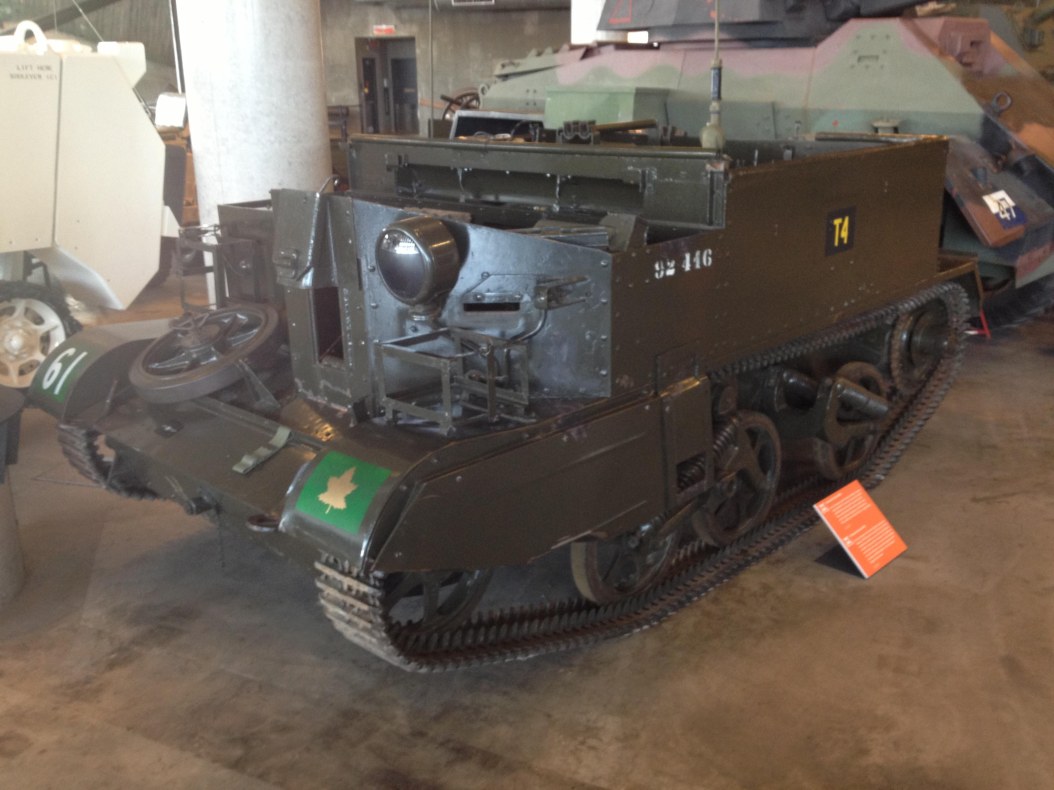
One of the Canadian War Museum’s carriers, painted with markings for the Lincoln and Welland Regiment, Royal Canadian Armoured Corps (author’s photo)
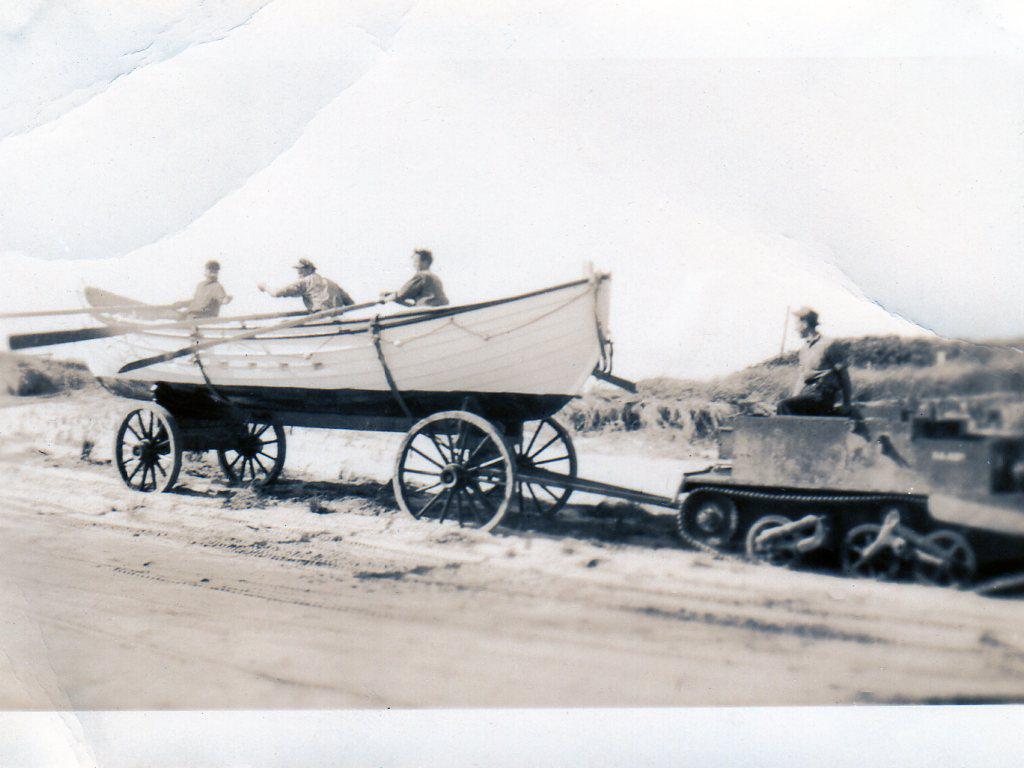
There were mixed opinions of the suitability of a carrier, with some parties (including the Chief of Aids to Navigation) thinking it would soon be immobilized in the sandy dunes. Attempts at procuring a test vehicle were frustrated when a vehicle offered up from War Assets stocks in Debert, N.S., was found to have over 2,000 miles on it (DND ordnance personnel had advised the transportation officials this was too much to guarantee reliability). The eventual 1942 Ford carrier was shipped all the way from Longue Pointe Ordnance Depot, near Montreal, to Dartmouth, N.S., and sent out to the island in the usual steamer resupply on Canadian Government Ship LADY LAURIER, accompanied by a Willys MB Jeep (I have no idea what happened to this). After a lot of casting about online, I located this tweet and image:
Using the carrier to tow a trailer and boat-crew, early 1950s. You’d think pneumatic tires may have helped! (photo credit: Ernest O’Hara, permission graciously granted by Our Sable Island Home)
Whatever the trials and tribulations of this carrier on the Island, the era of modern navigation made shipwrecks (mostly) a thing of the past, and the stations were all abandoned in 1958. The carrier, like much else, became derelict. Today, it is a conspicuous wreck from the last phase of the Humane Establishment’s Century-and-a-half of life-preserving efforts.
This remains one of our most popular posts, please leave us a comment!


 The Searchers