Commander Leopold McClintock tours Beechey Island in 1854 and creates the first photographic record of the Canadian Arctic

Beechey Island, Nunavut, (Iluvialuit) is an important site connected to both the Sir John Franklin Expedition (1845) and the period of searching for the lost crews of HMS Erebus and Terror. In August 1854 Commander F.L. McClintock captured the earliest known photographic depictions of the Canadian Arctic at Beechey. For anyone interested in this era of Arctic exploration, the ruins, cairns, memorials, and graves can become touchstones to the lost Franklin crewmembers and to the other sites of the ill-fated Expedition. In this post we will travel back in time to the critical moment in the creation of the built environment of the Beechey Island National Historic Site.1 We will also digitally reconstitute an incredible collection that has been dispersed across at least two continents. Join us as we accompany McClintock on his photographic expedition: A tour of Beechey in four amazing photographs!
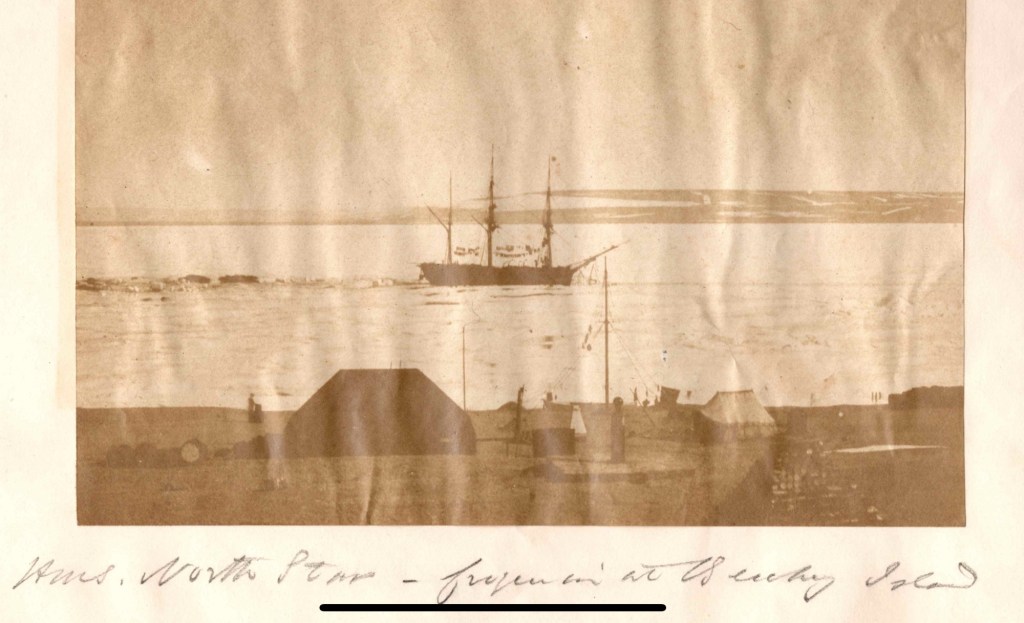
HMS North Star at Beechey Island, August 1854 (Photograph # 1). The squat shape of Northumberland House and the high pyramid of tins and tent at right are notable. Courtesy of Douglas Wamsley

Arctic history scholar Douglas Wamsley holds in his personal collection two historically important photographs, the earliest depictions of Beechey Island Sites National Historic Site of Canada. These were taken in an era when the crews of five exploration ships – Sir Edward Belcher’s Expedition – were engaged in the most extensive official effort to find the missing crews of Sir John Franklin’s Expedition that would ever be mounted. In their 1996 Polar Record article “Early Photographers of the Arctic,” William Barr and Doug Wamsley identified the photographer of these two views as Royal Navy Commander F. Leopold McClintock (1819-1907).2 They connected the two photos to his journal entries, and dated the first photo as having been most likely taken on 12 August 1854. McClintock – a veritable “go anywhere do anything” phenom of Arctic exploration – had commanded HMS Intrepid.
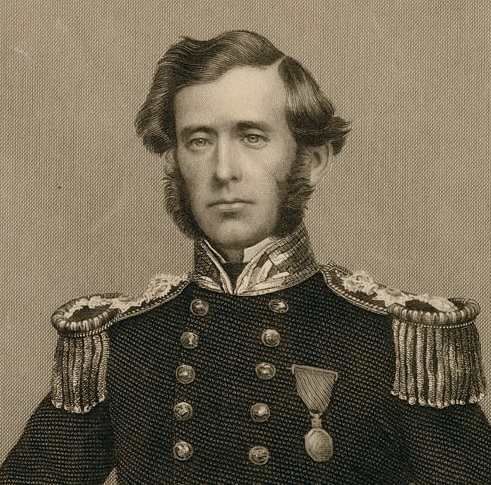
The explorer behind the camera! Sir Francis Leopold McClintock, ca. 1860 [detail of] in a captain’s uniform wearing the Arctic Medal. From Cheyne / Pound engraving. Credit: Library and Archives Canada, Acc. No. 1939-150-1  (removed from 1860 Illustrated London News).

Accompanying HMS Resolute (Capt. Henry Kellett) as a steam tender on the western arm of the Belcher searches, both ships were beset in ice, with no guarantee crews could extricate them. The northern arm of the searches also being iced-in, Belcher ordered Kellett and McClintock to abandon their ships during May 1854 and return to Beechey. After sledging back eastwards over the still-frozen channels and straits, they were welcomed with cheers from the crew of HMS North Star, the Expedition’s depot ship, which was under the command of William John Samuel Pullen.3 Resolute’s Assistant Carpenter, William Mumford, worked up a view of the overall scene which they encountered on their arrival, 28 May 1854. This watercolour helps us contextualize McClintock’s subsequent photographic expeditions. North Star is shown locked in ice and pointed northeast into the Bay.4
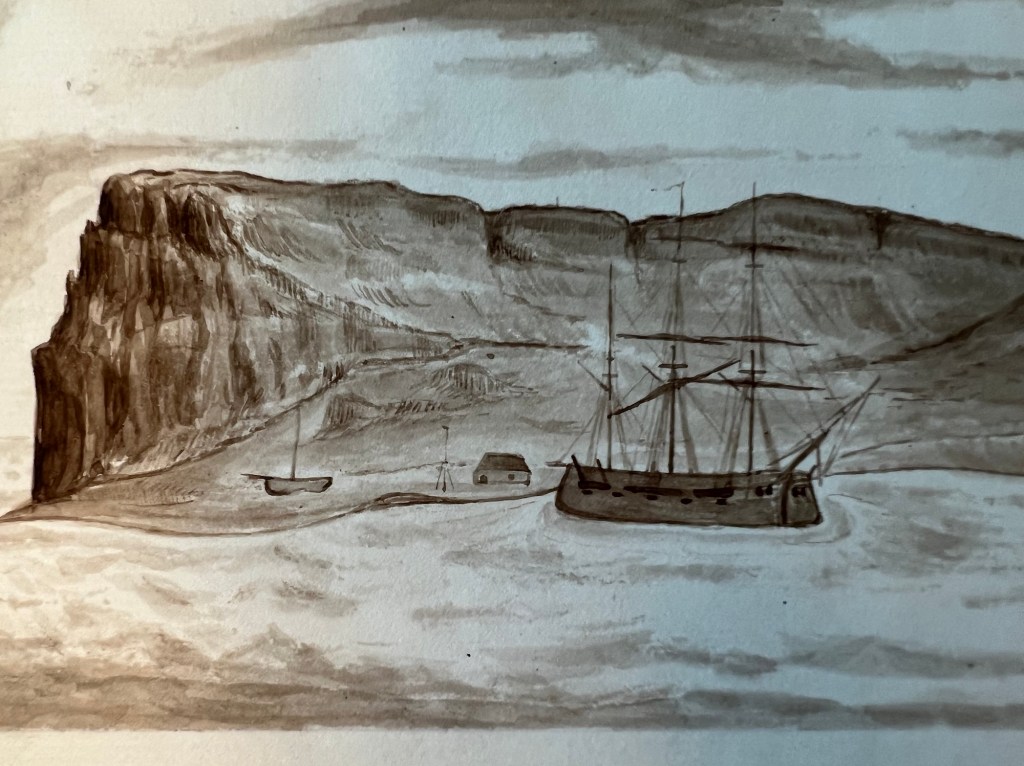
HMS North Star, dated May 1854, by Assistant Carpenter William Mumford. This remarkable view from the end of May shows the beset vessel under Beechey’s imposing and bleak cliffs. Ashore, Northumberland House, the storehouse the Belcher crews built, and a large boat which is likely Sir John Ross’s rescue yacht Mary, are visible. This was drawn before the installation of the cenotaph. [Detail of] LAC 1986-18-27
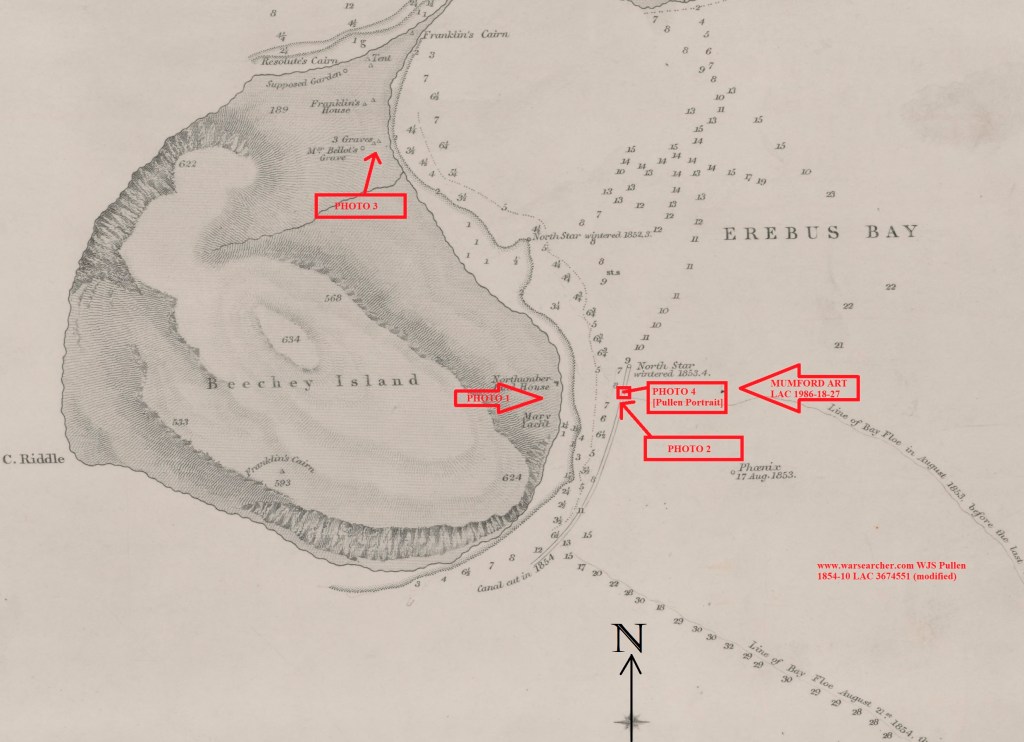
“Arctic Sea. Barrow Strait. Erebus Bay” Beechey Island and surroundings as surveyed by WJS Pullen, including annotations of ship locations, depth soundings in fathoms, and extent of ice [cropped and modified with photograph location annotations relevant to this post] created in 1854 and modified in 1876. Note that the 1,000 yard canal that crew cut between July and August 1854 to free HMS North Star is indicated. Credit: Library and Archives Canada R11630-3259-1-E

Having returned to Beechey without a ship, and not being then engaged in long-distance sledging (which he excelled at), McClintock decided to take up the role of “quasi-official” Belcher Expedition photographer. Before the Expedition departed England, HMS Resolute’s surgeon, William T. Domville, had originally been trained on taking photographic negatives using a camera obscura and developing them into prints using the calotype process. Domville took a few early photos in Greenland in 1852.5 It appears likely the camera was then stowed away for two years. Wamsley and Barr note that McClintock began taking pictures in early August 1854, and soon gained confidence with the apparatus and the complicated chemical treatment and development process.6 Despite the incredible challenges involved in producing an 1850s photographic record in the Arctic, McClintock even tried his hand at portraiture, capturing some of his companions (more on that below).
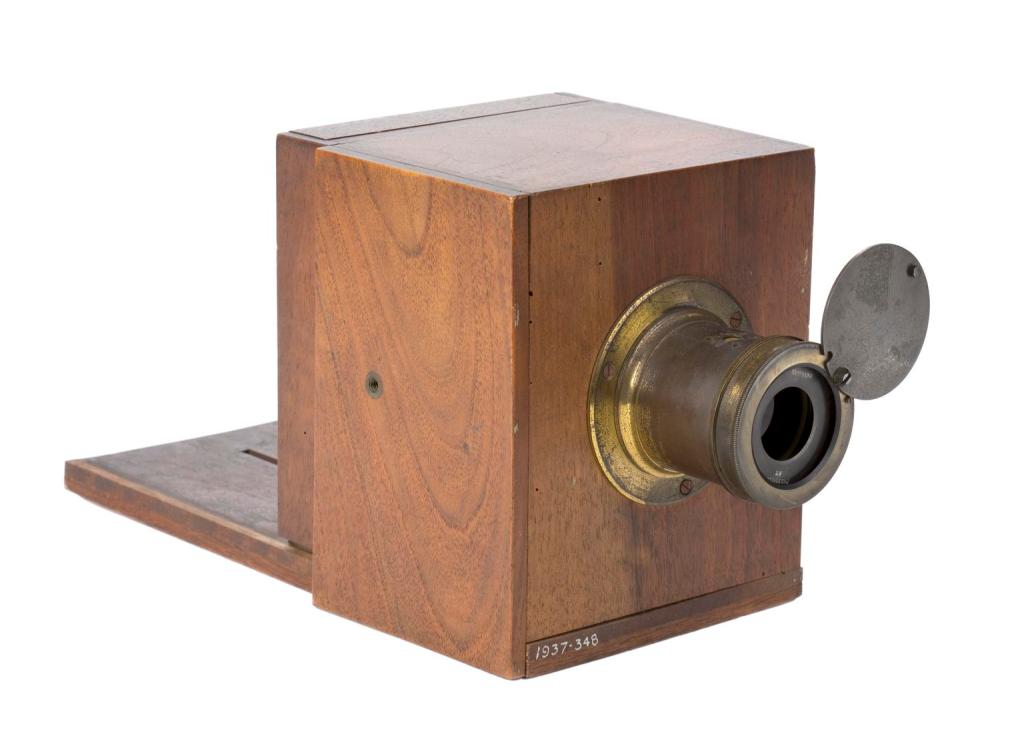
A camera obscura of French design, which resembles something similar to what McClintock would have used at Beechey. The Chevalier lens has two settings: Portrait and Landscape. Credit: Matilda Talbot. Science Museum Group © The Board of Trustees of the Science Museum, London CCBY 4.0.

Let’s journey back to Beechey as it existed then, to accompany McClintock on his photographic excursions. In early August 1854 the explorer, now firmly in command of the northernmost example of one of Her Majesty’s cameras, struggled west across the uneven ice from HMS North Star towards the Island. He most likely led a small shore party to assist him in hefting the heavy camera and tripod. Having ascended the rocky beach, past some of the new construction the North Star crew had completed over the last two years, he tucked himself under the soaring, fortress-like cliffs, and pointed the apparatus towards the east, back across Erebus and Terror Bay (see the annotated map above).

Laid out before him was an incredible Arctic vista: The frozen bay stretched into the distance, with an almost incandescent glare rising off the ice. Above the far shore, the bulk of Devon Island (Tallurutit) extended out towards Cape Riley, whose grand headland would be just to the right of the frame. It was a view that the lost men of the Franklin Expedition would have been completely familiar with, as they had overwintered near this same spot 1845-46. The actual moment of capture was probably not attended with much drama–no flash like a cannon’s discharge, no crashing report like a musket volley fired over a crew members’ burial. Yet by removing the lens cap for a few moments, McClintock had yet again triumphed in the northern latitudes. As light passed through the lens and into the camera chamber, an image was projected and recorded onto a sheet of chemically-treated, light-sensitive writing paper placed at the back of the camera. Another wonder of the Victorian age had arrived in the Arctic! The process pioneered by William Henry Fox Talbot would have involved McClintock treating the paper with noxious chemicals before leaving North Star, perhaps having started the first washes and sensitizing steps in an improvised darkroom deep in the ship (sheltered from the 24-hour sunshine). The stages of photography and print-making can be seen in the youtube tutorial from the Victoria and Albert Museum:

Opening the lens allowed for the image of this unique scene to be transmitted onto the sensitized paper that had been loaded into the back of the camera.7 At a later moment, another treatment process in the darkroom was used to develop this now-exposed negative and fix the image in place. Through a similar (though simpler) chemical process used to prepare calotype negatives, another sheet of sensitized paper would be physically pressed beneath the negative and exposed to sunlight via contact printing. This would create a positive version of the image. These positive variants are commonly known as salted paper-prints. They display a characteristic fuzziness – from the paper-to-paper printing process- while the printed image takes on sepia-like tones.7 Here was the great advance in photography over daguerrotypes: a film developer could use the process to create MANY salted paper-prints from the single calotype negative.
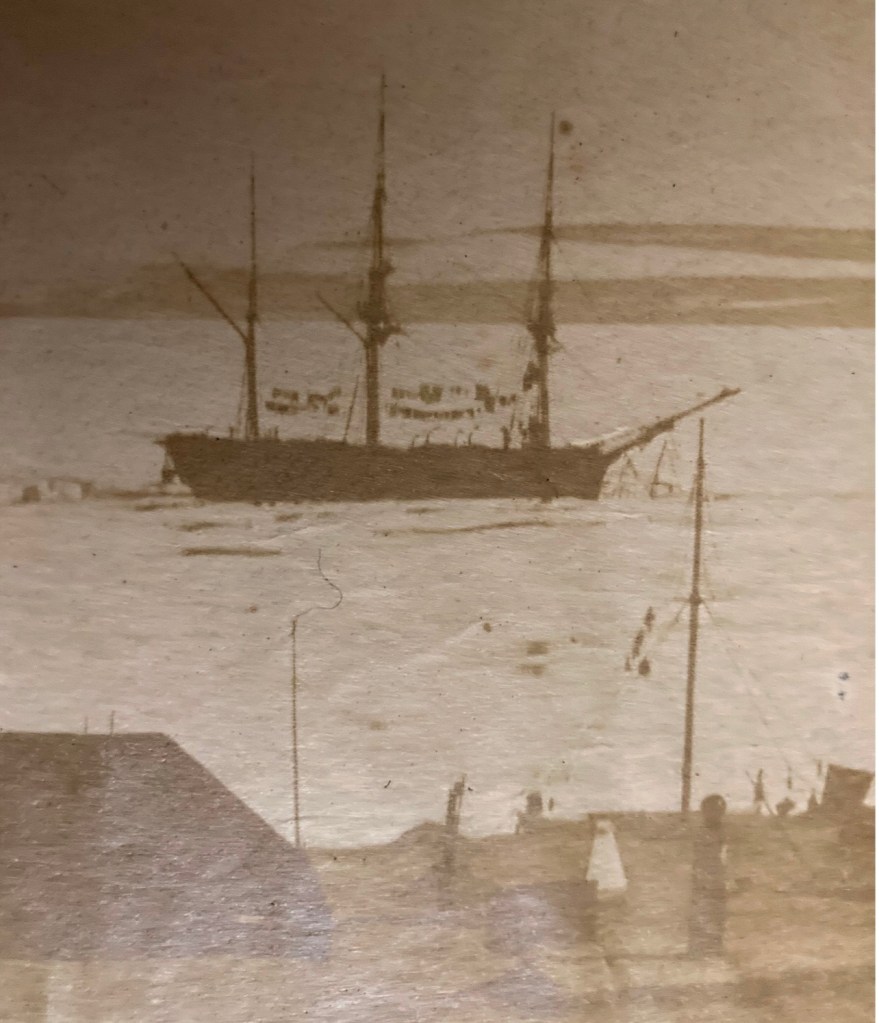
Detail of photo #1, showing HMS North Star, with wash hanging to dry, and what is likely the ship’s rudder hanging from the stern davits. In the foreground is the low-pitched roof of Northumberland House, a high flagstaff and signal mast, and the newly-erected cenotaph to the lost Franklin searchers. Precise cross-referencing of details of the construction with Mumford’s journal entries indicates the image could date from 1-12 August, 1854. Courtesy of Douglas Wamsley

On this first print, Northumberland House appears in the left foreground as a squat roofed-over structure. This depot or Arctic storehouse had been built over the 1852-1854 summers by the crew of North Star. Captain Kellett, McClintock, and the Resolute and Intrepid crews had built a similar structure at Dealey Island.8 The house had not yet been ringed by a low wall to the north and west, which is much in evidence during Allen Young’s 1875 Pandora visit.9 To the right, a signal mast – complete with stays and a topmast – is rigged near to the shoreline, with another shorter staff standing nearer to the House.10 In the near foreground, the brand-new monument or “Franklin Cenotaph,” is conspicuous, wearing its original somber coat of black. It had been shaped by Mumford and the other carpenters from the pawl bitt of the lost whaling ship McLellan’s windlass, and raised at the very end of July. The photograph may have actually been taken on the first or second of August, when crew were paving round the monument, but had not yet finished walling in the casks on the west and north sides of the House.11 This is the only image we will likely ever see of this important cenotaph before the Joseph René Bellot memorial was affixed to the front of the pedestal at the end of that August.12
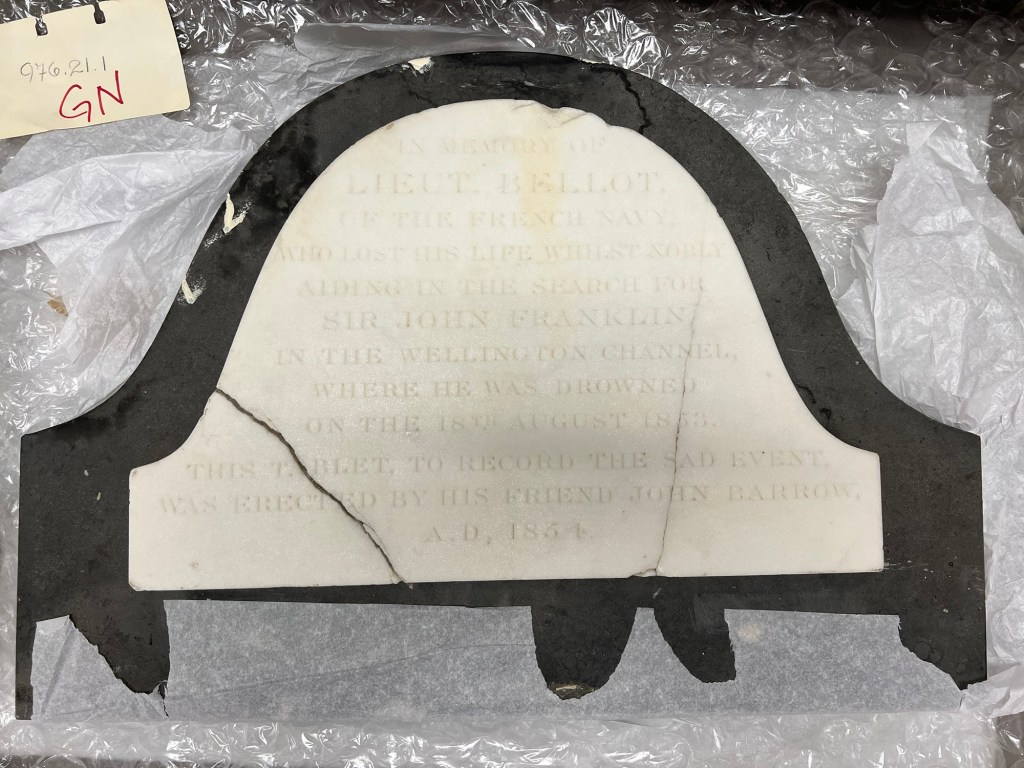
The original Joseph René Bellot memorial plaque, which would be affixed to the Franklin Cenotaph days after McClintock took his photographs. Courtesy Nunavut Archives.

There is a pyramid of tins in the right foreground, while a tent (most likely a marquee tent raised in mid-July to prepare the site for the arrival of Captain Belcher from the still-beset HMS Assistance) had been pitched to the right. Just off the beach rests the considerable bulk of a three-masted sailing vessel in good focus. A motionless ship sailing a static sea makes for an ideal subject, given the technical limitations of 1850s photography.13 North Star was locked in ice, with masts all up but no sails bent on the yards. Though the scene has few crew members depicted, one gets the sense of industrious bustle ashore from casks lined up on the far side of Northumberland House, and what appears to be a line of boats aft of North Star. Wamsley and Barr noted that there was visible evidence at the bows that crew had commenced cutting the ice around the bows with ice saws. By the crew’s exertions cutting and parbuckling the ice, North Star had been turned with her bows now pointing south towards the open waters of the Barrow Strait.
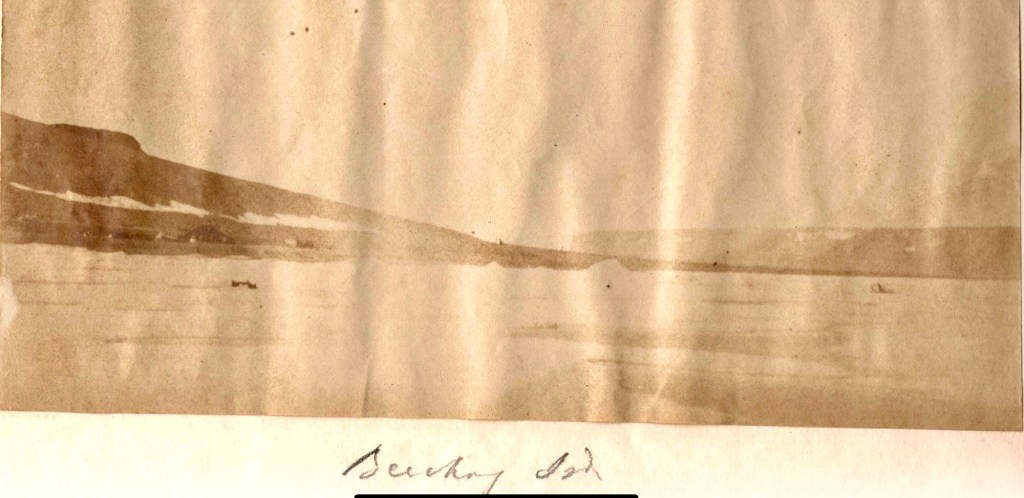
Photo # 2: taken from an elevated position onboard HMS North Star. Northumberland House appears to left, while the low ground between Beechey and Devon Islands, and the historic Franklin Expedition graves, are at centre [cropped] Courtesy of Douglas Wamsley

The second photo used in this post was taken from onboard the North Star, in a northwesterly direction. It shows a distant and indistinct view of the shores of Beechey Island and the land bridge stretching around the bay to Devon Island. Northumberland House can be seen on the near shore. The House appears at a greater distance from the ship than in the first photo. It seems reasonable to assume this was taken days later, as North Star was gradually hauled south towards the edge of the ice. The ice appears disrupted in the foreground, suggesting the route the crew had already cut. Some black flecks at the very center of the photo may hint at the Franklin crewmembers grave boards, our next stop!

Up until a few years ago, these two prints comprised the entire extent of McClintock’s Arctic photography. That has changed over the last few years, starting with the digitization and uploading of a another salted paper print of the Franklin crewmembers’ graves located in the Gell family album at the Derbyshire Record Office (DRO). Franklin scholar Russell Potter has written an interesting contextual post about the discovery of this mysterious photograph, which we will identify here as photograph #3.14
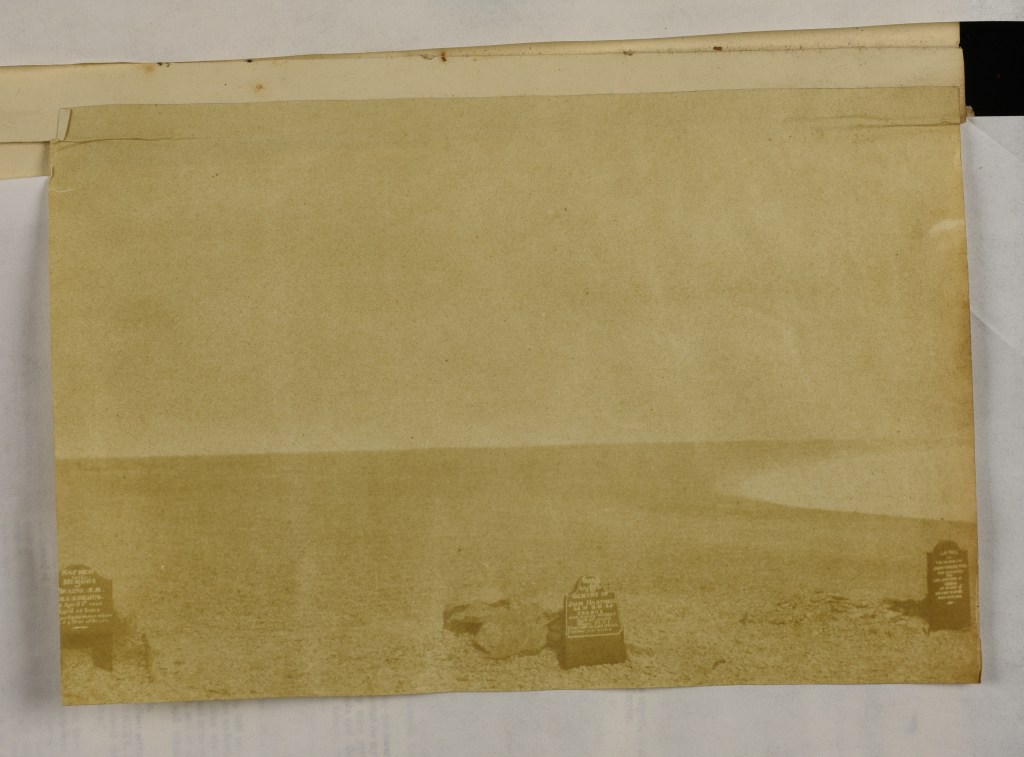
Photo # 3: Salted paper print of the Beechey Island Franklin graves, located in the Gell family album about the Franklin searches, and likely taken by Leopold McClintock, August 1854. The graves are (L to R) William Braine, John Hartnell, John Torrington. Credit: Derbyshire Record Office (D8760/F/LIB/10/1/1) used with written permission.

It now seems likely that McClintock did what any modern visitor to Beechey equipped with a camera would do: He walked about 1.5 kilometers up the beach and snapped the first known photo of those famous graves, which, after all, contained the only Franklin crewmembers that any searchers had (as of 1854) yet located.15 Two important details link the McClintock prints to this mysterious DRO print of the three Franklin crew members’ graves: Erebus and Terror Bay (the shoreline to the right) is a blinding expanse of frozen ice, but there is no snow on the rocky ground.16 The dimensions of the three prints are also similar, which is consistent with having been created by the same camera apparatus.17 Since Domville is believed to have stopped taking photographs after the departure from Greenland, there is also, to date, no other known photographer using a camera combined with the calotype development process that was active in the area at this time.

Wamsley and Barr noted (in 1996) that none of McClintock’s calotype portraits from mid-August 1854 had ever been located.18 I believe we may now also have one example of this series, which, according to the journals of both McClintock and George Ford (ship’s carpenter from HMS Investigator), were taken on 21 August 1854, on the deck of North Star.19 Recently, an item came up for sale on ebay with a strong Beechey 1854 connection: A seated portrait of an officer of the mid-nineteenth century Royal Navy (photograph #4). Notations below the print indicate it to have been taken in 1850 aboard HMS North Star, before “Father” departed on an Admiralty search for Sir John Franklin in the Arctic region. “Remembering the Franklin Expedition” Facebook group member Conner Nelson noted a strong resemblance to Cmdr. W.J.S. Pullen.20 The portrait appears consistent with an unwaxed positive, salted paper-print, from a calotype negative taken using the camera’s portrait lens setting (or possibly a separate lens formatted for portraits).
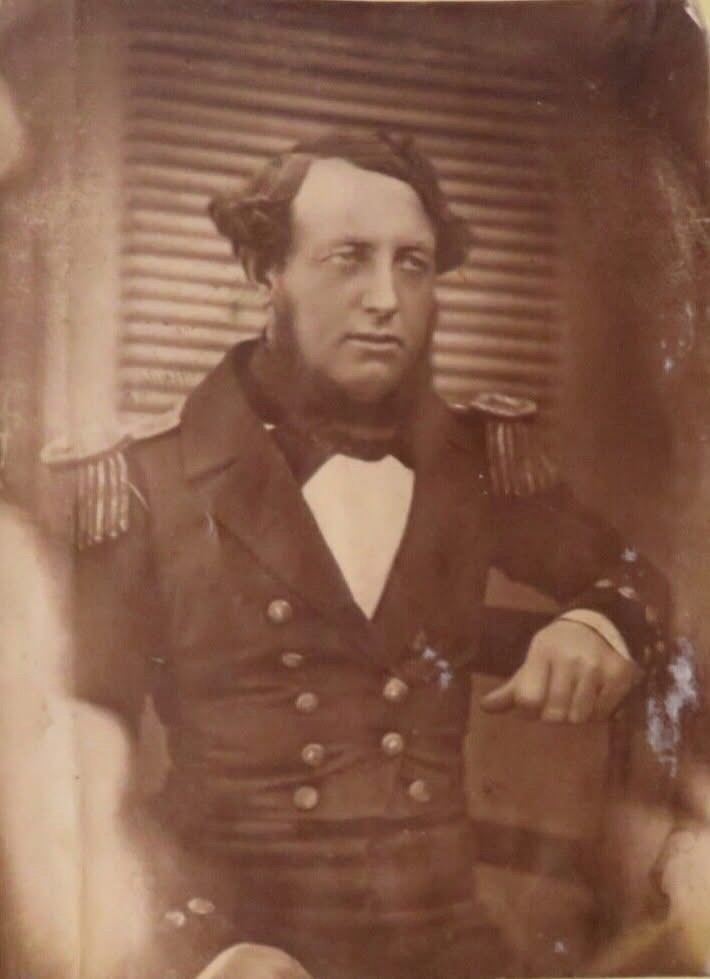
Photo # 4: Master T.C. Pullen, most likely onboard HMS North Star, wearing the undress tailcoat and epaulettes of a Royal Navy officer, via ebay.com

I believe this portrait was most likely taken onboard North Star by McClintock in that high Arctic summer of 1854. I also believe it depicts W.J.S. Pullen’s brother, Thomas. W.J.S. had been appointed Commander while away on his first expedition searching for Franklin in 1850, two years before he was appointed to command North Star. For this new search effort, he would be accompanied by his younger brother, Thomas C. Pullen, who served in the role of Master (a senior warrant officer). Though I have not been able to examine the portrait in person, it is unique from the contemporary image that the engraving of the Belcher Expedition commanders is based off in The Illustrated London News.21 In contrast to his older brother, T.C. appears to be the right age. He is depicted in the pre-1856 undress uniform of an officer.22 Masters in the Royal Navy had recently been granted the authority to wear the epaulettes of a junior officer, which in this era were unadorned with the distinctive anchors, crowns, or pips worn by commanders and more senior officers. Where precisely was this calotype portrait taken? My familiarity with North Star’s layout and plans leads me to suggest one likely place: Just to the side of the ship’s wheel, tucked under a “poop” deck that, uniquely of all Belcher Expedition ships, North Star was equipped with.23
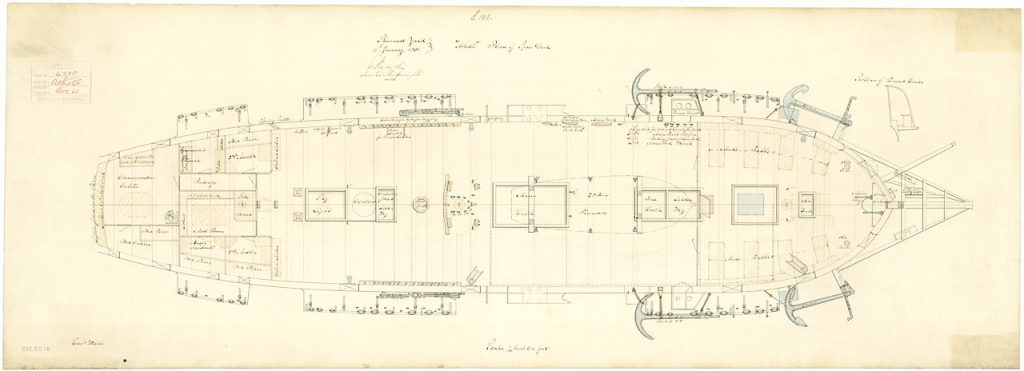
Our research has established that this plan depicts the 1851 modifications to HMS North Star in advance of the Belcher Expedition. T.C. Pullen would have been sitting just on the side of the ship’s wheel tucked under the poop deck, about 1/4 of the way from the stern (left). ZAZ5516 © Crown copyright. National Maritime Museum, Greenwich, London

Though the louvered door is similar to the style of door found in an earlier illustration of North Star‘s flag locker (depicted prior to the James Saunders’ supply expedition this was located directly over the transom at the very stern), it is my belief this door led directly into “Officer’s country” – the decked-over passage and cabins at the stern that held the berthing for the Pullen brothers and the other officers.24 This would have been an ideal setting for McClintock to utilize a portrait lens (or a dual setting lens like the Chevalier lens fitted to the above Science Museum, London, artifact).25 The series of portraits captured by McClintock on 21 August may have been intended for a celebratory purpose: on that day, North Star crew finally cut through or blasted with explosive charges the final stretch of the more than 1,000 yard canal southwards and arrived at the edge of the floe. North Star had survived two punishing winters at Beechey, and could now escape the Arctic. T.C. Pullen’s 1854 journal entries record his titanic efforts – despite illness and profound weariness – to spur his crew on to free the ship from an icy grave.26
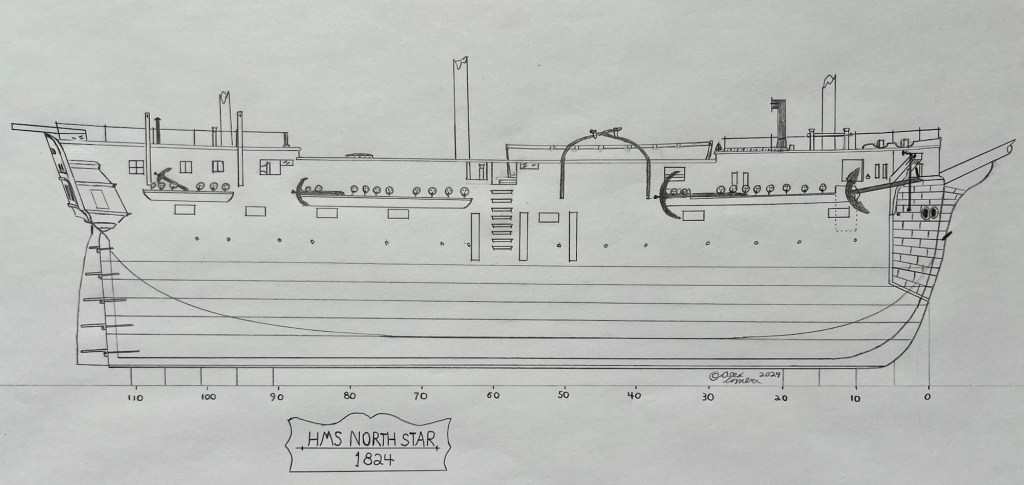
HMS North Star reconstruction 1852-54 [detail of] for information on my reconstruction of this original “Arctic Juggernaut”, and stern/bow elevations, as well as sources and other illustrations, please see our post. The TC Pullen photo would be taken just under the break of the poop. Credit: http://www.warsearcher.com

The depot ship was now burdened by supernumeraries from five abandoned Franklin search ships: Investigator, Resolute, Assistance, Intrepid, Pioneer. Just before departure, a strange sail to the east resolved itself into Edward Augustus Inglefield’s trim steamer, HMS Phoenix and the storeship Talbot. Onboard the steamer was the distinctive plaque to the memory of Bellot, to be affixed to the front of the monument, and – relevant to our photographic survey – a new generation of camera: a glass-plate camera employing the vastly superior wet collodion process. The age of the calotype photographic process had arrived and now departed from the shores of Beechey Island! Thank you for accompanying McClintock and I onboard HMS North Star, and out onto the rugged landscape of Beechey Island, these seventeen decades ago!

Acknowledgements: I would like to thank Douglas Wamsley for his support and advice and for reviewing an early version of this post, and Russell Potter for facilitating our contact last December. Library and Archives Canada Audiovisual Specialist Anitta Martignago generously shared her expertise about calotype negatives and salted paper-prints: She has actually taken and developed calotypes herself! Sylvia Wright, a direct descendant of Sir Leopold McClintock, also provided feedback. The Derbyshire Record Office staff provided additional information and kindly consented to the usage of the Beechey grave print.

ENDNOTES:

CLICK FOR ENDNOTES
What Sir John Franklin’s High Arctic Cenotaph is Made of – A Whaler of a Tale!

A cenotaph to lost Royal Navy personnel – a National Historic Site of Canada – and archival records that show that it is made from an American shipwreck! Readers may recall the very origins of this website were to help explore and add provenance to relics and artifacts connected to Canadian military cenotaphs. So in a sense, after interpreting the history and shipwrecks connected to the lost 1845 Sir John Franklin Expedition in search of a Northwest Passage, we’ve come home!

We recently posted about the history of the “Franklin Cenotaph” at Beechey Island, Nunavut. This isolated monument is an incredibly rare memorial to the crews of the lost 1845 Sir John Franklin Expedition and the searchers who died looking for them. It is identified by Parks Canada as a “character-defining element” of the Beechey Island Sites National Historic Site of Canada. It is important to understand what the cenotaph is and what components combine to create it.

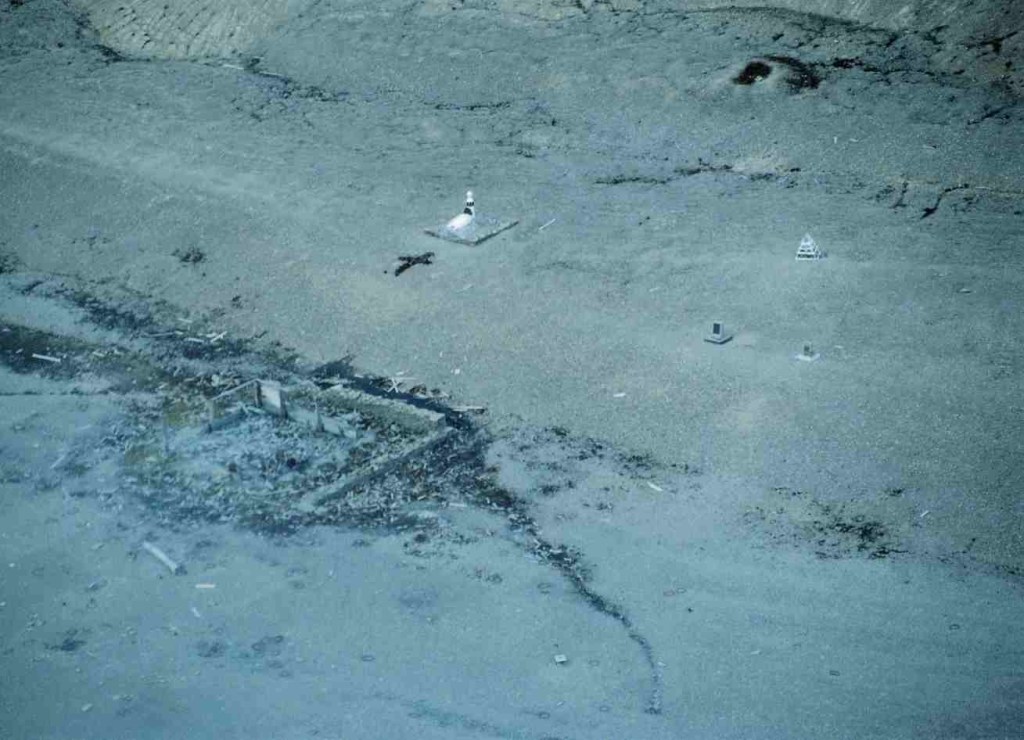
Beechey Island sites, photographed from the air in 1997. This shows the Franklin Cenotaph at the top center above the crucifix made out of empty tins. The ruins of Northumberland House (the supply depot) are down towards the beach, while other memorials are located at right. Credit: Ansgar Walk, CC BY-SA 3.0 http://creativecommons.org/licenses/by-sa/3.0/, via Wikimedia Commons

The column itself, built in the arctic summer of 1854, under the direction of Captain W.J.S. Pullen, HMS North Star, is thought to be made out of the machinery of a lost American whaling ship, the McLellan. This little-known detail further solidifies the Anglo-American character of the commemorative program of the monument.1 We ended our earlier post with a series of questions we hoped could be answered about the column’s origins. We also wondered if it really could have been made out of the capstan of the McLellan, as has been reported.2 A capstan, as defined by wikipedia is “a vertical-axled rotating machine developed for use on sailing ships to multiply the pulling force of seamen when hauling ropes, cables, and hawsers.”

An image of the “Franklin Cenotaph” and surroundings (left) compared to a capstan located at Whitby, England. One origin story of the Franklin monument is that the central “Belcher Column” is made from the capstan of the American whaling ship McLellan. The model of capstan at right exposes the octagonal spindle, which more often formed the core, surrounded by a substantial drum. Credit: (left) NWT Archives/Stuart M. Hodgson fonds/N-2017-008: 0918 / (right) Neil Reed / Capstan, Whitby East Pier, 2009 via wikimedia commons.

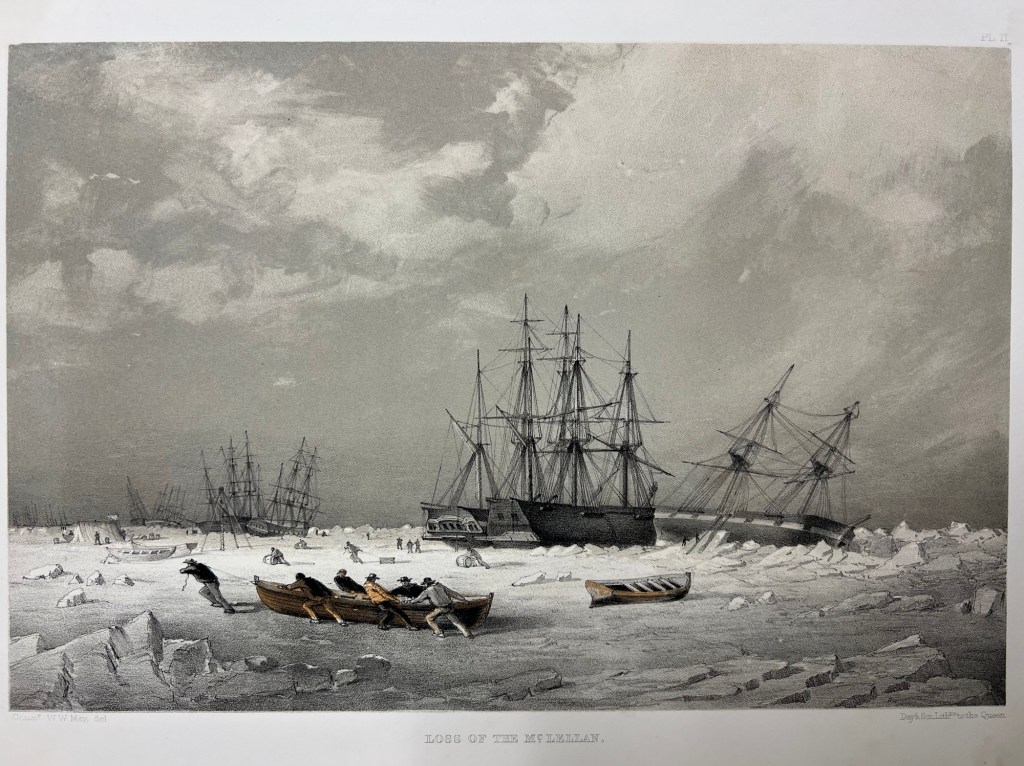
McLellan was a 366-ton barque-rigged wooden ship which had served as a general merchant in the 1830s, but had been purchased by the firm Perkins & Smith for the bowhead whaling industry in 1846. It was homeported out of New London, Connecticut, under the command of Captain William Quayle.3 We recently had an opportunity to closely examine a work at Library and Archives Canada which depicts the July 1852 loss of this ship:

Cmdr. Walter W. May (1855) “Loss of the McLellan” (Engr. J. Needham) Credit: Library and Archives Canada, Acc. No. R9266-2137 Peter Winkworth Collection of Canadiana.

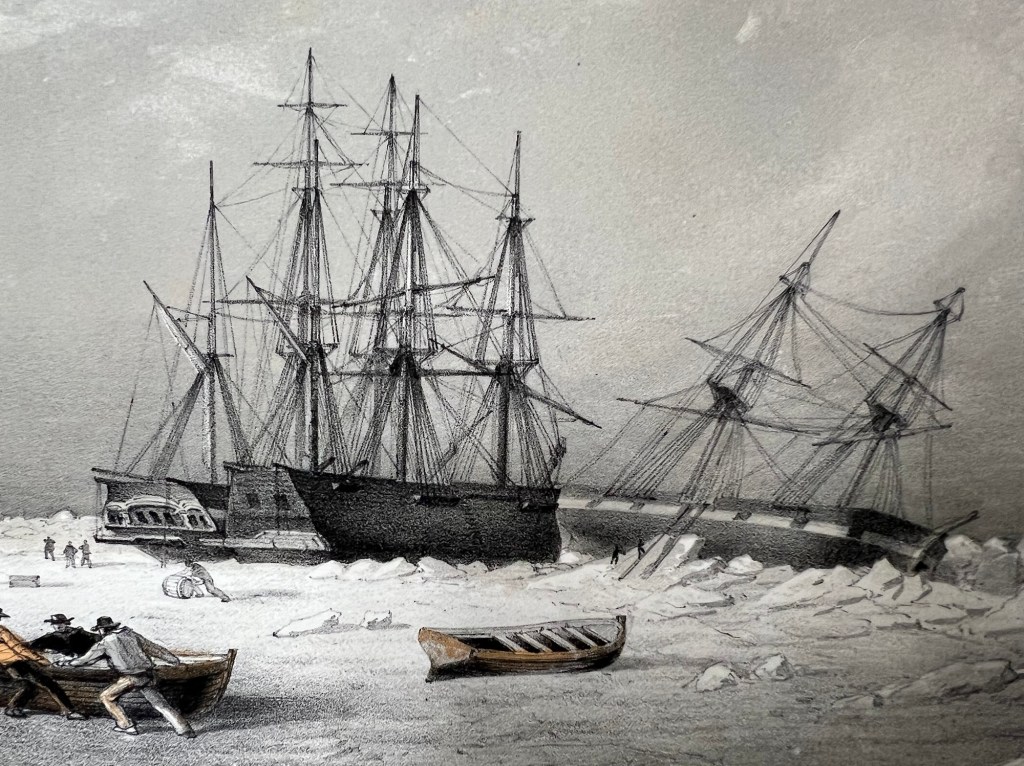
The engraving, made from a sketch by Cmdr. Walter W. May – who witnessed the events –includes many interesting details of whaling ships beset in ice near each other, and Royal Navy vessels. It also shows crew members salvaging items from a visibly-damaged ship.

Walter W. May was a gifted artist and an officer serving on HMS Assistance. This most likely depicts HMS North Star, which was nipped, but repaired, Alexander, a whaling ship, and McLellan at the far right being salvaged. [detail of op. cit.]

During the 1851 season, McLellan had been involved in a milestone in the development of the American whaling industry. Quayle had landed a shore party, led by mate Sydney O. Budington, at Nimegen Island, Cumberland Sound. This small group built a stout structure there and hunkered down to overwinter. With the assistance of local Inuit families, crew were able to live in relative comfort into 1852, trading for items and swapping their clothes for warmer furs.4

The plan was for the group to begin whaling far earlier than any ship-based crew could gain access to the area. It was a bold plan and it worked – they were able to land a huge catch of seventeen bowheads. They also became the first commercial interest to overwinter in the Canadian Arctic since the 16th Century voyages of Martin Frobisher. This shore party stayed on until September of 1852, and would eventually have to be taken off by another whaling ship.

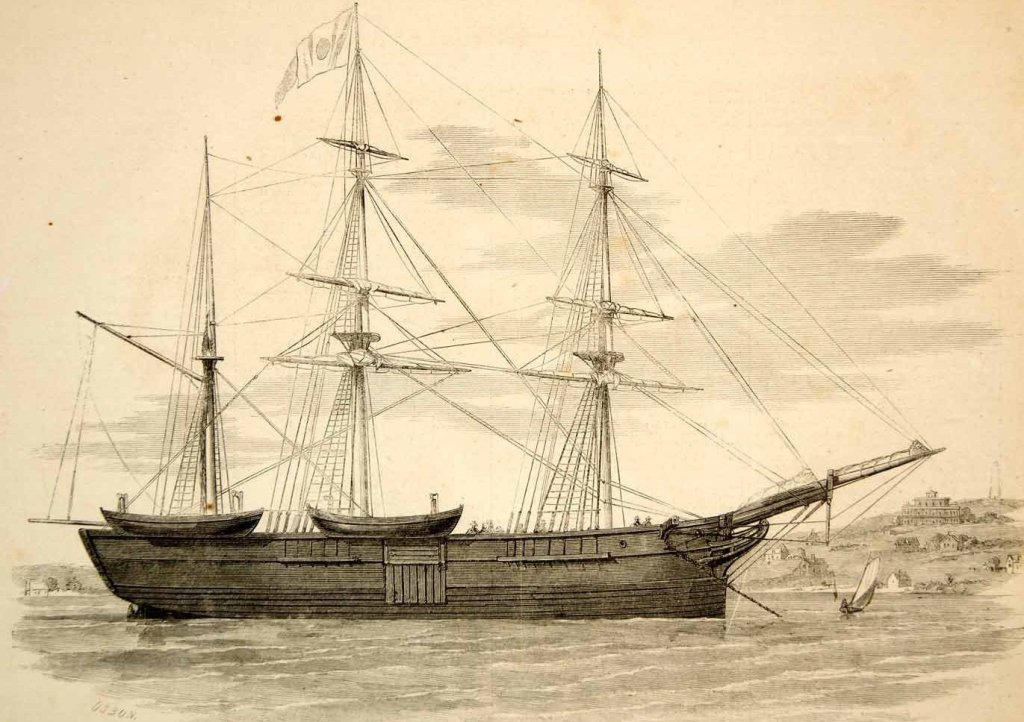
The George Henry (1841) whaling ship. This ship was similar to McLellan, and was later commanded by both Sydney O. Budington and his uncle James Buddington. James would stumble across the abandoned Franklin search ship HMS Resolute in 1855. The prominent boarded-up port amidships is for the “cutting stage,” a relatively recent development to flense whales. Credit: Sherard Osborn, Public domain, via Wikimedia Commons

At the beginning of the 1852 season, McLellan, on the return voyage to the whaling grounds and to pick up Budington’s party, was one of a group of whaling ships that were beset in ice in the Davis Strait near Melville Bay. The ships were in a perilous position, between the land ice and the shifting sea floes.  Sir Edward Belcher’s Arctic Squadron, comprising HM Ships North Star, Assistance, Resolute, Pioneer, and Intrepid, were on their way up to Lancaster Sound to launch a sustained effort to locate Sir John Franklin and the crews of HMS Erebus and Terror (by this time missing for seven years). On June 20th, just as the naval squadron was coming up with the group of whalers, the veteran Kirkaldy whaling ship Regalia was crushed by ice. What followed seems unusual nowadays, but was apparently the accepted practice: The ship was quickly stripped of valuables, crew set out to find another whaler to serve in, something of a party broke out on the ice, and the hulk was burned to ensure it would not menace other ships.

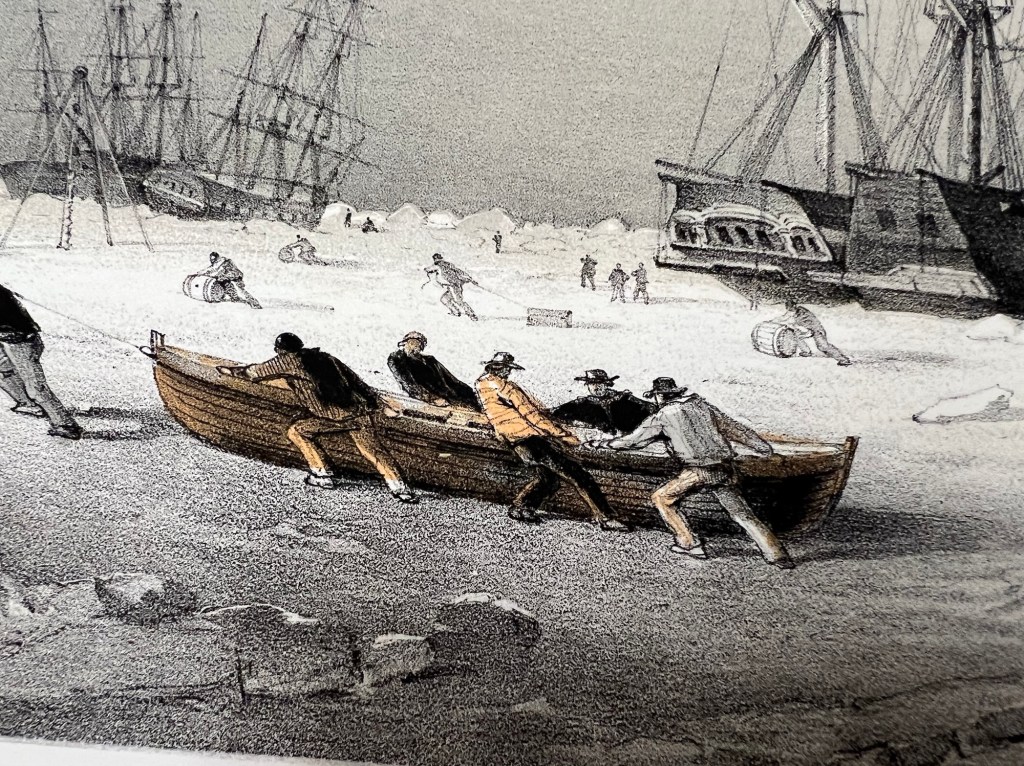
In early July, McLellan ran afoul of North Star, the depot ship of the Expedition, and the Alexander, a Dundee whaler. It damaged the cathead of the North Star, and the bowprit of the Alexander. The mizzen mast of McLellan had to be cut away to avoid further damage. The American whaler was severely nipped by the encroaching ice. The crew were preparing to abandon ship and the whalers in the area looked forward to commencing the usual “sacking and burning.” Instead, Belcher purchased the damaged vessel from Captain Quayle. The Royal Navy crews set about repairing the whaler. The repairs held until the ship was nipped more forcibly on 8 July. McLellan was gradually crushed over the next week. Naval crews salvaged spars, stout timbers, fittings, machinery, and cargo from their newly-purchased hulk. Valuable items were shifted over to North Star and the search ships.

Crew members salvage boats, casks, and other items as McLellan is destroyed. [detail of op. cit.]

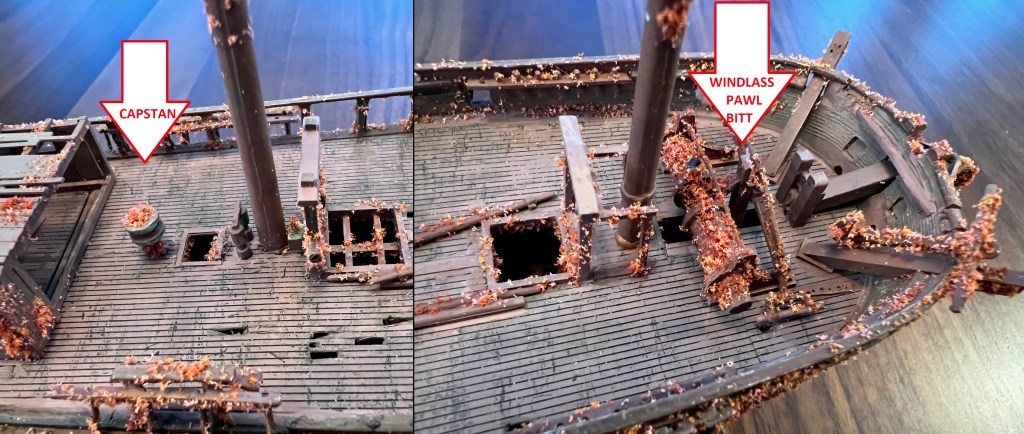
Two years later, these parts were a ready source of materials for the program of construction and “beautification” that Belcher and W.J.S. Pullen organized at Beechey Island, the site of the Expedition’s depot. We originally believed that the (interior) spindle of McLellan’s capstan had been transformed into the central element to the Franklin Cenotaph. At the time of our earlier post, we were concerned about one issue: not all whaling ships had capstans. For example, the most similar ship to McLellan remaining in existence, the Charles W. Morgan, isn’t fitted out with this prominent piece of machinery. To effectively operate a capstan, a ship required a large crew. Many merchant ships favoured the use of their windlasses, which could be operated with their smaller crews. A windlass, normally situated near the bows, forward or immediately aft of the foremast, is “ A mechanism operating on the same principle as the capstan, but on a horizontal axis, used on board merchant ships, and some smaller vessels of the royal Navy, for weighing the anchor, hoisting and hauling.”5

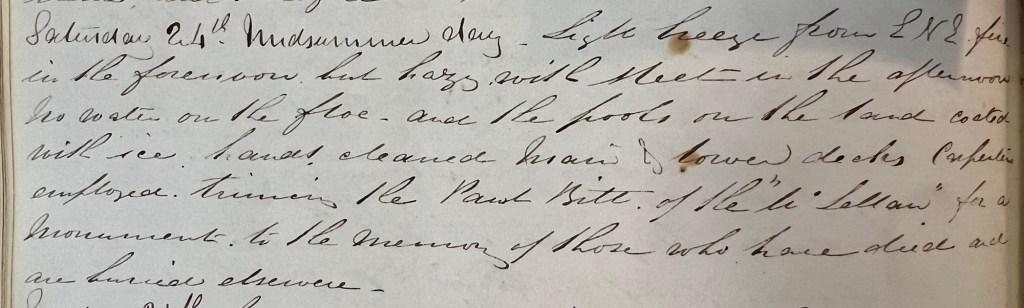
Resolute’s apprentice carpenter, William T. Mumford, the subject of our recent post, was an active participant both in the July 1852 salvage of McLellan, and in building the cenotaph during June 1854. He had just arrived back to Beechey after the mid-May abandonment of Resolute off Dealey Island. Mumford’s information, from his records at Library and Archives Canada, has helped us update the provenance of this important memorial. He wrote in his diary on Saturday, June 24th, 1854: “Midsummer Day, Light breeze from the E-N-E full in the forenoon but hazy with sleet in the afternoon. No water on the floe, and the pools on the land coated with ice. Hands cleaned main & lower decks carpenters employed trimming the Pawl Bitt of the McLellan for a monument to the memory of those who died and are buried elsewhere.

“The Pawl Bitt of the ‘McLellan'” – WT Mumford Diary entry 24 June 1854 (not paginated). Credit: Library and Archives Canada W.T. Mumford Fonds, 1986-018 PIC.

More than almost any other member of the Belcher expedition, Mumford’s occupation and prior experiences make him the expert on the origins of the central monument at Beechey. The “Pawl Bitt” was a strong timber, normally square, that was an important part of a ship’s windlass in the era of wooden sailing ships. It supported the “pawl”, a strong ratchet that ensured that leverage gained by the rotation of the windlass barrel was not lost. The pawl bitt was a substantial structural timber that usually connected straight down to the lower deck. It also usually supported the ornamental bracket the ship’s bell was hung off. This made it an important ceremonial and commemorative site. In this case, the Belcher Expedition carpenters’ efforts at “trimming” seems to have involved carefully working the square timber into an octagonal column, creating a finial ball to surmount the column, carving out or adapting some cavity to house the idiosyncratic “postal office” plaque now located at the rear of the column, and installing the original eight dedicatory plaques to memorialize lost crew members (which are individually identified in a note in our earlier post).

As it happens, there are contemporary examples of both a capstan and a windlass less than three kilometers away from the Cenotaph, on the seafloor of the Barrow Strait! Breadalbane, whose well preserved-wreck is also part of the National Historic Site at Beechey Island, was equipped with both a capstan and a windlass, including a pawl bitt. The pawl bitt is the stout post just forward of the horizontal windlass drum, with the ratchet-like pawl angling down. There was usually a brass ship’s bell sited atop this bitt. This is our scale model interpretation of the wreck. Credit: http://www.warsearcher.com

As we hope we have shown with both posts about the “Franklin Cenotaph,” this memorial is a powerful site of memory of a great era of polar exploration history. As a very early example of a military cenotaph, it has much in common with First World War battlefield memorials. It was constructed from relics and materials on hand, by comrades who knew the lost and the missing. Ship’s Carpenter William Mumford’s diary has helped enrich the provenance of this important monument by linking it to an identified feature of the wrecked American whaling ship McLellan. We hope that visitors to Beechey Island, Nunavut, who stand in contemplation before the cenotaph can better appreciate this remarkable artifact. To paraphrase a oft-repeated inscription from other memorials: HERE SEARCHED BRAVE SAILORS – YOU WHO TREAD THEIR FOOTSTEPS REMEMBER THEIR GLORY.

  1. An inscription added later recognizes Anglo-American cooperation in the search efforts over the High Arctic. The United States participated in search efforts such as the two Grinnell expeditions, and Elisha Kent Kane’s later searches. The 1858 addition to the monument of Lady Franklin’s marble (eventually brought up by Captain Leopold McClintock) expresses the shared Anglo-American concern for establishing the fate of the Franklin crews. ↩︎
  2. The link between the Belcher column and McLellan is noted in Barr and Stein’s January 2017 article “Frederick J. Krabbé, last man to see HMS Investigator afloat, May 1854” Journal of the Hakluyt Society. (P27) The authors appear to have consulted Mumford’s diary, but mention the source of the column is McLellan’s capstan drum. ↩︎
  3. This description of McLellan’s wrecking draws extensively from information in Philip Goldring’s Jan-Feb. 1986 Beaver Magazine article “The Last Voyage of the McLellan” PP39-44. The issue is currently accessible at the Canada’s History Magazine archive: https://www.canadashistoryarchive.ca/canadas-history/canadas-history-feb-mar-2019/flipbook/1/ Captain (later Colonel) William Quayle had a remarkable life, before and after his four years with McLellan, with many notable events outlined in a 20 June 1901 Moberly Weekly Monitor profile of him: https://www.newspapers.com/article/moberly-weekly-monitor-william-quayle/66609/ that article also gives Quayle’s description of McLellan as having been a barque of 110 feet overall length, 27 feet 7 inches wide, 14 feet nine inches deep, of about 326 tons. ↩︎
  4. McLellan and the other American whalers had more diverse crews than mid-Victorian Royal Navy ships. It would be interesting to know if Budington’s shore party had brought Black whalers directly into contact with Inuit families. ↩︎
  5. “Windlass” A Sea of Words ; A Lexicon and companion for Patrick O’Brian’s Seafaring Tales (New York: Owl Books 1997) P.458. ↩︎