Commander Leopold McClintock tours Beechey Island in 1854 and creates the first photographic record of the Canadian Arctic

Beechey Island, Nunavut, (Iluvialuit) is an important site connected to both the Sir John Franklin Expedition (1845) and the period of searching for the lost crews of HMS Erebus and Terror. In August 1854 Commander F.L. McClintock captured the earliest known photographic depictions of the Canadian Arctic at Beechey. For anyone interested in this era of Arctic exploration, the ruins, cairns, memorials, and graves can become touchstones to the lost Franklin crewmembers and to the other sites of the ill-fated Expedition. In this post we will travel back in time to the critical moment in the creation of the built environment of the Beechey Island National Historic Site.1 We will also digitally reconstitute an incredible collection that has been dispersed across at least two continents. Join us as we accompany McClintock on his photographic expedition: A tour of Beechey in four amazing photographs!
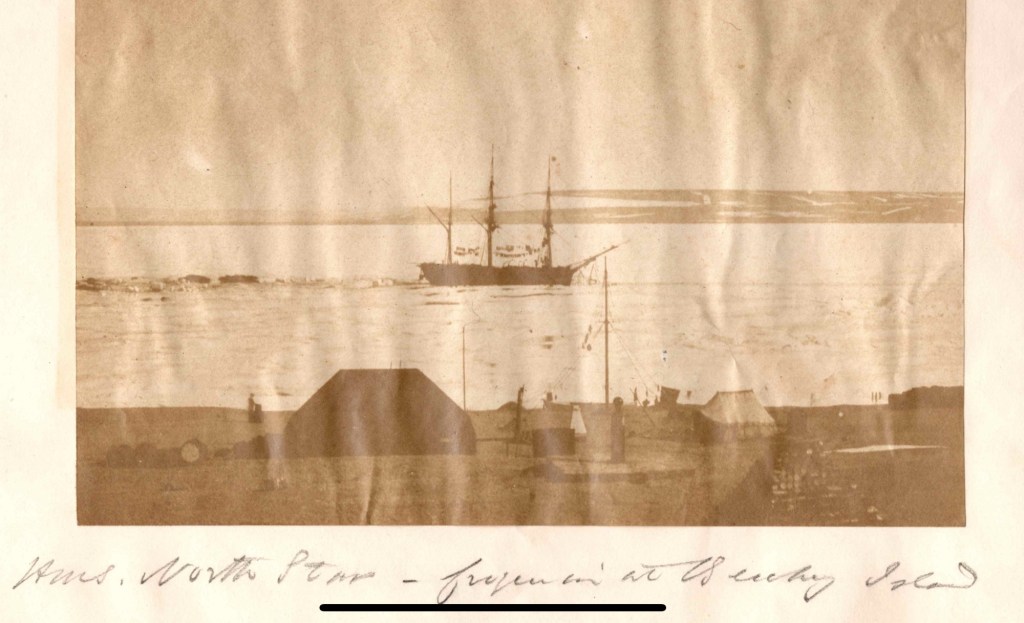
HMS North Star at Beechey Island, August 1854 (Photograph # 1). The squat shape of Northumberland House and the high pyramid of tins and tent at right are notable. Courtesy of Douglas Wamsley

Arctic history scholar Douglas Wamsley holds in his personal collection two historically important photographs, the earliest depictions of Beechey Island Sites National Historic Site of Canada. These were taken in an era when the crews of five exploration ships – Sir Edward Belcher’s Expedition – were engaged in the most extensive official effort to find the missing crews of Sir John Franklin’s Expedition that would ever be mounted. In their 1996 Polar Record article “Early Photographers of the Arctic,” William Barr and Doug Wamsley identified the photographer of these two views as Royal Navy Commander F. Leopold McClintock (1819-1907).2 They connected the two photos to his journal entries, and dated the first photo as having been most likely taken on 12 August 1854. McClintock – a veritable “go anywhere do anything” phenom of Arctic exploration – had commanded HMS Intrepid.
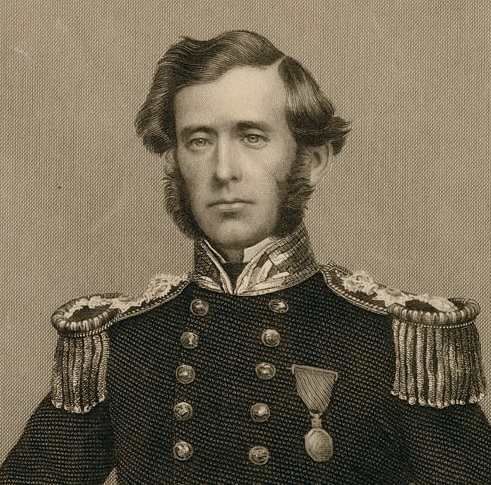
The explorer behind the camera! Sir Francis Leopold McClintock, ca. 1860 [detail of] in a captain’s uniform wearing the Arctic Medal. From Cheyne / Pound engraving. Credit: Library and Archives Canada, Acc. No. 1939-150-1  (removed from 1860 Illustrated London News).

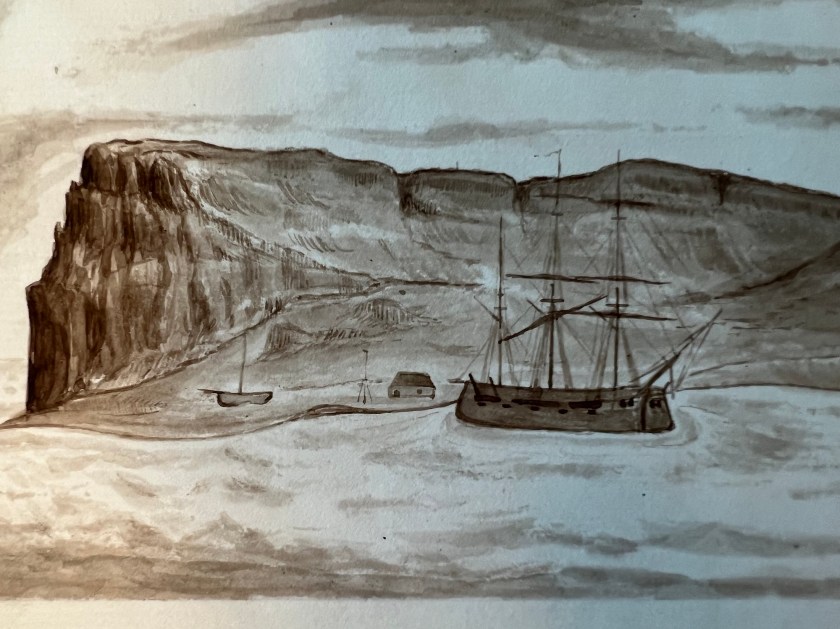
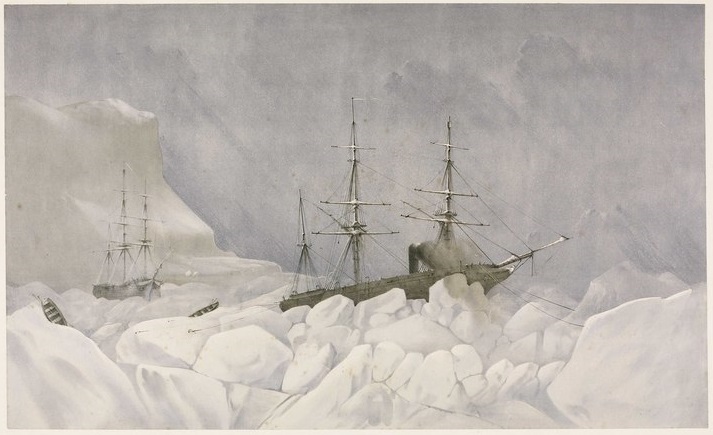
Accompanying HMS Resolute (Capt. Henry Kellett) as a steam tender on the western arm of the Belcher searches, both ships were beset in ice, with no guarantee crews could extricate them. The northern arm of the searches also being iced-in, Belcher ordered Kellett and McClintock to abandon their ships during May 1854 and return to Beechey. After sledging back eastwards over the still-frozen channels and straits, they were welcomed with cheers from the crew of HMS North Star, the Expedition’s depot ship, which was under the command of William John Samuel Pullen.3 Resolute’s Assistant Carpenter, William Mumford, worked up a view of the overall scene which they encountered on their arrival, 28 May 1854. This watercolour helps us contextualize McClintock’s subsequent photographic expeditions. North Star is shown locked in ice and pointed northeast into the Bay.4
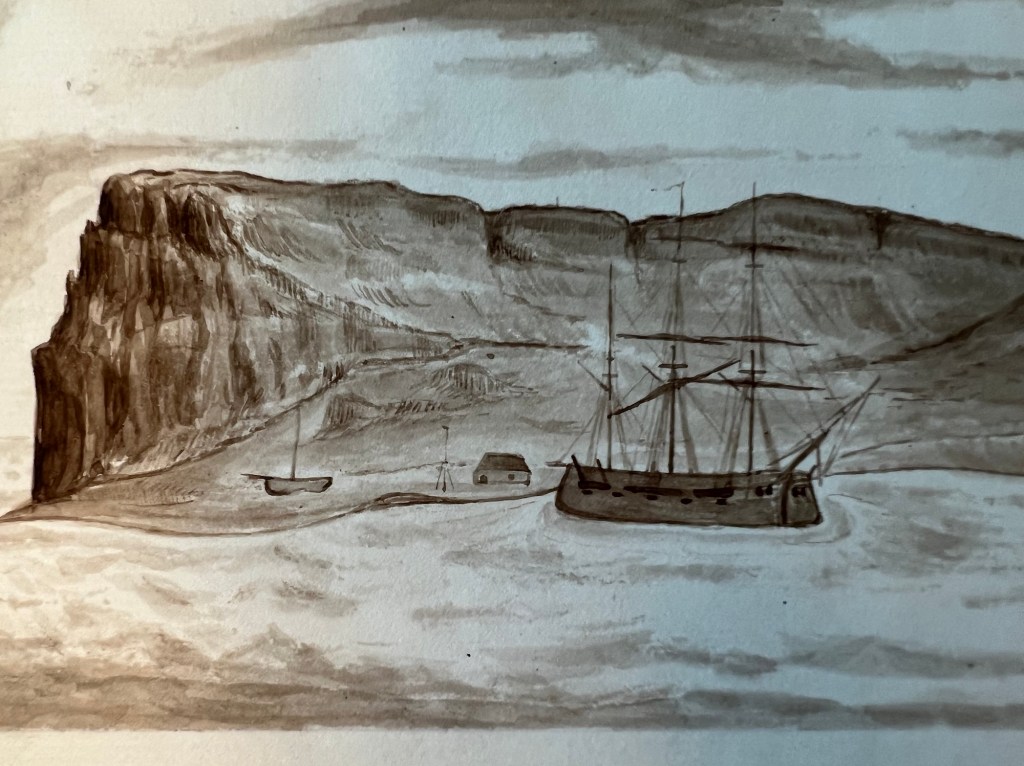
HMS North Star, dated May 1854, by Assistant Carpenter William Mumford. This remarkable view from the end of May shows the beset vessel under Beechey’s imposing and bleak cliffs. Ashore, Northumberland House, the storehouse the Belcher crews built, and a large boat which is likely Sir John Ross’s rescue yacht Mary, are visible. This was drawn before the installation of the cenotaph. [Detail of] LAC 1986-18-27
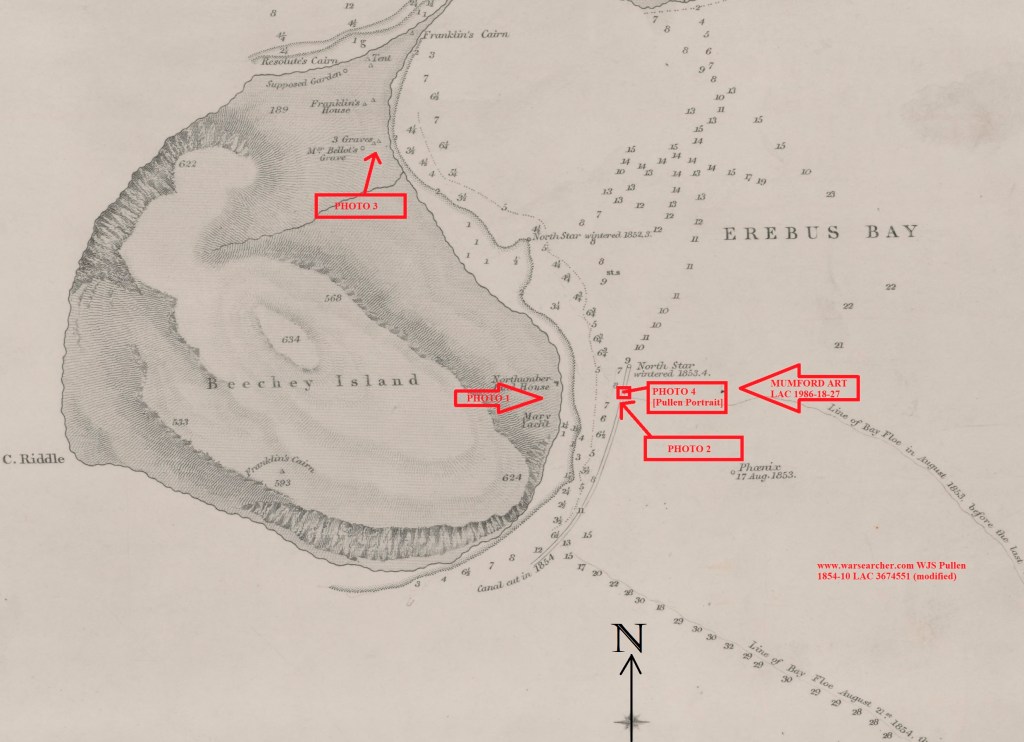
“Arctic Sea. Barrow Strait. Erebus Bay” Beechey Island and surroundings as surveyed by WJS Pullen, including annotations of ship locations, depth soundings in fathoms, and extent of ice [cropped and modified with photograph location annotations relevant to this post] created in 1854 and modified in 1876. Note that the 1,000 yard canal that crew cut between July and August 1854 to free HMS North Star is indicated. Credit: Library and Archives Canada R11630-3259-1-E

Having returned to Beechey without a ship, and not being then engaged in long-distance sledging (which he excelled at), McClintock decided to take up the role of “quasi-official” Belcher Expedition photographer. Before the Expedition departed England, HMS Resolute’s surgeon, William T. Domville, had originally been trained on taking photographic negatives using a camera obscura and developing them into prints using the calotype process. Domville took a few early photos in Greenland in 1852.5 It appears likely the camera was then stowed away for two years. Wamsley and Barr note that McClintock began taking pictures in early August 1854, and soon gained confidence with the apparatus and the complicated chemical treatment and development process.6 Despite the incredible challenges involved in producing an 1850s photographic record in the Arctic, McClintock even tried his hand at portraiture, capturing some of his companions (more on that below).
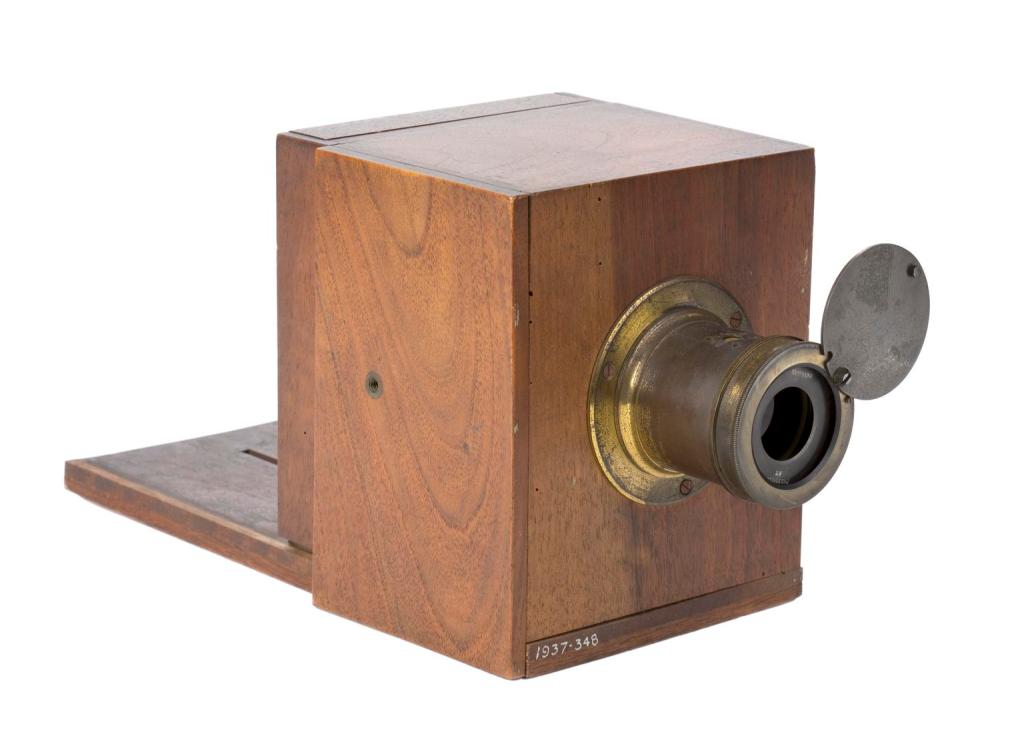
A camera obscura of French design, which resembles something similar to what McClintock would have used at Beechey. The Chevalier lens has two settings: Portrait and Landscape. Credit: Matilda Talbot. Science Museum Group © The Board of Trustees of the Science Museum, London CCBY 4.0.

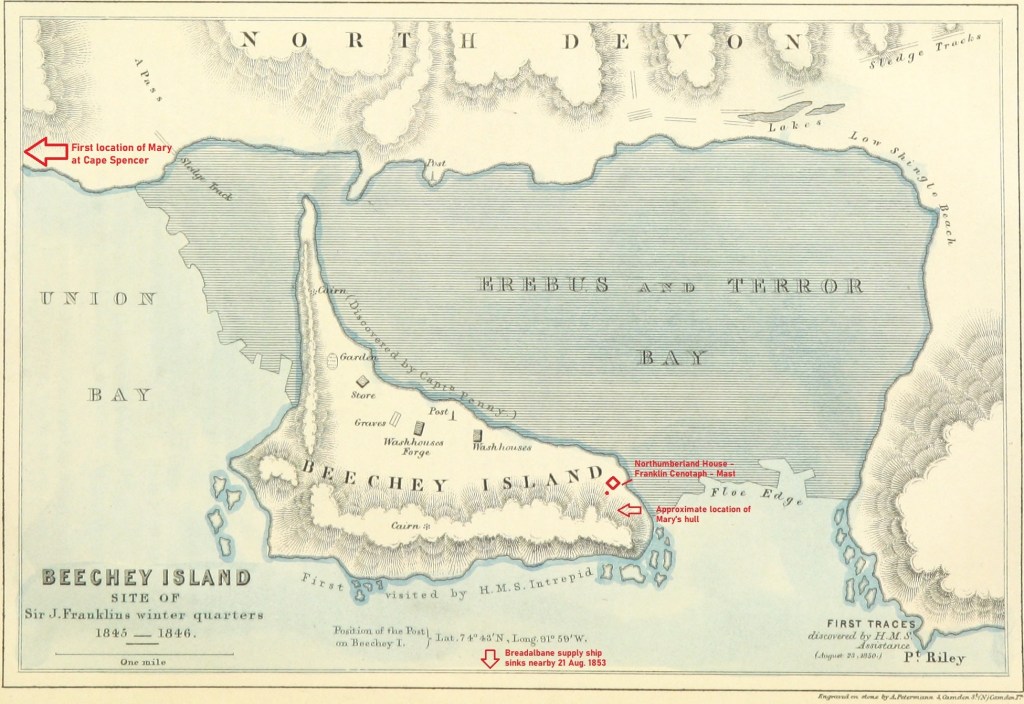
Let’s journey back to Beechey as it existed then, to accompany McClintock on his photographic excursions. In early August 1854 the explorer, now firmly in command of the northernmost example of one of Her Majesty’s cameras, struggled west across the uneven ice from HMS North Star towards the Island. He most likely led a small shore party to assist him in hefting the heavy camera and tripod. Having ascended the rocky beach, past some of the new construction the North Star crew had completed over the last two years, he tucked himself under the soaring, fortress-like cliffs, and pointed the apparatus towards the east, back across Erebus and Terror Bay (see the annotated map above).

Laid out before him was an incredible Arctic vista: The frozen bay stretched into the distance, with an almost incandescent glare rising off the ice. Above the far shore, the bulk of Devon Island (Tallurutit) extended out towards Cape Riley, whose grand headland would be just to the right of the frame. It was a view that the lost men of the Franklin Expedition would have been completely familiar with, as they had overwintered near this same spot 1845-46. The actual moment of capture was probably not attended with much drama–no flash like a cannon’s discharge, no crashing report like a musket volley fired over a crew members’ burial. Yet by removing the lens cap for a few moments, McClintock had yet again triumphed in the northern latitudes. As light passed through the lens and into the camera chamber, an image was projected and recorded onto a sheet of chemically-treated, light-sensitive writing paper placed at the back of the camera. Another wonder of the Victorian age had arrived in the Arctic! The process pioneered by William Henry Fox Talbot would have involved McClintock treating the paper with noxious chemicals before leaving North Star, perhaps having started the first washes and sensitizing steps in an improvised darkroom deep in the ship (sheltered from the 24-hour sunshine). The stages of photography and print-making can be seen in the youtube tutorial from the Victoria and Albert Museum:

Opening the lens allowed for the image of this unique scene to be transmitted onto the sensitized paper that had been loaded into the back of the camera.7 At a later moment, another treatment process in the darkroom was used to develop this now-exposed negative and fix the image in place. Through a similar (though simpler) chemical process used to prepare calotype negatives, another sheet of sensitized paper would be physically pressed beneath the negative and exposed to sunlight via contact printing. This would create a positive version of the image. These positive variants are commonly known as salted paper-prints. They display a characteristic fuzziness – from the paper-to-paper printing process- while the printed image takes on sepia-like tones.7 Here was the great advance in photography over daguerrotypes: a film developer could use the process to create MANY salted paper-prints from the single calotype negative.
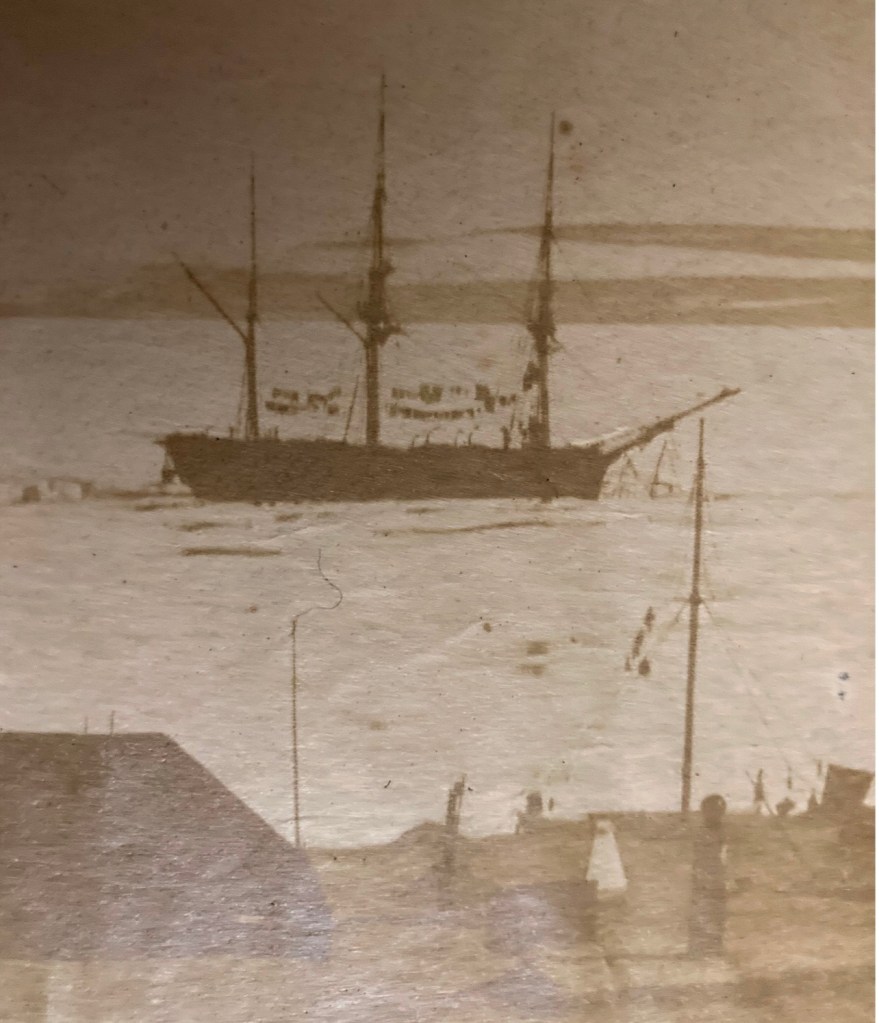
Detail of photo #1, showing HMS North Star, with wash hanging to dry, and what is likely the ship’s rudder hanging from the stern davits. In the foreground is the low-pitched roof of Northumberland House, a high flagstaff and signal mast, and the newly-erected cenotaph to the lost Franklin searchers. Precise cross-referencing of details of the construction with Mumford’s journal entries indicates the image could date from 1-12 August, 1854. Courtesy of Douglas Wamsley

On this first print, Northumberland House appears in the left foreground as a squat roofed-over structure. This depot or Arctic storehouse had been built over the 1852-1854 summers by the crew of North Star. Captain Kellett, McClintock, and the Resolute and Intrepid crews had built a similar structure at Dealey Island.8 The house had not yet been ringed by a low wall to the north and west, which is much in evidence during Allen Young’s 1875 Pandora visit.9 To the right, a signal mast – complete with stays and a topmast – is rigged near to the shoreline, with another shorter staff standing nearer to the House.10 In the near foreground, the brand-new monument or “Franklin Cenotaph,” is conspicuous, wearing its original somber coat of black. It had been shaped by Mumford and the other carpenters from the pawl bitt of the lost whaling ship McLellan’s windlass, and raised at the very end of July. The photograph may have actually been taken on the first or second of August, when crew were paving round the monument, but had not yet finished walling in the casks on the west and north sides of the House.11 This is the only image we will likely ever see of this important cenotaph before the Joseph René Bellot memorial was affixed to the front of the pedestal at the end of that August.12
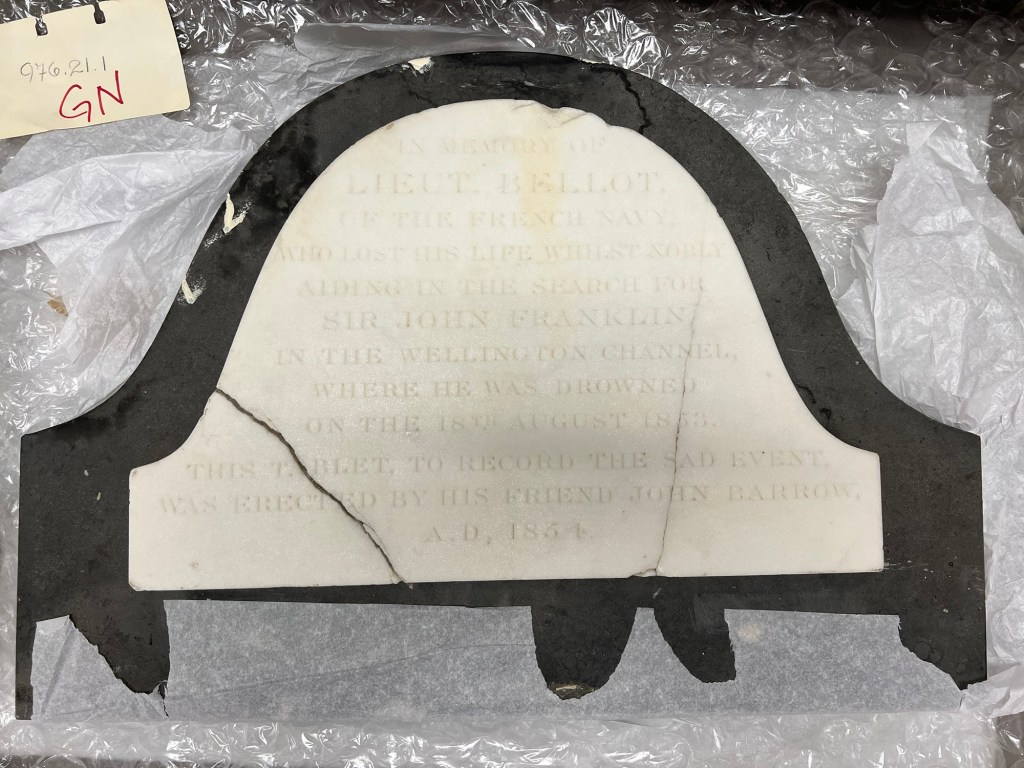
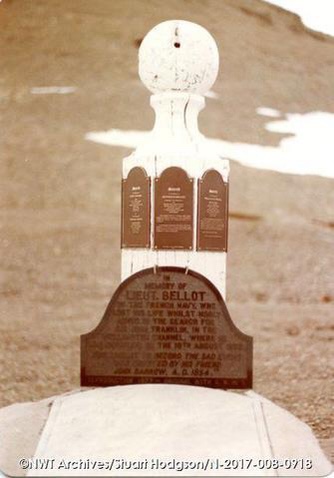
The original Joseph René Bellot memorial plaque, which would be affixed to the Franklin Cenotaph days after McClintock took his photographs. Courtesy Nunavut Archives.

There is a pyramid of tins in the right foreground, while a tent (most likely a marquee tent raised in mid-July to prepare the site for the arrival of Captain Belcher from the still-beset HMS Assistance) had been pitched to the right. Just off the beach rests the considerable bulk of a three-masted sailing vessel in good focus. A motionless ship sailing a static sea makes for an ideal subject, given the technical limitations of 1850s photography.13 North Star was locked in ice, with masts all up but no sails bent on the yards. Though the scene has few crew members depicted, one gets the sense of industrious bustle ashore from casks lined up on the far side of Northumberland House, and what appears to be a line of boats aft of North Star. Wamsley and Barr noted that there was visible evidence at the bows that crew had commenced cutting the ice around the bows with ice saws. By the crew’s exertions cutting and parbuckling the ice, North Star had been turned with her bows now pointing south towards the open waters of the Barrow Strait.
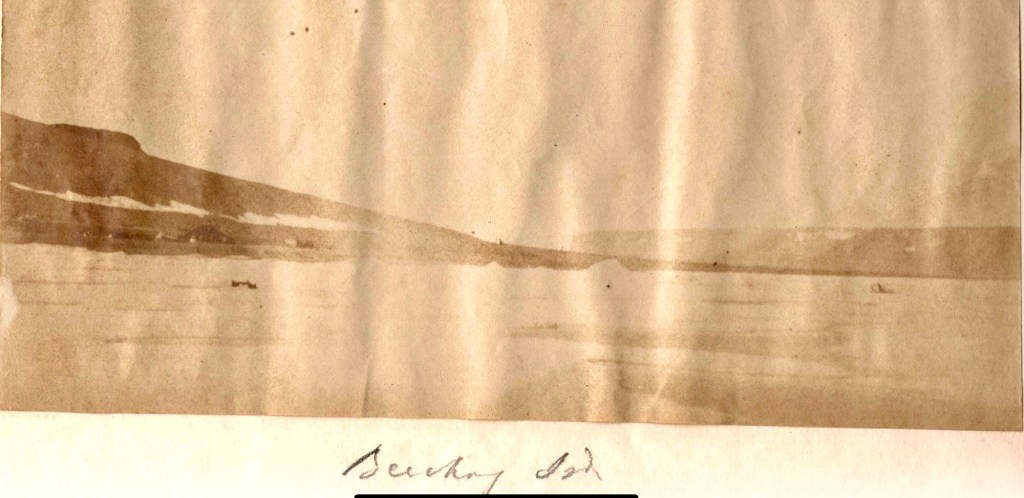
Photo # 2: taken from an elevated position onboard HMS North Star. Northumberland House appears to left, while the low ground between Beechey and Devon Islands, and the historic Franklin Expedition graves, are at centre [cropped] Courtesy of Douglas Wamsley

The second photo used in this post was taken from onboard the North Star, in a northwesterly direction. It shows a distant and indistinct view of the shores of Beechey Island and the land bridge stretching around the bay to Devon Island. Northumberland House can be seen on the near shore. The House appears at a greater distance from the ship than in the first photo. It seems reasonable to assume this was taken days later, as North Star was gradually hauled south towards the edge of the ice. The ice appears disrupted in the foreground, suggesting the route the crew had already cut. Some black flecks at the very center of the photo may hint at the Franklin crewmembers grave boards, our next stop!

Up until a few years ago, these two prints comprised the entire extent of McClintock’s Arctic photography. That has changed over the last few years, starting with the digitization and uploading of a another salted paper print of the Franklin crewmembers’ graves located in the Gell family album at the Derbyshire Record Office (DRO). Franklin scholar Russell Potter has written an interesting contextual post about the discovery of this mysterious photograph, which we will identify here as photograph #3.14
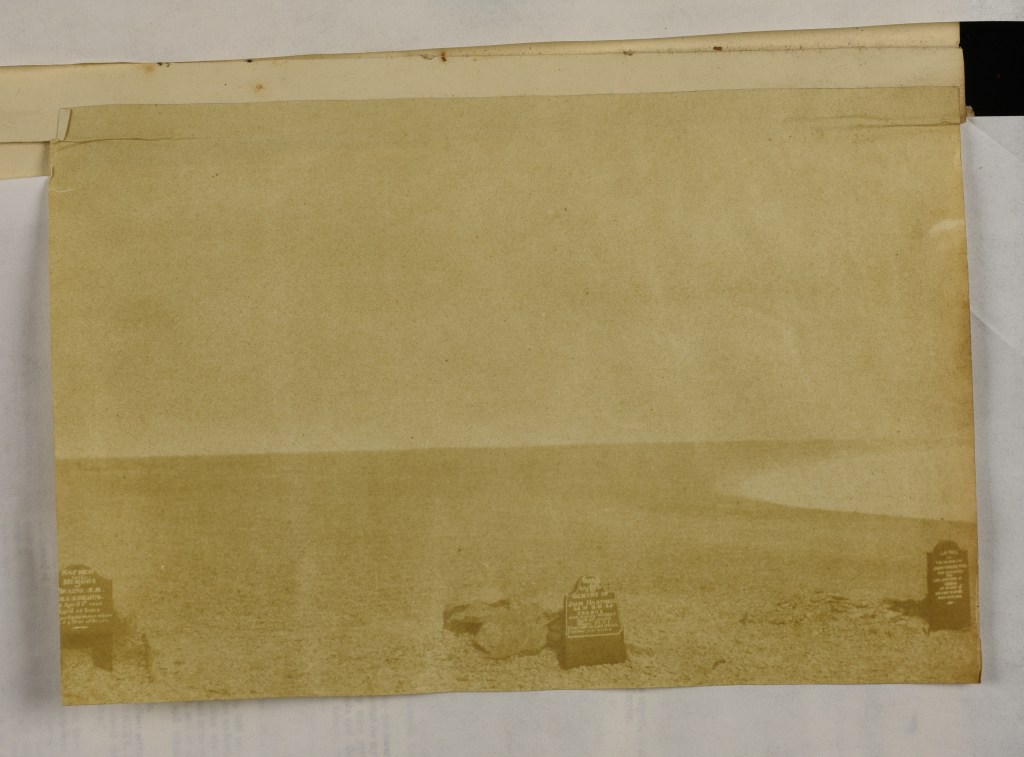
Photo # 3: Salted paper print of the Beechey Island Franklin graves, located in the Gell family album about the Franklin searches, and likely taken by Leopold McClintock, August 1854. The graves are (L to R) William Braine, John Hartnell, John Torrington. Credit: Derbyshire Record Office (D8760/F/LIB/10/1/1) used with written permission.

It now seems likely that McClintock did what any modern visitor to Beechey equipped with a camera would do: He walked about 1.5 kilometers up the beach and snapped the first known photo of those famous graves, which, after all, contained the only Franklin crewmembers that any searchers had (as of 1854) yet located.15 Two important details link the McClintock prints to this mysterious DRO print of the three Franklin crew members’ graves: Erebus and Terror Bay (the shoreline to the right) is a blinding expanse of frozen ice, but there is no snow on the rocky ground.16 The dimensions of the three prints are also similar, which is consistent with having been created by the same camera apparatus.17 Since Domville is believed to have stopped taking photographs after the departure from Greenland, there is also, to date, no other known photographer using a camera combined with the calotype development process that was active in the area at this time.

Wamsley and Barr noted (in 1996) that none of McClintock’s calotype portraits from mid-August 1854 had ever been located.18 I believe we may now also have one example of this series, which, according to the journals of both McClintock and George Ford (ship’s carpenter from HMS Investigator), were taken on 21 August 1854, on the deck of North Star.19 Recently, an item came up for sale on ebay with a strong Beechey 1854 connection: A seated portrait of an officer of the mid-nineteenth century Royal Navy (photograph #4). Notations below the print indicate it to have been taken in 1850 aboard HMS North Star, before “Father” departed on an Admiralty search for Sir John Franklin in the Arctic region. “Remembering the Franklin Expedition” Facebook group member Conner Nelson noted a strong resemblance to Cmdr. W.J.S. Pullen.20 The portrait appears consistent with an unwaxed positive, salted paper-print, from a calotype negative taken using the camera’s portrait lens setting (or possibly a separate lens formatted for portraits).
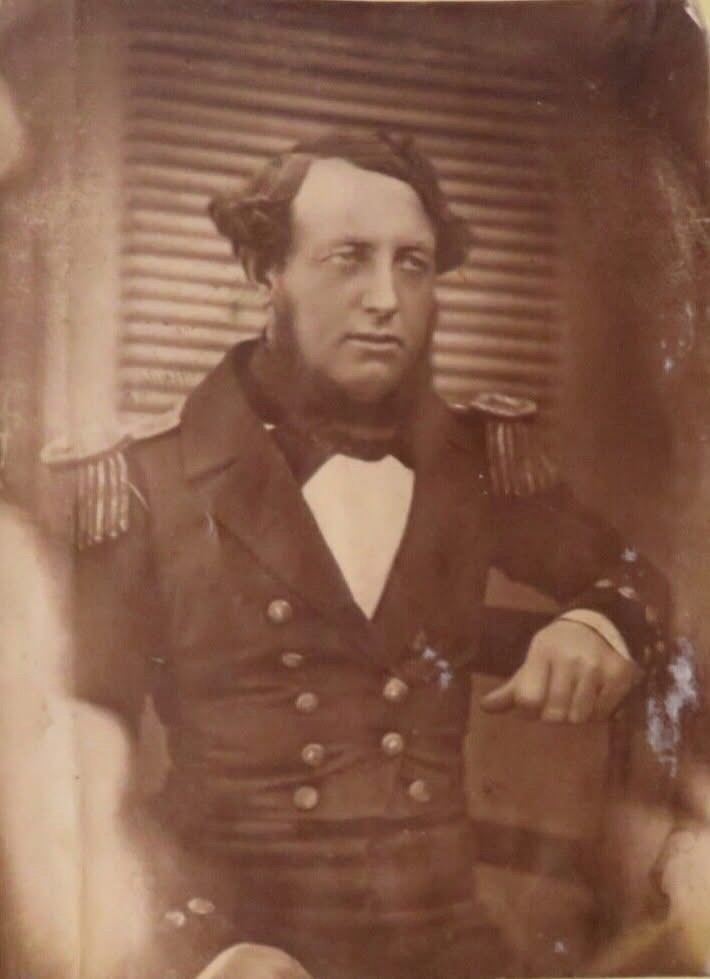
Photo # 4: Master T.C. Pullen, most likely onboard HMS North Star, wearing the undress tailcoat and epaulettes of a Royal Navy officer, via ebay.com

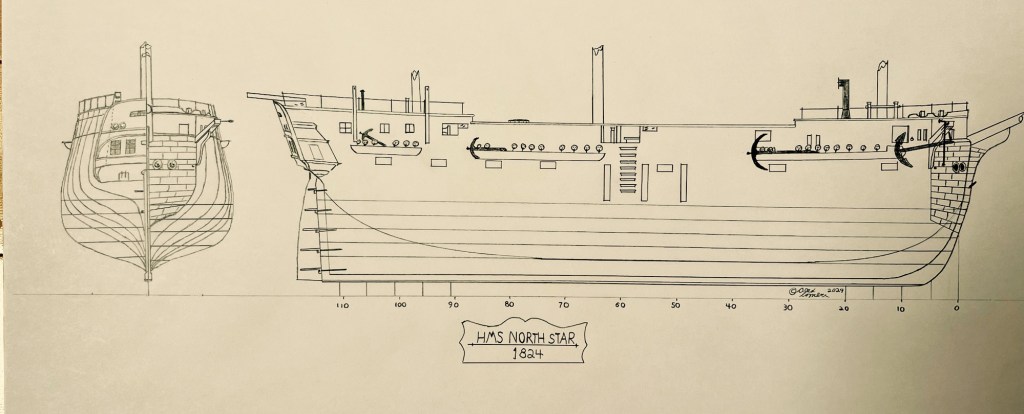
I believe this portrait was most likely taken onboard North Star by McClintock in that high Arctic summer of 1854. I also believe it depicts W.J.S. Pullen’s brother, Thomas. W.J.S. had been appointed Commander while away on his first expedition searching for Franklin in 1850, two years before he was appointed to command North Star. For this new search effort, he would be accompanied by his younger brother, Thomas C. Pullen, who served in the role of Master (a senior warrant officer). Though I have not been able to examine the portrait in person, it is unique from the contemporary image that the engraving of the Belcher Expedition commanders is based off in The Illustrated London News.21 In contrast to his older brother, T.C. appears to be the right age. He is depicted in the pre-1856 undress uniform of an officer.22 Masters in the Royal Navy had recently been granted the authority to wear the epaulettes of a junior officer, which in this era were unadorned with the distinctive anchors, crowns, or pips worn by commanders and more senior officers. Where precisely was this calotype portrait taken? My familiarity with North Star’s layout and plans leads me to suggest one likely place: Just to the side of the ship’s wheel, tucked under a “poop” deck that, uniquely of all Belcher Expedition ships, North Star was equipped with.23
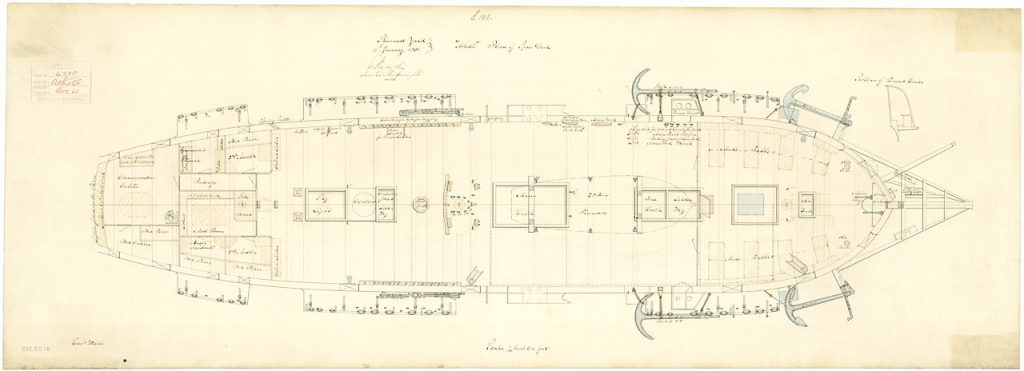
Our research has established that this plan depicts the 1851 modifications to HMS North Star in advance of the Belcher Expedition. T.C. Pullen would have been sitting just on the side of the ship’s wheel tucked under the poop deck, about 1/4 of the way from the stern (left). ZAZ5516 © Crown copyright. National Maritime Museum, Greenwich, London

Though the louvered door is similar to the style of door found in an earlier illustration of North Star‘s flag locker (depicted prior to the James Saunders’ supply expedition this was located directly over the transom at the very stern), it is my belief this door led directly into “Officer’s country” – the decked-over passage and cabins at the stern that held the berthing for the Pullen brothers and the other officers.24 This would have been an ideal setting for McClintock to utilize a portrait lens (or a dual setting lens like the Chevalier lens fitted to the above Science Museum, London, artifact).25 The series of portraits captured by McClintock on 21 August may have been intended for a celebratory purpose: on that day, North Star crew finally cut through or blasted with explosive charges the final stretch of the more than 1,000 yard canal southwards and arrived at the edge of the floe. North Star had survived two punishing winters at Beechey, and could now escape the Arctic. T.C. Pullen’s 1854 journal entries record his titanic efforts – despite illness and profound weariness – to spur his crew on to free the ship from an icy grave.26
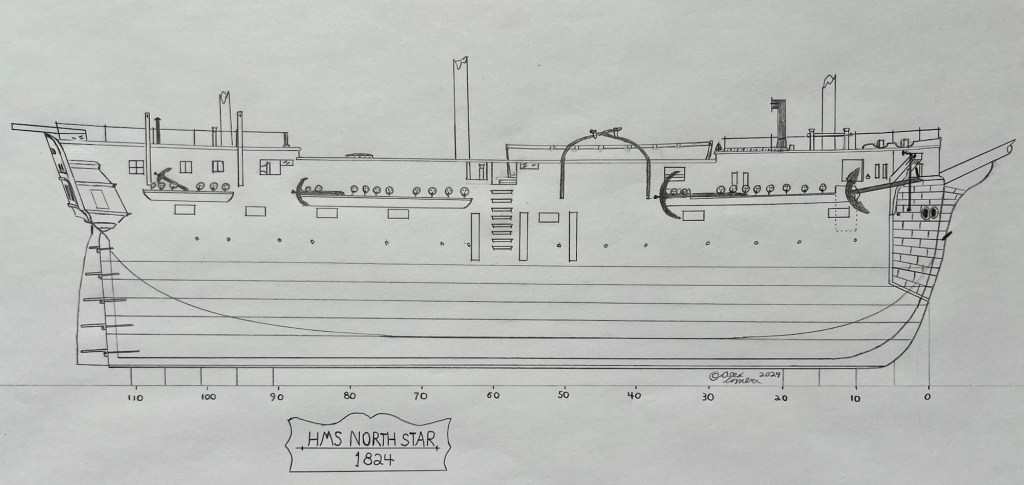
HMS North Star reconstruction 1852-54 [detail of] for information on my reconstruction of this original “Arctic Juggernaut”, and stern/bow elevations, as well as sources and other illustrations, please see our post. The TC Pullen photo would be taken just under the break of the poop. Credit: http://www.warsearcher.com

The depot ship was now burdened by supernumeraries from five abandoned Franklin search ships: Investigator, Resolute, Assistance, Intrepid, Pioneer. Just before departure, a strange sail to the east resolved itself into Edward Augustus Inglefield’s trim steamer, HMS Phoenix and the storeship Talbot. Onboard the steamer was the distinctive plaque to the memory of Bellot, to be affixed to the front of the monument, and – relevant to our photographic survey – a new generation of camera: a glass-plate camera employing the vastly superior wet collodion process. The age of the calotype photographic process had arrived and now departed from the shores of Beechey Island! Thank you for accompanying McClintock and I onboard HMS North Star, and out onto the rugged landscape of Beechey Island, these seventeen decades ago!

Acknowledgements: I would like to thank Douglas Wamsley for his support and advice and for reviewing an early version of this post, and Russell Potter for facilitating our contact last December. Library and Archives Canada Audiovisual Specialist Anitta Martignago generously shared her expertise about calotype negatives and salted paper-prints: She has actually taken and developed calotypes herself! Sylvia Wright, a direct descendant of Sir Leopold McClintock, also provided feedback. The Derbyshire Record Office staff provided additional information and kindly consented to the usage of the Beechey grave print.

ENDNOTES:

CLICK FOR ENDNOTES
Launching a Sad Little Boat Model

What if we could rebuild the “Boat Place” Franklin Expedition boat from its wrecked and scattered remains? In this post I will show my efforts to reconstruct the important boat I explored last week, at the same small scale as the HMS Terror wreck diorama.

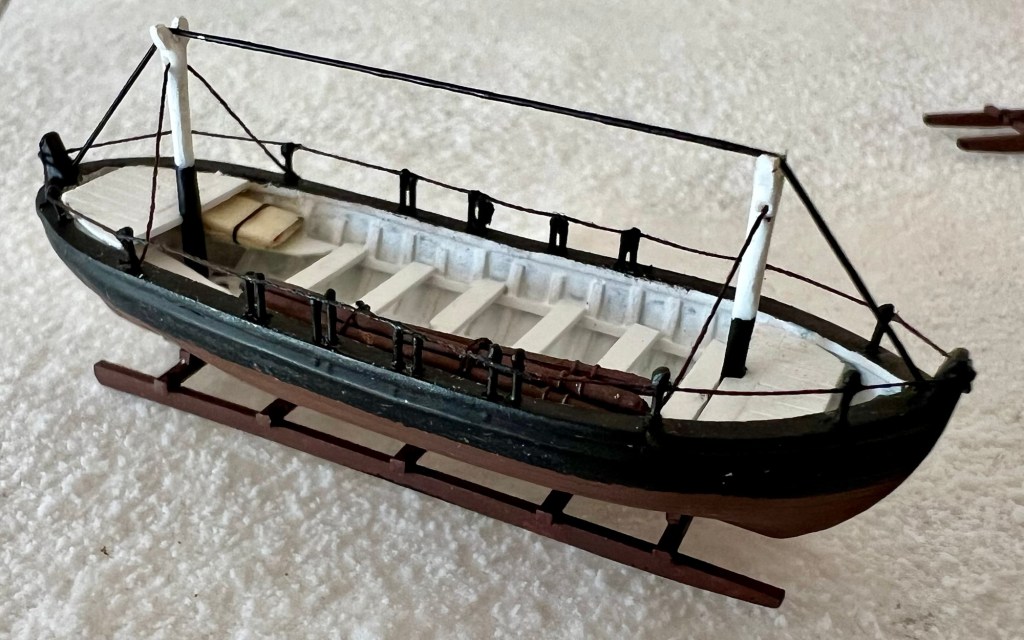
The 2.4″/6cm long model on its sledge. Credit: http://www.warsearcher.com

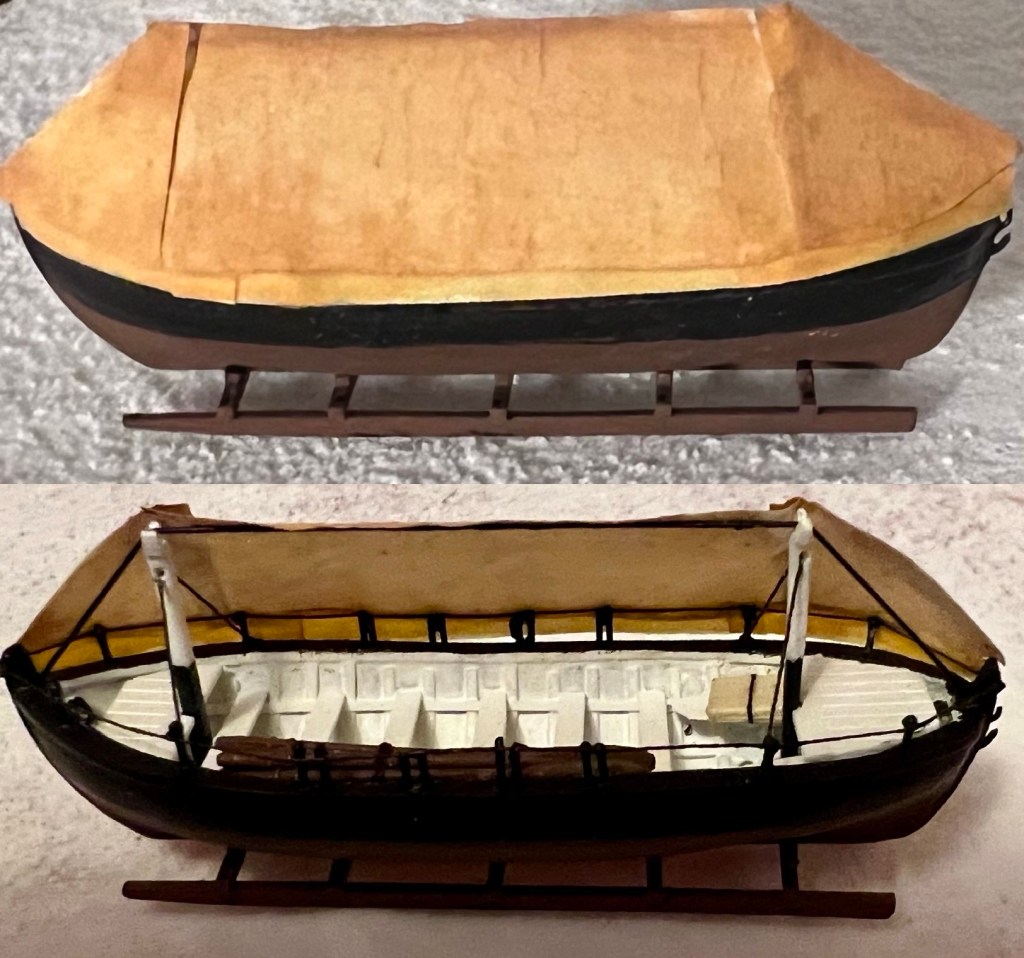
In early 2025 I set about transforming a tiny plastic model to represent the boat and sledge that searchers looking for the lost Sir John Franklin 1845 Expedition came across in 1859 on the western coast of King William Island.1 My research is summarized in the “design dossier” section of my recent post on this discovery. Stages of my build resembled some of the real modifications ship carpenters would have worked at early in 1848, as they prepared to desert HM Ships Erebus and Terror – I sawed off the old square transom (visible in the below photo) and reshaped a sharp or rounded stern using Milliput putty around a balsa wood carved-out form (later removed), and built a new curved sternpost. I added two gudgeons, on the chance that the boat could have been fitted with a rudder. As of this writing, I believe the converted boat was based on the hull of the lighter 25’ Cutter instead of the Pinnace (see below boat dimensions section for detailed information).

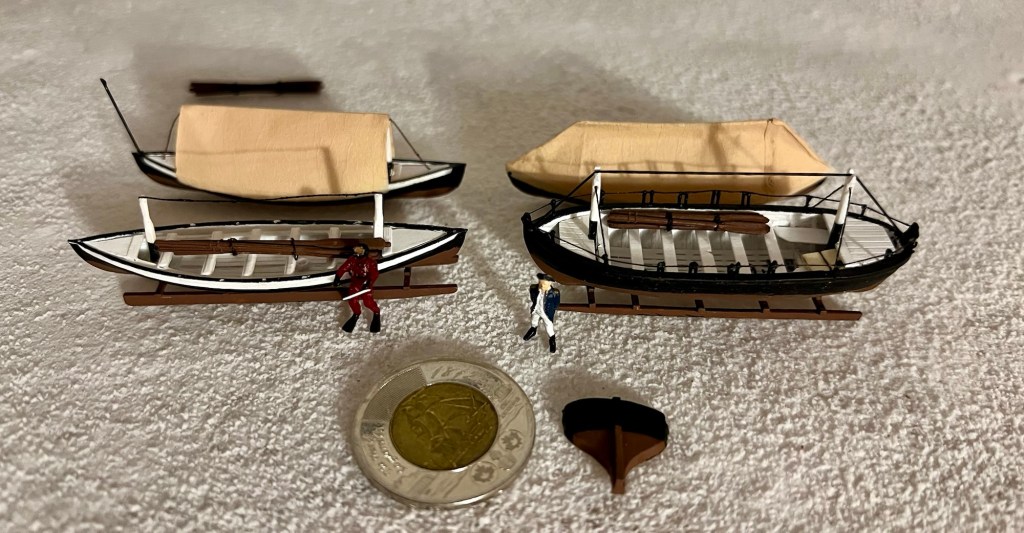
The model boats. The sharper and narrower whale boats are 30 scale feet long. The original square transom of the model appears beside the two-dollar Canadian coin. Credit: http://www.warsearcher.com

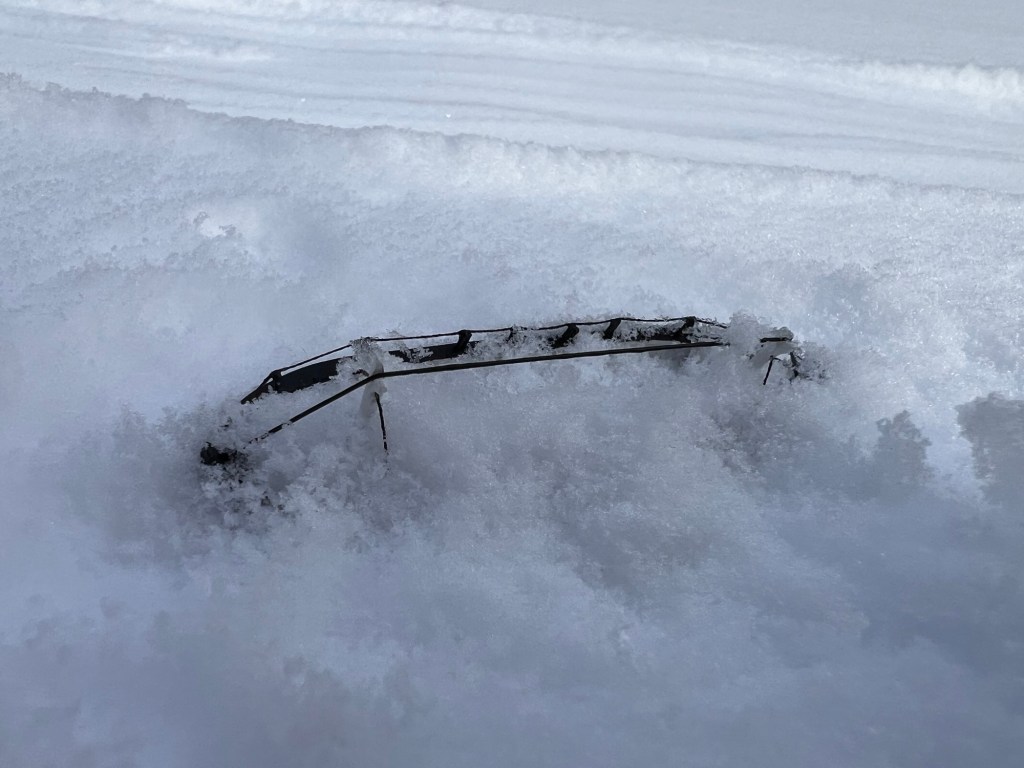
I modelled the stanchions (the two posts rising out of the hull painted two-tone black and white) to be high, with gaff jaws at their tops (as described by Lt. Hobson). Some practical tests with the model revealed that the pronounced list observed in 1859 meant that, in order for Hobson’s team to have spotted anything emerging from the high drifts of snow, that stanchion would have to be significantly taller than represented in most reconstructions. With its gaping jaws open to the sky, it must have appeared a grim marker, indeed!

The model and sledge with a list down to starboard, buried in a drift of snow in my backyard. Credit: http://www.warsearcher.com

I decked over the bow and stern areas based on the Durand-Brager illustration (seen in the last post). The internal layout is similar to the whale boats that the ships carried. I like to think that the crews had a space in each boat to shelter an exhausted or ill member. A foredeck and covered stern sheets may also help explain the decade-long survival in decent condition of some of the artifacts that Hobson and McClintock discovered in the boat.

The gunwales were drilled for the thowells – tiny metal rods. I believe there was no washstrake boards, so I spaced the twenty-four thowells to support a washcloth that wrapped around the hull between the posts. Hobson noted these thowells (National Maritime Museum artifact AAA2143) were doubled up to assist the paddling. I paired them to create four rowing positions a side, and ran a rope along the top of the thowells, which the washcloth would have been rove into along its top edge.

The awning, and “cutaway” view. It is also possible that the awning connected directly to the gunwales, and not to the tops of the stanchions, which may not have been fitted while sledging on land. Credit: http://www.warsearcher.com

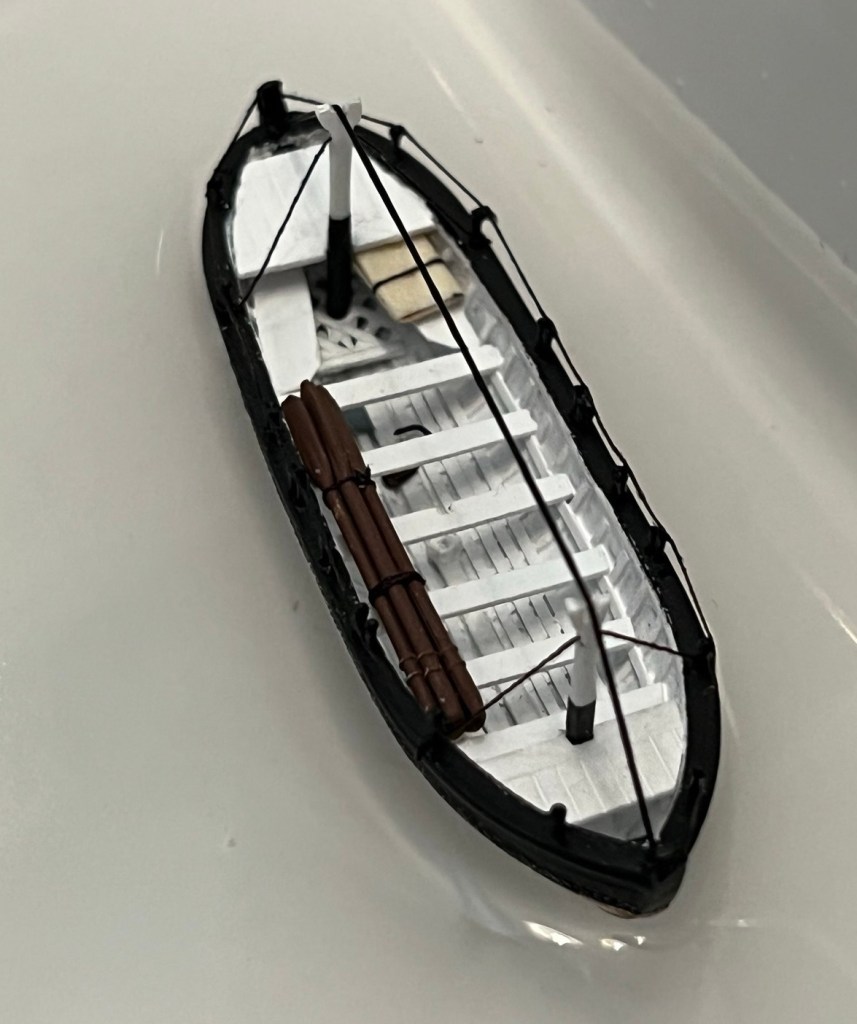
Artifacts currently placed in the model hull include six modified oars (cut down with add-on blade extensions), the sheet block (AAA2198), the folded-up lead sheets (AAA2280), and some sailcloth that could be the awning or the washcloths (AAA2144). Basic pieces of boat equipment, such as two masts, and a rudder, have never been found. I have added a mast step amidships, in case information or evidence of these details turn up. When under sail, the boat would likely have carried lugsails on its two masts.2 I hope someday to model the ice grapple/anchor encountered by the searchers. The bewildering assortment of personal items, cutlery, packets of chocolate, and human remains have not been represented.

The model takes to the water. Credit:www.warsearcher.com

This boat and sledge combination may look unwieldy, especially when compared to the supremely well-adapted Inuit equivalents: animal hide boats (Umiaks) on sledges built of lightweight organic materials. But in 1859, Francis Leopold McClintock – a masterful long-distance sledge traveler – seems to have been impressed by the lost crews’ efforts at lightening it.

As with so many of the specifics about the 1845 Franklin Expedition, we continue along our own voyages of discovery. This is not the first interpretation of the Erebus Bay boat, nor will it be the last. I have created a sad miniature of that “melancholy relic.” [Read more in the Appendix below for technical info about the boats and sources]

Appendix-JC Ross (1839) and Franklin (1845) Expedition boat types and sizes and notes:

Interpreting that “Melancholy Relic” – the Erebus Bay Boatwreck

In this post I will describe the “boat place” boat at Erebus Bay that searchers looking for the lost Sir John Franklin 1845 Expedition came across in 1859. A later post will show my effort to construct a small model of this unique and sadly-fated boat, and propose some likely dimensions of the full complement of Franklin boats.

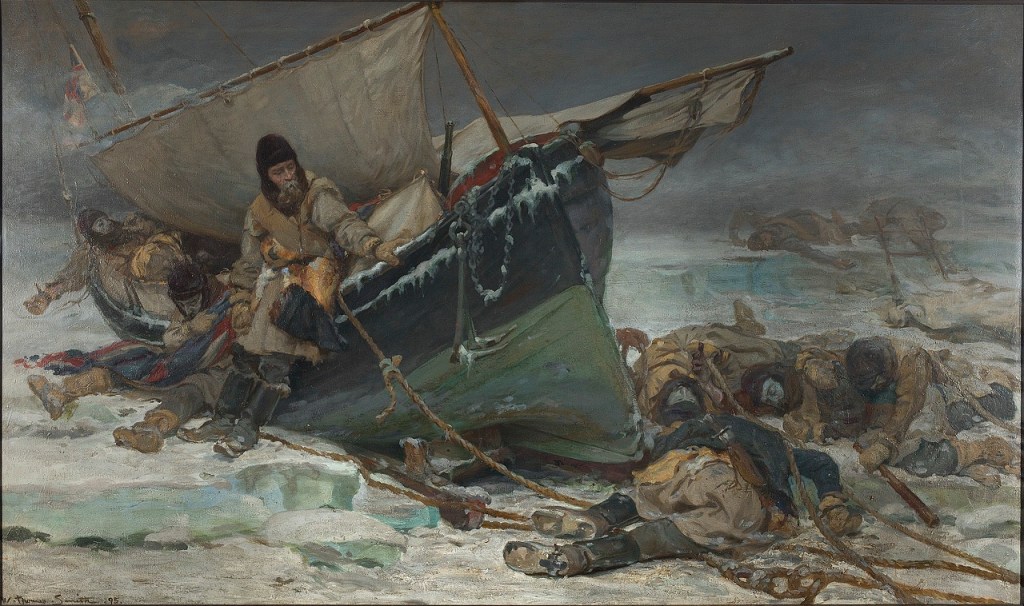
William Thomas Smith’s powerful 1895 work “They forged the last link with their lives: HMS Erebus and Terror, 1849-50.” The boat has several well-researched components, such as the washcloth around the gunwale and the ice grapnel. It also appears rigged for sailing with full masts stepped. (CC-BY-NC-ND) copyright: National Maritime Museum, Greenwich London

On May 23rd, 1859, at a wide bay on the frozen western shores of King William Island, a group looking for the lost Franklin Expedition found something incredible: A large boat on a sledge. Fourteen years after Franklin’s two ships had left Greenhithe, England, searchers had finally arrived at “ground zero” of the Franklin Expedition escape saga. They were a decade too late. Quartermaster Henry Toms and Carpenter’s Mate George Edwards – both members of Lt. William Hobson’s detached sledge party searching the coast as part of Francis Leopold McClintock’s Franklin search expedition – first spotted something odd projecting out of the snow as they scouted ahead of their mates.1 Closer examination revealed it to be a wooden stanchion, hanging like a beacon over the curved outlines of a gunwale in the high drifts of snow – beneath their feet was the ghostly outline of a large boat.

Chart showing the vicinity of King William Island with the various positions in which relics of the Arctic expedition under Sir John Franklin have been found / compiled by Lieut.-Cmdr. R.T. Gould, R.N [detail of]. “Boat Place” is indicated in red text at the base of Erebus Bay. Credit: Library and Archives Canada 3674742

The next morning Hobson’s group began in earnest a two-day process of clearing out the site and inventorying an unusual assortment of artifacts. That stanchion also marked a gravesite – the resting place of at least two unidentified Royal Navy crewmembers who were entombed within the hull. McClintock’s sledge team arrived a few days after Hobson had departed. His published description of what he called this “melancholy relic” is the standard account of the site.2 But Hobson had also drafted a report on his sledge team’s discoveries, which included a detailed description of the boat. We are indebted to archaeologist Dr. Douglas Stenton’s work resuscitating Hobson’s report about his journey from obscurity. Stenton’s publication of the report provides important additional details to help explore the boat place.3 Since Hobson’s team had excavated the snow from the boat and examined the objects found therein, the site had already been altered before McClintock’s party reached it. For a detailed list of the interesting and unusual contents of the boat, please see Russell Potter’s Visions of the North blog “The Boat” on the topic. My interest here remains focused on the boat itself.

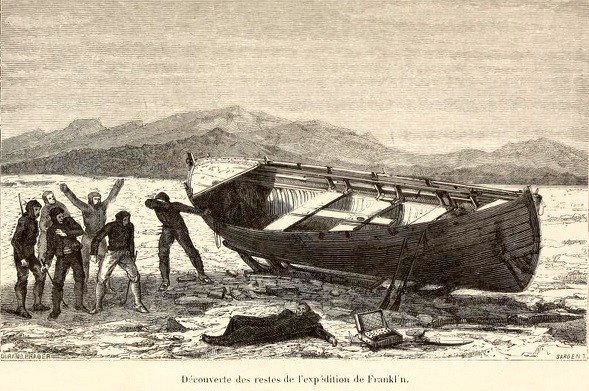
This early 1860s illustration represents some of the major relics accurately, and shows the double-ended appearance and large proportions of the vessel. Credit: Durand-Brager, from Arthur Mangin, Voyages et Découvertes outre-mer au XIXe siècle, illustrations par Durand-Brager, 1863 ː Découverte des restes de l’expédition Franklin. Public domain, via Wikimedia Commons

The Erebus Bay find remains the only Franklin Expedition boat and sledge, originally encountered reasonably intact, whose appearance and contents were described in detail. Its importance is tied to the slightly earlier discovery by Hobson’s party of the Victory Point record, in a sealed cylinder in a cairn about 60 km northeast. An update to a routine Admiralty form mentioned the abandonment of the long-beset ships, and recorded captains Crozier and Fitzjames’s intention to mount a desperate trek with their ailing crews towards Back’s Great Fish River. The note had no specific information about how they planned to cross the vast distances involved. The Boat Place discovery seemed to illustrate the mechanism of the evacuation plan: Crew members would use drag ropes to man-haul boat/sledge combinations down and around the coastline of King William Island. They would then unship the sledges and navigate the boats to the mainland and down a treacherous river towards a still-distant fur trading post. We don’t know how this plan changed as they struggled along, losing more men, and abandoning more boats. Some of the last of a group of weary men laid down to die, under another boat, on the mainland at Starvation Cove.

Back at Erebus Bay, the 28’/8.5 m boat was found just above the frozen shoreline. It listed dramatically down to starboard. A hole may have allowed wildlife – bears or scavenging foxes – access on the low side. Both boat and heavy sledge were oriented back towards the northeast, though if that was by intent (to return towards the ships), or by happenstance, no one can say. McClintock commented on both the boat’s lightness, and the sledge’s weight. He estimated the weight of the boat to be about 700-800 lbs while the sledge could have been as much as 650 lbs (the average weight of a 28-foot whaling boat, by contrast, was about 1,000 lbs).4 His observations were informed by his great expertise in sledging, acquired during his participation on this and earlier expeditions.

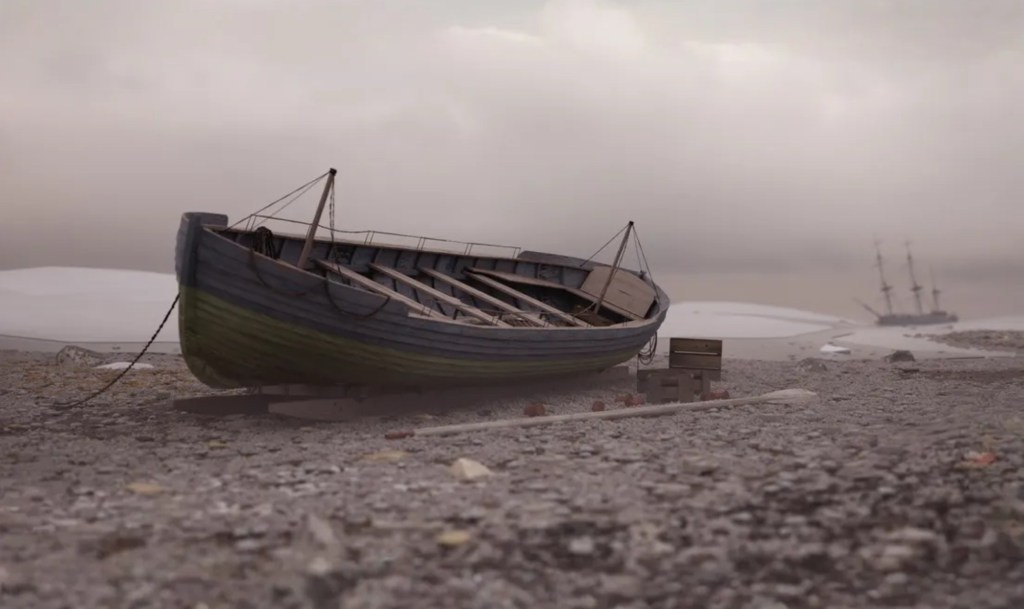
A remarkable 3D interpretation of “Boat Place.” This well-researched depiction of the boat and sledge is a recent and valuable addition to the artistic reconstructions of Erebus Bay. It was inspired by Matthew Betts’ reconstruction (see notes). The outlines of one of the ships in the distance heightens the pathos of this bleak scene. Certainly, the ships did transit by the Bay at some point after April 1848. Used with written permission of Case Western, who maintains a site with 3D printing models.

The boat had been modified by the ships’ carpenters – the square transom at the stern had been removed and the boat was now pointed or “sharp” at both ends, with a curving stem and sternpost, like a broader, deeper version of the two ships’ whale boats. The “carvel” planking (flush-edge-to-edge) of the top strakes of the hull had been replaced and lighter fir “clinker” planks (overlapping) re-laid in their place. An ingenious washcloth design of canvas was fitted in the place of the heavier washstrake boards. The set of six paddles – cut-down oars converted with larger “add-on” blades – indicate that the boat had been converted for inland/river navigation.

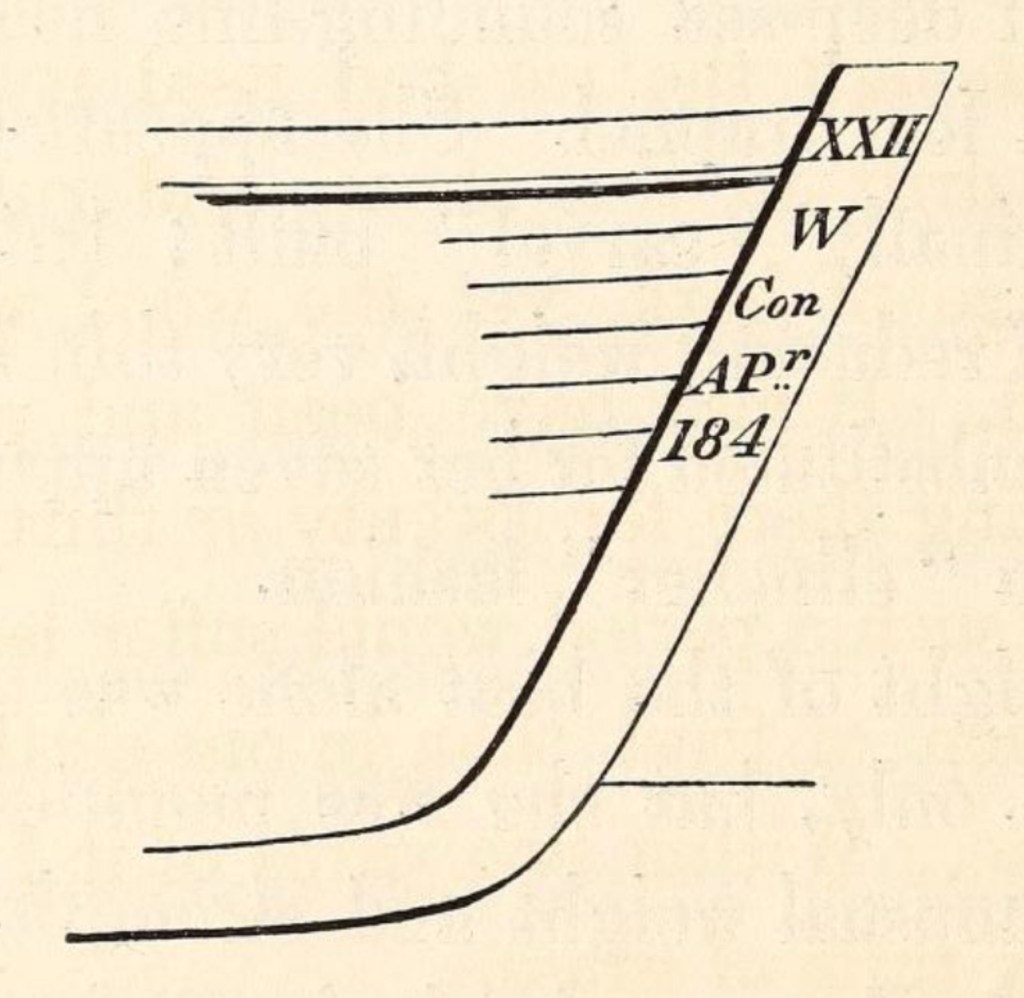
The stem, as drawn by McClintock in his 1859 edition of The voyage of the ‘Fox’ in the Arctic seas: A narrative of the discovery of the fate of Sir John Franklin and his companions (P 292) see notes section for link.

The distinctive stem of the boat was sketched by McClintock. This was recovered two decades later by American Franklin searcher Frederick Schwatka, who, while looking for records, was leading the first expedition on King William Island that encountered the sites in the summer, not under cover of snow and ice.

According to Inuit oral testimony, there was at least one other abandoned boat with many more skeletal remains that was located nearby.5 Both boats were dismantled in the early 1860s for their useful materials and fittings. Following the initial recovery of some artifacts, the dismantling, and Schwatka’s later removals, only archaeological traces and a memorial with bone fragments remain at the site – the last vestiges of a melancholy relic.

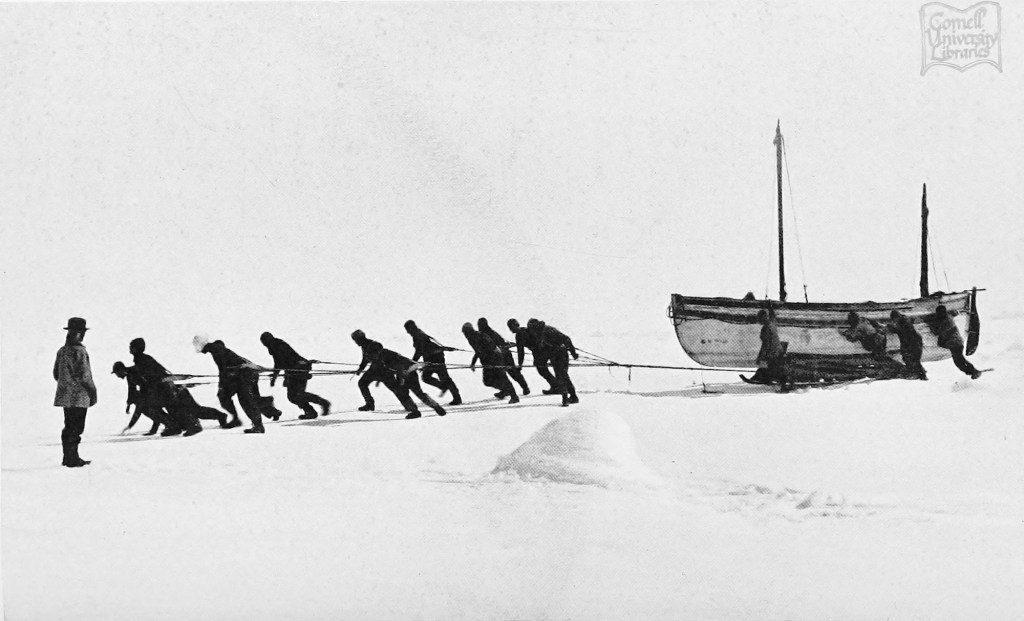
Another famous boat/sledge with a less tragic outcome, the James Caird, originally one of Sir Ernest Shackleton’s 22.5’/6.9m boats from his exploration ship Endurance, being dragged across the sea ice in Antarctica, Dec. 1915. Credit: Frank Hurley : via wikimedia commons.
The Design Dossier and References (click here):

HMS North Star CRUSHES IT in the Arctic and Saves the Searchers!

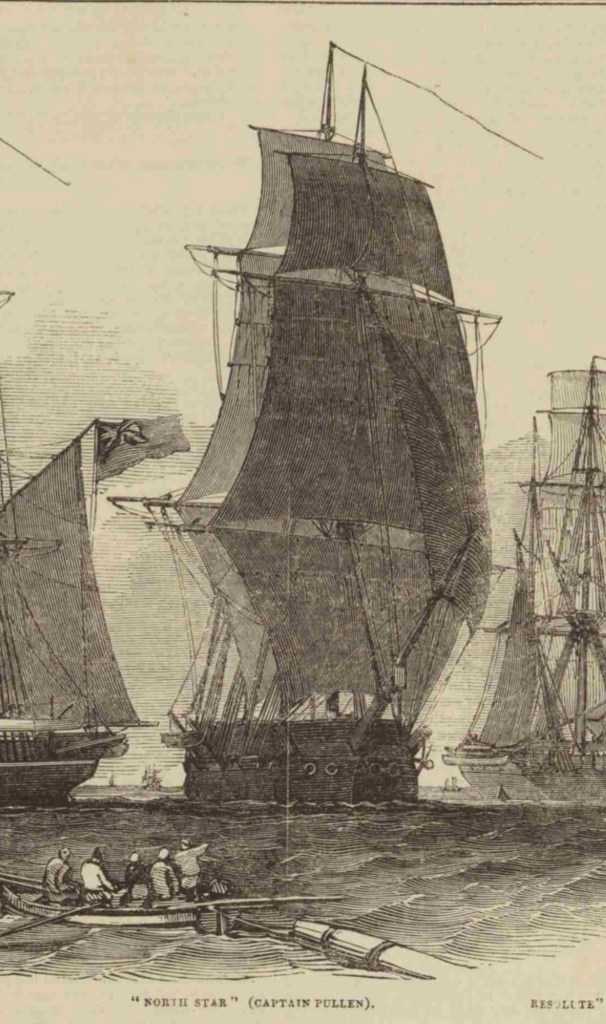
HMS North Star was an outstanding ship with a most fitting name. Like her namesake, the Pole Star, she guided mariners back home from the edges of the charted World. Though overshadowed by the lost Sir John Franklin 1845 Expedition ships Erebus and Terror, and the famous vessels searching for them, Resolute and Investigator (to name two), North Star did exceptional work in the Arctic.1 Her transformation from fighting corvette to expedition depot ship may not seem as interesting as the refits those other ships received. Actually, the 1849 rebuild created an Arctic juggernaut – a vessel tough enough to withstand collisions, groundings, ice “nipping,” and general Arctic pummeling during two missions over the course of five busy years. When all other ships had to be abandoned, North Star brought the Sir Edward Belcher Expedition home – saving the Franklin searchers!
Our interpretation of HMS North Star’s updated appearance ca. 1849-1854, ready for the Arctic! Credit:www.warsearcher.com adapted from National Maritime Museum plan ZAZ3213 and other technical info and used with written permission of NMM staff.

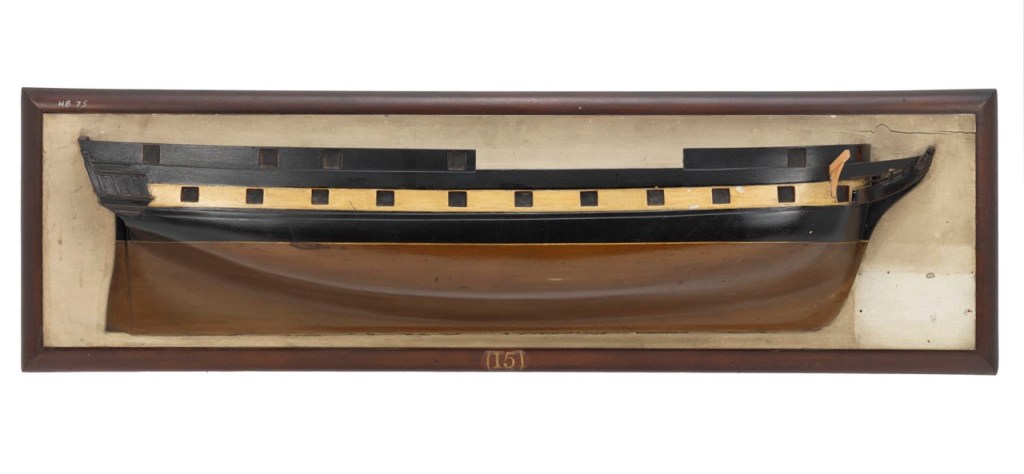
HMS North Star was launched at Woolwich dockyard in 1824 and completed in 1826, to a trim design – an Atholl class corvette – that we explored in a recent post.2 Like other “Donkey Frigates,” she spent much of her career in distant waters. “Donkey Frigates” was a contemporary term for a small frigate-like corvette performing the roles normally taken on by larger, more expensive to operate warships, such as Leda class frigates. A fine record of the 1826-1848 events of North Star exists at the “Index of 19th Century Naval Vessels and some of their movements” at RootsWeb. Her early service came as a member of the West African Squadron – patrolling to suppress the Atlantic slave trade. This was followed by participation in two of Britain’s imperial wars of the mid-19th Century.

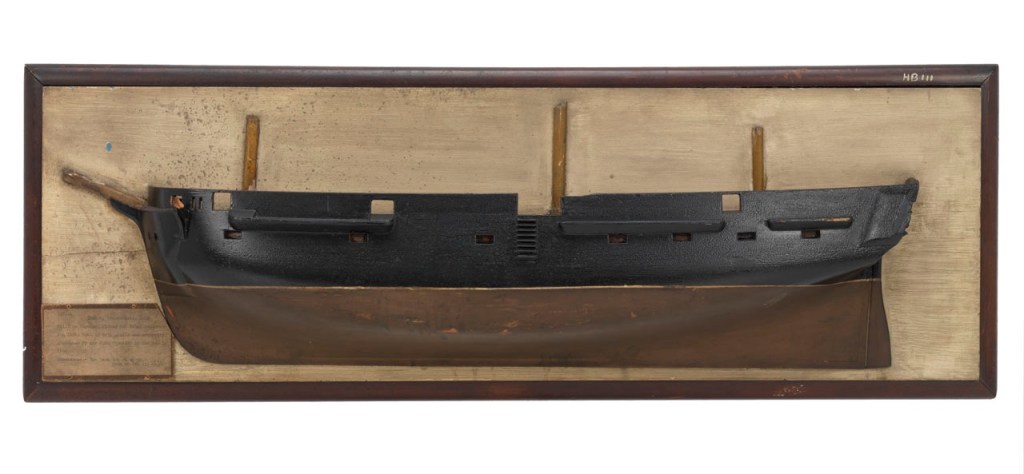
A half-hull model of HMS Rainbow (1823) North Star’s sister. This model shows the clean lines of the original corvette design. SLR0706 Credit: National Maritime Museum, Greenwich, London.

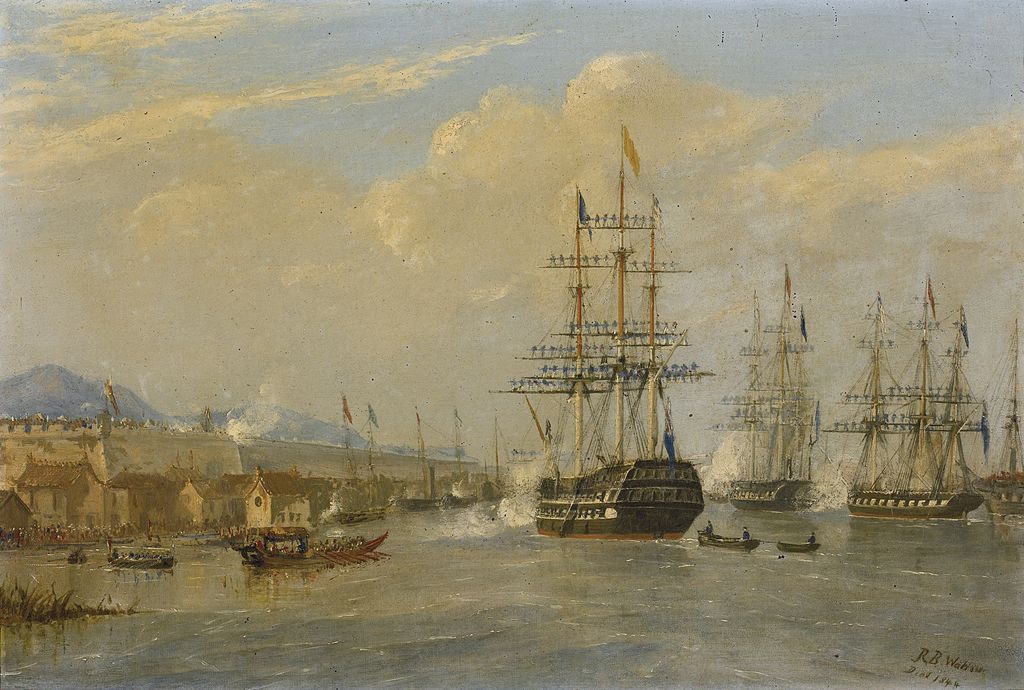
A member of Sir William Parker’s fleet involved in the First Opium War (Anglo-Chinese War), she was present at the signing of the Treaty of Nanking in August, 1842. During 1845-46 North Star operated around New Zealand during the Flagstaff War, contributing shore parties that fought in battles against Maori warriors who were resisting the recently-imposed colonial regime. At the same time, at the frozen top of the North American landmass, Sir John Franklin and his two ships – making their bid for completing a Northwest Passage – were wintering at a location that would figure large in North Star’s subsequent history: Beechey Island.

HMS Cornwallis and the British Squadron saluting the peace treaty at the signing of the Treaty of Nanking 29 August 1842. HMS North Star under Captain J.E. Home was present. Rundle Burges Watson, Public domain, via Wikimedia Commons

Three years later, public concern about the condition of the missing Franklin crews was reaching fever pitch. North Star was ordered north to rendezvous with Sir James Ross’s search expedition, consisting of HMS Enterprise and Investigator. North Star, under the command of Master James Saunders, would carry provisions to help continue Captains Ross and Edward Bird’s Franklin search. Saunders was familiar with the Arctic and the lost ships: he had served on Terror for George Back’s 1836 Frozen Straits Expedition. Before the veteran warship and her forty crew members could depart, she had to be extensively modified to survive in one of the harshest maritime environments.

Master Shipwright Oliver Lang, who had been involved in the 1845 modifications to Erebus and Terror, supervised the work. More than a hundred shipwrights were tasked with the modifications at Sheerness dockyard from late February 1849. In April, that number surged to two hundred. They worked feverishly to get the ship ready for a mid-May sailing. Of all the ships that Lang was involved in refitting for Arctic service, North Star was special. What emerged from drydock wasn’t like the three other Atholls involved in the Franklin searches. It wasn’t last war’s corvette, a light survey vessel, a troopship, or some “Donkey Frigate.” Lang had created a monster! The design looked whacky, but it would prove to be the right kind of crazy for the challenges that awaited the Belcher Expedition in the Arctic.3

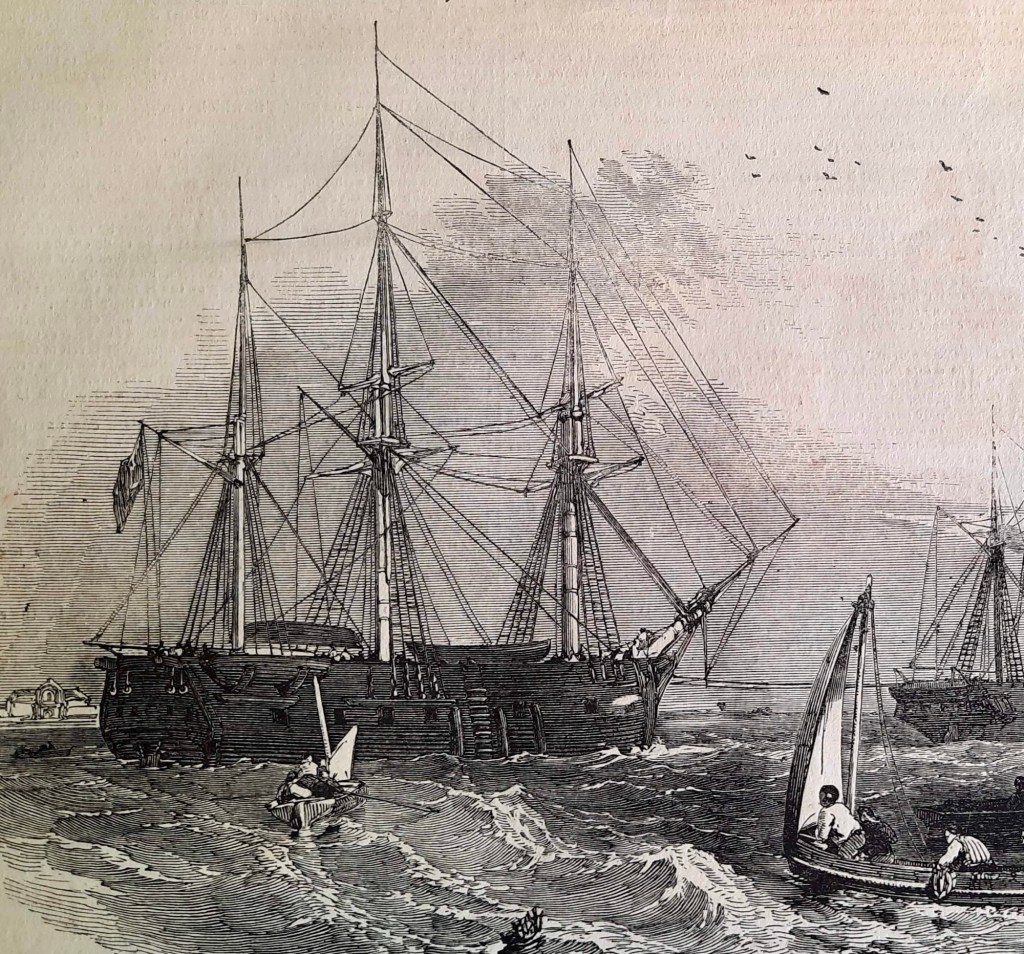
HMS North Star‘s updated bows, including the simplified stem and massive iron sheathing. Credit: ILN staff The Illustrated London News, 26 May 1849, Public domain, via Wikimedia Commons

The headrails and decoration at the bows were removed and a prominent ice guard of iron sheathing was installed. This projected out on a shelf-like section. Two massive hawse holes pierced this ice guard on either bow, to pay out and haul in the thick anchor cables. Reinforced catsheads supported massive port and starboard bower anchors.

A detailed view of North Star‘s bow as it appeared in 1852.”Sir Edward Belcher’s Arctic Expedition, sent in search of Sir John Franklin” Illustrated London News 17 April 1852 P305

Stretching aft along the sides of the hull, the channels were filled-in to protect the shrouds against ice damage, and massive vertical riders were installed amidships near the entryway stairs. Along the gundeck, several gunports were deleted, while the remaining ones were simplified to small scuttles-an identifying feature of this vessel. Heavy davits were hung out over either quarter over the mizzen channels to hold the boats securely. The davits over the stern had to be especially strong as this was also a location to hang the comparatively fragile rudder off of when the ships were beset in ice.

An Admiralty model long thought to be HMS Terror or Enterprise, has been identified by us as HMS North Star as modified for Arctic service. Credit: National Maritime Museum, Greenwich, (SLR0832)

The decorative stern and quarter galleries were simplified, with the lights (windows) appearing as narrow slits. Another pair of hawse holes appear to have been installed in the transom over the stern at the level of the quarterdeck, in a similar position to sister Rattlesnake’s fittings (an image of this appeared in the earlier post). These may have been intended to help position the vessel during anchoring or for shifting cargo to expedition vessels alongside. Flanking this rugged stern, the old quarter galleries were simplified. The three-masted ship rig was reduced to a barque by simplifying the yards of the mizzen mast.

HMS North Star towed out by the Stromboli departing for her first Arctic Franklin search expedition in early 1849 [detail of]. This is one of the most detailed views of North Star‘s modified appearance. Illustrated London News 26 May 1849 P340.

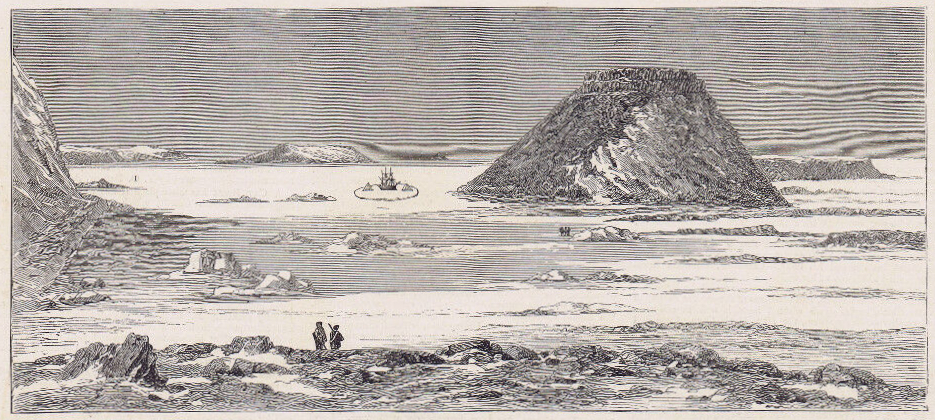
North Star was towed from Greenhithe by HM Steam Vessel Stromboli, departing 16 May 1849. As the season progressed, Saunders was not able to locate Ross, and instead dropped stores where they may have come in handy to either Franklin’s crews or expeditions searching for them. He departed the Canadian Arctic to re-cross Baffin Bay to Greenland. On the return journey, North Star endured treacherous ice conditions starting in July, and was nearly crushed several times. Eventually the crew sought shelter at Wolstenholme Fjord and the ship was beset in September. They overwintered further north than previous expeditions, on the coast of northwest Greenland near a table-topped mountain named Dundas Hill (Umanaq).

North Star Bay, with the ship frozen into the unusual surroundings of Dundas Hill/Uummannaq near the site of present-day Qaanaaq (fmr. Thule). Credit: Horace Harral, the Graphic 13 Nov. 1875 Public domain, via Wikimedia Commons

Four crew members perished during this time, and were buried nearby. When the ice cleared, Saunders turned west to return to the Canadian Arctic, to Baffin Bay and Wellington Channel, depositing more supplies at Navy Board Inlet. He learned that Ross had sailed for home from a chance encounter with William Penny (leading a privately-funded search expedition). North Star returned to England in the summer of 1850. Penny and Capt. Horatio Austin’s crews jointly discovered that Beechey Island had been the site of Franklin’s first overwintering – an event that would focus subsequent searches.

The Admiralty sent North Star back up again in early 1852, under the command of William J.S. Pullen. Pullen had distinguished himself in boat-led exploration missions while detached from the early western Arctic searches of HMS Plover and Herald. The new assignment was to travel with the large search squadron now being assembled by Sir Edward Belcher: HMS Assistance (Cmdr. George H. Richards) and HMS Resolute (Capt. Henry Kellett), and their steam tenders, Pioneer (Cmdr. Sherard Osborn) and Intrepid (Cmdr. Francis Leopold McClintock). North Star’s role was the unglamorous-yet-vital one of supply and provisioning.


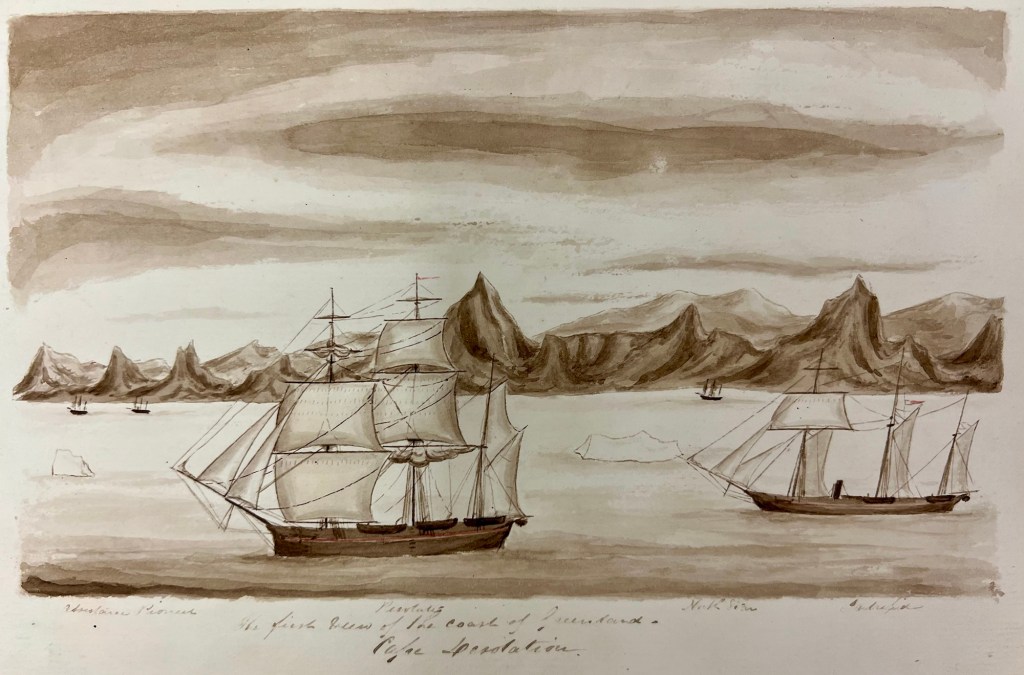
“The first view of Greenland, Cape Desolation 21 May 1852” the Belcher squadron is all depicted, with Kellett’s and McClintock’s commands, Resolute and Intrepid, in the foreground, passing some bergy bits. Credit: Mumford Fonds, Library and Archives Canada 86-18-3

The Belcher Expedition used the same successful quartet of vessels that had gone up under the command of Austin in 1850, but added the depot ship to the mix. This, it was hoped, would help the search ships explore further and stay on mission longer than previous attempts to locate the long-lost Expedition.

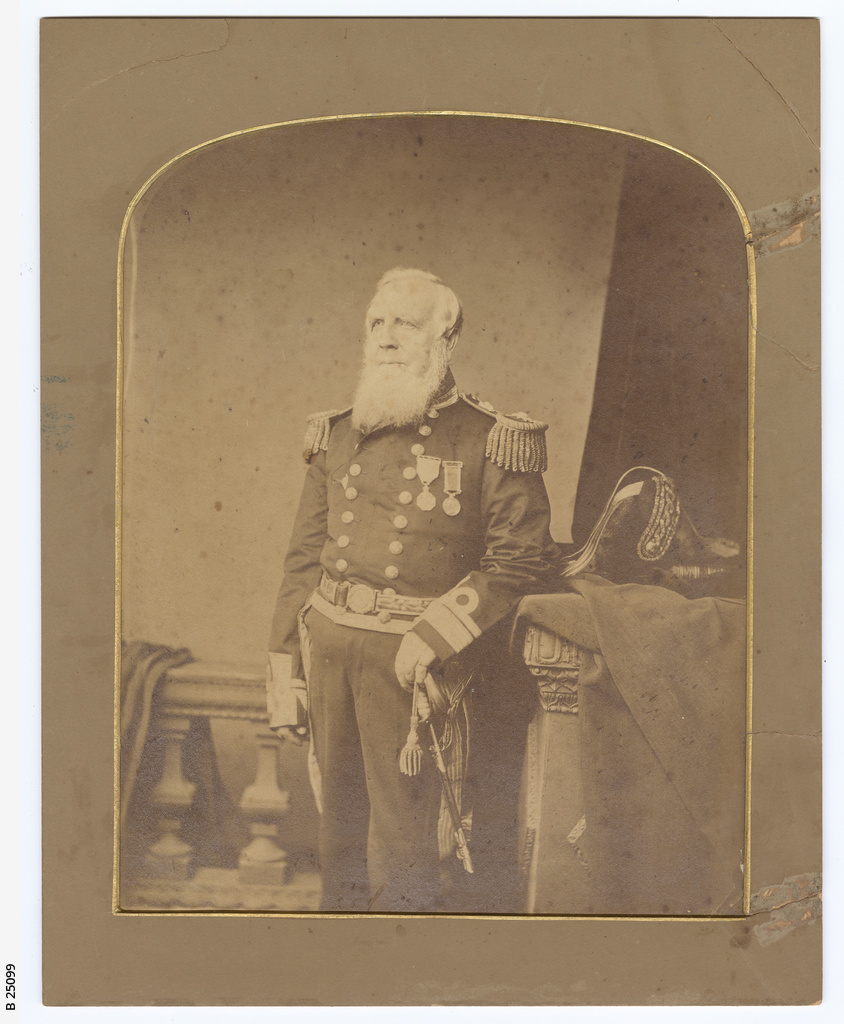
A formal portrait of WJS Pullen 1813-1887, depicted later in life, in the full dress uniform of a Rear Admiral, wearing the Arctic and Crimea Medals. Courtesy of the State Library of South Australia B25099.

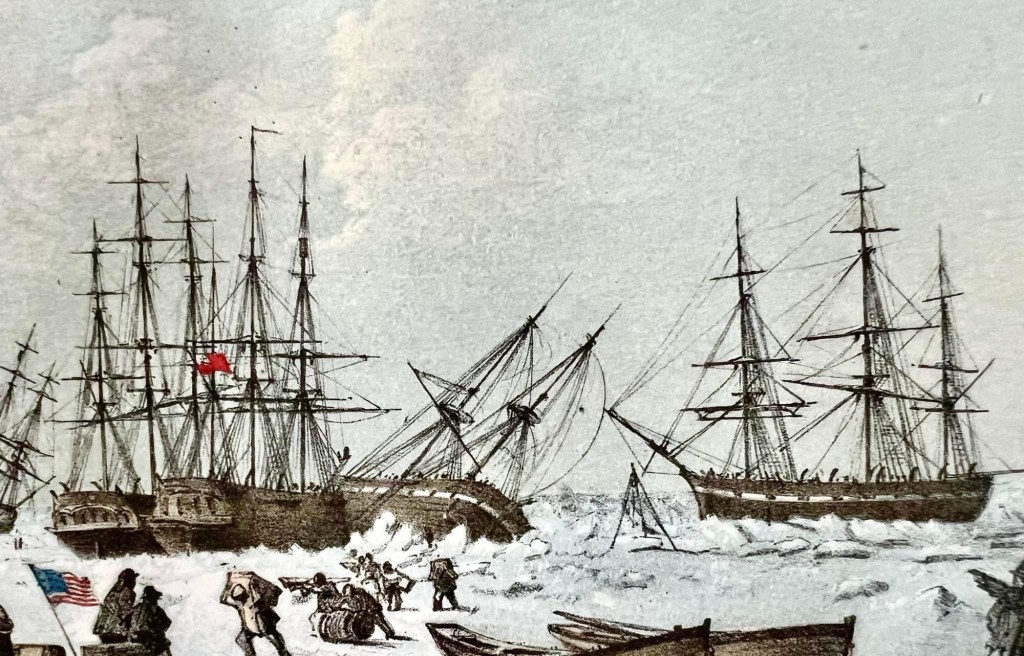
In early July 1852 the squadron was moving up Baffin Bay. They encountering some of the yearly whaling fleet while navigating along ice floes. North Star was damaged by the American barque McLellan. The threat of being caught between land floes and the floating pack ice was ever-present. A moment’s change in conditions could “nip” ships between these two frozen masses, without sufficient time to cut a protective “ice dock” into the land floe. Several whalers and North Star were nipped July 7th. The shuddering and wild pitching of hulls created a demonic clanging of ships’ bells. The unfortunate American whaler had also been forced against both North Star and the Alexander whaler (from Dundee). North Star‘s starboard cathead was mauled, and crew worked frantically to save the jibboom and bowsprit. As McLellan was further destroyed on the 8th, carpenters salvaged much of the hulk, and set North Star to rights.

George Frederick McDougall “The Loss of the McClellan – American Whaler” 8 July 1852 [detail of] this view shows a view of North Star, the nearer ship at left flying the red ensign, which shows some remaining transom lights and decoration, and the rudder suspended from the stern davits. Credit: Elizabeth Matthews (https://www.hms-resolute.co.uk/) used with permission.

Days later, the ship was proceeding up Lancaster Sound along the southern shores of Devon Island. Even with her rugged alterations, North Star proved the finest sailer in the squadron.4 In August, at Beechey Island, the search ships topped up coal stocks from the depot ship’s supplies. Assistance and Resolute departed separately with their steam tenders to search different areas of the Arctic archipelago. They deposited caches of supplies and left records in prominent cairns as they went. North Star’s coal supplies were vital to extending the range of the whole effort: The combination of sail and towing by steam tender proved especially successful to advancing deep into uncharted passages and extricating Assistance and Resolute from perilous conditions. North Star remained at Beechey Island from 1852-1854, overwintering twice in Erebus and Terror Bay.

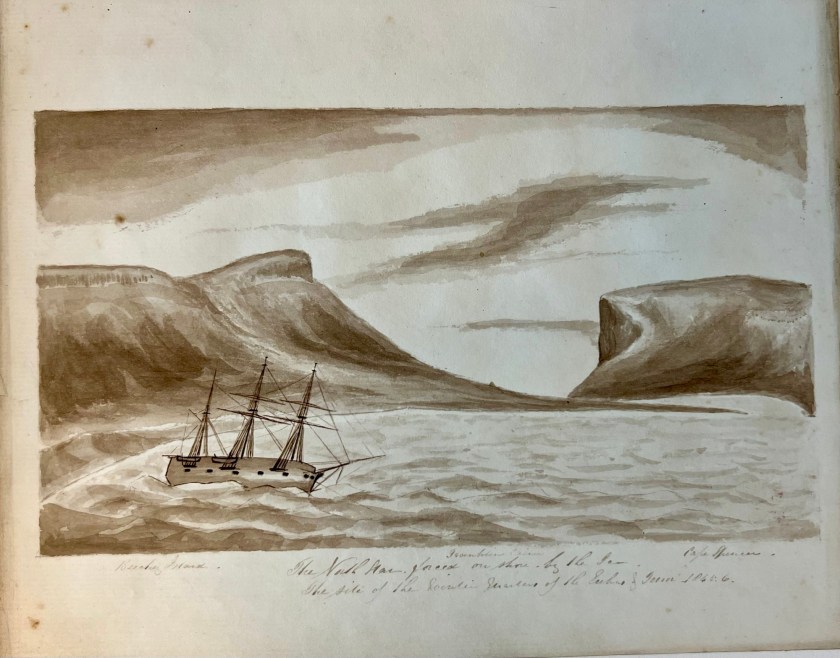
“HMS North Star forced on shore by the ice at Beechey, near Cape Spencer”, This dramatic June 1853 view by HMS Resolute’s WT Mumford shows another instance where North Star was in peril. Credit: Mumford Fonds, Library and Archives Canada 1986-18-20

In September, as the Barrow Strait became a treacherous seascape of shifting ice, the Bay froze over. North Star was almost destroyed against the shore. The next June, she was again forced up. In between existential crises, Pullen kept his crew busy building up the shore establishment at Beechey with a new depot/storehouse, Northumberland House, built from components of the lost whaling ship. Crew moved Mary, a yacht left by Sir John Ross, to Beechey from nearby Cape Spencer to serve as a “rescue yourself” lifeboat, should anyone require it. In 1854 ships’ carpenters even built a cenotaph to commemorate their lost shipmates, again from timbers salvaged from McLellan.

HMS North Star, at Beechey Island. Dated May 1854, this remarkable view by HMS Resolute’s William Mumford shows Beechey’s imposing and bleak cliffs. Ashore, Northumberland House, the storehouse, and a large boat which is likely Sir John Ross’s rescue yacht Mary, are visible. [Detail of] Credit: Mumford Fonds, Library and Archives Canada 1986-18-27

The North Star and the Beechey establishment remained as the vital link in the logistical chain that sustained the Franklin search. Other vessels, under the command of Captain E.A. Inglefield, journeyed from England to resupply North Star at Beechey in the high summers of 1853-54. In early 1854, with crews weakening from the effects of scurvy and other ailments, and with no immediate prospect of escape for the ice-imprisoned search ships, Sir Edward Belcher took the difficult decision to order his captains to abandon their ships. Crews would sledge back to Beechey, along a route they knew, that they themselves had stocked with supply depots. Pullen and his forty crew assisted in bringing them in, provided medical assistance to the weakened, closed up Northumberland House in good order, and cut their own canal out of Erebus and Terror Bay to start for home at the end of August. Five crews adding up to about 230 sailors had abandoned their frozen ships and were in sledging parties marching a long trail through difficult terrain. But, unlike the 129 dead men they had been sent to find, these sailors knew they were trekking back to salvation – a beacon in the High Arctic – their familiar North Star.5

  1. This account draws from the article “Icy Imprisonment: the 1848 Voyage of the HMS North Star” at https://beyondthebackyard.com/2014/09/03/icy-imprisonment-the-1849-voyage-of-the-hms-north-star/ and from Richard J. Cyriax (1964) “The Voyage of H.M.S. North Star, 1849-50” The Mariner’s Mirror, 50:4, 302-318. (which was provided to us with thanks from Randall Osczevski). I would also like to thank Fabiënne Tetteroo for providing higher-resolution images of the first and third ILN illustrations used above, and Elizabeth Matthews of HMS Resolute, for the same help with G.F. McDougall’s “The Loss of the McClellan – American Whaler.” ↩︎
  2. Please see our earlier post on the Atholl Class sister ships that were involved in the British search efforts for the missing Sir John Franklin Expedition, for a description of the original design of the class of fourteen ships and a brief account of the Franklin search-related careers of HMS Herald, Rattlesnake, and Talbot. The group contributed a lot to the Franklin search efforts! ↩︎
  3. To see how far the original Atholl class corvette design had evolved, see for example, the 1844 plans of sistership HMS Crocodile (1825), modified for rugged service as a surveying ship, also with a fortified bow guard, and a built-up weatherdeck: National Maritime Museum ZAZ5498. This was an important source for our reconstruction. There would also have been an extensive doubling, fortification, and interior strengthening of the hull of North Star. Our plan is not considered a final plan, but is a simplified representation, and it is the only of its kind. ↩︎
  4. Observers on HMS Resolute, George McDougall and William Mumford, both commented in August 1852 entries on North Star’s turn of speed while detached to arrive at the rendezvous of Beechey to check for Assistance and Pioneer (who had become separated but were themselves were still miles away). McDougall’s 1857 published account is currently available online at babel.hathitrust.org. Mumford’s invaluable diary exists as the main part of his archival fonds at Library and Archives Canada. ↩︎
  5. HMS Investigator’s 61-man crew, frozen in at Mercy Bay, was fortuitously located by a party from HMS Resolute under Lt. Bedford Pim on 6 April 1853. Robert McClure abandoned Investigator, and moved his ailing crew over to Resolute and her steam tender Intrepid (which eventually allowed him to claim his crew had been first to transit-not sailing- the Northwest Passage). I have counted the crew in with the 180 other men of the search ships. HMS North Star’s crew was about forty strong, if she had the same numbers born as for the 1850-51 voyages, making the Expedition total to about 281 men, 13 of whom, tragically, died in the course of their service and are commemorated by name on the remote but important Beechey Island Cenotaph. The French officer Lt. Émile-Frédéric de Bray, in his published account, lists the total number of personnel at 263 (Quoted in Barr and Stein’s “Frederick J. Krabbé, last man to see HMS Investigator afloat,
    May 1854″ Journal of the Hakluyt Society 2017/01 P28). As North Star was leaving Beechey on 26 August 1854, HMS Phoenix and Talbot (North Star’s sister ship) arrived on their resupply mission, and so helped disperse the Belcher crews to transport them home to England in three vessels. ↩︎

A Lonely Cenotaph to Lost Searchers

One of the remarkable monuments at Beechey Island, connected with the searches for the Sir John Franklin 1845 expedition, is the “Franklin Cenotaph.” It may be the oldest cenotaph – an incredibly early example of a memorial that commemorates sailors individually by name – in Canada. This distinctive monument is located inland of the ruins of Northumberland House and the fallen mast of Sir John Ross’s yacht Mary. Beechey Island is an isolated, barren place, just off the southwest coast of Devon Island, in the High Arctic, in present-day Nunavut. It had been the site of the Franklin Expedition’s first winter encampment, when HM ships Erebus and Terror had sought shelter here in 1845 and been frozen-in. In 1846, before the ice released the ships, three members of the Expedition were buried just up the beach. The area later became prominent as a staging base/supply depot in the expeditions sent to try and ascertain the fate of Franklin and his crews. Today, this incredibly remote 170-year old cenotaph serves as a lasting memorial to the human cost of these efforts.

The monument, ca. 1978. Credit: NWT Archives/Stuart M. Hodgson fonds/N-2017-008: 0918

A brief description of the monument could be: A column now white but sometimes black, in the form of an octagonal piece of ships’ machinery, affixed with plaques, with a larger one predominating, surmounted by a large finial (ball), the column approached by a marble slab on a concrete base, with the whole raised on a small platform of cemented limestone. The Belcher column and Bellot’s monument AND Lady Franklin’s memorial plaque have a unique history, like many other relics, ruins, graves, and wrecks at Beechey. This composite monument, often simplified to “the Franklin Cenotaph,” was begun in June 1854 by the crew of HMS North Star, under the command of W.J.S. Pullen. Its original intent was to honour sailors who had perished in the great efforts to locate the crews of Franklin’s vanished ships. North Star was serving as a depot and stores vessel for the larger Royal Navy search effort, Sir Edward Belcher, commanding.

Map of the 1845-46 Franklin Expedition sites, and a record of their discovery[annotated with approximate locations of some sites mentioned in this post, including the cenotaph, located just behind the square Northumberland House] The British Library, “Papers and Despatches relating to the Arctic Searching Expeditions of 1850-51. Together with a few remarks as to the probable course pursued by Sir John Franklin, etc. [Compiled by James Mangles. With maps.(London: 1851)] No restrictions, via Wikimedia Commons

This new “Belcher column” adhered to the classical definition of a cenotaph: It memorialized the dead without being a burial site. By commemorating enlisted personnel – sailors and marines – it was also incredibly rare for its time.1 Small plaques on each face of the column identify 13 deceased members of HM ships Investigator, Resolute, Assistance, Intrepid, whose remains were buried elsewhere.2 These men are not all commemorated in the same manner; some entries are descriptive, some employ religious passages, some are brief.

The column was reportedly made out of the interior section (the spindle) of the capstan of the American whaling ship McLellan. McLellan had been lost two years previously, on 8 July 1852 on the way to Arctic whaling grounds, in Melville Sound, when it and a fleet of British whaling ships had been frozen in pack ice, alongside Belcher’s small Royal Navy squadron, then journeying up to begin the search. McLellan had run afoul of North Star. It was then crushed by fast moving ice. The vessel must have remained on the surface or pinned to the ice for some time, as much seems to have been salvaged. McLellan’s spars would also be a source of timbers used to construct Northumberland House, the large storehouse constructed soon after the ships got to Beechey.3

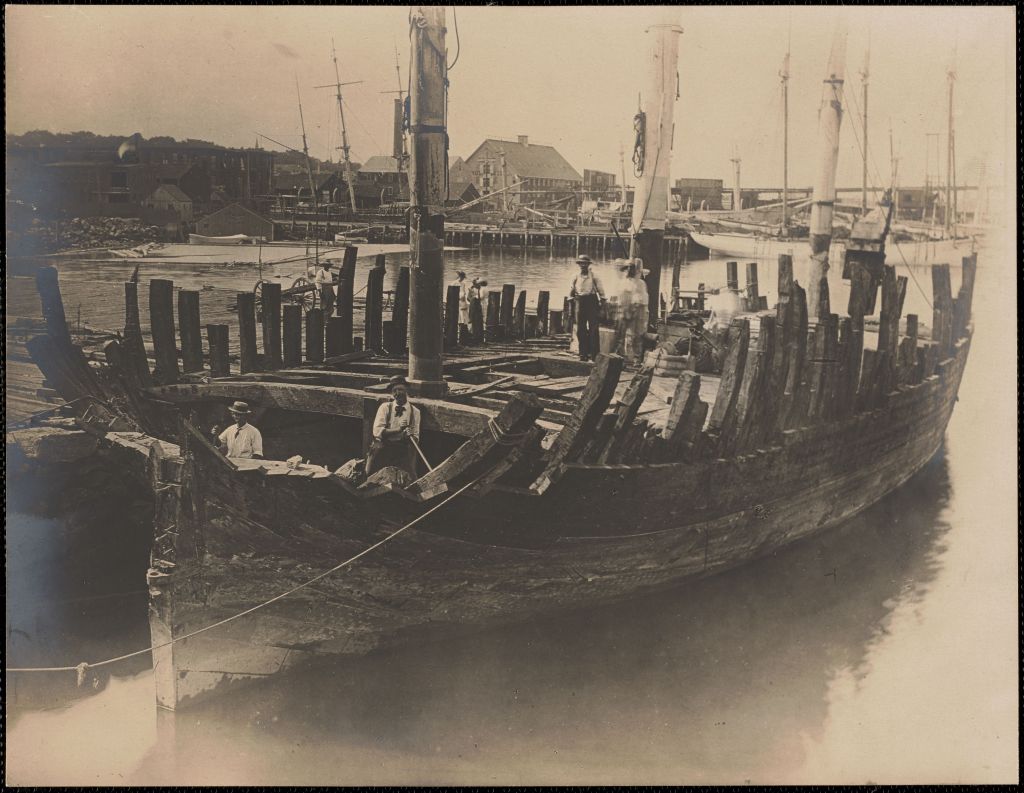
Dismantling the very old whaling ship Rousseau at New Bedford MA, ca. 1893. This shows many of the spars, masts, timbers, and other materials that would have been sourced from the similar ship McLellan, that were used in Beechey Island construction projects. note the crews are down to the level of the lower deck, and the vessel is still afloat with intact coppering! Credit: Joseph G. Tirrell 2012.008.0055, Digital Commonwealth (CC BY-NC-ND)

The second major component of the monument was added later that summer to memorialize Lt. Joseph-René Bellot. Bellot, an officer of the French Navy, had accompanied Captain Edward Augustus Inglefield, commanding HMS Phoenix, on the same 1853 journey to resupply Belcher’s ships that resulted in the loss of the Breadalbane supply ship nearby.

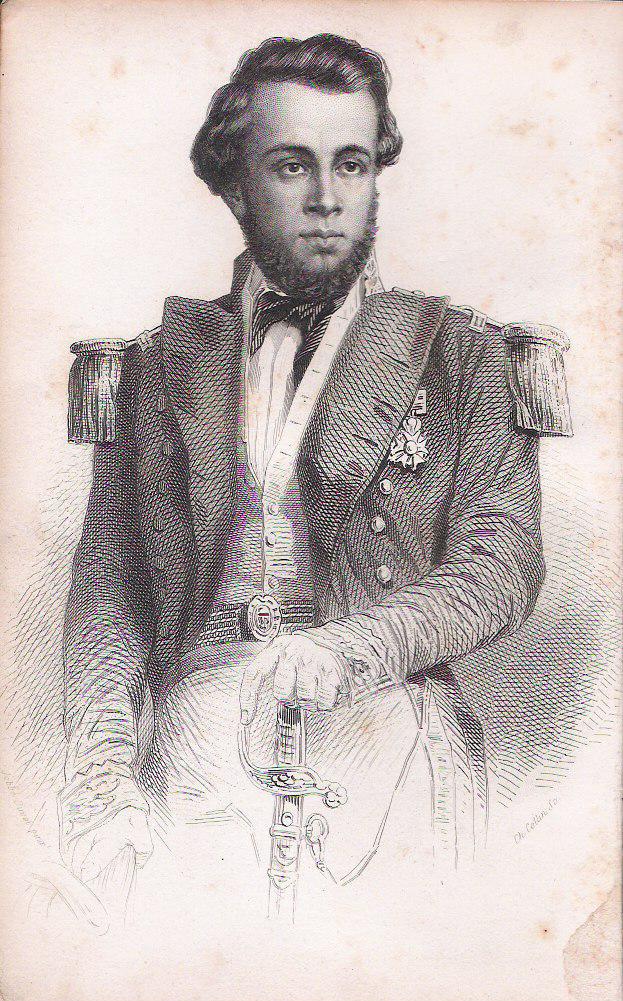
Portrait gravé sur acier de l’explorateur français Joseph-René Bellot (1826-1853), en tête de son ouvrage Journal d’un voyage aux mers polaires à la recherche de Sir John Franklin, introduction de Paul Boiteau, Paris, Perrotin, 1866.Credit: Wikinade, CC0, via Wikimedia Commons

Bellot was a seasoned Arctic explorer who had already been out as second in command on the 1851 William Kennedy expedition. He was respected and admired by his comrades. As Phoenix and Breadalbane were driven away from Beechey, in a gale, he had volunteered to brave the ice and elements to carry despatches north to Wellington Channel, to deliver them to Belcher. Bellot disappeared 18 August, when the ice suddenly opened around him. This loss was felt deeply by the searchers in the Arctic.

HMS Phoenix, with Breadalbane supply ship behind on 18 Aug. 1853, in the same perilous conditions that Bellot, transporting despatches, was lost in. Credit: Admiral Sir Edward Augustus Inglefield, Public domain, via Wikimedia Commons

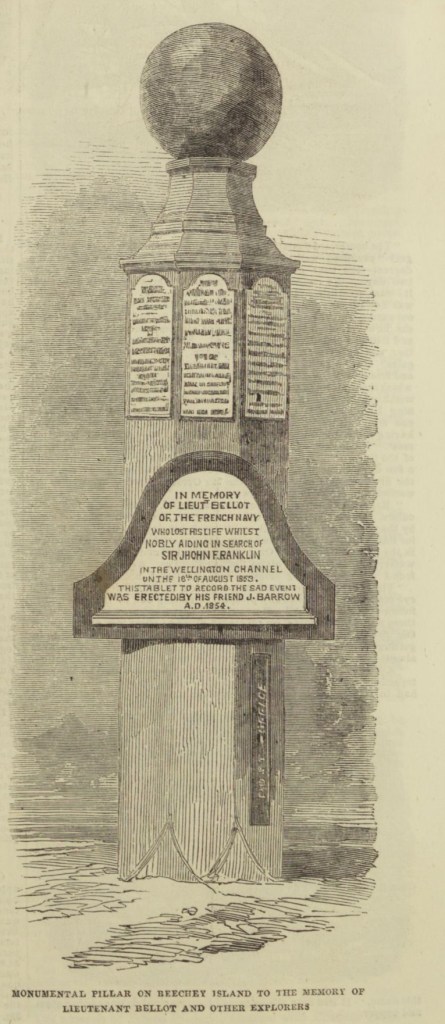
In August 1854, when Inglefield returned to the Arctic on the next resupply effort, he brought up a plaque dedicated to the memory of Bellot to be added to the Belcher column. The plaque had been commissioned by an important friend, Sir John Barrow, (Second Secretary at the Admiralty and the second Barrow heavily involved in polar exploration) and was cast in a headstone-like shape.

The monument as it appeared soon after construction, with the Bellot plaque, whose text is legible here, mounted low on the front face. The Illustrated London News, 28 October 1854[detail of] Unidentified engraver, Public domain, via Wikimedia Commons

Francis Leopold McClintock’s search expedition of 1858 brought up the last major addition to the monument: A large marble slab commissioned by Lady Jane Franklin, Sir John Franklin’s widow. The marble was inscribed with text dedicating it “To the Memory of Franklin, Crozier, Fitzjames, and all their gallant brother officers and faithful companions…” This, aptly, concluded the memorialization program on the monument by incorporating the lost explorers into the monument to the lost searchers of those explorers. The marble was to have been brought north in 1855 by an American expedition looking for Dr. Kane, commanded by Lt. Henry J. Hartstene. That expedition turned back when they located Kane, so the plaque waited at Disko, Greenland, for three years. McClintock’s expedition routed it on up (with an additional small plaque added to reference this) and deposited the marble flat on the ground in front of the column.

One of the original oddities of the monument is the metal “Post Office” letterbox panel affixed to a rear surface. Despite the prevalence of seances in Victorian England, this was not intended as a correspondence box to the lost, to communicate with the spirit world. According to an October 1854 London Illustrated News article, which featured a sketch of the monument, this letterbox was actually functional, intended for future visitors to leave letters as a receipt of having visited the Island.

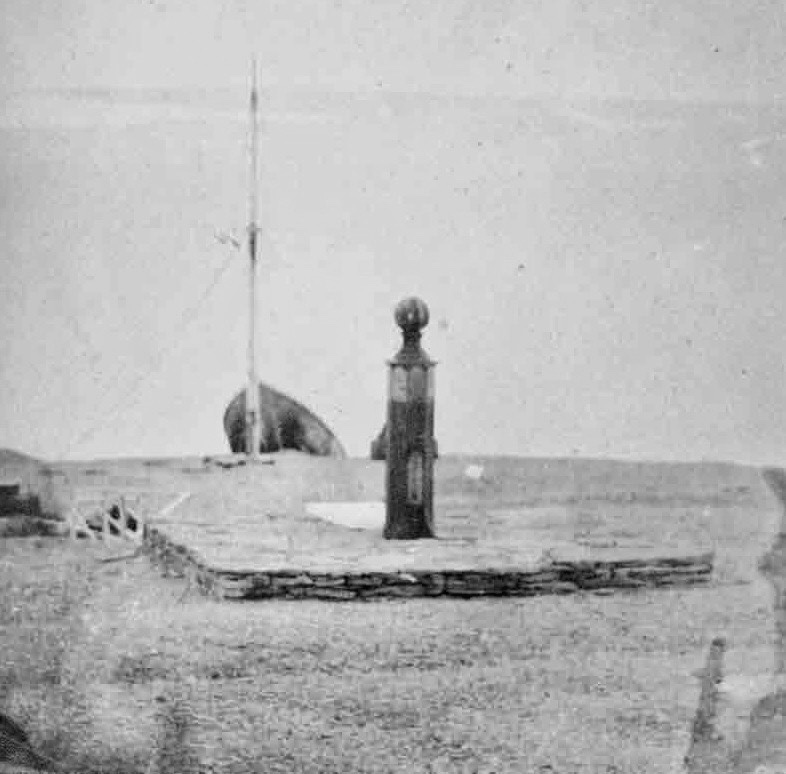
Lt. Allen Young’s 1876 photograph of the monument, looking towards the beach at Beechey, with Lady Franklin’s marble on the ground and the post office plaque on the lower rear face. Credit: Allen Young “Cruise of the Pandora” (London, 1876) Page 43. Public domain via Library and Archives Canada 1984-109 NPC

In 1876, Allen Young, in HMS Pandora, revisited Beechey’s lonely shores. He had last been there while serving as Navigator on Fox, McClintock’s ship. He took a valuable photographic record of the site that was incorporated into his published journal.4 At this time the monument was painted black. Young described opening the letterbox on the monument to retrieve a single document. Pen pals were in short supply at Beechey, and the only contents were a memo left by Belcher more than two decades before.

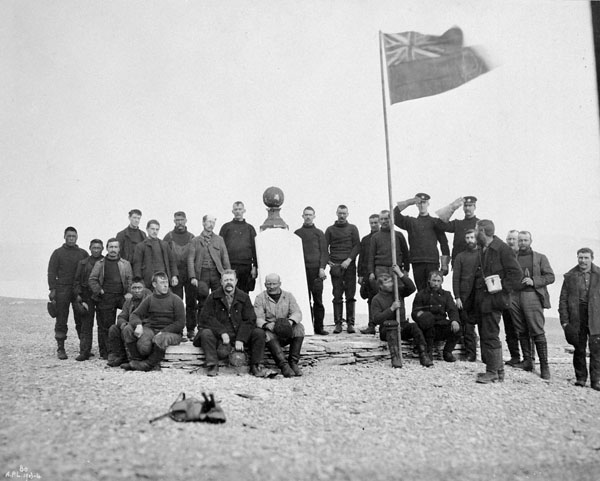
The cenotaph, like so many other relics, wrecks, and remains at Beechey, seems to have mostly escaped the ravages of time. A half-century after its installation, in August 1904, the Canadian ship DGS Neptune visited Beechey, as part of the Dominion Government Expedition, A.P. Low commanding. This visit saw expedition members raise the marble plaque for a photograph and then reorient it to face upwards (Low’s interesting description of Beechey and the cenotaph is in this 1906 report). At this time a flagpole may have been installed at the rear or very near the monument.

The Dominion Government expedition’s visit to the memorial, 15 August 1904. A.P. Low describes how they found a note from the previous year in a sealed case attached to the rear of the cenotaph, left by Roald Amundsen, whose ship Gjoa was unlocated at this time. The note was forwarded to the Norwegian government. Credit: Albert Peter Low / Library and Archives Canada / PA-053580

During the 1922-23 visit to the monument, on one of Captain J.E. Bernier’s yearly voyages/sovereignty patrols north in CGS Arctic, the marble appears to have been set into a more secure and aesthetically pleasing angled concrete base. The head of the marble now rested just under the Bellot plaque. Other than the removal of the flagpole, and the application of white paint, the memorial has remained substantially unaltered since then. It continues to stand tall in a lonely vigil at Beechey, down through the decades. Today, the Franklin Cenotaph is a powerful site of memory connected with the search for the Northwest Passage, and an important tribute to the men who died far from home looking for lost comrades.

Capt. Bernier, CGS Arctic, with other crew at the Franklin Cenotaph, 1923. Credit: Library and Archives Canada R216, Vol. 14946, p54.

Please see our 2024/03 update to this story, where we used an archival source, William Mumford’s diary, to determine more accurate provenance of the column to a different part id the McLellan whaling ship. We still have many questions about the monument, including what dates sections of the monument were altered or rebuilt, why the small plaques were sometimes missing from archival photos, and the subsequent history of archaeology at the monument. There are many discrepancies in the sources, and we know there are folks out there who know more than us, so we are happy to stand corrected! We also hope this post spurs greater study of this important memorial. If you’ve visited Beechey Island, we’d love to see your photos!

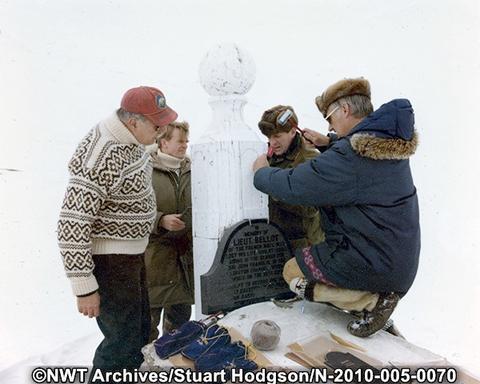
Northwest Territories Commissioner Stuart Hodgson (at left – the creator of the Franklin Probe, a maritime historian and a Canadian naval veteran) and others help replace the Cenotaph plaques with replicas during a July 1978 visit.

  1. This cenotaph may even be unique on Canada. We have never heard of one that commemorates not just senior officers but the regular sailors and marines of military ships, erected before the 20th century. A hundred years earlier, the terrible loss of more than a thousand officers and enlisted men, when HMS Victory (1737-1744) sank in the English Channel, had resulted in the kind of traditional commemoration to the leader, Admiral Sir John Balchen, at Westminster Abbey. The oldest naval monument now located in Canada is Montreal’s Lord Horatio Nelson column (constructed 1809). ↩︎
  2. Thomas Morgan of HMS Investigator, who died 1854-05-22 onboard North Star, is buried nearby with the three original Franklin crewmembers. Aside from Morgan and Bellot (who is commemorated twice on this monument), the other members of search crews memorialized on the column (with their ships and dates of death) are: William Cutbush HMS Assistance 1853-02-27; Isaac Barnett HMS Assistance 1854-01-28; George Harris HMS Assistance 1854-01-09, John Ames, HMS Investigator 1853-04-11; John Boyle HMS Investigator 1853-04-05; H.H. Sainsbury HMS Investigator 1853-11-14; Thomas Mobley HMS Resolute 1852-10-19; George Drover HMS Intrepid 1852-12-12; John Coombs HMS Intrepid 1853-05-12; Thomas Hood HMS Intrepid 1854-01-02; John Kerr HMS Investigator 1853-04-13; James Wilkie HMS Intrepid 1854-02-2. These names can be verified at Maritime Memorials at RMG. ↩︎
  3. Brian D. Powell Polar Record 42 Issue 4 provides a detailed summary of the construction of this and other monuments at Beechey, and there is still more work to do on the commemorative intent of the various monuments. Other evidence for the source of the Belcher column, the whaling ship McLellan, is found in Barr and Stein’s January 2017 article “Frederick J. Krabbé, last man to see HMS Investigator afloat, May 1854” Journal of the Hakluyt Society. We have usually encountered spindles with ten or more sides as part of naval capstans. ↩︎
  4. Young had been sent in HMS Pandora to aid the 1875-76 British Arctic Expedition, which encountered many difficulties. Young’s ship, a reinforced gunboat, would be acquired as USS Jeanette for the Grealy expedition, which ended in more shipwreck and tragedy. His account The Two Voyages of the Pandora ; 1875-76 has a chapter (pp. 43-46) about Beechey with a brief description of the letter box, Northumberland House, the Mary yacht left by Sir John Ross, and other boats on the site: https://archive.org/embed/cu31924091208565 ↩︎

Oh, They’ll be No More Yachting from Beechey, me Boys!

Arctic Album #7 (trip of SS Beothic 1926-1927) Credit : Department of Indian and Northern Affairs Canada / Library and Archives Canada, Accession 1974-366 R 216 Vol. 14948.

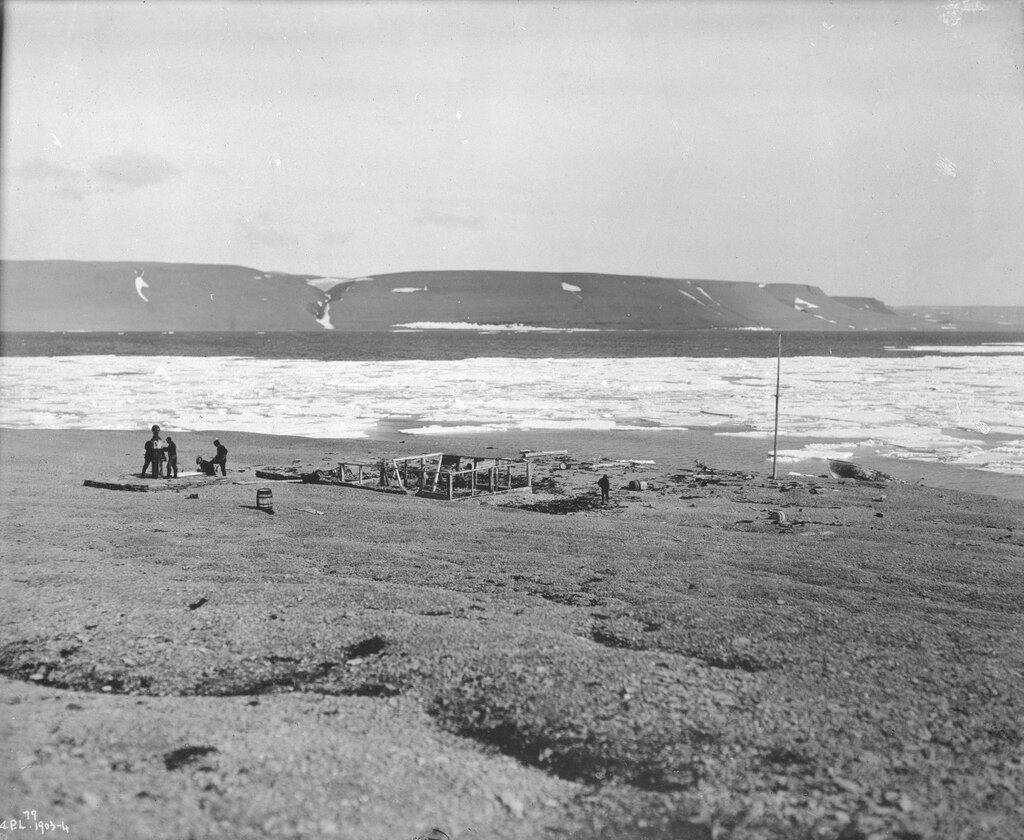
One of the remarkable relics at Beechey Island, connected with the searches for the Sir John Franklin 1845 expedition, is a large mast which has collapsed along the beach, pointing out to Erebus and Terror Bay. This stood for years in front of the ruins of Northumberland House and a motley collection of memorials. Beechey Island is an isolated, barren place, just off the southwest coast of Devon Island, in the High Arctic, in present-day Nunavut. It had been the site of the Franklin Expedition’s first winter encampment, when HM ships Erebus and Terror had sought shelter here in 1845 and been frozen-in. In 1846, before the Bay released the ships, three members of the Expedition were buried just up the beach. The island and surroundings later became prominent as a staging base/supply depot in the expeditions sent to try and ascertain the fate of Franklin and his crews. More searchers would die at and around Beechey, and the Breadalbane supply ship would be wrecked nearby in 1853. Today, burials, monuments, ruins and shipwrecks remain.

Beechey’s Erebus Harbour as it appeared in 1903. The Belcher Column and Bellot monument is at left (Painted black here but later white, with Lady Franklin’s white marble plaque on the ground), with the ruins of Northumberland House and an erect mast standing nearest Erebus and Terror Bay. Credit: Albert Peter Low collection at the Canadian Museum of History, CC BY-SA 4.0 https://creativecommons.org/licenses/by-sa/4.0, via Wikimedia Commons

The mast is a significant artifact with an important story.1 It is reputed to be the last large remnant of the Mary, Sir John Ross’s yacht. This trim little 12-ton cutter-rigged craft had been brought North by Ross, and accompanied his much larger yacht, the brig Felix. It had been built for the trip out, and both it and 70-foot, 100-ton Felix (sometimes referred to as a brig, sometimes a schooner) were reinforced for polar service with strong hulls and iron or zinc hull sheathing. Felix was Ross’s search ship, but Mary was intended for a different purpose.

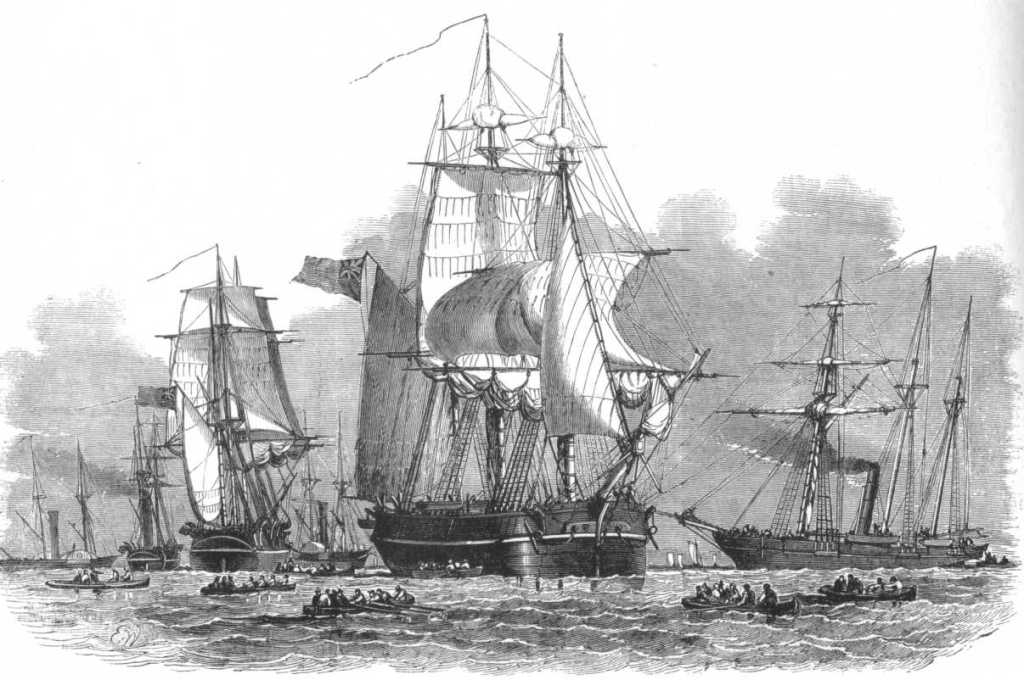
In August 1850, Sir Horatio Austin’s crews of HMS Resolute and Assistance (accompanied by HM Steamships Pioneer and Intrepid) and Captain William Penny’s ships Lady Franklin and Sophia made exciting discoveries at and around Beechey Island.2 These first traces of the lost expedition invigorated search efforts.

The heavies form up! “Captain Austin’s Arctic Expedition; HMS Resolute and squadron.” Illustrated London News 11 May 1850. Credit: Edwin Weedon, Public domain, via Wikimedia Commons

Ross arrived days later in Felix, honouring a promise he had made to come to the aid of Franklin. He was 72 years old, and his sense of duty and concern for his friend brought him out of retirement. When the Admiralty declined his offer to lead an expedition, the Hudson’s Bay Company funded the expedition. His plan, should the lost expedition not be located or turn up, was to leave Mary behind.

Map of the 1845-46 Franklin Expedition sites, and a record of their discovery[annotated with approximate locations of some sites mentioned in this post] The British Library, “Papers and Despatches relating to the Arctic Searching Expeditions of 1850-51. Together with a few remarks as to the probable course pursued by Sir John Franklin, etc. [Compiled by James Mangles. With maps.(London: 1851)] No restrictions, via Wikimedia Commons

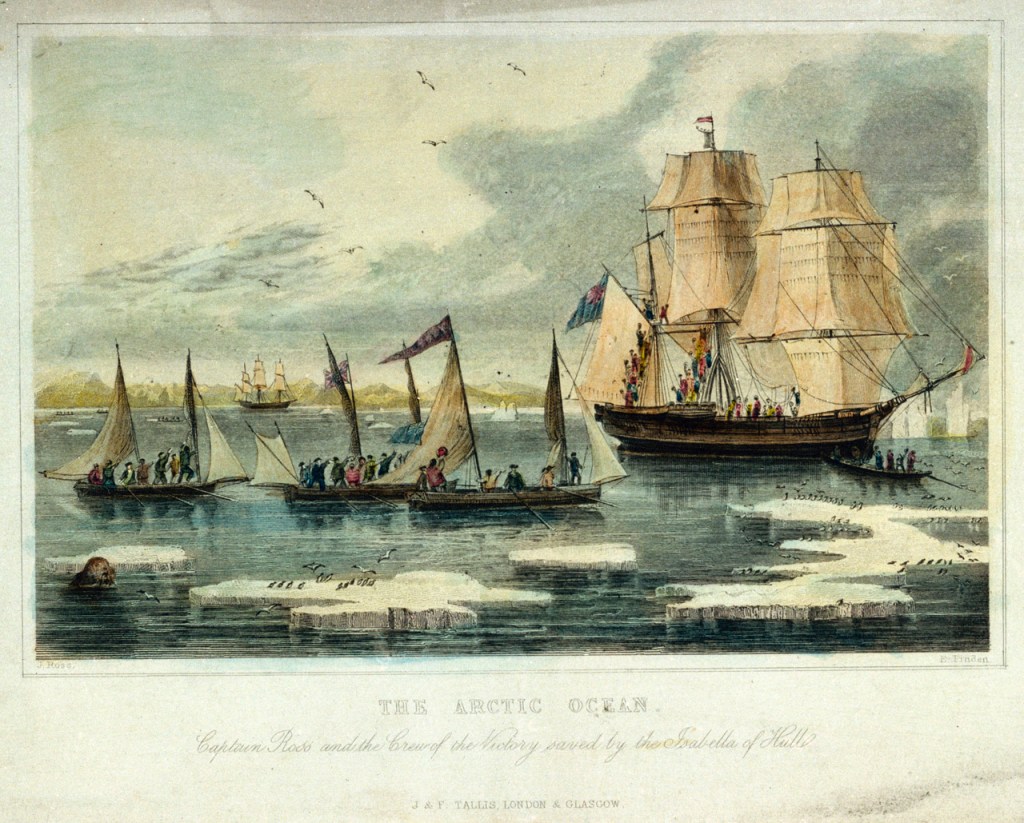
Ross knew better than anyone the value of a cache of food and stores and a serviceable boat. On his 1829 expedition, accompanied by his nephew James Clark Ross, his ship Victory had been trapped in ice. Three years later they were forced to abandon their refuge. They retreated to Fury Beach, where they had to spend yet another long, dark winter frozen-in. But Fury Beach was their salvation: Parry’s 1825 expedition had left a cache of supplies and three boats from their wrecked ship, HMS Fury. The boats and supplies allowed an expedition, which had been widely assumed to have ended in death and disaster, to escape to Prince Regent Inlet and rescue. Ross hoped that some similar depot and boat could help Franklin Expedition survivors, or anyone else trapped in the area.

Edward F. Finden’s engraving (John Tallis & Co) of John Ross’s crew, sailing in some of HMS Fury’s old boats, encountering the whaling ship Isabella, his old ship, in 1833 after four years. Ross hoped that Mary would be involved in a similar mission. PAD6090 Courtesy of the National Maritime Museum.

With larger Admiralty-supported expeditions scouring the Arctic, it was time for Ross to return home. Mary was initially left west of Beechey at Cape Spencer, packed with a good store of provisions. The boat was moved soon after to Erebus Harbour when the Edward Belcher expedition incorporated it into new construction. The crew of HMS North Star, the depot ship supplying the Belcher search ships, dragged Mary up the beach and deposited her under Beechey’s soaring cliffs. The yacht was intended as a companion to Northumberland House, which was packed with useful supplies and provisions. Stranded crews that came to Beechey, once they had sheltered and replenished their stocks, could strike off in the yacht in the very short navigation season that those high latitudes allow. Mary and Northumberland House functioned together as their own extraordinarily remote lifesaving establishment. Robert McClure informed the crew of his long-trapped ship, HMS Investigator, that one group would travel to Cape Spencer to board Mary.3 As every one of the Belcher search ships would later need to be abandoned, with their crews completing harrowing marches to safety, the idea had merit.

In 1876, Allen Young, on his second Arctic expedition in the retired gunboat Pandora, found Mary to be in very good shape, still tight and dry and with mast up and sails stowed onboard, in a mostly dry cabin.4 Northumberland House, by comparison, had been damaged and ransacked (reportedly by bears). Young had been one of the last to see this same spot from the Fox, as the navigator on the Capt. Francis Leopold McClintock’s 1858 expedition. With the Pandora’s departure, Mary was again left to her lonely fate.

Mary as the yacht appeared in 1876, still substantially intact. The placement appears to have been up the beach from most of the sites, closer to Cape Riley. Credit: Allen Young “Cruise of the Pandora” (London, 1876) Page 41. Public domain via Library and Archives Canada 1984-109 NPC

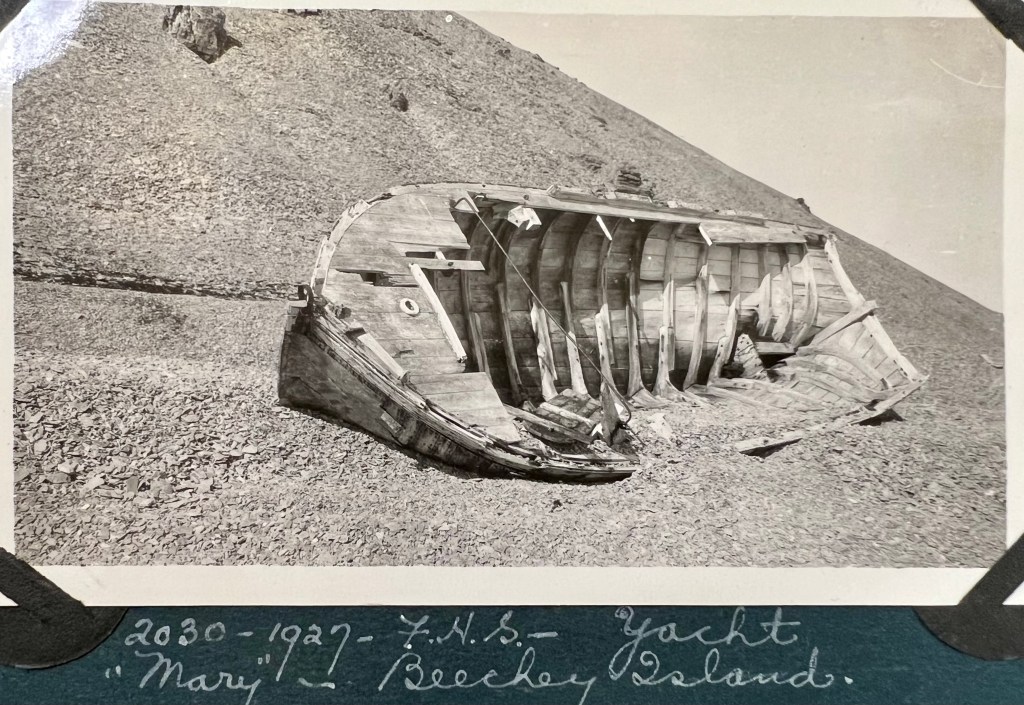
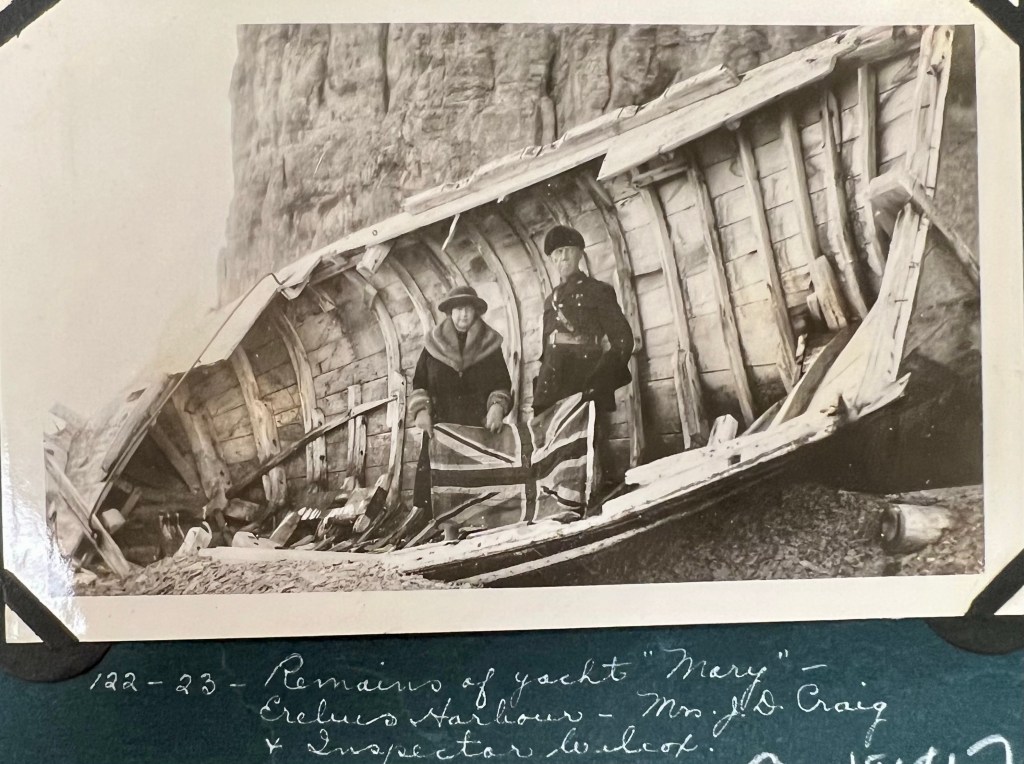
Occasional visits by notable Arctic explorers continued into the 20th Century. Mary sustained more damage and deterioration and at some point the mast was taken from near the hull and erected in front of Northumberland House, near a large whaling boat.5 The hull assumed a prominent list, and the decking deteriorated. Visitors also speeded deterioration by taking a few choice souvenirs. The derelict vessel was photographed in 1923 and 1927, during annual trips to the Arctic by Canadian government ships.

Inspector C.E. Wilcox and Mrs. Craig standing in the remains of the yacht Mary, 1923. Credit: John Davidson Craig / Canada. Dept. of Indian and Northern Affairs / Library and Archives Canada / PA-186867 Arctic Album #5, trip of CGS Arctic 1923 R 216 Vol. 14946.

During the 1970s and 80s, the mast leaned at an increasingly rakish angle, until it fell to the ground sometime before 1992. Like everything else at Beechey, the mast is undergoing a very gradual deterioration. We conclude our brief account of a yacht that was intended to serve as a rescue vessel with an important takeaway: If you plan to be shipwrecked in the high latitudes of the Canadian Arctic somewhere around Beechey Island, you can no longer depend on Mary to yacht away from it!

  1. Season Osborne’s detailed history of Mary “What Happened to the Mary? A Historic Site ravaged through time” (Above and Beyond – Canada’s Arctic Journal 2015/2 pp. 23-27) helped sort out many contradictions. It is available at https://issuu.com/arctic_journal/docs/above_n_beyond_marchapril_2015/ ↩︎
  2. This is a simplified account of discoveries, for a more fulsome treatment of the moment of the first discoveries at Cape Riley (by Capt. Ommanney of HMS Assistance) and Capt. Penny’s team, including R.A. Goodsir, finding the graves at Beechey, please see Alison Freebairn’s finger-post blog and Logan Zachary’s Illuminator blog on the topic. ↩︎
  3. George F. McDougall “The Eventful Voyage of H.M. discovery ship “Resolute”…(London: Longman et. al. 1857) P216. McClure ended up encountering the HMS Resolute party sent to look for him under Lt. Pim and evacuating everyone to Resolute). Available at Babel.hathitrust. ↩︎
  4. The above source refers to the mast as having been moved sometime around the Second World War, but the 1903 photo seems to show a similar mast in front of Northumberland House, which is more substantial than the flag pole that had been on the site during the 1870s. ↩︎
  5. This section is drawn from Lt. Allen Young’s Cruise of the Pandora; from the private journal kept by Allen Young commander of the expedition (1876; republished by Cambridge University Press 2012). The illustrations are from a copy of the original at Library and Archives Canada. ↩︎