Thirty-five years ago today, during Operation Desert Storm, the Canadian Navy came to the assistance of our US allies, in a characteristically classy way.1Today, we mark the anniversary of HMCS Athabaskan entering into a mined area of the Persian Gulf to assist the damaged cruiser USS Princeton. This episode marked a meaningful connection between the careers of two storied warships.2
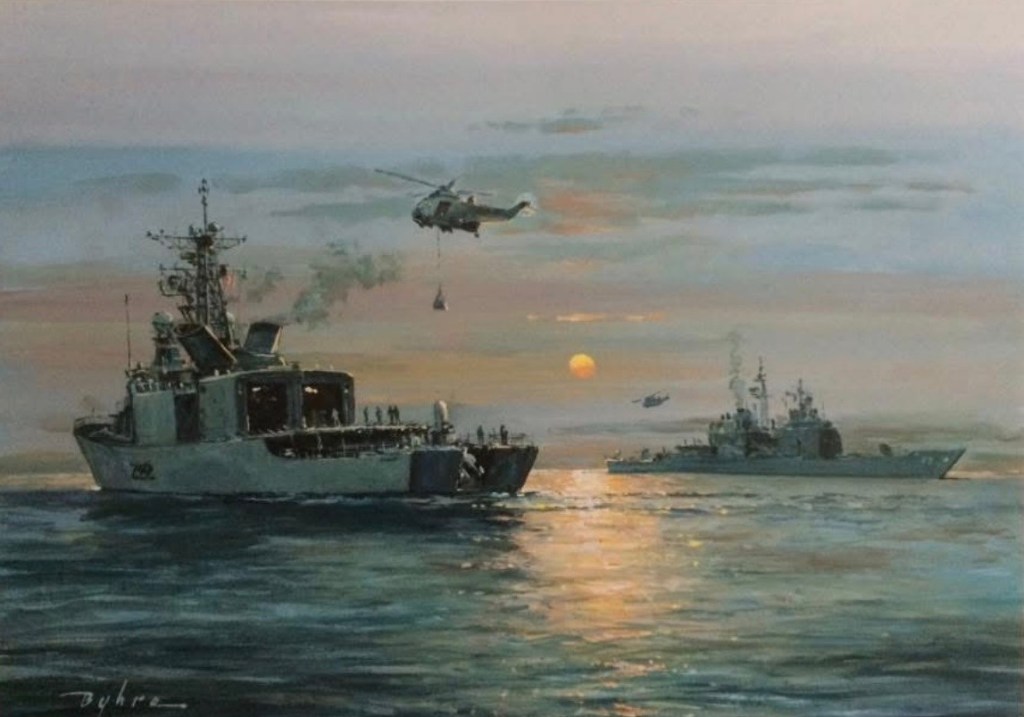
“Rendering Assistance” by Maritime Artist Dale Byhre, which depicts the moment 35 years ago that HMCS Athabaskan (at left) escorted the damaged cruiser USS Princeton (right). This shows CH-124 Sea King helicopters transporting supplies. Used with the written permission of the artist, who has prints available for sale.
At daybreak, 18 February 1991, Captain Edward Hontz, USN, was speaking to the crew of his command, the guided-missile cruiser USS Princeton (CG-59) over the ship’s 1MC (PA system).3 The ship was crawling forwards at 3 knots through a suspected minefield, in shallow water near Falaika Island in the northern Persian Gulf. A crew member in a jury-rigged chair at the bows peered intently down into the water. Beside him, a shipmate manned a .50 caliber machine gun.
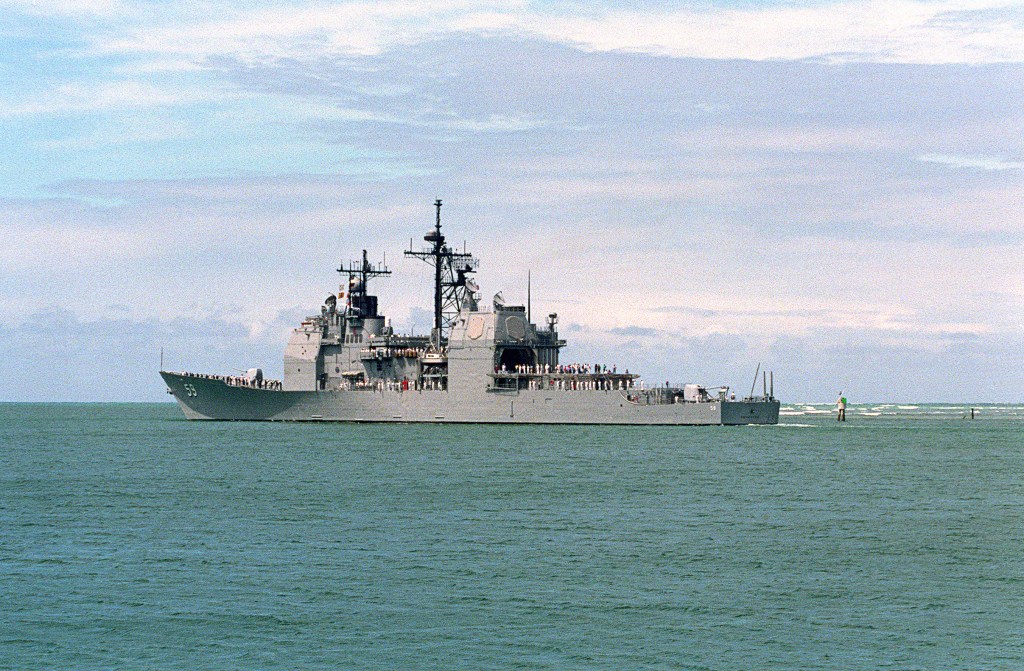
Crew members man the rails aboard the guided missile cruiser USS Princeton (CG-59) as the ship departs from Pearl Harbor soon after its return from Desert Storm, 1 June 1991 Credit: USN official (OS2 John Bouvia) via NARA DNSC9203674.
Princeton was using its AEGIS missile-defense system to protect a force of minesweepers that was tasked with clearing a corridor for Coalition ships through an Iraqi-laid minefield. There was a suspected “Silk worm” anti-ship missile site on the coast. Hontz had just notified the crew that USS Tripoli (LPH-10), an Amphibious Assault Ship, serving as flagship of the minesweeping force, had been damaged by a mine early that morning.
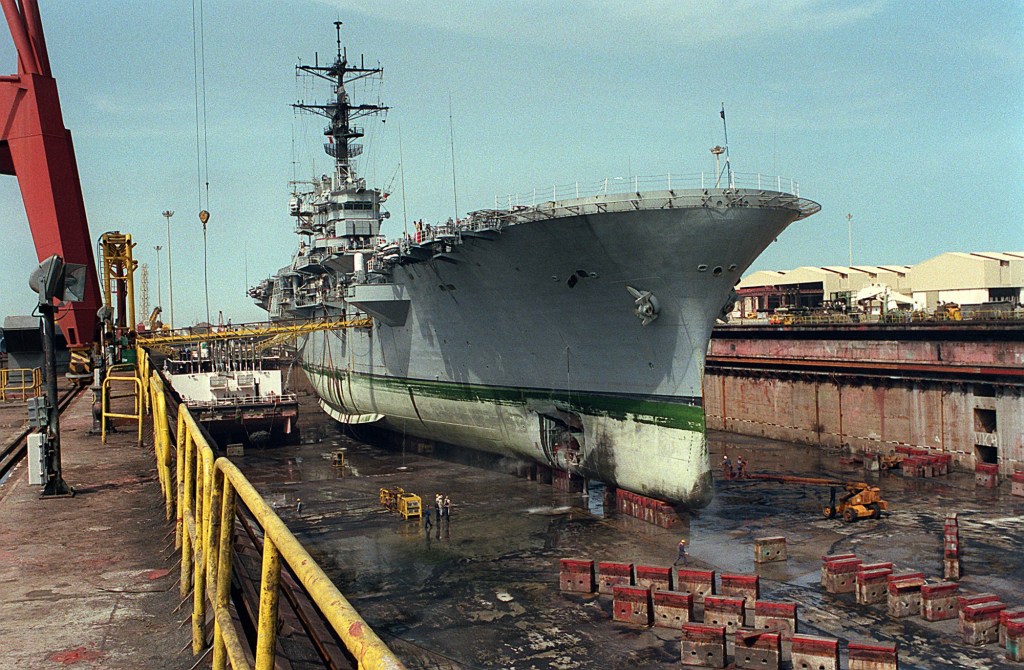
USS Tripoli (LPH-10), having hull damage repaired in Bahrain after striking a mine on 18 February 1991, while engaged in mine clearing with its helicopters. Tripoli was decommissioned in 1995 but used as a test ship, and was the last Iwo Jima class amphibious assault ship in existence, only being dismantled in 2018. Credit: USN official (JO1 Gawlowicz) via NARA DNSC9108075
At 7:15 AM local time – just as Hontz reminded crew to remain vigilant during their current mission – a mine exploded underneath the Princeton’s port propeller and rudder. Seconds later another mine detonated off the starboard bow.4 Crew members were thrown around like rag dolls all over the ship. The up-and-down whiplash motion was especially violent at both bow and stern. This terrifying movement was joined by gut-wrenching side-to-side seesaw. The ship bent and flexed beyond what it was designed to take. Deck seams opened up, frames were fractured, the deckhouse structure cracked, and aluminum flexed and distorted. The propeller shaft was damaged and the rudder was jammed.5 As crew struggled to get to their General Quarters posts, many thought they’d be abandoning ship. The damage was serious. Miraculously, no one had been killed.6
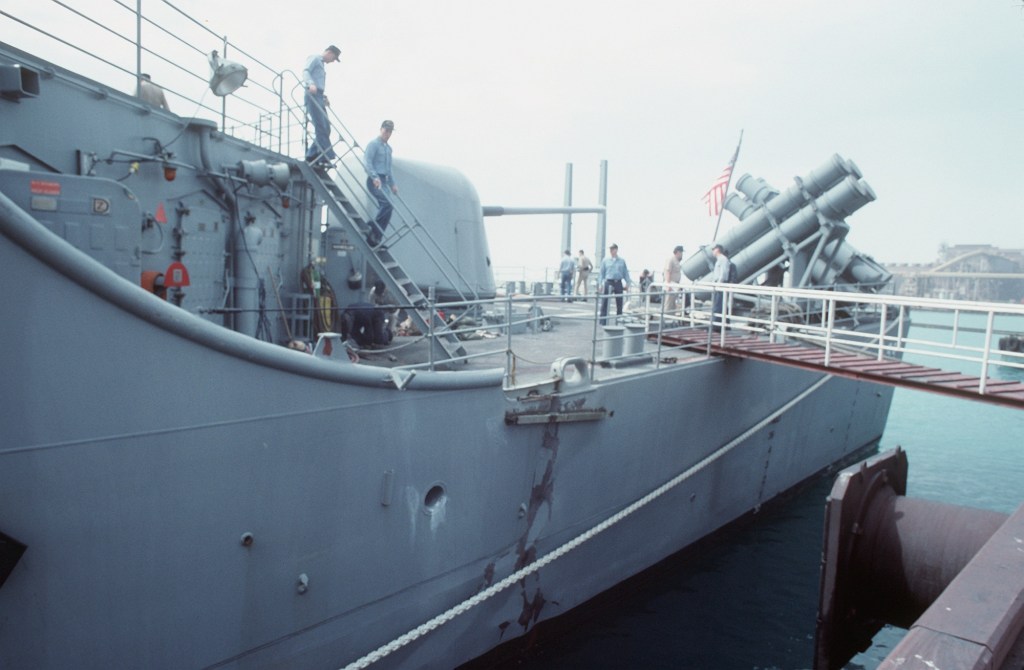
USS Princeton at Bahrain three days after the incident, showing a jury repair over the hull cracking near the stern. (CWO Bailey) NARA/DoD 330-CFD-DN-ST-91-05714.
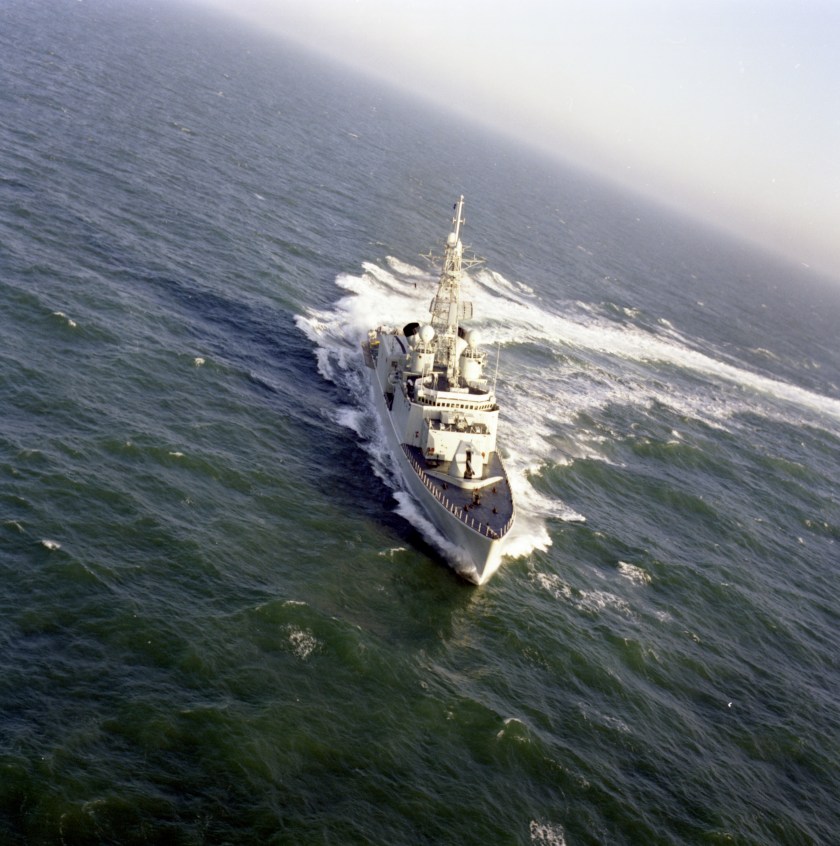
At 09:05, Commander John Pickford, RCN, aboard the Canadian Iroquois-class destroyer HMCS Athabaskan (DDG-282), received information about USS Princeton’s damage. Athabaskan was deployed to the Persian Gulf, along with HMCS Terra Nova, an older Restigouche-class destroyer, and the replenishment vessel HMCS Protecteur, as the naval component of Operation FRICTION, Canada’s military contribution to Desert Storm. Athabaskan had been operating to the south, in the central Gulf, escorting coalition vessels.
HMCS Athabaskan (DDG-282) photographed during 1983 while serving with STANAVFORLANT. Credit: Department of National Defence / Library and Archives Canada ISC-83-227
Pickford was ordered to escort the tug Smit New York to Princeton. Reportedly, Capt. Hontz had specifically requested Athabaskan’s assistance, acknowledging the usefulness of the Canadian ships’ specialized mine-avoidance sonar and the deployed air component of recently-upgraded CH-124 Sea King helicopters.7Athabaskan had just refueled from USS Platte, “the preferred oiler of the Persian Gulf” the day before, and had received a visit from the commander of the Canadian naval forces in the region, CANCOMFORME, Commodore Kenneth Summers.
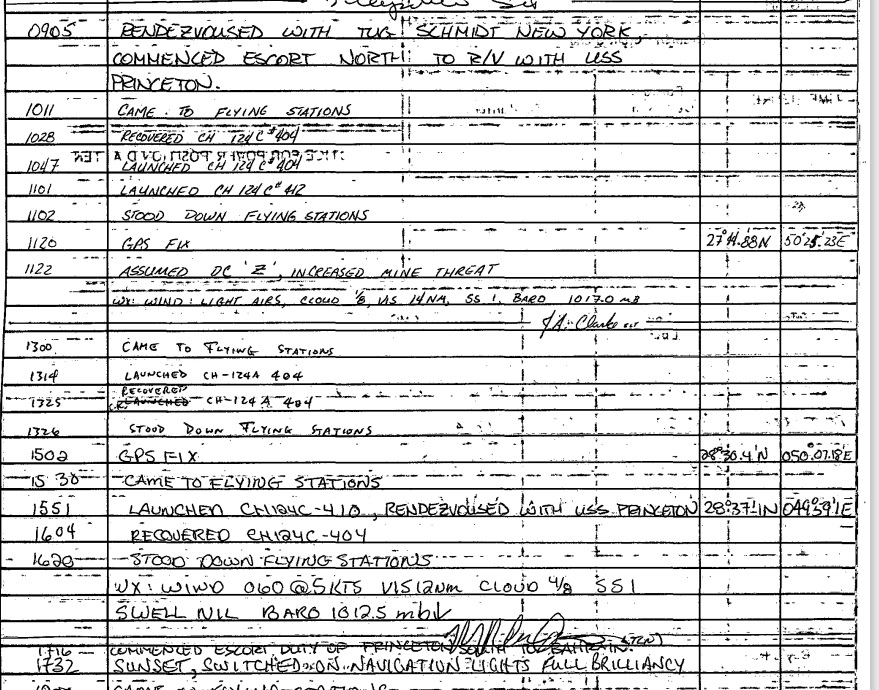
Extract of the 18 February 1991 Ship’s logbook entry of HMCS Athabaskan, deployed to Op Friction. This record was recently released through an Access to Information request to Library and Archives Canada where this can be found under RG24-D-2, Accession/BAN: 2017-00299-2, Box: 4.
Athabaskan immediately set a course north and assumed Defence Condition “Zulu,” bringing the ship and crew to full readiness while ensuring all watertight compartments were closed. Princeton’s crew were working to contain the damage, as the few serious injuries received medevac transport. The AEGIS system had not been disabled, and the ships’ 5″ guns and the missile systems were rapidly brought back online. Athabaskan rendezvoused with Princeton at 15:51 at position 28°37′ north, 49°59′ east and commenced the escort south towards Bahrain at 17:16. The Canadians handed the escort over to the elderly wooden-hulled minesweeper USS Adroit, while the tow was take up by the salvage ship USS Beaufort. While Princeton was repaired first in Bahrain and then in Dubai, Athabaskan replenished from HMCS Protecteur and then returned to escort work in the central Gulf.8
HMCS Athabaskan refuelling from HMCS Protecteur Persian Gulf 1990. This photo was likely taken from HMCS Terra Nova. LAC Credit: Canada. Department of National Defence / Library and Archives Canada / ISC 90 2080 (WO Wayne Loane)
Athabaskan’s next high-profile tasking involved escorting the hospital ships USNS Comfort and Mercy.9 As a parting gift for the exhausted crew of Princeton, a Sea King was used to “cross-deck” a pallet loaded with several cases of Labatt beer, and a bottle of Canadian Club whisky for Capt. Hontz.10
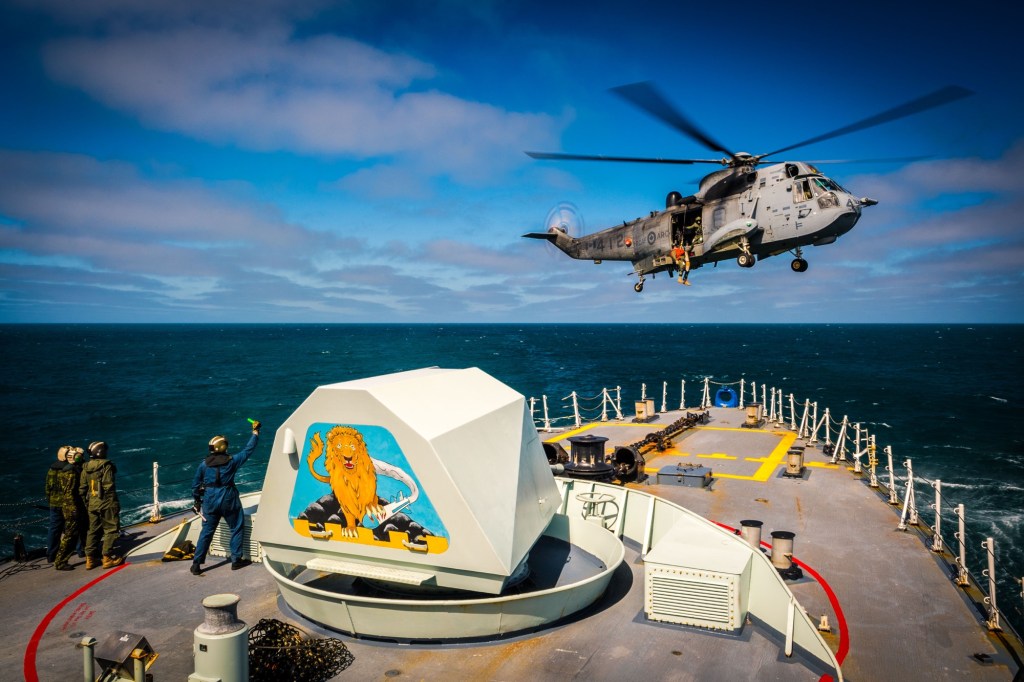
CH-124 Sea King helicopter 12404 “Black Horse,” performs Foc’sle transfer training aboard HMCS St. John’s, June 30, 2018, while deployed to Operation REASSURANCE. This same aircraft flew operations on 18 February 1991 from HMCS Athabaskan and is referenced in the ship’s log. Photo: Corporal Tony Chand, Formation Imaging Services RP17-2018-0028-15649
As a result of deployments to the Persian Gulf in 1990-1991, both Athabaskan and Princeton added new battle honours to the records of their illustrious forebears.11 HMCS Athabaskan served on until 2017, and was scrapped the next year.12 USS Princeton was set to rights and rejoined the US fleet, and continues to serve as one of the last Ticonderoga-class guided missile cruisers in commission.13 In Canada and the United States, former crewmembers of these outstanding vessels will continue to gather at reunions and online events, and, in their separate reminisces of their time in the Gulf, will think back to a remarkable episode of Operation Desert Storm.
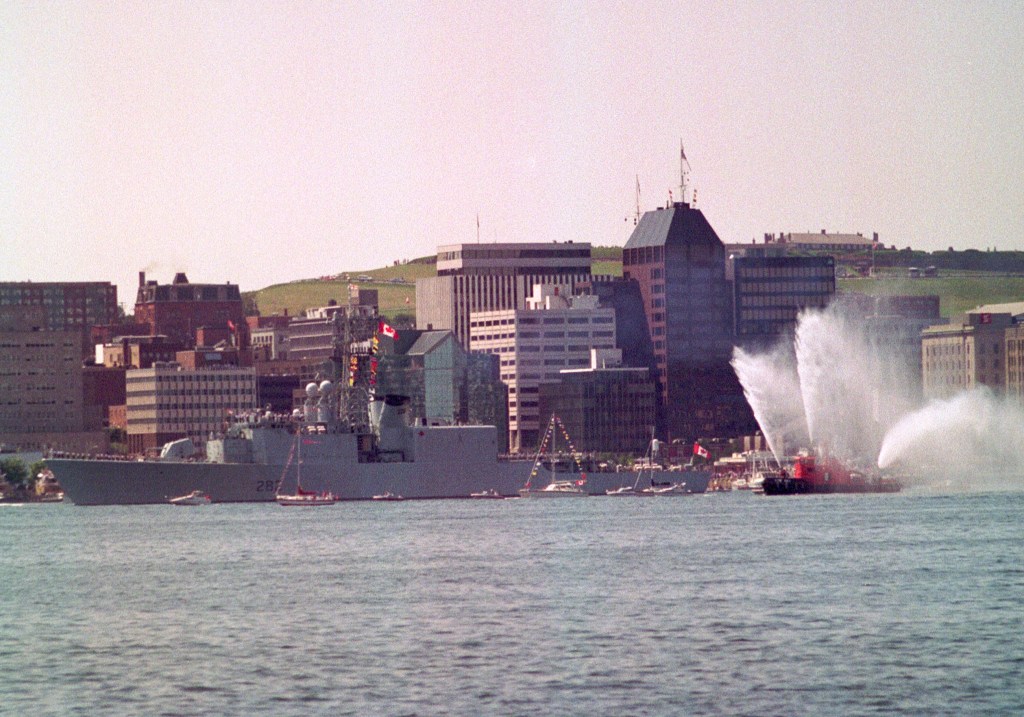
HMCS Athabaskan led the Task Force out of Halifax on 24 August 1990 with fanfare. The author and his dad witnessed this memorable scene from onboard the CGS Acadia museum ship, which is immediately behind the red fireboat in this photo. The ships returned on 17 April 1991 to an exuberant welcome! Credit: Andrew Thomas from Shrewsbury, UK, CC BY-SA 2.0 https://creativecommons.org/licenses/by-sa/2.0, via Wikimedia CommonsCLICK FOR ENDNOTES
HMS Calypso was completed as a a steam-powered corvette – a uniquely Victorian mix of old and new technologies- in 1883. After a career of transformations, her hulk rests, all these years later, in a quiet cove in Newfoundland. She remains a historic artifact of Newfoundland’s important naval traditions. Years after adding a Google Earth view to my shipsearcher database, I recently got a chance to visit the site. Join me as I explore Calypso’s interesting past and current state!
Calypso’s port bows, including two large hawse pipes. This is one of the most recognizable sections of the derelict hull (Credit: http://www.warsearcher.com). Inset image shows Calypso under sail, driving before the wind, ca. 1898. Credit: Imperial War Museum, Symonds & Co. collection (Q 21057).
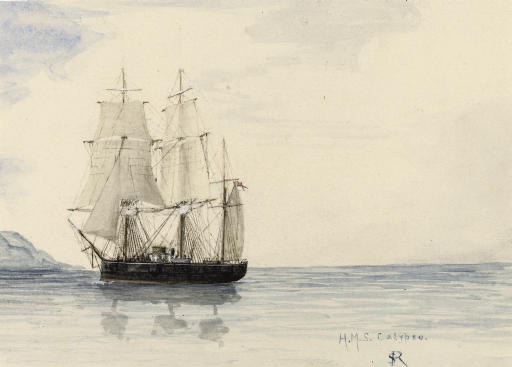
In 1883, Robert Falcon Scott, a young midshipman serving in HMS Boadicea, sat down to sketch a picturesque seascape and a lovely ship: The newly-commissioned HMS Calypso. Boadicea, an older corvette, was sold to the scrappers at the turn of the 20th Century. Scott went on to legendary fame as a polar explorer, before perishing in Antarctica after attaining the South Pole in 1912. All these decades later, Calypso remains.
Robert Falcon Scott sketch of Calypso, ca. 1883, sold at a 2007 Christie’s auction. Via wikimedia commons
Sir Nathaniel Barnaby, Director of Naval Construction, had designed this and several predecessor classes of corvettes, and sisterships Calypso and Calliope were both built at Chatham Royal Dockyards. Where earlier corvettes were built of a mix of iron frames and wood planking, the Calypso class had a steel hull, with wooden sheathing, and a copper-clad underbody. The modern steel hull was structural and complete, but the wood (mahogany planking above water) aesthetically linked the ships to the rest of the sail-and-steam navy. More wood below the waterline created a barrier between the steel and the same sheets of copper alloy that the Royal Navy had used to protect its ships from wood-boring marine life and biofouling since the mid-eighteenth Century.1
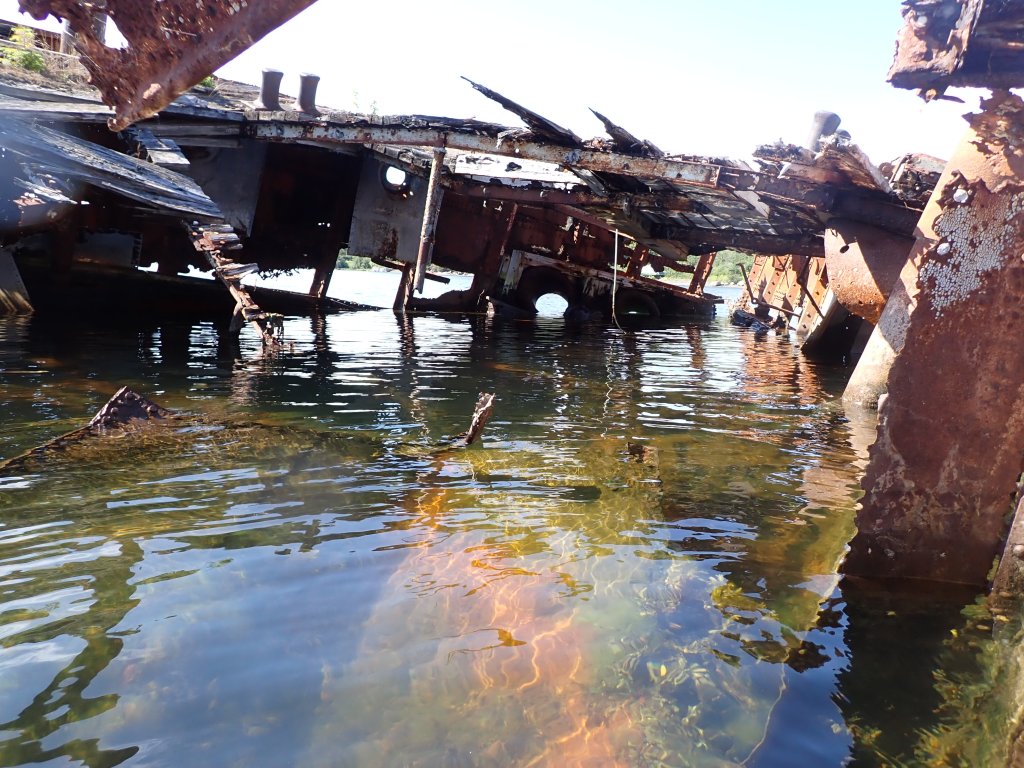
The view looking forwards towards the bows of the ship, with the inside of the distinctive hawseholes and some of the forecastle deck remaining above, including the cutout for the forward skylight, portholes, and a pair of heavy bollards. The steel hull is the reason that any of the structure of Calypso survives today, after deterioration and fire damage. Credit: http://www.warsearcher.com
The ship had vestigial features from the Victorian sailing navy: A towering three-masted sailing rig, a broadside layout of cannon, and elaborate stern galleries (which were merely decorative cladding).2 Contemporary photographs show that the Calypso had a spectacular appearance with all sails set, and, when running before the wind, studdingsails could extend the canvas outwards like wings. Improving on the Barnaby’s earlier Comus class, they were slightly longer, at 235’/71.6 m between perpendiculars, and heavier, at 2,700 tons. They were substantially more powerful, with larger engines that could propel the single screw with over 4,000 units of installed horsepower.3
HMS Calypso‘s original appearance, with a stately rig and aesthetic elements derived from the wooden-hulled sailing frigates. Allan C. Green original glass negative in State Library of Victoria, Australia, Public domain, via Wikimedia Commons
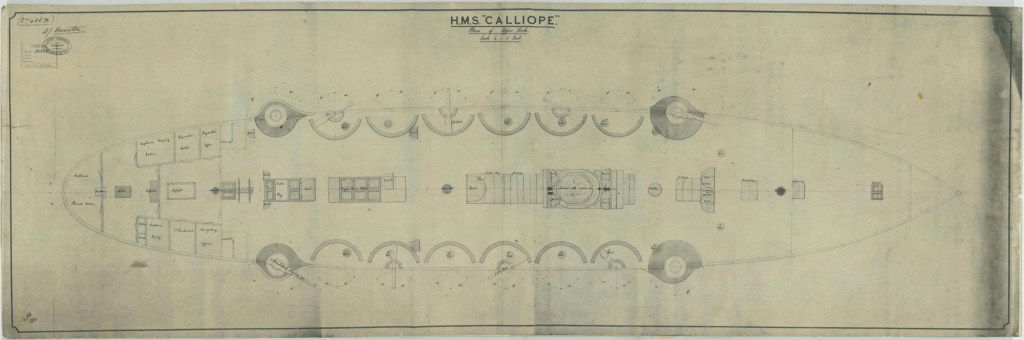
The class was armed with modern 6” breech-loading rifled guns.4 These were mounted in four sponsons (structures that mount armament which project out from the hull), with a wide field of fire. Five gunports were sited along the upper deck between the sponsons. A 5″ gun was mounted behind each port. Quicker firing light guns, Nordenfelts, were mounted high on the bulwarks, and were intended to protect from smaller, faster craft, such as torpedo boats. The two ships had a pair of 14″ diameter “carriage torpedoes.” These used compressed air to launch themselves out of cradles to start their run. Like the Comus class, the Calypsos had a partially-armoured deck of steel that protected some of the vital machinery – engines and boilers – low down in the hull just under the waterline.
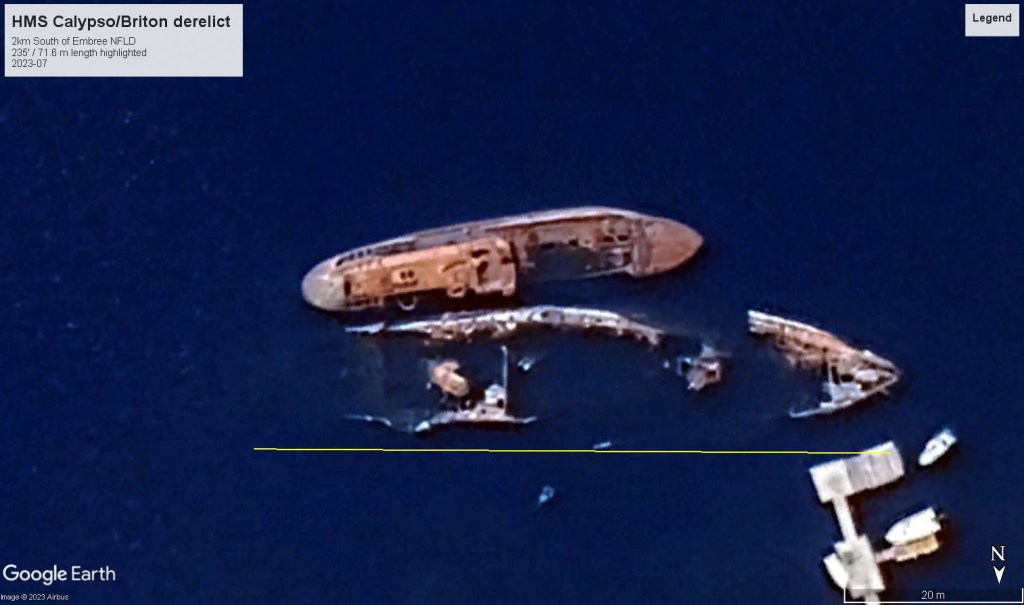
Plan of Upper Deck of HMS Calliope (1884) National Archives and Records Administration 78116457A recent Google Earth capture from July 2023 of the remains of Calypso, with a smaller trawler outboard. The google earth historical imagery shows marked deterioration since the first image, from 2006.
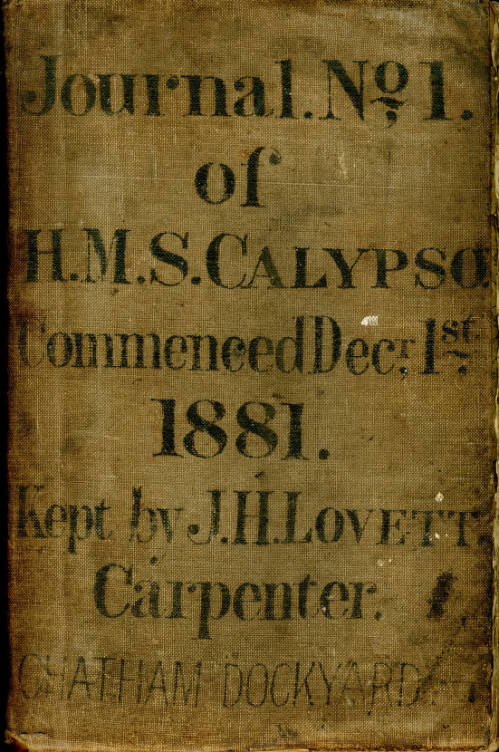
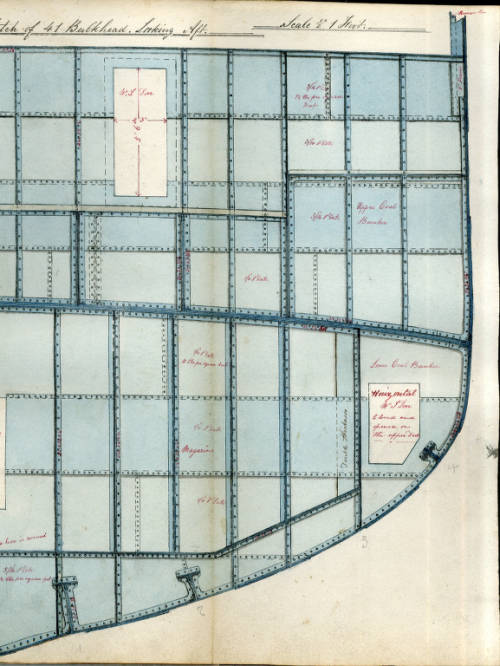
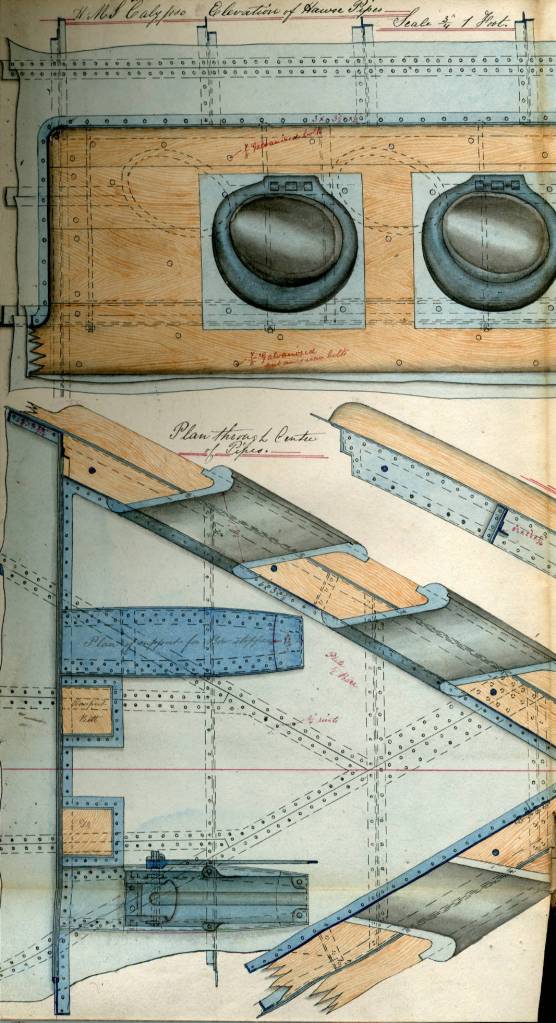
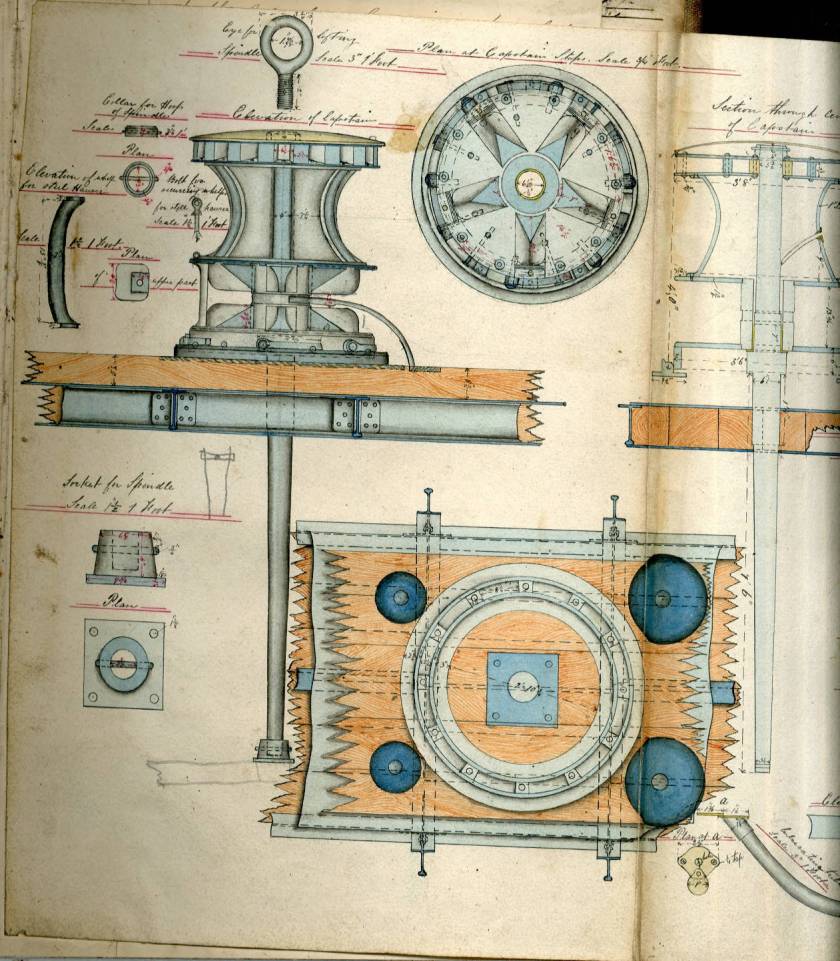
Predecessor Royal Naval classes had abandoned the graceful clipper stem for an upright bow with a massive bronze ram installed underwater. These were the last Royal Navy corvettes with a full sailing rig. Gaping deck ventilators and a wide buff-coloured funnel broke up the run of the upper deck. The ships were designed to be economical for long-distance cruising about the far-flung British Empire, and could sail and steam between widely-dispersed coaling stations. A contemporary folio of design blueprints, today in the archival collection of the Maritime History Archive, Memorial University, Newfoundland and Labrador, helps us reconstruct some of these technical design features (look out for these structures in our photos of what remains of Calypso elsewhere in this post)5:
1881 Construction Journal, Maritime History Archive, Calypso fonds, P1.
Sectional view of a steel bulkhead with watertight doors and the supports for the sloping armoured deck. Maritime History Archive, Calypso fonds P58.
Hawse Pipes at bows, showing teak bolsters. Maritime History Archive, Calypso fonds P135.
Capstan design. Maritime History Archive, Calypso fonds P144.
Unfortunately, from the day they were designed, the idea of a sailing-steaming corvette cruising the world’s oceans was on borrowed time: A new generation of cruisers, the Leander class were being designed, and the Admiralty quickly halted plans to build more corvettes.6 The Leanders were larger, heavier, more powerful, and had more armour and more bunker capacity to steam to distant ports, or police merchant sea lanes. They improved upon the Iris class despatch vessels, and had a similarly cut-down barquentine rig.
Calypso’s Sistership HMS Calliope -completed in 1884- had an eventful career in the Far East, gaining fame for being the sole surviving warship from a terrible cyclone off Samoa in 1889. Calliope became a drill ship on the Tyne in 1907, and survived until dismantlement in 1951. Her name is perpetuated by the current shore establishment at Gateshead.
HMS Calliope at Blyth, ca. 1920 . This shows the trim appearance of the class, which is hulked with a built-up quarterdeck housing and rigging mostly unshipped, but still has the sponsons and funnel fitted. Credit: From an uncredited postcard collection, Public domain, via Wikimedia Commons
Calypso had a brief period of active service, cruising to distant ports as a member of the Sail Training Squadron. In 1895, Walter Hose, who would go on to serve as Director of the (Canadian) Naval Service during the Interwar era, was posted to Calypso. She was laid up at the end of the Nineteenth Century. In 1902, she was taken out of reserve and sent to Newfoundland to help train naval reservists in St. John’s for the newly-created Newfoundland Royal Naval Reserve. Newfoundland was the first colony where a naval reserve was formally established, and the Dominion was seen as a potential goldmine of seafaring experience, with many residents connected into seafaring traditions in the ports and outports of “the Rock.”7Calyspo’s sailing and steaming days were over; the vessel was quickly converted to a depot ship, with deck houses built over the weather deck, funnels and machinery taken ashore, and most of the masts taken down.
Across the North Atlantic from Calliope, at St. John’s, Newfoundland, here is a similar view of Calypso around 1915. The false gallery windows have been emphasized in white, which also are cut-through with two heavy stern hawse pipes. The standing lower mizzen mast, the only vestige of the original rig, would remain a feature of the ship until at least 1960. Credit: Maritime History Archive, Malcolm Griffin Sealing Album collection PF-345.004
During the First World War, the Calypso establishment trained many young Newfoundlanders for service with the Royal Navy. Almost 2,000 members served in everything from the massive battlewagons of the Grand Fleet, to armed trawlers, and 192 died.8 Alongside the Royal Newfoundland Regiment, the Forestry Corps, and merchant mariners, they represented the Dominion’s outsized-contribution to the Allied cause.
Reservists alongside the forward starboard side of Calypso, St. John’s, ca. 1916-1922. The ship still has armament in the sponsons, a Hotchkiss gun mounted near the gangway, and a heavy anchor suspended from the forward davit. Credit: The Rooms, Collection MG 110, Item A 142-30; B 3-29; NA 1529
The starboard bows, showing the remains of forecastle decking, skylights, paired bollards and a heavy fish davit for the anchors. Credit: http://www.warsearcher.com
Calypso was renamed HMS Briton in 1916, to leave the name available for the new “C” Class cruiser. Eventually, Briton was sold off in 1922 to become a salt hulk in St. John’s. Moved to Lewisporte in 1952, most of the interior was stripped of valuable items. Some local residents hoped to save the moldering vessel for preservation. Instead, during 1968 the hulk was towed slightly north to near Embree, and set on fire.9
Calypso/Briton hulk with both port sponsons removed, decks built-over, and the lower mizzenmast still stepped. The photo was taken at St. John’s before the tow to Lewisporte. The Crowsnest Vol.12 No.4 Feb. 1960 P.15, Department of National Defence CN-3077.
The derelict has slowly deteriorated there ever since.10 Today, she functions as a sort of jetty or breakwater, alongside an old fishing trawler. There is remarkable drone and video footage of the site from 2022 at “Discovering Newfoundland.”11 Take a look at the footage below to see the submerged portions:
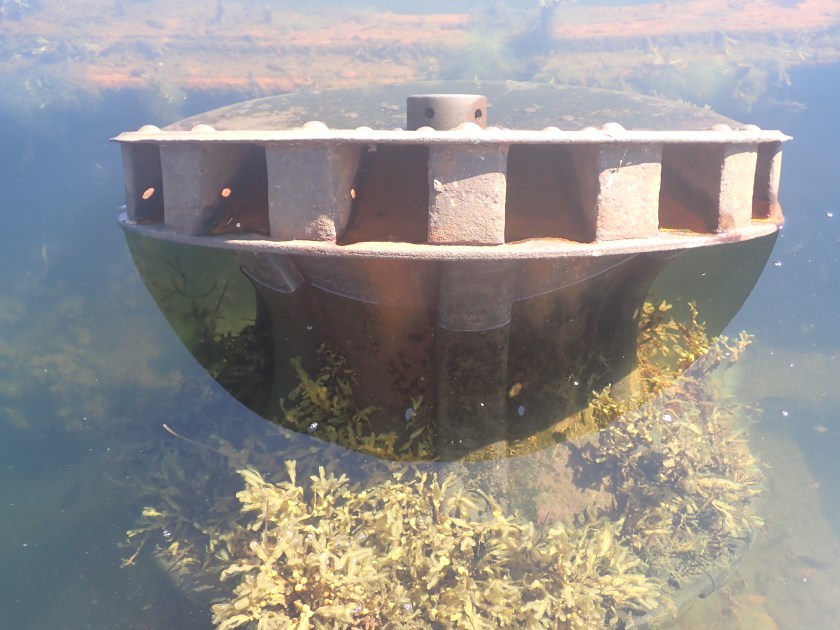
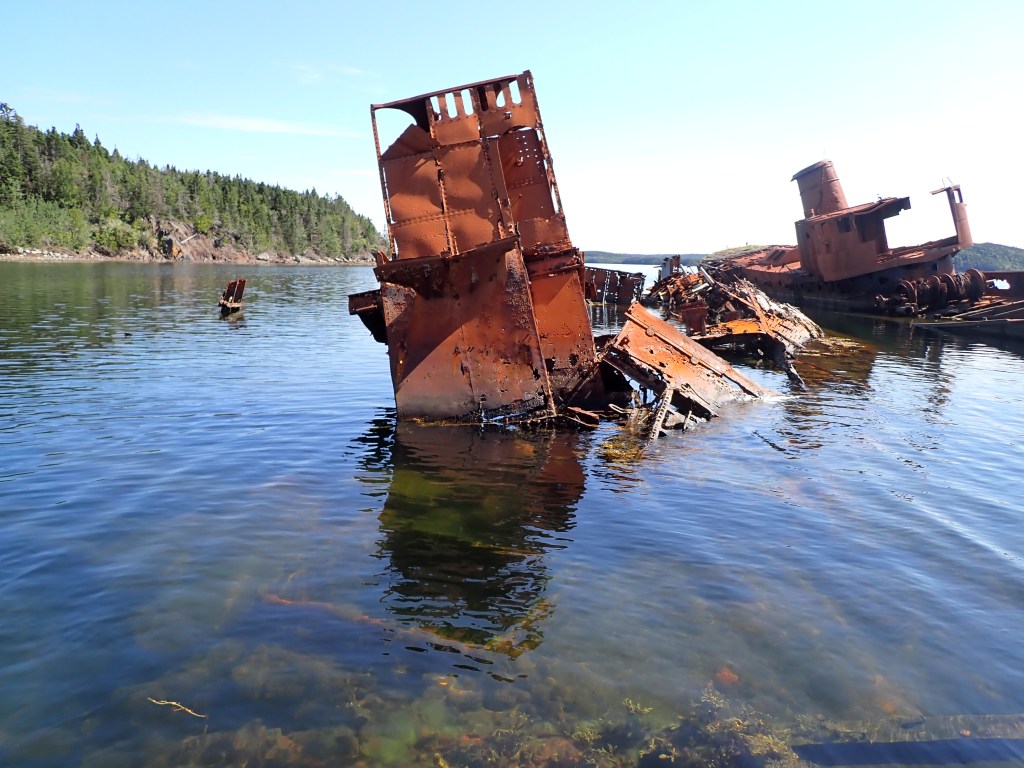
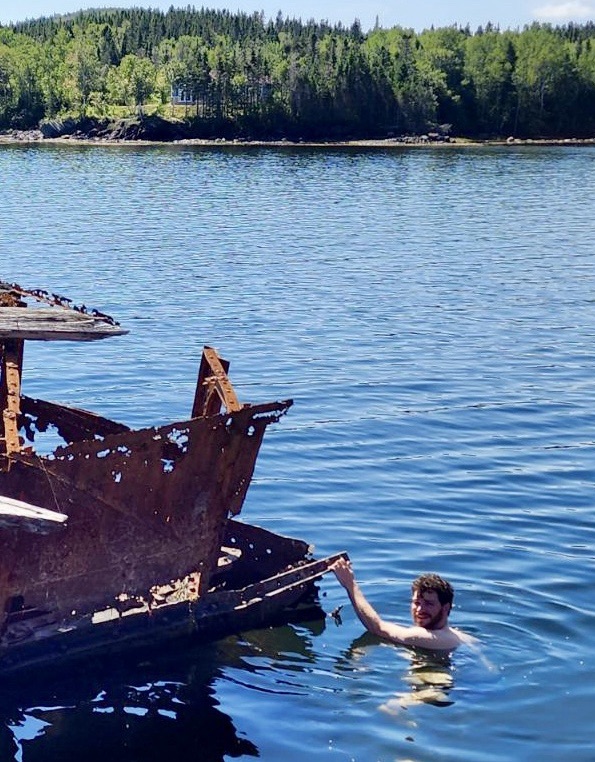
On a recent trip to Newfoundland, I had a chance to visit Embree and swim around the remains. The hull has settled at a slight list to starboard. The bows are most recognizable, along with the some of the ship’s deck structures, which rise out of the muck. These tall boxy features originally housed a set of ventilators, connected by a louvered structure. As the above drone footage shows, the submerged stern section is recognizable, and, incredibly, Calypso still had the remains of the lower mizzen mast jutting upwards above the site in 2022!12 The capstan, about a third of the way aft from the bows, is one of the remaining distinctive naval artifacts.
Much of the starboard side, adjacent to a small pier, is collapsed and displaced outwards onto the bottom. A small portion rises where the wheel would have been, where a bulkhead still shows a doorway.
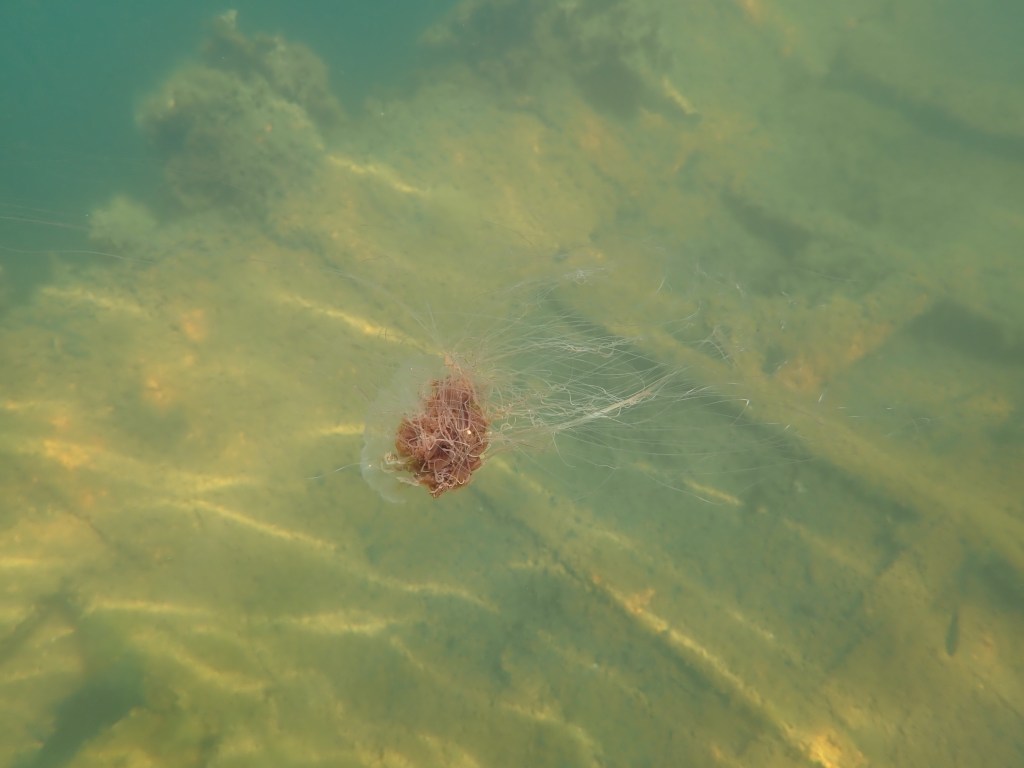
The now submerged starboard side, with a visiting jelly fish. Much of that side appears to have collapsed outwards onto the cove seabed. Credit: http://www.warsearcher.com
Immediately forwards of that is the housing for a large central ventilator with another distinctive louvered top. The port side elevation is more intact. In addition to this massive semi-submerged hulk, there are many artifacts which are preserved from Calypso.
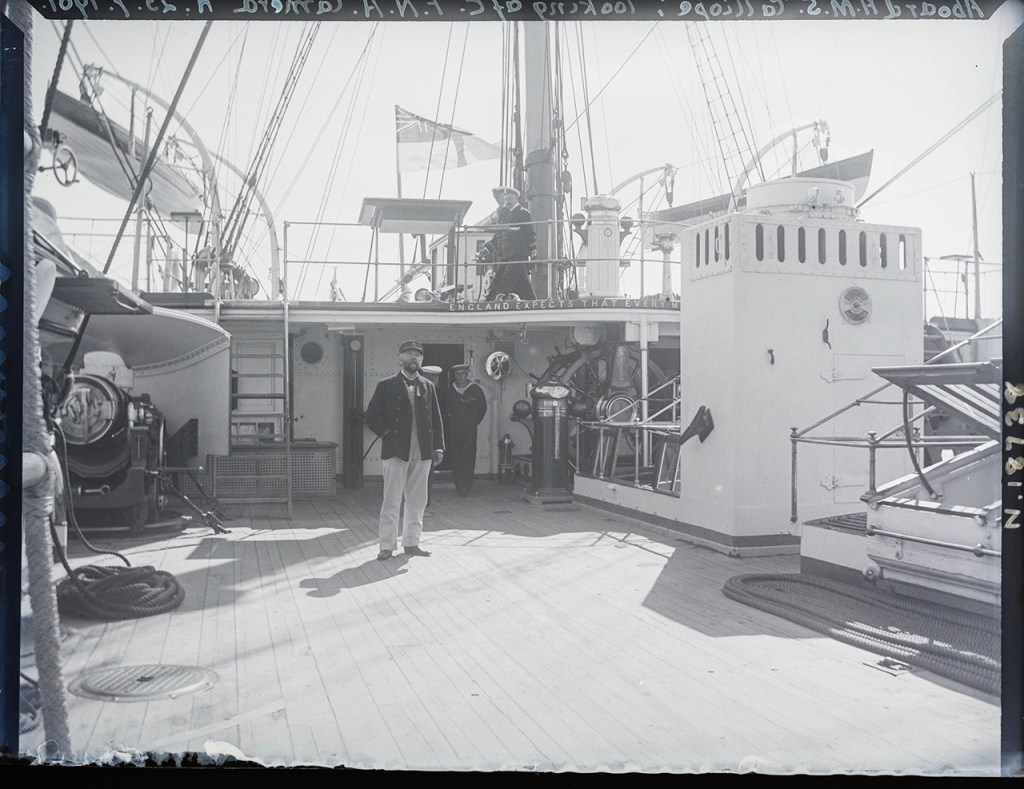
On deck of HMS Calliope in July, 1901, at anchor in the Downs, looking after towards the poop with the ships double wheel. A 6” gun is at left, while at right there is a distinctive deck structure, near the ladders to the lower deck, that trunked up a single large ventilator. N18738 Credit: National Maritime Museum, Greenwich, London, Adams CollectionWe are roughly at the level of the upper deck, looking aft from the original break of the forecastle deck. A similar structure near the forward ladderway is one of the remaining highpoints of Calypso. It originally brought a matched set of ventilators above deck level (note two circular cutouts in the original roof). Credit: http://www.warsearcher.com
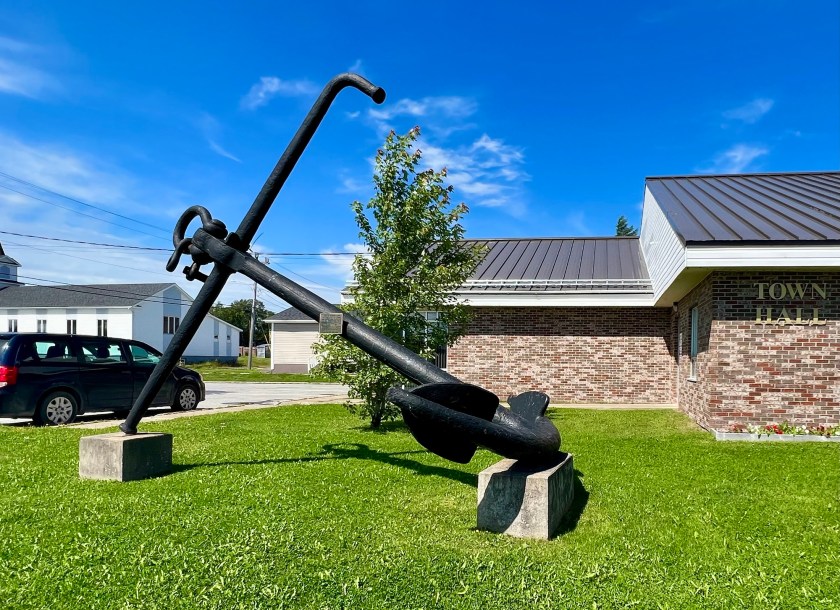
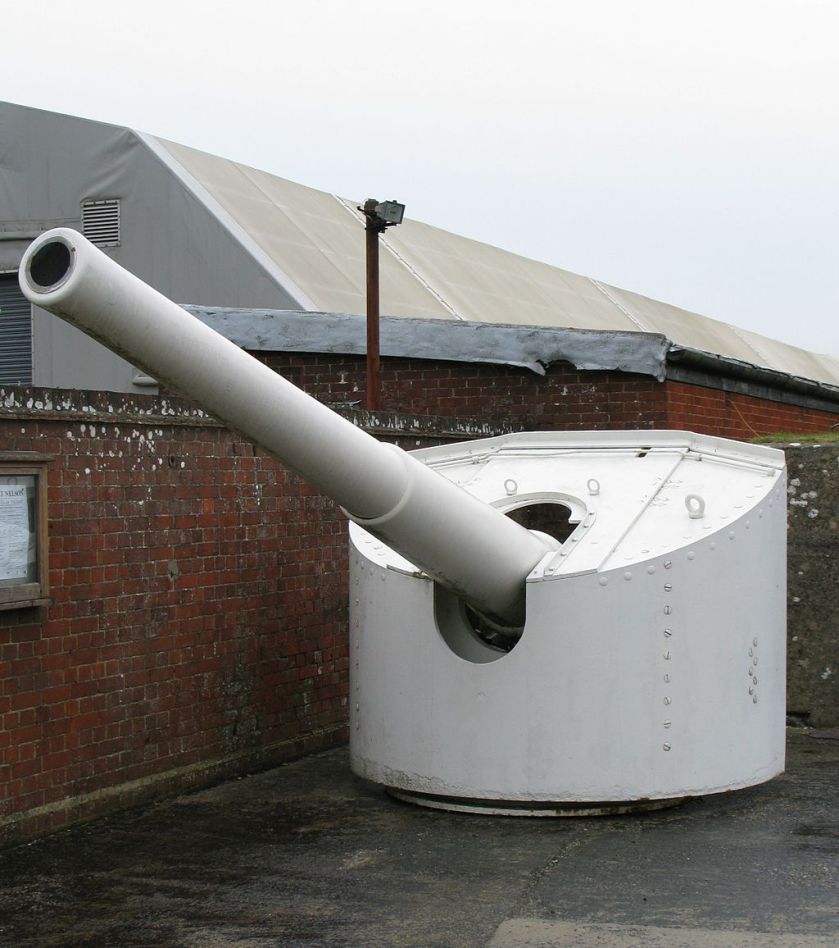
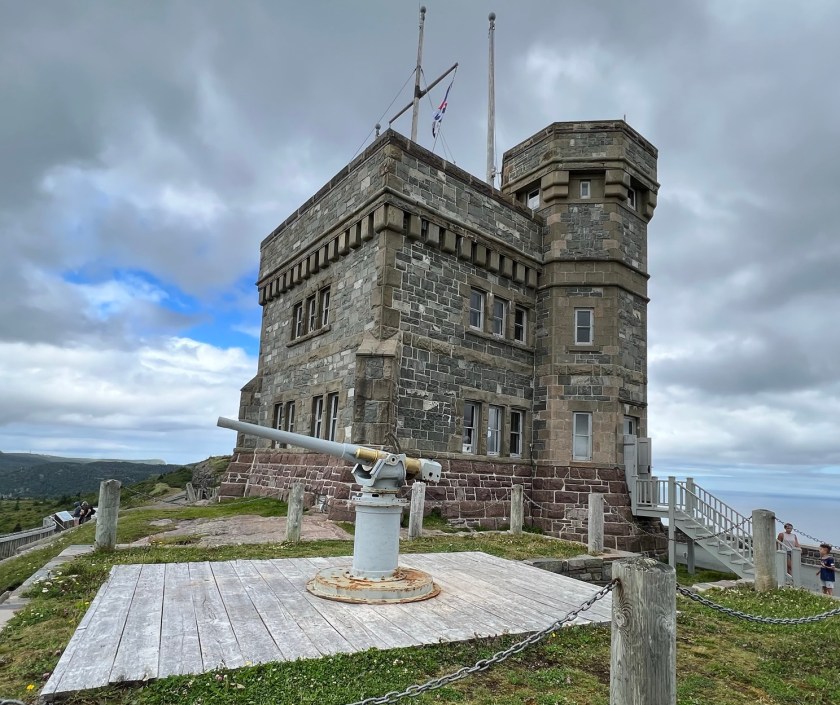
One of the ship’s large stockless anchors is now on display at Embree, while one of the 6” guns that originally was housed in one of the four sponsons is on display back in Portsmouth, UK. Two 3 pdr. Hotchkiss guns said to be from Calypso are also found at the shore establishment in St. John’s, HMCS Cabot, and near Cabot Tower at Signal Hill.13 This last still serves as a Noon Day Gun during the Summer!
HMS Calypso large anchor, on display in front of the Embree Town Hall. Credit:www.warsearcher.com
The picturesque siting of one of Calypso’s 3pdr. Hotchkiss guns at Cabot Tower, Signal Hill NL (Aug. 2023). Credit: http://www.warsearcher.com
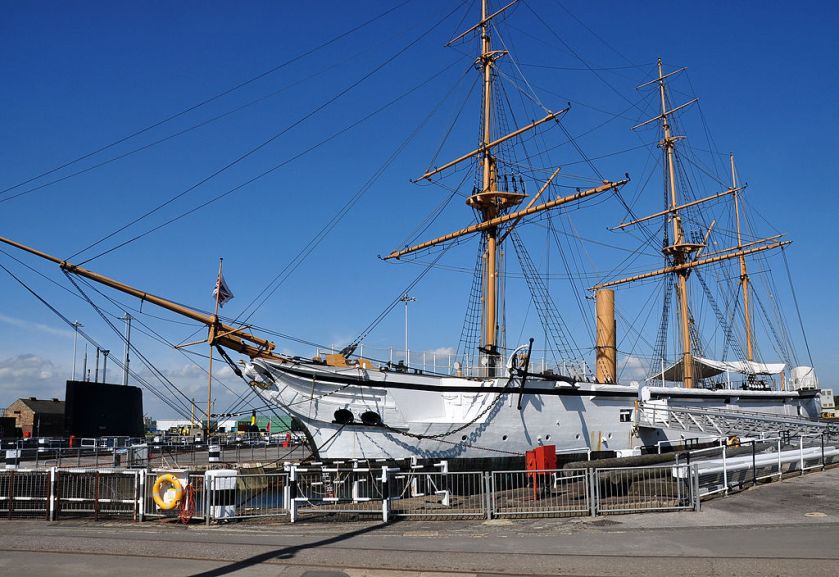
Back where it all began, at Chatham dockyards, we are fortunate to have a preserved example of a smaller Barnaby design: A Doterel class sloop. HMS Gannet was about half the size of Calypso, and commissioned five years earlier. Like Scott’s old ship Boadicea, Her hull is composite – wood with iron frames – and she has a more traditional clipper bows.14 However, many of the interior spaces share much in common with Calypso, and this preserved museum ship has a sponson aft and quick-firing Nordenfelts installed!
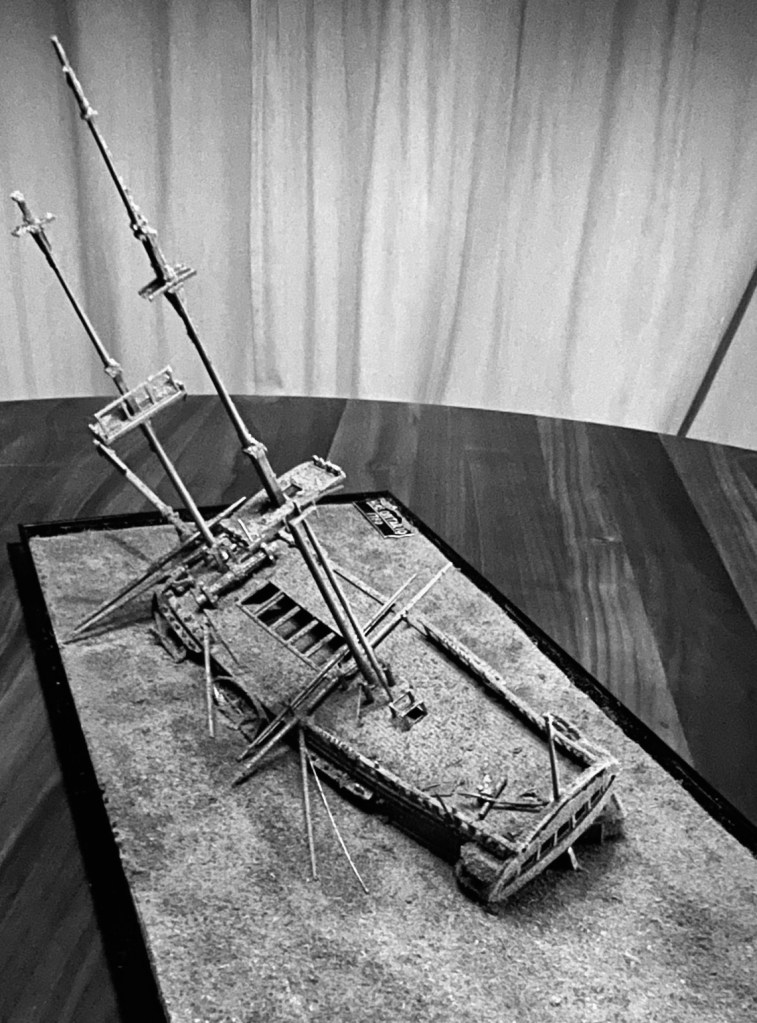
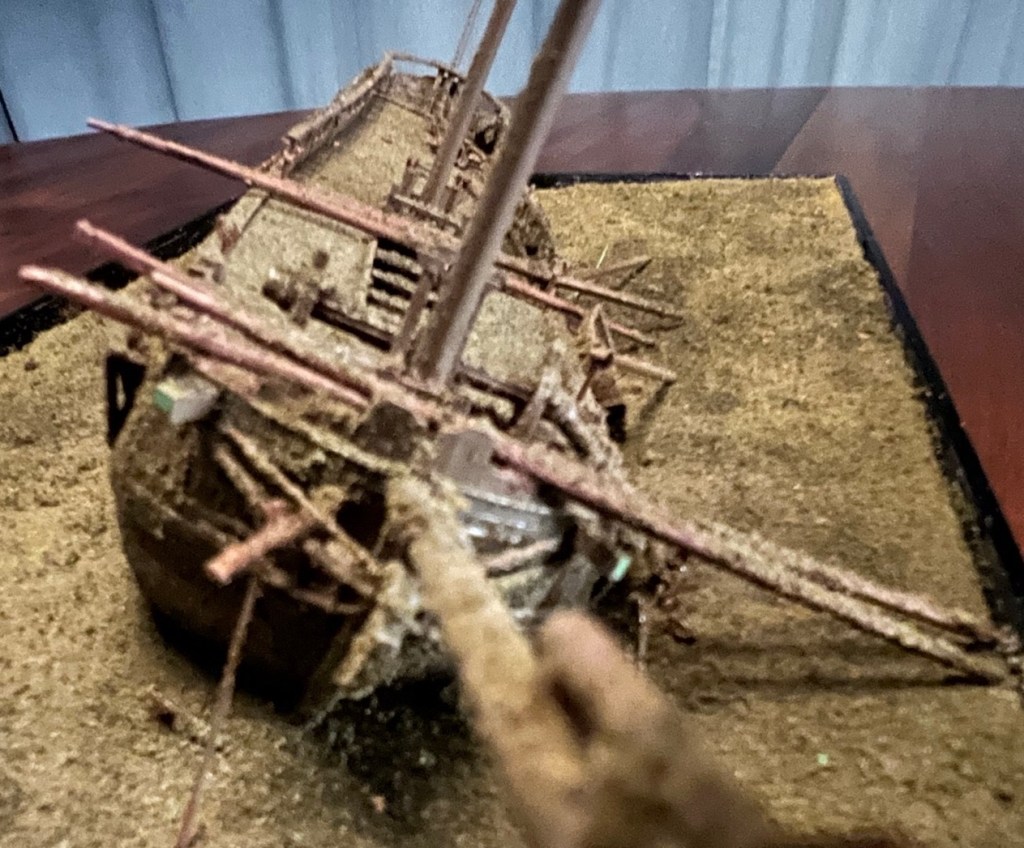
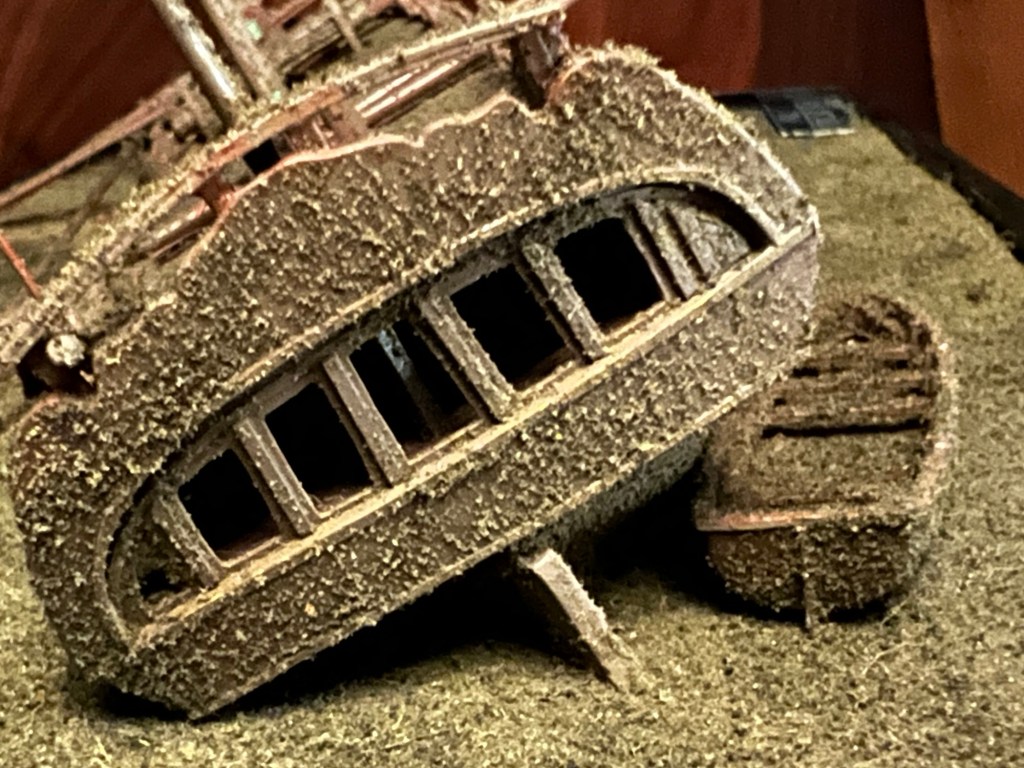
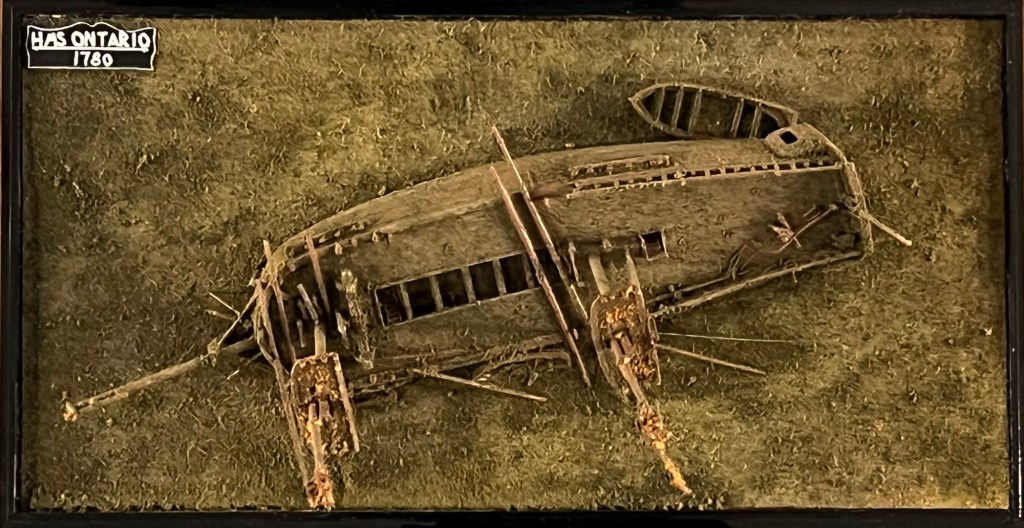
There is an incredible ship, frozen in time down in the depths of Lake Ontario. HMS Ontario was a wooden warship that sank in a storm October 31st, 1780. This tragedy claimed the lives of as many as 129 sailors, soldiers, Indigenous warriors, American prisoners, women and children. All these decades later she is still down there, astonishingly intact. This ghostly Revolutionary War relic appears almost as if she is sailing west across the lakebed. After months of work, we have completed a model diorama to help interpret the history of this archaeological marvel.1
Early in 1779, with the American Revolutionary War raging along the Lower Great Lakes watershed, Master Shipwright Jonathan Coleman designed a British warship for service on Lake Ontario. He drafted out a scaled-down version of his Royal George, already active on Lake Champlain.
British vessels active on nearby Lake Champlain early in the Revolutionary War. These types are similar to those on Lake Ontario. The ship-rigged Inflexible (near left) was a similar size to Ontario, but had been taken apart at Quebec City and rebuilt. Lake Champlain was a more contested body of water, and many of these ships would fight an American flotilla at the Battle of Valcour Island, in 1776. Charles Randle Credit: Library and Archives Canada, Acc. No. 1996-82-1
This new vessel, to be named Ontario, had a pleasing sheer, a full underbody, and elegant decoration at the stern.2 The bows were adorned with a simple scroll. This impressive inland warship was built at Carleton Island (the dockyard facilities of the British on Lake Ontario near present-day Kingston). She was launched 10 May 1780, and when completed that summer, her twenty-two cannon made her the most powerful warship operating on the Lake.
The gundeck was 80’/24.4m long, the ship displaced about 220 tons and the two masts were set up as a snow (similar to a brig-rig but with a small pole mast running from deck up to the level of the maintop, which normally carried a loose-footed gaff sail). She was a beamy 25’/7.6m wide, and had a capacious hold, appropriate to her main role of military transport. Her armament consisted of sixteen six-pounder cannon, mostly disposed on the gundeck, and lighter pieces on the quarterdeck and focs’l. Her hull was somewhat shallower than an ocean-going vessel of this length.
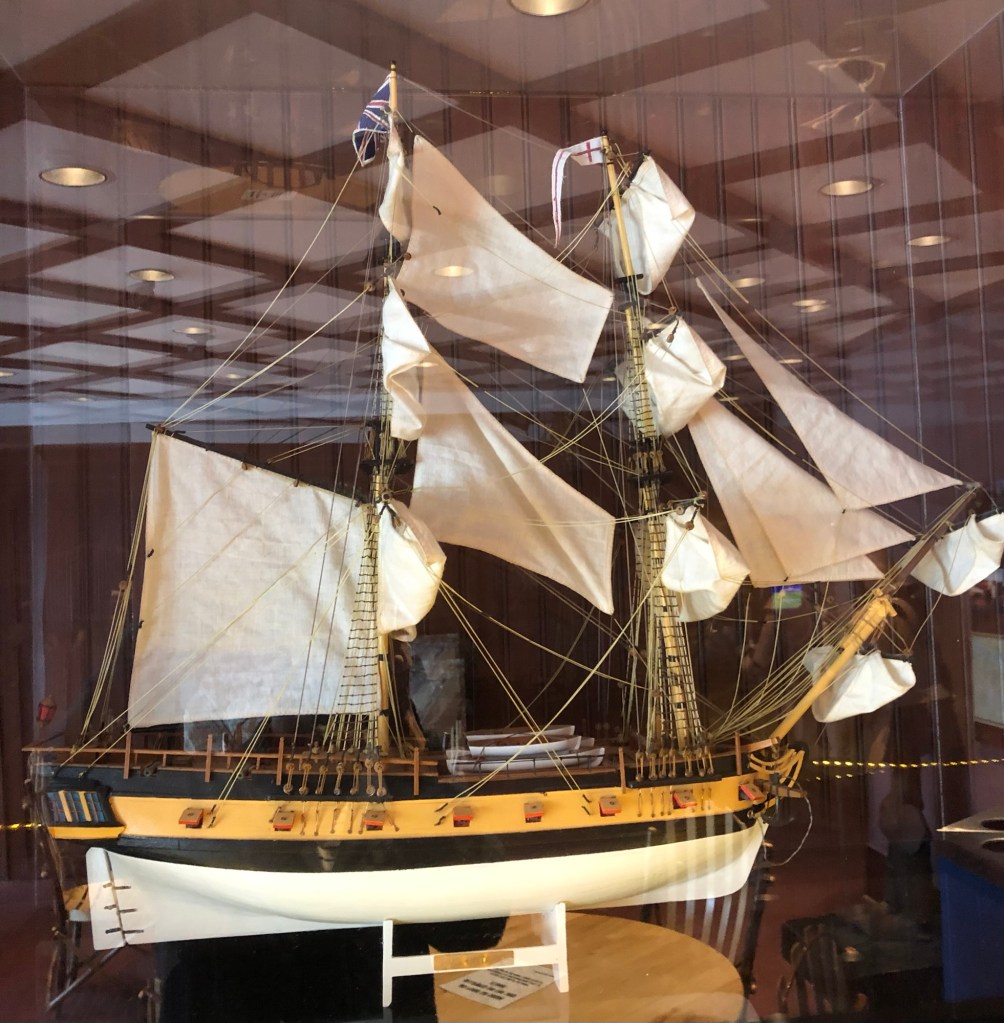
A model of Ontario on display at the Aquatarium, Brockville ON (modeller unknown). From details, the model appears to have been completed before the discovery. The bowsprit has been forced up in the case. Credit:www.warsearcher.com
The careers of warships on the Great Lakes during the 18th and early 19th centuries were generally brief, as hulls were often hastily-constructed of green wood and wore-out quickly over the harsh winters. Even so, Ontario had a woefully short existence: a few months of ferrying troops and supplies. Under the command of Captain James Andrews, she supported the continuing “Burning of the Valleys” campaigns, helping to supply John Butler and Mohawk leader Thayendanegea (Joseph Brant)’s forces and other Indigenous allies fighting as part of the Haudenosaunee / Iroquois confederacy. On 26 October 1780, she departed Niagara bound for either Oswego or Carleton Island. Lt. Colonel Mason Bolton, Commanding Officer of the 8th King’s Regiment at Fort Niagara, was taking passage to England to convalesce. The crowded ship was sailing along the southern shore of the Lake.
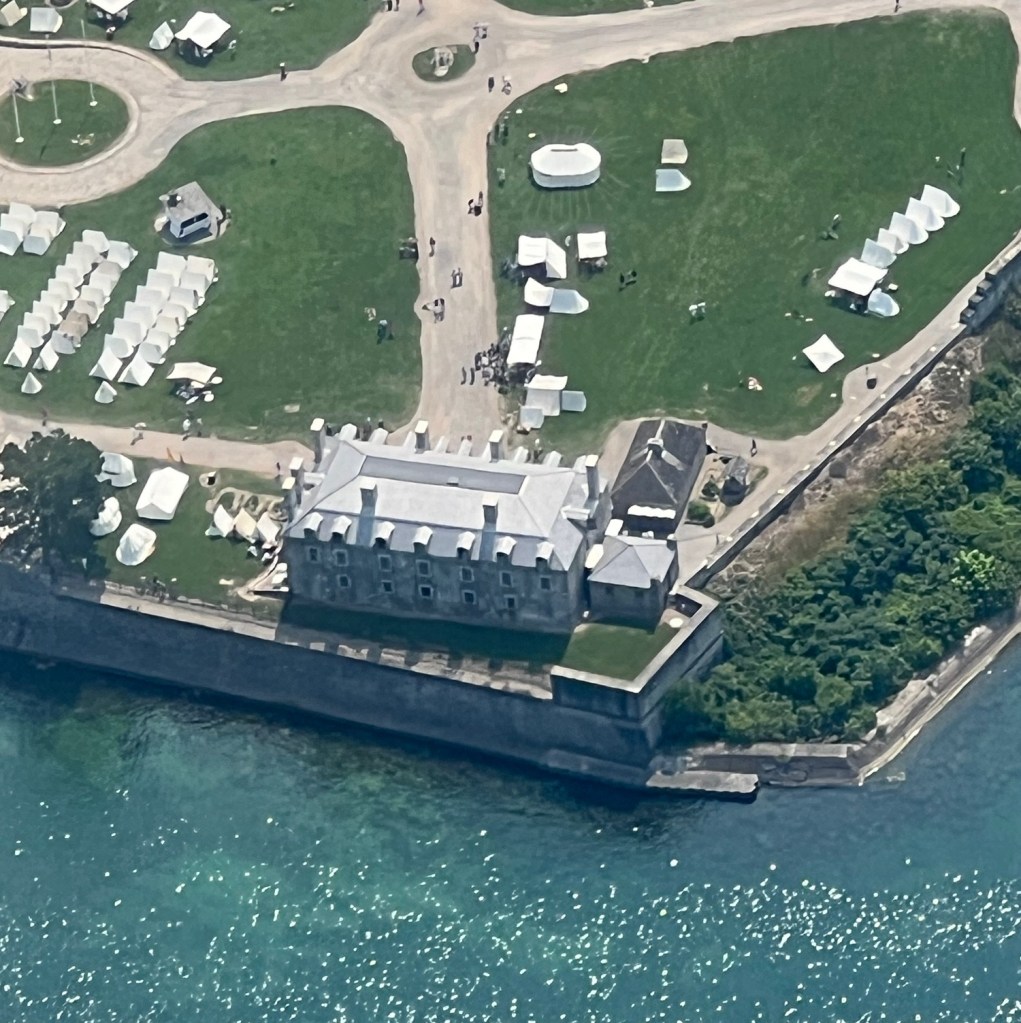
Fort Niagara, now located in New York. This is the original French fort HMS Ontariodeparted from. Taken from a PBY Canso aircraft belonging to the Canadian Warplane Heritage Museum 2024/07/27. Credit: http://www.warsearcher.com
A violent storm swept from northeast to southwest across the Lake on 31 October. The crew were likely caught by surprise late at night, as a sudden squall overcame the ship in the darkness and laid her over on to her beam ends. Andrews, Bolton, and more than a hundred other unfortunates disappeared into the Lake.3 The next day, debris was found near Golden Hill by a party of Butler’s Rangers and others who were returning to Niagara from Oswego. Boats, hatch coamings, sails, hats (including Andrews’ own tricorn), the binnacle cabinet, and some sections of quarter lights (windows) had washed up. Much later, in July 1781, a macabre reminder of the loss surfaced–six bodies floated ashore. These victims had been trapped at some intermediate depth until the lake waters released them. No other discoveries would provide context to the loss. The War and life in the (warring) colonies moved on. Ontario’s place in the squadron was taken by a new sistership, Limnade, and the story faded from memory.
Historians of the frontier campaigns of 1780, maritime scholars, and history buffs did not forget about Ontario. Of the many ships that have come to grief in the Lake, her story remained unique. When new technologies were developed that allowed amateur shipwreck hunters to search in deeper areas (which had been the preserve of well-funded professional expeditions employing incredibly expensive specialist equipment), enthusiastic searchers set out on the Lake to find the resting place. There were several claims over the years announcing that Ontario had been located, and many other lost ships were discovered.
Jim Kennard, of Fairport, NY, had an interest in Ontario that stretched back to the 1970s. After retirement, he returned to searching and built his own sonar outfit. He partnered up with Dan Scoville, a recreational diver from Rochester who had experience building ROVs (Remote Operated Vehicles). On 24 May 2008 – after three years of dedicated searching – a promising target appeared on side-scan sonar images onboard their search boat. In common with almost every discovery story we have ever heard, they were packing up and turning for home when the target appeared! The find was confirmed two weeks later by footage from Dan’s ROV. The rich documentary record revealed a shocking sight 500’/152m down: During the twenty-two decades the ship had awaited discovery, she had barely decayed!4
Ontario’s decorative stern gallery, with the large ship’s launch sitting on the lake tucked against the starboard quarter. The rudder post is visible in the central stern light, climbing to the hard-over tiller on deck. There is a single stern-chaser cannon still poking through the carvings over the damaged port quarter-gallery.
The ship is deeply embedded in lake sediment, with a pronounced list to port. The two masts still tower over the site. The mainmast is fully intact to its topgallant mast cap. It is unusual for a wooden wreck to be leaning so steeply to one side, and may speak to a fatal shifting of ballast or guns under the onslaught of the storm. The bowsprit and decorative scroll points west, back towards Fort Niagara.
A large ship’s boat rests just off the starboard quarter above the sediment. The loss of lights from quarter and stern galleries opens up tantalizing views of the interior of the great cabin. On deck the tiller bar leans over hard, continuing the angle of the rudder tucked under the counter. It is as if the ship went down while the crew tried desperately to steer the vessel to starboard. Two cannon carriages appear to be wedged underneath it. There is very little visible damage, and few missing elements. On the whole, it is difficult to credit that an 18th Century ship could have survived into the 21st Century in this condition. The Ontario site endures as a lovely wreck of a beautiful ship. We hope the diorama helps interpret this site, and that the Ontario resting place is protected from harm.
Using Google Earth imagery to document warships, the one problem is, you can never go back. Before about the year 2000, there are very few captures. This means the warship types documented in our pages overwhelming represent ship classes in service from the late 1970s (leaving service in the early 2000s) up to today.
HMCS Mackenzie Sep. 1962 (cropped), a fine example of the St. Laurent class and their derivatives, up to twenty units which served from the mid-1950s to the 1990s, with none preserved. Credit: Department of National Defence CN-6516/ Library and Archives Canada
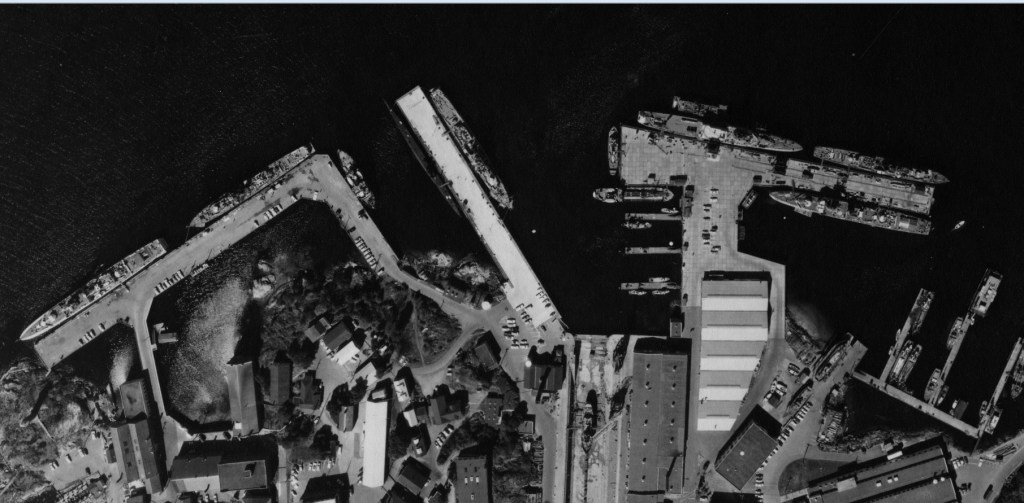
Wouldn’t it be nice if older aerial imagery of naval ports could be incorporated into our database? Well, for our home fleet, the Royal Canadian Navy (RCN), we were able to do just that. In the Fall of 2022, as the World blundered out of Pandemic closures, the Shipsearcher Identification Section (SIS) deployed to the offices of the National Air Photo Library, at Natural Resources Canada. We have been updating our list with these unique views. We look forward to continuing the research.
Where the aerial mapping magic happens: Ottawa’s Booth St. National Air Photo Library, a federalist pile roughly contemporary with the early Cold War fleet.
Wading through photo reconnaissance flight lines and a challenging database, we called up aerials from Esquimalt, BC, and Halifax, NS, from the 1960s and early 1970s. What we found was a target-rich environment of Cold War fleet units on Atlantic and Pacific coasts.
The RCN Pacific Command fleet at Esquimalt BC on a sunny 12 April 1965. This view was captured by an aircraft of 408 RCAF Squadron at roughly 2,500 feet. Here we see three modern destroyer escorts, three Prestonian class escorts, HMCS Grilse (submarine) and a variety of auxiliaries. Credit: National Air Photo Library VRR2634 photo 1047 NRCAN. Crown Copyright.
The RCN of the early postwar era continued to be oriented to Anti-Submarine Warfare (ASW). The aerial mapping flights caught views of St. Laurent class and follow-on Destroyer Escorts, including some of the newer upgrades with helicopter flight decks or ASROC anti-submarine mortars replacing a Limbo ASW launcher.
A 1966 view of one of the RCN’s sleek 1950s designed Destroyer Escorts, at Esquimalt, showing both Limbo Anti-submarine mortars in uncovered wells aft, a 3″/50 caliber turret forward, and a 3″/70 caliber turret in the bows.
Older Prestonian-class ocean escorts, based on wartime River class frigate hulls, were economical conversions. To complement these surface combatants, we also have a view of both former USN submarines HMCS Grilse, a Balao class diesel-electric attack boat and veteran of World War 2 that had served six war patrols in the Pacific War, and HMCS Rainbow, a similar Tench class. Before the acquisition of new Oberon class boats, these two old boats –Rainbow succeeding Grilse– kept the submarine service afloat. Other long-gone RCN units we added range from Cape Class fleet maintenance ships (having posted about the last of these), HMCS Provider replenishment ship, HMCS Labrador icebreaker, and the list goes on down to the little Bird Class patrol boats.
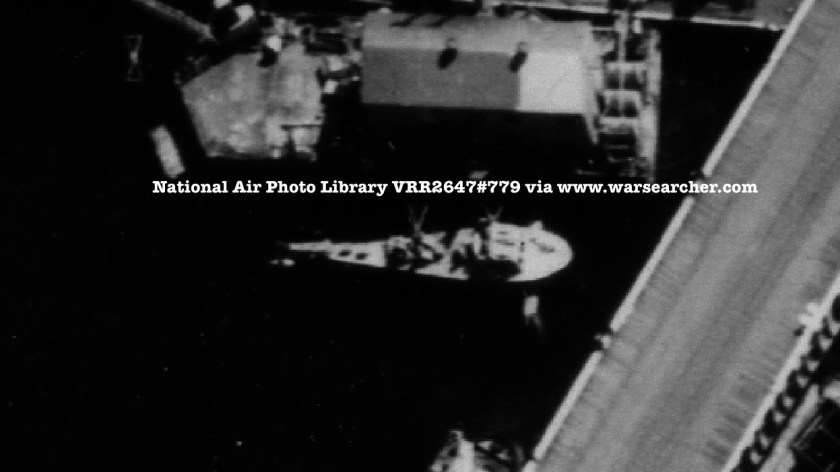
A remarkable view of Baddeck R-103 experimental hydrofoil at the Government Wharf, Dartmouth June 1964. National Air Photo Library NRCAN VRR2647 photo 779 Crown Copyright.
We encourage you to visit the pages to see these views of a vanished era in Canadian naval history. It all adds up to a more robust documentation of the post-Second World War Canadian Navy: 18 new views that help add 10 new classes of RCN ships. We hope to continue to expand our listings to include new sources of aerial or satellite imagery.
This little fellow may help bridge the gap in capability until we can procure our fleet of aerial maritime reconnaissance drones. [Edited] Bundesarchiv_Bild_183-R01996,_Brieftaube_mit_Fotokamera.jpg: o.Ang.derivative work: Hans Adler, CC BY-SA 3.0 DE , via Wikimedia Commons
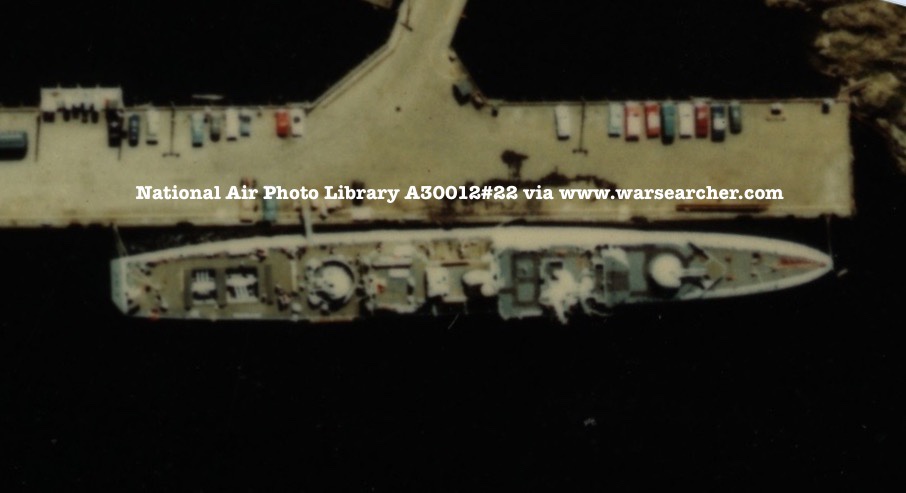
20 years after her sinking, we feature unique views of HMCS Cape Breton, the Royal Canadian Navy’s Cape class maintenance ship, and the second last of the whole group of 320 wartime Park/Fort class merchant ships built in Canada.
For a history of Park/Fort ships, which are Canadian-built ships designed along the similar lines as the famous US Liberty ships, please see part 1, which profiled the last of these wartime ships in existence, HMS Rame Head, scrapped in 2009. The Shipsearcher staff historian was excited to tell the story of HMS Rame Head, but he was thrilled when Shipsearcher Identification Section (SIS) staff stumbled across views of the 2nd last ship, the former HMCS Cape Breton (ARE-100), before it was sunk as an artificial reef.
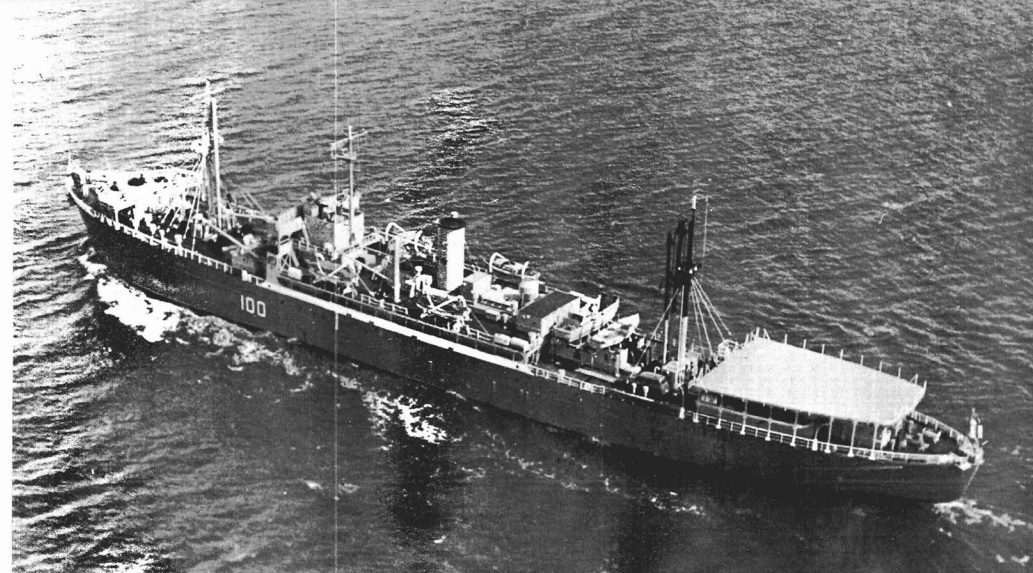
HMCS Cape Breton ARE-100 DND CN-6406 image taken from Crowsnest 14/3 Jan.1962 inside cover.
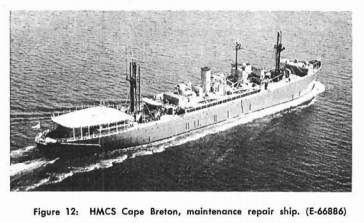
HMCS Cape Breton was a sister-ship to HMS Rame Head, and 19 other similar Depot, Repair and Maintenance ships built for the Royal Navy. This batch of ships were a variation on the basic Fort or Park merchant ship design, that had been built in many yards in Canada as a vital wartime emergency program. HMS Flamborough Head was completed at North Vancouver’s Burrard shipyards and commissioned on 2 May 1945, a few days before Victory in Europe. The ship was transferred to the Royal Canadian Navy in 1952, along with HMS Beachy Head, another Burrard-built sister, that had served a stint in the Dutch Navy.
HMCS Cape Breton, showing the large stern flight deck. DND photo E-66886. Image taken from Crowsnest 15/8 Aug. 1963 P.9.
HMCS Cape Breton, and the ship that would later be commissioned as HMCS Cape Scott, were both used alongside at the RCN dockyard, Halifax, providing classroom and repair facilities.
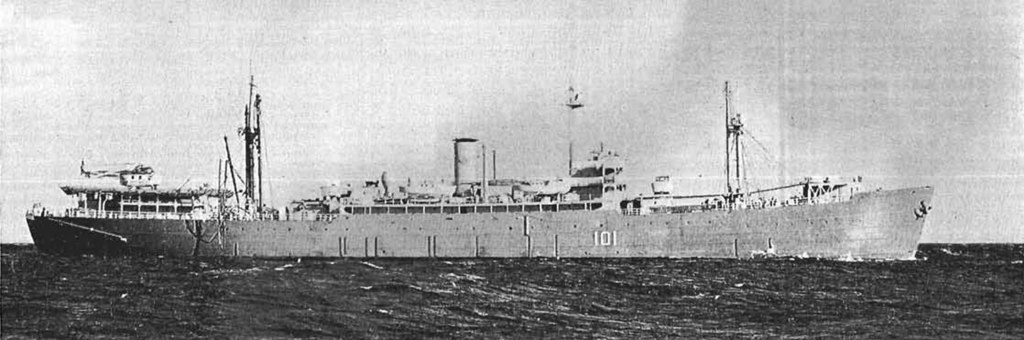
HMCS Cape Breton’s sister ship, and the other unit of the Cape class, was HMCS Cape Scott, ARE-101, which was formerly HMS Beachy Head. This ca. 1964 photograph shows the large landing pad being used by a Sikorsky Horse helicopter. Royal Canadian Navy, HS-59754 Public domain, via Wikimedia Commons
In 1959, Cape Breton was transferred to the West Coast, home-ported at Esquimalt, BC, and was reconfigured to an escort maintenance ship. Both ships by this time had a large flight deck on the stern, which could accommodate a Sikorsky helicopter.
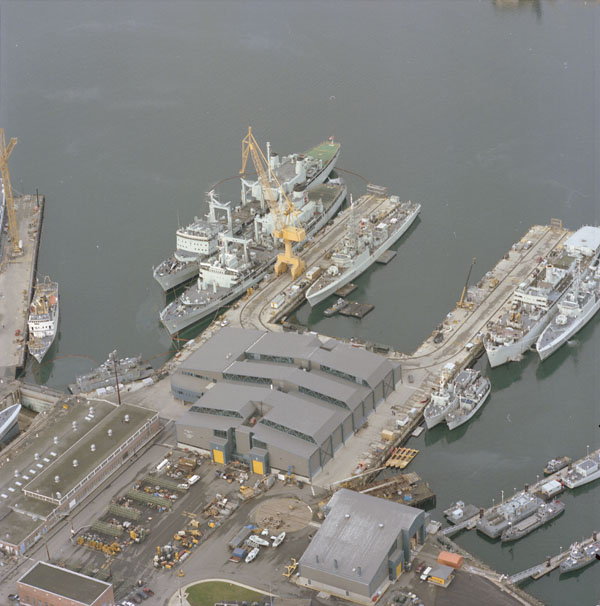
RCN West Coast fleet, CFB Esquimalt, July 1992. Cape Breton or “Building 100” as it was known, is the ship with the large stern flight deck at extreme right. Other ships include CFAV Endeavour, at the far left, HMCS Provider, HMCS Protecteur, and two destroyer escorts. Forward of Cape Breton is a Bay class minesweeper/training ship, with a Porte class gate vessel outboard. Credit: Library and Archives Canada / Department of National Defence ETC93-1111
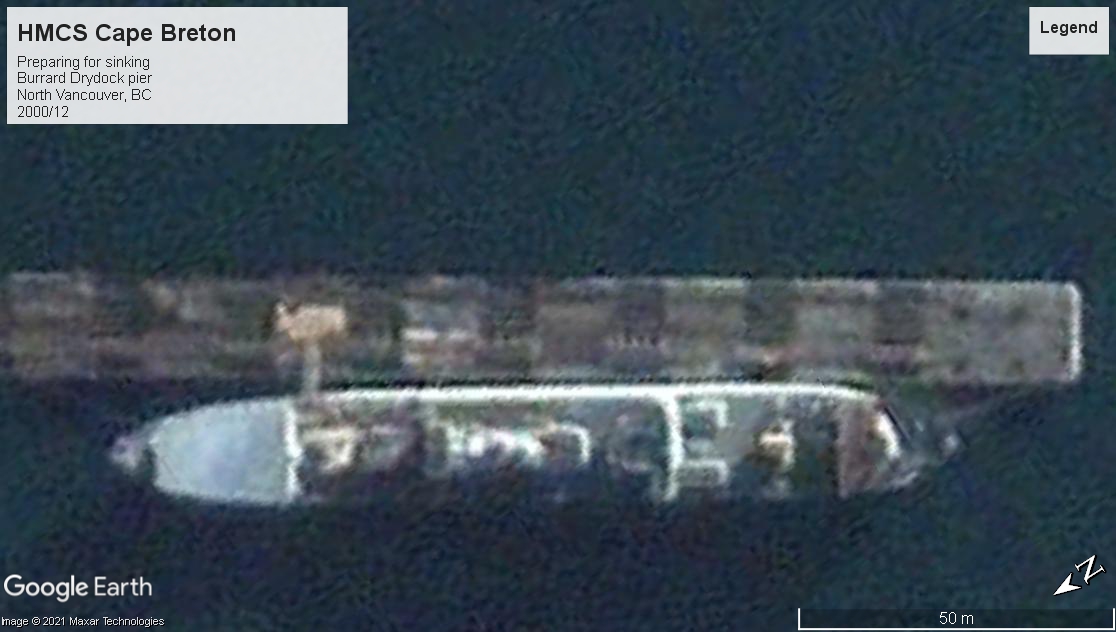
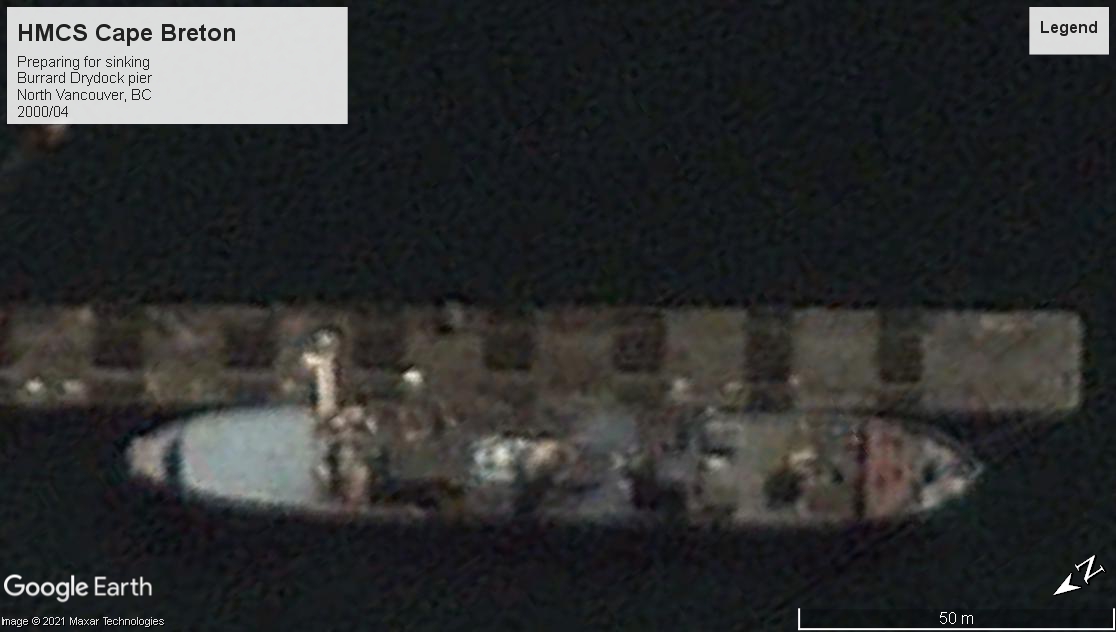
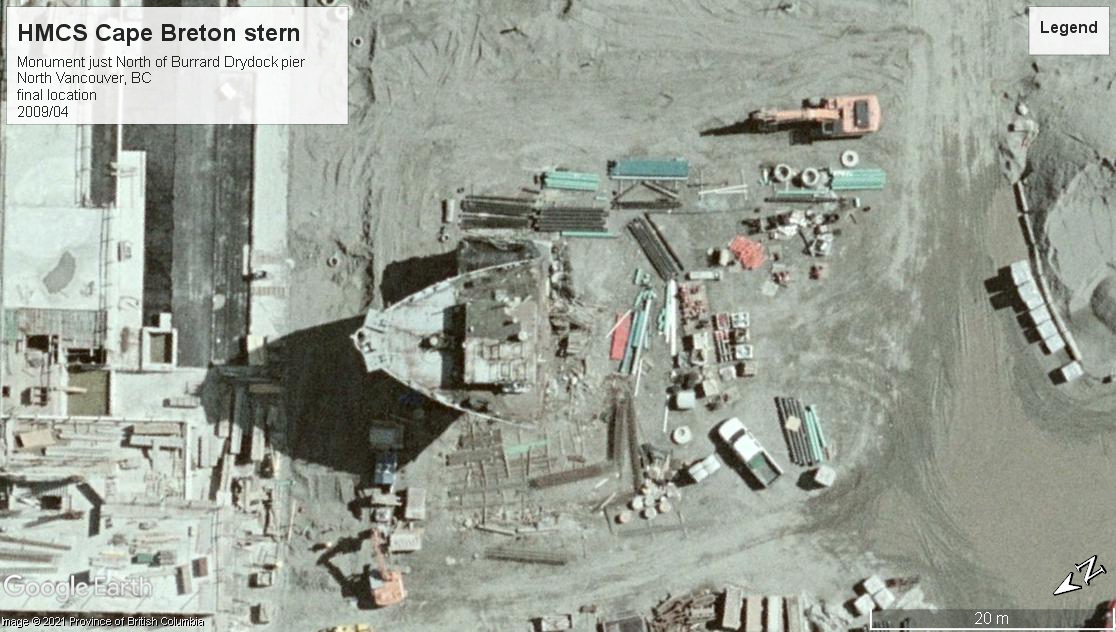
Decommissioned in 1963, to reduce RCN expenditures, from 1964-1993, she served as an alongside maintenance facility. By the early 2000s the ship was being prepared for sinking, docked on the site of Burrard shipyards in North Vancouver, back where she had been built 65 years before. Thirty feet of the stern of the ship was removed. This section, along with one of the ship’s reciprocating engines, was intended to have become part of a maritime museum. A truncated transom was fastened to the now 410′ long hulk, which also had many access holes cut into the hull for divers to use. The old ship was towed out to Snake Island near Nanaimo, BC, and sunk on 20 Oct. 2001. The wreck remains a popular dive site, close to the resting place of HMCS Saskatchewan. The monument, meanwhile, was first moved near an old shipbuilding shed slightly North of the Burrard pier.
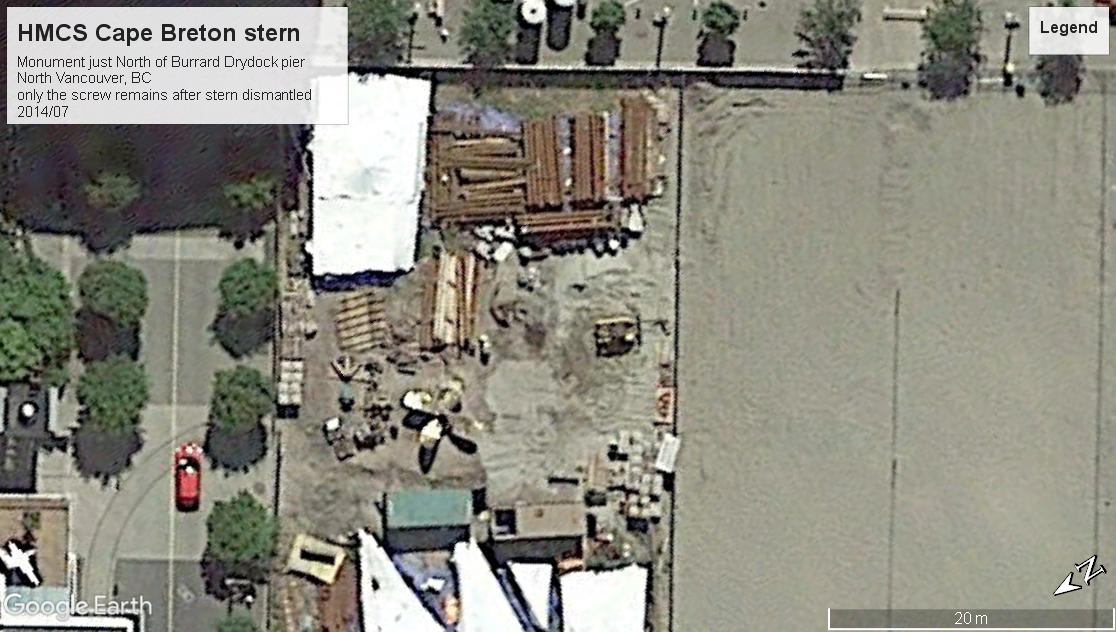
The maritime center never materialized, and eventually the unsightly and exposed stern was dismantled in early 2014, when the cradle it was resting on was judged to be reaching the end of its design life. So went the last of the remaining Fort or Park ships located in Canada.
*The title of both posts was inspired by S.C. Heal’s book A great fleet of ships: The Canadian forts & parks
52 years after the record smashing flight of HMCS Bras d’Or FHE-400, we explore Canadian milestones in the development of naval hydrofoil technology with great images!
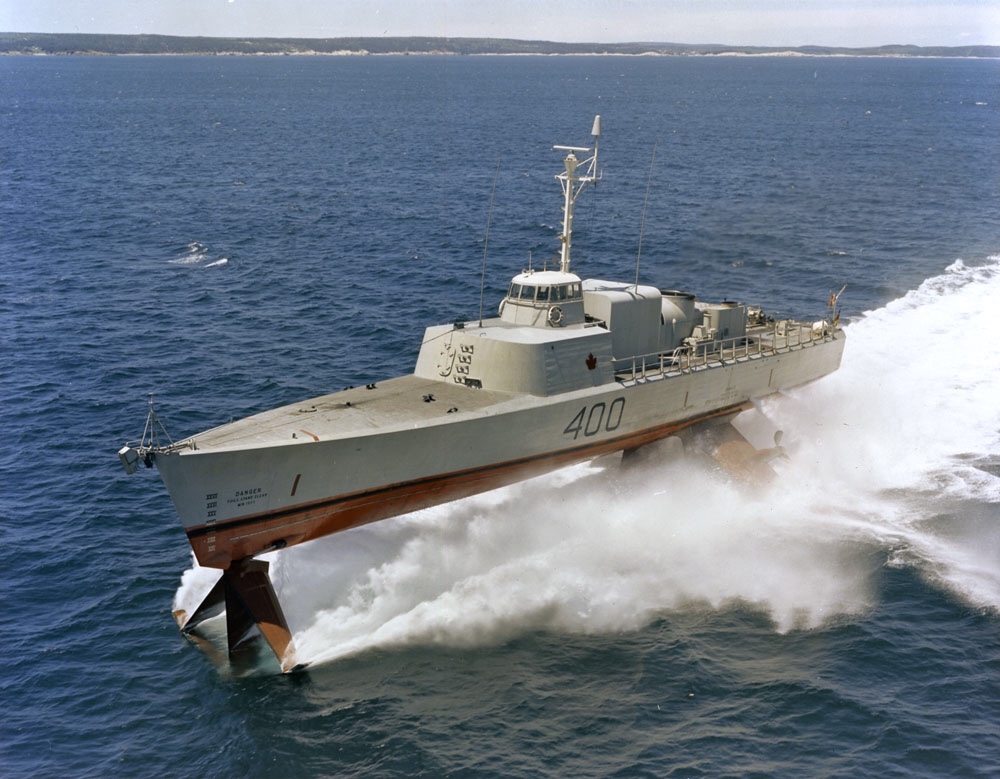
Have the naval hydrofoils had their day? It’s hard not to think that the best flying is behind us, when we look at the glory days when HMCS Bras d’Or (FHE-400) wowed observers near Halifax, Nova Scotia, flying up on her foils at 62 knots, or 114.8 km/h. This wondrous burst of speed occurred 52 years ago today. For this post, the Shipsearcher staff historian takes a look at Canadian naval hydrofoils. A future post will provide a brief survey of other navies’ remaining hydrofoils.
HMCS Bras d’Or flying (foil-borne) 1970: Library and Archives Canada Copyright belongs to the Crown REC70-367
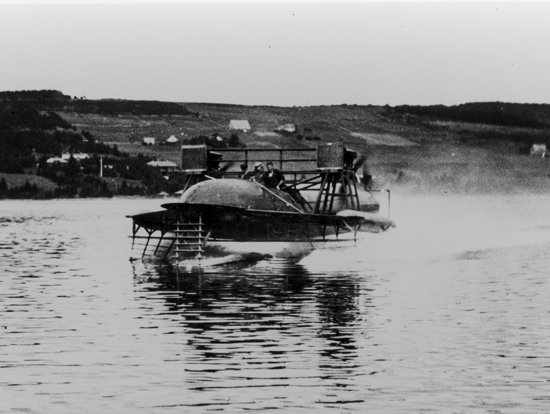
Hydrofoils are a unique mix of aircraft and boat: “Foils” fitted to the lower hull of a vessel act in the water like wings do in the air. With speed and adjustment of the foils, lift is achieved, which raises the watercraft up, and allows it to become “foilborne” with the hull or main body of the craft flying over the surface of the water. When flying, there is very little water resistance to slow the craft down, and so hydrofoils can attain remarkable speeds, and can also be very stable during their flight.
Enrico Forlanini testing one of his boats on Lake Maggiore, 1911. This boat had a ladder-style arrangement of foils, and, in flight, could achieve 37 knots, or 68 km/h. Unknown author, Public domain, via Wikimedia Commons
The development of hydrofoil technology was an international effort. Canada played an important role in both the origins of the technology, and some of its milestones. Scottish/American inventor Alexander Graham Bell may be regarded as the founding father of naval hydrofoil technology. Hydrofoil experiments came out of his interest in aviation, where he and a small group were designing pioneering aircraft or “aerodrome” (Bell’s term) designs at the very beginnings of powered flight.
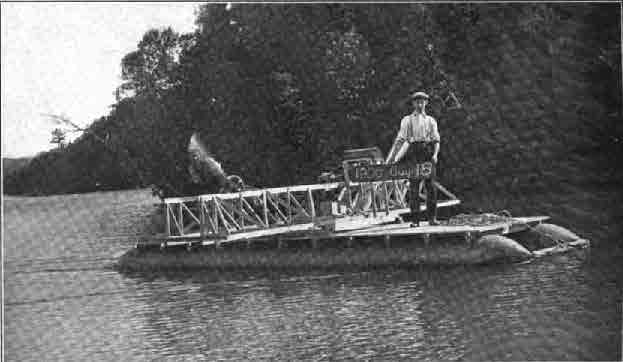
Early Days – the “Ugly Duckling” aircraft engine test boat of 1907 shows some of the main features of Bell’s later hydrofoils – aircraft engines, light aircraft construction, and long torpedo-like floats. Dr. Alexander Graham Bell and Cyrus Adler, National Geographic, Public domain, via Wikimedia Commons
Experiments in designing floats for aircraft to become airborne from a water-start led to a passionate interest in achieving lift using wing-like foils in the water. Bell worked out of his estate and laboratory “Beinn Bhreagh” on the Bras d’Or Lakes of Cape Breton, Nova Scotia, in the first years of the 20th Century. He had been inspired by Italian inventor Enrico Forlanini’s earlier work building hydrofoil boats on Lake Maggiore, in Italy, and had travelled there in 1910 to see these craft. He and his associates, especially F.W. “Casey” Baldwin, collaborated on a whole series of experimental designs.
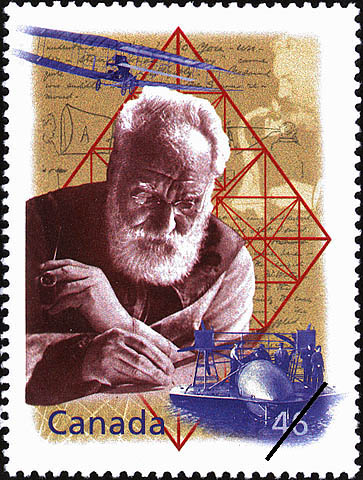
Bell and some of his important inventions, including the Silver Dart aircraft and the HD-4 Hydrodome. Credit: Library and Archives Canada; Copyright: Canada Post Corporation 2266911
Each iteration of hydrodome overcame faults which had often destroyed the previous craft. During 1913, Bell and Baldwin got to work on a new design, “Hydrodome number 4” – HD-4 – that they hoped would correct previous design flaws, and lead to possible naval contracts. The First World War interrupted further work, as Bell’s Cape Breton boat-works were given over to wartime construction.
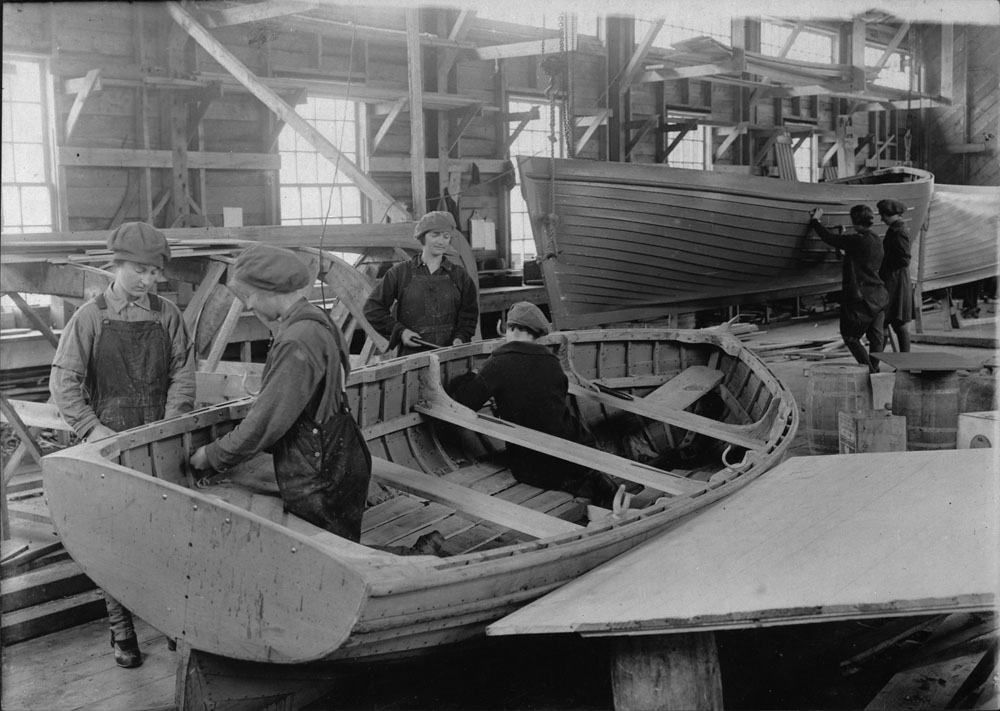
Female workers at Dr. Alexander Graham Bell’s laboratory, Beinn Bhreagh. During wartime, the boatworks was given over to the production of lifeboats. Canada. Dept. of National Defence / Library and Archives Canada / PA-024363
Work on HD-4 resumed at the conclusion of hostilities. The US Navy supplied the Liberty V-12 aircraft engines, and evaluated her in September, 1919. The HD-4 was a triumph for Bell and Baldwin, flying at 61.5 knots, or 114 km/h – a record-breaking speed. Two years later the Royal Canadian Navy (RCN) evaluated HD-4 for different purposes. No naval construction followed these projects. Casey Baldwin continued development of several more HD craft after Alexander Graham Bell’s death in August, 1922.
The Royal Canadian Navy’s interest in hydrofoil development goes back to the years just after the First World War. HMCS Patriot, a destroyer, is shown towing the HD-4 at 14 knots on the Bras d’Or Lakes, near Baddeck, in 1921. HD-4 was not equipped with any engines for the 1921 evaluation. Credit: Library and Archives Canada / Department of National Defence CN-2947.
Development of a military hydrofoil project became a focus of Canadian government defence research after the Second World War. The RCN partnered with the Defence Research Board (DRB) to work on the Canadian Hydrofoil Project. A cadre of experts forming around the Naval Research Establishment in Halifax, NS. The team looked again at the designs of Bell and Baldwin, subsequent developments, and contemporary programs, such as US Navy hydrofoil designs. Canadian designs would focus on surface-piercing hydrofoil technology. A 45-foot boat, the Massawippi (R-100), was initially acquired in 1951. It helped develop the ladder style of foils used in subsequent designs.
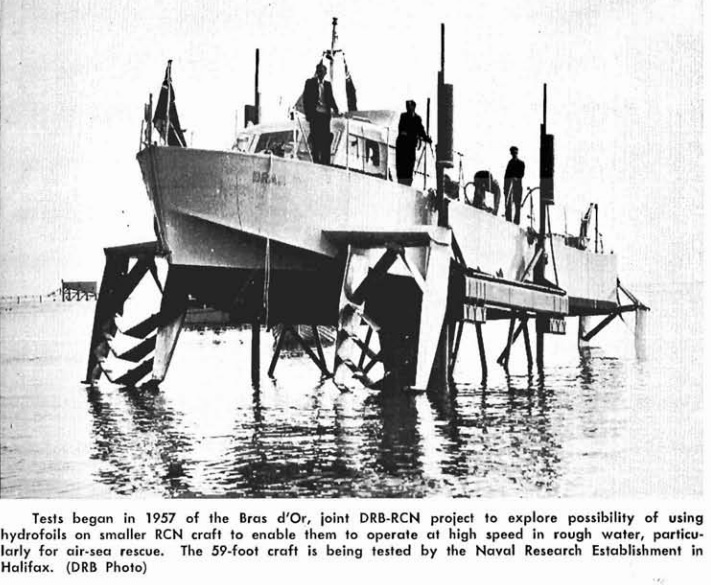
Next came the Bras d’Or (R-103), built by British Saunders-Roe as a unique design. The hull tapered along its length, to a distinctive narrow transom, to give the rear foils room. The V-shaped ladder foils had not benefited from the same rigorous design experimentation as other aspects, and the craft struggled to become foil-borne on trials. Bras d’Or was shipped across the Atlantic in 1957 on the new RCN carrier, HMCS Bonaventure. In testing she eventually reached speeds of 30 knots, or 55 km/h.
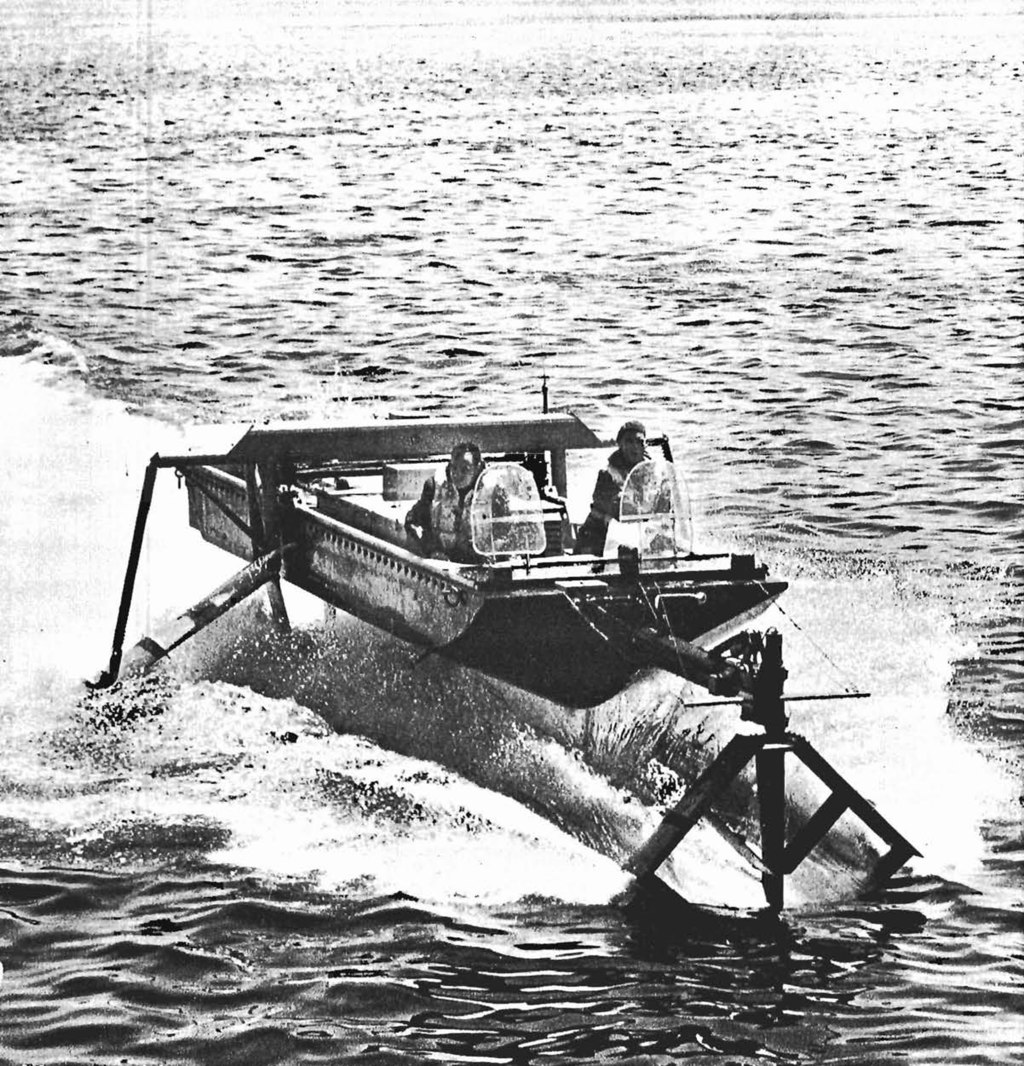
The Crowsnest 1959/01, P.13 [http://publications.gc.ca/collections/collection_2015/mdn-dnd/D12-19-10-3-eng.pdf]Defence researchers also used a small experimental craft, Rx, to try and overcome issues that were encountered with Bras d’Or, and the “cavitation barrier” which was impeding the development of faster hydrofoils. The hydrofoil system could be easily modified to test different concepts.
Rx, used in testing various configurations, including a small scale trial of the same arrangement to be fitted to FHE-400. NRE Photo by W. R. Carty, Public domain, July 1964 Crowsnest, Vol. 16 No. 7via Wikimedia Commons
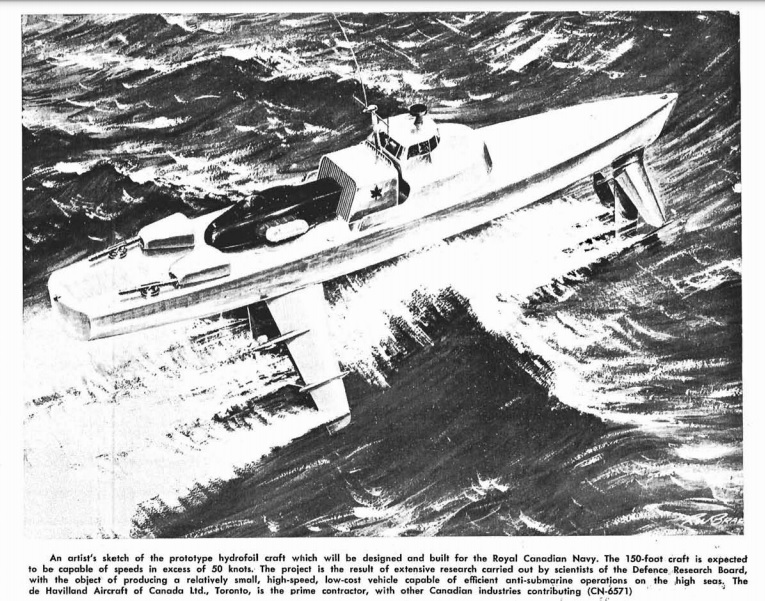
Challenges encountered during the testing of R-103, and solutions for optimizing the foil configuration tested on the Rx, would continue to inform the design of the ultimate Canadian project: HMCS Bras d’Or (FHE-400). The new craft was a 160-foot long, 240 ton space-aged wonder. De Havilland Canada was selected as the prime contractor and the craft was built at Marine Industries Ltd., at Sorel Quebec, between 1963-1968.
Artist’s conception of HMCS Bras d’Or. DND CN-6571 featured in Crowsnest, 15/7 July 1963 P.5.
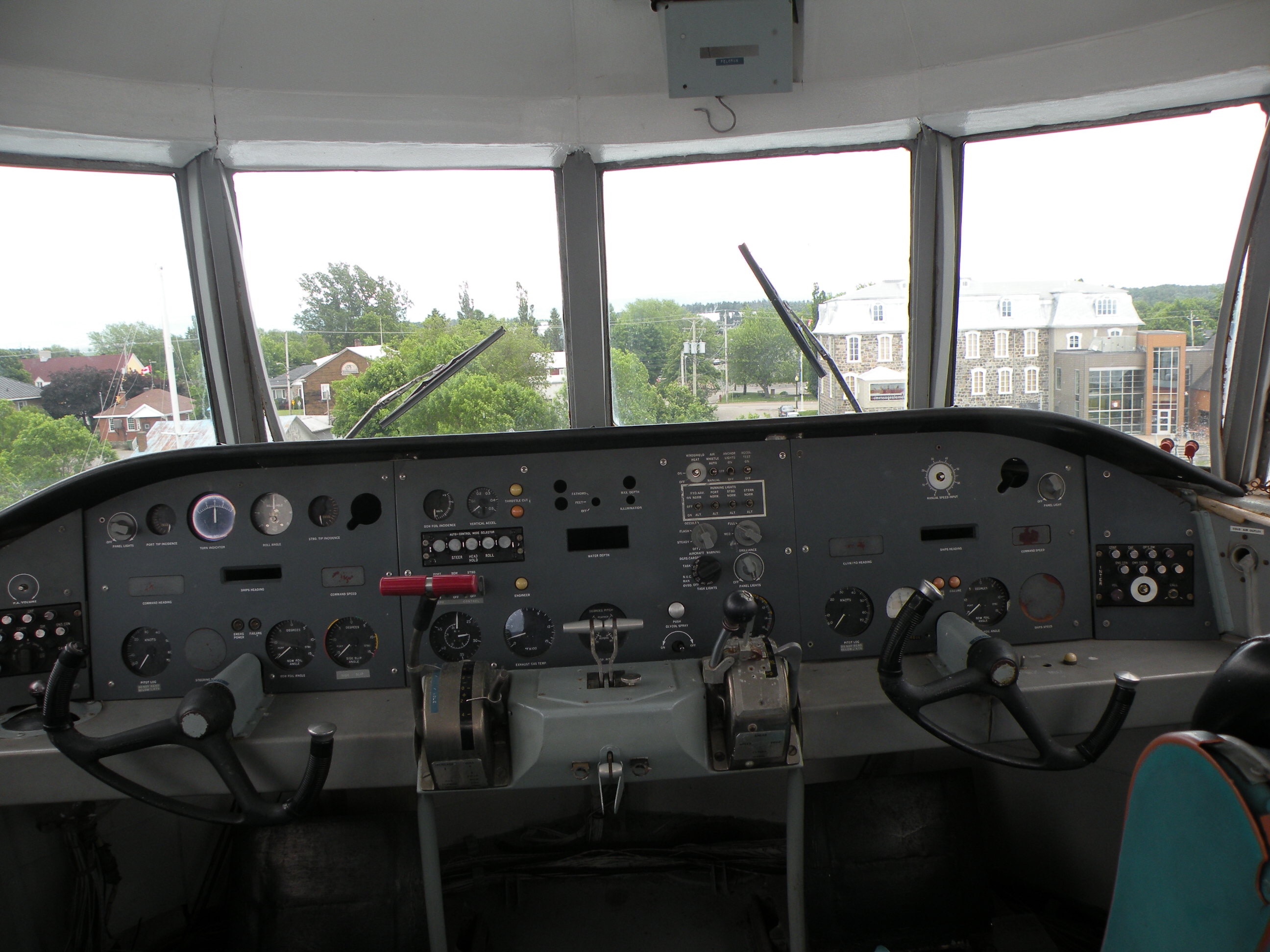
Just about everything about the construction of this craft was innovative, from the aluminum hull-form (built upside-down in the shed at Sorel) and Pratt & Whitney gas turbine engines used in construction, to the advanced diamond shaped foils, forged from special maraging steel. The ship needed to be controlled by a qualified pilot, and the small wheelhouse looked more like the cockpit of a jetliner. Instead of rudders, the vessel’s steering was controlled by the unique rotating forward foil. Designers worried about the crew tasked with serving in this revolutionary craft, and effort was spent trying to develop comfortable quarters and sleeping arrangements, and, since a galley was out of the question, the ship was even fitted with the newly-developed microwave oven!
The cockpit of HMCS Bras d’Or, as it currently exists. Credit: Warsearcher.com
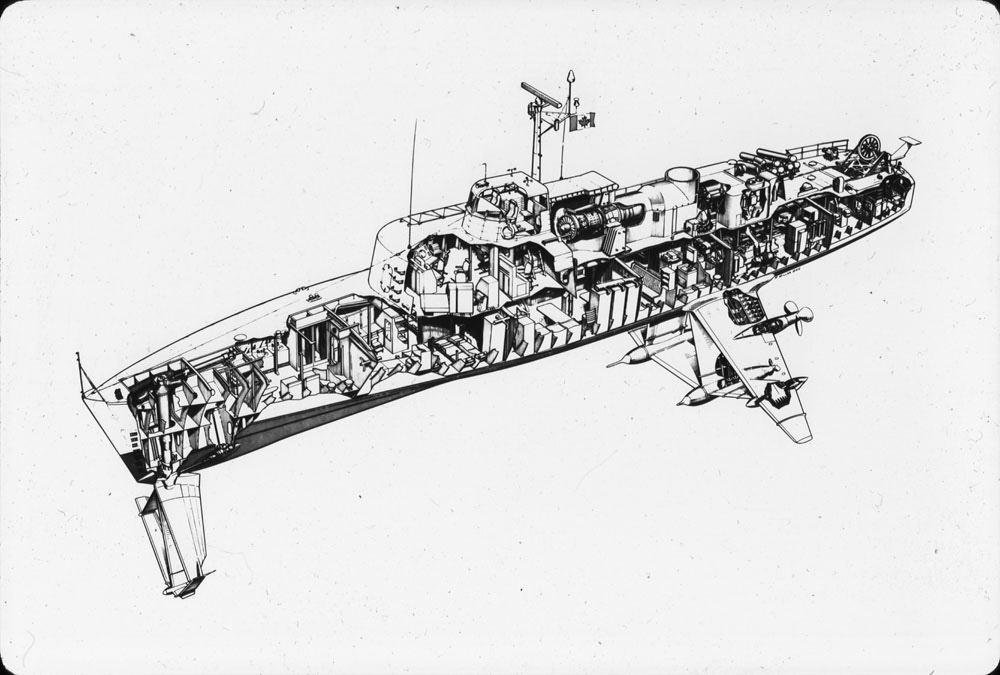
Unusual as it might sound today, Bras d’Or was intended to have been used in an open-ocean or Anti-Submarine Warfare (ASW) role, with the navy also experimenting with a special light and compact Variable Depth Sonar outfit: the SQS-507. The armament would have featured two sets of triple torpedo tubes. It was hoped that a small fleet of hydrofoils would replace the aging, wartime-built fleet of frigates then leaving service, and be significantly less expensive than the RCN’s “Cadillac” destroyer-escorts. The concept of the ASW hydrofoil was that it would patrol in hull-borne mode up to a respectable speed of 23 knots, using regular marine diesels. Bras d’Or was fitted with Paxman diesel engines. Upon establishing a sonar contact, the ship would dash to close proximity using the extraordinary foil-borne speed, before reacquiring the contact and attacking. After lengthy development and a fire that set back construction, Bras d’Or was ready for commissioning in July 1968 (the smaller R-103 was renamed Baddeck to leave the name free for its bigger successor).
HMCS Bras d’Or cutaway. This plan shows what looks a VDS rig on the stern, and what looks like the two torpedo tube launchers on the quarterdeck. Copyright belongs to the Crown: Library and Archives Canada Mikan 5014188
Testing in the waters near Halifax showed her exceptional stability when flying, even in heavy seas. On 9 July 1969, Bras d’Or flew at speeds of up to 62 knots (114 km/h). As far as we know, this still makes her the fastest commissioned warship.* Unfortunately, changing government defence priorities resulted in the hydrofoil project being set aside. HMCS Bras d’Or was decommissioning in November 1971, and this coincided with an end to further Canadian military hydrofoil development. The costs of the program no longer looked likely to provide the RCN with a fleet of “cheap” ASW hydrofoils, and many of the technologies, such as the special sonar and the armament for the ship, had yet to be fully developed, and may have led to more costly programs. As a concept, the ASW hydrofoil was an evolutionary dead-end. Internationally, the development of military hydrofoils continued to focus on high-speed coastal patrol, torpedo boats, and fast-attack craft (gun and missile-armed).
HMCS Bras d’Or as she exists today. Credit: Warsearcher.com
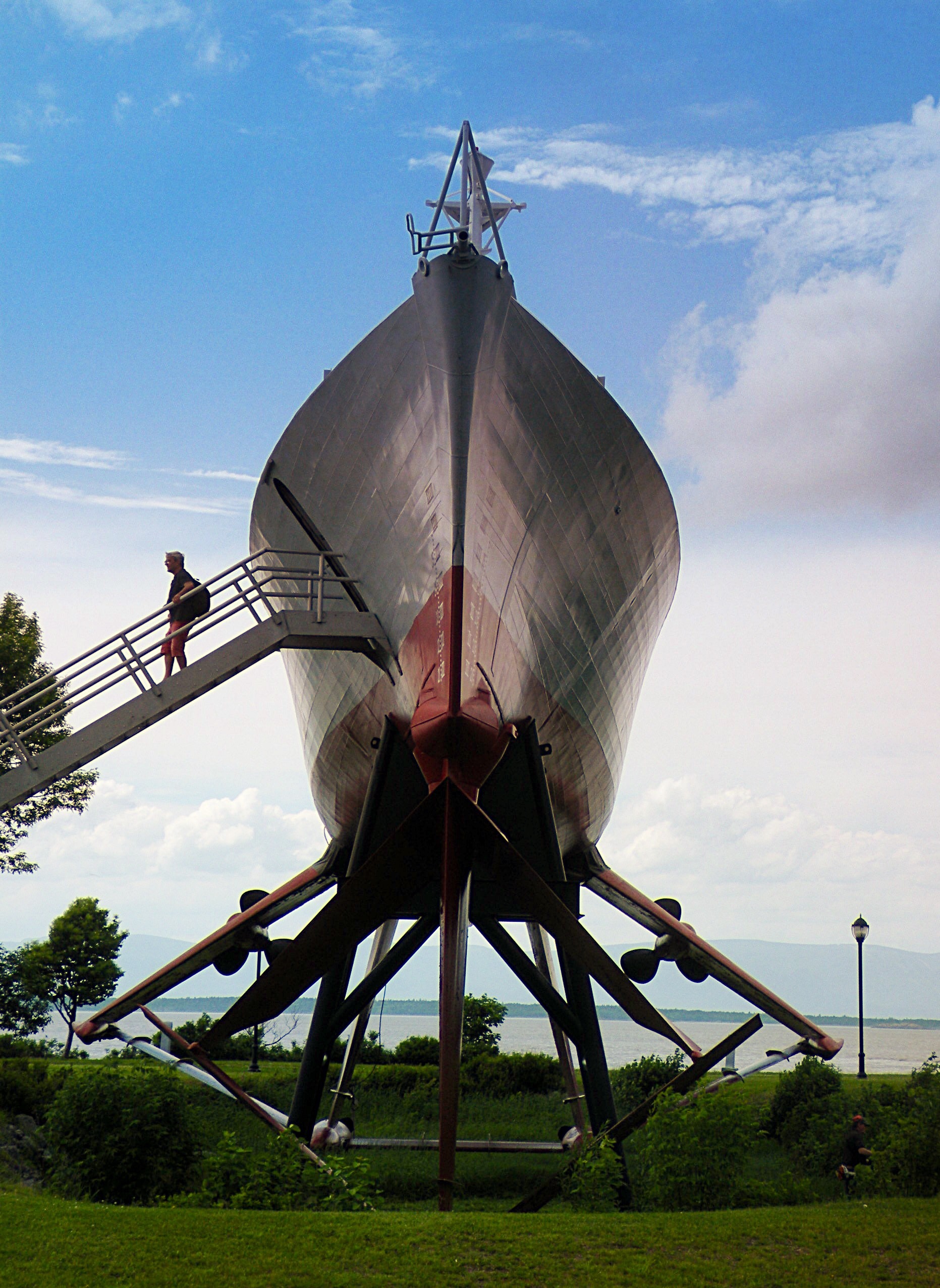
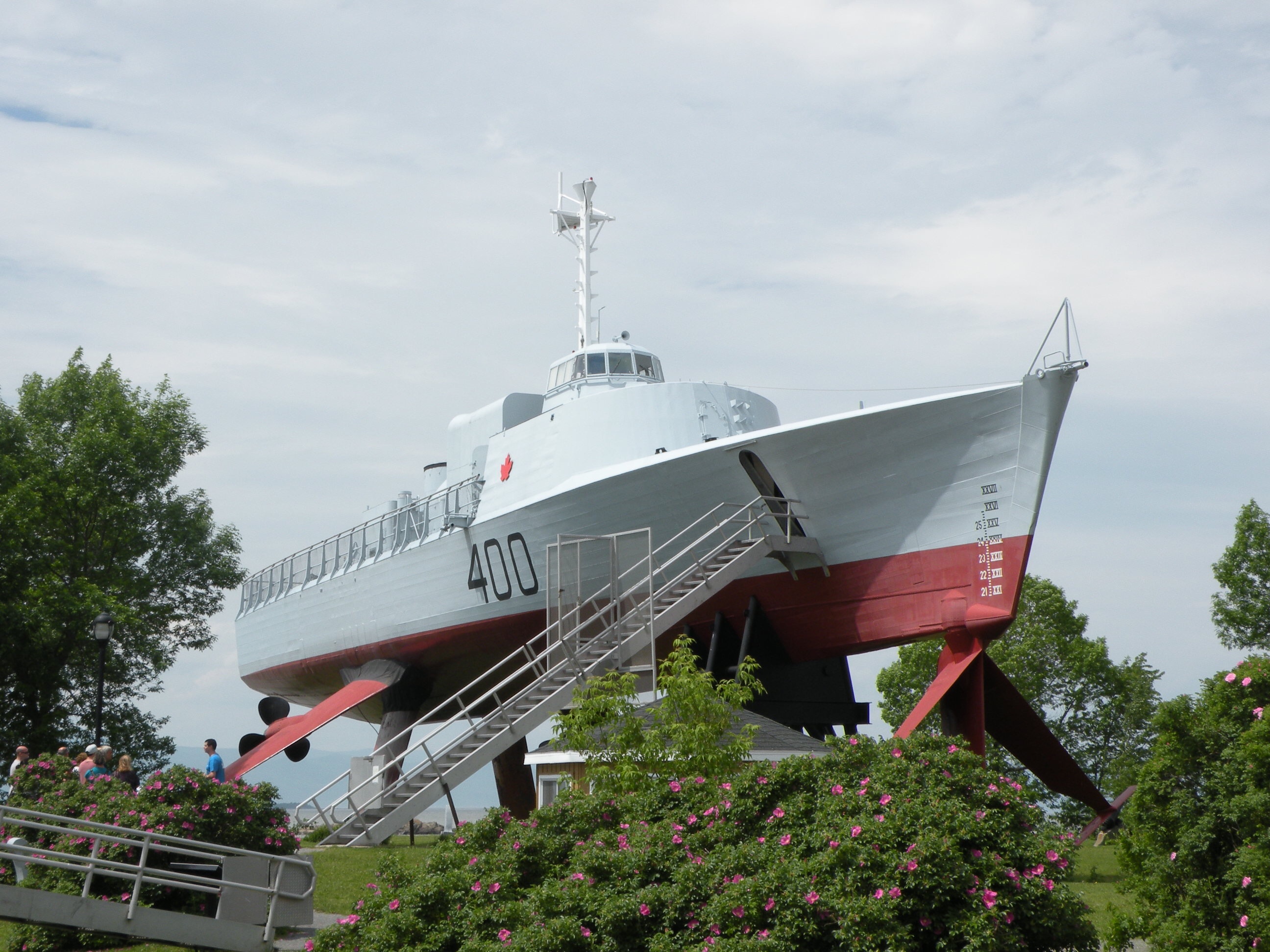
Today, we are fortunate to have relics of the era when Canada was at the cutting edge of hydrofoil development. HMCS Bras d’Or survives out of the water at the Musée Maritime du Québec, at Islet, QC.
HMCS Bras d’Or FHE-400 on exterior display out of the water at Musée Maritime du Québec. Credit; Warsearcher.com
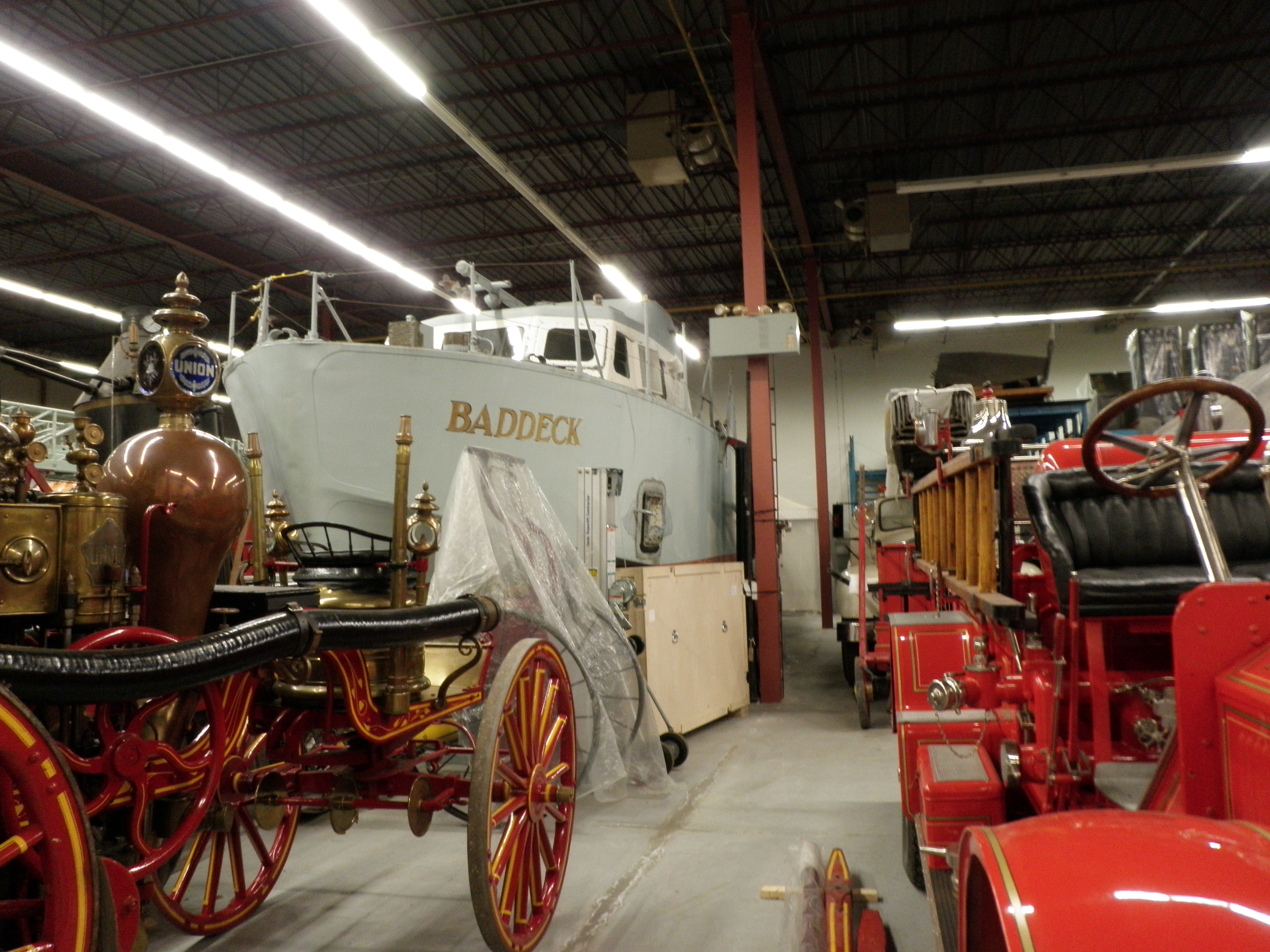
Baddeck (the former Bras d’Or) is in storage at the Canadian Museum of Science and Technology in Ottawa, Ontario. After a long period of outside storage, the partially-disassembled boat rests inside a new state-of-the-art preservation facility, and, we hope, will be reunited with its preserved foils.
Baddeck (R-103) stored indoors at the Canada Science and Technology Museum storage facility, ca. 2009. Credit: Kyle Huth.
R-103 Baddeck / Bras d’Or Canada Science and Technology Museum artifact 1990.0323.001 when it was on exterior display / storage. This image sourced from the museum’s online catalog.
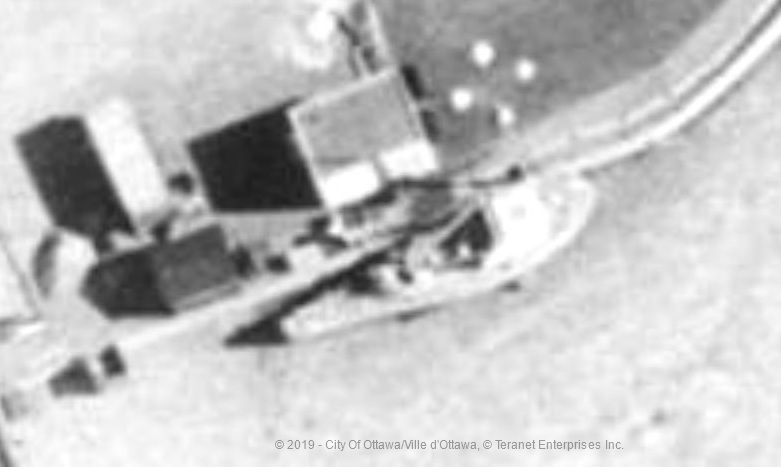
Baddeck (R-103) at rear of Canada Museum of Science and Technology, where it was on outside display in the 1990s and early 2000s. The foils were elsewhere. Contains information licensed under the Open Government Licence – City of Ottawa.
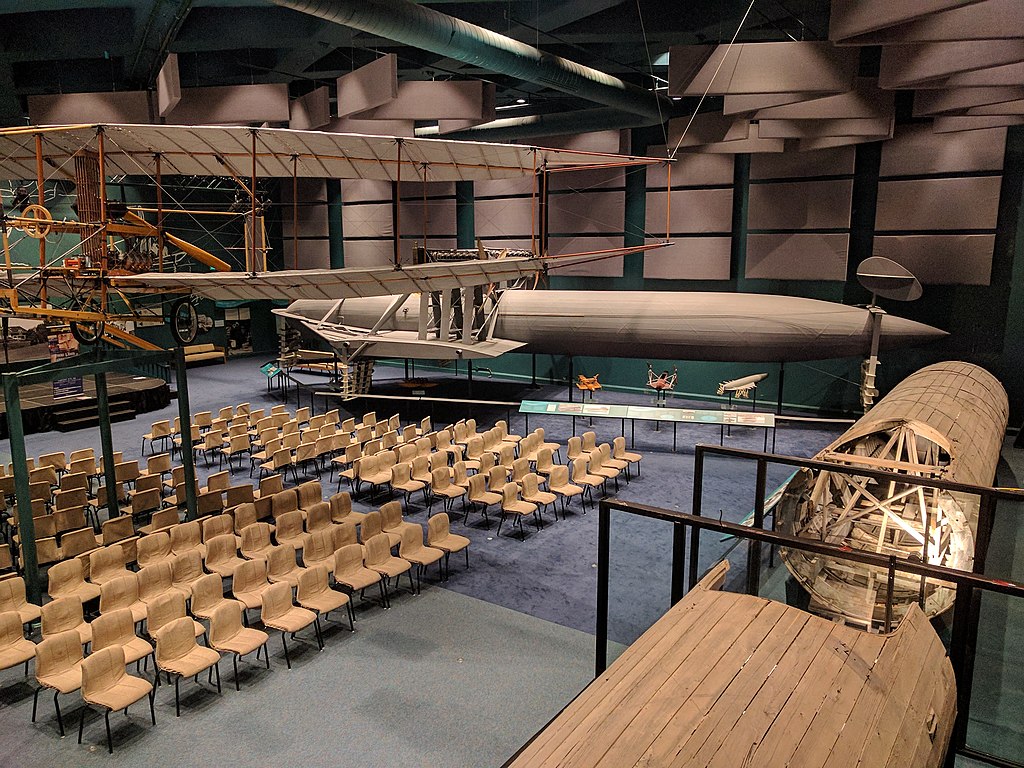
Massawippi (R-100) appears to have survived, after her 1959 decommissioning, at either at the Nova Scotia Museum or the Maritime Museum of the Atlantic (possibly at a storage facility in Mount Uniacke, NS). Canadian Aviation Historical Society member Kyle Huth let us know about the survival of this boat, while we also located some information about historian Thomas Lynch’s attempts to locate R-100, which can be found at the International Hydrofoil Society’s website. Alexander Graham Bell’s HD-4 Hydrodome also partially survives in Baddeck, NS, at the Alexander Graham Bell Museum, near a full-scale replica. A future post will pick up the story by examining international naval hydrofoil development and other surviving craft.
The Alexander Graham Bell National Historic Site and Museum at Baddeck, with this remarkable display of the remains of the HD-4 in the foreground, a full-scale replica, and the Silver Dart replica aircraft. Credit: jockrutherford from Owen Sound, ON, CC BY-SA 2.0 , via Wikimedia Commons
For a detailed account of both Alexander Graham Bell and Casey Baldwin’s work, as well as the subsequent RCN projects, see John Boileau’s Fastest in the World; the Saga of Canada’s Revolutionary Hydrofoils (Halifax: Formac Publishing Co. 2004).
* The fastest armed warships, currently, are the Skjold class missile catamarans, which also use Pratt & Whitney of Canada engines to attain speeds of up to 60 knots, or 111 km/h
July 3rd 1970 – 50 years ago today, HMCS Bonaventure, Canada’s aircraft carrier, was decommissioned, in a move that surprised many.
July 3rd 1970 – 50 years ago today, HMCS Bonaventure, Canada’s aircraft carrier, was decommissioned, in a move that surprised many. “Bonnie,” the largest and most powerful warship the Royal Canadian Navy (RCN) has ever operated, had just undergone a major “mid-life” refurbishment.
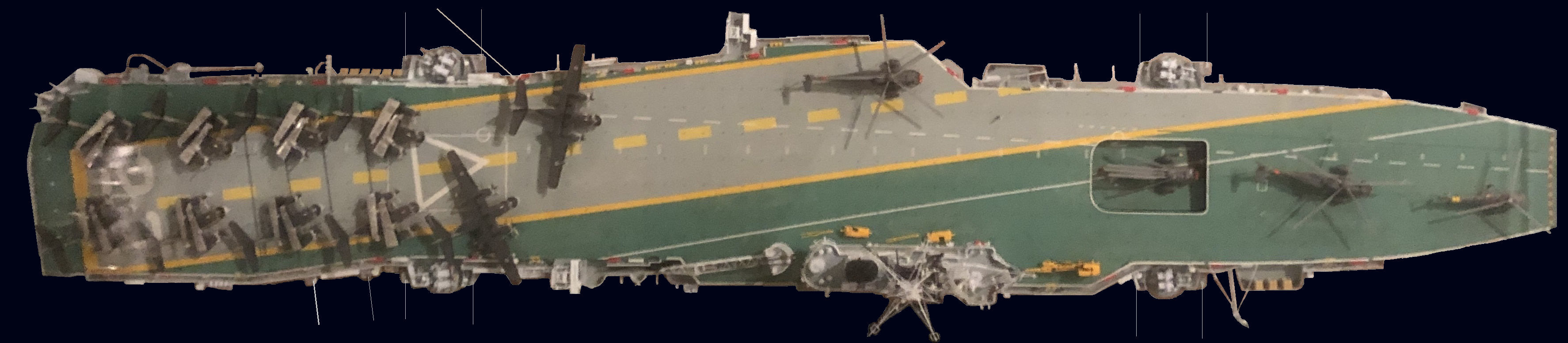
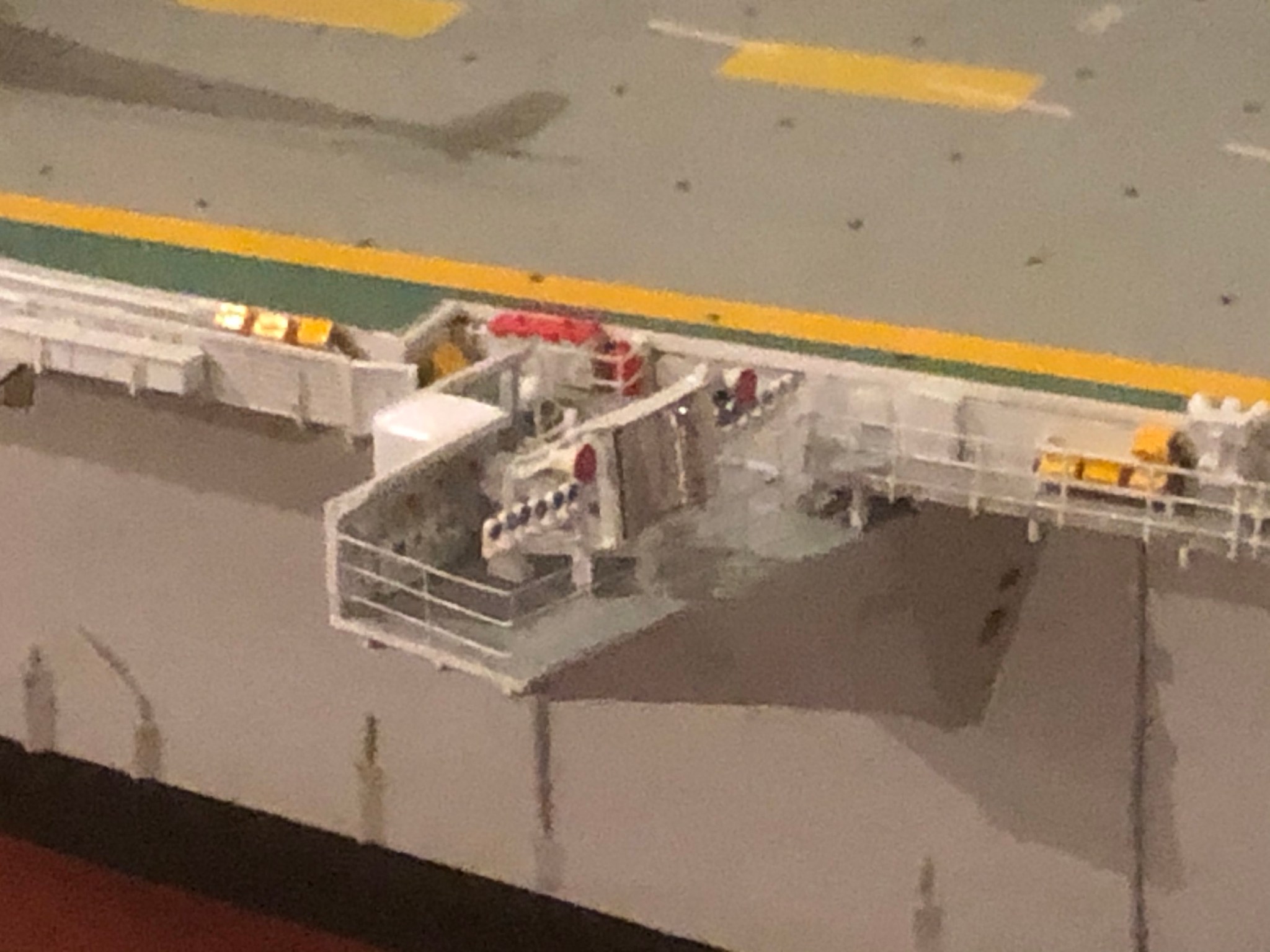
Overhead photo of a Canadian Aviation and Space Museum artifact, a fine 1/144 Scale model of HMCS Bonaventure made by Dan Linton from Stouffville ON, with various aircraft that served aboard during career. For all use please credit Warsearcher with the URL of the website.
A few years before this, an official history of Canadian naval aviation produced by the Naval Historical Section, Department on National Defence, had concluded a section on Bonaventure with: “At the time of writing Bonaventure has been in commission over five and a half years, with the prospect of many more to come. Canada being deeply committed to the North Atlantic Treaty Organization for the defence of the Free World, the carrier will, no doubt, in the future, as in the past, be frequently working with the warships of her allies.”1 In fact, Bonaventure, and all carrier-based RCN operations, had little time left. The lengthy refit proved costlier than anticipated. The government of Prime Minister Pierre Trudeau decided to dispose of the ship, as a cost-cutting exercise, in the fall of 1969. This controversial decision removed fixed wing aircraft from Canadian naval aviation and limited it to helicopters attached to destroyers and frigates.
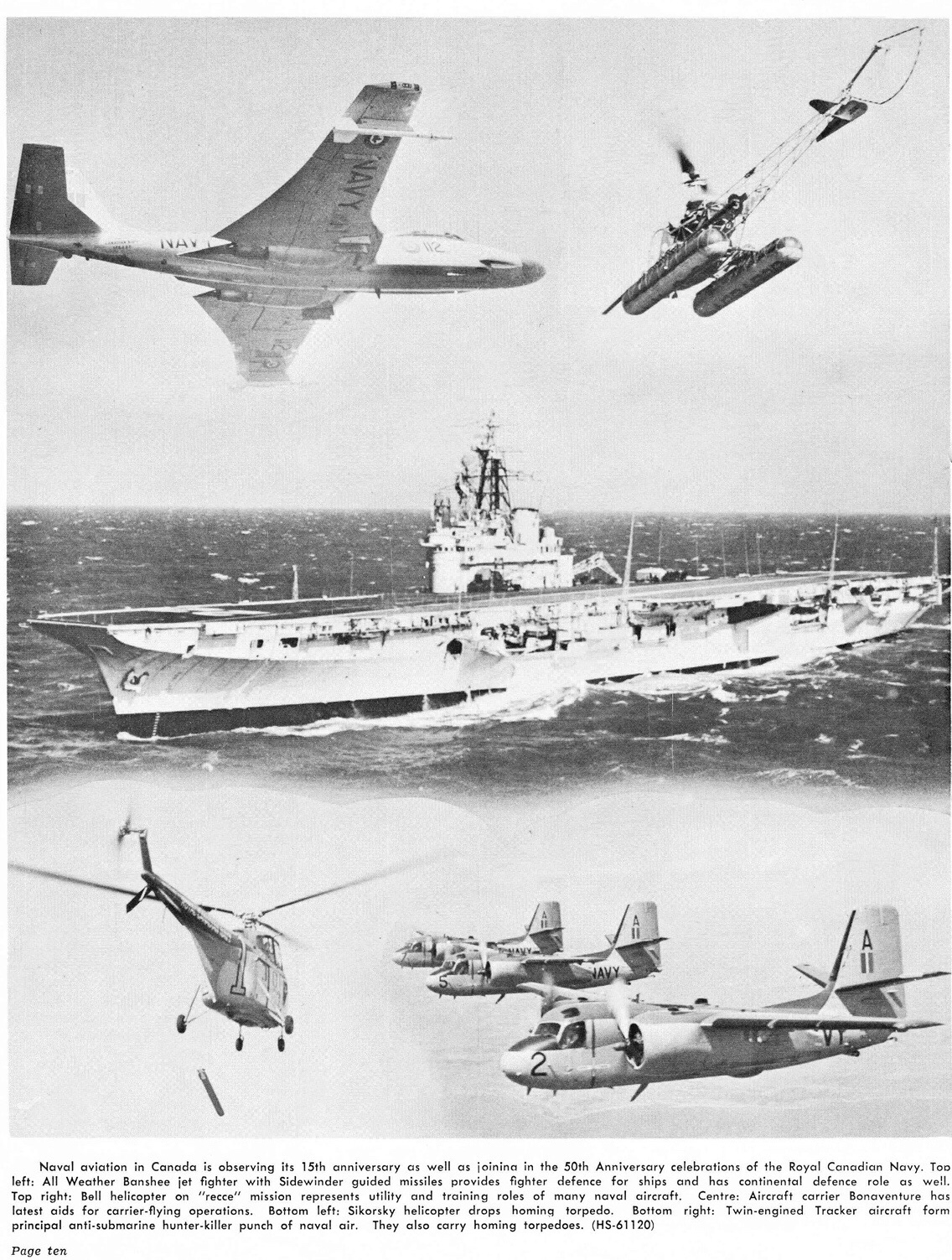
This composite shows Bonaventure and RCN naval aircraft, including many types that operated from the carrier. Late in her RCN career, Bonaventure also operated the new Sikorsky Sea King Anti-submarine helicopter. Crowsnest May-June 1960 edition, p.10. Photo credit would now be Crown Copyright, Department of National Defence, HS-61120
Bonaventure was a Majestic class variant of the British 1942 Light Fleet Carrier design. The concept was born out of wartime necessity. By mid-1942 the Royal Navy (RN) had lost a total of five fleet carriers, and two escort carriers, to enemy action. The vast sphere of operations, and expanding duties carriers and their aircraft could perform, meant that more “flat-tops” were needed, and they had to be produced faster. The plan for 16 ships was intended to fill the gap between large, expensive, and difficult to produce fleet carriers, and smaller escort carriers, whose roles were more limited. Light Fleet Carriers were also suitable for construction in civilian shipyards, freeing up naval yards for other priority work. They were certainly not intended to be an enduring cornerstone of any fleet. And yet, after the Second World War, of the 15 ships completed under two sub-classes, 10 of them wound up serving for decades in other navies.2 For mid-sized navies, including Canada’s, these ships represented an excellent entry-level carrier to build a naval aviation service around.
This Dec. 1969 view of the last sail past of HMCS Bonaventure in Halifax Harbour shows the beautiful lines of this updated design. Credit Library and Archives Canada / Department of National Defence HS 69-3061 Crown Copyright.
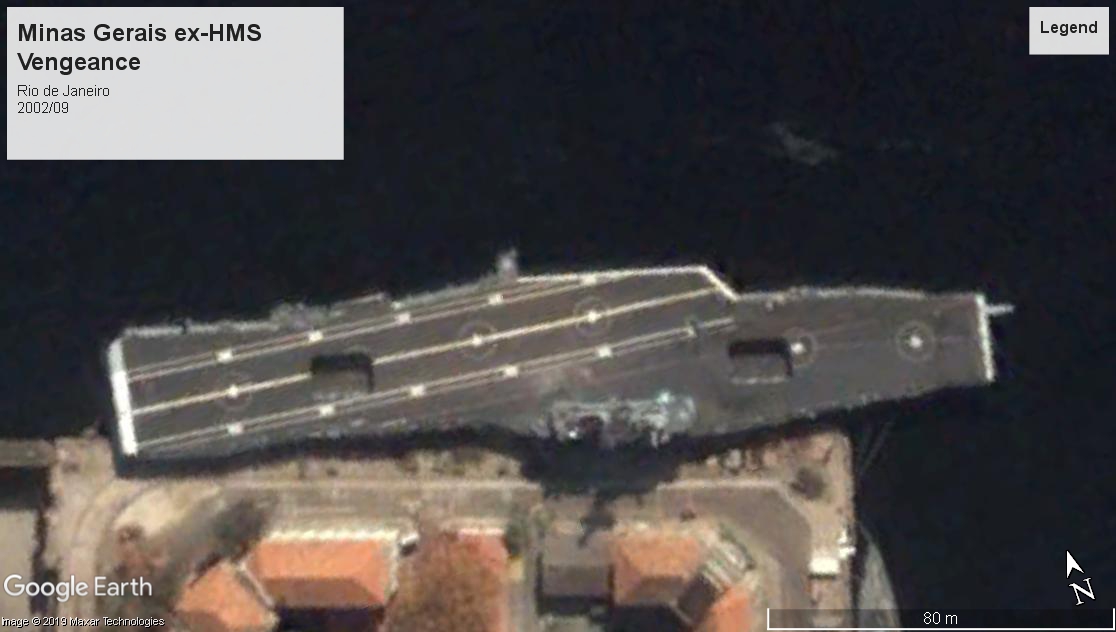
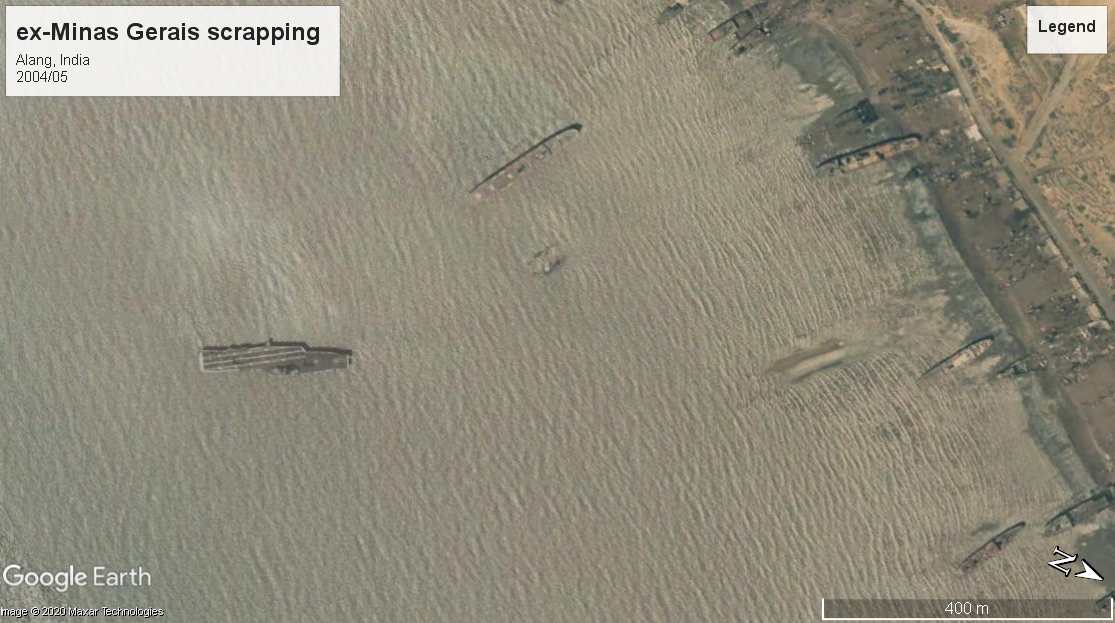
The careers of some of Bonaventure’s sister-ships are worth mentioning. The aptly-named HMS Venerable entered service early in 1945. During her 52-year career, she served in the Royal Netherlands Navy as HNMLS Karel Doorman, before being transferred to Argentina, as ARA Veinticinco de Mayo. During the 1982 Falklands War, she participated in some limited operations against the Royal Navy, and was also high on the list of targets for RN submarines. By the late 1980s she was inoperable, and became a source of spare parts for her sister-ship NAel Minas Gerais. This ship, also commissioned early in 1945, was originally HMS Vengeance. Vengeance also served in three navies (the Royal Navy, Royal Australian Navy, and the Brazilian Navy). As NAeL Minas Gerais, she became the last of the class in service, decommissioning in 2001, after an incredible 56 years!** This may well be the World’s second longest serving carrier.3
This remarkable view shows former NAeL Minas Gerais in May, 2004, immediately before she was run up on the beach at Alang, India, for scrapping.
Another sister-ship, the Indian Navy’s INS Vikrant, was decommissioned in 1997. It survived as a museum ship in Mumbai dockyards until 2014. Vikrant’s history is further explored in a recent post about her scrapping and the page for Indian Navy carriers.
INS Vikrant, at bottom, and the slightly newer INS Viraat (ex-HMS Hermes), both with very long service. Vikrant, the oldest remaining sister-ship of Bonaventure, was scrapped in Mumbai 2014-2015, while the Viraat appears to be destined to become a museum ship.
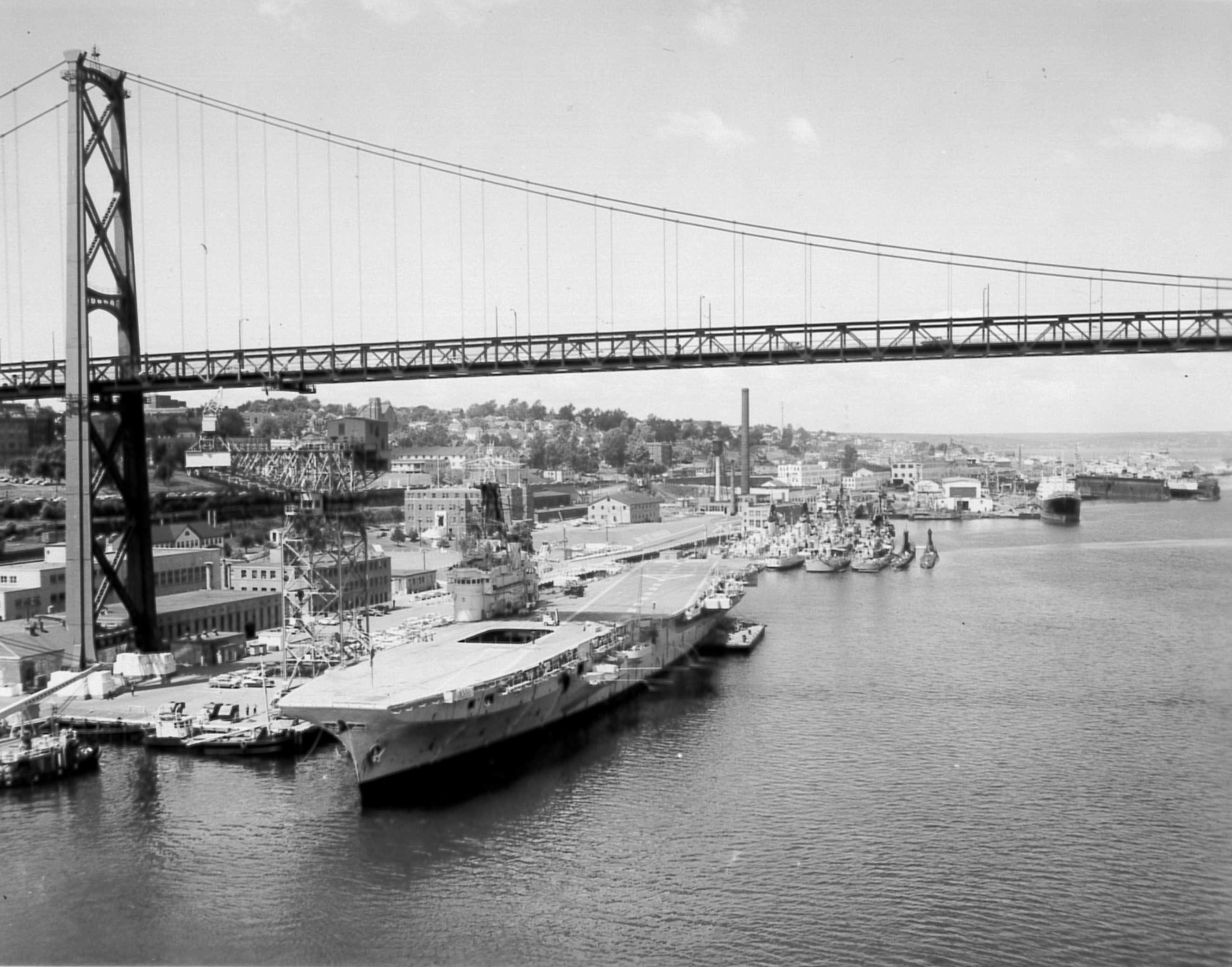
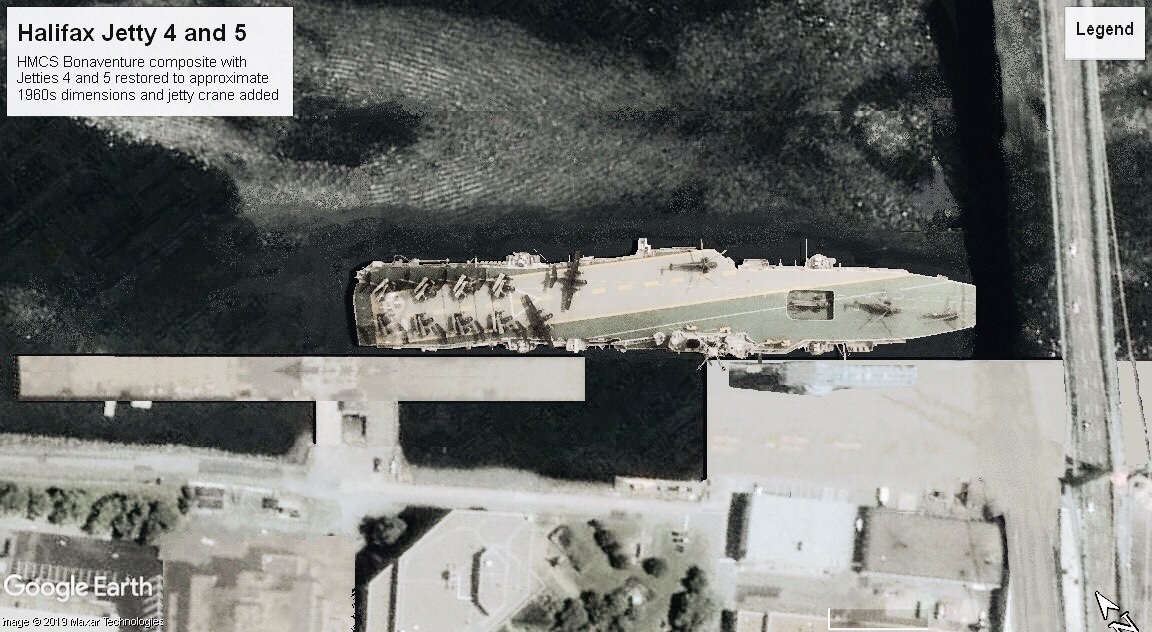
The Royal Canadian Navy built its postwar naval aviation service around three of these light fleet carriers, which served Canada successively as HMCS Warrior (1946-1948), HMCS Magnificent (1948-1957), and HMCS Bonaventure (1957-1970). Bonaventure, at 704′ overall length and 20,000 tons full-load displacement, was conspicuous at her usual berth at the Naval Dockyard, Halifax, NS.
HMCS Bonaventure in her usual berth under the Angus MacDonald Bridge, ca. 1960. Credit: Library and Archives Canada / Department of National Defence DNS-26014 Copyright belongs to Crown.Composite view of multiple satellite captures [2003, 2005, 2019/09] of Halifax naval dockyard wharf No. 4 and Jetty no. 5 edited to appear closer to the 1970 arrangement, with a crane added from the nearby government wharf, Dartmouth. Dan Linton’s model of HMCS Bonaventure has been superimposed on a 705’ footprint. Bonaventure would not have been moored across these two berths, but her usual berth at no.4 would place her directly under the Angus L. MacDonald bridge. This composite is inserted only to provide a general mock-up. For all use please credit Warsearcher with the URL of the website.
During the mid-1950s Canada arranged for the completion, to an updated design, of the ship which was intended to become HMS Powerful. Harland and Wolff shipyards in Belfast, Northern Ireland, (famous as the builders of ocean liners, including RMS Titanic) resumed work on the carrier, which was commissioned in January 1957 as HMCS Bonaventure. She had a stronger flight deck to operate larger, heavier aircraft, enlarged deck elevators to move them from the hangar, and more powerful steam catapults to launch these aircraft. A mirror landing sight system helped pilots maintain a safe approach, as they also heard audio tones to help them keep their eyes on the carrier, not their instruments.
Photo of the Mirror landing system, on the Canadian Aviation and Space Museum model, built by Dan Linton from Stouffville ON. For all use please credit Warsearcher with the URL of the website.
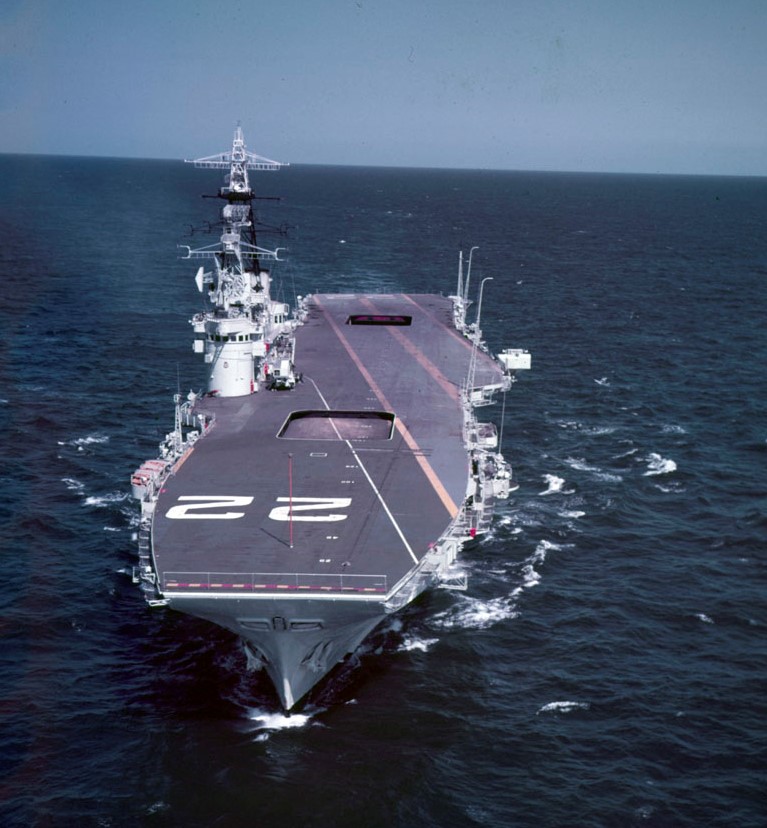
Most obviously, the carrier was the first in the class to be built with an angled flight deck, a development that made it one of the most advanced warships then in service. This feature helped increase the tempo of flying operations. Bonaventure could operate its complement of Banshee jet fighters, leaving some portions of the deck for landing as other areas could be used simultaneously for takeoffs, helicopter operation, or aircraft parking. The upgrades influenced other navies to embark on similar lengthy rebuilds of their carriers, and Vikrant, mentioned above, went through a similar rebuild of an uncompleted hull, before her transfer to the Indian Navy.
[Detail of] HMCS Bonaventure early in her RCN service off England in June 1957. Library and Archives Canada, Department of National Defence image CT-521 Copyright belongs to the Crown. The flight deck’s 7.5 degree angle and modest port projection (compared to a straight axial flight deck) may not seem like much today, but represented a real improvement in flying operations over her predecessors.
Compared to other ships in the class, Bonaventure had an active, if short, service life, with the standard ports-of-call visits, and many Cold War exercises with NATO allies designed to keep units ready to defend the sea lanes from Soviet submarines and surface ships. She operated several aircraft types, including McDonnell F2H Banshee jet fighters and Sikorsky HO4S helicopters. When the Banshees were decommissioned, the career was reoriented to an exclusively Anti-Submarine (ASW) role, with Grumman Tracker aircraft conducting patrols. Later, the new Sikorsky Sea King helicopters again upgraded Bonnie’s ASW capabilities. This busy career came to an abrupt end with the 1969 decision. Soon after her decommissioning, Bonaventure was sold for scrap, and made a last long journey to a ship breakers yard in Taiwan in 1971.
Bonaventure’s starboard anchor on display at the Collège militaire royal de Saint-Jean, Massey Building, Aug. 2014. Credit: Warsearcher.
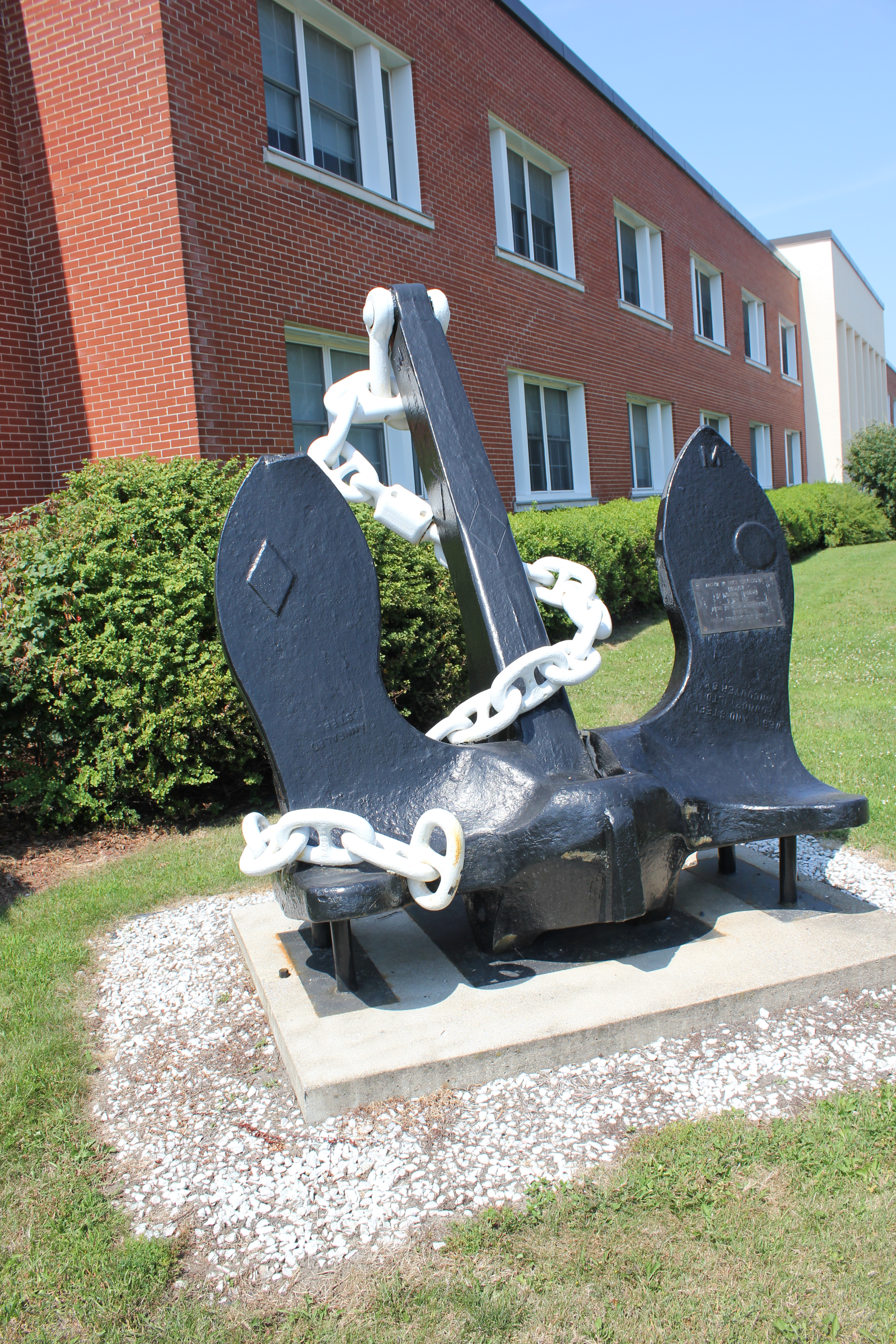
Fortunately, there are several relics of Bonaventure’s time in Canadian service scattered around Canada. In addition to several surviving aircraft in various museum collections, Bonnie’s “Mule” or deck tractor, is in the collection of the Canadian War Museum in Ottawa [click here for a link to the artifact entry]. The ship’s bell is at the Shearwater Aviation Museum, across the harbour from her usual berth, in Dartmouth, NS. Two signal guns are located at HMCS Discovery, Vancouver BC. Two of Bonaventure’s immense anchors are also preserved. The starboard anchor is on display at the Collège militaire royal de Saint-Jean, Saint-Jean-sur-Richelieu, Québec.
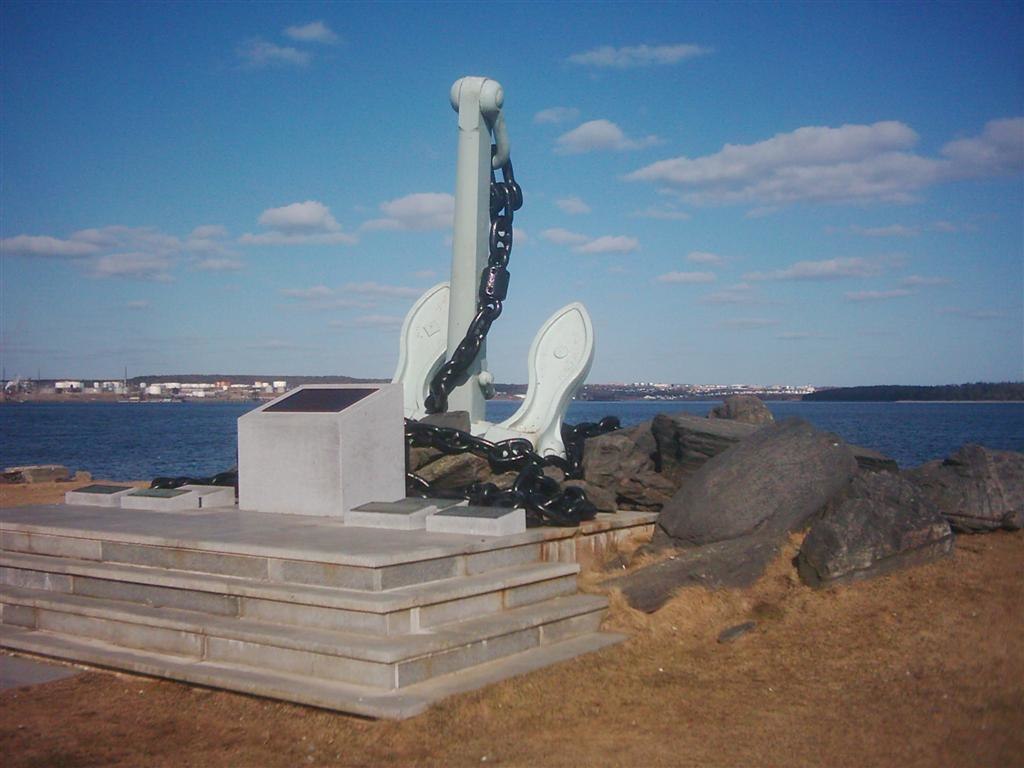
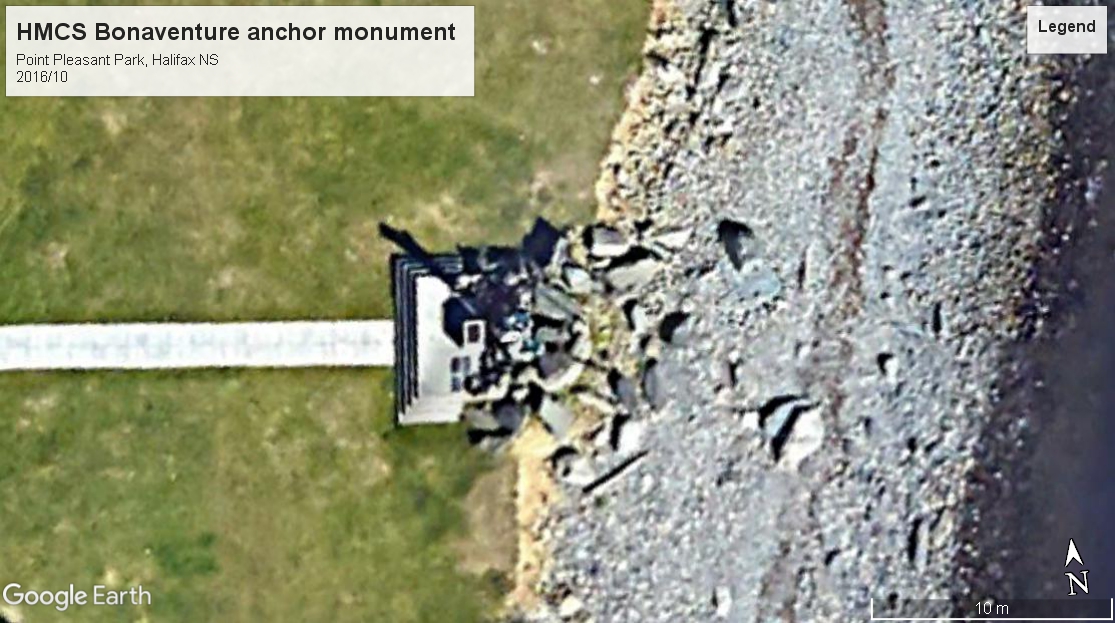
The port anchor has been located in Point Pleasant Park, Halifax, since 1973. This 9-ton stockless anchor is the centerpiece of the Canadian Peacetime Sailors’ Memorial, which is dedicated to the memory of post-1945 Canadian naval deaths. In early 2018, the deteriorating monument was substantially rebuilt by local reservist members of the Royal Canadian Air Force.
For a few more views of Bonnie and some related topics, check out our RCN carriers tribute page. We decided to add Bonaventure to our database project, which mostly features google earth images of (at last count) more than a thousand warships from 27 navies, because we intend to find other aerial imagery that allows us to further interpret the history of RCN carriers and other ships, once the World reopens.
J.D.F. Kealy and E.C. Russell A History of Canadian Naval Aviation 1918-1962 (Ottawa: Queen’s Printer, 1965) p.116. ↩︎
Differences between the two sub-classes, the original Colossus and the Majestic units, are explored elsewhere on this site, under the relevant navy pages that include these carriers. Two ships of the 15 were also completed as maintenance carriers, and had very different careers. ↩︎
The Centaur class carrier INS Viraat (ex-HMS Hermes, shown above), served 58-years, from 1959-2017. By comparison, the longest serving US Navy aircraft carriers have been the USS Midway (1945-1992 – 47 years), and the recently decommissioned USS Enterprise (1961-2017 – 55 years) ↩︎



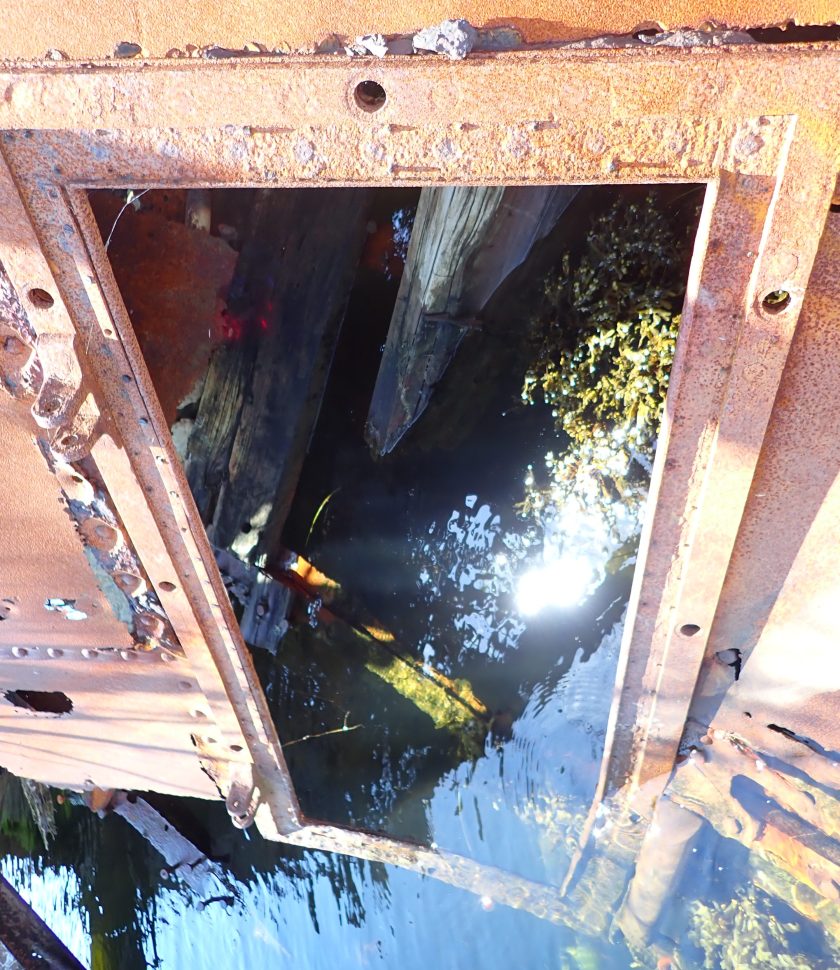

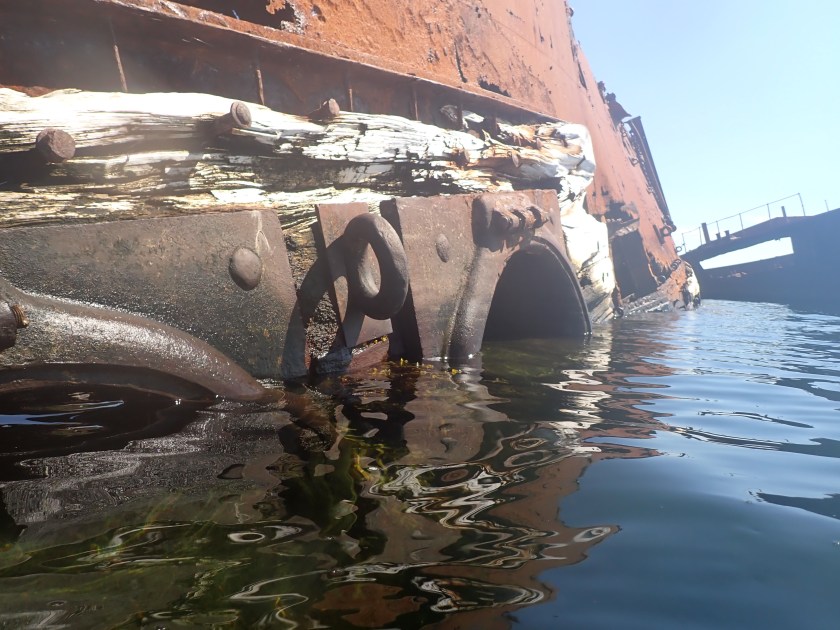
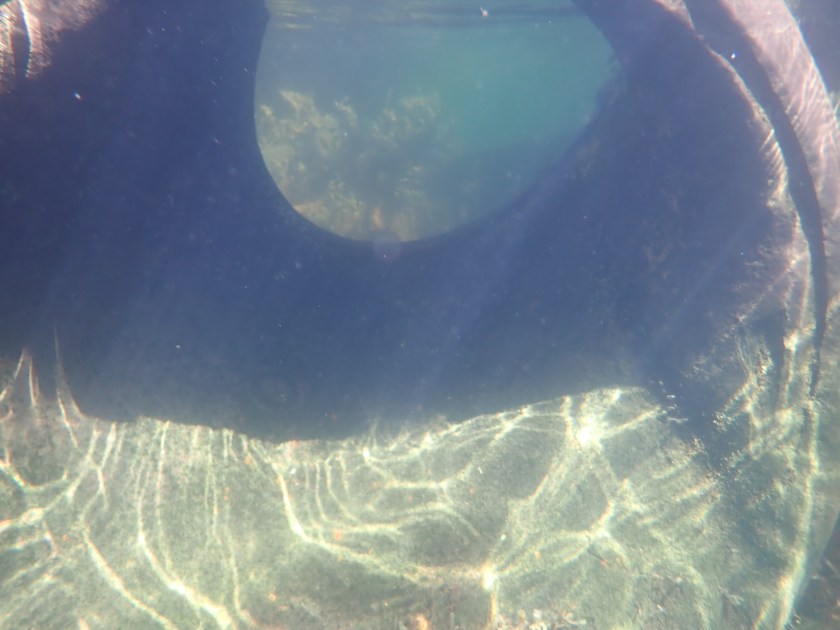

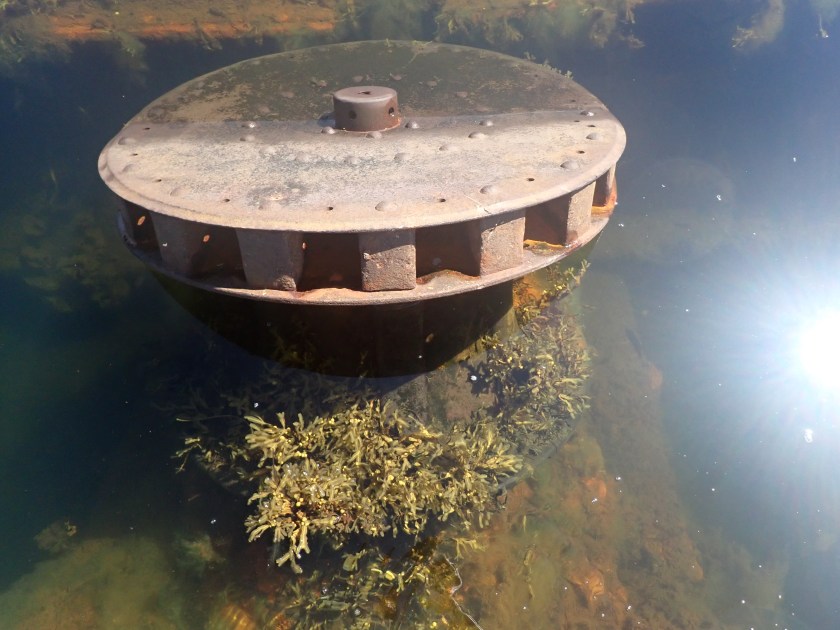
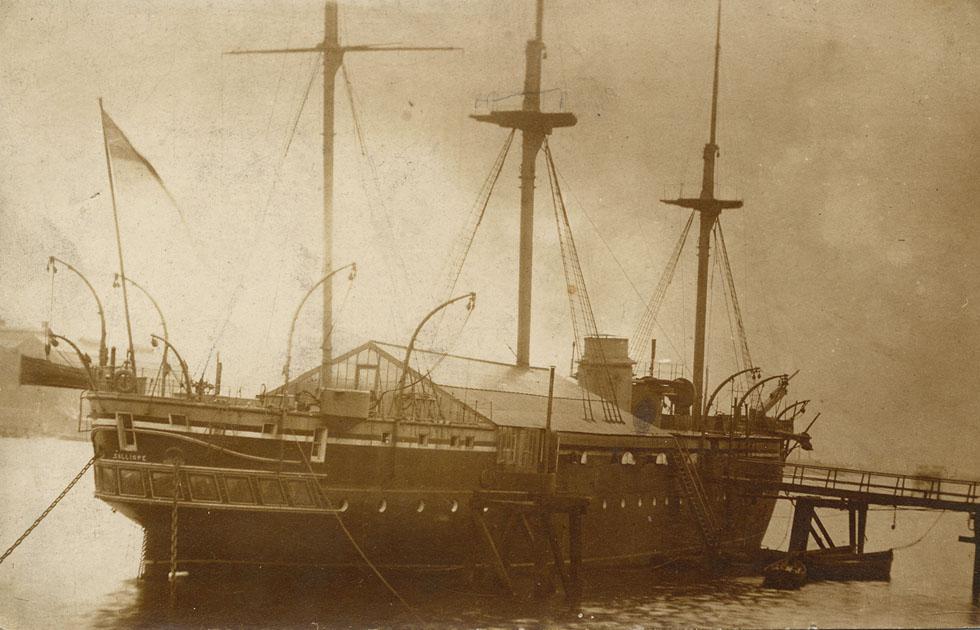

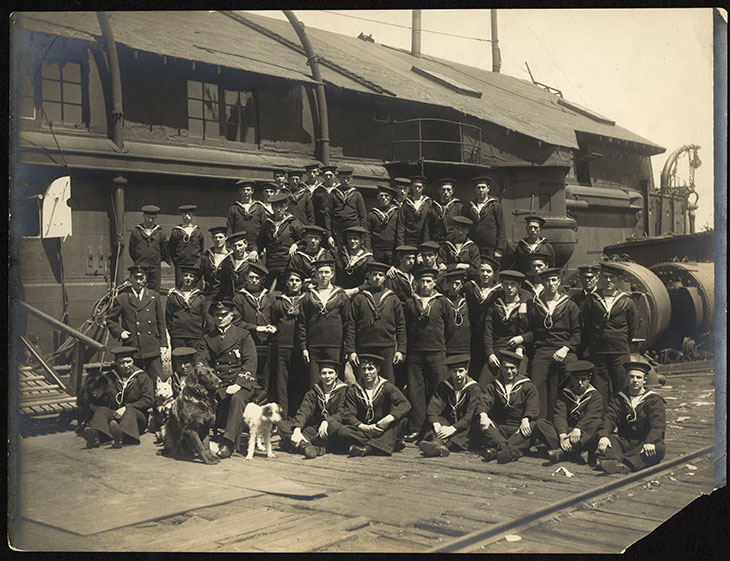
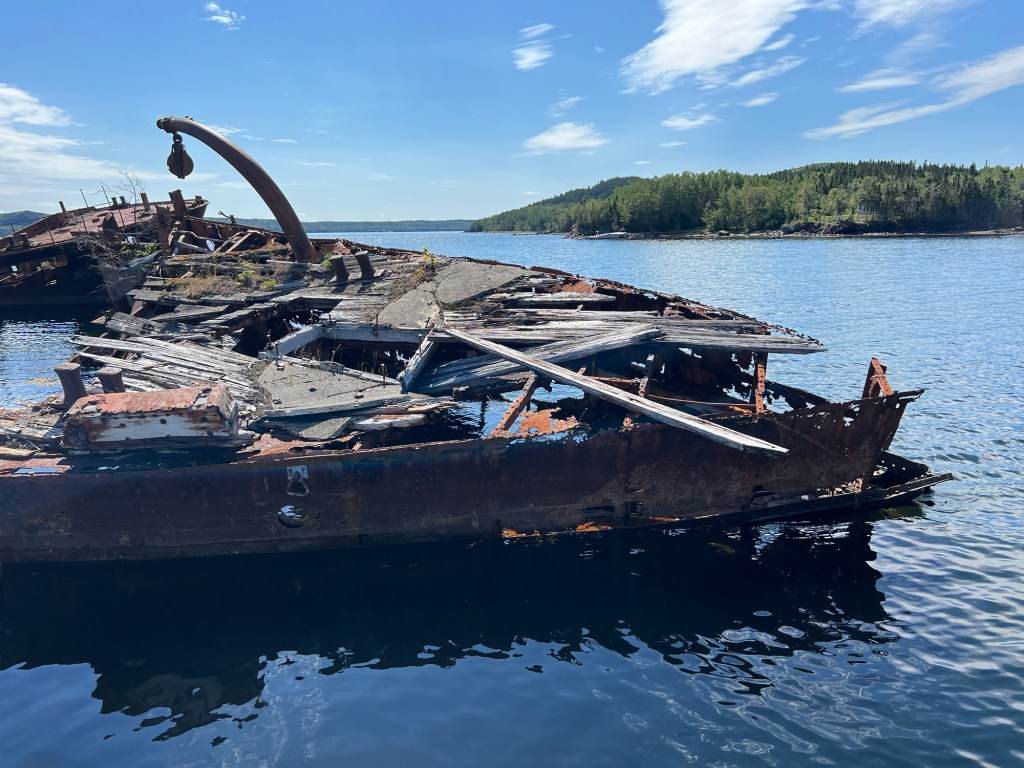
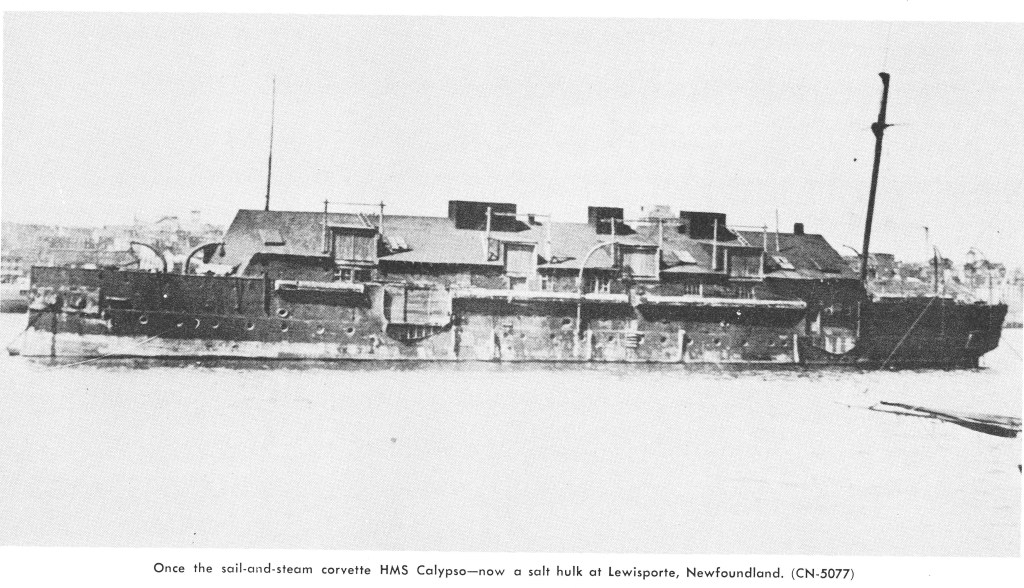







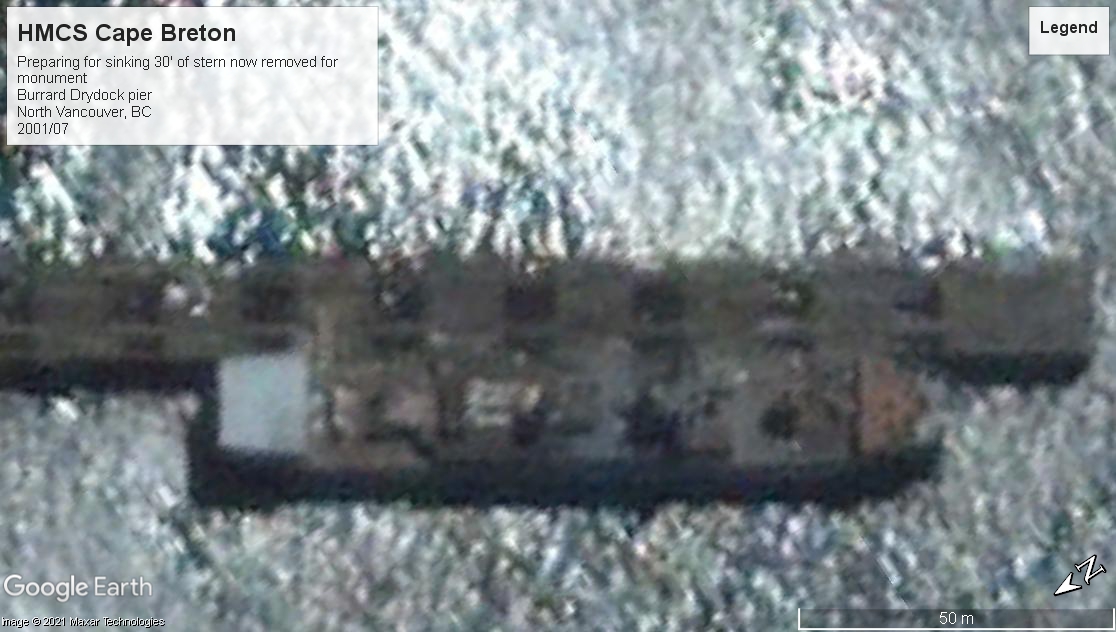 The old ship was towed out to Snake Island near Nanaimo, BC, and sunk on 20 Oct. 2001. The wreck remains a popular dive site, close to the resting place of HMCS Saskatchewan. The monument, meanwhile, was first moved near an old shipbuilding shed slightly North of the Burrard pier.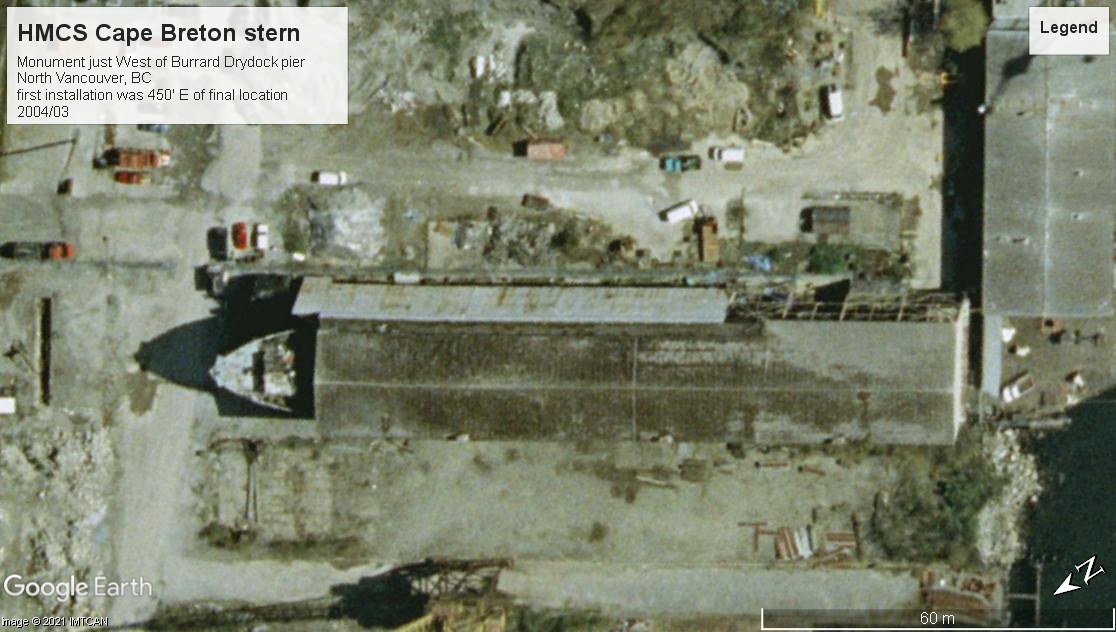






 For a few more views of Bonnie and some related topics, check out our
  The Searchers