Propelling the Terror – modelling a lost Franklin Expedition Ship’s “Steampunk” Victorian Stern

I recently wrote “Could I contemplate a scenario where new information would compel me to get back to work revising my Terror diorama?”1 Well, that situation happened almost immediately! In this post, I focus on what may seem a minor discovery – HMS Terror’s 1845 screw propeller. I argue that it is one of the outstanding finds at either Franklin Expedition wreck site. I will explore the history of this well-preserved artifact and situate it in a revolutionary program of naval ship design. I will conclude by showing how I incorporated the propeller into my diorama of the wreck site.

One hundred and eighty years ago, a visitor to Her Majesty’s Dockyard, Woolwich, near London, would have been treated to a memorable sight: one of Queen Victoria’s warships – under refit to explore the Arctic – was up on the stocks in dry-dock. This was one of a pair of bomb vessels (a type of specialized mortar-armed bombardment ship) which had been converted years before for polar missions. These tough ships had more than proved their mettle during James Clark Ross’s wildly successful expedition to Antarctica. Now the duo – each painted in severe black with a broad white strake stretching along the hull – had been selected for a new “Discovery Service” mission, to be commanded by Sir John Franklin: Complete a Northwest passage across the top of North America. Walking around the dock to the ship’s stern, that visitor would have seen something unusual: a strange cavity low down at the swollen stern post. This was just inboard from an enormous rudder. The hole opened clear through to the other side, like some casemated gun embrasure. Set into this void was a metal monstrosity: A cylindrical shaft with two broad blades twisting away from it. The visitor may have recognized this as a screw propeller – a marvel of the age. When coupled by a long shaft to a steam engine mounted in the bowels of the ship, the rotating screw could propel the vessel – all without a single sail of the lofty three-masted rig drawing a favourable breeze. If that same visitor had returned later, they may have felt the dupe of some trick: the machinery could have completely disappeared, leaving the man-sized hole. As if by some further sleight of hand, the whole cavity could have also appeared closed up, with only a faint rectangular outline now in evidence. What category of navy ship was this anyways? A sometimes-steamer with a propeller that unscrewed right off?! Indeed, here was something completely new: The first auxiliary screw-propelled polar exploration vessel!
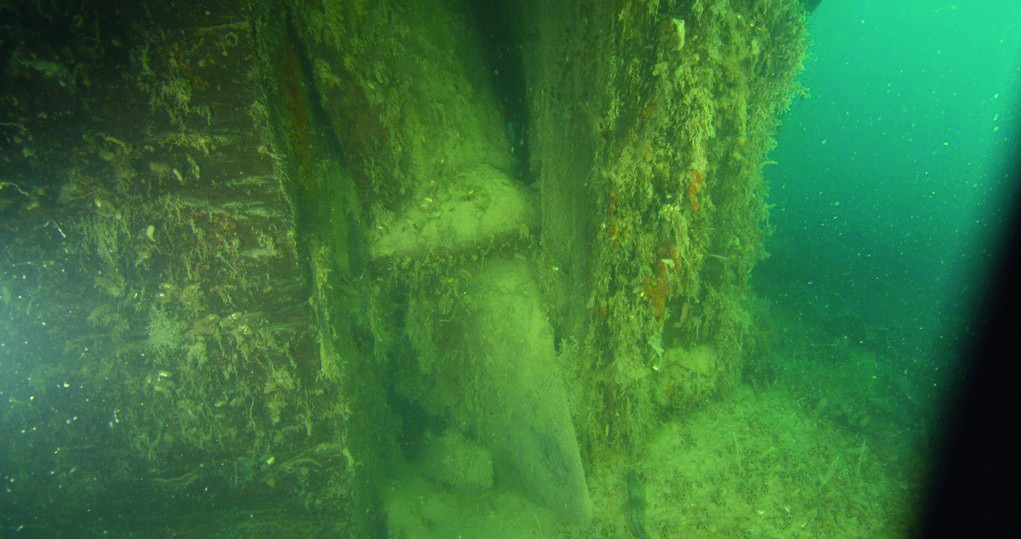
The propeller, lowered and possibly installed in its aperture at the stern of the HMS Terror wreck, as photographed by the Underwater Archaeology Team during the late summer of 2019. Credit: used with written permission of Parks Canada, who retain copyright. Scroll down to the next page to see my model of this area.

Early this year I was searching for information about the 2024 Parks Canada program of archaeology on the Sir John Franklin shipwrecks, HM Ships Erebus and Terror in Nunavut, Canada. Instead, I stumbled upon a new post “Anchors and Propellers” by Franklin Expedition scholar and veteran searcher David Woodman on his site: Aglooka.2 This update assembled interesting information about the ships’ complement of anchors, and also their propellers. Reading on, I encountered a previously unpublished image from the Parks Canada Underwater Archaeology Team (above). I was stopped dead in my wake! Here we see Terror’s screw propeller, installed in its aperture! With this photograph, we have the first visual confirmation that a marvelous piece of Victorian maritime technology has survived relatively intact after more than 175 years of immersion at Terror Bay.3

This simple two-bladed screw is one of the most important artifacts existing at either Franklin shipwreck site. The Commemorative Integrity Statement relating to this National Historic Site of Canada specifically identifies the marine screw propulsion as a character-defining aspect of the sites, demonstrating the 1845 technological innovation of the Expedition.4 From the waterline up, both ships looked much like they had during J.C. Ross’s expedition to Antarctica (1839-1843). Erebus and Terror were also not the first ships with an auxiliary steam engine to go north: In 1829 Ross’s uncle, Sir John Ross, had taken Victory north with an experimental – and mostly useless – steam engine.5 However, the idea of fitting a removable screw propeller into a Discovery Service exploration vessel was truly original. The suggestion came from a superstar in polar exploration. As Dr. Matthew Betts relates in his book HMS Terror – The Design, Fitting and Voyages of the Polar Discovery Ship, the seasoned Arctic explorer Sir William E. Parry – who now had an official role in investigating the optimal methods of steam propulsion in the Royal Navy – believed that the new propulsion technology could give vessels operating in the Arctic Archipelago a big advantage: The ability to navigate tight passages free from any dependence on the vagaries of the winds.6 Having auxiliary steam propulsion available to the Expedition captains could help force a constricted passage, position the vessels to better meet the rigors of overwintering in ice (for example by allowing them to get to a safe harbour or a more sheltered section of coast), or get them clear of an immediate hazard, such as an errant iceberg or a perilous lee shore. Parry’s experience commanding similar vessels in the Arctic provided him with an invaluable perspective on how screw propulsion could support this new attempt to transit the Northwest Passage. The Admiralty endorsed Parry’s idea.

Oliver Lang, Master Shipwright at Woolwich, was responsible for working up a technical plan to meet this new requirement. A half-century after he had begun drafting designs, he remained at the forefront of marine technological innovation. During the early 1840s, the military strength of the Royal Navy still rested on the line of battle ships of the sailing navy, those wind-powered “wooden walls” whose broadsides of cannon had allowed Great Britain to dominate the World’s sea lanes. Lang applied new technologies to both mercantile and Royal Navy vessels. He strengthened the basic structure of warships, packed their hulls with new innovations, and enhanced crew comforts onboard, especially to improve lighting and circulation of air. His innovations helped equip the fleet with larger, stronger, and safer warships. He had recently turned to incorporating steam technology into his designs. There had been experiments with steam engines and, since the early 1820s, some small naval units had been propelled by paddle-wheel. The Admiralty was conducting a series of trials of steamers to test a variety of newly-designed screw propellers against paddle-wheel propulsion.7
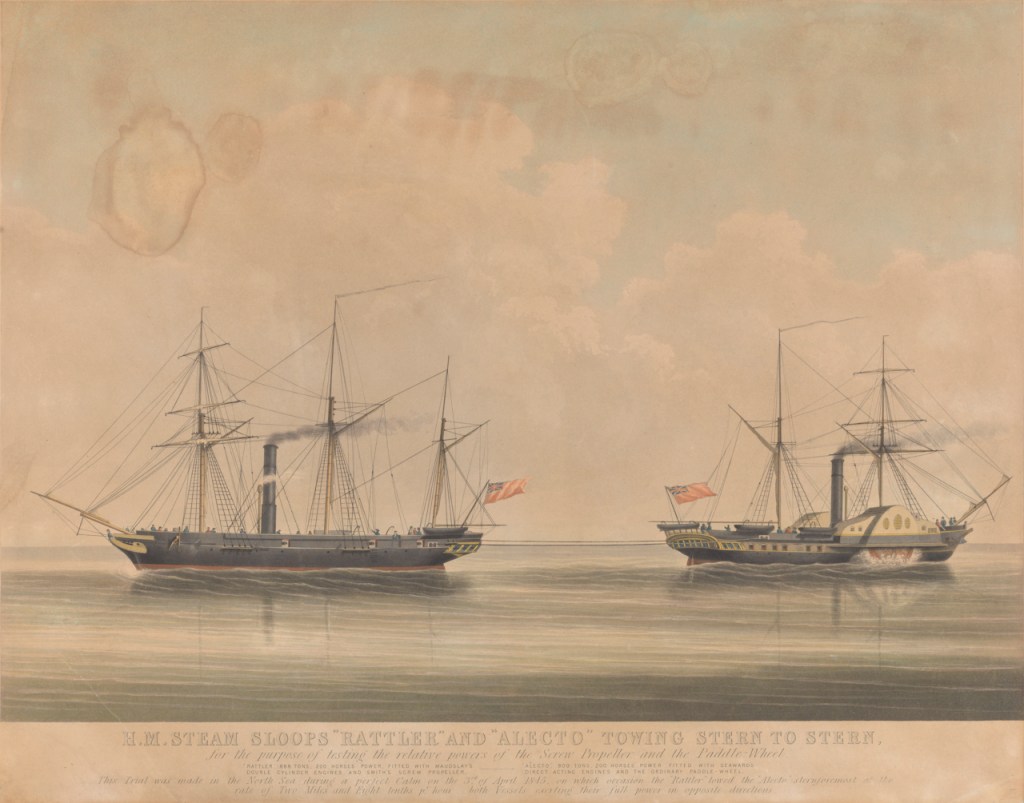
The famous trial of H.M. Steam sloops Rattler and Alecto, 3 April 1845 (artist unknown). Rattler (left) displays Lang’s newly-installed mizzen mast. PAH0923 Credit: National Maritime Museum, Greenwich

Lang’s own treatise Improvements in Naval Architecture (1853) is an important source for understanding his remarkable career. In his own words he “Arranged and fitted the first SCREW propeller to ship and unship in a TRUNK, so as to be taken up on deck in the ships “Erebus” and “Terror” on the late Arctic Expedition for Sir John Franklin.”8 The years 1844-46 were a busy period for Lang, which saw him embark on an ambitious campaign of propeller experimentation, design, and installation. He had first improved upon Rattler’s recently-installed propeller by re-rigging this steamer with a new mizzen mast, which could be used to lift the propeller in its frame straight upwards through a slot which communicated with the steamer’s weather deck. This allowed the crew to ship and unship the propeller, without specialized dockyard facilities.

While building the large steam frigate HMS Terrible (1845 – fitted with paddle wheels), he moved on to designing and fitting his first complete naval propeller assembly. HMS Phoenix (1832) was modified from a paddle-wheeler to a screw steamer. Most of the essential elements of a Lang screw-fitted stern were now in place: propeller aperture, screw propeller, false stern or rudderpost behind the sternpost, a passage for lifting the screw upwards to the weather deck, and the means for lifting it out. The modifications to the Phoenix were underway when he got the “rush order” for the work on the two Northwest Passage exploration vessels.9
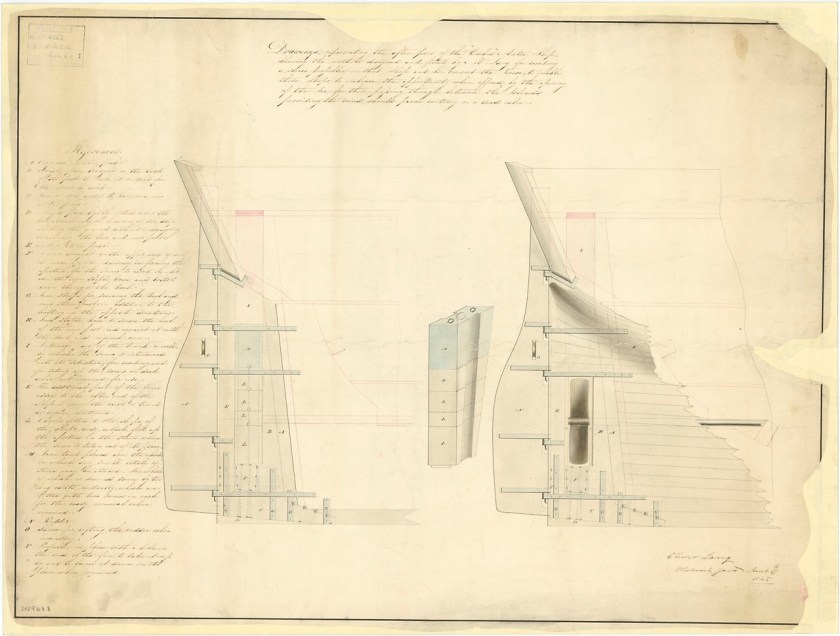
March 1845-dated plan of the modifications to the stern of both HMS Erebus and Terror, showing the massive rudder and stout construction. At left the screw propeller is raised and the full chock fills the aperture, while at right the simple two-bladed screw is installed and connected to the shaft which leads forward to the railroad steam locomotive that was installed in the hold. © Crown copyright. National Maritime Museum, Greenwich, London ZAZ5683, CC BY-NC-ND

The main difference in modifying Erebus and Terror with auxiliary propulsion (with much less powerful steam engines converted from railway locomotives) was that the screws would only be fitted during occasional steaming, and chocks would fill each ship’s propeller aperture most of the time. This filler needed to streamlined into the lines of the hull to not weaken a vulnerable area, and to continue to guide the flow of water aft to the rudder. Lang’s other designs had the propeller fitting into its own iron frame, with the entire assembly lifted through a narrow passage to the deck, or lowered back in place. Erebus and Terror, by contrast, had rails that guided the propeller, which was lifted on its own.
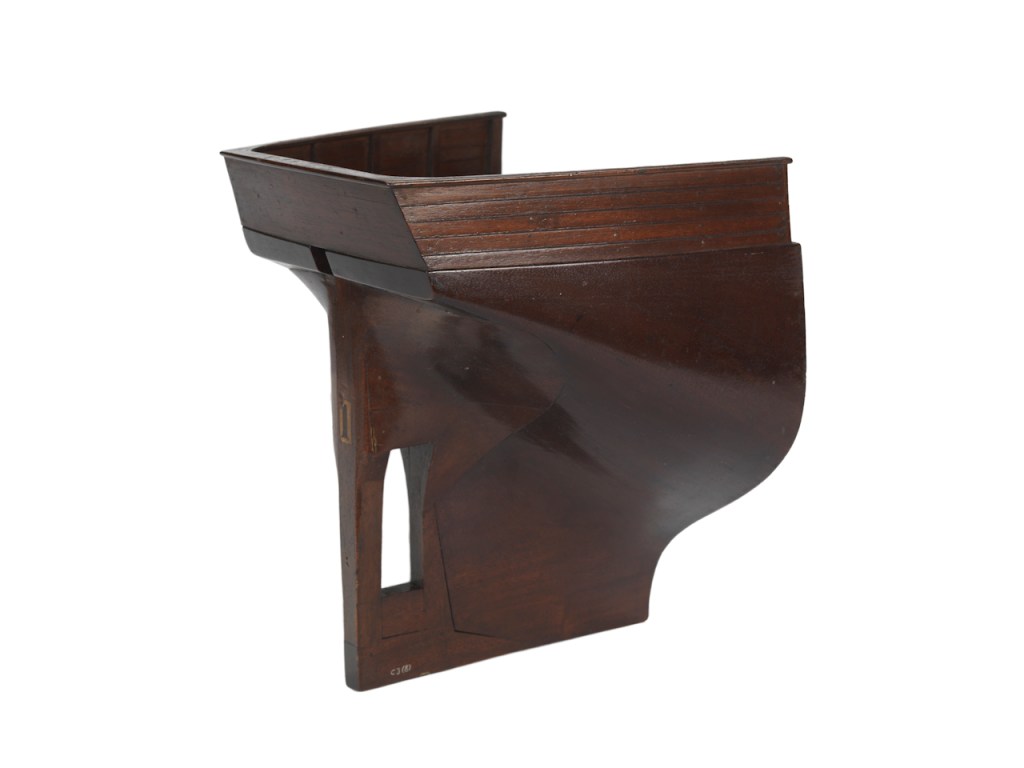
A model of the stern of the Arctic ships as modified by Lang in 1845, showing the propeller aperture, and the bracing of both the stern post and new rudder post to permit the propeller to be hauled up into the trunk and on deck. A view from above shows the almost square passage for lifting or lowering the screw and installing the chock, and the smaller opening for the head of the rudder. Like at the wreck-site, the enormous rudder that would normally project aft is absent. SLR2253 Credit: National Maritime Museum, Greenwich, London.

Phoenix was ready in February 1845, and Lang moved to the design of HMS Niger, which would go on to be used in a more balanced round of evaluations of screw-versus-paddle propulsion (with Niger and Basilisk a closer match than Rattler and Alecto had been). During April, the Franklin ships were modified with their unique combination of adapted railway steam locomotive – installed deep down in the after hold – and auxiliary propeller. Woolwich dockyards had its own highly specialized engineering facility – the “Steam Factory” – with the equipment and docking slips to install the new steam systems. Lieutenant Henry T.D. Le Vesconte of HMS Erebus provided a contemporary description of the work. Writing to his father on 2 April 1845 – after he discussed the excellent prospects for promotion that would come his way by serving with the Franklin Expedition – he noted: “The ships are at present in dock where we are rigging each and stowing them while the shipwrights are altering their sterns by bracing on abaft the stern posts an large mass of timber of the same thickness in which to work the screw propellers the engines will be put in next week[…].”10 After the engines and propellers were tested, and the ships finished provisioning, the Expedition departed from Greenhithe, 19 May 1845. (Continue to explore Terror’s screw propeller on the next page)
HMS North Star CRUSHES IT in the Arctic and Saves the Searchers!

HMS North Star was an outstanding ship with a most fitting name. Like her namesake, the Pole Star, she guided mariners back home from the edges of the charted World. Though overshadowed by the lost Sir John Franklin 1845 Expedition ships Erebus and Terror, and the famous vessels searching for them, Resolute and Investigator (to name two), North Star did exceptional work in the Arctic.1 Her transformation from fighting corvette to expedition depot ship may not seem as interesting as the refits those other ships received. Actually, the 1849 rebuild created an Arctic juggernaut – a vessel tough enough to withstand collisions, groundings, ice “nipping,” and general Arctic pummeling during two missions over the course of five busy years. When all other ships had to be abandoned, North Star brought the Sir Edward Belcher Expedition home – saving the Franklin searchers!

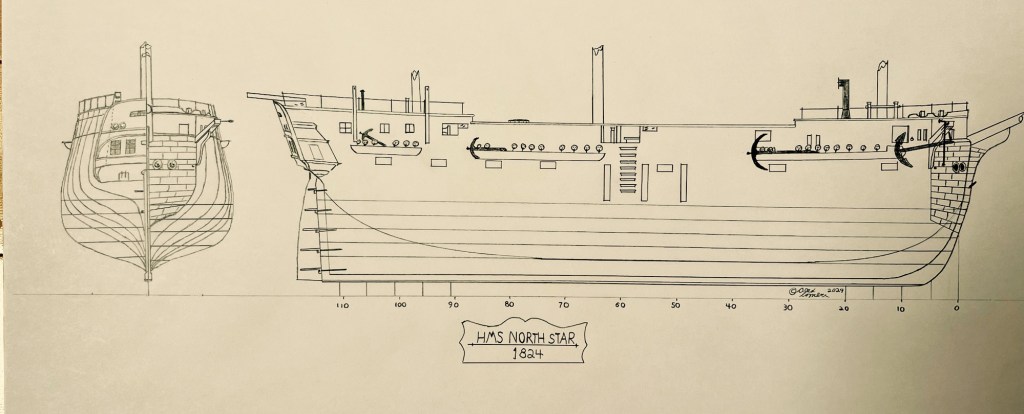
Our interpretation of HMS North Star’s updated appearance ca. 1849-1854, ready for the Arctic! Credit:www.warsearcher.com adapted from National Maritime Museum plan ZAZ3213 and other technical info and used with written permission of NMM staff.

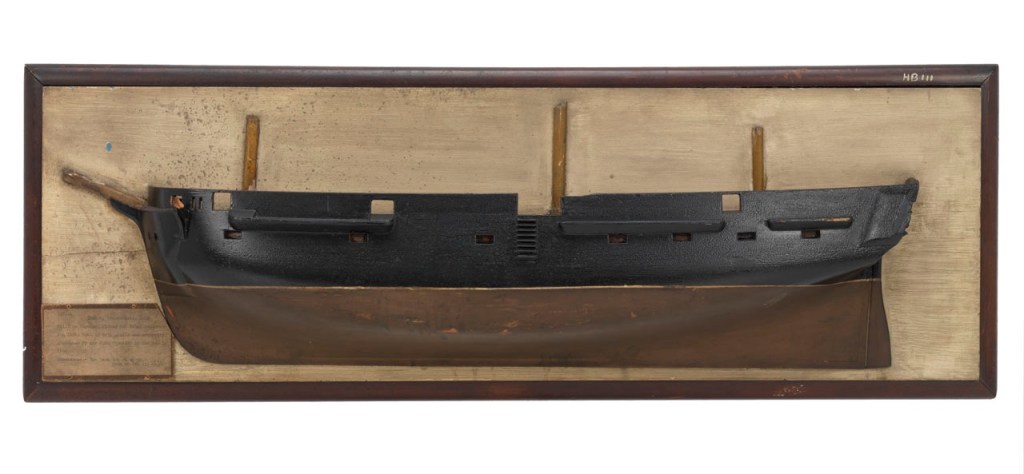
HMS North Star was launched at Woolwich dockyard in 1824 and completed in 1826, to a trim design – an Atholl class corvette – that we explored in a recent post.2 Like other “Donkey Frigates,” she spent much of her career in distant waters. “Donkey Frigates” was a contemporary term for a small frigate-like corvette performing the roles normally taken on by larger, more expensive to operate warships, such as Leda class frigates. A fine record of the 1826-1848 events of North Star exists at the “Index of 19th Century Naval Vessels and some of their movements” at RootsWeb. Her early service came as a member of the West African Squadron – patrolling to suppress the Atlantic slave trade. This was followed by participation in two of Britain’s imperial wars of the mid-19th Century.

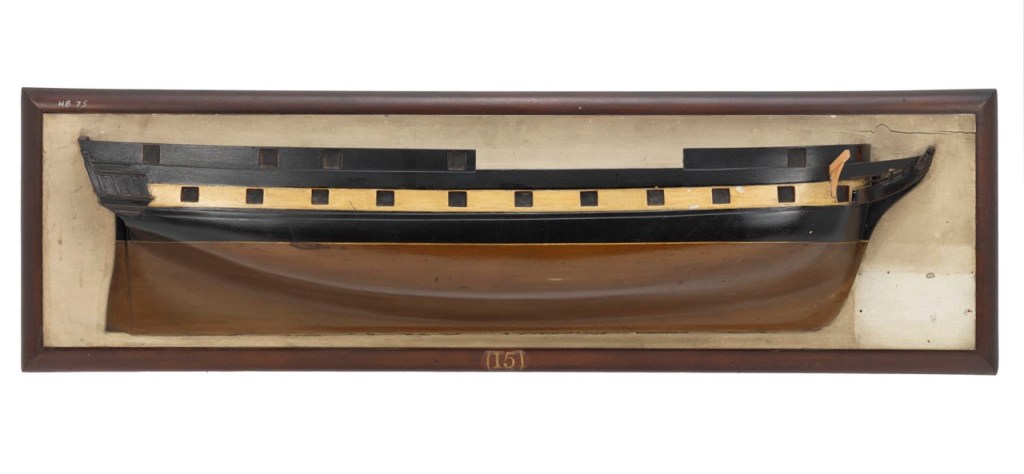
A half-hull model of HMS Rainbow (1823) North Star’s sister. This model shows the clean lines of the original corvette design. SLR0706 Credit: National Maritime Museum, Greenwich, London.

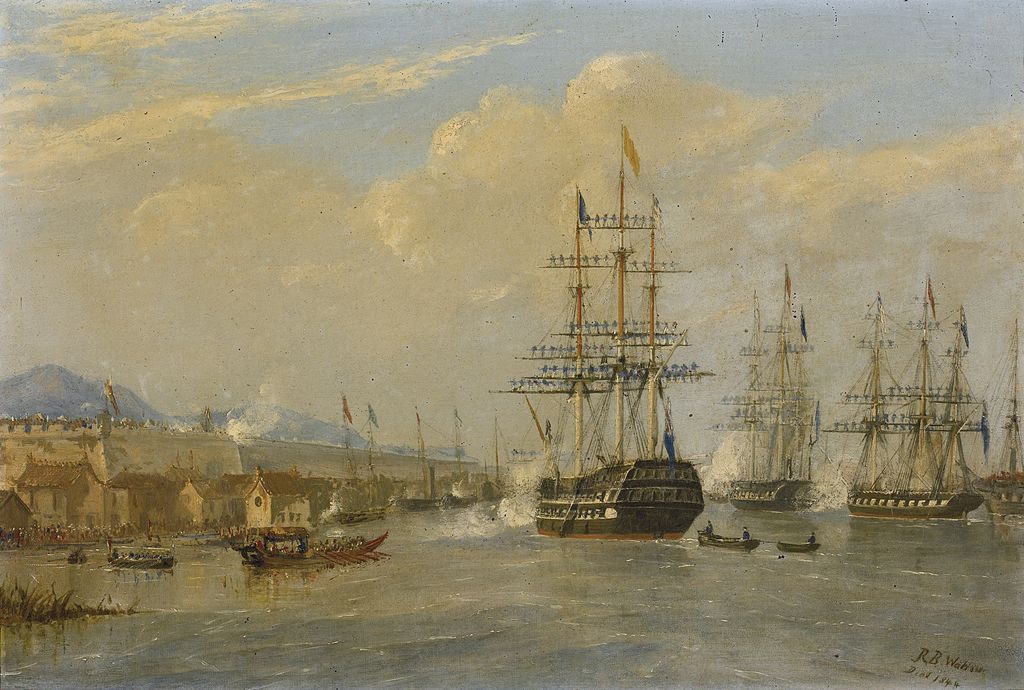
A member of Sir William Parker’s fleet involved in the First Opium War (Anglo-Chinese War), she was present at the signing of the Treaty of Nanking in August, 1842. During 1845-46 North Star operated around New Zealand during the Flagstaff War, contributing shore parties that fought in battles against Maori warriors who were resisting the recently-imposed colonial regime. At the same time, at the frozen top of the North American landmass, Sir John Franklin and his two ships – making their bid for completing a Northwest Passage – were wintering at a location that would figure large in North Star’s subsequent history: Beechey Island.

HMS Cornwallis and the British Squadron saluting the peace treaty at the signing of the Treaty of Nanking 29 August 1842. HMS North Star under Captain J.E. Home was present. Rundle Burges Watson, Public domain, via Wikimedia Commons

Three years later, public concern about the condition of the missing Franklin crews was reaching fever pitch. North Star was ordered north to rendezvous with Sir James Ross’s search expedition, consisting of HMS Enterprise and Investigator. North Star, under the command of Master James Saunders, would carry provisions to help continue Captains Ross and Edward Bird’s Franklin search. Saunders was familiar with the Arctic and the lost ships: he had served on Terror for George Back’s 1836 Frozen Straits Expedition. Before the veteran warship and her forty crew members could depart, she had to be extensively modified to survive in one of the harshest maritime environments.

Master Shipwright Oliver Lang, who had been involved in the 1845 modifications to Erebus and Terror, supervised the work. More than a hundred shipwrights were tasked with the modifications at Sheerness dockyard from late February 1849. In April, that number surged to two hundred. They worked feverishly to get the ship ready for a mid-May sailing. Of all the ships that Lang was involved in refitting for Arctic service, North Star was special. What emerged from drydock wasn’t like the three other Atholls involved in the Franklin searches. It wasn’t last war’s corvette, a light survey vessel, a troopship, or some “Donkey Frigate.” Lang had created a monster! The design looked whacky, but it would prove to be the right kind of crazy for the challenges that awaited the Belcher Expedition in the Arctic.3

HMS North Star‘s updated bows, including the simplified stem and massive iron sheathing. Credit: ILN staff The Illustrated London News, 26 May 1849, Public domain, via Wikimedia Commons

The headrails and decoration at the bows were removed and a prominent ice guard of iron sheathing was installed. This projected out on a shelf-like section. Two massive hawse holes pierced this ice guard on either bow, to pay out and haul in the thick anchor cables. Reinforced catsheads supported massive port and starboard bower anchors.

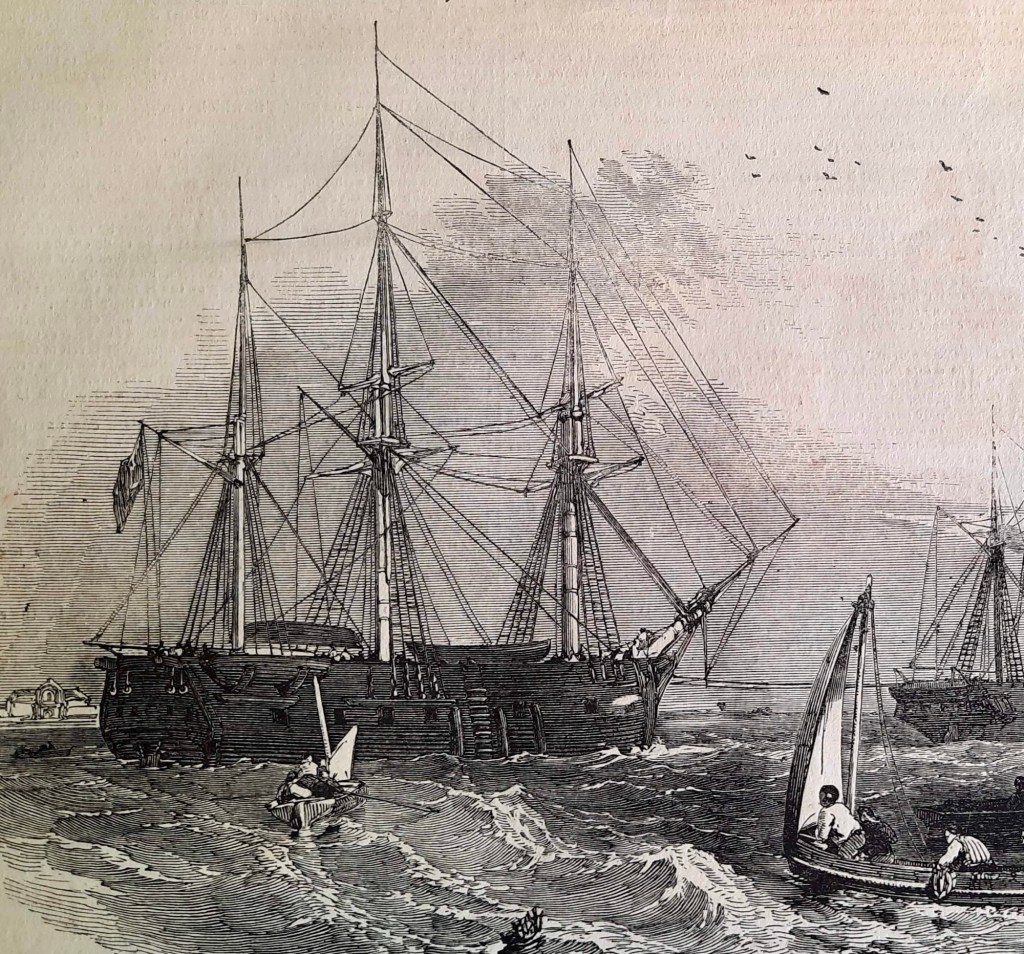
A detailed view of North Star‘s bow as it appeared in 1852.”Sir Edward Belcher’s Arctic Expedition, sent in search of Sir John Franklin” Illustrated London News 17 April 1852 P305

Stretching aft along the sides of the hull, the channels were filled-in to protect the shrouds against ice damage, and massive vertical riders were installed amidships near the entryway stairs. Along the gundeck, several gunports were deleted, while the remaining ones were simplified to small scuttles-an identifying feature of this vessel. Heavy davits were hung out over either quarter over the mizzen channels to hold the boats securely. The davits over the stern had to be especially strong as this was also a location to hang the comparatively fragile rudder off of when the ships were beset in ice.

An Admiralty model long thought to be HMS Terror or Enterprise, has been identified by us as HMS North Star as modified for Arctic service. Credit: National Maritime Museum, Greenwich, (SLR0832)

The decorative stern and quarter galleries were simplified, with the lights (windows) appearing as narrow slits. Another pair of hawse holes appear to have been installed in the transom over the stern at the level of the quarterdeck, in a similar position to sister Rattlesnake’s fittings (an image of this appeared in the earlier post). These may have been intended to help position the vessel during anchoring or for shifting cargo to expedition vessels alongside. Flanking this rugged stern, the old quarter galleries were simplified. The three-masted ship rig was reduced to a barque by simplifying the yards of the mizzen mast.

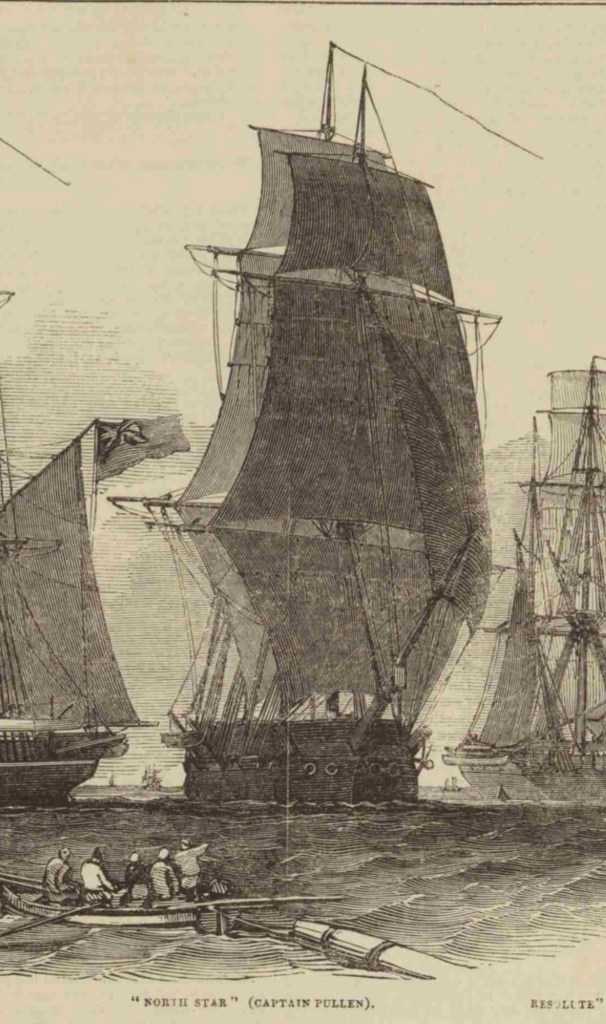
HMS North Star towed out by the Stromboli departing for her first Arctic Franklin search expedition in early 1849 [detail of]. This is one of the most detailed views of North Star‘s modified appearance. Illustrated London News 26 May 1849 P340.

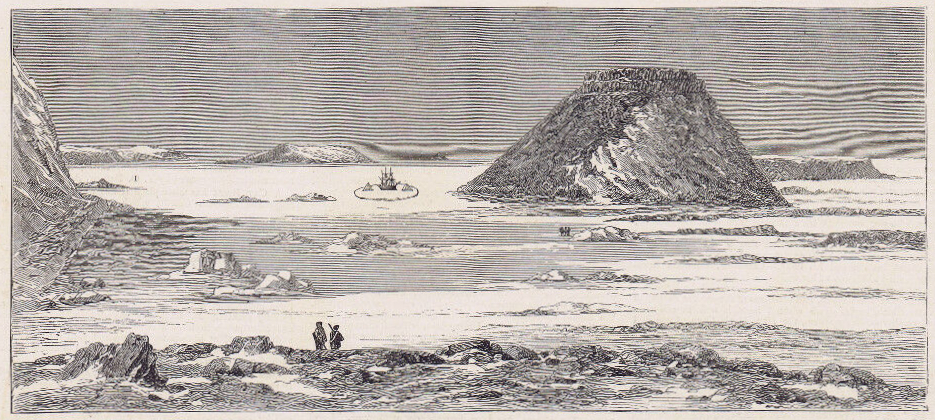
North Star was towed from Greenhithe by HM Steam Vessel Stromboli, departing 16 May 1849. As the season progressed, Saunders was not able to locate Ross, and instead dropped stores where they may have come in handy to either Franklin’s crews or expeditions searching for them. He departed the Canadian Arctic to re-cross Baffin Bay to Greenland. On the return journey, North Star endured treacherous ice conditions starting in July, and was nearly crushed several times. Eventually the crew sought shelter at Wolstenholme Fjord and the ship was beset in September. They overwintered further north than previous expeditions, on the coast of northwest Greenland near a table-topped mountain named Dundas Hill (Umanaq).

North Star Bay, with the ship frozen into the unusual surroundings of Dundas Hill/Uummannaq near the site of present-day Qaanaaq (fmr. Thule). Credit: Horace Harral, the Graphic 13 Nov. 1875 Public domain, via Wikimedia Commons

Four crew members perished during this time, and were buried nearby. When the ice cleared, Saunders turned west to return to the Canadian Arctic, to Baffin Bay and Wellington Channel, depositing more supplies at Navy Board Inlet. He learned that Ross had sailed for home from a chance encounter with William Penny (leading a privately-funded search expedition). North Star returned to England in the summer of 1850. Penny and Capt. Horatio Austin’s crews jointly discovered that Beechey Island had been the site of Franklin’s first overwintering – an event that would focus subsequent searches.

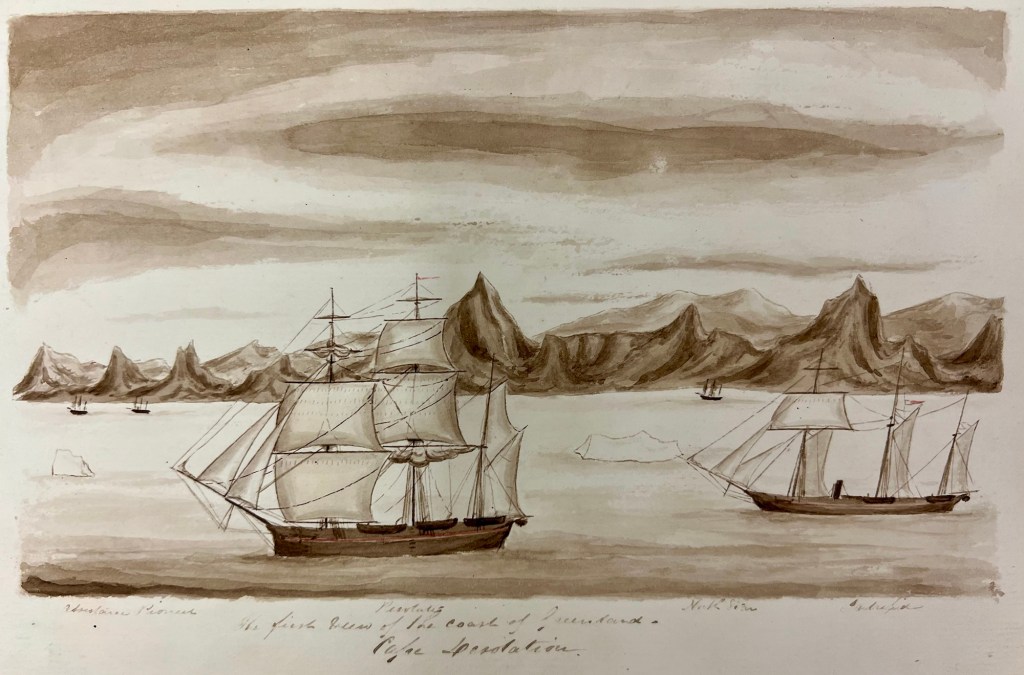
The Admiralty sent North Star back up again in early 1852, under the command of William J.S. Pullen. Pullen had distinguished himself in boat-led exploration missions while detached from the early western Arctic searches of HMS Plover and Herald. The new assignment was to travel with the large search squadron now being assembled by Sir Edward Belcher: HMS Assistance (Cmdr. George H. Richards) and HMS Resolute (Capt. Henry Kellett), and their steam tenders, Pioneer (Cmdr. Sherard Osborn) and Intrepid (Cmdr. Francis Leopold McClintock). North Star’s role was the unglamorous-yet-vital one of supply and provisioning.


“The first view of Greenland, Cape Desolation 21 May 1852” the Belcher squadron is all depicted, with Kellett’s and McClintock’s commands, Resolute and Intrepid, in the foreground, passing some bergy bits. Credit: Mumford Fonds, Library and Archives Canada 86-18-3

The Belcher Expedition used the same successful quartet of vessels that had gone up under the command of Austin in 1850, but added the depot ship to the mix. This, it was hoped, would help the search ships explore further and stay on mission longer than previous attempts to locate the long-lost Expedition.

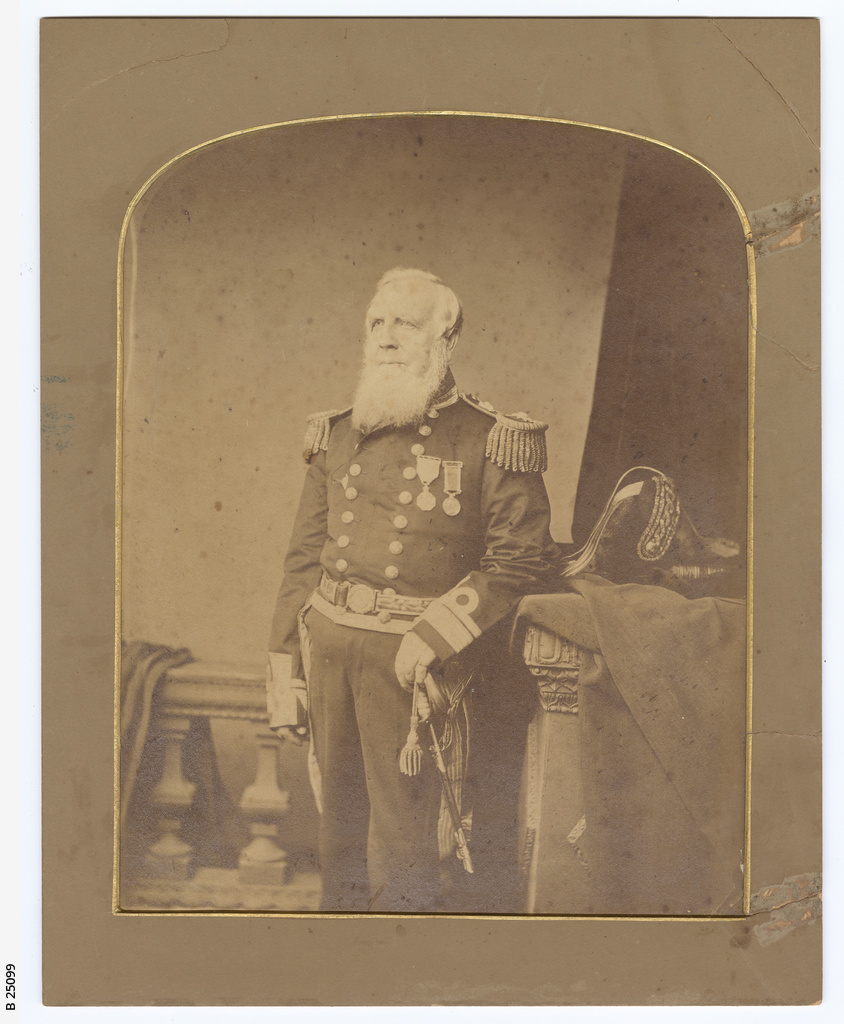
A formal portrait of WJS Pullen 1813-1887, depicted later in life, in the full dress uniform of a Rear Admiral, wearing the Arctic and Crimea Medals. Courtesy of the State Library of South Australia B25099.

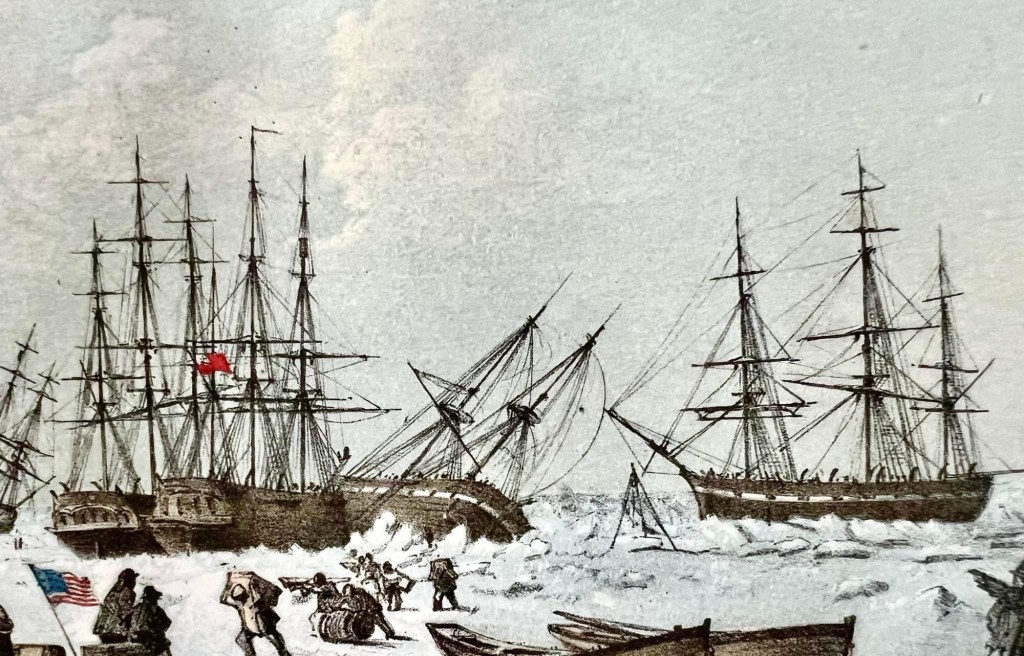
In early July 1852 the squadron was moving up Baffin Bay. They encountering some of the yearly whaling fleet while navigating along ice floes. North Star was damaged by the American barque McLellan. The threat of being caught between land floes and the floating pack ice was ever-present. A moment’s change in conditions could “nip” ships between these two frozen masses, without sufficient time to cut a protective “ice dock” into the land floe. Several whalers and North Star were nipped July 7th. The shuddering and wild pitching of hulls created a demonic clanging of ships’ bells. The unfortunate American whaler had also been forced against both North Star and the Alexander whaler (from Dundee). North Star‘s starboard cathead was mauled, and crew worked frantically to save the jibboom and bowsprit. As McLellan was further destroyed on the 8th, carpenters salvaged much of the hulk, and set North Star to rights.

George Frederick McDougall “The Loss of the McClellan – American Whaler” 8 July 1852 [detail of] this view shows a view of North Star, the nearer ship at left flying the red ensign, which shows some remaining transom lights and decoration, and the rudder suspended from the stern davits. Credit: Elizabeth Matthews (https://www.hms-resolute.co.uk/) used with permission.

Days later, the ship was proceeding up Lancaster Sound along the southern shores of Devon Island. Even with her rugged alterations, North Star proved the finest sailer in the squadron.4 In August, at Beechey Island, the search ships topped up coal stocks from the depot ship’s supplies. Assistance and Resolute departed separately with their steam tenders to search different areas of the Arctic archipelago. They deposited caches of supplies and left records in prominent cairns as they went. North Star’s coal supplies were vital to extending the range of the whole effort: The combination of sail and towing by steam tender proved especially successful to advancing deep into uncharted passages and extricating Assistance and Resolute from perilous conditions. North Star remained at Beechey Island from 1852-1854, overwintering twice in Erebus and Terror Bay.

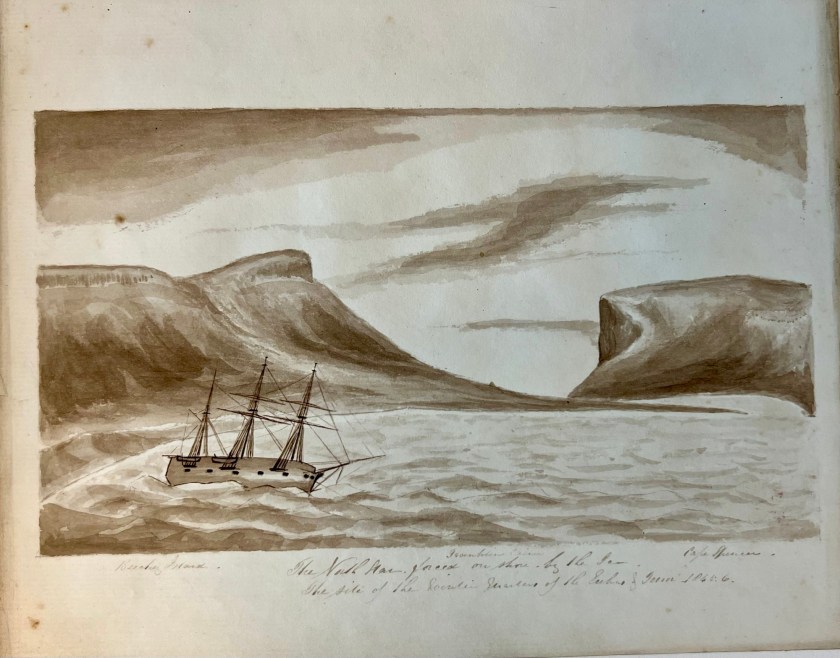
“HMS North Star forced on shore by the ice at Beechey, near Cape Spencer”, This dramatic June 1853 view by HMS Resolute’s WT Mumford shows another instance where North Star was in peril. Credit: Mumford Fonds, Library and Archives Canada 1986-18-20

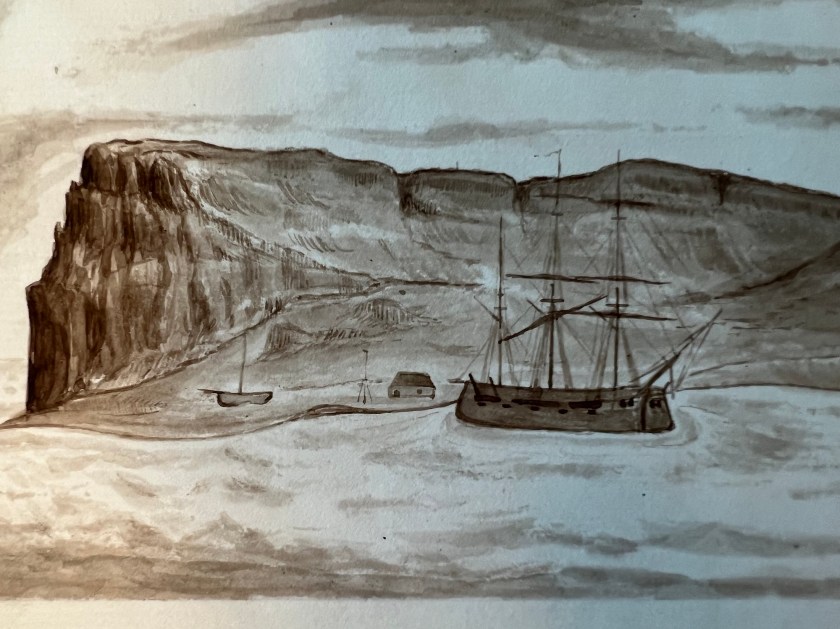
In September, as the Barrow Strait became a treacherous seascape of shifting ice, the Bay froze over. North Star was almost destroyed against the shore. The next June, she was again forced up. In between existential crises, Pullen kept his crew busy building up the shore establishment at Beechey with a new depot/storehouse, Northumberland House, built from components of the lost whaling ship. Crew moved Mary, a yacht left by Sir John Ross, to Beechey from nearby Cape Spencer to serve as a “rescue yourself” lifeboat, should anyone require it. In 1854 ships’ carpenters even built a cenotaph to commemorate their lost shipmates, again from timbers salvaged from McLellan.

HMS North Star, at Beechey Island. Dated May 1854, this remarkable view by HMS Resolute’s William Mumford shows Beechey’s imposing and bleak cliffs. Ashore, Northumberland House, the storehouse, and a large boat which is likely Sir John Ross’s rescue yacht Mary, are visible. [Detail of] Credit: Mumford Fonds, Library and Archives Canada 1986-18-27

The North Star and the Beechey establishment remained as the vital link in the logistical chain that sustained the Franklin search. Other vessels, under the command of Captain E.A. Inglefield, journeyed from England to resupply North Star at Beechey in the high summers of 1853-54. In early 1854, with crews weakening from the effects of scurvy and other ailments, and with no immediate prospect of escape for the ice-imprisoned search ships, Sir Edward Belcher took the difficult decision to order his captains to abandon their ships. Crews would sledge back to Beechey, along a route they knew, that they themselves had stocked with supply depots. Pullen and his forty crew assisted in bringing them in, provided medical assistance to the weakened, closed up Northumberland House in good order, and cut their own canal out of Erebus and Terror Bay to start for home at the end of August. Five crews adding up to about 230 sailors had abandoned their frozen ships and were in sledging parties marching a long trail through difficult terrain. But, unlike the 129 dead men they had been sent to find, these sailors knew they were trekking back to salvation – a beacon in the High Arctic – their familiar North Star.5

  1. This account draws from the article “Icy Imprisonment: the 1848 Voyage of the HMS North Star” at https://beyondthebackyard.com/2014/09/03/icy-imprisonment-the-1849-voyage-of-the-hms-north-star/ and from Richard J. Cyriax (1964) “The Voyage of H.M.S. North Star, 1849-50” The Mariner’s Mirror, 50:4, 302-318. (which was provided to us with thanks from Randall Osczevski). I would also like to thank Fabiënne Tetteroo for providing higher-resolution images of the first and third ILN illustrations used above, and Elizabeth Matthews of HMS Resolute, for the same help with G.F. McDougall’s “The Loss of the McClellan – American Whaler.” ↩︎
  2. Please see our earlier post on the Atholl Class sister ships that were involved in the British search efforts for the missing Sir John Franklin Expedition, for a description of the original design of the class of fourteen ships and a brief account of the Franklin search-related careers of HMS Herald, Rattlesnake, and Talbot. The group contributed a lot to the Franklin search efforts! ↩︎
  3. To see how far the original Atholl class corvette design had evolved, see for example, the 1844 plans of sistership HMS Crocodile (1825), modified for rugged service as a surveying ship, also with a fortified bow guard, and a built-up weatherdeck: National Maritime Museum ZAZ5498. This was an important source for our reconstruction. There would also have been an extensive doubling, fortification, and interior strengthening of the hull of North Star. Our plan is not considered a final plan, but is a simplified representation, and it is the only of its kind. ↩︎
  4. Observers on HMS Resolute, George McDougall and William Mumford, both commented in August 1852 entries on North Star’s turn of speed while detached to arrive at the rendezvous of Beechey to check for Assistance and Pioneer (who had become separated but were themselves were still miles away). McDougall’s 1857 published account is currently available online at babel.hathitrust.org. Mumford’s invaluable diary exists as the main part of his archival fonds at Library and Archives Canada. ↩︎
  5. HMS Investigator’s 61-man crew, frozen in at Mercy Bay, was fortuitously located by a party from HMS Resolute under Lt. Bedford Pim on 6 April 1853. Robert McClure abandoned Investigator, and moved his ailing crew over to Resolute and her steam tender Intrepid (which eventually allowed him to claim his crew had been first to transit-not sailing- the Northwest Passage). I have counted the crew in with the 180 other men of the search ships. HMS North Star’s crew was about forty strong, if she had the same numbers born as for the 1850-51 voyages, making the Expedition total to about 281 men, 13 of whom, tragically, died in the course of their service and are commemorated by name on the remote but important Beechey Island Cenotaph. The French officer Lt. Émile-Frédéric de Bray, in his published account, lists the total number of personnel at 263 (Quoted in Barr and Stein’s “Frederick J. Krabbé, last man to see HMS Investigator afloat,
    May 1854″ Journal of the Hakluyt Society 2017/01 P28). As North Star was leaving Beechey on 26 August 1854, HMS Phoenix and Talbot (North Star’s sister ship) arrived on their resupply mission, and so helped disperse the Belcher crews to transport them home to England in three vessels. ↩︎