In this post I will describe the “boat place” boat at Erebus Bay that searchers looking for the lost Sir John Franklin 1845 Expedition came across in 1859. A later post will show my effort to construct a small model of this unique and sadly-fated boat, and propose some likely dimensions of the full complement of Franklin boats.
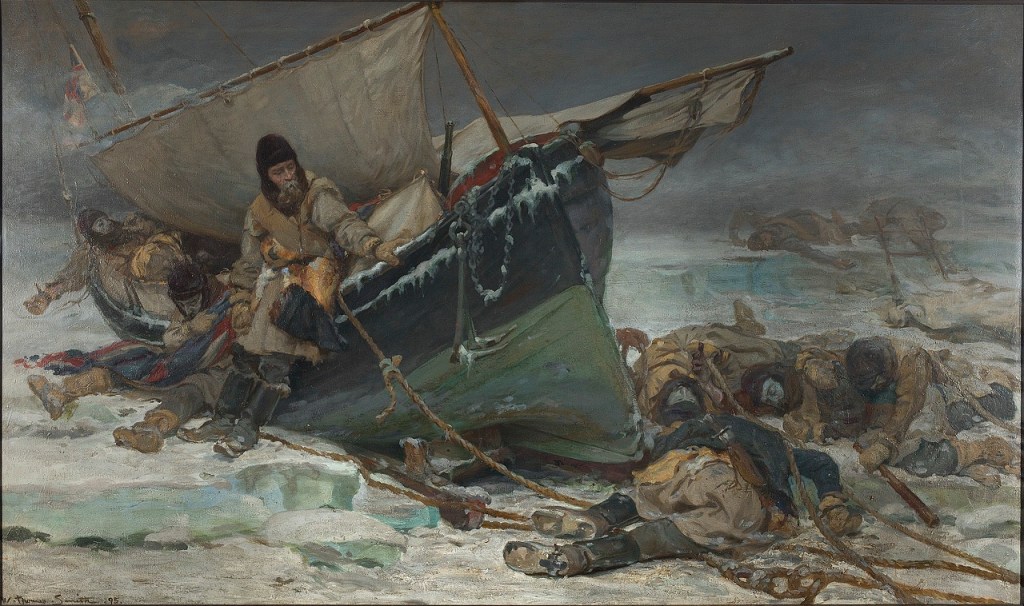
On May 23rd, 1859, at a wide bay on the frozen western shores of King William Island, a group looking for the lost Franklin Expedition found something incredible: A large boat on a sledge. Fourteen years after Franklin’s two ships had left Greenhithe, England, searchers had finally arrived at “ground zero” of the Franklin Expedition escape saga. They were a decade too late. Quartermaster Henry Toms and Carpenter’s Mate George Edwards – both members of Lt. William Hobson’s detached sledge party searching the coast as part of Francis Leopold McClintock’s Franklin search expedition – first spotted something odd projecting out of the snow as they scouted ahead of their mates.1 Closer examination revealed it to be a wooden stanchion, hanging like a beacon over the curved outlines of a gunwale in the high drifts of snow – beneath their feet was the ghostly outline of a large boat.
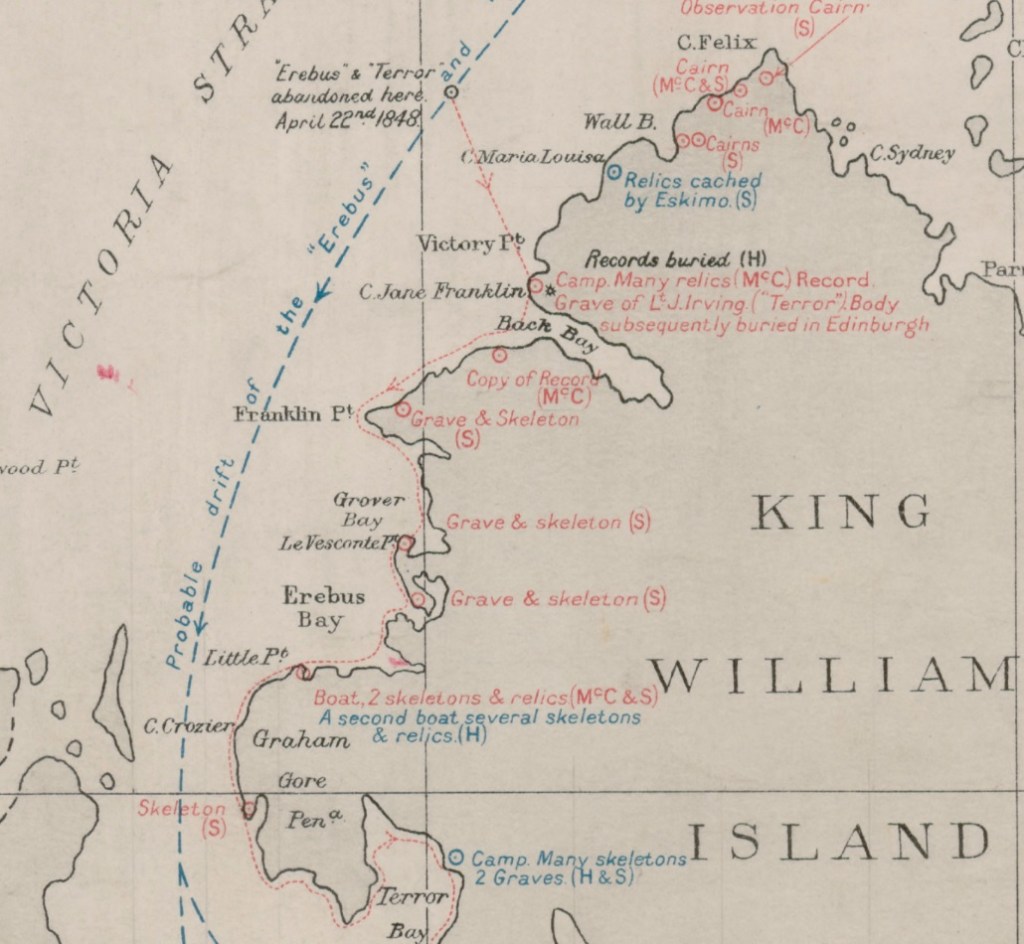
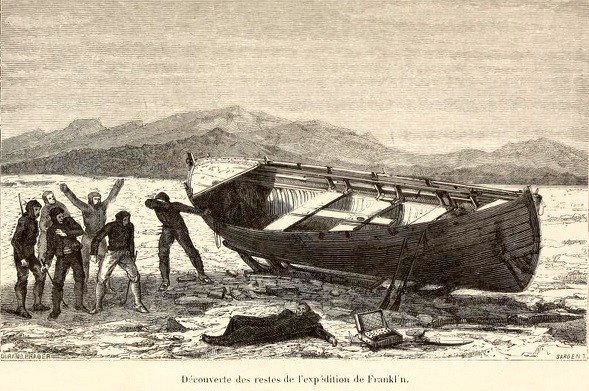
The next morning Hobson’s group began in earnest a two-day process of clearing out the site and inventorying an unusual assortment of artifacts. That stanchion also marked a gravesite – the resting place of at least two unidentified Royal Navy crewmembers who were entombed within the hull. McClintock’s sledge team arrived a few days after Hobson had departed. His published description of what he called this “melancholy relic” is the standard account of the site.2 But Hobson had also drafted a report on his sledge team’s discoveries, which included a detailed description of the boat. We are indebted to archaeologist Dr. Douglas Stenton’s work resuscitating Hobson’s report about his journey from obscurity. Stenton’s publication of the report provides important additional details to help explore the boat place.3 Since Hobson’s team had excavated the snow from the boat and examined the objects found therein, the site had already been altered before McClintock’s party reached it. For a detailed list of the interesting and unusual contents of the boat, please see Russell Potter’s Visions of the North blog “The Boat” on the topic. My interest here remains focused on the boat itself.
The Erebus Bay find remains the only Franklin Expedition boat and sledge, originally encountered reasonably intact, whose appearance and contents were described in detail. Its importance is tied to the slightly earlier discovery by Hobson’s party of the Victory Point record, in a sealed cylinder in a cairn about 60 km northeast. An update to a routine Admiralty form mentioned the abandonment of the long-beset ships, and recorded captains Crozier and Fitzjames’s intention to mount a desperate trek with their ailing crews towards Back’s Great Fish River. The note had no specific information about how they planned to cross the vast distances involved. The Boat Place discovery seemed to illustrate the mechanism of the evacuation plan: Crew members would use drag ropes to man-haul boat/sledge combinations down and around the coastline of King William Island. They would then unship the sledges and navigate the boats to the mainland and down a treacherous river towards a still-distant fur trading post. We don’t know how this plan changed as they struggled along, losing more men, and abandoning more boats. Some of the last of a group of weary men laid down to die, under another boat, on the mainland at Starvation Cove.
Back at Erebus Bay, the 28’/8.5 m boat was found just above the frozen shoreline. It listed dramatically down to starboard. A hole may have allowed wildlife – bears or scavenging foxes – access on the low side. Both boat and heavy sledge were oriented back towards the northeast, though if that was by intent (to return towards the ships), or by happenstance, no one can say. McClintock commented on both the boat’s lightness, and the sledge’s weight. He estimated the weight of the boat to be about 700-800 lbs while the sledge could have been as much as 650 lbs (the average weight of a 28-foot whaling boat, by contrast, was about 1,000 lbs).4 His observations were informed by his great expertise in sledging, acquired during his participation on this and earlier expeditions.
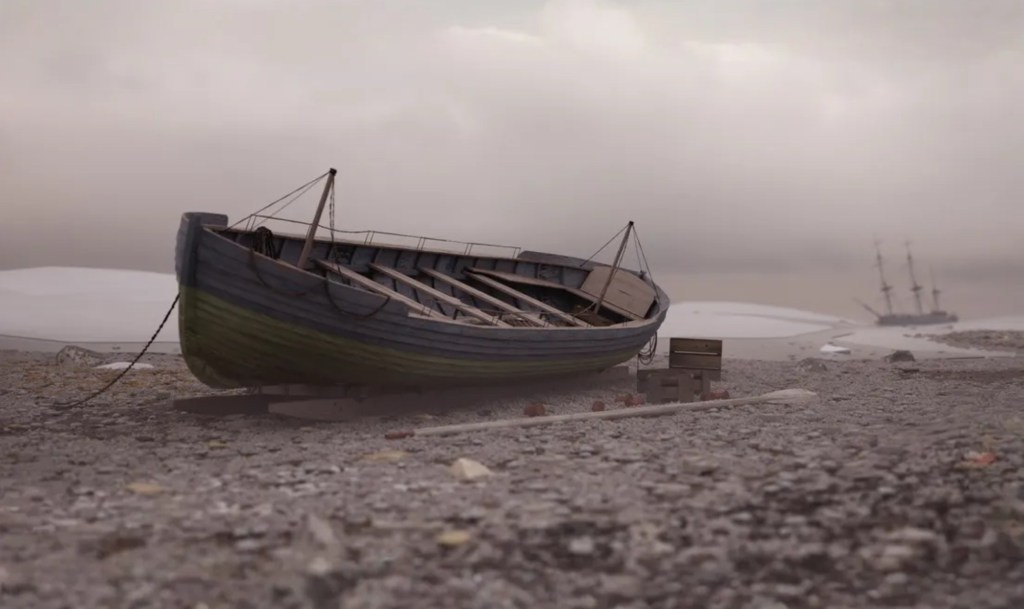
The boat had been modified by the ships’ carpenters – the square transom at the stern had been removed and the boat was now pointed or “sharp” at both ends, with a curving stem and sternpost, like a broader, deeper version of the two ships’ whale boats. The “carvel” planking (flush-edge-to-edge) of the top strakes of the hull had been replaced and lighter fir “clinker” planks (overlapping) re-laid in their place. An ingenious washcloth design of canvas was fitted in the place of the heavier washstrake boards. The set of six paddles – cut-down oars converted with larger “add-on” blades – indicate that the boat had been converted for inland/river navigation.
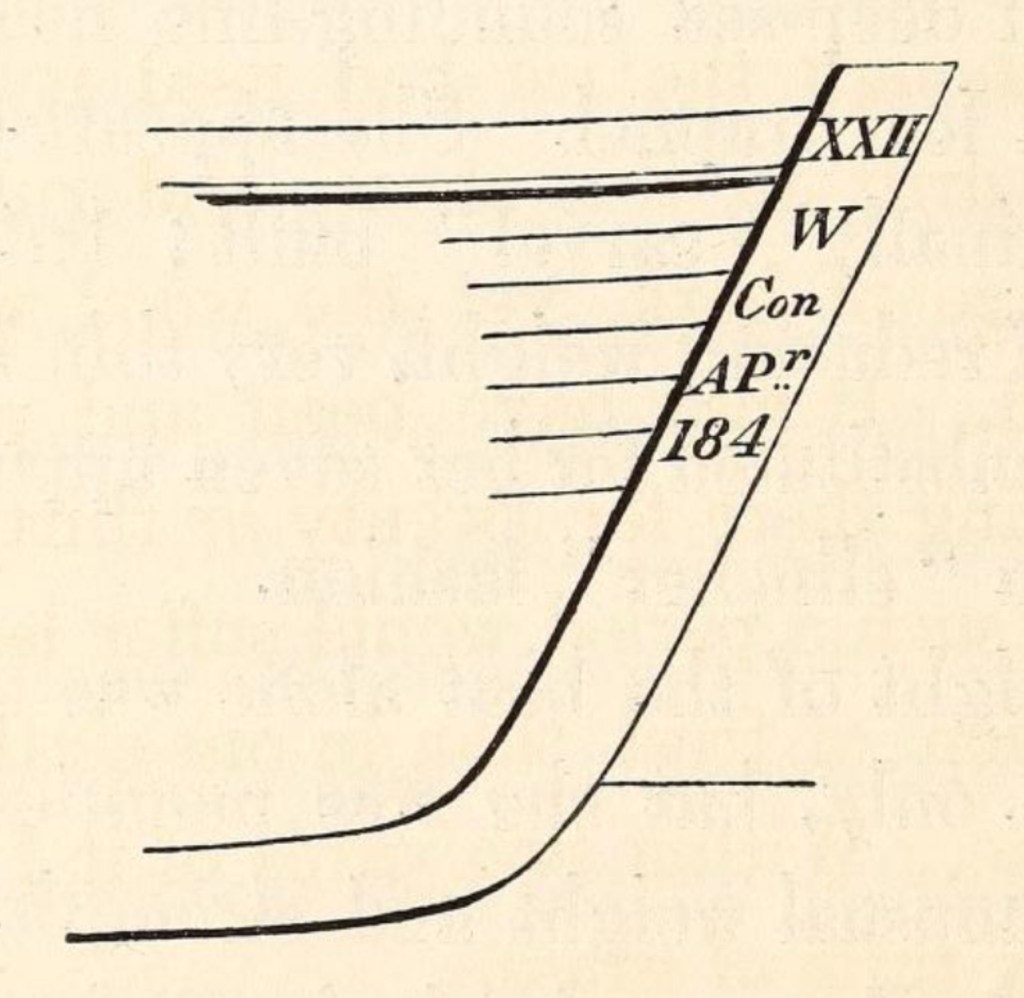
The distinctive stem of the boat was sketched by McClintock. This was recovered two decades later by American Franklin searcher Frederick Schwatka, who, while looking for records, was leading the first expedition on King William Island that encountered the sites in the summer, not under cover of snow and ice.
According to Inuit oral testimony, there was at least one other abandoned boat with many more skeletal remains that was located nearby.5 Both boats were dismantled in the early 1860s for their useful materials and fittings. Following the initial recovery of some artifacts, the dismantling, and Schwatka’s later removals, only archaeological traces and a memorial with bone fragments remain at the site – the last vestiges of a melancholy relic.
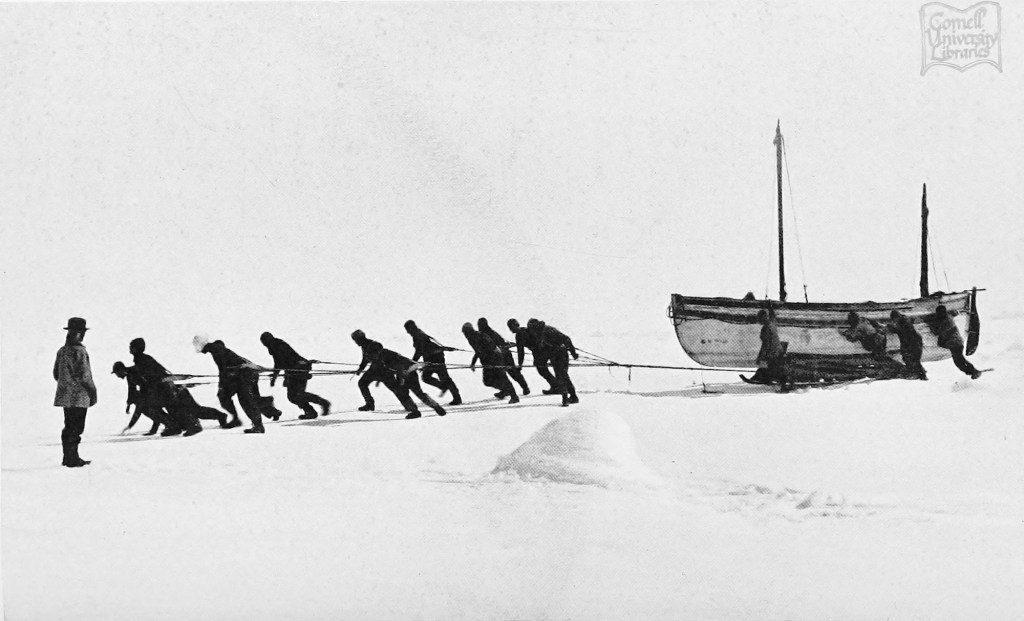
The Erebus Bay Boat design:
With the lack of contemporary depictions of the boat and sledge, important gaps remain in our understanding of the design of this interesting combination. Please see the hyperlinks below for the Royal Museums Greenwich/National Maritime Museum artifact records to explore the actual items recovered from Boat Place. For an interesting analysis of artistic representations of the Erebus Bay boat, see Andrés Paredis’s July 2014 blog post “Illustrations and Paintings of the Boat Place….”
Dr. Stenton has indicated the boat was most likely converted from one of the ships’ pinnaces. By Hobson’s measurements, it was 28’/8.5m long, about 7.5’/2.3 m wide, and 2.5’/ 0.8m deep (from the waterline). It rested partially on a heavy sledge with iron runners that was 24’/7.3 m long. Matthew Betts noted these sources in his own reconstruction of the boat and sledge, also based on the pinnace, both in his published history of HMS Terror and a blog post.6
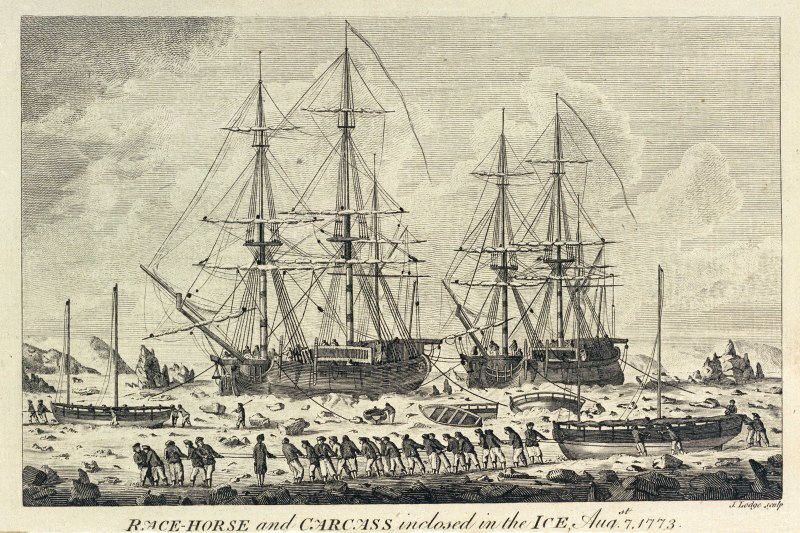
Hobson described the boat as having exactly twenty-four 9″ iron supports – lower stanchions – that were fixed by plates (AAA2360 ?) to the gunwales all around the hull of the boat (AAA2143 and AAA2144). These supported a weather cloth that would have stood in the place of the old washstrake boards, which normally would help shelter the boat and crew from turbulent waters and swamping. These boards were normally pierced by eight offset openings for oarlocks to work the oars (one oar position per thwart, alternating sides). Presumably the stanchions could be uninstalled and thowells to take the oars could be inserted in the sockets instead. I believe this detail of the Franklin boat has a polar precedent in the 1773 Phipps “North Pole” Expedition, when the iced-in crews of HMS Racehorse and Carcass modified their boats to drag them on the ice, and fitted them with stanchions and tarpaulins.7
The six paddles that Hobson and his men found were in the place of the boat’s original complement of oars. In 1859 the men used them like shovels to clear the snow out of the boat – something that would not be practicable with the full length boat oars they had been cut down from. A recovered example at NMM (AAA2194) is broken. The thowells were arranged to support the paddles in some manner which McClintock and Hobson may have been familiar with, but which doesn’t seem normal with modern paddling, which is unencumbered by attachments.
The boat was surmounted by two high wooden stanchions that Hobson notes had gaff jaws at their apex, to support a ridge rope, pole or mast that held up the sloping awning, and housed over the boat. With the full awning in place, connecting down to the thowells and the canvas cloth all round, the occupants may have felt some comfort from the elements. When covered over, the boat must have looked like a small version of the beset ships the crew had left behind, whose decks were also sheltered under large awnings.
The sledge (AAA2283) had five cross bars, each fitted with chocks to support and tether the boat hull (AAA2200). It does seem odd how heavily built the sledge was in contrast to the rigorous program of lightening apparent in the boat. During the search expeditions for Franklin’s crews, McClintock and others, when they sledged with boats, hauled light double-ended boats with much less substantial sledges that appeared closer to Inuit designs.
As mentioned above, the stem of this boat is particularly note-worthy (AAA2282), and even features the remains of markings. Royal Navy boats had a type of data stamp on the outer surfaces of the upper stem, which identified the length of the boat, expressed in feet, using roman numerals (and other details such as the place of construction, contract or boat number, and the month and year the boat was built). This stem had been planed down, to further lighten the boat for the 1848 overland journey. This effectively removed the last letters or digits. McClintock drew the markings for the first publication of his narrative, and then updated this for a later addition with different markings. The best photo I have encountered of this was taken by Logan Zachary during his 2018 visit to the “Death in the Ice” exhibit at Mystic Seaport and posted to his website. Taken together, it is an inconclusive series of markings with lengths reported for the original boat between twenty-two and twenty-eight feet long! My research and reconstruction of the boat is ongoing, so please look out for the update.
References and other sources:
- Logan Zachary “Edwards the Carpenter and the Discovery of the Boat Place” https://www.illuminator.blog/p/edwards.html Hobson was ill from scurvy at this time, but rallied to examine the boat. Zachary has also pointed out that Hobson’s description of the contents of the boat have proven most accurate. Quartermaster H. Toms would return to the Arctic with Allen Young in 1876 in the Pandora. ↩︎
- Francis Leopold McClintock The voyage of the ‘Fox’ in the Arctic seas: A narrative of the discovery of the fate of Sir John Franklin and his companions (London: J. Murray 1859) The boat is described from pages 290-299. Available at the internet archive: https://archive.org/details/voyageoffoxinarc00mcli_0/page/292/mode/2up ↩︎
- Douglas Stenton “A Most Inhospitable Coast: The Report of Lieutenant William Hobson’s 1859 Search for the Franklin Expedition on King William Island.” Arctic Journal 67:4 (December 2014) 511-522. Edward Atkinson, Nunavut Archivist, helped Stenton locate a microfilmed copy of Hobson’s report in the custody of Library and Archives Canada. William Barr also shared his transcription with Stenton, who is also most responsible for the definitive identification of the archaeological site known as NgLj-3 with Hobson/McClintock’s Boat Place. ↩︎
- For the weight of a whale boat (28’) see for example Whaling City Rowing’s description: https://www.whalingcityrowing.org/about-whaleboats ↩︎
- Douglas Stenton and Robert Parks “History, Oral History and Archaeology: Reinterpreting the “Boat Places” of Erebus Bay” Arctic Journal 70:2 (June 2017) 208. ↩︎
- Matthew Betts HMS Terror: The Design, Fitting and Voyages of the Polar Discovery Ship (Seaforth 2022) and “A Man Hauled Boat Sledge from HMS Terror” https://buildingterror.blogspot.com/2019/01/a-man-hauled-boat-sledge-from-hms-terror.html . Also see this book for Dr. Betts’ description of how the Erebus Bay boat seems to have closely followed the design of Sir George Back’s earlier boats, used to explore Back’s Great Fish River, exactly where the Franklin crews were attempting to get to. The first account I have heard of that draws this connection was actually Paul Fenimore Cooper in his 1961 publication Island of the Lost (P123) Cooper provided a detailed description of the boat and relied on both McClintock and Back’s published journals. ↩︎
- Ann Savours “A very interesting point in geography”: The 1773 Phipps Expedition towards the North Pole Arctic Journal 37:4 (December 1984) 402-428. https://pubs.aina.ucalgary.ca/arctic/Arctic37-4-402.pdf The fitting of stanchions and tarpaulins are mentioned on page 418. ↩︎
The list of boat place-related artifacts that were recovered or described at the site was cross-referenced with Garth Walpole’s Relics of the Franklin Expedition ; Discovering Artifacts from the Doomed Arctic Voyage of 1845 Ed. Russell Potter (Jefferson NC: McFarland & Co. 2017) PP-199-213.

 The Searchers