I would like to share an artistic reconstruction of HMS Terror, one of the 1845 Sir John Franklin Expedition’s lost ships. This astonishing, barely-wrecked ship of wonders now rests in a bay named after her, in 80’/ 24m of water! I based my sketch, as much as possible, on archaeological information, reconstructions and site plans at the Parks Canada page “Underwater archaeology at the Franklin wrecks“:
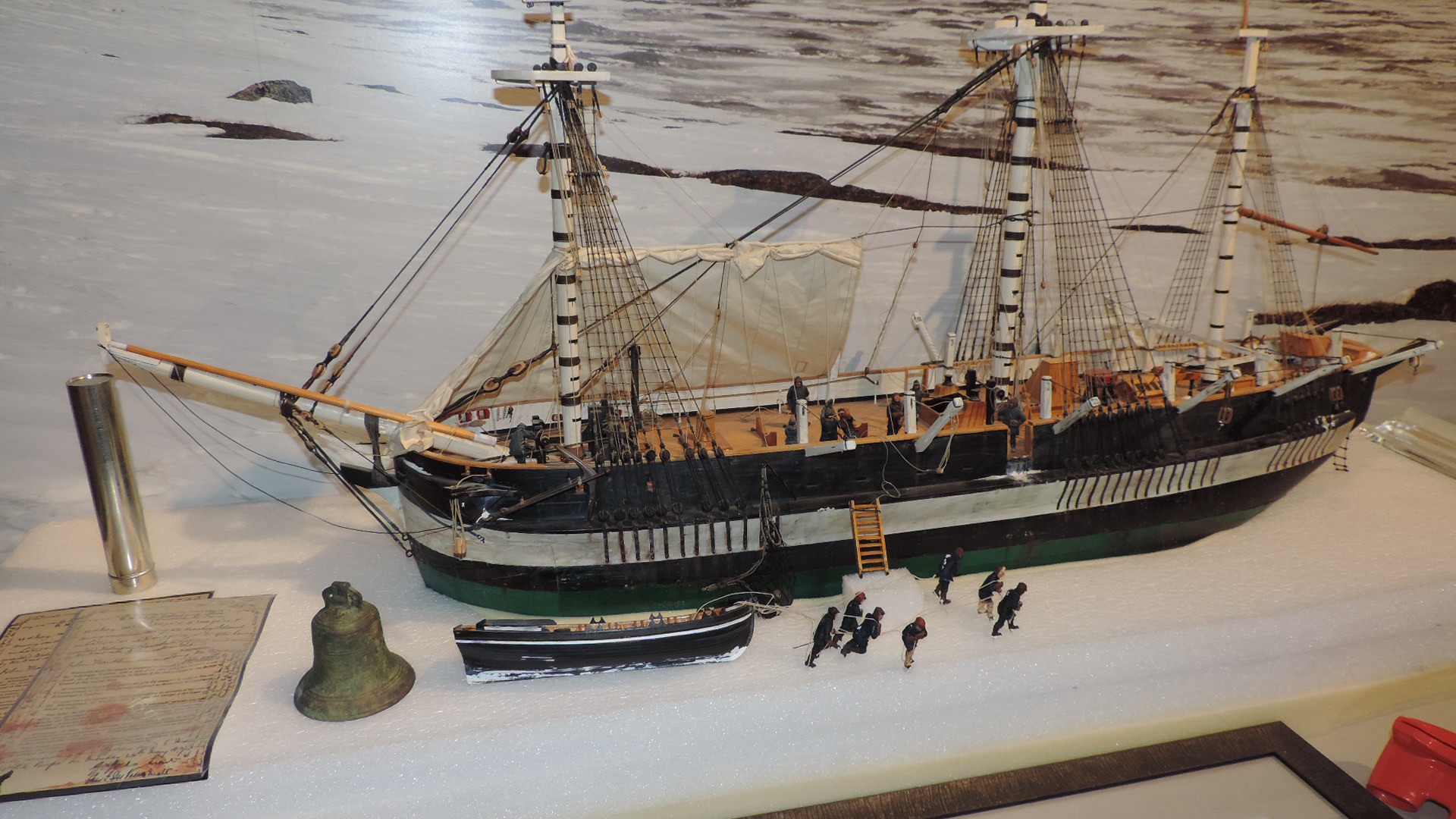
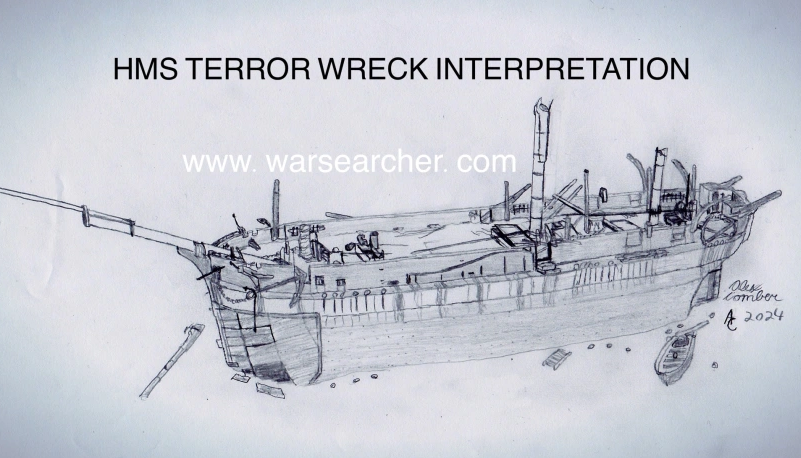
The above reconstruction is based on sources I discussed in “An Excellent State of Terror now Exists” and other Terror-related posts. It is a preliminary effort, based on a photograph of the model of Erebus at the Nattilik Heritage Centre, Gjoa Haven.1 After more than two years of research, and the construction of a model diorama interpreting the wreck environment, I felt it was time to put something down on paper. The sketch is an idealized representation of the 210-year old exploration vessel. Silt or marine sediment still hides many artifacts and prominent areas of the deck.
I have chosen to omit other marine growth, such as kelp strands, that mask the basic shapes of wreck structures. The overall effect is of a fantastically preserved wreck site. Terror is one tough little ship, a veteran of battles, storms, and ordeals in both Arctic and Antarctic exploration that would have smashed a weaker vessel to splinters. All those with an interest are eagerly awaiting more information about both Terror and Erebus sites.
- The model of Erebus on display at the Nattilik Heritage Centre is actually a closer representation of Terror in all details, and appears to have closely followed the 1836/45 National Maritime Museum plans that depict Terror. See our recent post on Erebus to explore the distinctive visual differences. The archaeological investigation by Parks Canada is far from complete. Very little information exists about the entire starboard side of the wreck, or the artifacts scattered on the seafloor in the immediate vicinity of the hull. ↩︎

 The Searchers